
Wave Properties How do frequency amplitude and wavelength







- Slides: 71
Wave Properties How do frequency, amplitude, and wavelength of a transverse wave affect its energy?
Stage 1: Identification of the task & guiding question Background Information
What is a wave? A disturbance that transmits energy through matter or space “a wiggle in time” The wave medium is not the wave nor does it make the wave. The medium transports the wave from its source to other locations.
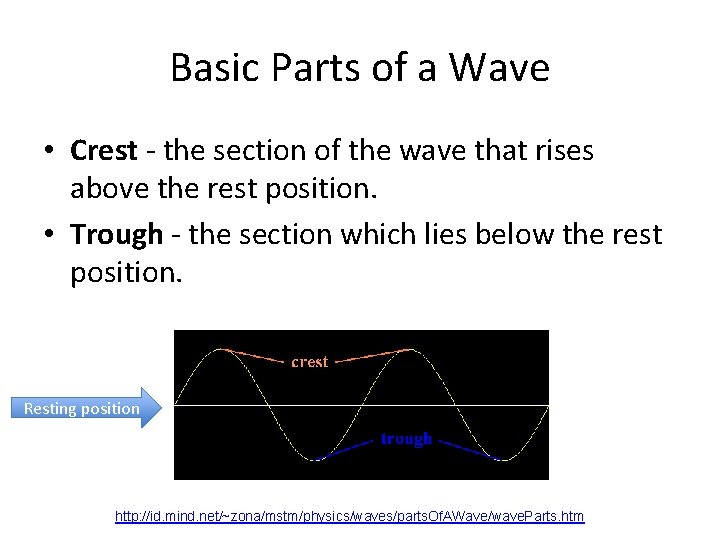
Basic Parts of a Wave • Crest - the section of the wave that rises above the rest position. • Trough - the section which lies below the rest position. Resting position http: //id. mind. net/~zona/mstm/physics/waves/parts. Of. AWave/wave. Parts. htm
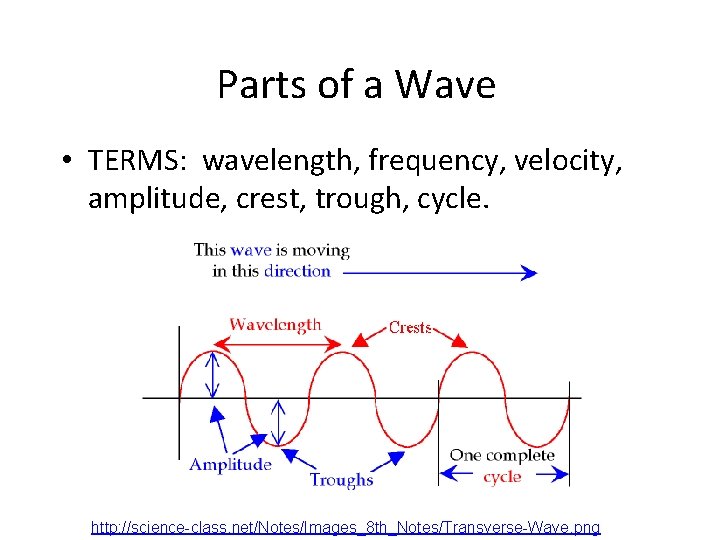
Parts of a Wave • TERMS: wavelength, frequency, velocity, amplitude, crest, trough, cycle. http: //science-class. net/Notes/Images_8 th_Notes/Transverse-Wave. png
What do waves carry? ENERGY Energy is carried away from a source, but the material the wave travels through (medium) does not move with the energy. Stadium waves are a good model of a wave. In this model, people are the particles in the medium. They vibrate “up and down”. The “energy” is transported, but the particles return to their starting position.
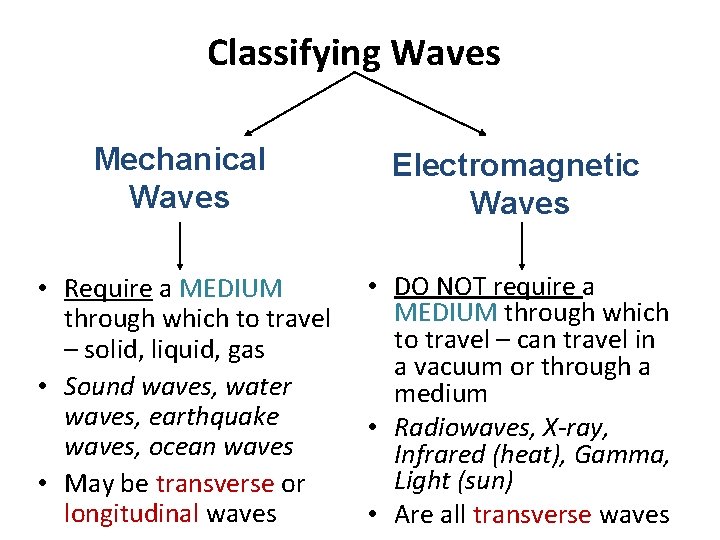
Classifying Waves Mechanical Waves Electromagnetic Waves • Require a MEDIUM through which to travel – solid, liquid, gas • Sound waves, water waves, earthquake waves, ocean waves • May be transverse or longitudinal waves • DO NOT require a MEDIUM through which to travel – can travel in a vacuum or through a medium • Radiowaves, X-ray, Infrared (heat), Gamma, Light (sun) • Are all transverse waves
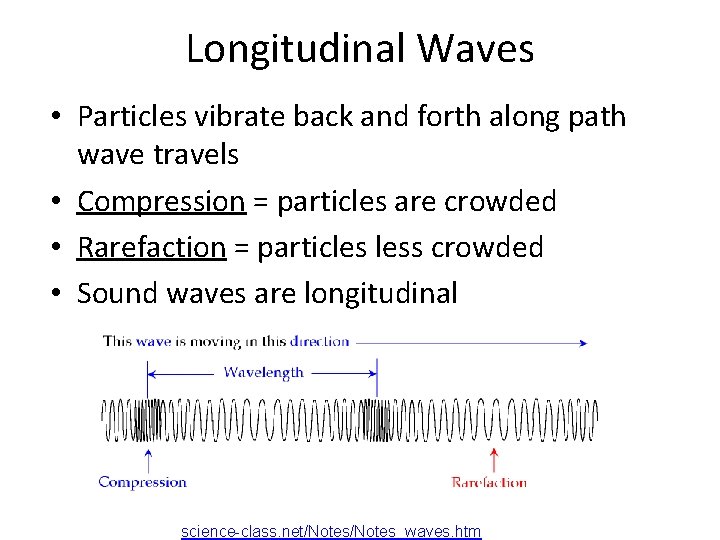
Longitudinal Waves • Particles vibrate back and forth along path wave travels • Compression = particles are crowded • Rarefaction = particles less crowded • Sound waves are longitudinal science-class. net/Notes_waves. htm
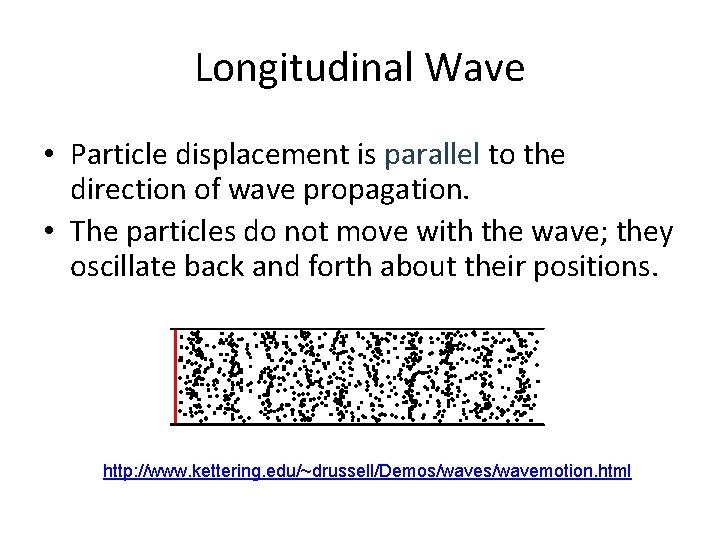
Longitudinal Wave • Particle displacement is parallel to the direction of wave propagation. • The particles do not move with the wave; they oscillate back and forth about their positions. http: //www. kettering. edu/~drussell/Demos/wavemotion. html
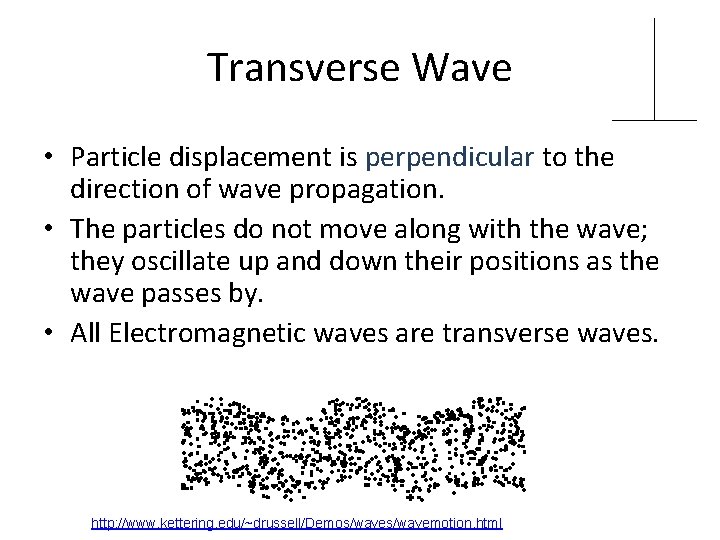
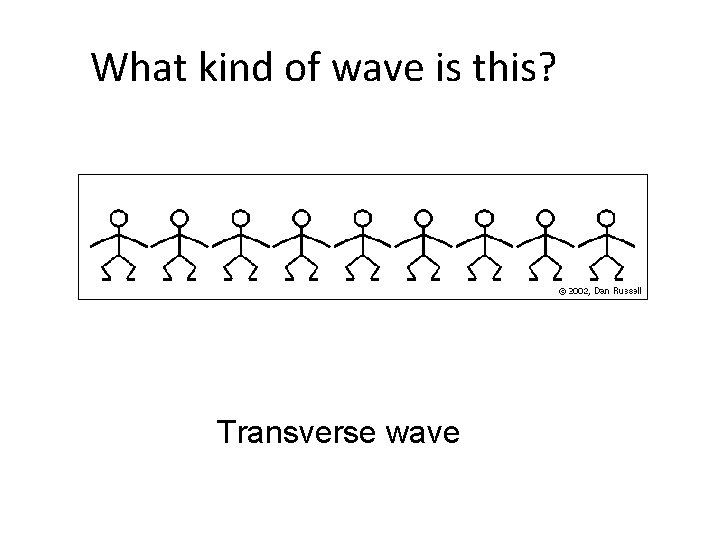
Transverse Wave • Particle displacement is perpendicular to the direction of wave propagation. • The particles do not move along with the wave; they oscillate up and down their positions as the wave passes by. • All Electromagnetic waves are transverse waves. http: //www. kettering. edu/~drussell/Demos/wavemotion. html
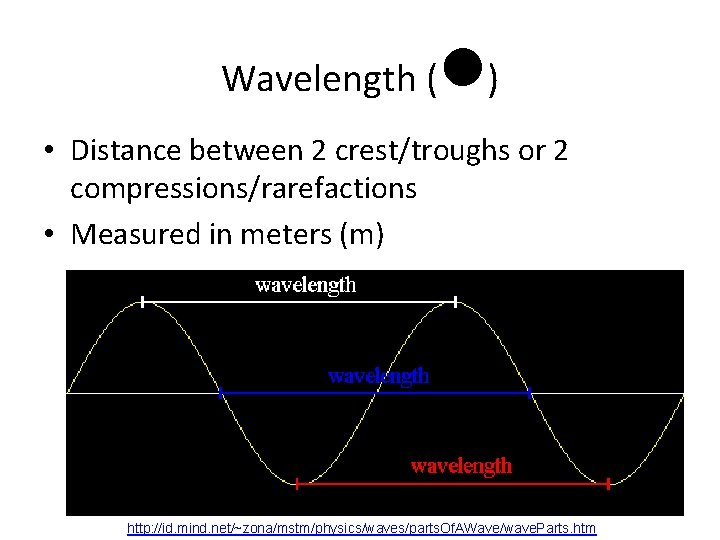
Wavelength ( l) • Distance between 2 crest/troughs or 2 compressions/rarefactions • Measured in meters (m) http: //id. mind. net/~zona/mstm/physics/waves/parts. Of. AWave/wave. Parts. htm
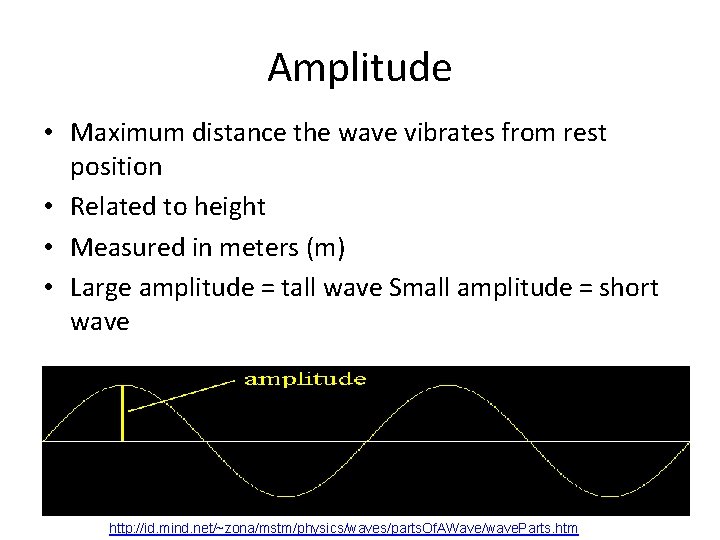
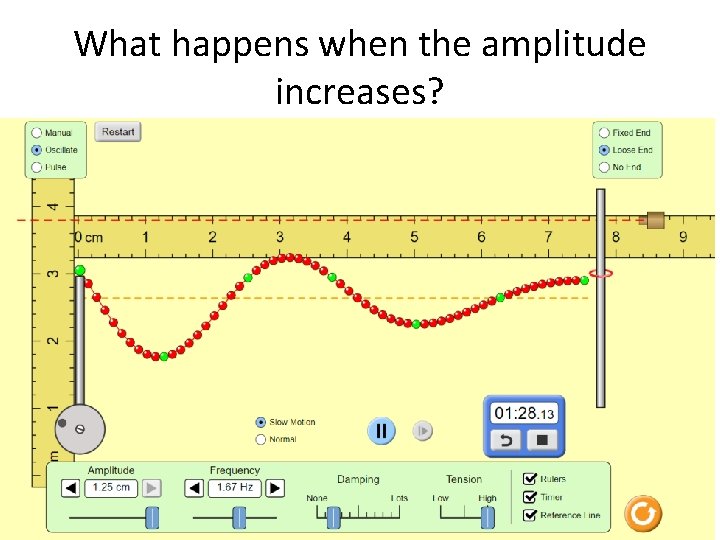
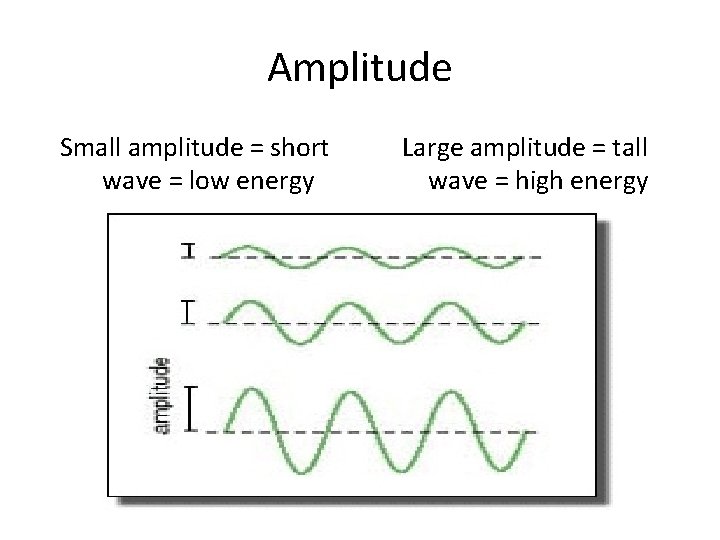
Amplitude • Maximum distance the wave vibrates from rest position • Related to height • Measured in meters (m) • Large amplitude = tall wave Small amplitude = short wave http: //id. mind. net/~zona/mstm/physics/waves/parts. Of. AWave/wave. Parts. htm
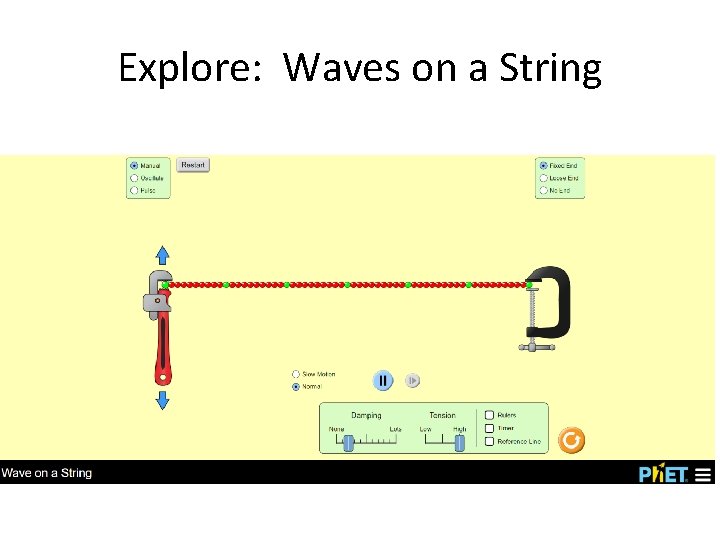
Explore: Waves on a String https: //phet. colorado. edu/en/simulation/wave-on-a-string
Explore: Waves on a String
Stage 2: Design a method & collect data How will your organize your data? To determine what type of data you need to collect, think about the following questions: • How will you test the ability to make the action figure jump higher? • How will you measure the height of the jump? • What type of measurements or observations will you need to record during your investigation? To determine how you will collect your data, think about the following questions: • How often will you collect data and when will you do it? • How will you make sure that your data are of high quality (i. e. , how will you reduce error)? How will you keep track of the data you collect and how will you organize it? • To determine how you will analyze your data, think about the following questions: • What type of calculations will you need to make? • What type of graph could you create to help make sense of your data?
Collect data during your investigation
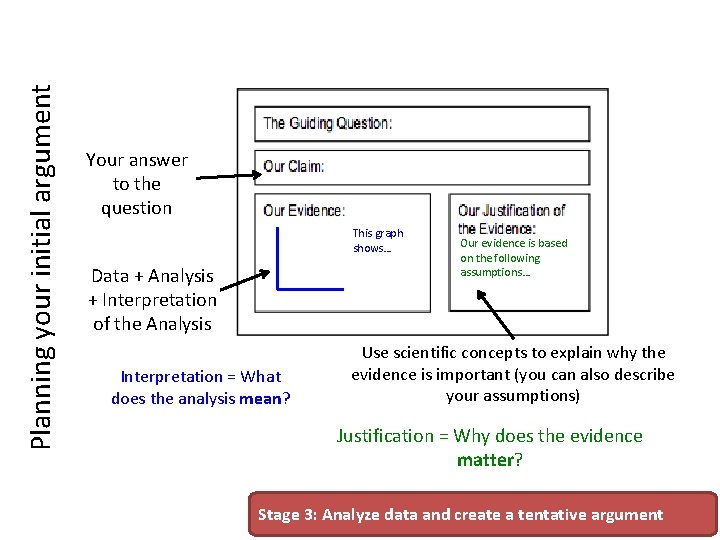
Planning your initial argument Your answer to the question This graph shows… Data + Analysis + Interpretation of the Analysis Interpretation = What does the analysis mean? Our evidence is based on the following assumptions… Use scientific concepts to explain why the evidence is important (you can also describe your assumptions) Justification = Why does the evidence matter? Stage 3: Analyze data and create a tentative argument
What is the difference between evidence and justification?
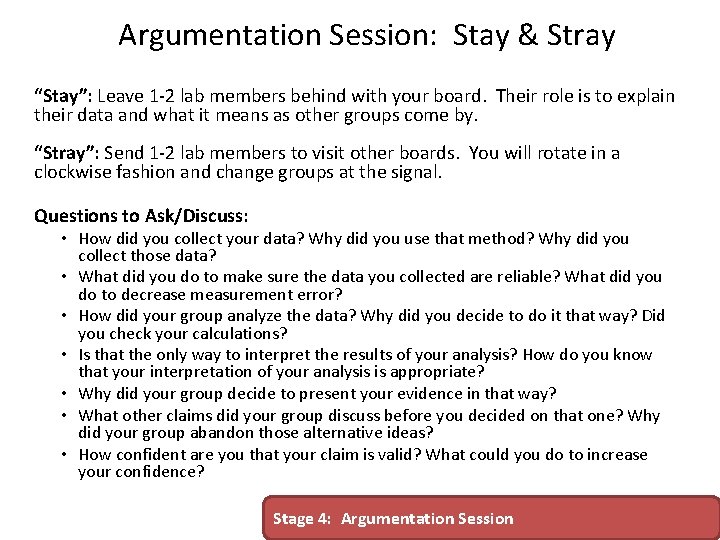
Argumentation Session: Stay & Stray “Stay”: Leave 1 -2 lab members behind with your board. Their role is to explain their data and what it means as other groups come by. “Stray”: Send 1 -2 lab members to visit other boards. You will rotate in a clockwise fashion and change groups at the signal. Questions to Ask/Discuss: • How did you collect your data? Why did you use that method? Why did you collect those data? • What did you do to make sure the data you collected are reliable? What did you do to decrease measurement error? • How did your group analyze the data? Why did you decide to do it that way? Did you check your calculations? • Is that the only way to interpret the results of your analysis? How do you know that your interpretation of your analysis is appropriate? • Why did your group decide to present your evidence in that way? • What other claims did your group discuss before you decided on that one? Why did your group abandon those alternative ideas? • How confident are you that your claim is valid? What could you do to increase your confidence? Stage 4: Argumentation Session
Stage 5: Explicit/Reflective Discussion Let’s talk a little about the big ideas underlying this investigation
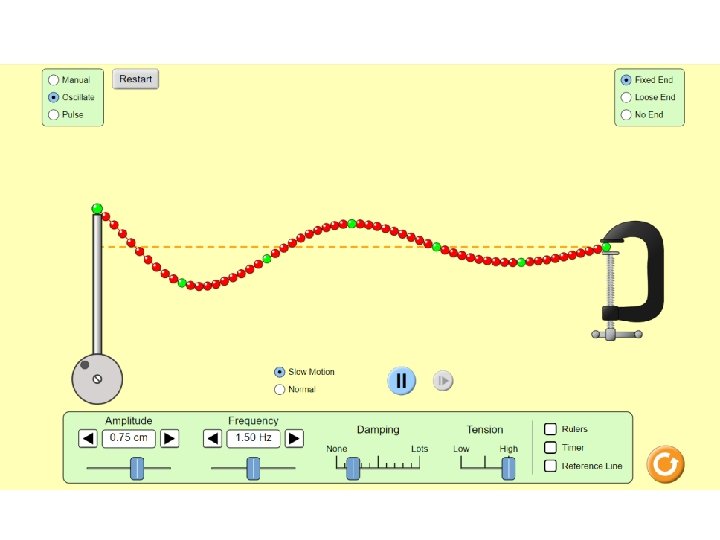
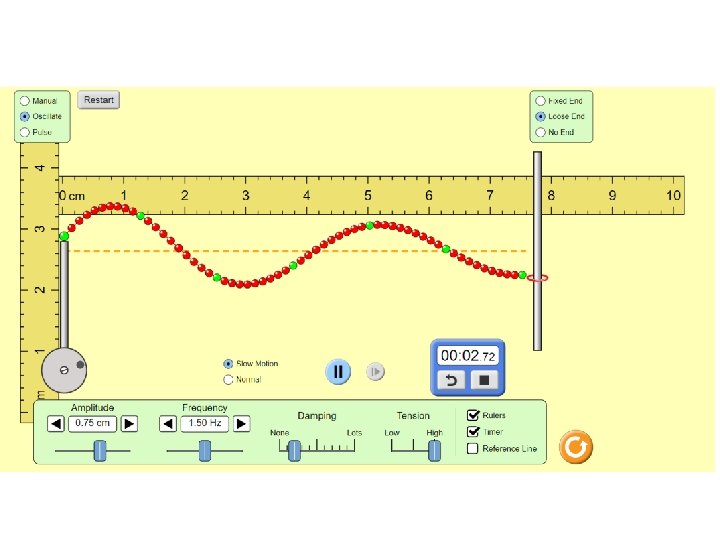
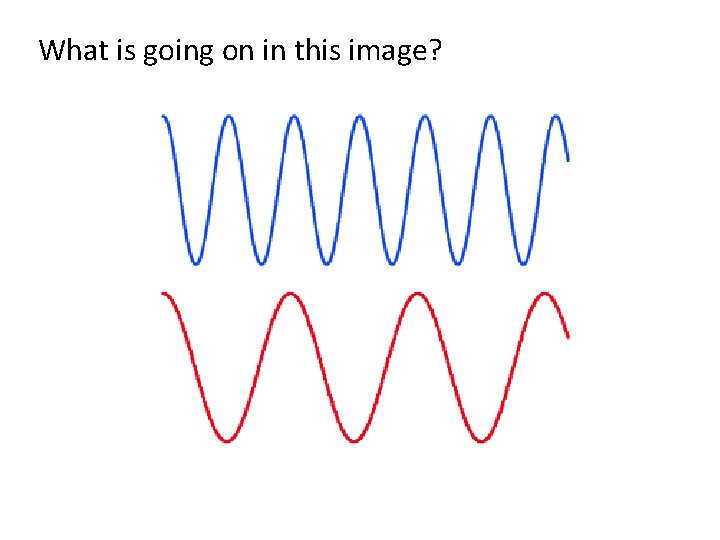
What is going on in this image?
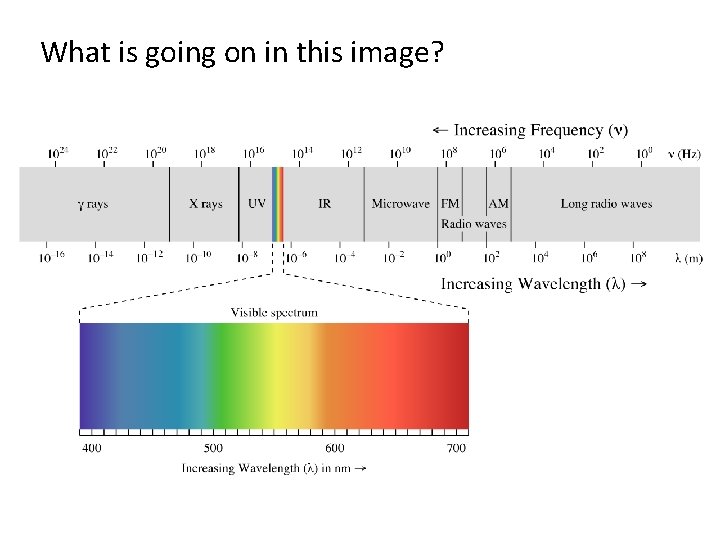
What is going on in this image?
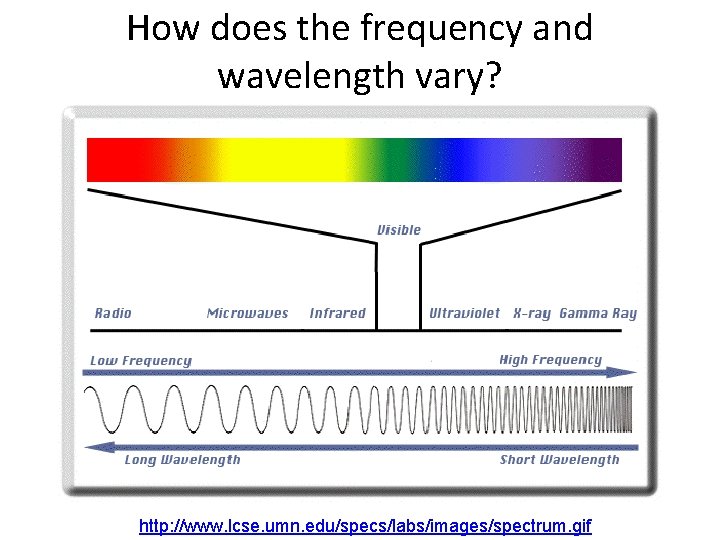
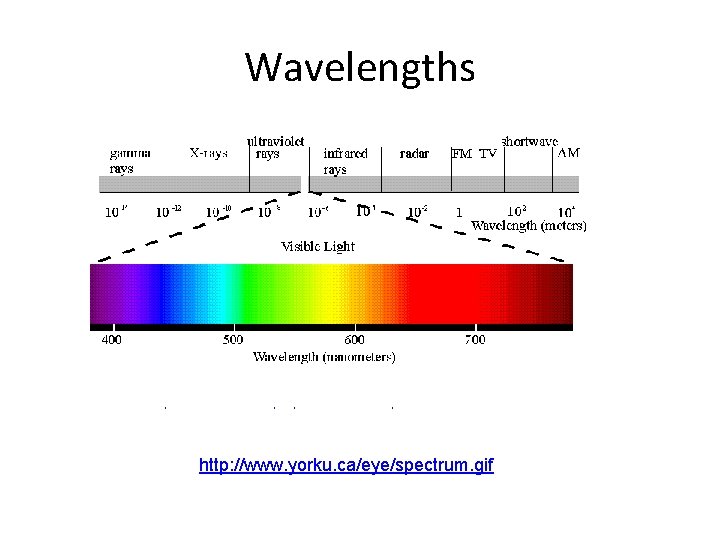
How does the frequency and wavelength vary? http: //www. lcse. umn. edu/specs/labs/images/spectrum. gif
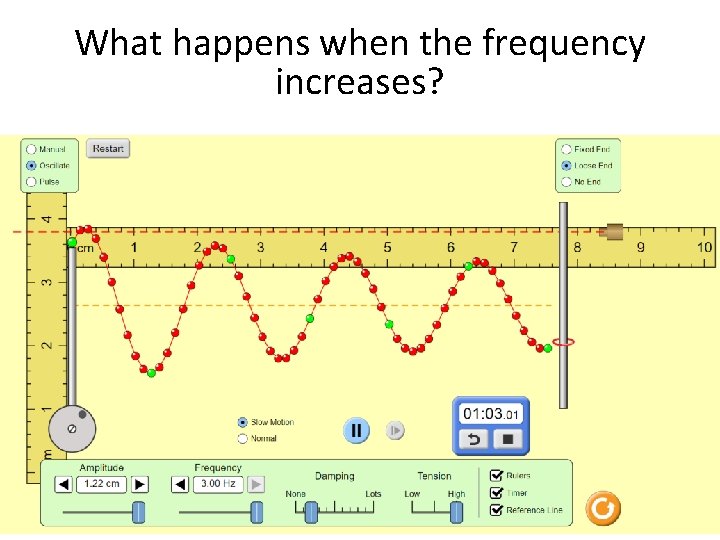
What happens when the frequency increases?
What happens when the amplitude increases?
Amplitude Small amplitude = short wave = low energy Large amplitude = tall wave = high energy
What kind of wave is this? Transverse wave
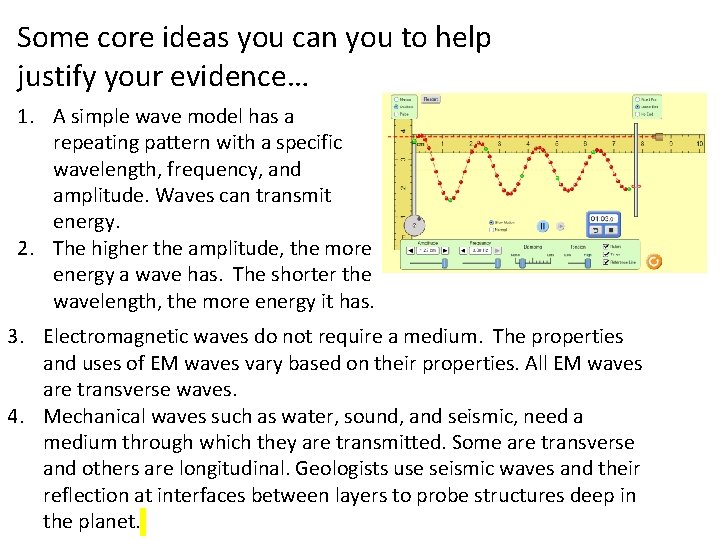
Some core ideas you can you to help justify your evidence… 1. A simple wave model has a repeating pattern with a specific wavelength, frequency, and amplitude. Waves can transmit energy. 2. The higher the amplitude, the more energy a wave has. The shorter the wavelength, the more energy it has. 3. Electromagnetic waves do not require a medium. The properties and uses of EM waves vary based on their properties. All EM waves are transverse waves. 4. Mechanical waves such as water, sound, and seismic, need a medium through which they are transmitted. Some are transverse and others are longitudinal. Geologists use seismic waves and their reflection at interfaces between layers to probe structures deep in the planet.
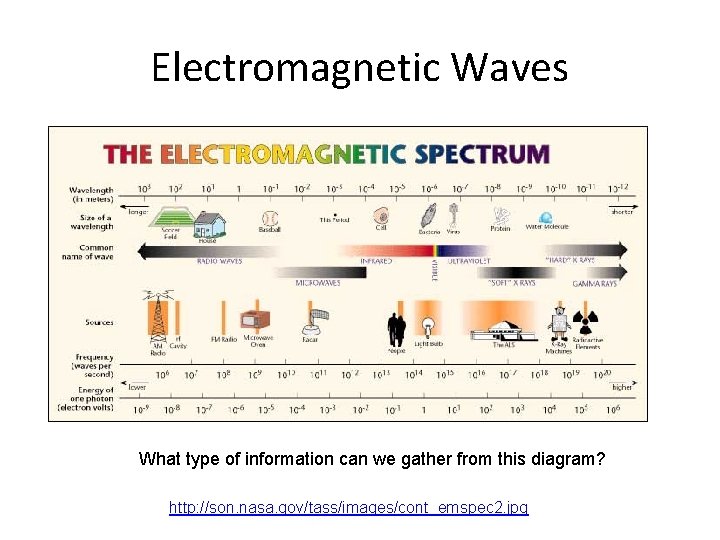
Electromagnetic Waves What type of information can we gather from this diagram? http: //son. nasa. gov/tass/images/cont_emspec 2. jpg
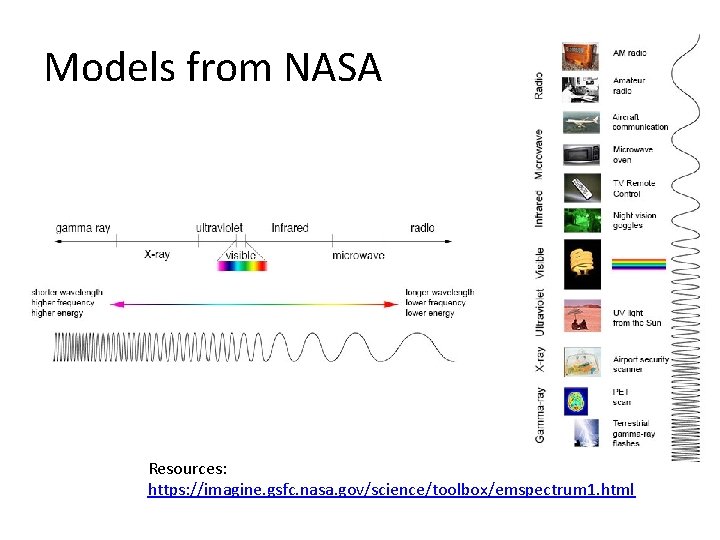
Models from NASA Resources: https: //imagine. gsfc. nasa. gov/science/toolbox/emspectrum 1. html
Tour of the EM Spectrum (NASA)
Now let’s talk a little about the way you planned and carried out your investigation
What were some strengths of the way you planned or carried out your investigation? (What made it scientific? )
What were some weaknesses of the way you planned and carried out your investigation? (What made it less scientific? )
What rules should we make in order to ensure that our next investigation is scientific?
Now let’s talk a little about the nature of science and scientific inquiry
Scientific knowledge can change over time
Can anyone think of an example of how scientific knowledge has changed over time? Discuss with your group and be ready to share.
Now let’s talk a little about some important crosscutting concepts of science
Scientists often use models to explain natural phenomena.
Can you give me an example of some of the models we used during this investigation? Discuss with your group and be ready to share
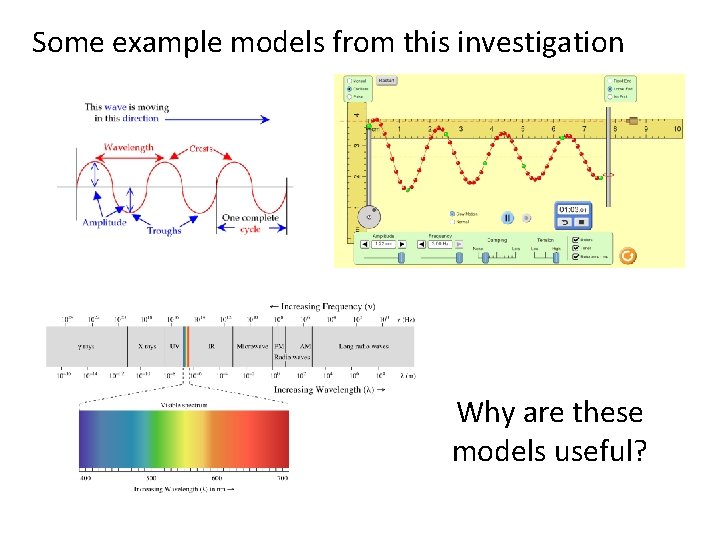
Some example models from this investigation Why are these models useful?
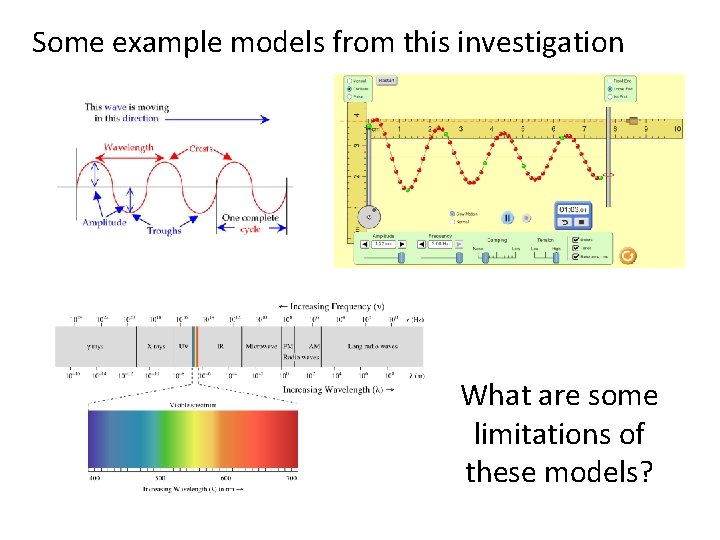
Some example models from this investigation What are some limitations of these models?
It is important for scientists to look for patterns in the data they collect during an investigation.
What are some examples of ways you looked for patterns during this investigation? Discuss with your group and be ready to share
Stage 6: Write an individual argument You are now going to write your investigation report
Section I: The Introduction What were you trying to do and why? Be sure to… 1. Provide a context for the investigation 2. Explain the task 3. Make the guiding question clear You can find this information in the introduction of your lab handout
Section II: The Method What did you do and why did you do it that way? Be sure to explain… 1. How you collected your data and why you decided to do it that way 2. What type of data you collected and why you collected that data 3. How you analyzed your data and why you decided to analyze it that way
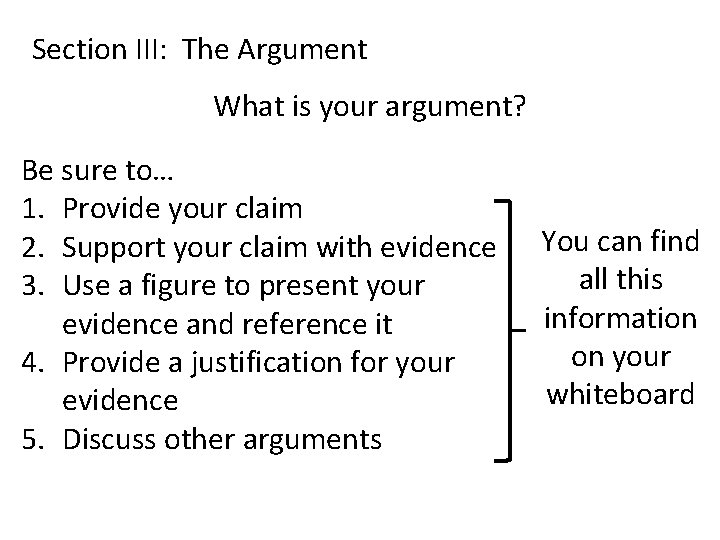
Section III: The Argument What is your argument? Be sure to… 1. Provide your claim 2. Support your claim with evidence 3. Use a figure to present your evidence and reference it 4. Provide a justification for your evidence 5. Discuss other arguments You can find all this information on your whiteboard
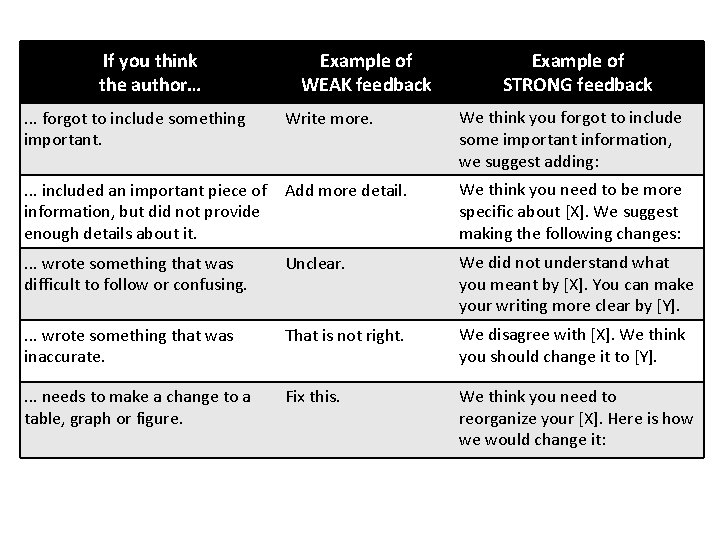
If you think the author… Example of WEAK feedback Example of STRONG feedback . . . forgot to include something important. Write more. We think you forgot to include some important information, we suggest adding: . . . included an important piece of information, but did not provide enough details about it. Add more detail. We think you need to be more specific about [X]. We suggest making the following changes: . . . wrote something that was difficult to follow or confusing. Unclear. We did not understand what you meant by [X]. You can make your writing more clear by [Y]. . wrote something that was inaccurate. That is not right. We disagree with [X]. We think you should change it to [Y]. . needs to make a change to a table, graph or figure. Fix this. We think you need to reorganize your [X]. Here is how we would change it:
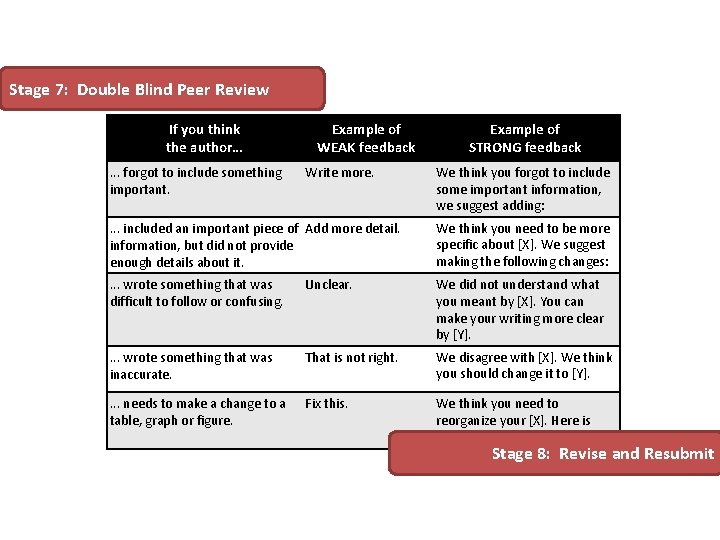
Stage 7: Double Blind Peer Review If you think the author…. . . forgot to include something important. Example of WEAK feedback Write more. Example of STRONG feedback We think you forgot to include some important information, we suggest adding: . . . included an important piece of Add more detail. information, but did not provide enough details about it. We think you need to be more specific about [X]. We suggest making the following changes: . . . wrote something that was difficult to follow or confusing. Unclear. We did not understand what you meant by [X]. You can make your writing more clear by [Y]. . wrote something that was inaccurate. That is not right. We disagree with [X]. We think you should change it to [Y]. . needs to make a change to a table, graph or figure. Fix this. We think you need to reorganize your [X]. Here is how we would change it: Stage 8: Revise and Resubmit
Additional Optional Slides
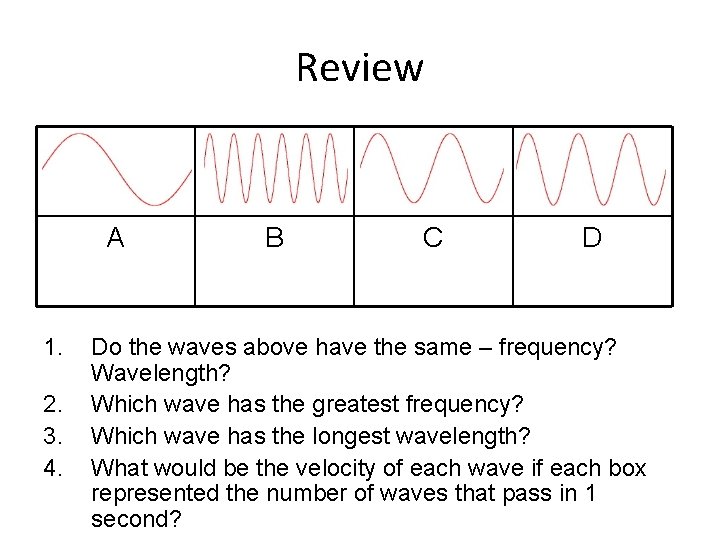
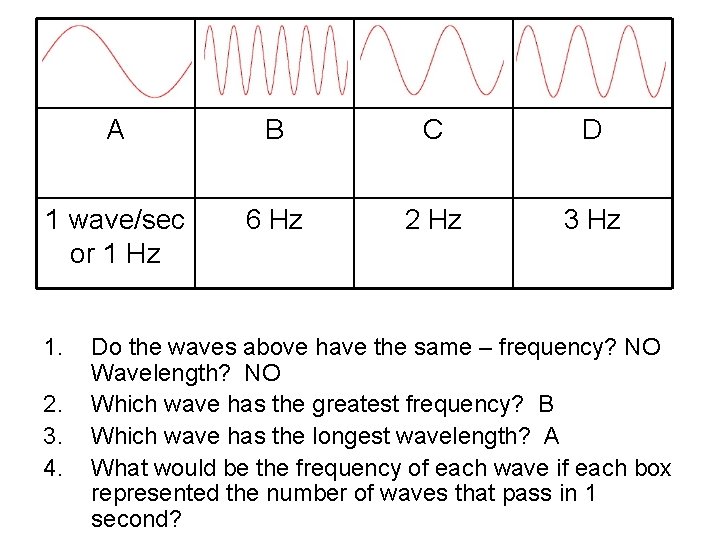
Review A 1. 2. 3. 4. B C D Do the waves above have the same – frequency? Wavelength? Which wave has the greatest frequency? Which wave has the longest wavelength? What would be the velocity of each wave if each box represented the number of waves that pass in 1 second?
A B C D 1 wave/sec or 1 Hz 6 Hz 2 Hz 3 Hz 1. 2. 3. 4. Do the waves above have the same – frequency? NO Wavelength? NO Which wave has the greatest frequency? B Which wave has the longest wavelength? A What would be the frequency of each wave if each box represented the number of waves that pass in 1 second?
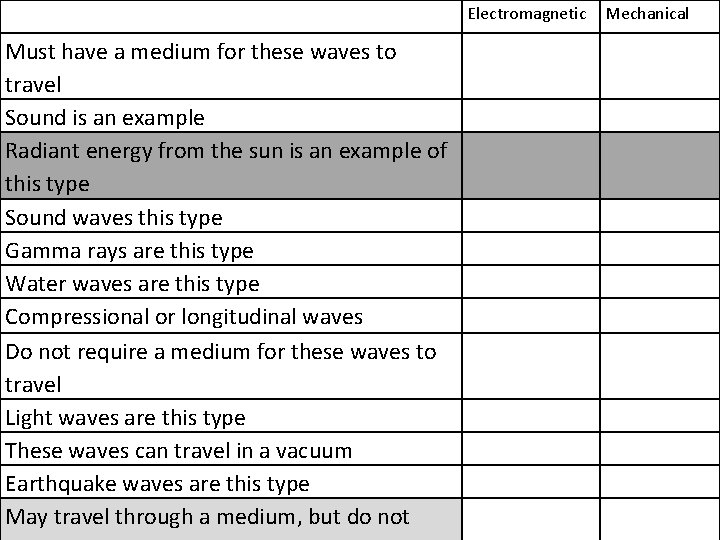
Electromagnetic Must have a medium for these waves to travel Sound is an example Radiant energy from the sun is an example of this type Sound waves this type Gamma rays are this type Water waves are this type Compressional or longitudinal waves Do not require a medium for these waves to travel Light waves are this type These waves can travel in a vacuum Earthquake waves are this type May travel through a medium, but do not Mechanical
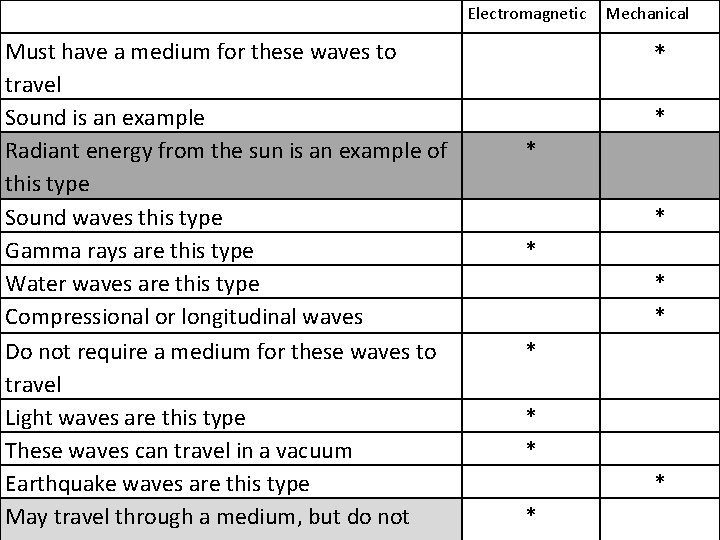
Electromagnetic Must have a medium for these waves to travel Sound is an example Radiant energy from the sun is an example of this type Sound waves this type Gamma rays are this type Water waves are this type Compressional or longitudinal waves Do not require a medium for these waves to travel Light waves are this type These waves can travel in a vacuum Earthquake waves are this type May travel through a medium, but do not Mechanical * * *
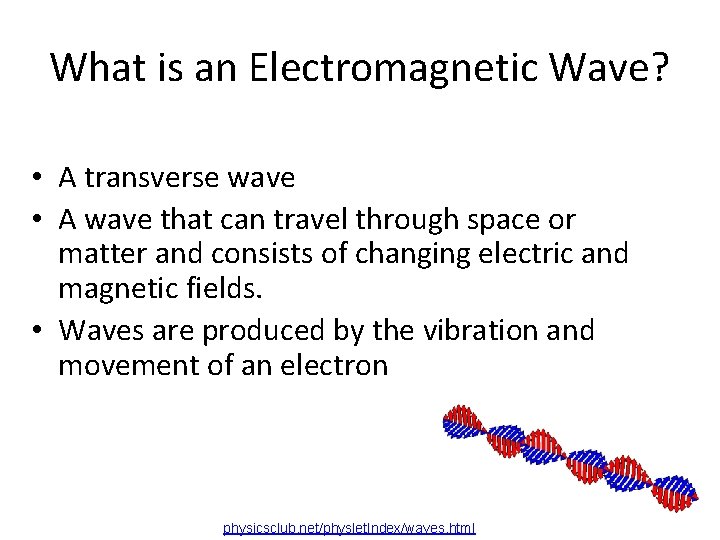
What is an Electromagnetic Wave? • A transverse wave • A wave that can travel through space or matter and consists of changing electric and magnetic fields. • Waves are produced by the vibration and movement of an electron physicsclub. net/physlet. Index/waves. html
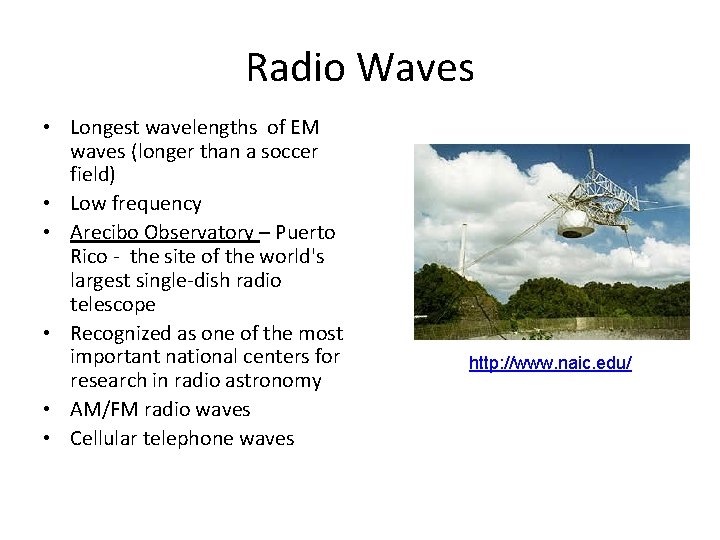
Radio Waves • Longest wavelengths of EM waves (longer than a soccer field) • Low frequency • Arecibo Observatory – Puerto Rico - the site of the world's largest single-dish radio telescope • Recognized as one of the most important national centers for research in radio astronomy • AM/FM radio waves • Cellular telephone waves http: //www. naic. edu/
Microwaves • Radio waves with wavelengths ranging from one meter to as short as one millimeter, or equivalently, with frequencies between 300 MHz (0. 3 GHz) and 300 Ghz • Micro doesn’t mean they are small but they are smaller than radiowaves • Used in broadcasting, telecommunications
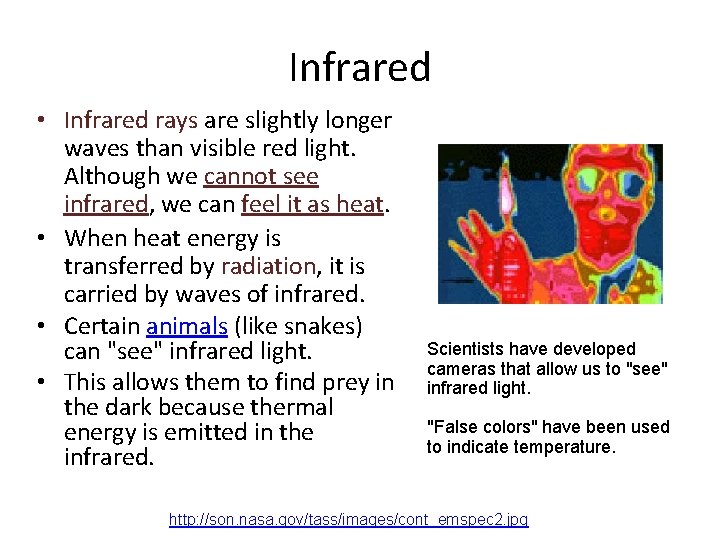
Infrared • Infrared rays are slightly longer waves than visible red light. Although we cannot see infrared, we can feel it as heat. • When heat energy is transferred by radiation, it is carried by waves of infrared. • Certain animals (like snakes) can "see" infrared light. • This allows them to find prey in the dark because thermal energy is emitted in the infrared. Scientists have developed cameras that allow us to "see" infrared light. "False colors" have been used to indicate temperature. http: //son. nasa. gov/tass/images/cont_emspec 2. jpg
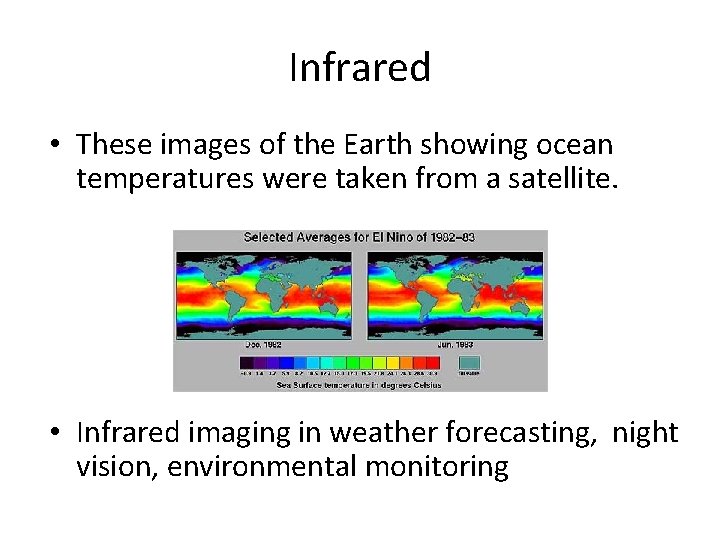
Infrared • These images of the Earth showing ocean temperatures were taken from a satellite. • Infrared imaging in weather forecasting, night vision, environmental monitoring
Visible Light • Electromagnetic radiation that is visible to the human eye, and is responsible for the sense of sight • Light, which is emitted and absorbed in tiny "packets" called photons, exhibits properties of both waves and particles. Source: Wikpedia
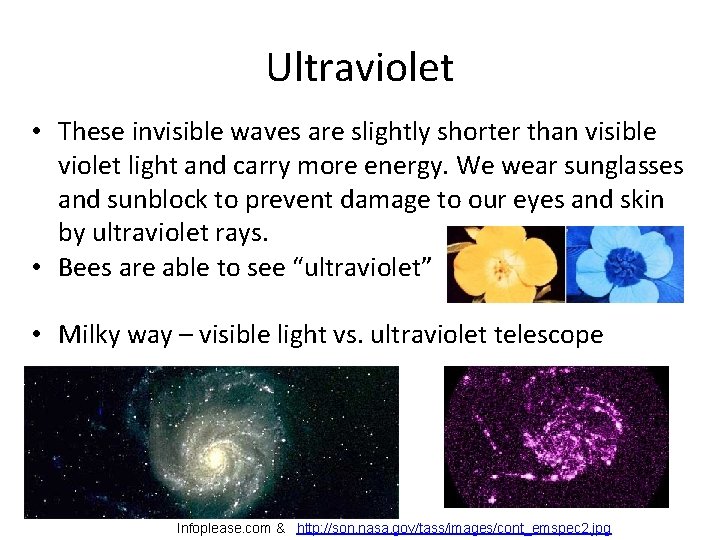
Ultraviolet • These invisible waves are slightly shorter than visible violet light and carry more energy. We wear sunglasses and sunblock to prevent damage to our eyes and skin by ultraviolet rays. • Bees are able to see “ultraviolet” • Milky way – visible light vs. ultraviolet telescope Infoplease. com & http: //son. nasa. gov/tass/images/cont_emspec 2. jpg
X-Ray • Emitted by – – – Astronomical objects X-ray machines CAT scan machines Older televisions Radioactive minerals Airport luggage scanners • Detected by – Space based X-ray detectors – X-ray film – CCD detectors
Gamma Rays • They have a short wavelength and a high frequency and carry large amounts of energy. They are very harmful and can cause cancer in humans and animals. • Emitted by – Radioactive materials – Exploding nuclear weapons – Solar flares • Sources – Pulsars, Black Holes, Supernovae • Detected by – Gamma detectors and astronomical satellites
Wavelengths http: //www. yorku. ca/eye/spectrum. gif
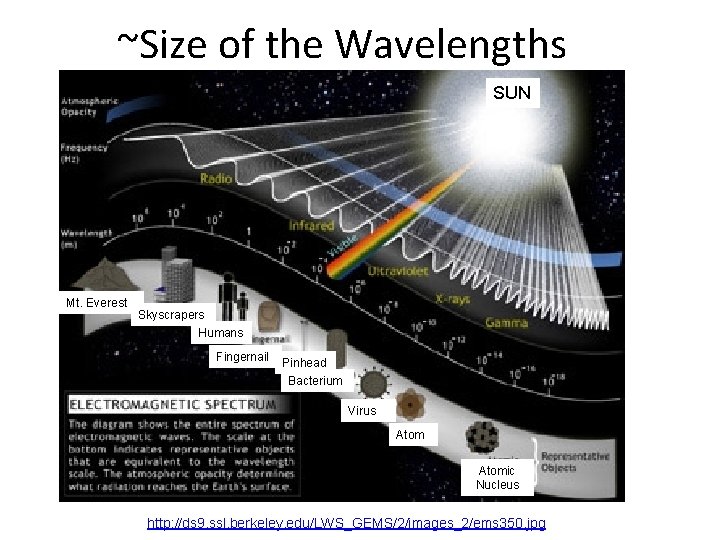
~Size of the Wavelengths SUN Mt. Everest Skyscrapers Humans Fingernail Pinhead Bacterium Virus Atomic Nucleus http: //ds 9. ssl. berkeley. edu/LWS_GEMS/2/images_2/ems 350. jpg
http: //www. glenbrook. k 12. il. us/GBSSCI/PHYS/Class/waves/u 10 l 1 c. html#emmech Explore: Stadium Wave • Doing the wave as a class – arrange seats in a circle with class members sitting – simulate a wave at a sports event • A noticeable ripple is produced which travels around the circular stadium or back and forth across a section of bleachers. • The observable ripple results when a group of enthusiastic fans rise up from their seats, swing their arms up high, and then sit back down. • The wave is passed from row to row as each individual member of the row becomes temporarily displaced out of their seat, only to return to it as the wave passes by. • The medium through which the stadium wave travels is the fans who are in the stadium. • And in the case of a stadium wave, the particles or interacting parts of the medium are the fans in the stadium.
A Wave Transports Energy and Not Matter • When a wave is present in a medium (that is, when there is a disturbance moving through a medium), the individual particles of the medium are only temporarily displaced from their rest position. • There is always a force acting upon the particles which restores them to their original position. In a slinky wave, each coil of the slinky ultimately returns to its original position. • In a water wave, each molecule of the water ultimately returns to its original position. • In a stadium wave, each fan in the bleacher ultimately returns to its original position. • A wave is said to involve the movement of a disturbance without the movement of matter. • The particles of the medium (water molecules, slinky coils, stadium fans) simply vibrate about a fixed position as the pattern of the disturbance moves from one location to another location.