
Wave Particle Duality of Light wave particle or



- Slides: 21
Wave Particle Duality of Light wave, particle, or both?
The Behavior of Particles - Wave particle duality says that every elementary particle may be partly described in terms not only of particles, but also as waves. - They are quantized as either a wave or particle. So everything’s a wave?
Wave Refresher
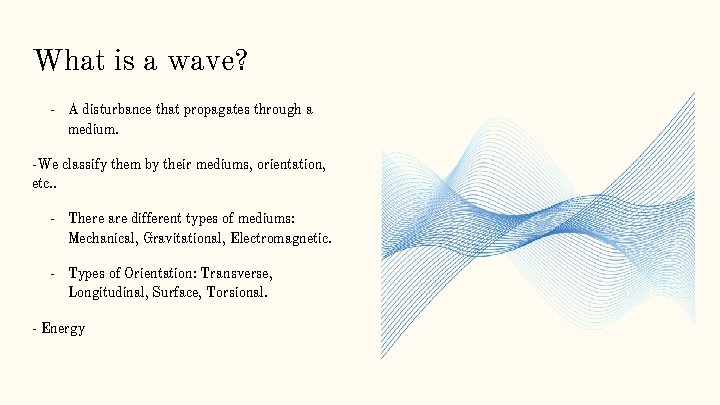
What is a wave? - A disturbance that propagates through a medium. -We classify them by their mediums, orientation, etc. . - There are different types of mediums: Mechanical, Gravitational, Electromagnetic. - Types of Orientation: Transverse, Longitudinal, Surface, Torsional. - Energy
But what about particles? ?
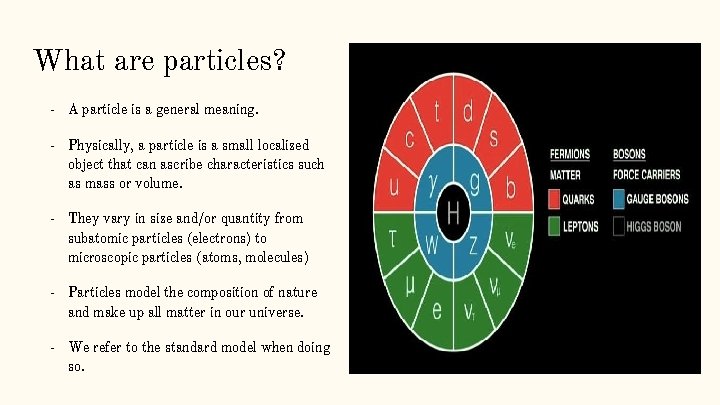
What are particles? - A particle is a general meaning. - Physically, a particle is a small localized object that can ascribe characteristics such as mass or volume. - They vary in size and/or quantity from subatomic particles (electrons) to microscopic particles (atoms, molecules) - Particles model the composition of nature and make up all matter in our universe. - We refer to the standard model when doing so.
So what is Light?
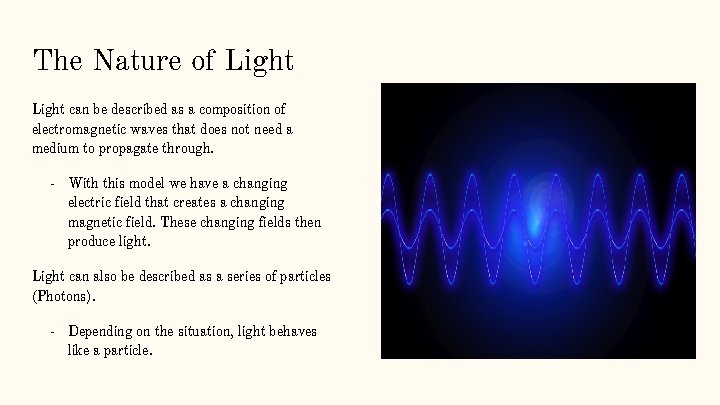
The Nature of Light can be described as a composition of electromagnetic waves that does not need a medium to propagate through. - With this model we have a changing electric field that creates a changing magnetic field. These changing fields then produce light. Light can also be described as a series of particles (Photons). - Depending on the situation, light behaves like a particle.
Well how did we get here?
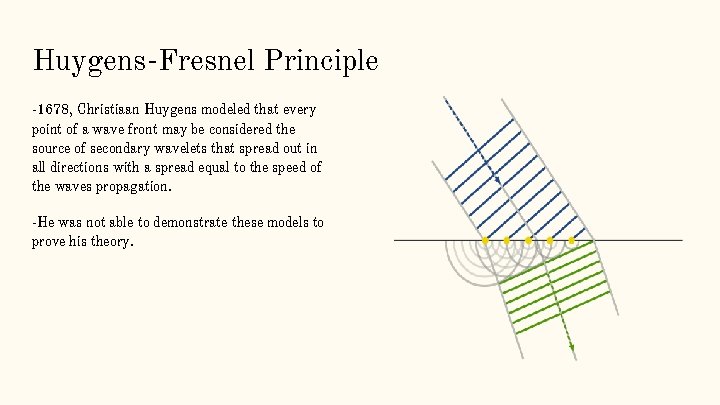
Huygens-Fresnel Principle -1678, Christiaan Huygens modeled that every point of a wave front may be considered the source of secondary wavelets that spread out in all directions with a spread equal to the speed of the waves propagation. -He was not able to demonstrate these models to prove his theory.
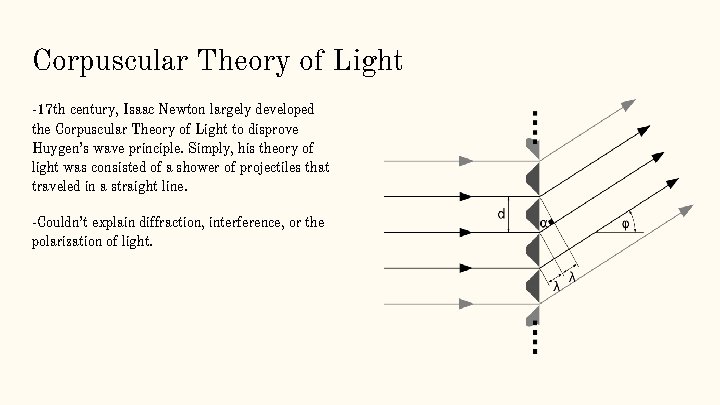
Corpuscular Theory of Light -17 th century, Isaac Newton largely developed the Corpuscular Theory of Light to disprove Huygen’s wave principle. Simply, his theory of light was consisted of a shower of projectiles that traveled in a straight line. -Couldn’t explain diffraction, interference, or the polarization of light.
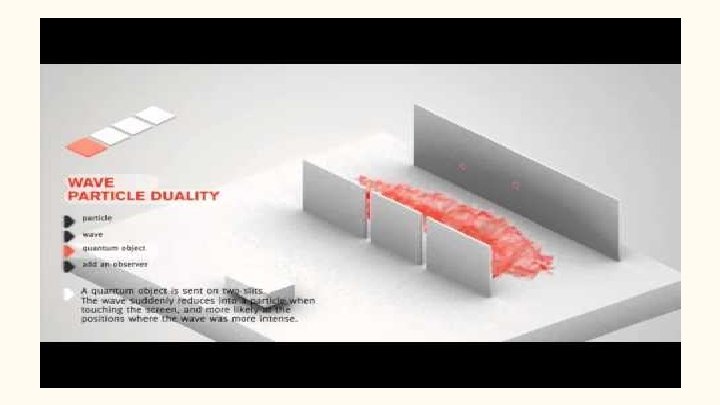
Young’s Double-Slit Experiment - Early 19 th century, Thomas Young - Provided evidence that light acts as a wave - Displayed interference pattern
Young’s Experiment conclusions - Light displayed characteristics of both our classically defined waves and particles - Created an interference pattern, was the first to correctly interpret this phenomenon - Displayed the probabilistic nature of quantum phenomena
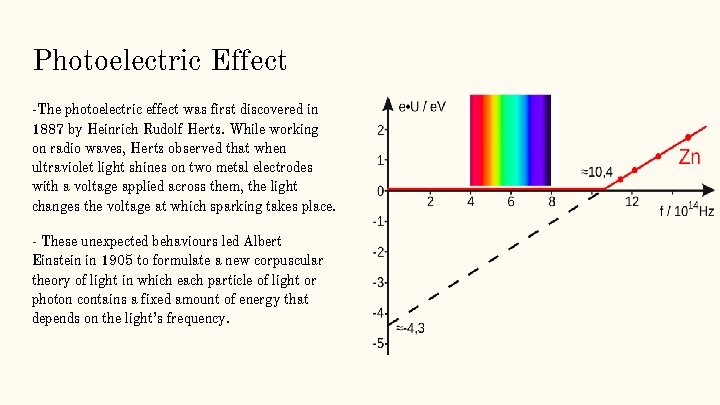
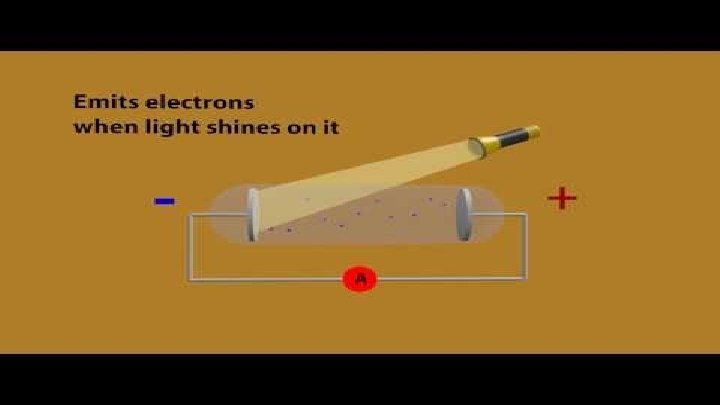
Photoelectric Effect -The photoelectric effect was first discovered in 1887 by Heinrich Rudolf Hertz. While working on radio waves, Hertz observed that when ultraviolet light shines on two metal electrodes with a voltage applied across them, the light changes the voltage at which sparking takes place. - These unexpected behaviours led Albert Einstein in 1905 to formulate a new corpuscular theory of light in which each particle of light or photon contains a fixed amount of energy that depends on the light’s frequency.
Nowadays
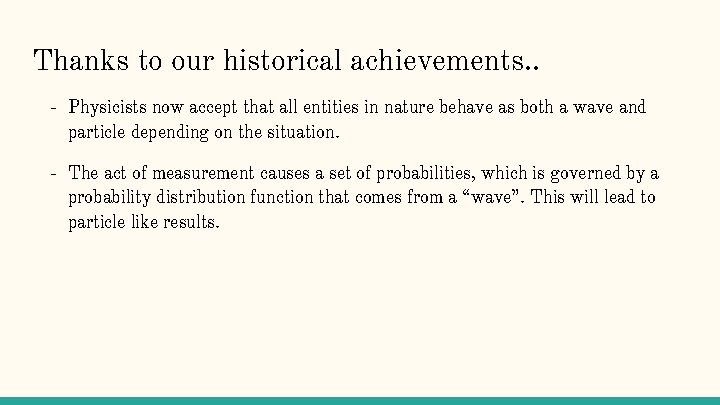
Thanks to our historical achievements. . - Physicists now accept that all entities in nature behave as both a wave and particle depending on the situation. - The act of measurement causes a set of probabilities, which is governed by a probability distribution function that comes from a “wave”. This will lead to particle like results.
References 1) Ruechardt, Edward. Light Visible And Invisible. 1 st ed. Michigan University Of Michigan Press, 1958. Print. 2) "The Nature Of Light – The Physics Hypertextbook". Physics. info. N. p. , 2017. Web. 28 May 2017. 3) Serway, R. A. and Jewett, J. W. (2007) Physics for scientists and engineers, chapters 1 -39. 7 th edn. United States: Wadsworth Publishing Co. 4) "Electromagnetic Waves And Interference | Physics | Science |Khan Academy". Khan Academy. N. p. , 2017. Web. 31 May 2017. 5) Weiss, Richard J. A Brief History Of Light And Those That Lit The Way. 1 st ed. Singapore: World Scientific Pub. , 1996. Print.