
Wave nature of light and optical instruments Physics
- Slides: 10
Wave nature of light and optical instruments Physics 123, Spring 2006 10/7/2020 Lecture VII 1
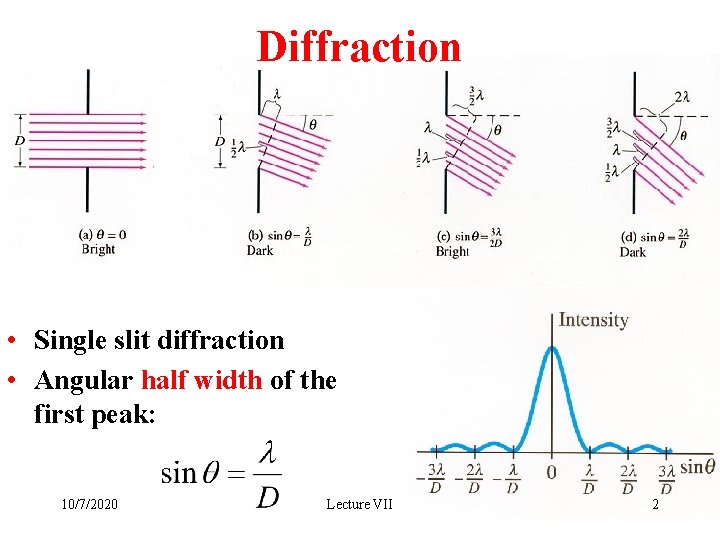
Diffraction • Single slit diffraction • Angular half width of the first peak: 10/7/2020 Lecture VII 2
True limit of geometric optics • Aberrations limit resolution of mirrors and lenses (optical devices) – This can be cured with careful manufacturing (parabolic mirrors, etc) • Diffraction is a true limitation of geometric devices, objects must be >> wavelength (500 nm) 10/7/2020 Lecture VII 3
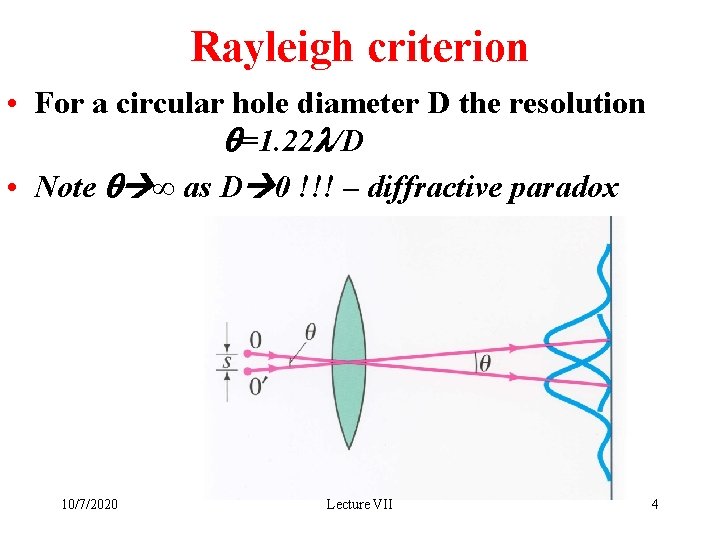
Rayleigh criterion • For a circular hole diameter D the resolution q=1. 22 l/D • Note q ∞ as D 0 !!! – diffractive paradox 10/7/2020 Lecture VII 4
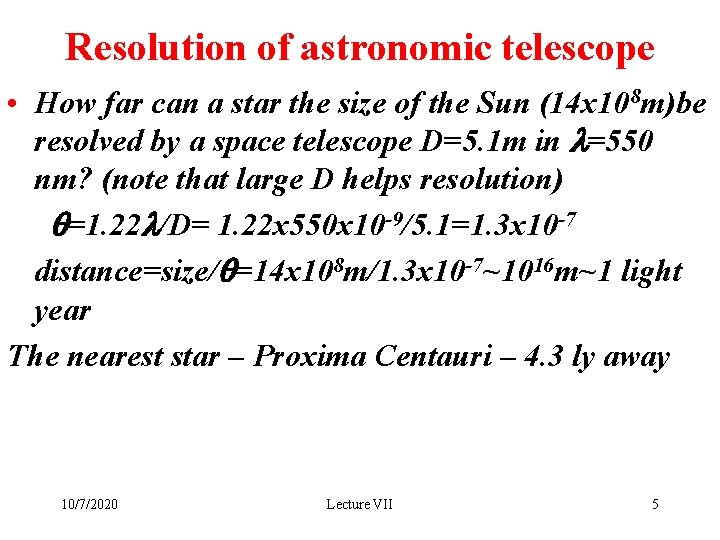
Resolution of astronomic telescope • How far can a star the size of the Sun (14 x 108 m)be resolved by a space telescope D=5. 1 m in l=550 nm? (note that large D helps resolution) q=1. 22 l/D= 1. 22 x 550 x 10 -9/5. 1=1. 3 x 10 -7 distance=size/q=14 x 108 m/1. 3 x 10 -7~1016 m~1 light year The nearest star – Proxima Centauri – 4. 3 ly away 10/7/2020 Lecture VII 5
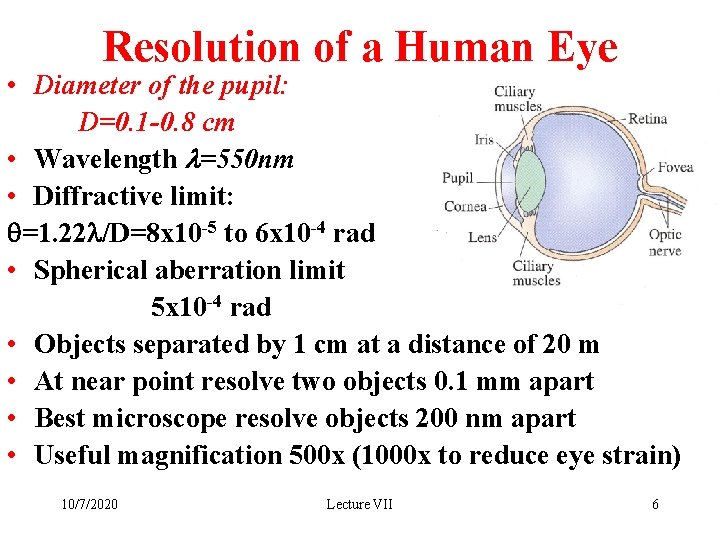
Resolution of a Human Eye • Diameter of the pupil: D=0. 1 -0. 8 cm • Wavelength l=550 nm • Diffractive limit: q=1. 22 l/D=8 x 10 -5 to 6 x 10 -4 rad • Spherical aberration limit 5 x 10 -4 rad • Objects separated by 1 cm at a distance of 20 m • At near point resolve two objects 0. 1 mm apart • Best microscope resolve objects 200 nm apart • Useful magnification 500 x (1000 x to reduce eye strain) 10/7/2020 Lecture VII 6
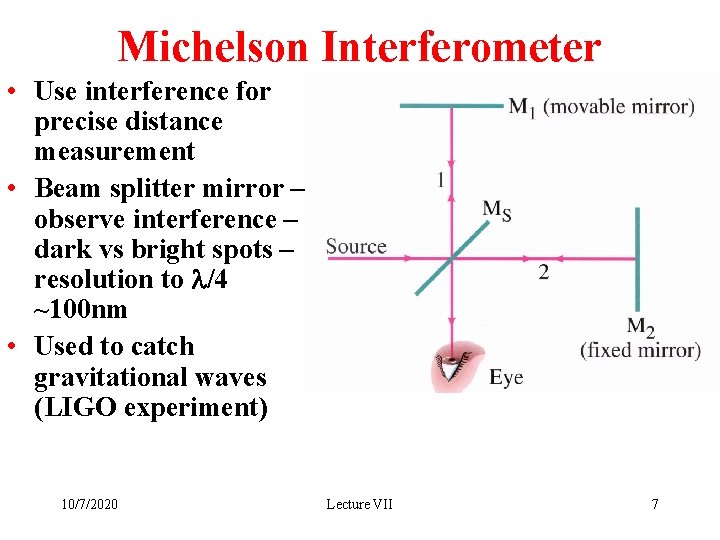
Michelson Interferometer • Use interference for precise distance measurement • Beam splitter mirror – observe interference – dark vs bright spots – resolution to l/4 ~100 nm • Used to catch gravitational waves (LIGO experiment) 10/7/2020 Lecture VII 7
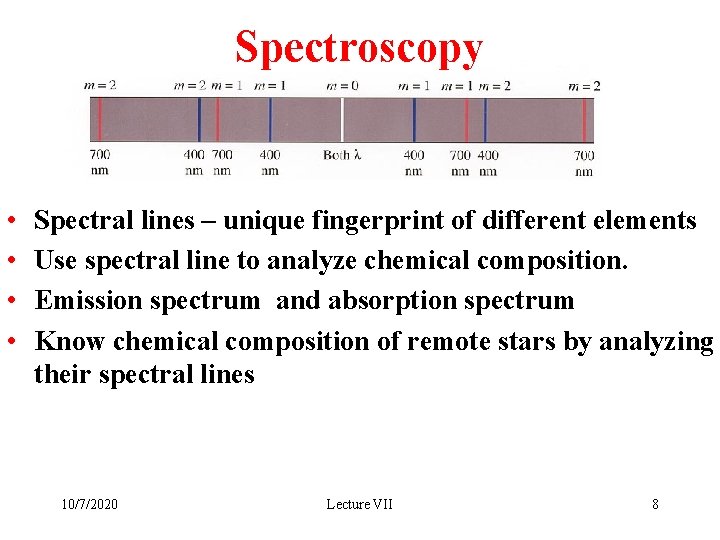
Spectroscopy • • Spectral lines – unique fingerprint of different elements Use spectral line to analyze chemical composition. Emission spectrum and absorption spectrum Know chemical composition of remote stars by analyzing their spectral lines 10/7/2020 Lecture VII 8
X-rays • In 1895 W. C. Roentgen discovered that • electrons accelerated by 30 -150 k. V in cathode tube produce new type of radiation when they strike the glass surface (or metal) • This radiation exposes photographic film – • X-ray photographs • Neutral – do not change direction in electric or magnetic film • Does not exhibit diffractive pattern on narrow slits • Light but very small wavelength 10/7/2020 Lecture VII 9
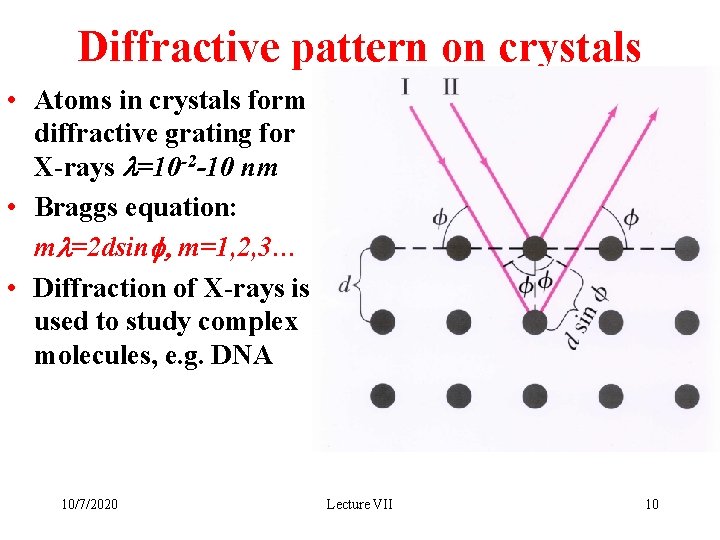
Diffractive pattern on crystals • Atoms in crystals form diffractive grating for X-rays l=10 -2 -10 nm • Braggs equation: ml=2 dsinf, m=1, 2, 3… • Diffraction of X-rays is used to study complex molecules, e. g. DNA 10/7/2020 Lecture VII 10