
Wave Motion Some Basics Sound waves are pressure
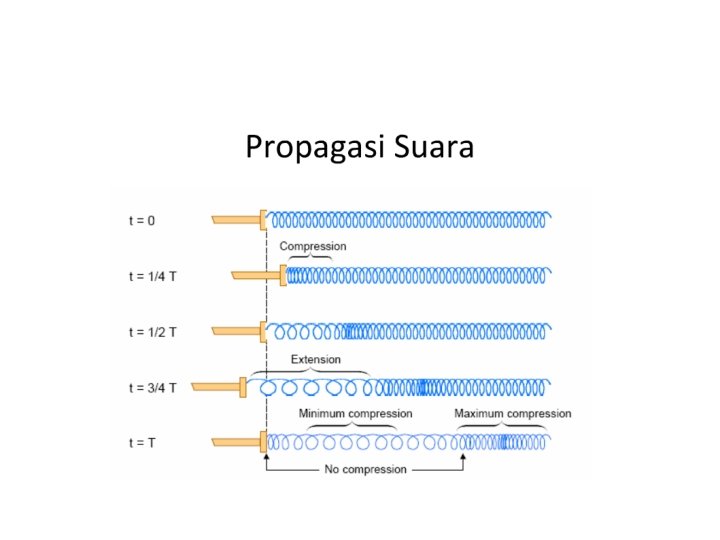
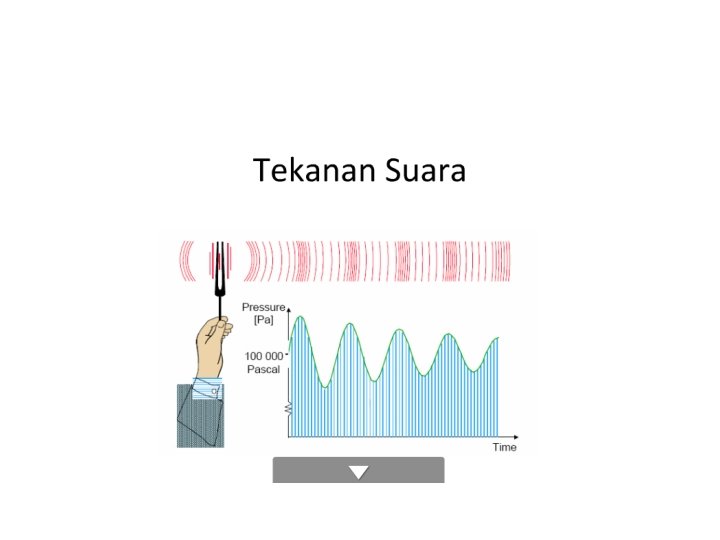
Wave Motion – Some Basics • Sound waves are pressure disturbances in fluids, such as air, caused by vibration, turbulence, explosions, etc. • These disturbances propagate at the speed of sound c (c = 343 m/s or 1125 ft/s in air at room temperature) • The wavelength = c/f. For f = 1 k. Hz, the wavelength is approximately 0. 34 m or 1. 13 ft. • As a sound wave passes a point, the fluid particles are displaced but return to their original position until the next wave passes. Wave animation Dept. of Mech. Engineering University of Kentucky 1
Traveling and Standing Waves • Traveling waves are waves that propagate away from a sound source at the speed of sound • A traveling wave moving in the opposite direction, e. g. , due to a reflection, combines with the original traveling wave to produce a standing wave Animation of a standing wave Dept. of Mech. Engineering University of Kentucky 2
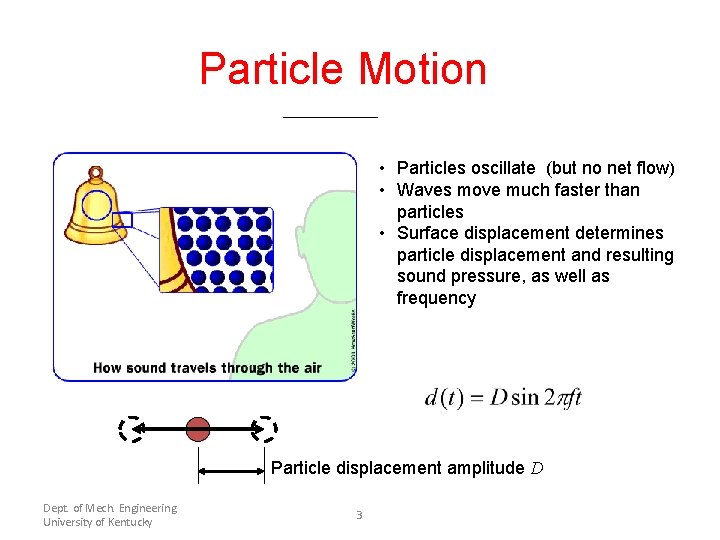
Particle Motion • Particles oscillate (but no net flow) • Waves move much faster than particles • Surface displacement determines particle displacement and resulting sound pressure, as well as frequency Particle displacement amplitude D Dept. of Mech. Engineering University of Kentucky 3
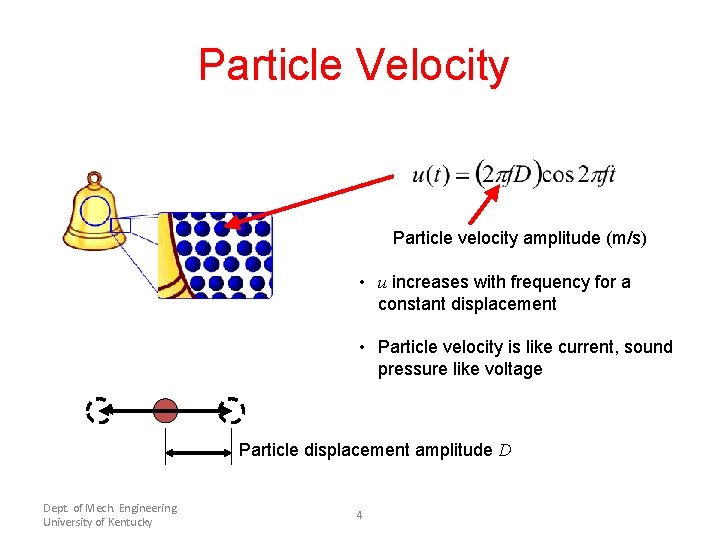
Particle Velocity Particle velocity amplitude (m/s) • u increases with frequency for a constant displacement • Particle velocity is like current, sound pressure like voltage Particle displacement amplitude D Dept. of Mech. Engineering University of Kentucky 4
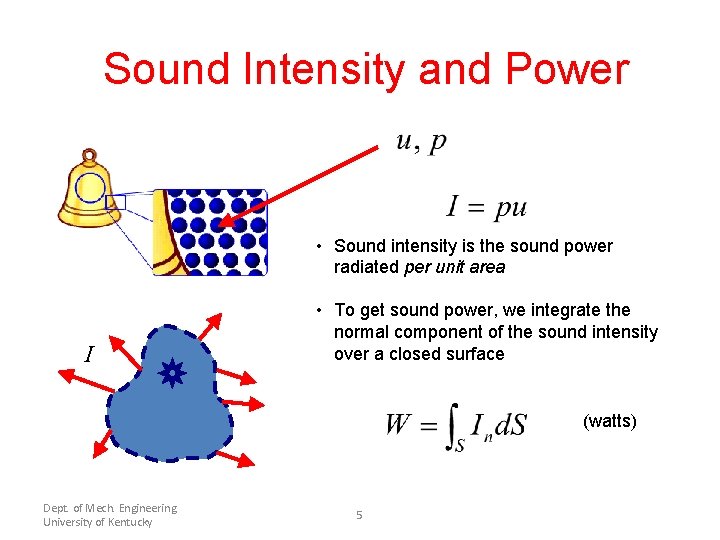
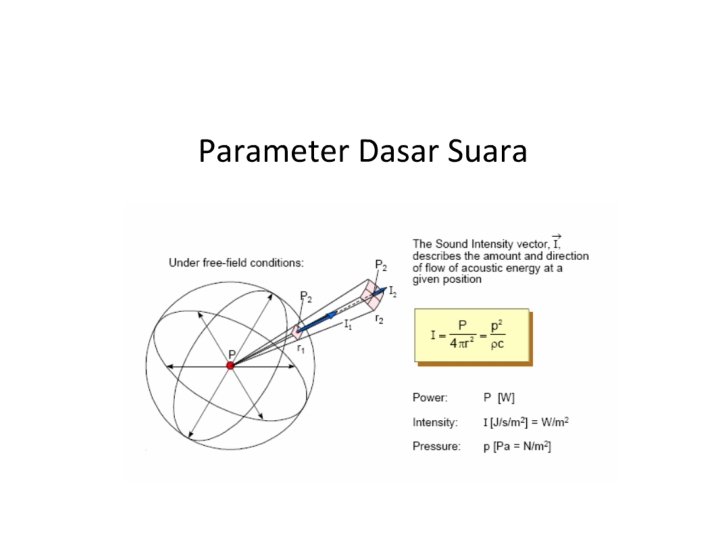
Sound Intensity and Power • Sound intensity is the sound power radiated per unit area I • To get sound power, we integrate the normal component of the sound intensity over a closed surface (watts) Dept. of Mech. Engineering University of Kentucky 5
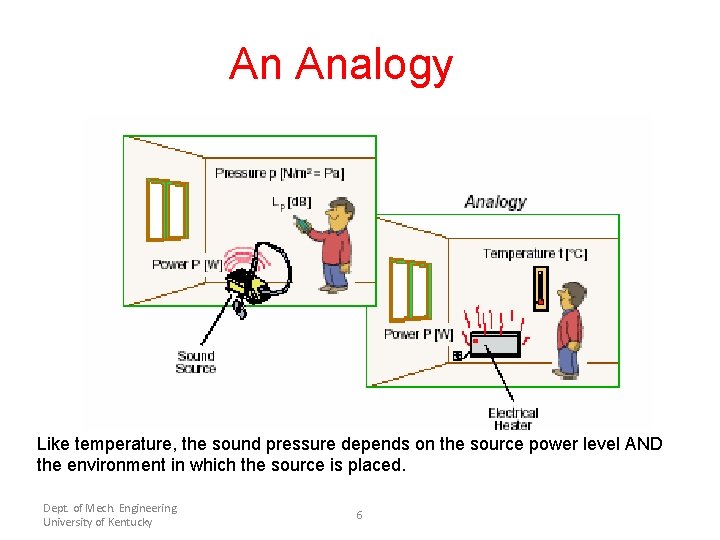
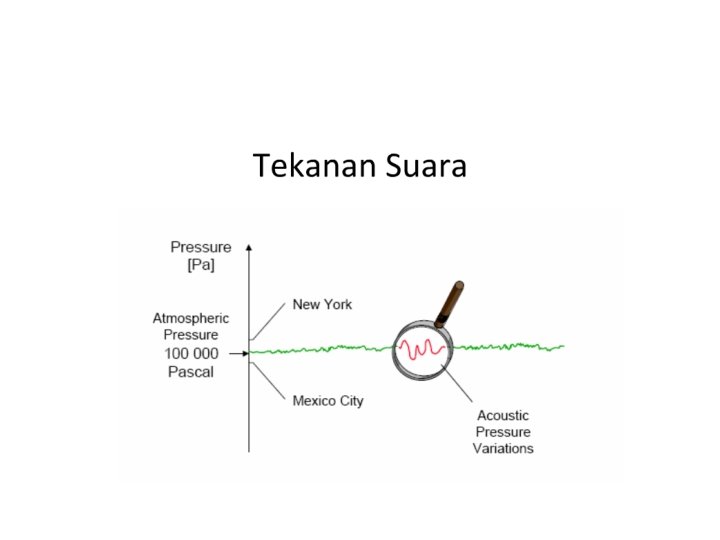
An Analogy Like temperature, the sound pressure depends on the source power level AND the environment in which the source is placed. Dept. of Mech. Engineering University of Kentucky 6
Another Analogy A light bulb produces the same optical power (in watts) regardless of its environment – big or small room – but the intensity of light depends on the environment (reflectance of the walls) and the distance from the light bulb. A sound source produces the same sound power (in watts) regardless of its environment* – big or small room – but the intensity of sound and the sound pressure depend on the environment (reflectance of the walls) and the distance from the source. _____ * There are some notable exceptions to this (exhaust noise) Dept. of Mech. Engineering University of Kentucky 7
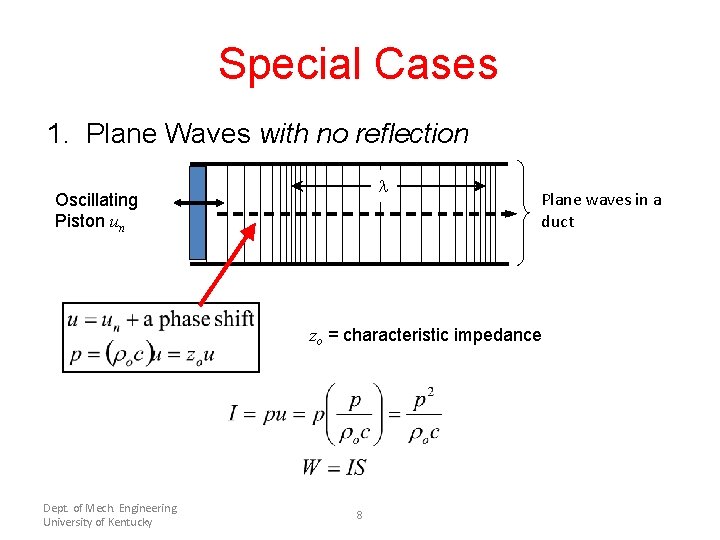
Special Cases 1. Plane Waves with no reflection Oscillating Piston un Plane waves in a duct zo = characteristic impedance Dept. of Mech. Engineering University of Kentucky 8
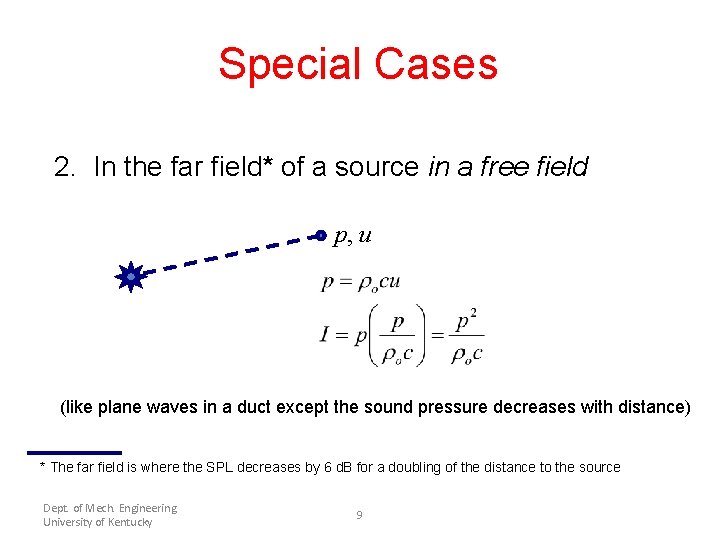
Special Cases 2. In the far field* of a source in a free field p, u (like plane waves in a duct except the sound pressure decreases with distance) * The far field is where the SPL decreases by 6 d. B for a doubling of the distance to the source Dept. of Mech. Engineering University of Kentucky 9
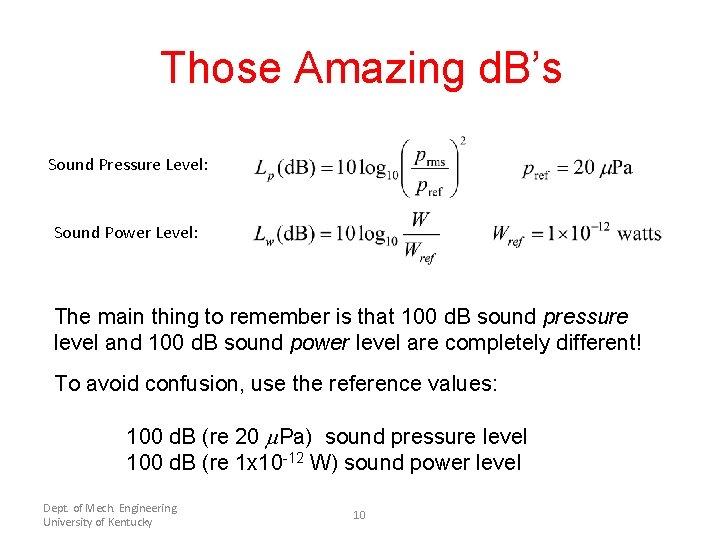
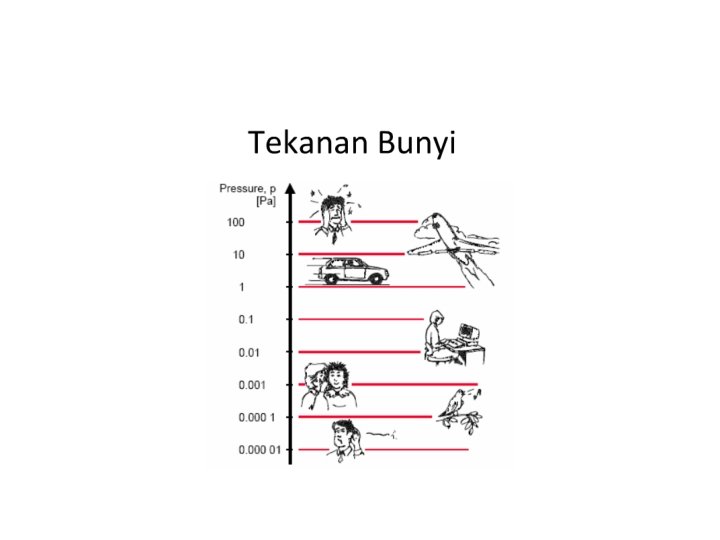
Those Amazing d. B’s Sound Pressure Level: Sound Power Level: The main thing to remember is that 100 d. B sound pressure level and 100 d. B sound power level are completely different! To avoid confusion, use the reference values: 100 d. B (re 20 Pa) sound pressure level 100 d. B (re 1 x 10 -12 W) sound power level Dept. of Mech. Engineering University of Kentucky 10
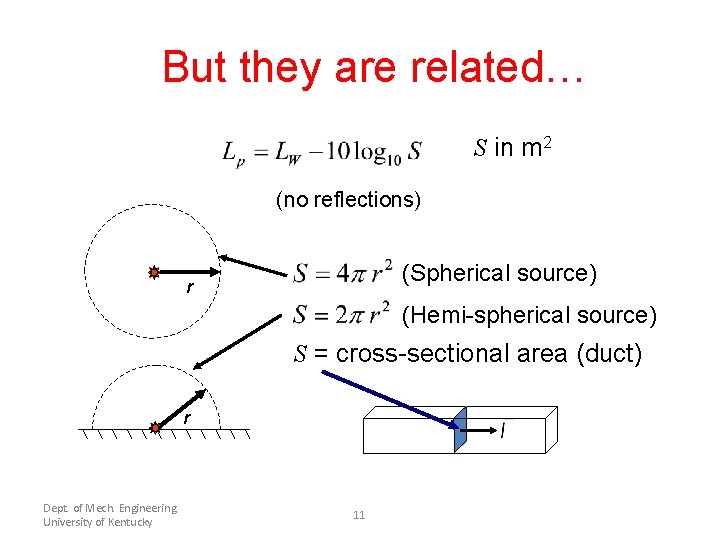
But they are related… S in m 2 (no reflections) (Spherical source) r (Hemi-spherical source) S = cross-sectional area (duct) r Dept. of Mech. Engineering University of Kentucky 11
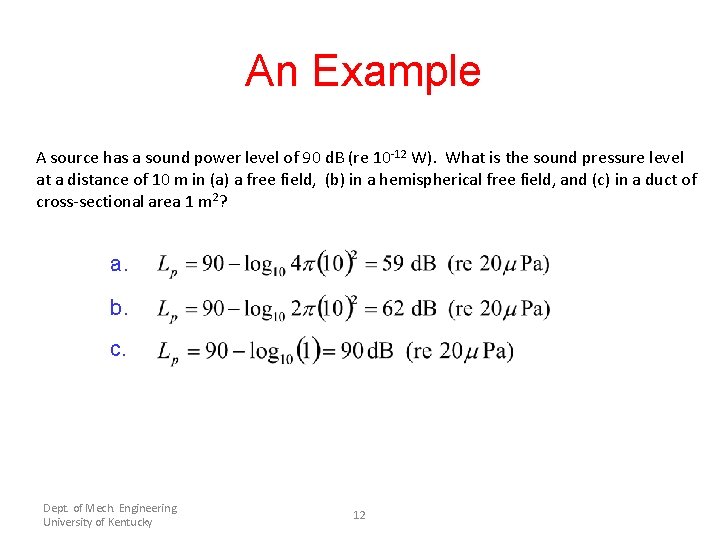
An Example A source has a sound power level of 90 d. B (re 10 -12 W). What is the sound pressure level at a distance of 10 m in (a) a free field, (b) in a hemispherical free field, and (c) in a duct of cross-sectional area 1 m 2? a. b. c. Dept. of Mech. Engineering University of Kentucky 12
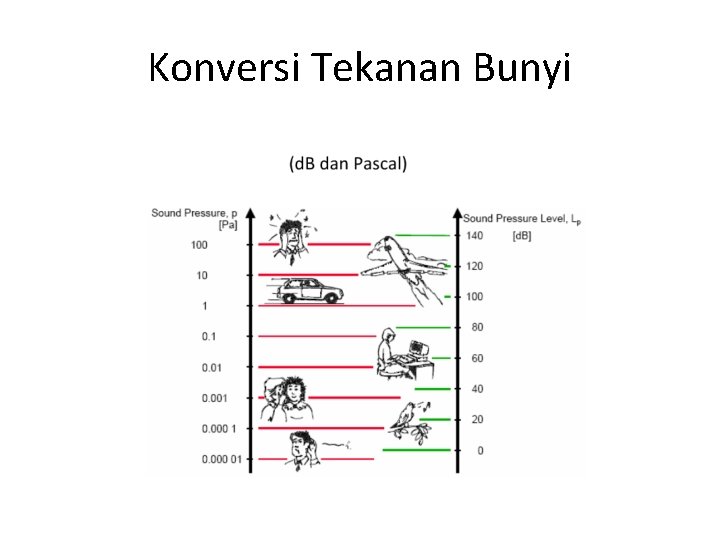
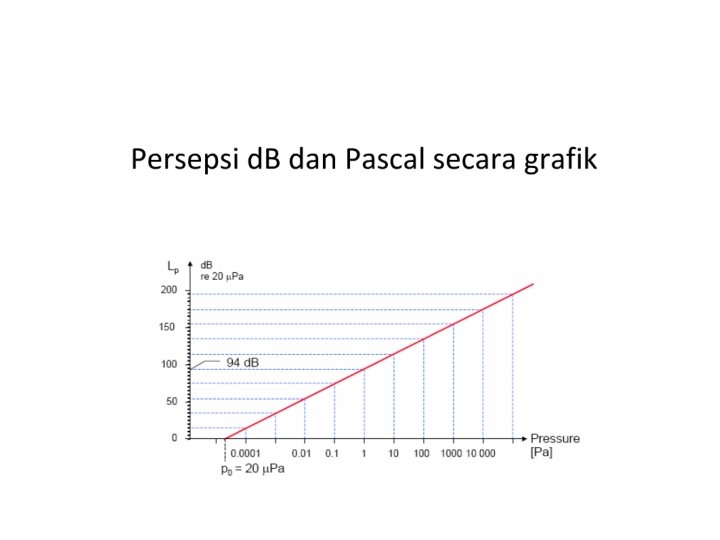
Konversi Tekanan Bunyi
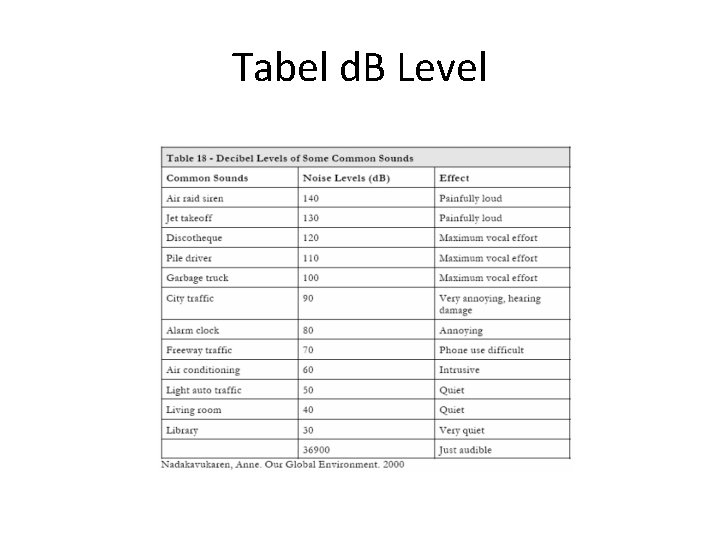
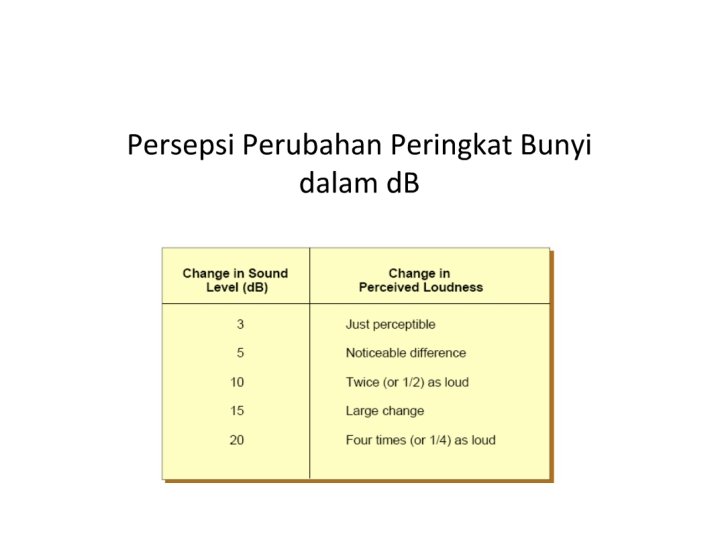
Tabel d. B Level
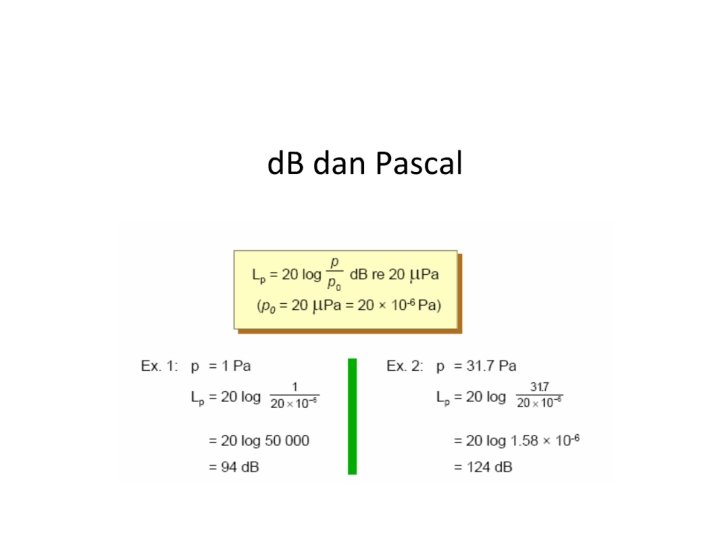

Tobe continued… Terima kasih…
- Slides: 23