
Wave Interactions When two waves come together they
- Slides: 8
Wave Interactions • When two waves come together, they do not bounce back from each other – instead they pass through one another. – Ex: Sound waves are unaffected by other sound waves (can hear more than one thing at a time) This is because mechanical waves are not matter, but are displacements of matter, and therefore they can occupy the same space at the same time. Superposition = the combination of two overlapping waves
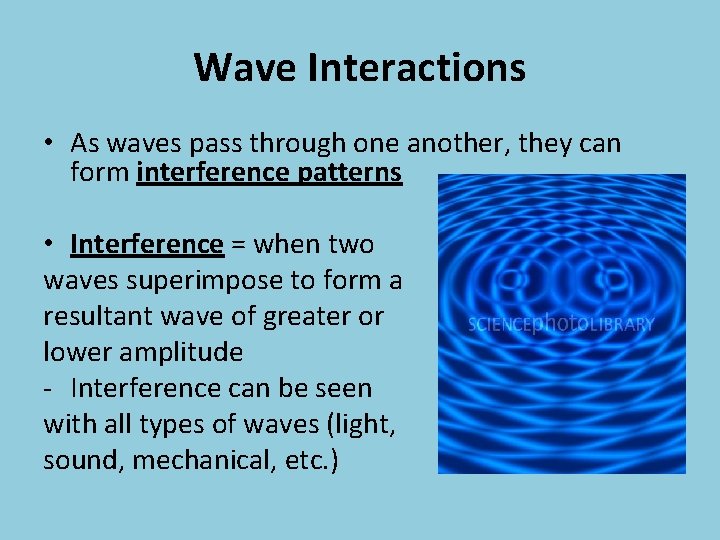
Wave Interactions • As waves pass through one another, they can form interference patterns • Interference = when two waves superimpose to form a resultant wave of greater or lower amplitude - Interference can be seen with all types of waves (light, sound, mechanical, etc. )
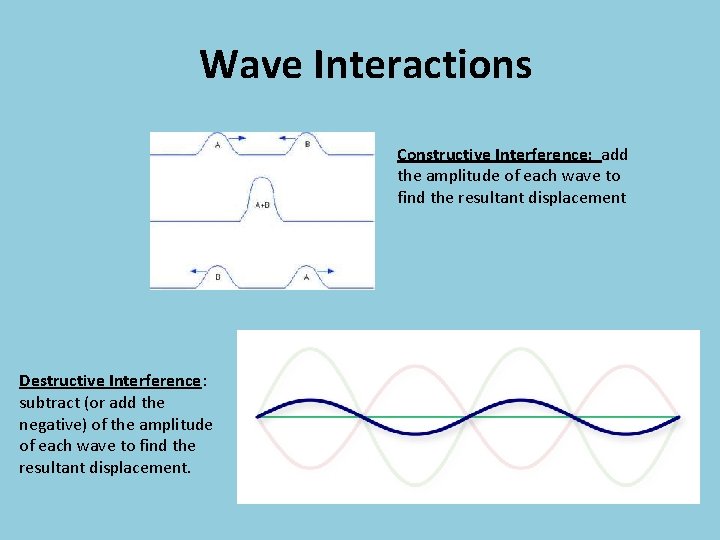
Wave Interactions Types of interference 1. Constructive interference = when the crest of a wave meets a crest of another wave of the same frequency at the same point. The magnitude of the displacement is the sum of the individual magnitudes (bigger crest) 2. Destructive interference = when the trough of a wave meets the crest of another wave of the same frequency at the same point. The magnitude of the displacements is equal to the difference in the individual magnitudes.
Wave Interactions Constructive Interference: add the amplitude of each wave to find the resultant displacement Destructive Interference: subtract (or add the negative) of the amplitude of each wave to find the resultant displacement.
Wave Interactions • Superposition Principle = when two or more waves travel through a medium at the same time, the resultant wave is the sum of the displacements of the individual waves at each point. • Wave superposition - You. Tube • In destructive interference, when the resultant displacement is a straight line, complete destructive interference occurs.
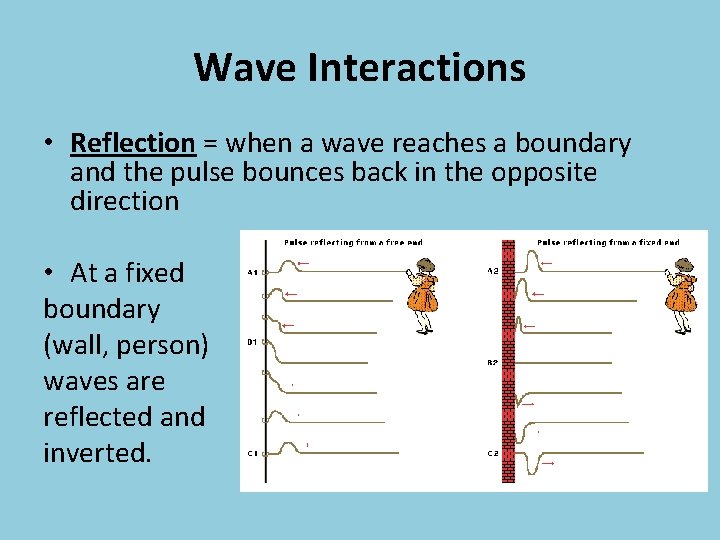
Wave Interactions • Reflection = when a wave reaches a boundary and the pulse bounces back in the opposite direction • At a fixed boundary (wall, person) waves are reflected and inverted.
Wave Interactions • Standing waves = a wave pattern resulting when two waves with the same frequency, wavelength, and amplitude travel in opposite directions and interfere. • Node = a point that has zero displacement. • Antinode = point of largest displacement halfway between two nodes.
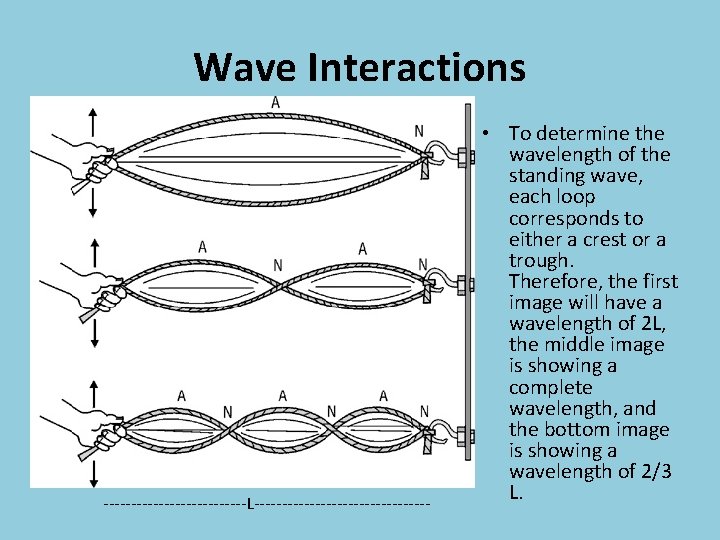
Wave Interactions -------------L---------------- • To determine the wavelength of the standing wave, each loop corresponds to either a crest or a trough. Therefore, the first image will have a wavelength of 2 L, the middle image is showing a complete wavelength, and the bottom image is showing a wavelength of 2/3 L.