
Wave Equation Dispersion Inversion of Guided PWaves WDG
- Slides: 25
Wave Equation Dispersion Inversion of Guided P-Waves (WDG) Jing Li 1, 2, Sherif Hanafy 1 and Gerard Schuster 1 1 King Abdullah University of Science and Technology (KAUST), Saudi Arabia 2 Department of Geophysics, Jilin University, China
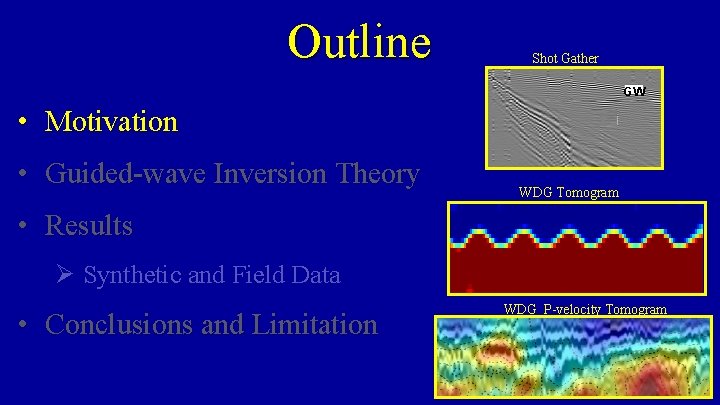
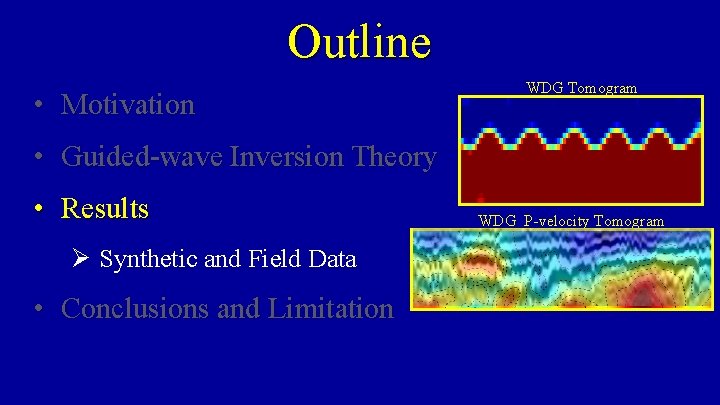
Outline Shot Gather GW • Motivation • Guided-wave Inversion Theory WDG Tomogram • Results Ø Synthetic and Field Data • Conclusions and Limitation WDG P-velocity Tomogram
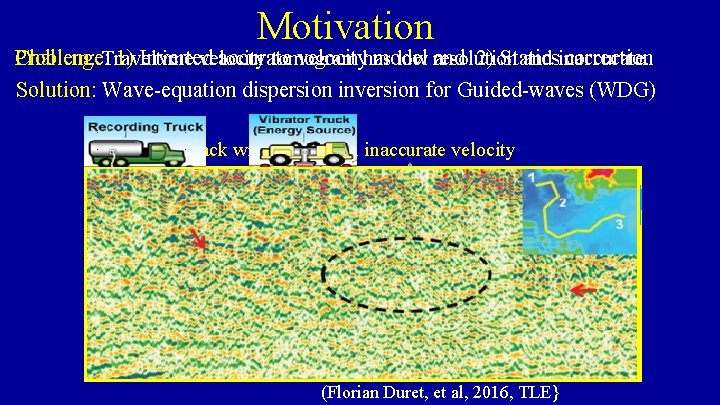
Motivation Challenge: 1) Inverted accurate velocityhas model and 2) Statics correction. Problem: Traveltime velocity tomogram low resolution and inaccurate Solution: Wave-equation dispersion inversion for Guided-waves (WDG) Stack with static from high resolutionvelocity Stack with static from inaccurate (Florian Duret, et al, 2016, TLE}
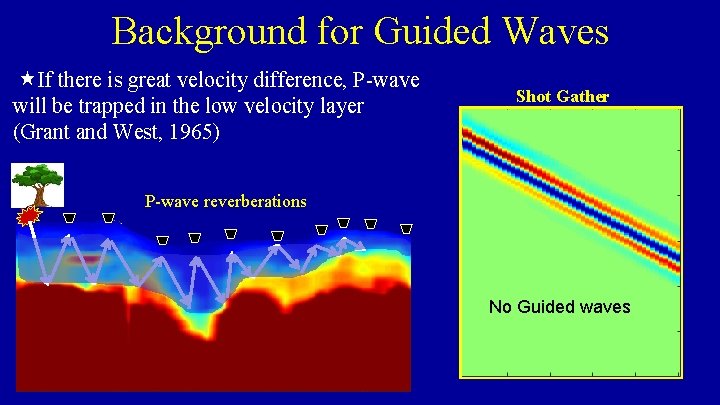
Background for Guided Waves If there is great velocity difference, P-wave will be trapped in the low velocity layer (Grant and West, 1965) Snapshots of wavefield Shot Gather (Mi, et al, 2018; LVL: low velocity layer) Guided-waves P-wave reverberations No Guided waves
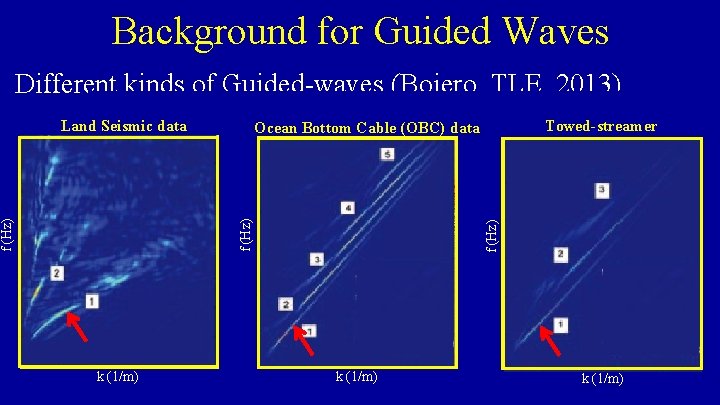
Background for Guided Waves Different kinds of Guided-waves (Boiero, TLE, 2013). k (1/m) Towed-streamer Ocean Bottom Cable (OBC) data f (Hz) Land Seismic data k (1/m)
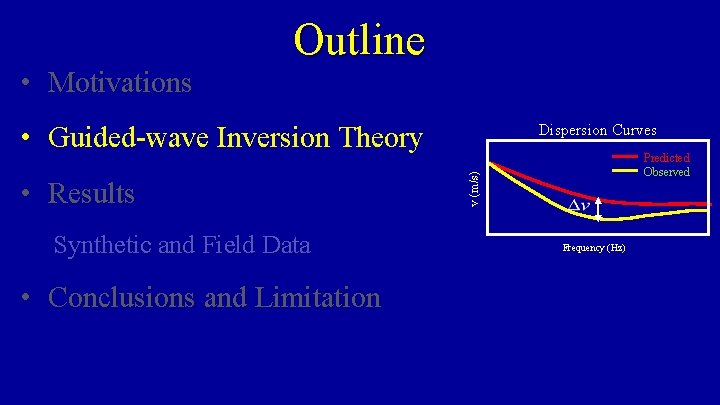
• Motivations Outline • Guided-wave Inversion Theory Synthetic and Field Data • Conclusions and Limitation Predicted Observed v (m/s) • Results Dispersion Curves Frequency (Hz)
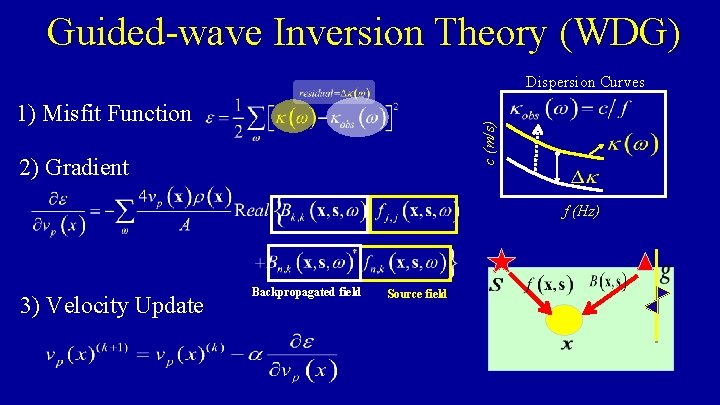
Guided-wave Inversion Theory (WDG) Dispersion Curves c (m/s) 1) Misfit Function 2) Gradient f (Hz) 3) Velocity Update Backpropagated field Source field
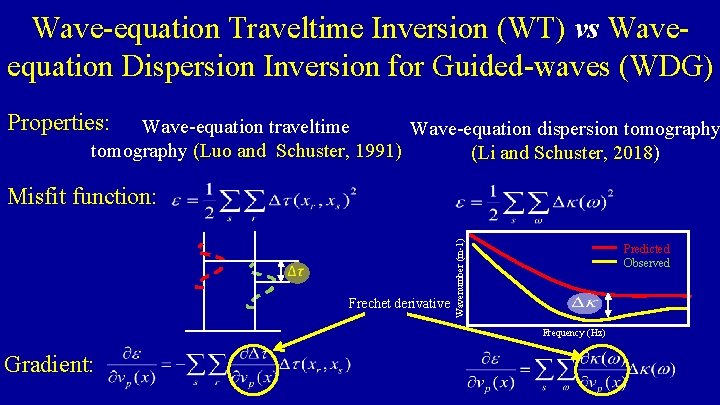
Wave-equation Traveltime Inversion (WT) vs Waveequation Dispersion Inversion for Guided-waves (WDG) Properties: Wave-equation traveltime Wave-equation dispersion tomography (Luo and Schuster, 1991) (Li and Schuster, 2018) Frechet derivative Wavenumber (m-1) Misfit function: Predicted Observed Frequency (Hz) Gradient:
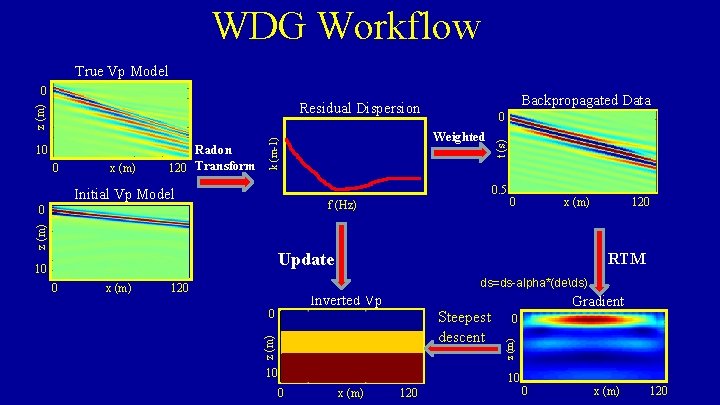
WDG Workflow True Vp Model Obs. Dispersion 0 x (m) Initial Vp Model v (m/s) z (m) 0. 5 f (Hz) 0 x (m) Update 10 120 ds=ds-alpha*(deds) f (Hz) Inverted Vp 0 Steepest descent 10 Gradient 0 10 0 120 RTM z (m) x (m) f (Hz) Pred. Dispersion 0 0 Weighted t (s) Radon 120 Transform 0 z (m) 10 Backpropagated Data Residual Dispersion k (m-1) z (m) v (m/s) 0 x (m) 120
Outline • Motivation WDG Tomogram • Guided-wave Inversion Theory • Results Ø Synthetic and Field Data • Conclusions and Limitation WDG P-velocity Tomogram
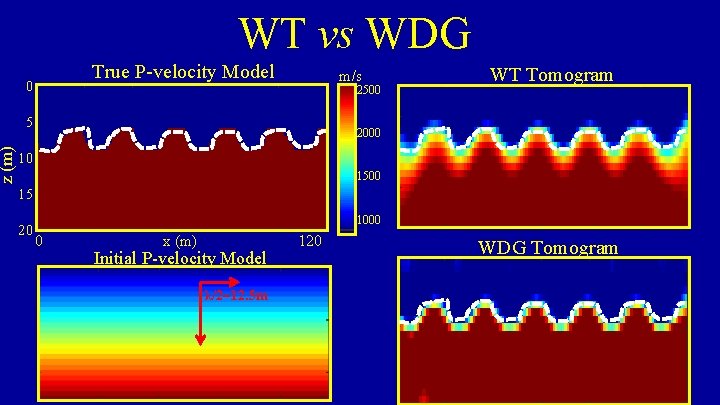
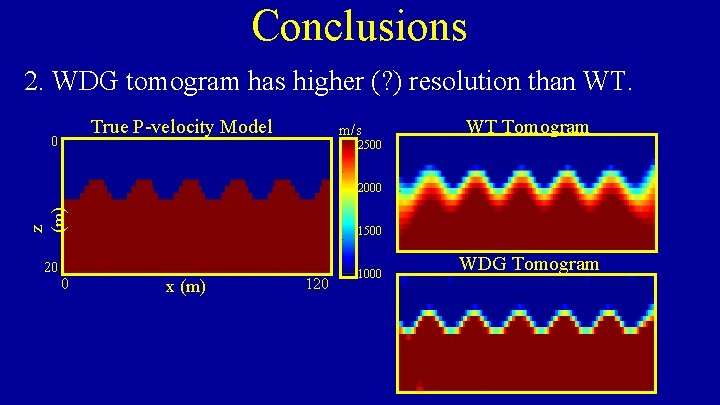
z (m) WT vs WDG True P-velocity Model 0 m/s 2500 5 WT Tomogram 2000 10 1500 15 20 1000 0 x (m) Initial P-velocity Model Parameter: λ/2=12. 5 m V 1=1000 m/s V 2=2500 m/s. f=40 Hz, λ=25 m Sr=30, Re=60; 120 WDG Tomogram
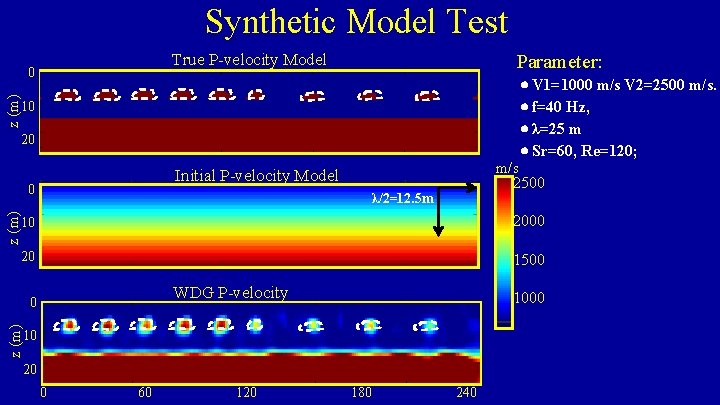
Synthetic Model Test Parameter: True P-velocity Model 0 z (m) V 1=1000 m/s V 2=2500 m/s. f=40 Hz, λ=25 m Sr=60, Re=120; 10 20 m/s 2500 Initial P-velocity Model 0 z (m) λ/2=12. 5 m 10 2000 20 1500 WDG P-velocity Tomogram 1000 z (m) 0 10 20 0 60 120 180 240
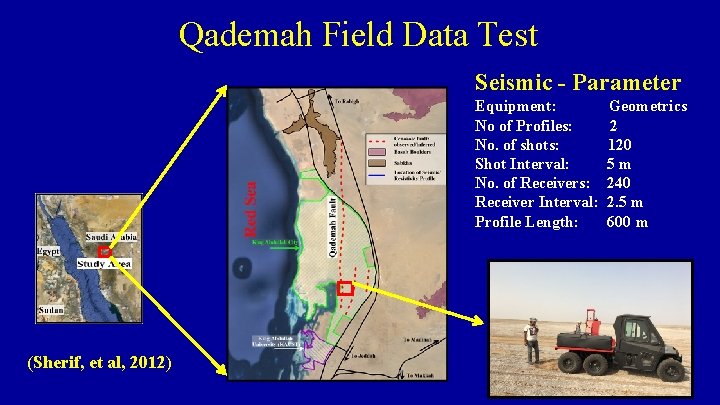
Qademah Field Data Test Seismic - Parameter Equipment: No of Profiles: No. of shots: Shot Interval: No. of Receivers: Receiver Interval: Profile Length: (Sherif, et al, 2012) Geometrics 2 120 5 m 240 2. 5 m 600 m
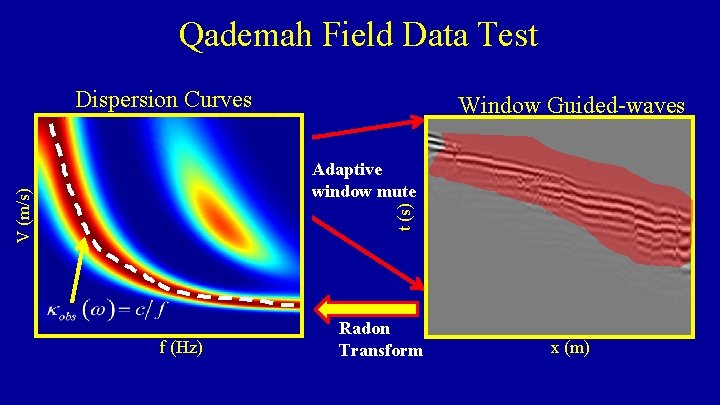
Qademah Field Data Test Dispersion Curves Raw Shot Gather Window Guided-waves t (s) V t(m/s) Adaptive window mute (Hz) x f(m) Radon Transform x (m)
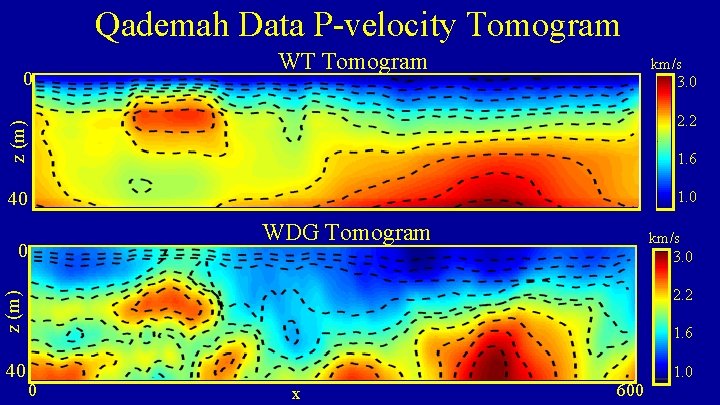
Qademah Data P-velocity Tomogram km/s 3. 0 2. 2 z (m) 0 WT Tomogram 1. 6 40 WDG Tomogram km/s 3. 0 z (m) 0 1. 0 2. 2 40 1. 6 0 x 600
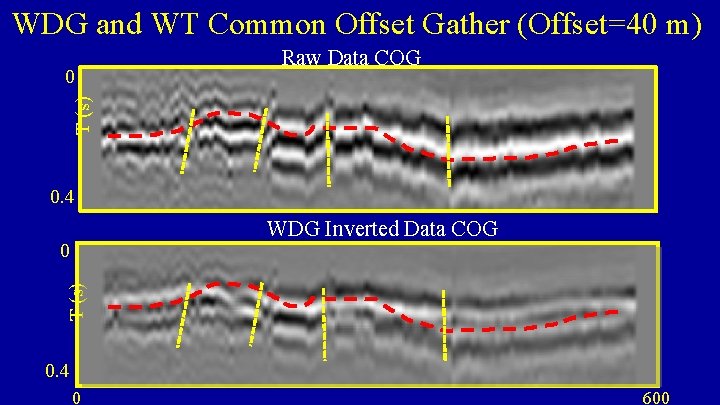
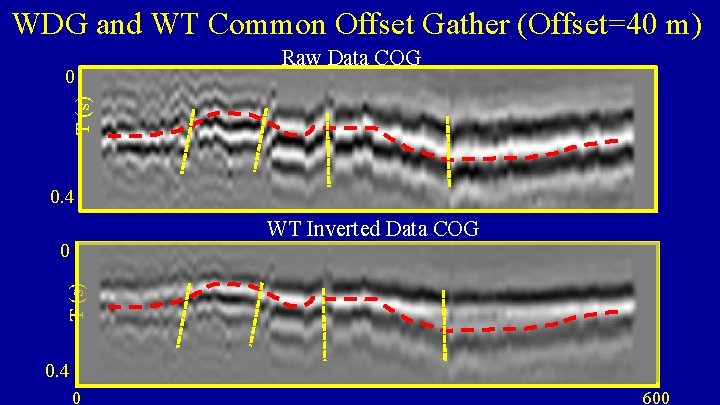
WDG and WT Common Offset Gather (Offset=40 m) T (s) 0 Raw Data COG 0. 4 WDG Inverted Data COG T (s) 0 0. 4 0 600
WDG and WT Common Offset Gather (Offset=40 m) T (s) 0 Raw Data COG 0. 4 WT Inverted Data COG T (s) 0 0. 4 0 600
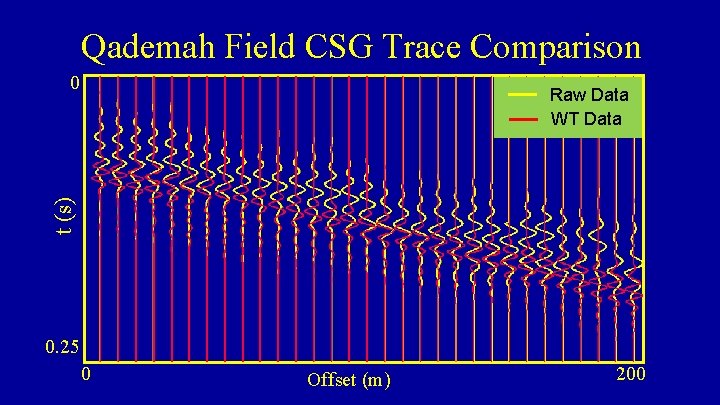
Qademah Field CSG Trace Comparison 0 t (s) Raw Data WT Data 0. 25 0 Offset (m) 200
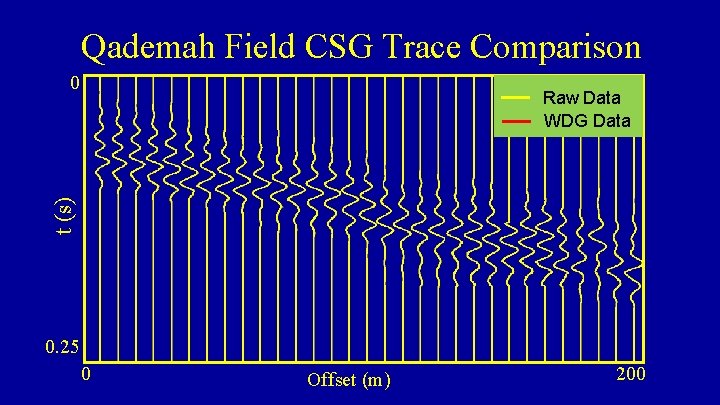
Qademah Field CSG Trace Comparison 0 t (s) Raw Data WDG Data 0. 25 0 Offset (m) 200
Outline • Motivation • Guided-wave Inversion Theory • Results Ø Synthetic and Field Data • Conclusions and Limitation
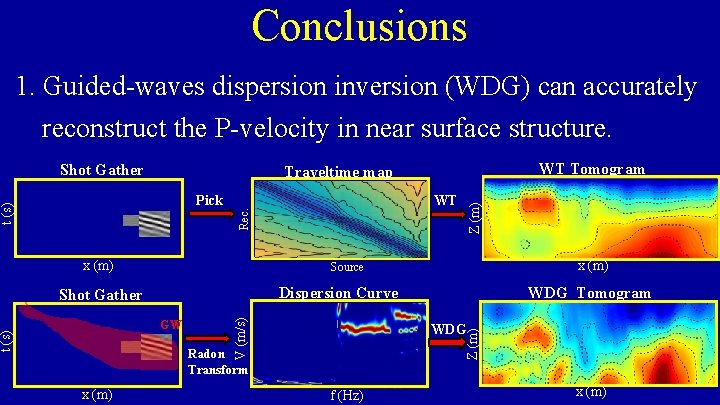
Conclusions 1. Guided-waves dispersion inversion (WDG) can accurately reconstruct the P-velocity in near surface structure. Shot Gather x (m) Source Dispersion Curve WDG Tomogram WDG Z (m) GW V (m/s) Shot Gather t (s) Z (m) WT Rec. t (s) Pick Radon Transform x (m) WT Tomogram Traveltime map f (Hz) x (m)
Conclusions 2. WDG tomogram has higher (? ) resolution than WT. True P-velocity Model 0 m/s WT Tomogram 2500 z (m) 2000 1500 20 0 x (m) 120 1000 WDG Tomogram
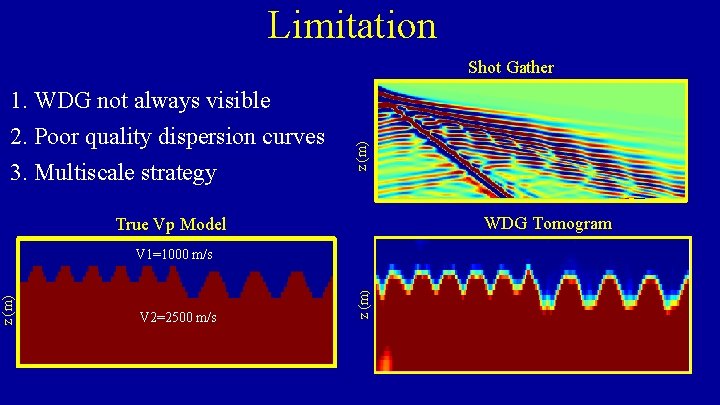
Limitation Shot Gather WDG Tomogram True Vp Model V 1=1000 m/s V 2=2500 m/s V 2=1400 z (m) 2. Poor quality dispersion curves 3. Multiscale strategy z (m) 1. WDG not always visible
Acknowledgements • Sponsors of the CSIM (csim. kaust. edu. sa ) consortium. ( • KAUST Supercomputing Laboratory (KSL) and IT research computing group.
Thank you