
Wave Behaviors Interference Doppler Effect Resonance Wave Behaviors
Wave Behaviors Interference | Doppler Effect | Resonance
Wave Behaviors Learning Objectives • Explain interference, the Doppler effect, and resonance • Recognize examples of various wave behaviors
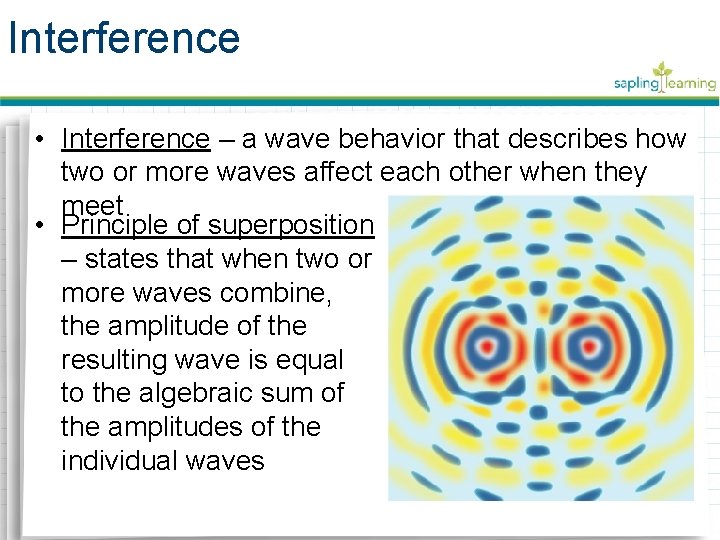
Interference • Interference – a wave behavior that describes how two or more waves affect each other when they meet • Principle of superposition – states that when two or more waves combine, the amplitude of the resulting wave is equal to the algebraic sum of the amplitudes of the individual waves
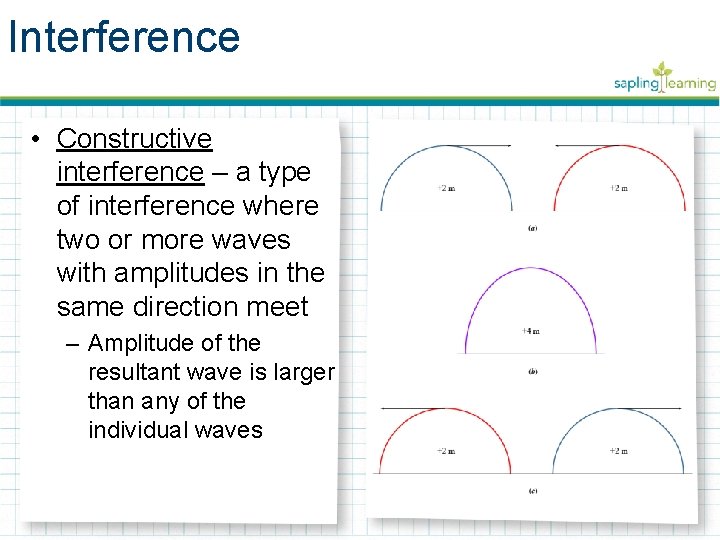
Interference • Constructive interference – a type of interference where two or more waves with amplitudes in the same direction meet – Amplitude of the resultant wave is larger than any of the individual waves
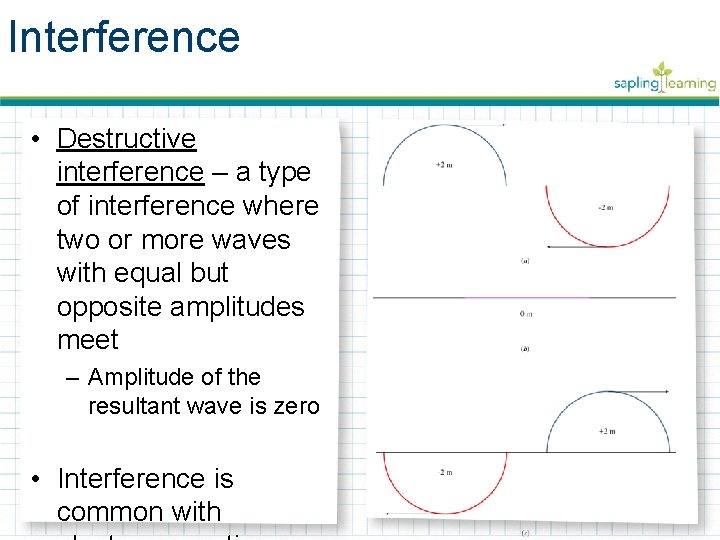
Interference • Destructive interference – a type of interference where two or more waves with equal but opposite amplitudes meet – Amplitude of the resultant wave is zero • Interference is common with
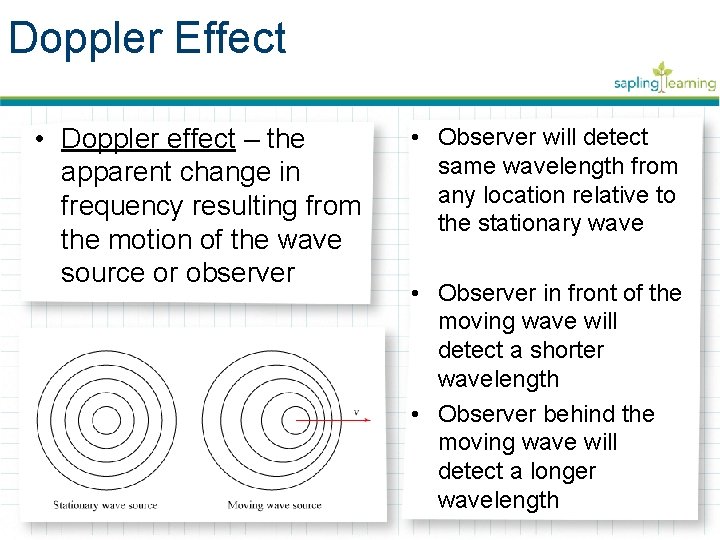
Doppler Effect • Doppler effect – the apparent change in frequency resulting from the motion of the wave source or observer • Observer will detect same wavelength from any location relative to the stationary wave • Observer in front of the moving wave will detect a shorter wavelength • Observer behind the moving wave will detect a longer wavelength
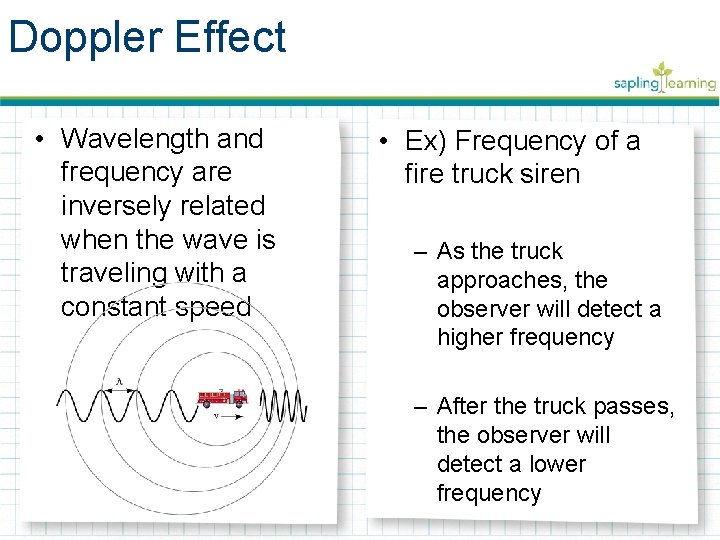
Doppler Effect • Wavelength and frequency are inversely related when the wave is traveling with a constant speed • Ex) Frequency of a fire truck siren – As the truck approaches, the observer will detect a higher frequency – After the truck passes, the observer will detect a lower frequency
Doppler Effect • Observer detects lower frequency – Observer stationary, source moving away – Source stationary, observer moving away – Source and observer are moving away from each other – Source moving away faster than observer is moving towards source – Observer moving away faster than source is moving towards observer • Observer detects higher frequency – Observer stationary, source approaching – Source stationary, observer approaching – Source and observer are moving towards each other – Source moving towards observer faster than observer is moving away – Observer moving towards source faster than source is moving away
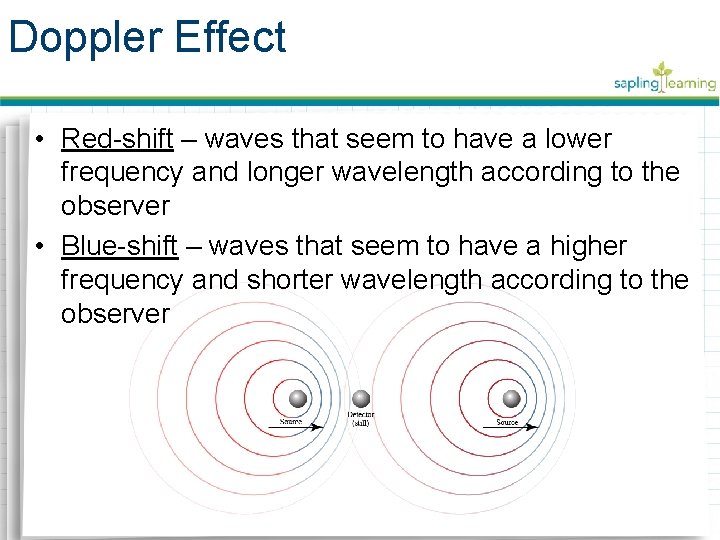
Doppler Effect • Red-shift – waves that seem to have a lower frequency and longer wavelength according to the observer • Blue-shift – waves that seem to have a higher frequency and shorter wavelength according to the observer
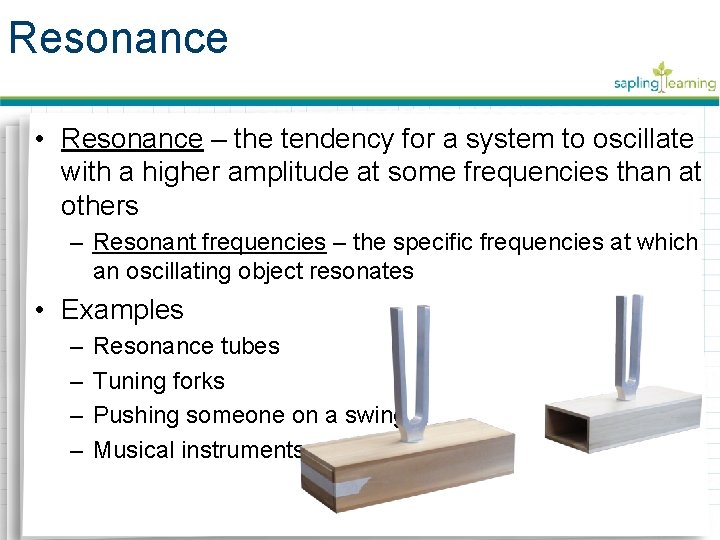
Resonance • Resonance – the tendency for a system to oscillate with a higher amplitude at some frequencies than at others – Resonant frequencies – the specific frequencies at which an oscillating object resonates • Examples – – Resonance tubes Tuning forks Pushing someone on a swing Musical instruments
Wave Behaviors Learning Objectives • Explain interference, the Doppler effect, and resonance • Recognize examples of various wave behaviors
- Slides: 11