
Wave Behavior Reflection Superposition Interference Reflection Waves are
Wave Behavior Reflection Superposition Interference
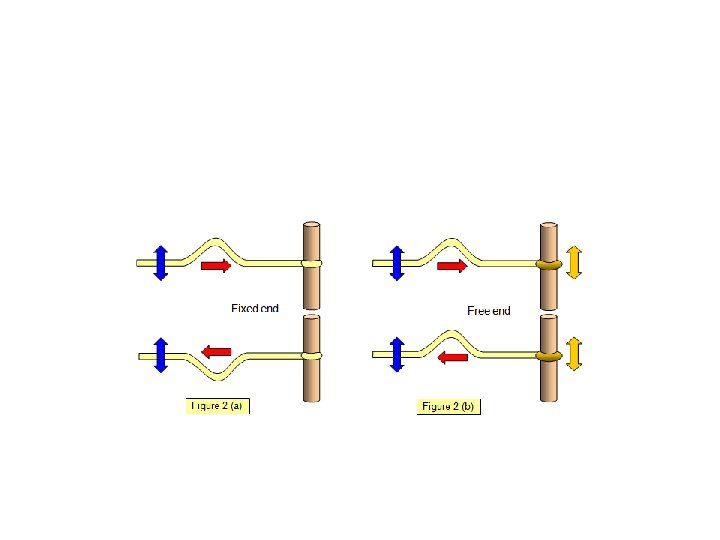
Reflection • Waves are reflected when they encounter a boundary of the medium – Example: Rope tied to a wall - Reflection of Waves from Boundaries • free boundary Rope can move up and down • fixed boundary Rope cannot move at all • At a free boundary, waves are reflected upright • At a fixed boundary, waves are reflected inverted
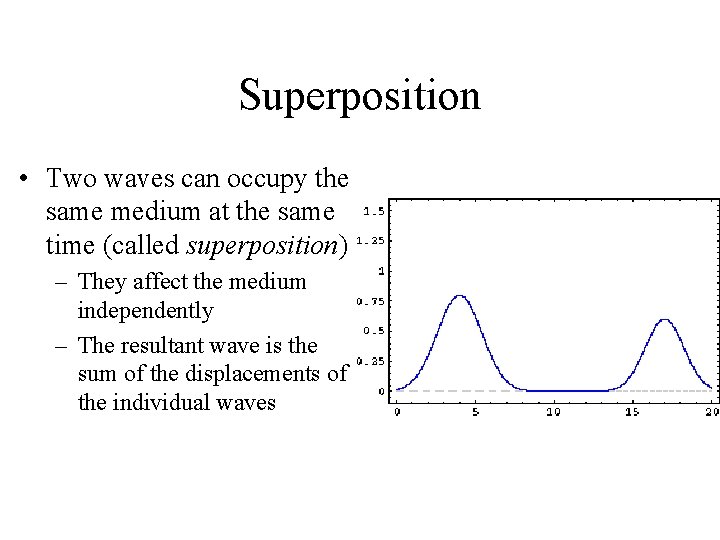
Superposition • Two waves can occupy the same medium at the same time (called superposition) – They affect the medium independently – The resultant wave is the sum of the displacements of the individual waves
Interference • When two waves approach each other from opposite directions they combine in a way called interference – When the displacements are in the same direction, constructive interference occurs – When the displacements are in opposite directions, destructive interference occurs – Transverse Waves-2
Sound
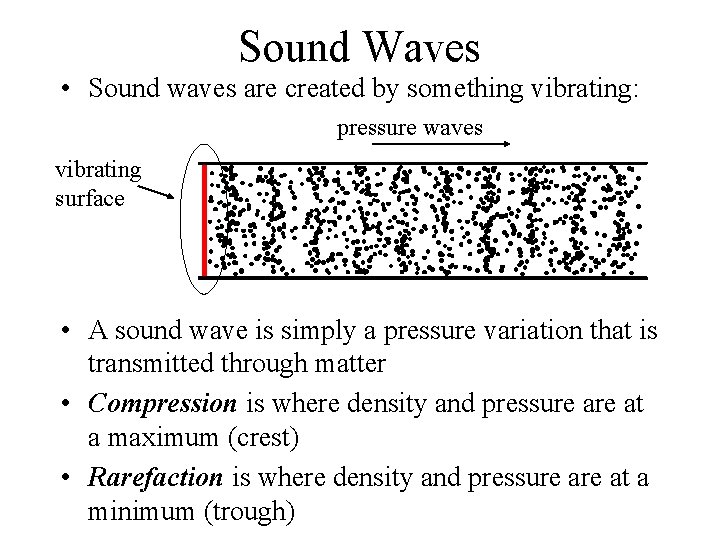
Sound Waves • Sound waves are created by something vibrating: pressure waves vibrating surface • A sound wave is simply a pressure variation that is transmitted through matter • Compression is where density and pressure at a maximum (crest) • Rarefaction is where density and pressure at a minimum (trough)
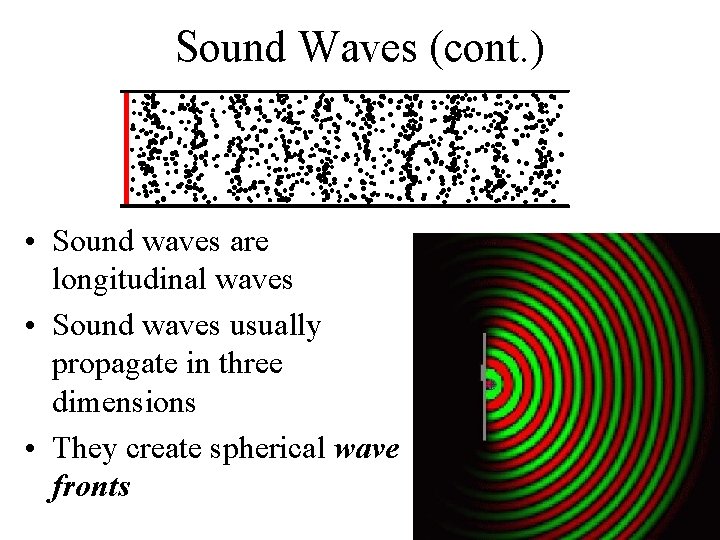
Sound Waves (cont. ) • Sound waves are longitudinal waves • Sound waves usually propagate in three dimensions • They create spherical wave fronts
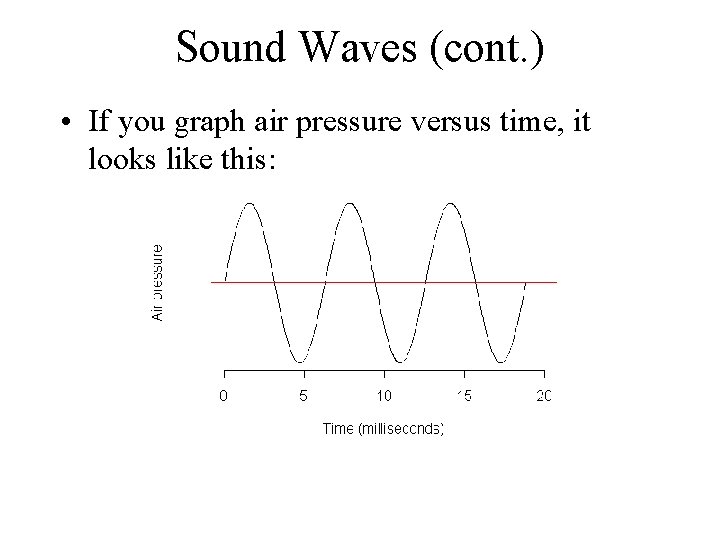
Sound Waves (cont. ) • If you graph air pressure versus time, it looks like this:
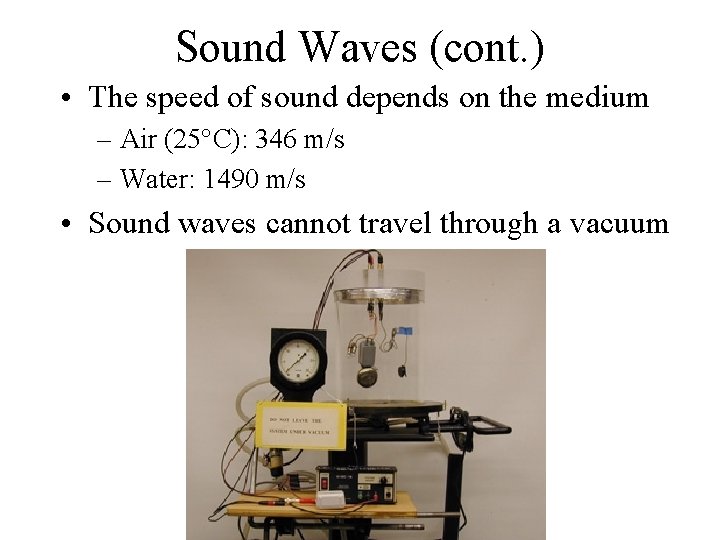
Sound Waves (cont. ) • The speed of sound depends on the medium – Air (25 C): 346 m/s – Water: 1490 m/s • Sound waves cannot travel through a vacuum
Sound Waves (cont. ) • The speed of sound in air depends on temperature. • The speed of sound in air at sea level at room temperature (20°C) is 343 m/s. • Example: If you are 100 m from the crack of a bat striking a baseball, how long before you hear it? t = d/v = (100 m)/(343 m/s) = 0. 29 s
Sound Waves (cont. ) • The loudness of sound is determined by the amplitude of the pressure wave. • The pitch of sound is determined by the frequency of the wave. • Humans can hear sounds between 20 Hz and 20, 000 Hz (audible sound) – Less than 20 Hz is called infrasound – Greater than 20, 000 Hz is called ultrasound
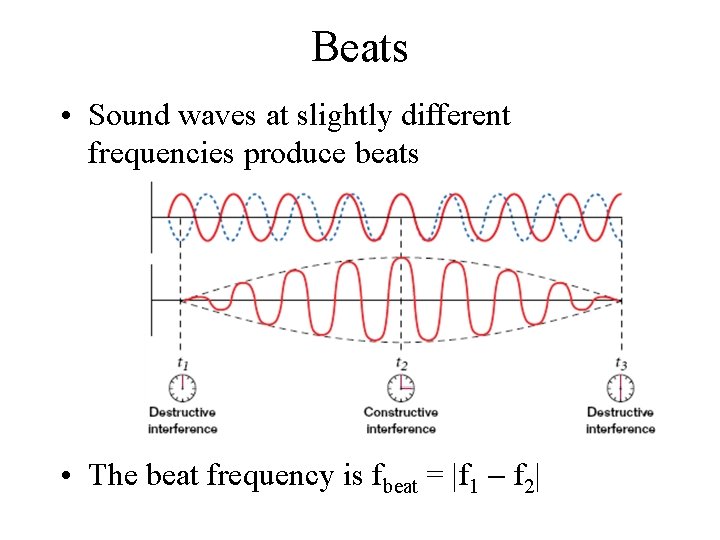
Beats • Sound waves at slightly different frequencies produce beats • The beat frequency is fbeat = |f 1 f 2|
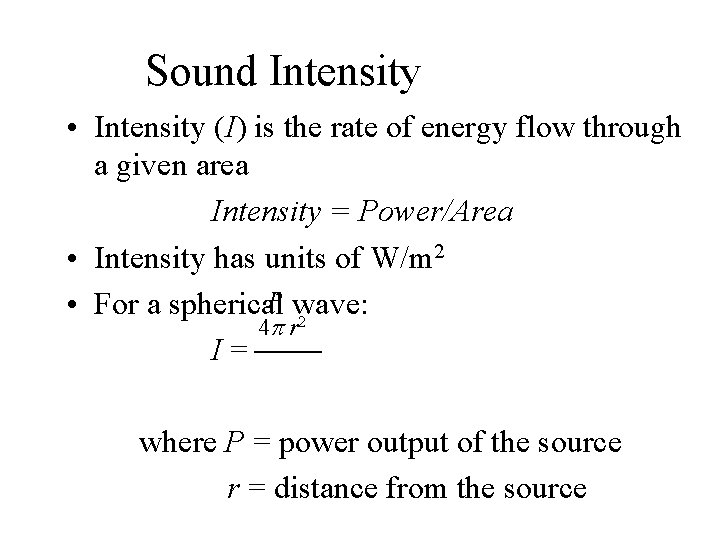
Sound Intensity • Intensity (I) is the rate of energy flow through a given area Intensity = Power/Area • Intensity has units of W/m 2 P wave: • For a spherical 4 r 2 I = where P = power output of the source r = distance from the source
Relative Intensity: Decibels • The sensation of loudness is logarithmic with respect to intensity • The decibel (d. B) is a measure of the relative loudness of sound – The reference intensity is the threshold of hearing, I 0 = 1. 0 10 -12 W/m 2 – Decibel level (d. B) = 10 log[I/I 0] • 0 d. B is the threshold of hearing • 120 d. B is the threshold of pain
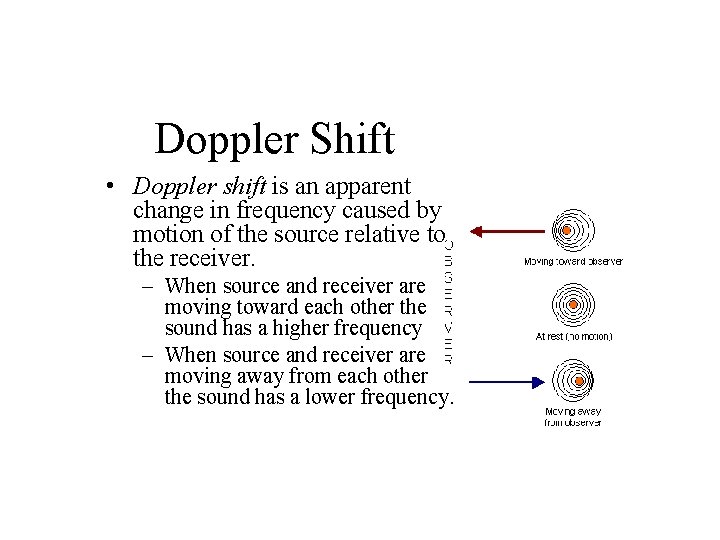
Doppler Shift • Doppler shift is an apparent change in frequency caused by motion of the source relative to the receiver. – When source and receiver are moving toward each other the sound has a higher frequency – When source and receiver are moving away from each other the sound has a lower frequency.
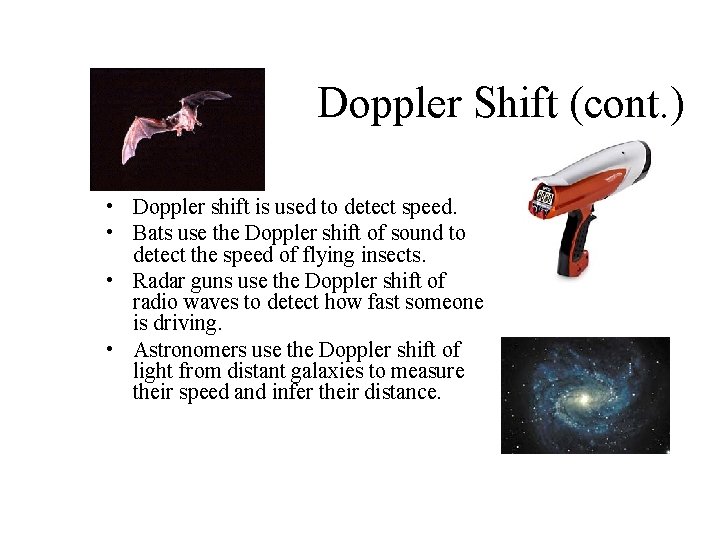
Doppler Shift (cont. ) • Doppler shift is used to detect speed. • Bats use the Doppler shift of sound to detect the speed of flying insects. • Radar guns use the Doppler shift of radio waves to detect how fast someone is driving. • Astronomers use the Doppler shift of light from distant galaxies to measure their speed and infer their distance.
Resonance • All structures (strings, buildings, bridges, columns of air) have natural frequencies – The natural frequencies correspond to standing waves in the structure – The smallest natural frequency is called the fundamental frequency • Resonance occurs when a periodic force acts on a structure at or near one of its natural frequencies – A resonating structure can have very large oscillations and even break (Tacoma Narrows Bridge)
Standing Waves • Standing waves form when a periodic wave interferes with its own reflection – Standing waves form at only certain frequencies – Nodes form where the displacement of the medium is zero – Antinodes form where the displacement of the medium is maximum
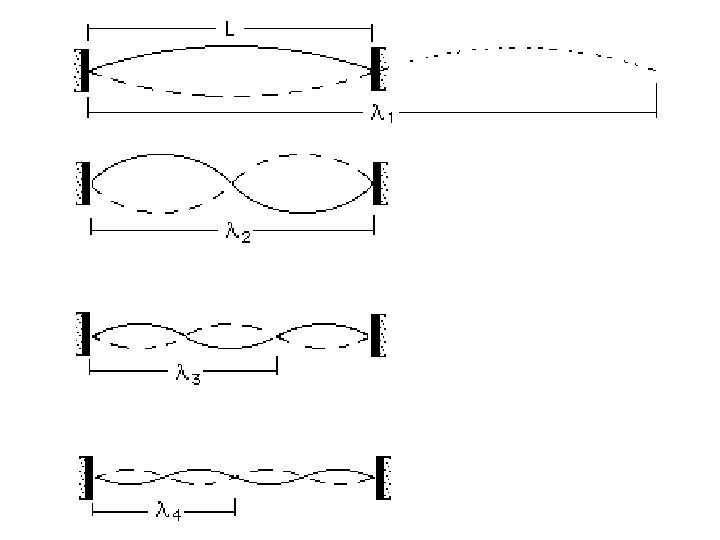
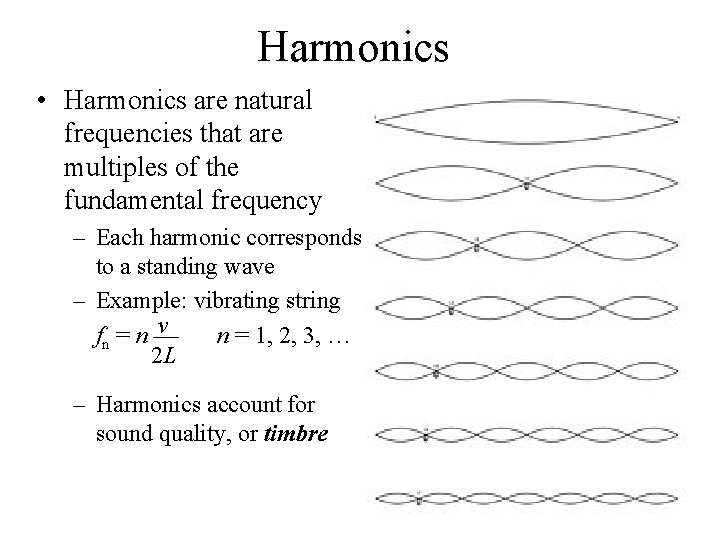
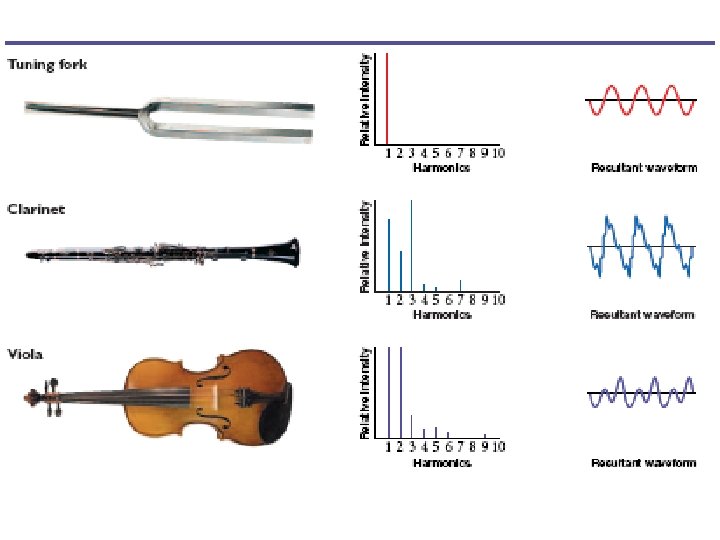
Harmonics • Harmonics are natural frequencies that are multiples of the fundamental frequency – Each harmonic corresponds to a standing wave – Example: vibrating string v fn = n n = 1, 2, 3, … 2 L – Harmonics account for sound quality, or timbre
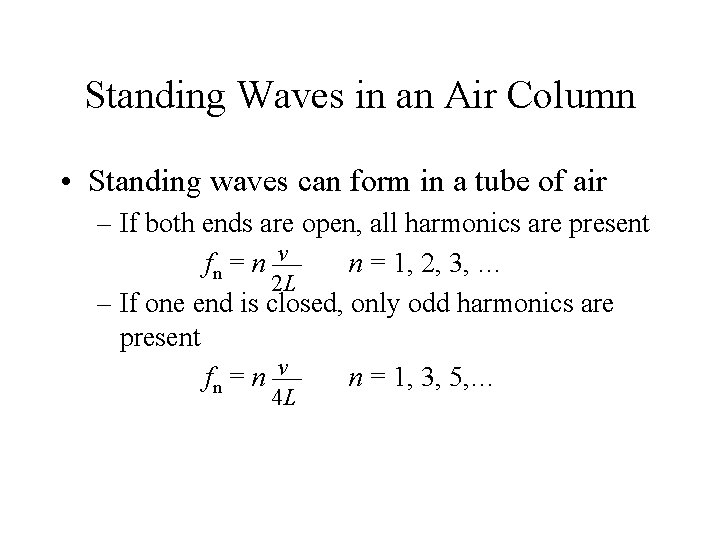
Standing Waves in an Air Column • Standing waves can form in a tube of air – If both ends are open, all harmonics are present v fn = n n = 1, 2, 3, … 2 L – If one end is closed, only odd harmonics are present v fn = n n = 1, 3, 5, … 4 L
- Slides: 23