
Wave Basics S 8 P 4 Students will
Wave Basics S 8 P 4. Students will explore the wave nature of sound and electromagnetic radiation. a. Identify the characteristics of electromagnetic and mechanical waves.
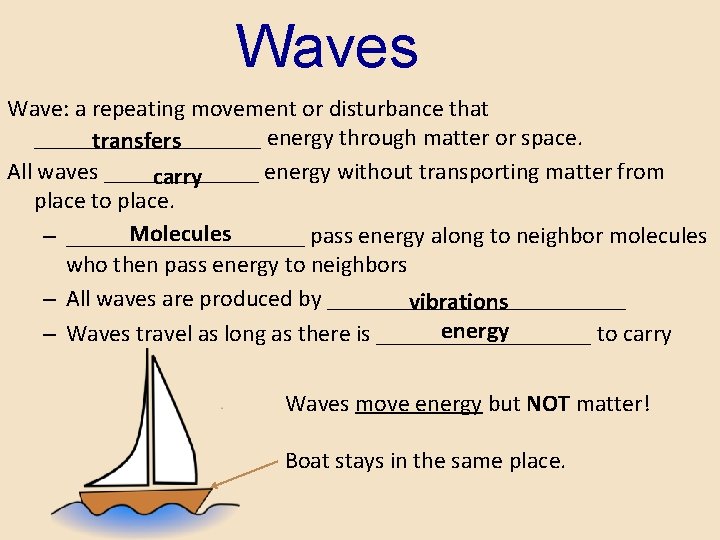
Waves Wave: a repeating movement or disturbance that __________ energy through matter or space. transfers All waves _______ energy without transporting matter from carry place to place. Molecules – __________ pass energy along to neighbor molecules who then pass energy to neighbors – All waves are produced by _____________ vibrations energy – Waves travel as long as there is _________ to carry Waves move energy but NOT matter! Boat stays in the same place.
Waves Medium __________: matter through which a wave travels. solid A medium can be _________, __________, liquid gas of these. ___________, or a combo Not all waves need a medium to travel _______________ waves can travel through space! electromagnetic (Light and radio waves)
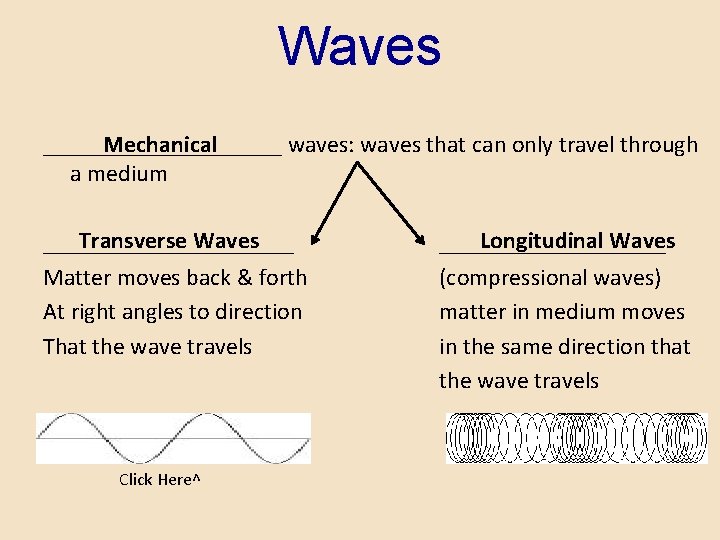
Waves Mechanical __________ waves: waves that can only travel through a medium Transverse Waves ___________ Matter moves back & forth At right angles to direction That the wave travels Click Here^ Longitudinal Waves __________ (compressional waves) matter in medium moves in the same direction that the wave travels
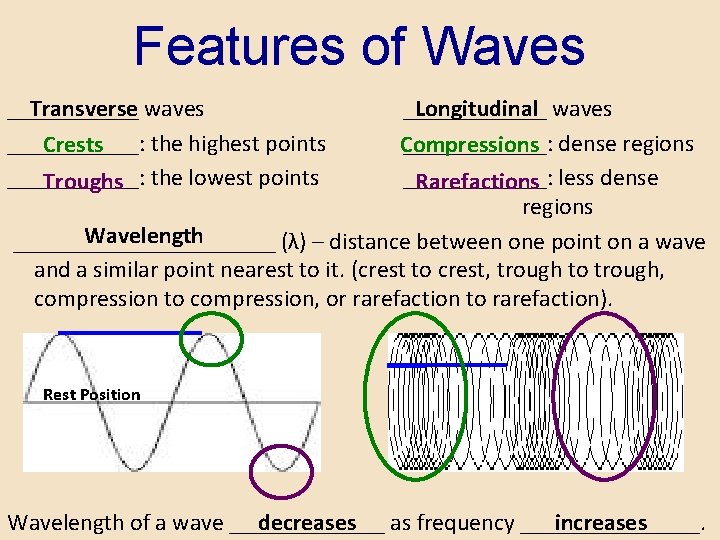
Features of Waves ______ Transverse waves ______: the highest points Crests ______: Troughs the lowest points ______ Longitudinal waves ______: dense regions Compressions ______: Rarefactions less dense regions Wavelength ___________ (λ) – distance between one point on a wave and a similar point nearest to it. (crest to crest, trough to trough, compression to compression, or rarefaction to rarefaction). Rest Position Wavelength of a wave _______ decreases as frequency ________. increases
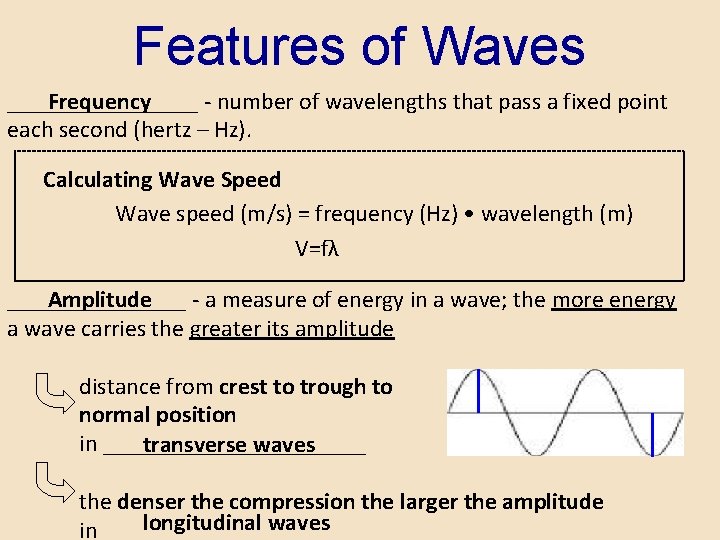
Features of Waves Frequency ________ - number of wavelengths that pass a fixed point each second (hertz – Hz). Calculating Wave Speed Wave speed (m/s) = frequency (Hz) • wavelength (m) V=fλ ________ Amplitude - a measure of energy in a wave; the more energy a wave carries the greater its amplitude distance from crest to trough to normal position in ___________ transverse waves the denser the compression the larger the amplitude longitudinal waves in ___________
- Slides: 6