
Wave Basics l Textbook Chapter 12 Wave Notes
Wave Basics l Textbook Chapter 12 Wave Notes Chapter 12, Pg 1
What is a wave ? l According to our text: èA wave is a disturbance that travels away from its source. l Examples: èSound waves (air moves back & forth) èStadium waves (people move up & down) èWater waves (water moves up & down) èLight waves (what moves ? ? ) Wave Notes Chapter 12, Pg 2 05

Types of Waves l Transverse: The medium oscillates perpendicular to the direction the wave is moving. èWater (really circles) èSpring Lab l Longitudinal: The medium oscillates in the same direction as the wave is moving èSound èSpring Lab Wave Notes Chapter 12, Pg 3 10
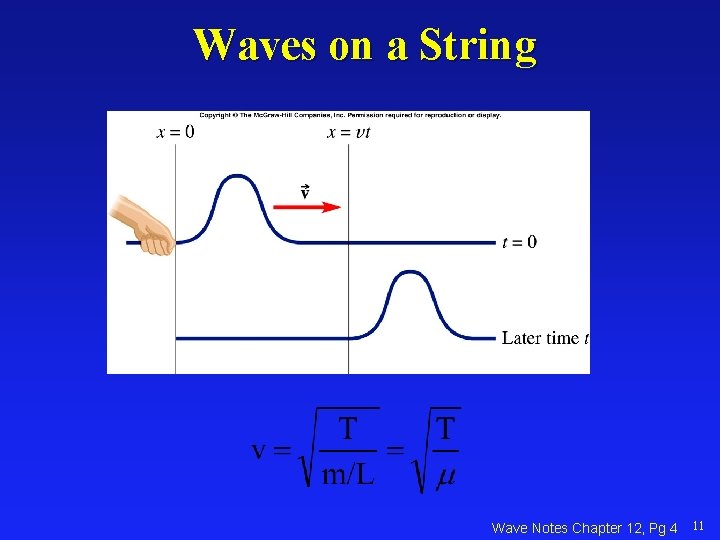
Waves on a String Wave Notes Chapter 12, Pg 4 11
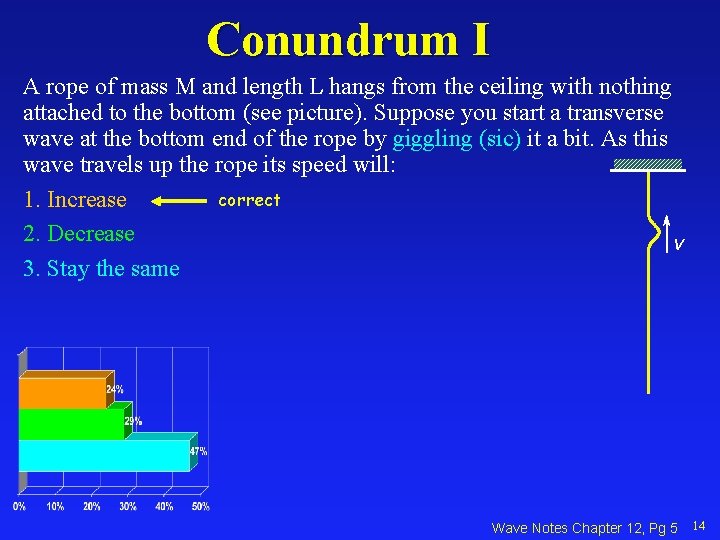
Conundrum I A rope of mass M and length L hangs from the ceiling with nothing attached to the bottom (see picture). Suppose you start a transverse wave at the bottom end of the rope by giggling (sic) it a bit. As this wave travels up the rope its speed will: correct 1. Increase 2. Decrease v 3. Stay the same Wave Notes Chapter 12, Pg 5 14
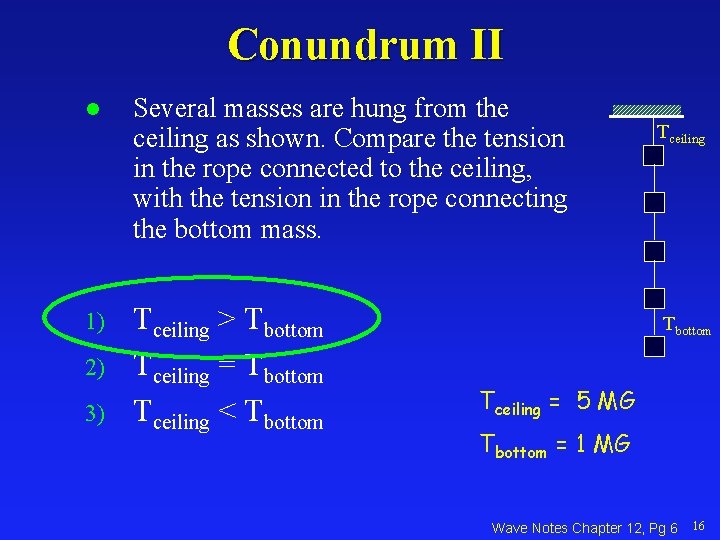
Conundrum II l Several masses are hung from the ceiling as shown. Compare the tension in the rope connected to the ceiling, with the tension in the rope connecting the bottom mass. 1) Tceiling > Tbottom Tceiling = Tbottom Tceiling < Tbottom 2) 3) Tceiling Tbottom Tceiling = 5 MG Tbottom = 1 MG Wave Notes Chapter 12, Pg 6 16

Harmonic Waves Where waves can go y(x, t) = A cos( t –kx) A = amplitude = angular frequency k = wave number = 2 / Wave Notes Chapter 12, Pg 7 18
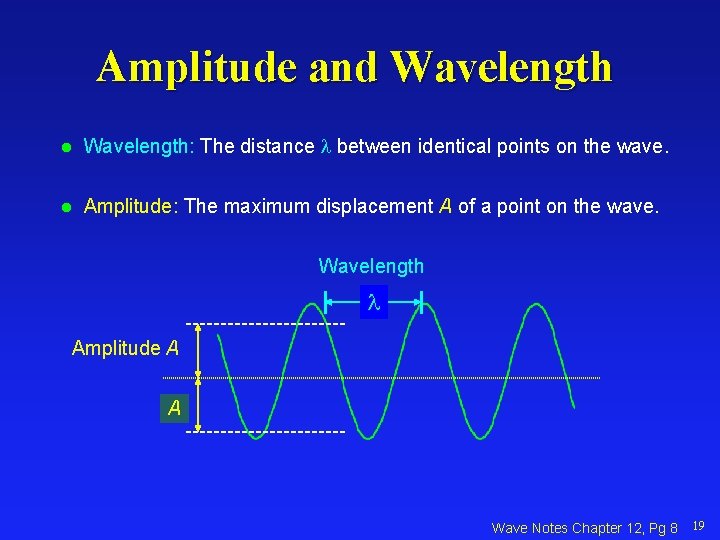
Amplitude and Wavelength l Wavelength: The distance between identical points on the wave. l Amplitude: The maximum displacement A of a point on the wave. Wavelength Amplitude A A Wave Notes Chapter 12, Pg 8 19
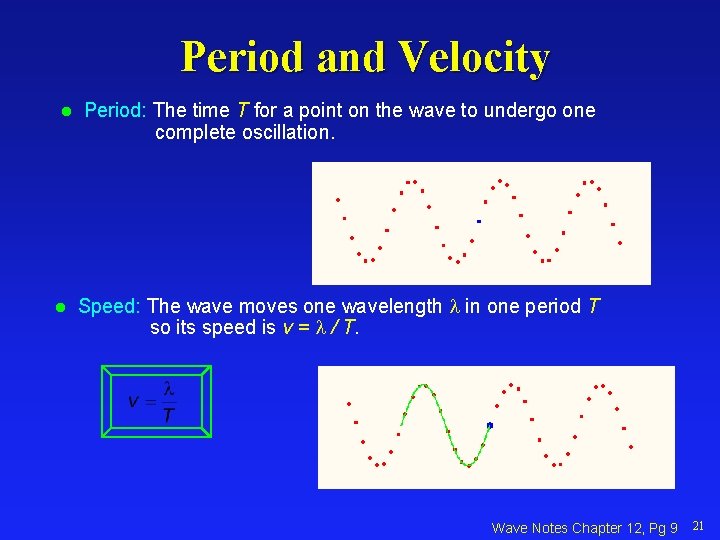
Period and Velocity l l Period: The time T for a point on the wave to undergo one complete oscillation. Speed: The wave moves one wavelength in one period T so its speed is v = / T. Wave Notes Chapter 12, Pg 9 21
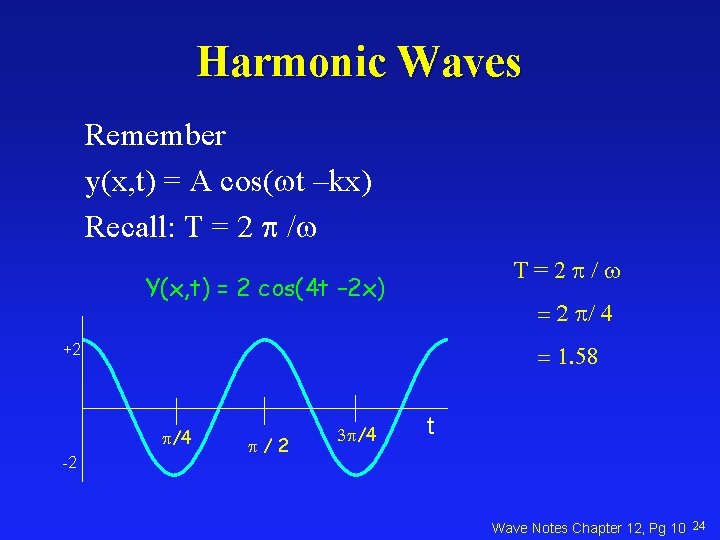
Harmonic Waves Remember y(x, t) = A cos( t –kx) Recall: T = 2 / Y(x, t) = 2 cos(4 t – 2 x) = 2 / 4 = 1. 58 +2 /4 -2 /2 3 /4 t Wave Notes Chapter 12, Pg 10 24
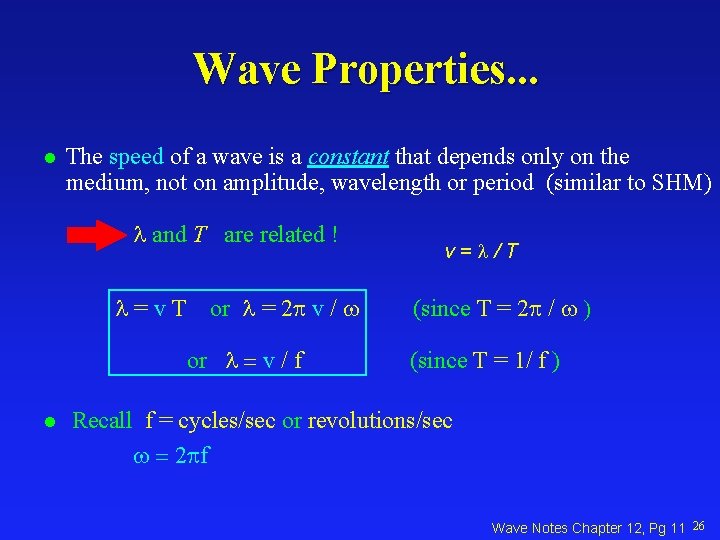
Wave Properties. . . l The speed of a wave is a constant that depends only on the medium, not on amplitude, wavelength or period (similar to SHM) and T are related ! =v. T l v= /T or = 2 v / (since T = 2 / or = v / f (since T = 1/ f ) Recall f = cycles/sec or revolutions/sec = 2 f Wave Notes Chapter 12, Pg 11 26
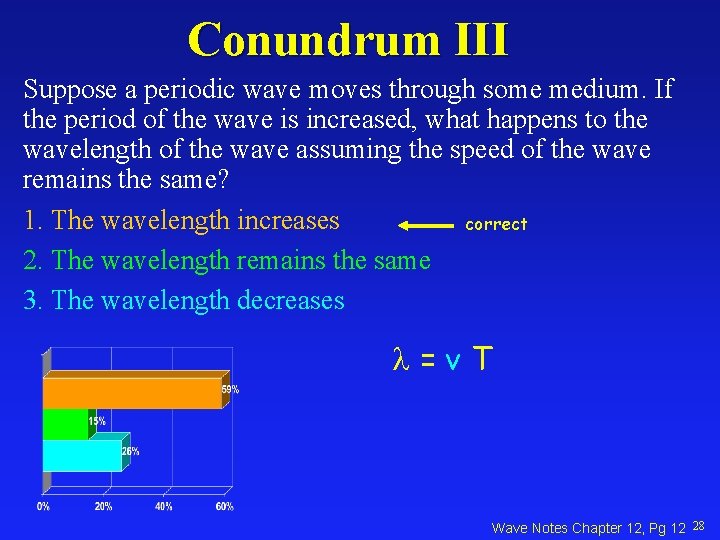
Conundrum III Suppose a periodic wave moves through some medium. If the period of the wave is increased, what happens to the wavelength of the wave assuming the speed of the wave remains the same? 1. The wavelength increases correct 2. The wavelength remains the same 3. The wavelength decreases =v. T Wave Notes Chapter 12, Pg 12 28
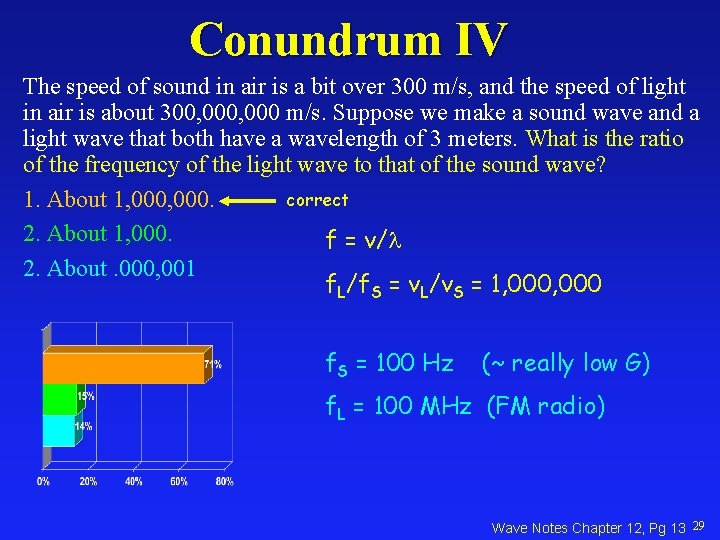
Conundrum IV The speed of sound in air is a bit over 300 m/s, and the speed of light in air is about 300, 000 m/s. Suppose we make a sound wave and a light wave that both have a wavelength of 3 meters. What is the ratio of the frequency of the light wave to that of the sound wave? correct 1. About 1, 000. 2. About 1, 000. f = v/ 2. About. 000, 001 f. L/f. S = v. L/v. S = 1, 000 f. S = 100 Hz (~ really low G) f. L = 100 MHz (FM radio) Wave Notes Chapter 12, Pg 13 29
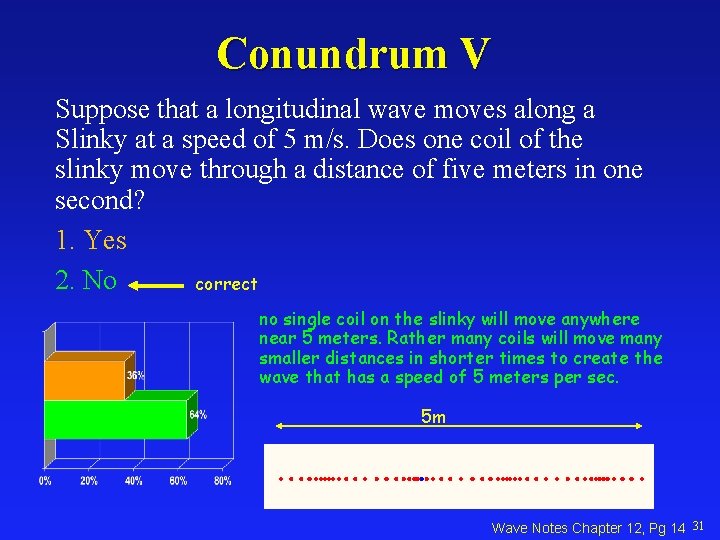
Conundrum V Suppose that a longitudinal wave moves along a Slinky at a speed of 5 m/s. Does one coil of the slinky move through a distance of five meters in one second? 1. Yes 2. No correct no single coil on the slinky will move anywhere near 5 meters. Rather many coils will move many smaller distances in shorter times to create the wave that has a speed of 5 meters per sec. 5 m Wave Notes Chapter 12, Pg 14 31
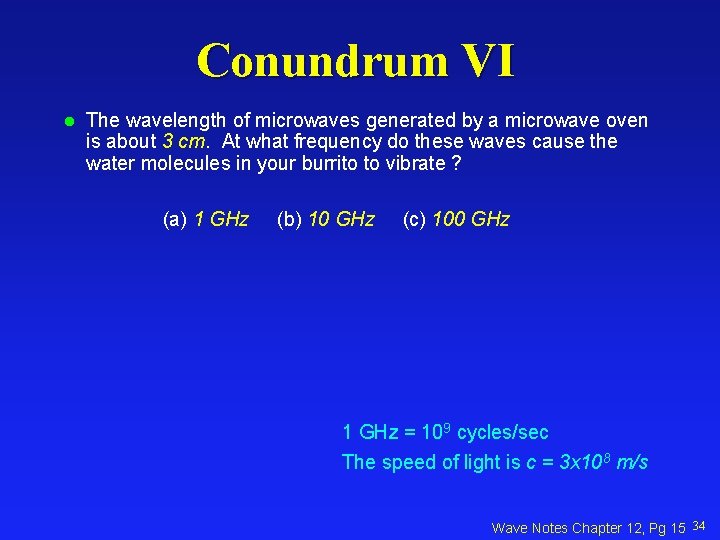
Conundrum VI l The wavelength of microwaves generated by a microwave oven is about 3 cm. At what frequency do these waves cause the water molecules in your burrito to vibrate ? (a) 1 GHz (b) 10 GHz (c) 100 GHz 1 GHz = 109 cycles/sec The speed of light is c = 3 x 10⁸ m/s Wave Notes Chapter 12, Pg 15 34
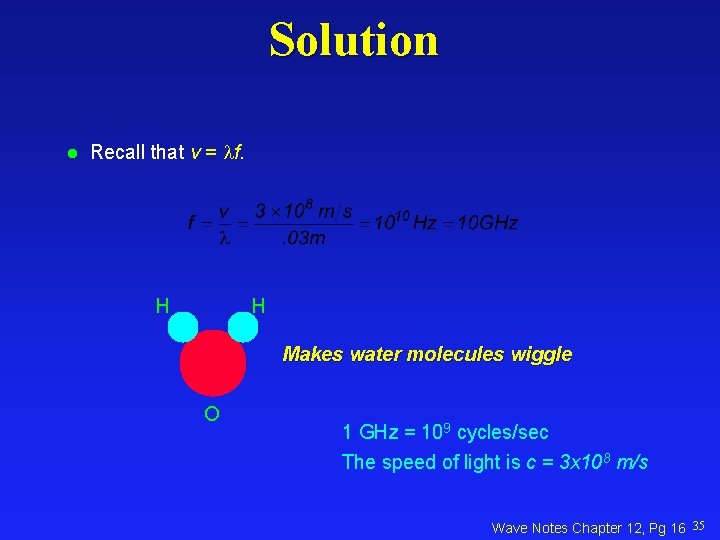
Solution l Recall that v = f. H H Makes water molecules wiggle O 1 GHz = 109 cycles/sec The speed of light is c = 3 x 10⁸ m/s Wave Notes Chapter 12, Pg 16 35
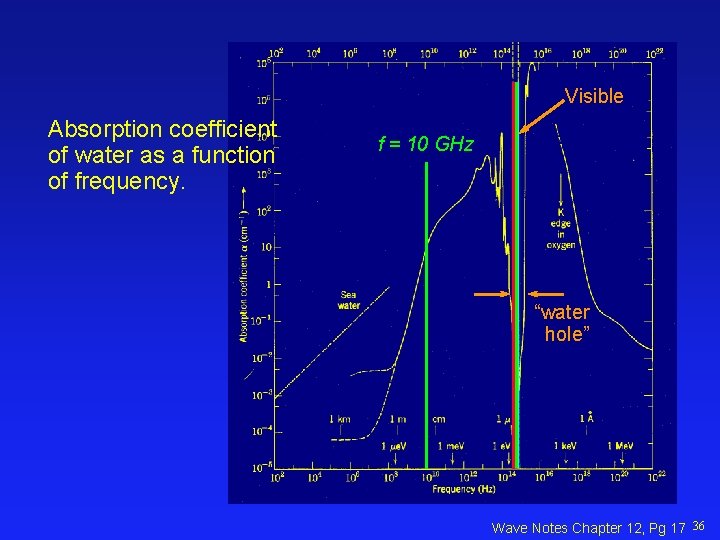
Visible Absorption coefficient of water as a function of frequency. f = 10 GHz “water hole” Wave Notes Chapter 12, Pg 17 36
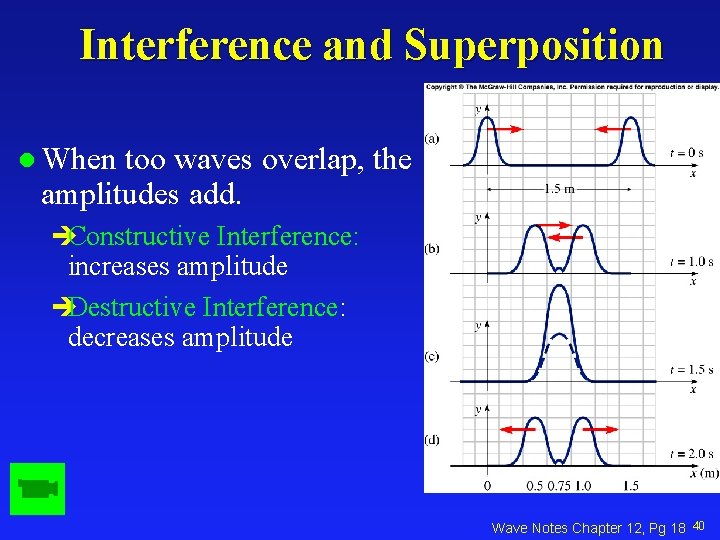
Interference and Superposition l When too waves overlap, the amplitudes add. èConstructive Interference: increases amplitude èDestructive Interference: decreases amplitude Wave Notes Chapter 12, Pg 18 40
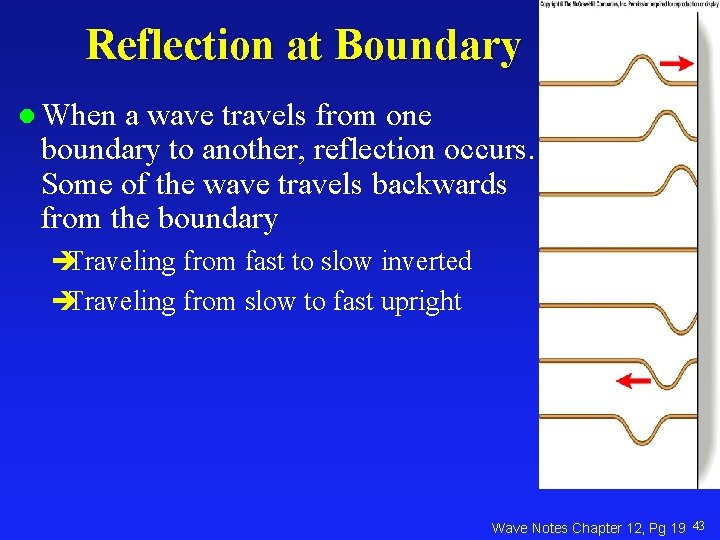
Reflection at Boundary l When a wave travels from one boundary to another, reflection occurs. Some of the wave travels backwards from the boundary èTraveling from fast to slow inverted èTraveling from slow to fast upright Wave Notes Chapter 12, Pg 19 43
Transmission at Boundary l Fast to slow l Wave amplitude decreases l Wave length decreases l Slow to fast l Wave amplitude decreases l Wave length increases Wave Notes Chapter 12, Pg 20
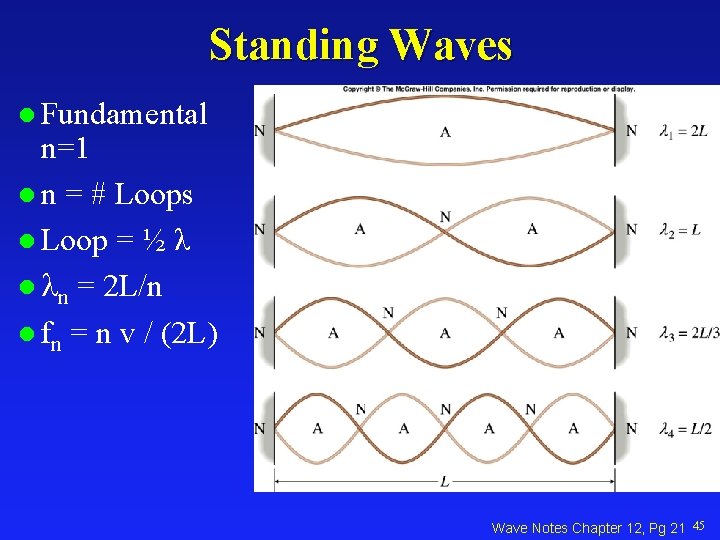
Standing Waves l Fundamental n=1 l n = # Loops l Loop = ½ λ l n = 2 L/n l fn = n v / (2 L) Wave Notes Chapter 12, Pg 21 45
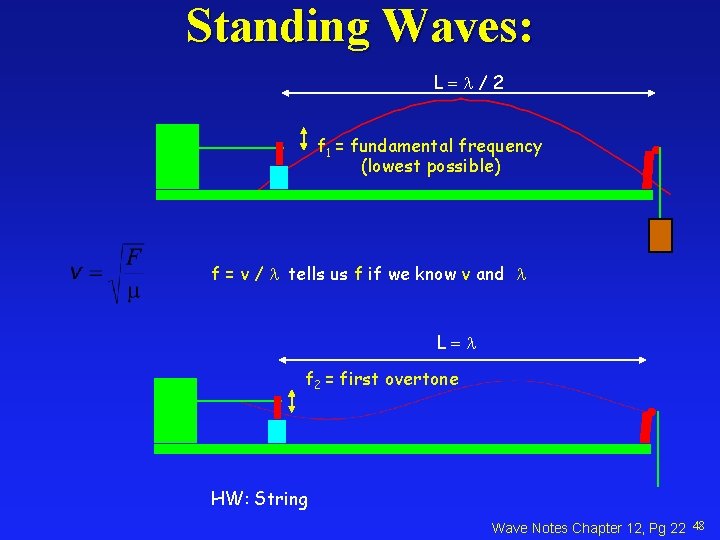
Standing Waves: L = / 2 f 1 = fundamental frequency (lowest possible) f = v / tells us f if we know v and L = f 2 = first overtone HW: String Wave Notes Chapter 12, Pg 22 48
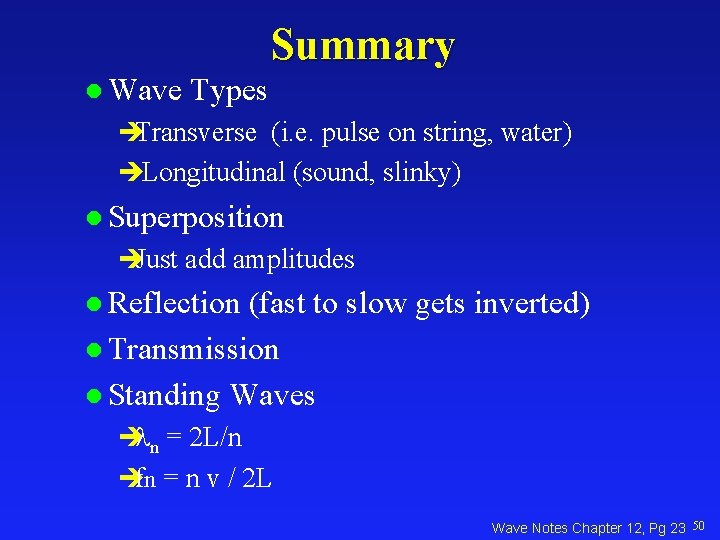
Summary l Wave Types èTransverse (i. e. pulse on string, water) èLongitudinal (sound, slinky) l Superposition èJust add amplitudes l Reflection (fast to slow gets inverted) l Transmission l Standing Waves è n = 2 L/n èfn = n v / 2 L Wave Notes Chapter 12, Pg 23 50
- Slides: 23