
Wave at Jeopardy Sounds good Properties of Waves


- Slides: 26
Wave at Jeopardy Sounds good Properties of Waves In real life Mix it up Nick. Toons 10 10 10 20 20 20 30 30 30 40 40 40 50 50 50
Calculate the wavelength of water waves which have a frequency of 0. 60 Hz and a speed of 4. 0 m/s. 6. 7 m
What is the frequency of a pendulum that makes 4. 0 complete vibrations in 2. 0 s? 2. 0 Hz
What is the period of a pendulum that makes 4. 0 complete vibrations in 2. 0 s? . 5 s
If 24 waves pass a point in 36 s, the period of the wave is… 1. 5 s
The units of frequency Hertz (Hz)
Like vibrating wine glasses, an object that is vibrating at its natural frequency is experiencing: Resonance
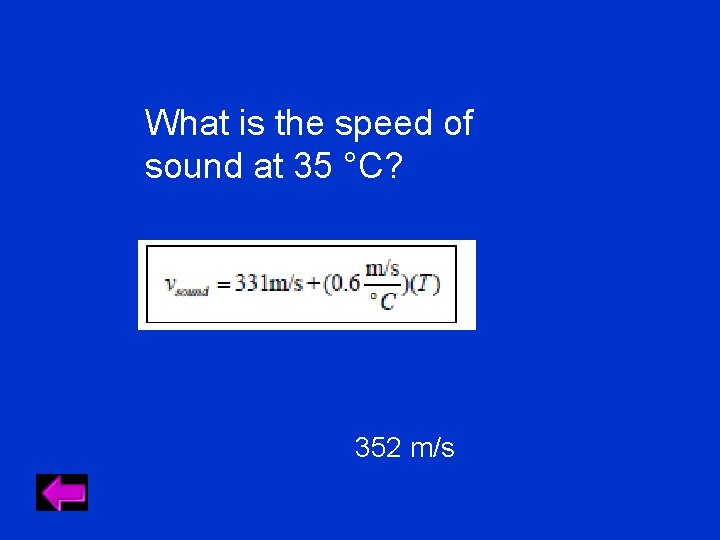
What is the speed of sound at 35 °C? 352 m/s
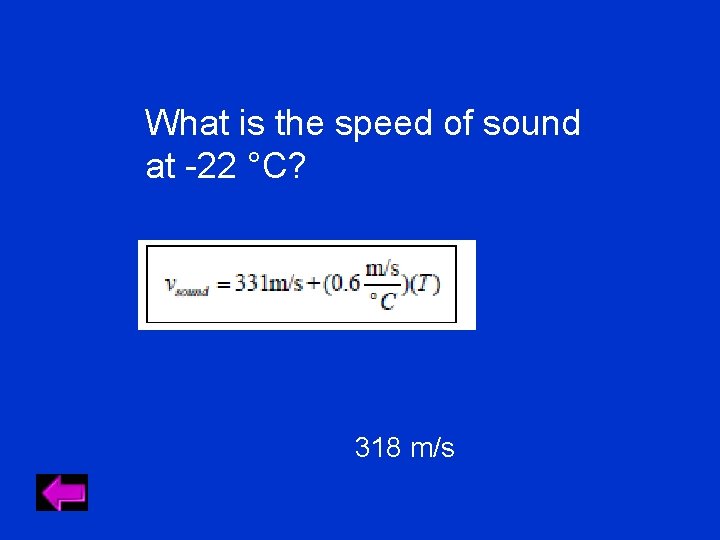
What is the speed of sound at -22 °C? 318 m/s
How far away is a mountain if you yell toward it and hear your echo 3. 10 s later? (Air temp. = 0°C) 513 m
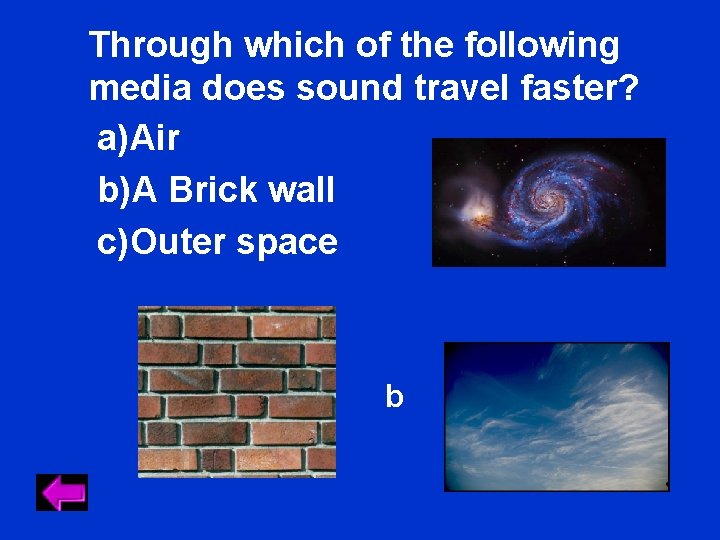
Through which of the following media does sound travel faster? a)Air b)A Brick wall c)Outer space b
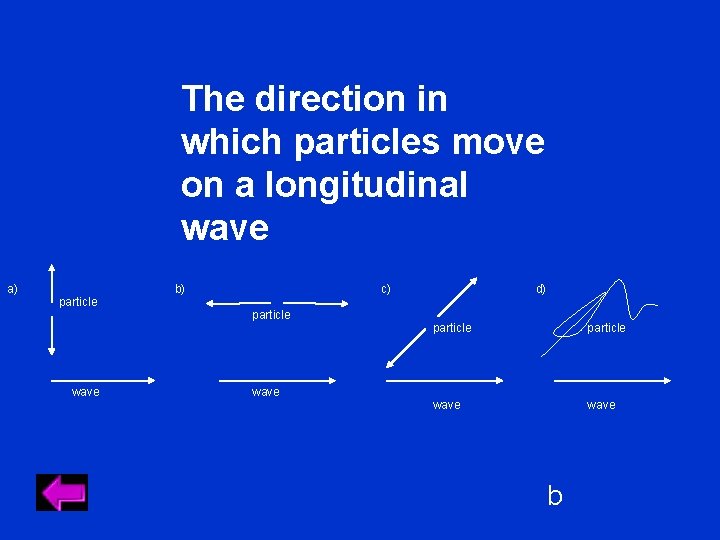
The direction in which particles move on a longitudinal wave a) particle wave b) c) particle wave d) particle wave b
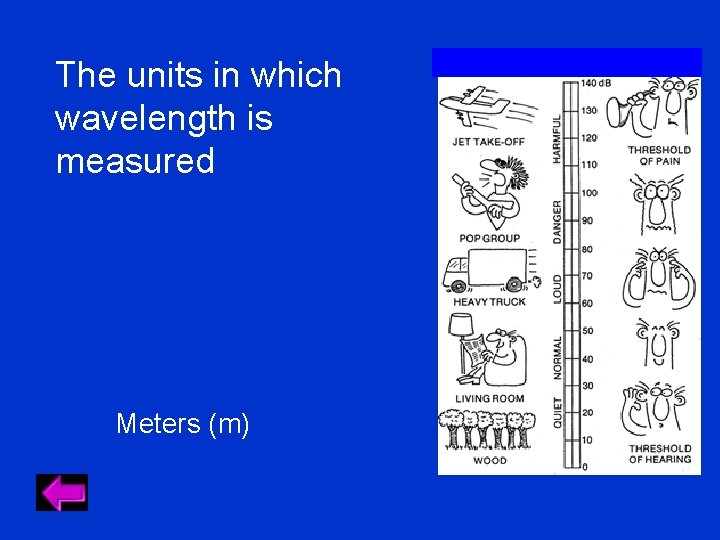
The units in which wavelength is measured Meters (m)
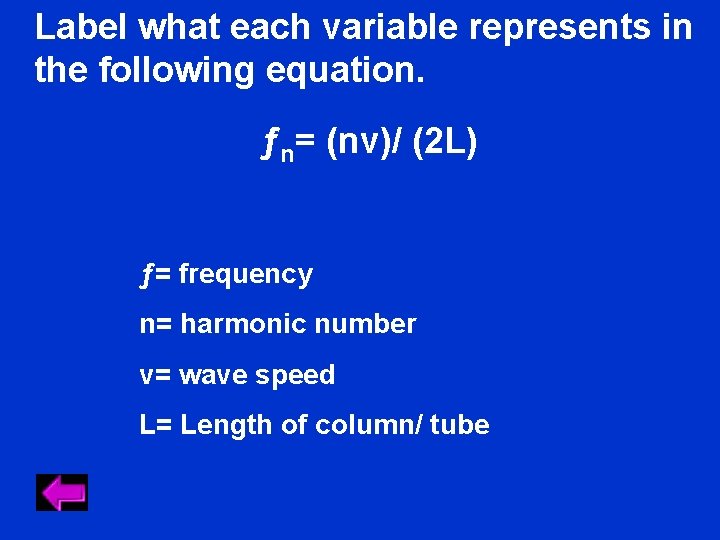
Label what each variable represents in the following equation. ƒn= (nv)/ (2 L) ƒ= frequency n= harmonic number v= wave speed L= Length of column/ tube
It takes 2 seconds for two cycles to pass through a point. What is the period of this wave? 1 second
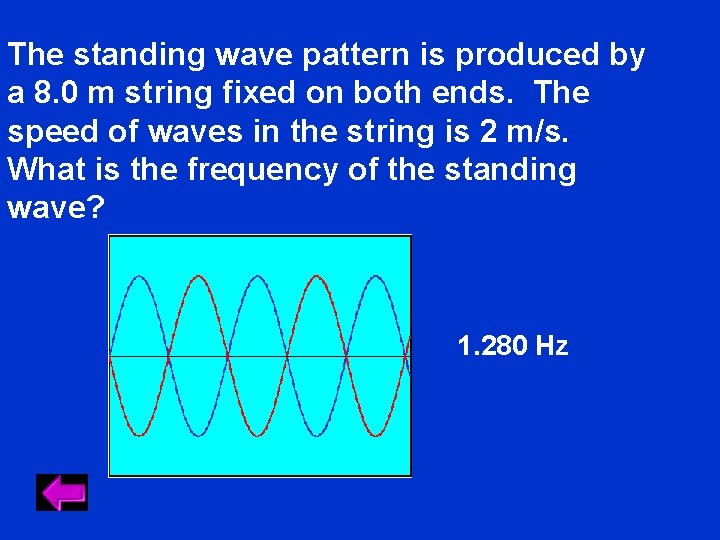
The standing wave pattern is produced by a 8. 0 m string fixed on both ends. The speed of waves in the string is 2 m/s. What is the frequency of the standing wave? 1. 280 Hz
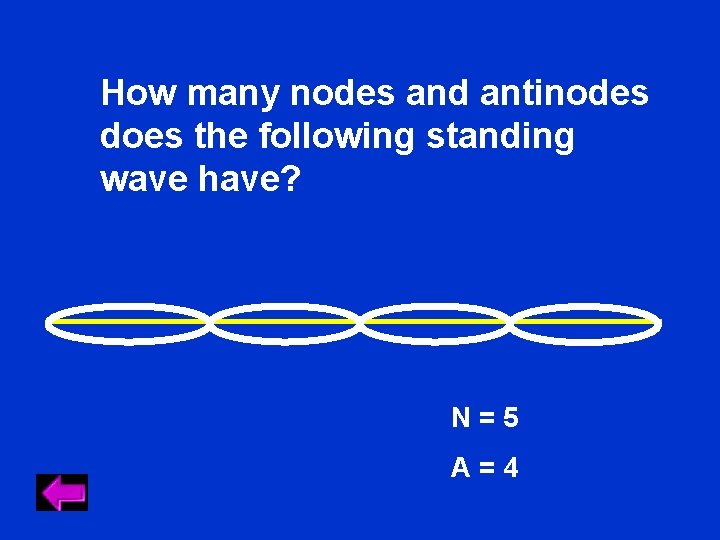
How many nodes and antinodes does the following standing wave have? N = 5 A = 4
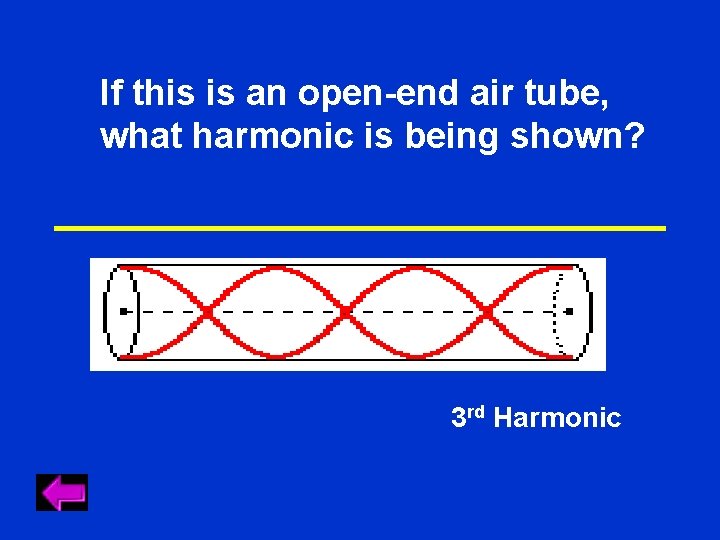
If this is an open-end air tube, what harmonic is being shown? 3 rd Harmonic
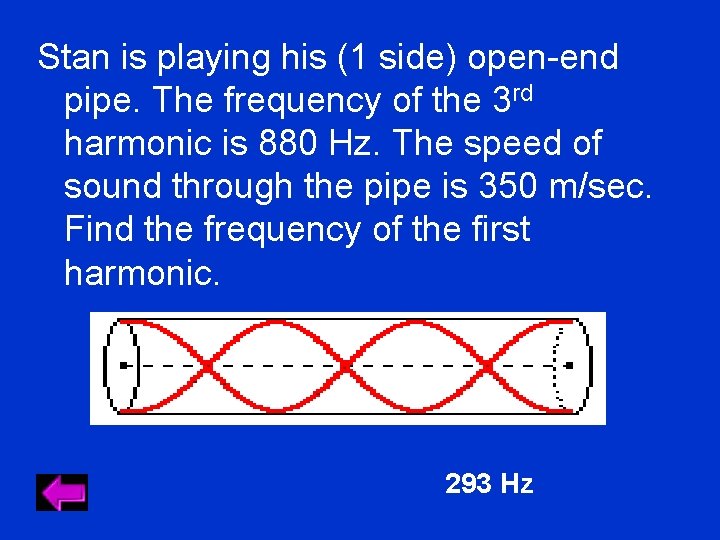
Stan is playing his (1 side) open-end pipe. The frequency of the 3 rd harmonic is 880 Hz. The speed of sound through the pipe is 350 m/sec. Find the frequency of the first harmonic. 293 Hz
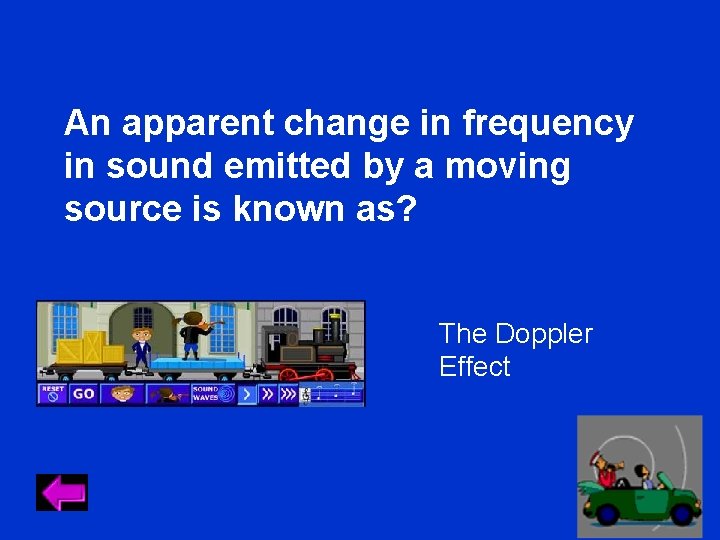
An apparent change in frequency in sound emitted by a moving source is known as? The Doppler Effect
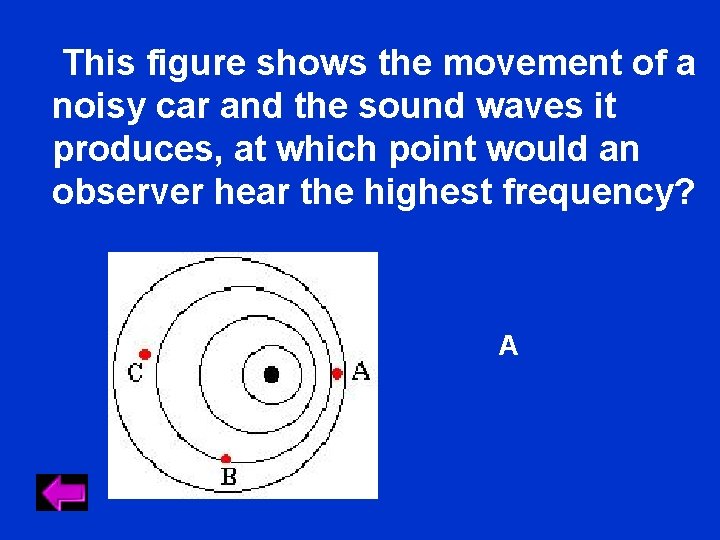
This figure shows the movement of a noisy car and the sound waves it produces, at which point would an observer hear the highest frequency? A
What happens to the speed of sound when the temperature changes? Temperature affects the speed of sound. Heat, like sound, is a form of kinetic energy. Molecules at higher temperatures have more energy, thus they can vibrate faster. Since the molecules vibrate faster, sound waves can travel more quickly. The formula to find the speed of sound in air is as follows: v = 331 m/s + 0. 6 m/s/C * T v is the speed of sound and T is the temperature of the air. One thing to keep in mind is that this formula finds the average speed of sound for any given temperature.
What happens when there is a change in the material through which the sound travels? The speed of sound is not always the same. Remember that sound is a vibration of kinetic energy passed from molecule to molecule. The closer the molecules are to each other and the tighter their bonds, the less time it takes for them to pass the sound to each other and the faster sound can travel. It is easier for sound waves to go through solids than through liquids because the molecules are closer together and more tightly bonded in solids. Similarly, it is harder for sound to pass through gases than through liquids, because gaseous molecules are farther apart. The speed of sound is faster in solid materials and slower in liquids or gases
What happens when there is a change in the material through which the light travels? The speed of light is not always the same. Remember that light is an electromagnetic wave. Unlike sound, light can travel through a vacuum. Light travels at 3 x 10⁸ m/s in a vacuum, but slows down depending on the medium. This difference in speed is represented by the index of refraction (n). When light travels from a medium with a high index of refraction to a medium with a low index of refraction the speed increases, the wavelength increases, but the frequency remains the same evidenced by the wave speed equation: v= ƒλ
Hey football head!! Hey Arnold
Catdog