
Watersheds 1 Outcomes Read a contour map Delineate
- Slides: 28
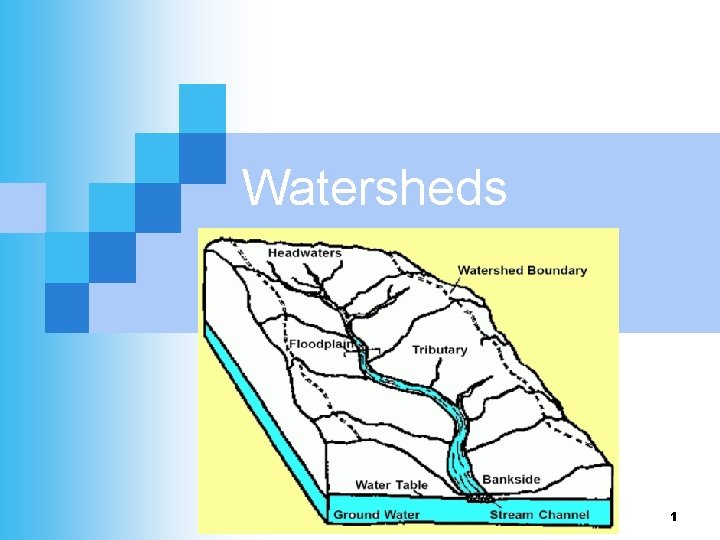
Watersheds 1
Outcomes Read a contour map Delineate a watershed Determine slopes/lengths Determine a drainage area 2
We All Live in a Watershed When water runs off your property where does it go? 3
Importance of Watersheds Pollutants can enter waterbodies ¨ Silt from construction sites, farms, erosion ¨ Septic system waste ¨ Fertilizers, pesticides ¨ Road salt ¨ Other pollutants (industry/commercial) 4
Watershed Protection SPDES (stormwater pollution discharge and elimination system) Watershed action plans Public Involvement (stewardship) 5
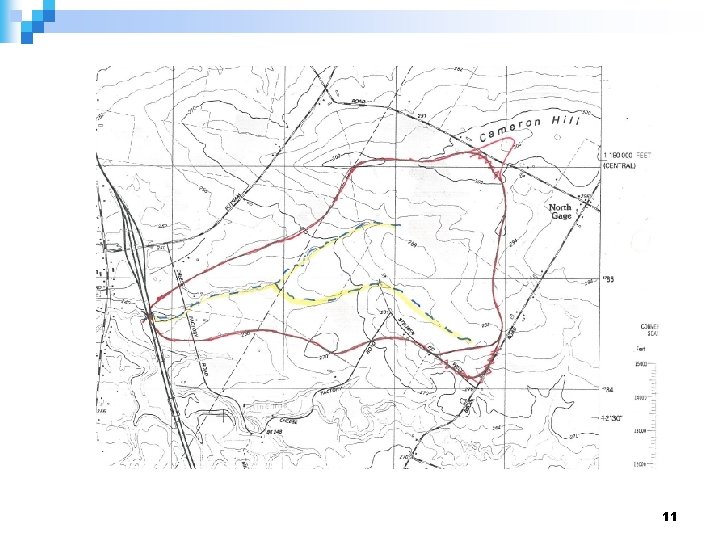
Watershed Delineation Any particular point on a water channel (stream, ditch, gutter, etc. ) has an associated watershed area n The boundaries of a watershed are ridge lines (high points) n You can identify ridge lines by contour lines on topographic maps n 6
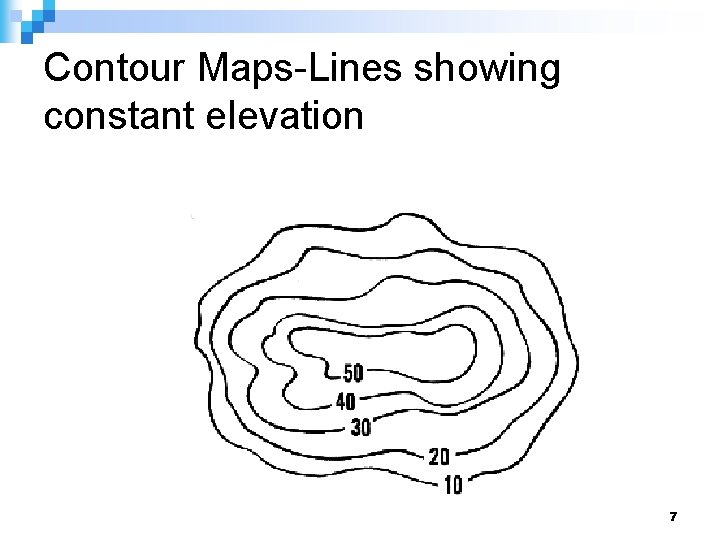
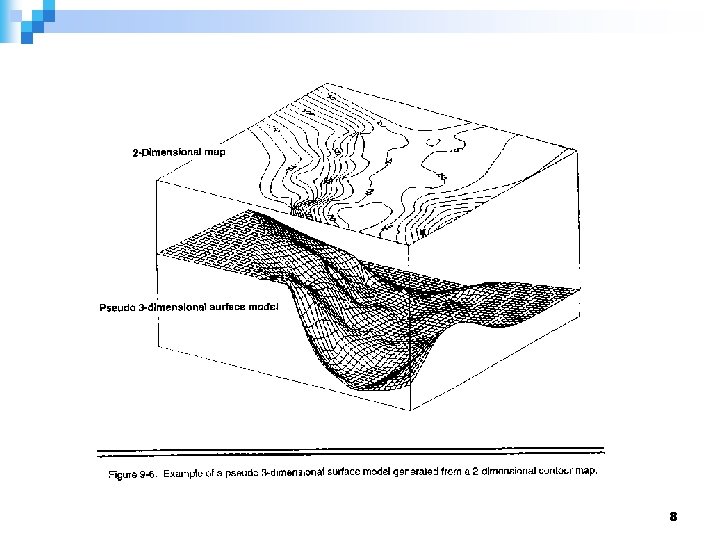
Contour Maps-Lines showing constant elevation 7
8
Hints for reading contour maps n n n n Flow paths are perpendicular to contour lines (why? ) Streams---Contour lines are concave (think V’s) Ridges----Contour lines are convex (think noses) Peaks of mountains and depressions (swamps, ponds) usually show as small circular areas Contour lines close together indicate steep slopes Contour lines which are far apart indicate flat slopes Highlight rivers/creeks to your point of interest (it also sometimes helps to highlight them outside your point of interest) Ignore roads; ideally, any construction project shouldn’t shift water to another watershed 9
Steps-Delineating Drainage Areas n Identify your point of interest n Identify the channels/subchannels (V’s) n Identify the hill tops (circles) n Draw from hill-top to hill-top along the ridges (noses) 10
11
Delineate Watershed Class Demonstration (pull up PDF’s 1 -2) 12
Sub-Drainage Areas Drainage areas may be broken up into subcatchments or sub-drainage areas because: ¨ Drainage areas are usually modeled as homogeneous systems ¨ Streams ¨ Points are branched of interest need to be isolated 13
Delineate Subareas Class demonstration: Delineating subareas for each reach 14
Break 15
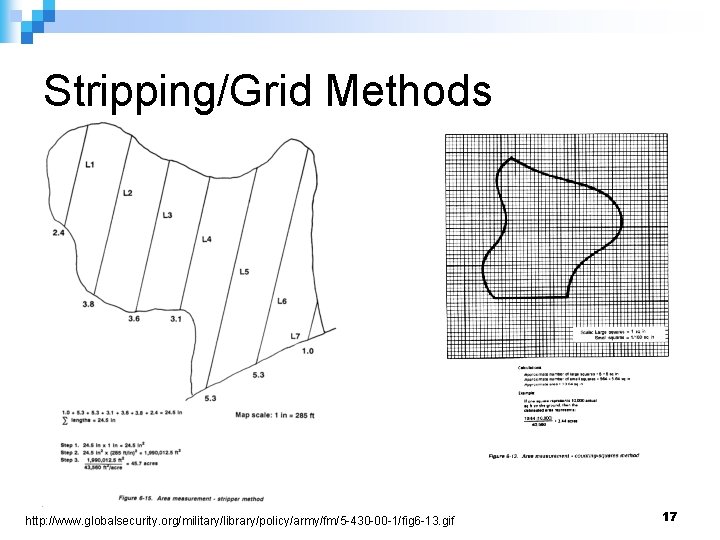
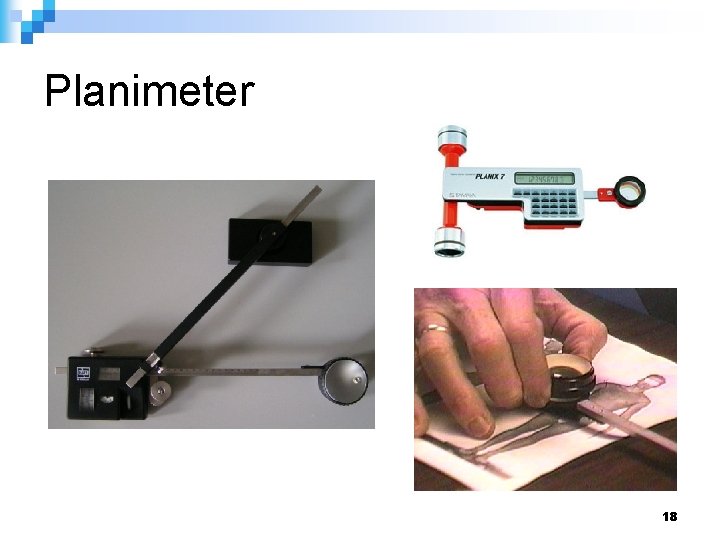
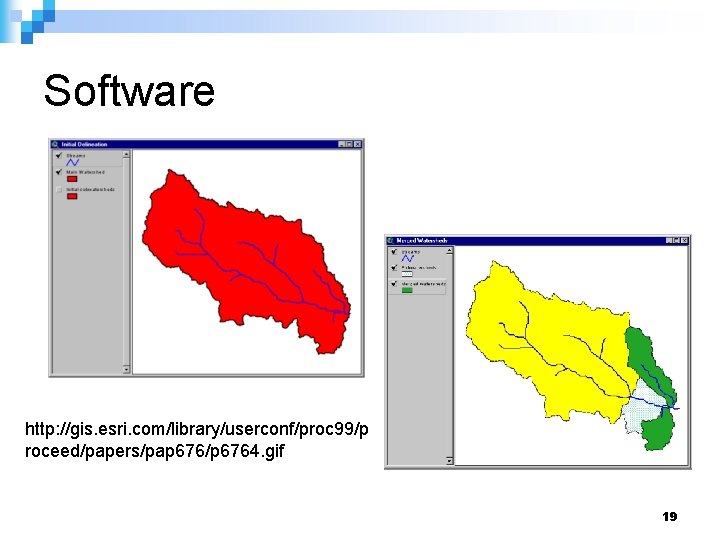
Determining Drainage Areas Stripping Method n Grid Method n Planimeter n Software Programs (GIS) n 16
Stripping/Grid Methods http: //www. globalsecurity. org/military/library/policy/army/fm/5 -430 -00 -1/fig 6 -13. gif 17
Planimeter 18
Software http: //gis. esri. com/library/userconf/proc 99/p roceed/papers/pap 676/p 6764. gif 19
Determining Lengths Edge of Paper Tic Method n String Method (non-stretch string) n n Don’t use “as the crow flies” n Check scale (1”=2000’ or other) 20
Data Collection Land Use n Soil Characteristics n Slope (overland channel) n Channel/Overland flow lengths n % Impervious n Channel cross-sections n Roughness characteristics n Storage (ponds, swamps, wetlands) n 21
Sources n n n n Field reconnaisance Aerial Photographs NRCS Soil Maps USGS Maps/Other Contour Maps Planimetric mapping Historical engineering studies Survey Data Soil Boring Data 22
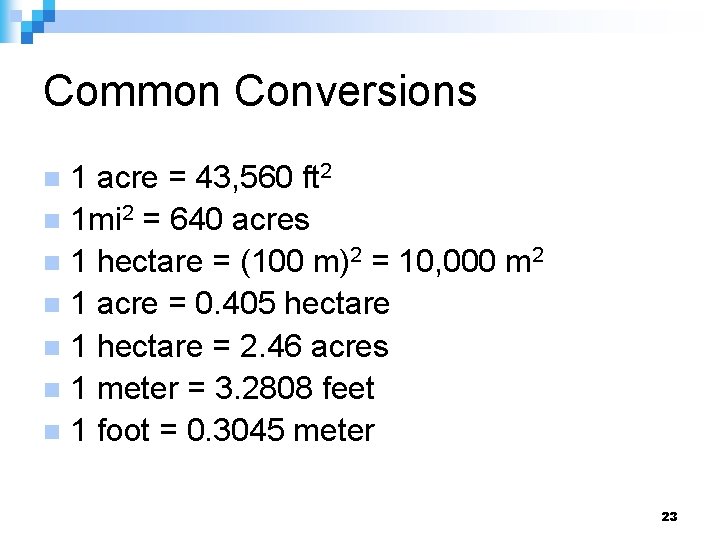
Common Conversions 1 acre = 43, 560 ft 2 n 1 mi 2 = 640 acres n 1 hectare = (100 m)2 = 10, 000 m 2 n 1 acre = 0. 405 hectare n 1 hectare = 2. 46 acres n 1 meter = 3. 2808 feet n 1 foot = 0. 3045 meter n 23
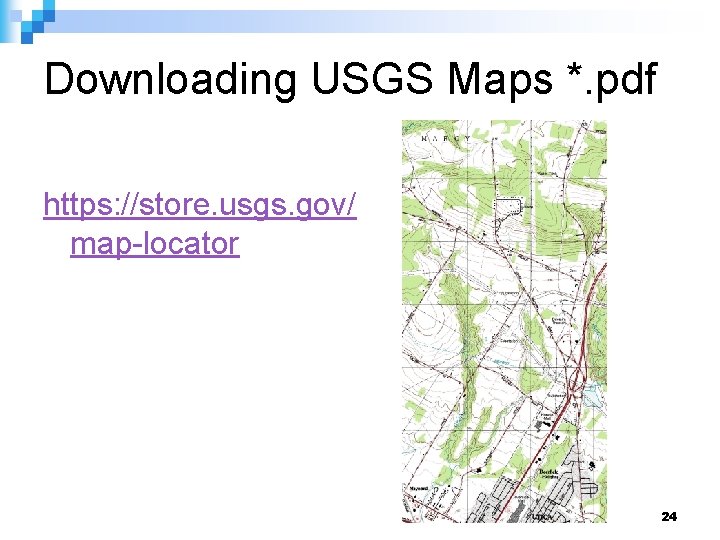
Downloading USGS Maps *. pdf https: //store. usgs. gov/ map-locator 24
Other tools: n Image capture software: ¨ Snipping Tool (on engineering computers) ¨ In adobe reader use tools, select and zoom, snapshot tool, to capture images n USGS pdf’s---click on images, click off orthoimages to turn off the background photogrammetry
Streamstats https: //water. usgs. gov/osw/streamstats/ 26
Other Sources NRCS pdf – determining watershed n http: //www. epa. gov/owow/watershed/ n http: //www. dec. ny. gov/lands/25563. html n 27
Next Lecture Precipitation ¨ Definition ¨ What affects it? ¨ Return period ¨ Probability of an event occurring over a time interval ¨ Design Frequencies ¨ IDF Curves 28