
WatershedBased Planning A Framework for Action A watershed
Watershed-Based Planning A Framework for Action!
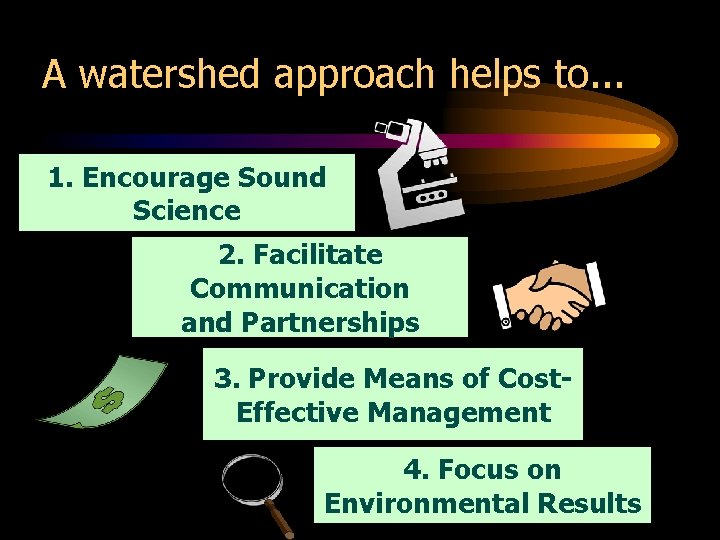
A watershed approach helps to. . . 1. Encourage Sound Science 2. Facilitate Communication and Partnerships 3. Provide Means of Cost. Effective Management 4. Focus on Environmental Results
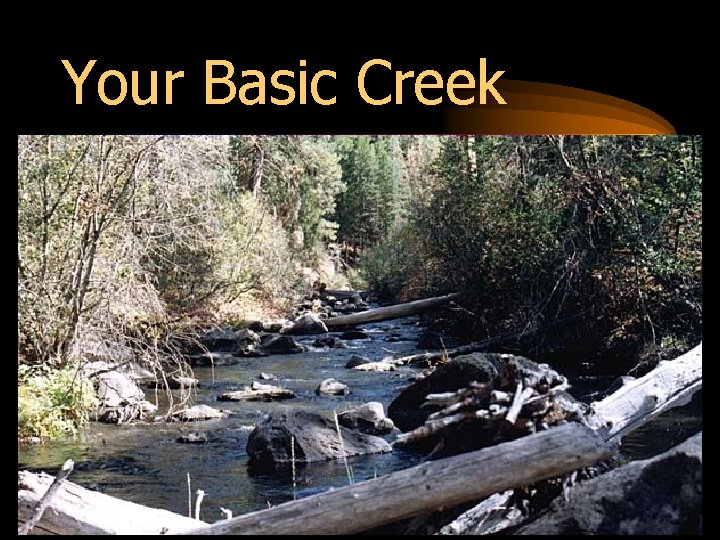
Your Basic Creek
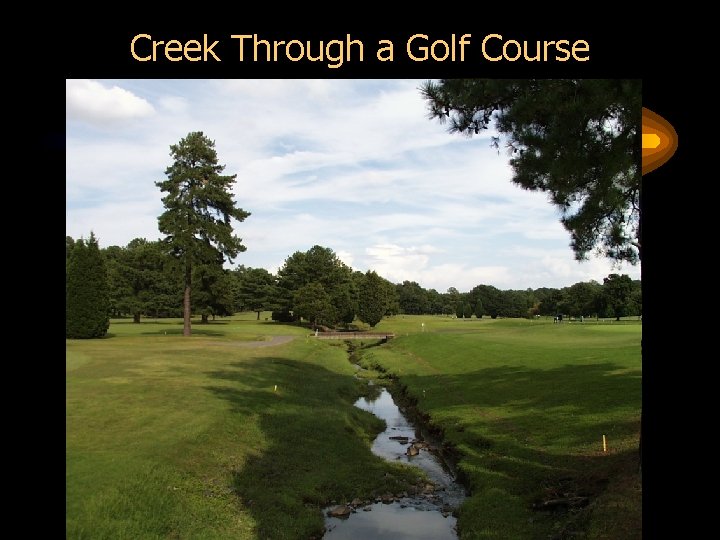
Creek Through a Golf Course
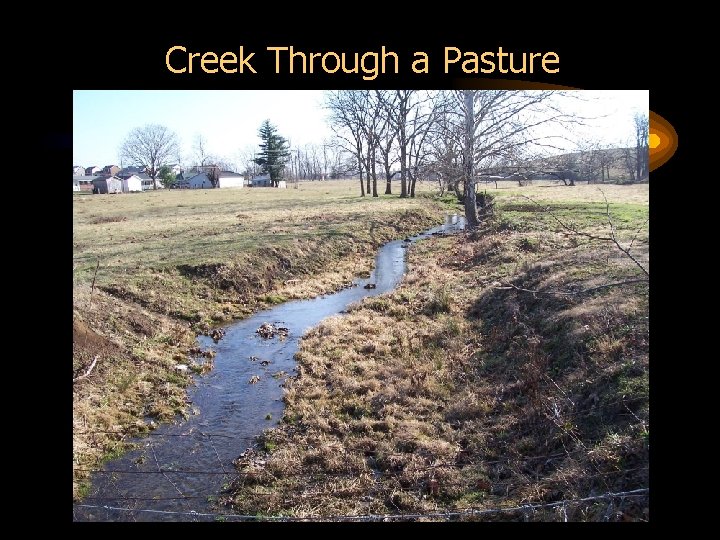
Creek Through a Pasture
Context for planning & management • We have problems – – Polluted waters Cultural disconnects Limited authority Few resources • We have solutions – Interested people – Improving science & technology – Excellent relationships among public/private sectors
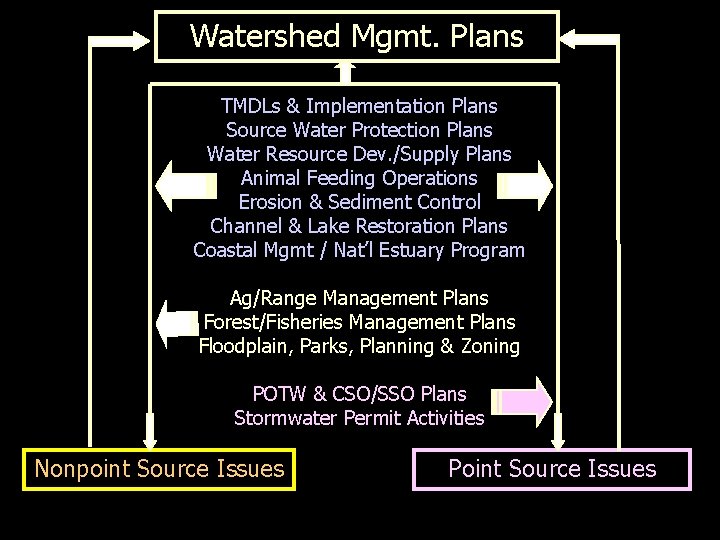
Watershed Mgmt. Plans TMDLs & Implementation Plans Source Water Protection Plans Water Resource Dev. /Supply Plans Animal Feeding Operations Erosion & Sediment Control Channel & Lake Restoration Plans Coastal Mgmt / Nat’l Estuary Program Ag/Range Management Plans Forest/Fisheries Management Plans Floodplain, Parks, Planning & Zoning POTW & CSO/SSO Plans Stormwater Permit Activities Nonpoint Source Issues Point Source Issues
Watershed Planning Handbook http: //www. epa. gov/owow/nps/watershed_handbook/
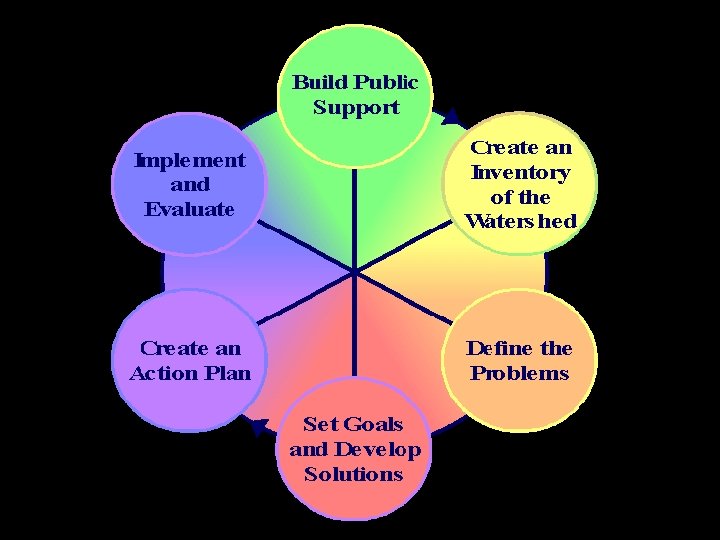
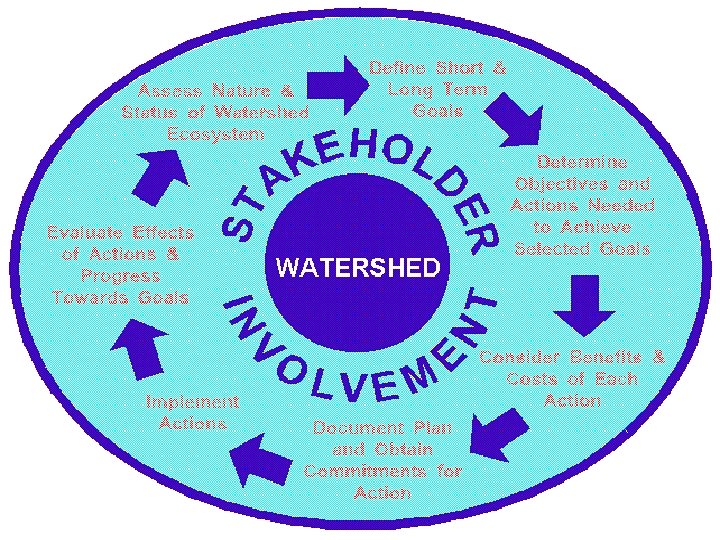
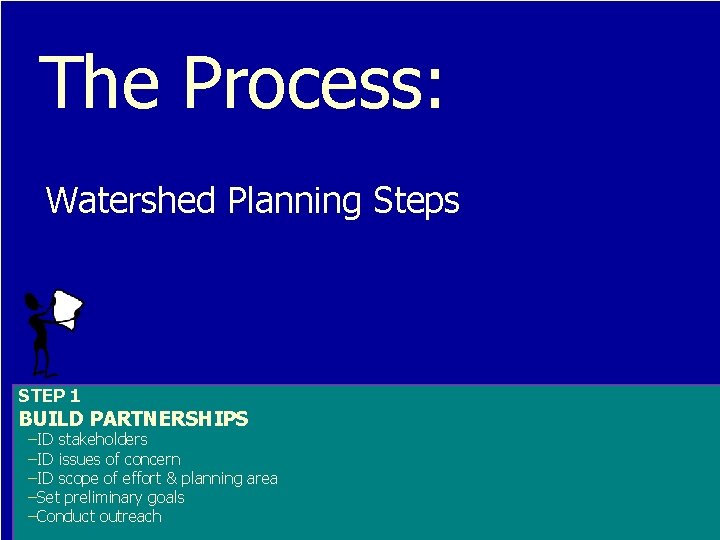
The Process: Watershed Planning Steps STEP 1 BUILD PARTNERSHIPS –ID stakeholders –ID issues of concern –ID scope of effort & planning area –Set preliminary goals –Conduct outreach
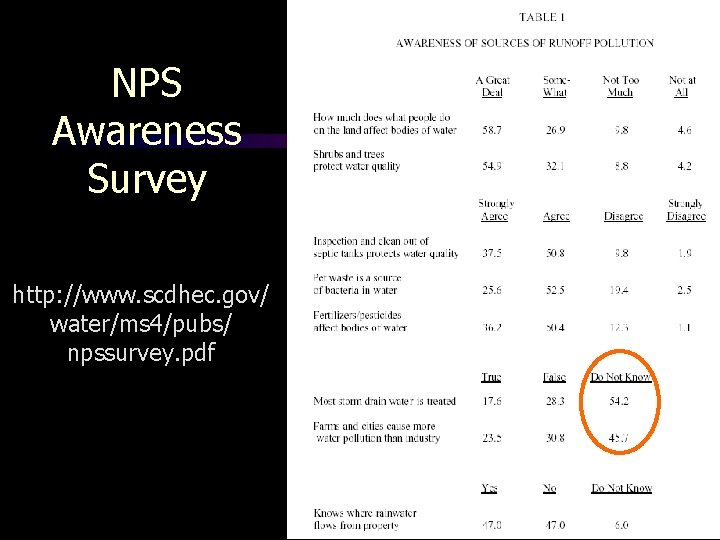
NPS Awareness Survey http: //www. scdhec. gov/ water/ms 4/pubs/ npssurvey. pdf
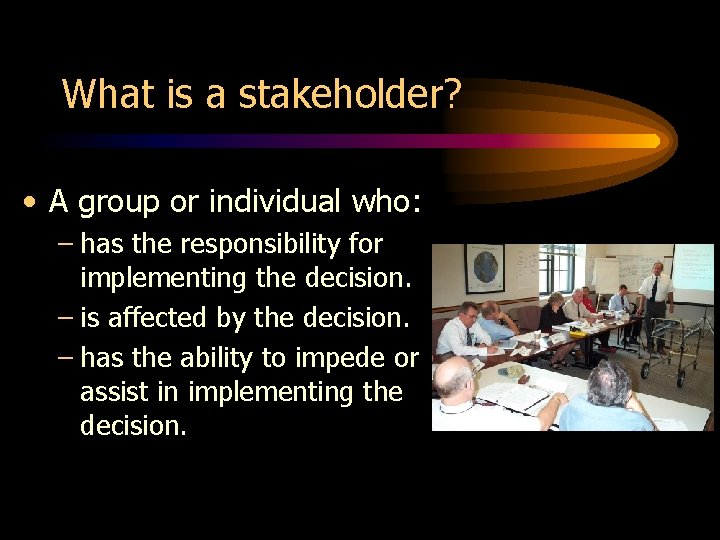
What is a stakeholder? • A group or individual who: – has the responsibility for implementing the decision. – is affected by the decision. – has the ability to impede or assist in implementing the decision.
Why are stakeholders important to the process? • Ensures that concerns are factored into the decisions made • Shares the responsibility of the decision • Enables partnerships to be formed to combine financial resources • Shares implementation of the decision • Establishes a framework for planning and conducting management activities
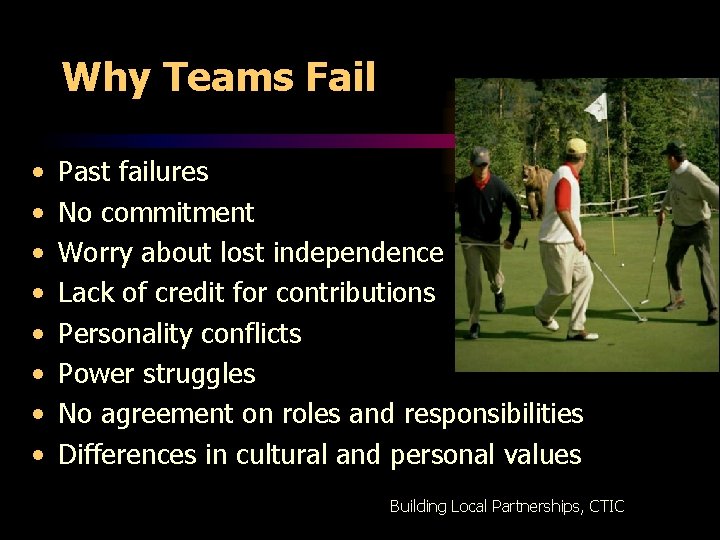
Why Teams Fail • • Past failures No commitment Worry about lost independence Lack of credit for contributions Personality conflicts Power struggles No agreement on roles and responsibilities Differences in cultural and personal values Building Local Partnerships, CTIC
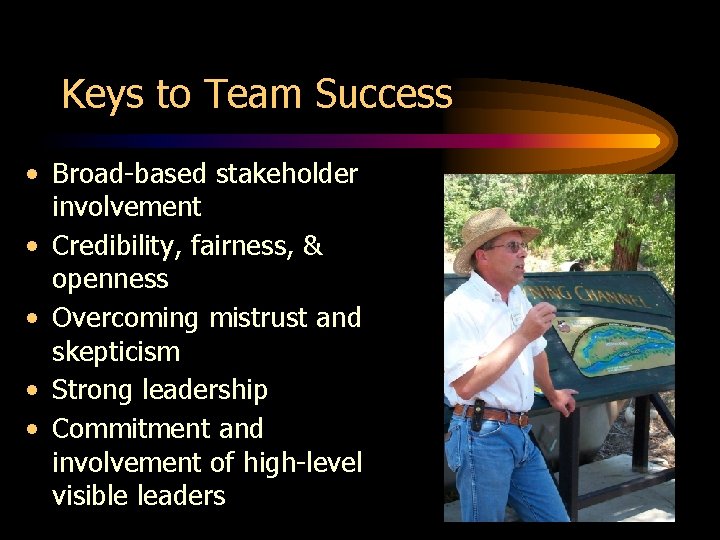
Keys to Team Success • Broad-based stakeholder involvement • Credibility, fairness, & openness • Overcoming mistrust and skepticism • Strong leadership • Commitment and involvement of high-level visible leaders
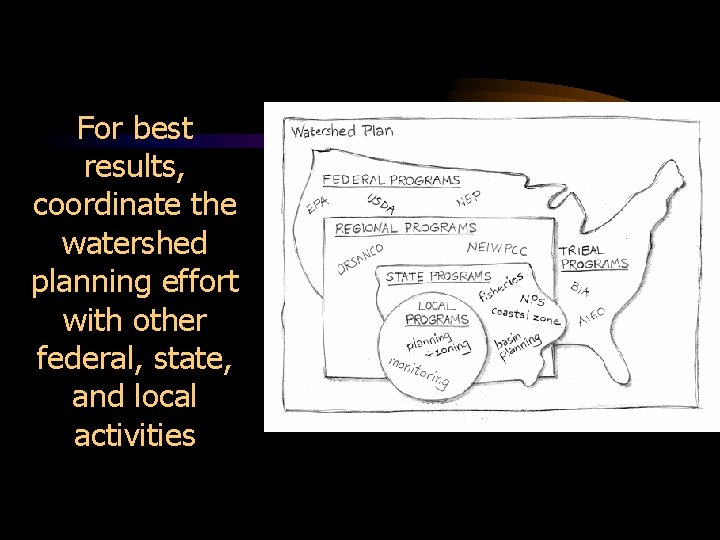
For best results, coordinate the watershed planning effort with other federal, state, and local activities
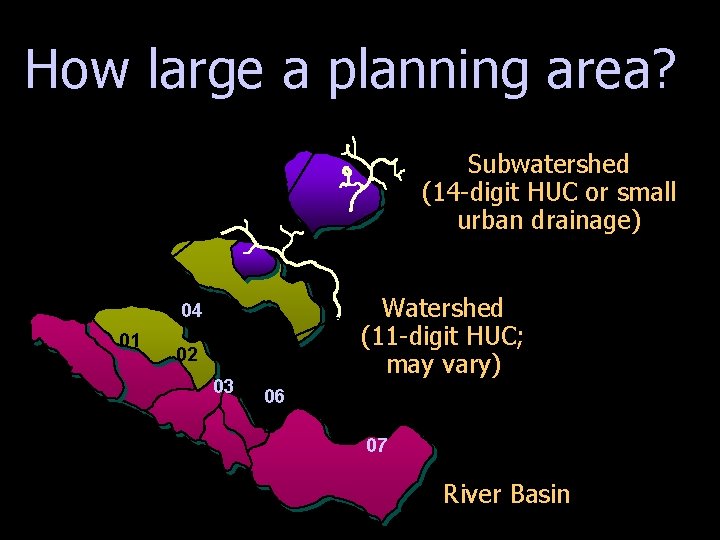
How large a planning area? Subwatershed (14 -digit HUC or small urban drainage) Watershed (11 -digit HUC; may vary) 04 01 02 03 06 05 07 River Basin
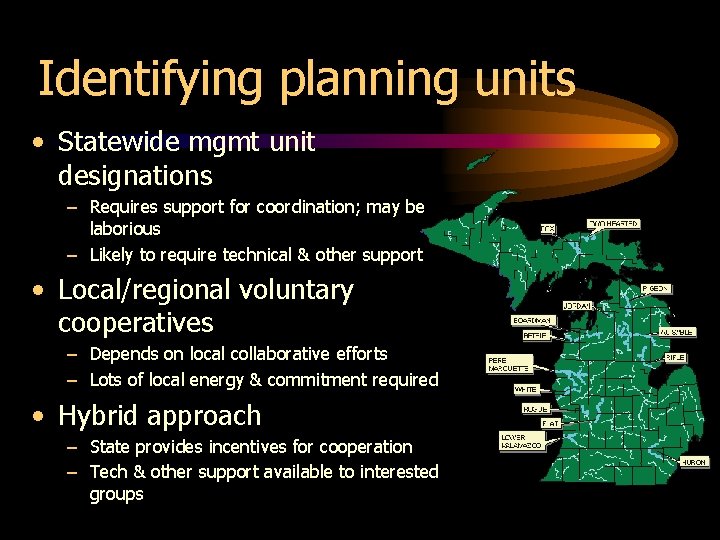
Identifying planning units • Statewide mgmt unit designations – Requires support for coordination; may be laborious – Likely to require technical & other support • Local/regional voluntary cooperatives – Depends on local collaborative efforts – Lots of local energy & commitment required • Hybrid approach – State provides incentives for cooperation – Tech & other support available to interested groups
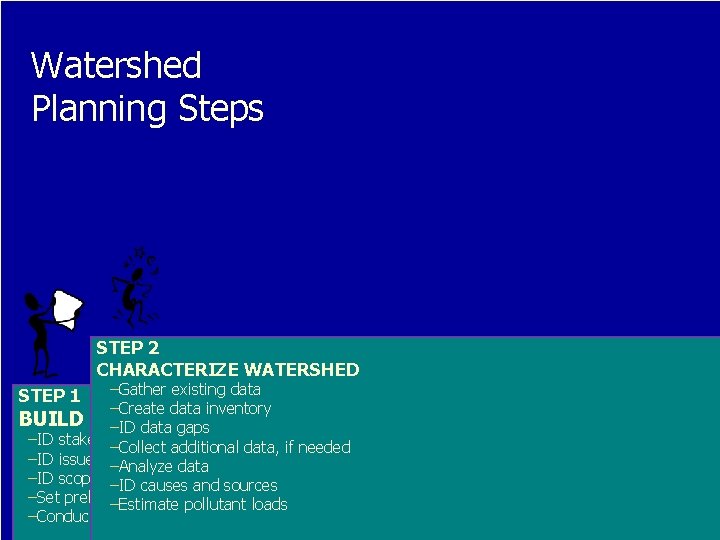
Watershed Planning Steps STEP 2 CHARACTERIZE WATERSHED –Gather existing data –Create data inventory BUILD PARTNERSHIPS –ID data gaps –ID stakeholders –Collect additional data, if needed –ID issues of concerndata –Analyze –ID scope of–ID effort & planning area causes and sources –Set preliminary goalspollutant loads –Estimate –Conduct outreach STEP 1
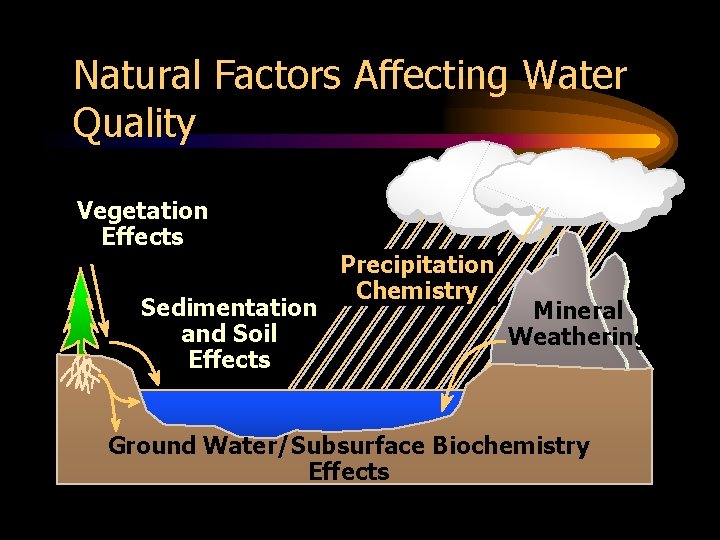
Natural Factors Affecting Water Quality Vegetation Effects Sedimentation and Soil Effects Precipitation Chemistry Mineral Weathering Ground Water/Subsurface Biochemistry Effects

Human Factors Contaminated Air Deposition Wetland Habitat Degradation Urban Development, Storm Water, CSO, and Wastewater Discharge Runoff/Infiltration from Animal Operations and Crop Farming Acid Mine Drainage Contamination of Drinking Water Sedimentation from Deforestation Recharge Zone Confining Bed Aquifer
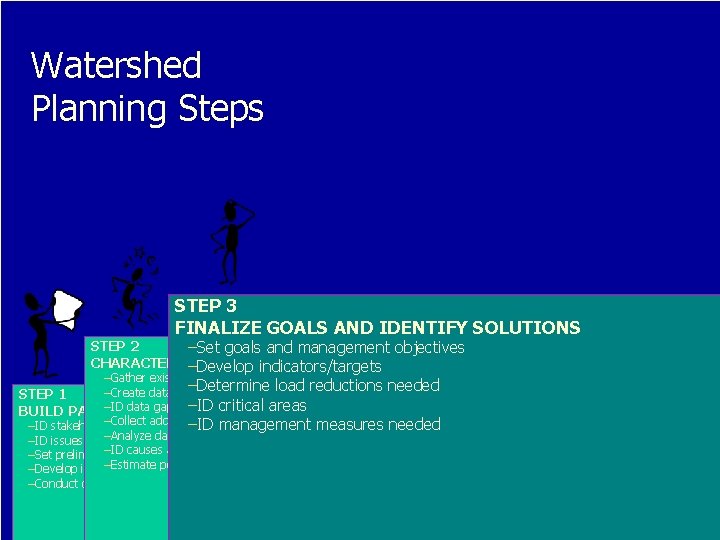
Watershed Planning Steps STEP 3 FINALIZE GOALS AND IDENTIFY SOLUTIONS STEP 2 –Set goals and management objectives CHARACTERIZE WATERSHED –Develop indicators/targets –Gather existing data –Determine load reductions –Create data inventory STEP 1 –ID data gaps –ID critical areas BUILD PARTNERSHIPS –Collect additional data, if needed –ID management measures –ID stakeholders – Analyze data –ID issues of concern –IDgoals causes and sources –Set preliminary –Estimate pollutant loads –Develop indicators –Conduct outreach needed
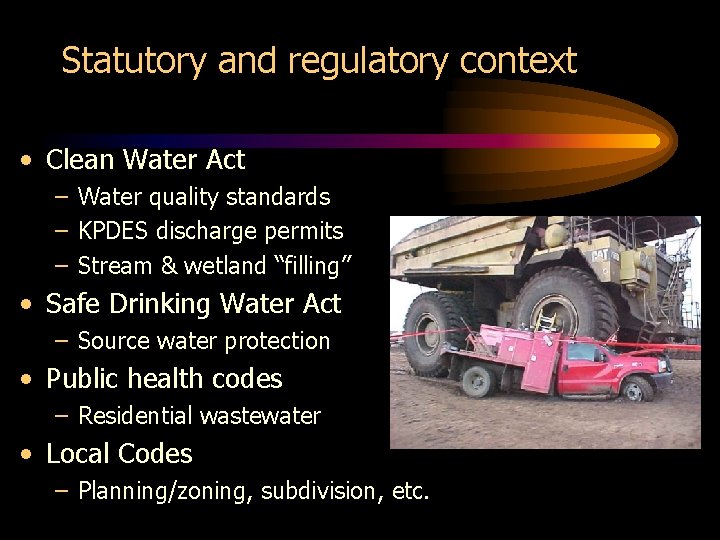
Statutory and regulatory context • Clean Water Act – Water quality standards – KPDES discharge permits – Stream & wetland “filling” • Safe Drinking Water Act – Source water protection • Public health codes – Residential wastewater • Local Codes – Planning/zoning, subdivision, etc.
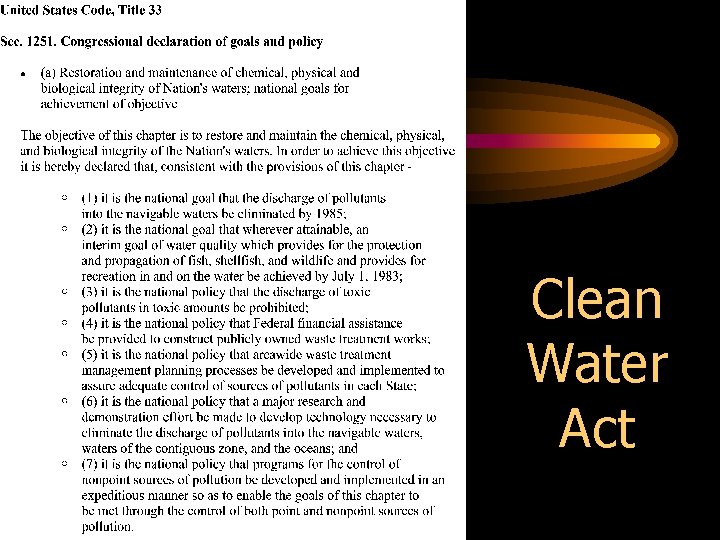
Clean Water Act
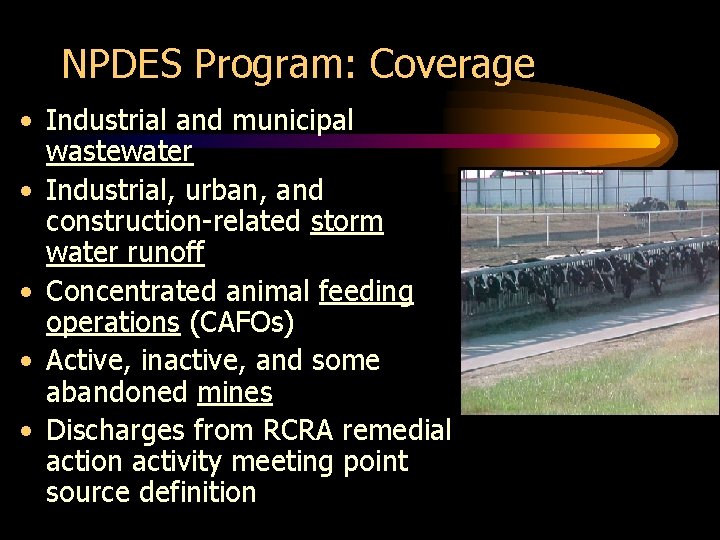
NPDES Program: Coverage • Industrial and municipal wastewater • Industrial, urban, and construction-related storm water runoff • Concentrated animal feeding operations (CAFOs) • Active, inactive, and some abandoned mines • Discharges from RCRA remedial action activity meeting point source definition
Effluent (discharge) limits • “Technology-based” end-of-pipe performance standards (concentration/mass) • BAT, NSPS, PSES, secondary treatment, etc. • Spelled out in EPA regulation packages (effluent guidelines) • Use best professional judgment (BPJ) if no EPA regulations • Water quality-based (linked to TMDLs) • Only where tech-based controls are insufficient to meet WQS – Back-calculated from numeric WQC: pollutant concentrations in discharge – Derived from narrative criteria: whole effluent toxicity testing
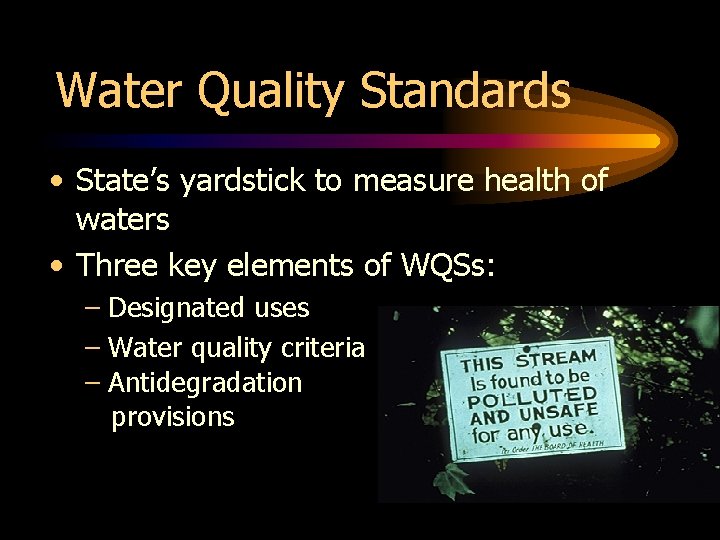
Water Quality Standards • State’s yardstick to measure health of waters • Three key elements of WQSs: – Designated uses – Water quality criteria – Antidegradation provisions
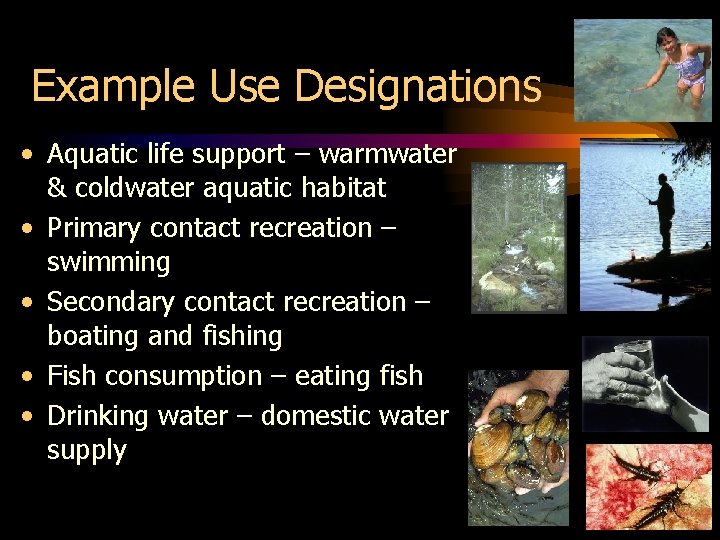
Example Use Designations • Aquatic life support – warmwater & coldwater aquatic habitat • Primary contact recreation – swimming • Secondary contact recreation – boating and fishing • Fish consumption – eating fish • Drinking water – domestic water supply
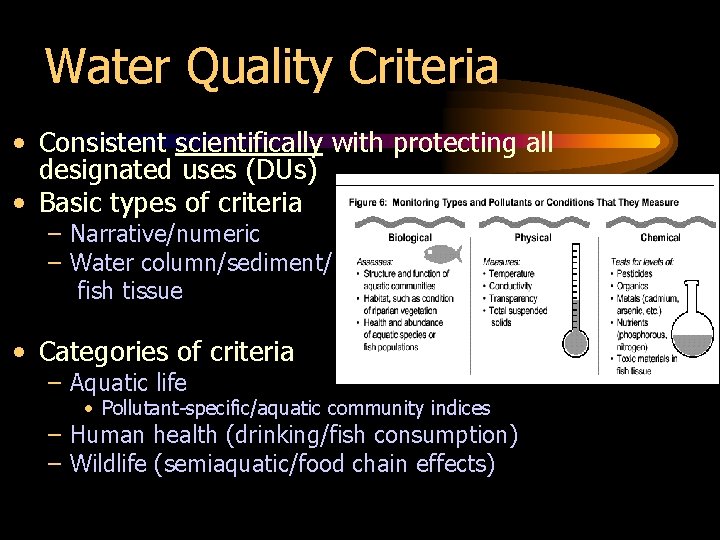
Water Quality Criteria • Consistent scientifically with protecting all designated uses (DUs) • Basic types of criteria – Narrative/numeric – Water column/sediment/ fish tissue • Categories of criteria – Aquatic life • Pollutant-specific/aquatic community indices – Human health (drinking/fish consumption) – Wildlife (semiaquatic/food chain effects)
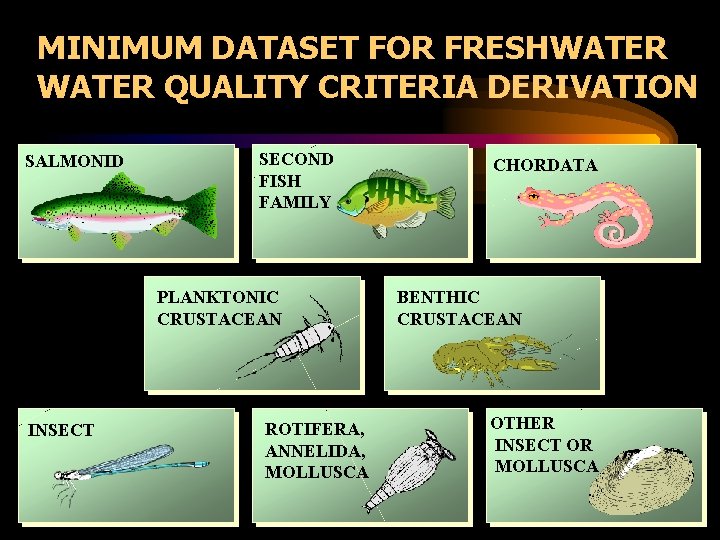
MINIMUM DATASET FOR FRESHWATER QUALITY CRITERIA DERIVATION SALMONID SECOND FISH FAMILY PLANKTONIC CRUSTACEAN INSECT ROTIFERA, ANNELIDA, MOLLUSCA CHORDATA BENTHIC CRUSTACEAN OTHER INSECT OR MOLLUSCA
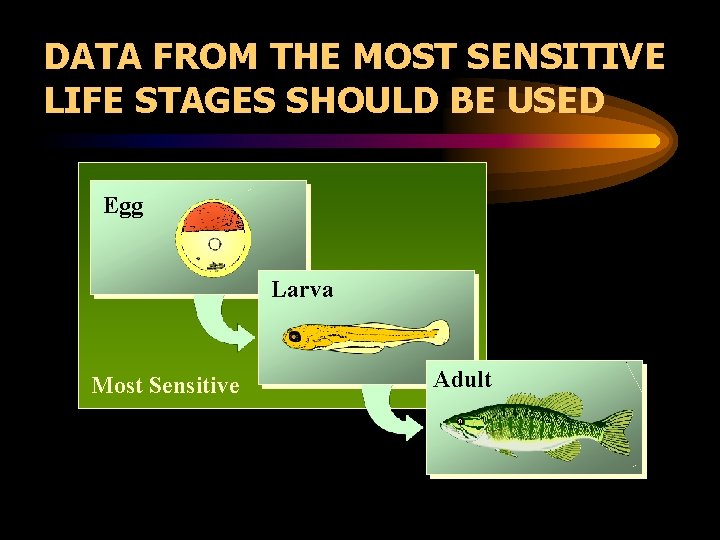
DATA FROM THE MOST SENSITIVE LIFE STAGES SHOULD BE USED Egg Larva Most Sensitive Adult
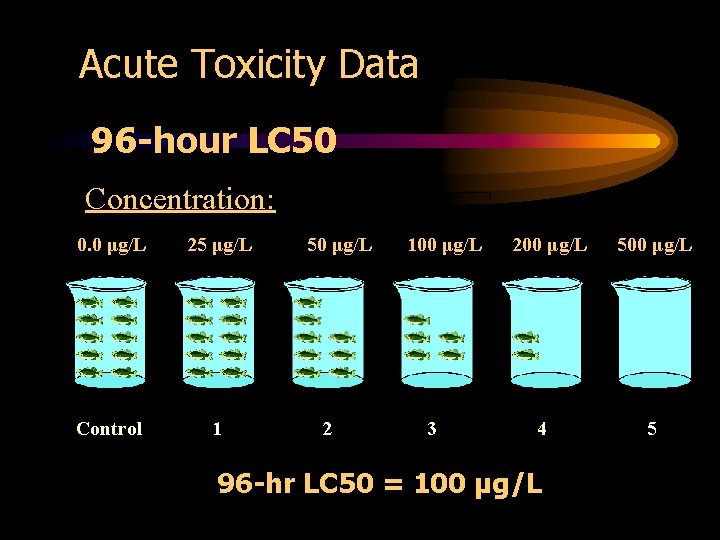
Acute Toxicity Data 96 -hour LC 50 Concentration: 0. 0 μg/L 25 μg/L Control 1 50 μg/L 2 100 μg/L 3 200 μg/L 4 96 -hr LC 50 = 100 μg/L 5
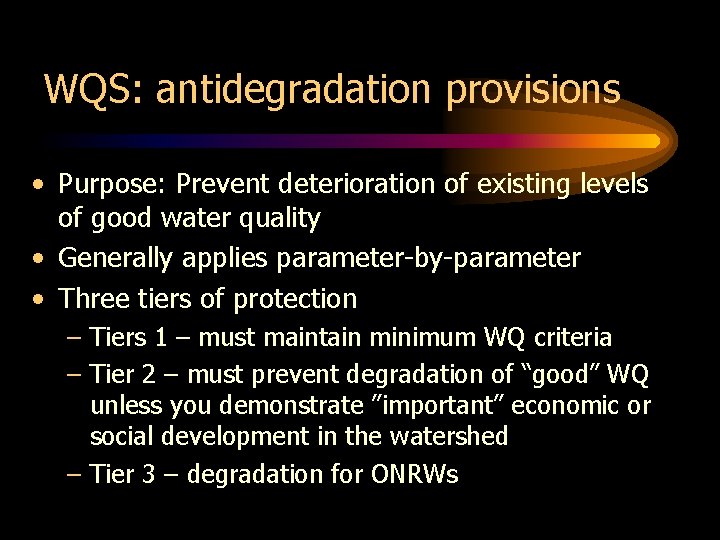
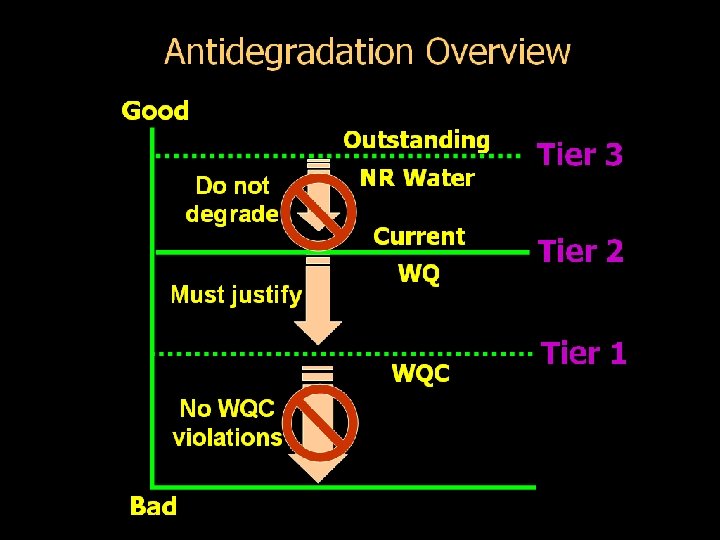
WQS: antidegradation provisions • Purpose: Prevent deterioration of existing levels of good water quality • Generally applies parameter-by-parameter • Three tiers of protection – Tiers 1 – must maintain minimum WQ criteria – Tier 2 – must prevent degradation of “good” WQ unless you demonstrate ”important” economic or social development in the watershed – Tier 3 – degradation for ONRWs
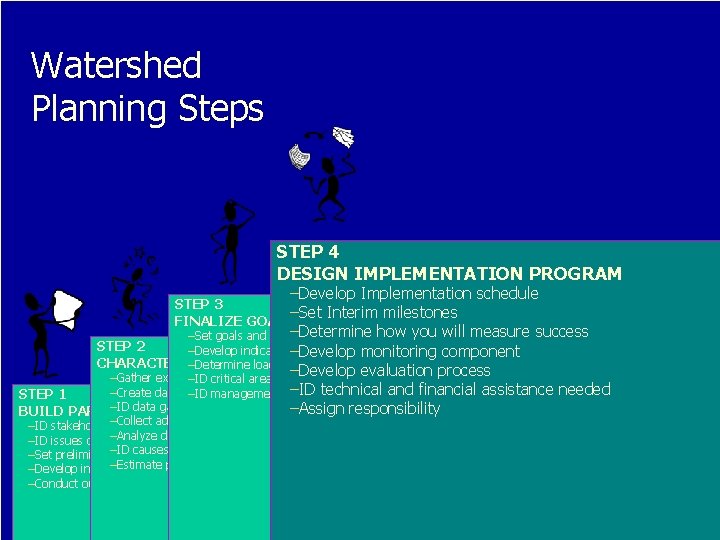
Watershed Planning Steps STEP 4 DESIGN k IMPLEMENTATION PROGRAM –Develop Implementation schedule STEP 3 –Set Interim milestones FINALIZE GOALS AND ID SOLUTIONS –Determine how –Set goals and management objectives you will measure success STEP 2 –Develop indicators/targets –Develop monitoring component CHARACTERIZE WATERSHED –Determine load reductions needed –Develop evaluation process assistance needed –Gather existing data –ID critical areas –ID technical –Create data inventory –ID management measures needed and financial STEP 1 –ID data gaps –Assign responsibility BUILD PARTNERSHIPS – Collect additional data, if needed –ID stakeholders –Analyze data –ID issues of concern causes and sources –Set preliminary–ID goals –Estimate pollutant loads –Develop indicators –Conduct outreach
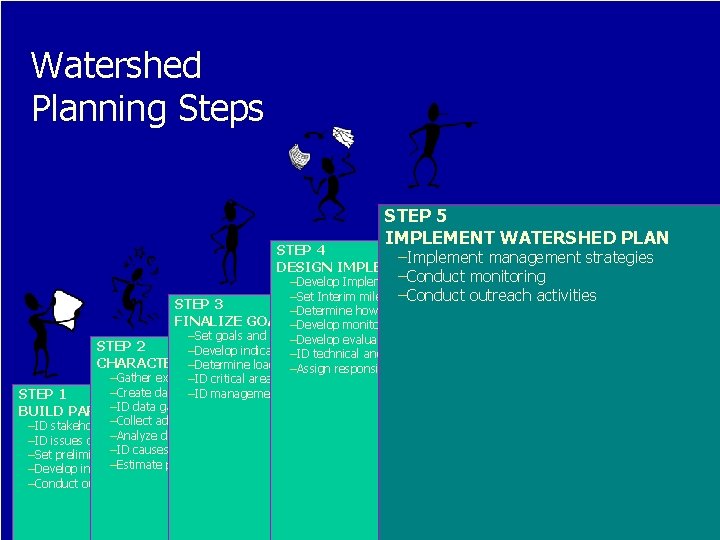
Watershed Planning Steps STEP 5 IMPLEMENT WATERSHED PLAN STEP 4 –Implement management strategies DESIGN IMPLEMENTATION PROGRAM k –Conduct monitoring –Develop Implementation schedule –Set Interim milestones –Conduct outreach activities STEP 3 –Determine how you will measure success FINALIZE GOALS–Develop AND ID SOLUTIONS monitoring component –Set goals and management objectives process –Develop evaluation STEP 2 –Develop indicators/targets –ID technical and financial assistance needed CHARACTERIZE WATERSHED –Determine load reductions needed –Assign responsibility –Gather existing data –ID critical areas –Create data inventory –ID management measures needed STEP 1 – ID data gaps BUILD PARTNERSHIPS –Collect additional data, if needed –ID stakeholders –Analyze data –ID issues of concern causes and sources –Set preliminary–ID goals –Estimate pollutant loads –Develop indicators –Conduct outreach
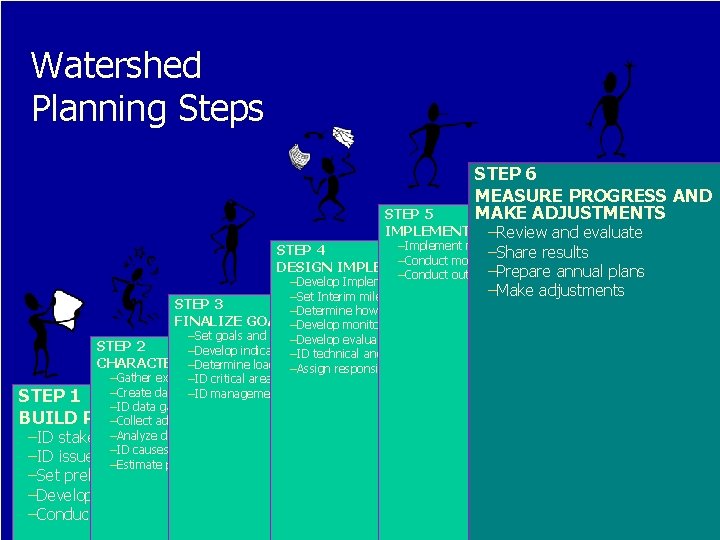
Watershed Planning Steps STEP 6 MEASURE PROGRESS AND MAKE ADJUSTMENTS STEP 5 IMPLEMENT WATERSHED PLAN –Review and evaluate –Implement management strategies STEP 4 –Share results –Conduct monitoring DESIGN IMPLEMENTATION PROGRAM –Prepare –Conduct outreach activities annual plans k –Develop Implementation schedule –Make –Set Interim milestones STEP 3 –Determine how you will measure success FINALIZE GOALS–Develop AND ID SOLUTIONS monitoring component –Set goals and management objectives process –Develop evaluation STEP 2 –Develop indicators/targets –ID technical and financial assistance needed CHARACTERIZE WATERSHED –Determine load reductions needed –Assign responsibility –Gather existing data –ID critical areas –Create data inventory –ID management measures needed STEP 1 –ID data gaps BUILD PARTNERSHIPS –Collect additional data, if needed –Analyze data –ID stakeholders –ID causes and sources –ID issues of concern –Estimate pollutant loads –Set preliminary goals –Develop indicators –Conduct outreach adjustments
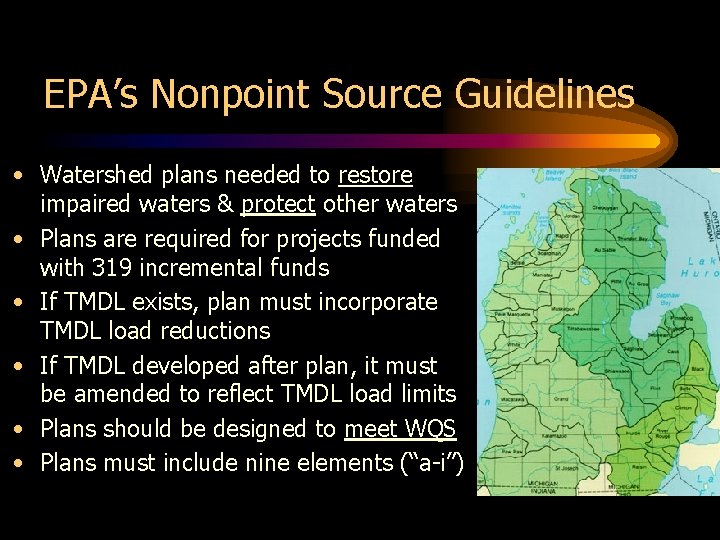
EPA’s Nonpoint Source Guidelines • Watershed plans needed to restore impaired waters & protect other waters • Plans are required for projects funded with 319 incremental funds • If TMDL exists, plan must incorporate TMDL load reductions • If TMDL developed after plan, it must be amended to reflect TMDL load limits • Plans should be designed to meet WQS • Plans must include nine elements (“a-i”)
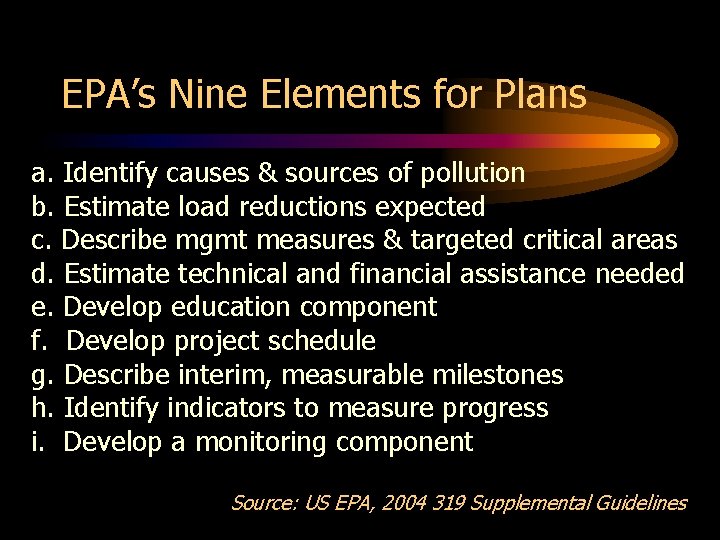
EPA’s Nine Elements for Plans a. Identify causes & sources of pollution b. Estimate load reductions expected c. Describe mgmt measures & targeted critical areas d. Estimate technical and financial assistance needed e. Develop education component f. Develop project schedule g. Describe interim, measurable milestones h. Identify indicators to measure progress i. Develop a monitoring component Source: US EPA, 2004 319 Supplemental Guidelines
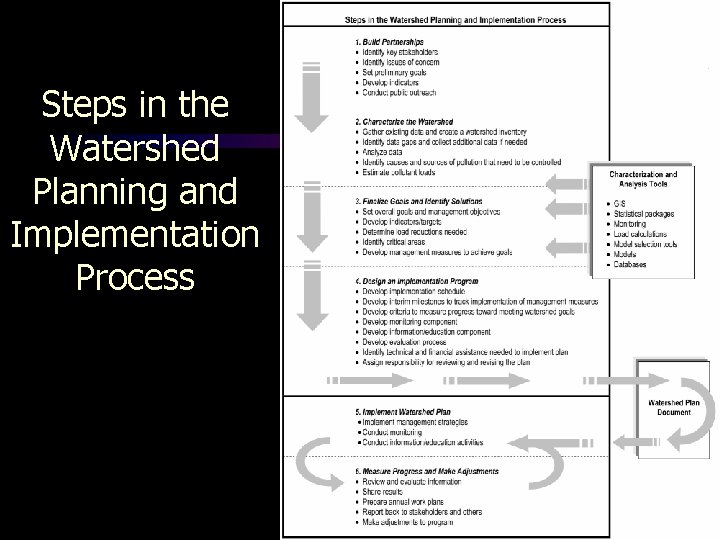
Steps in the Watershed Planning and Implementation Process
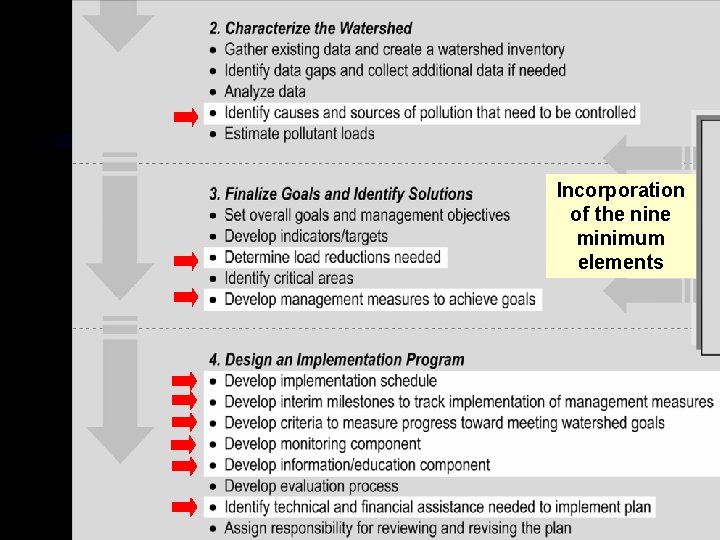
Incorporation of the nine minimum elements
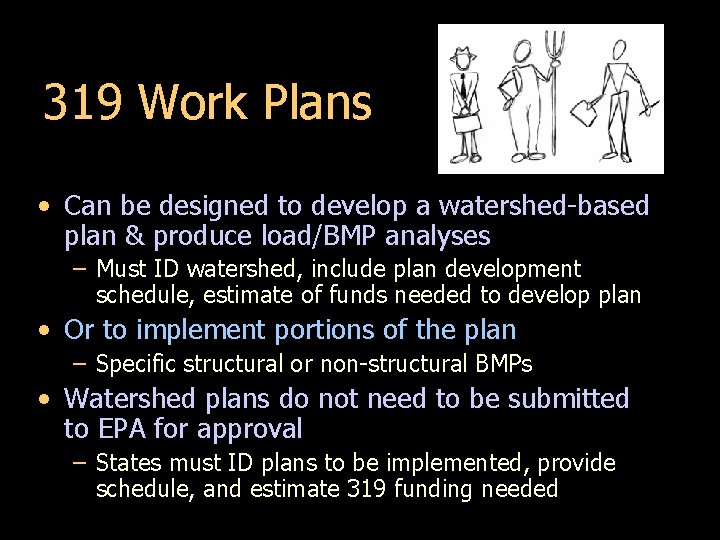
319 Work Plans • Can be designed to develop a watershed-based plan & produce load/BMP analyses – Must ID watershed, include plan development schedule, estimate of funds needed to develop plan • Or to implement portions of the plan – Specific structural or non-structural BMPs • Watershed plans do not need to be submitted to EPA for approval – States must ID plans to be implemented, provide schedule, and estimate 319 funding needed
Next Session: The Plan A Framework for Action
- Slides: 46