
Watershed Planning for Coral Reef Conservation in Southeast

- Slides: 21
Watershed Planning for Coral Reef Conservation in Southeast Florida August 22, 2017 Kurtis Gregg 1, Nigel Pickering 2, 3, Elizabeth Baker 3, Rob Ferguson 4, 5 and Dana Wusinich-Mendez 5 (1)ERT, Inc. in support of NOAA Fisheries Service (2) Washington State University, (3) Horsley Witten Group, Inc. , (4) The Baldwin Group, Inc. , (5) NOAA Coral Reef Conservation Program
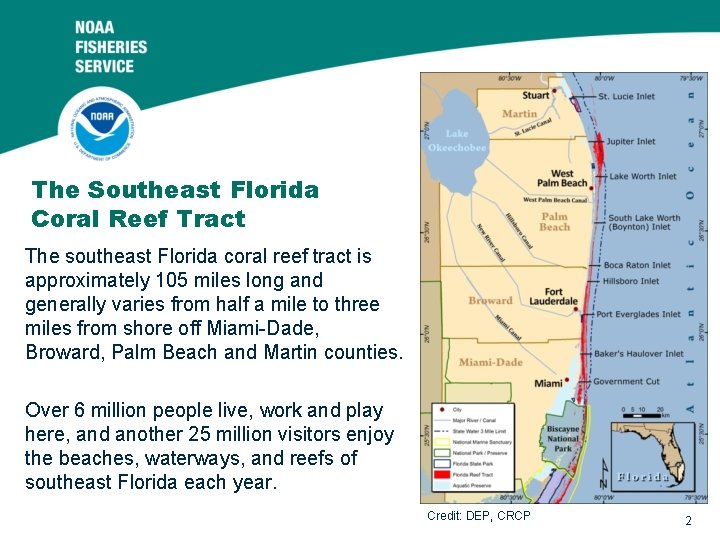
The Southeast Florida Coral Reef Tract The southeast Florida coral reef tract is approximately 105 miles long and generally varies from half a mile to three miles from shore off Miami-Dade, Broward, Palm Beach and Martin counties. Over 6 million people live, work and play here, and another 25 million visitors enjoy the beaches, waterways, and reefs of southeast Florida each year. Credit: DEP, CRCP 2
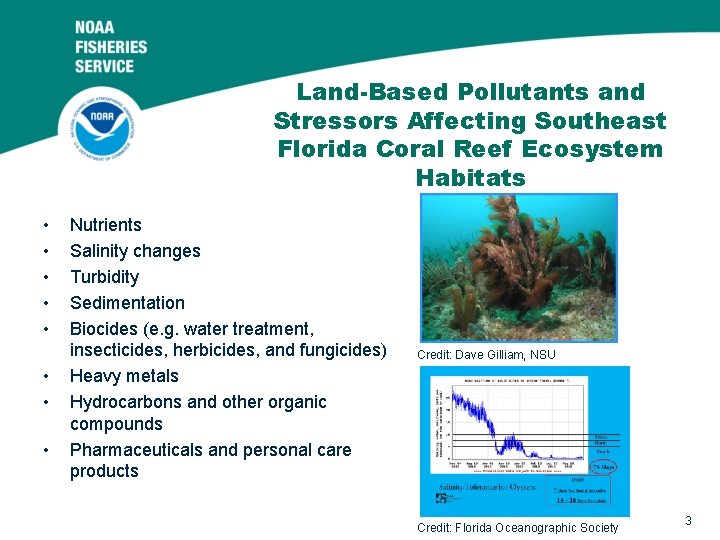
Land-Based Pollutants and Stressors Affecting Southeast Florida Coral Reef Ecosystem Habitats • • Nutrients Salinity changes Turbidity Sedimentation Biocides (e. g. water treatment, insecticides, herbicides, and fungicides) Heavy metals Hydrocarbons and other organic compounds Pharmaceuticals and personal care products Credit: Dave Gilliam, NSU Credit: Florida Oceanographic Society 3
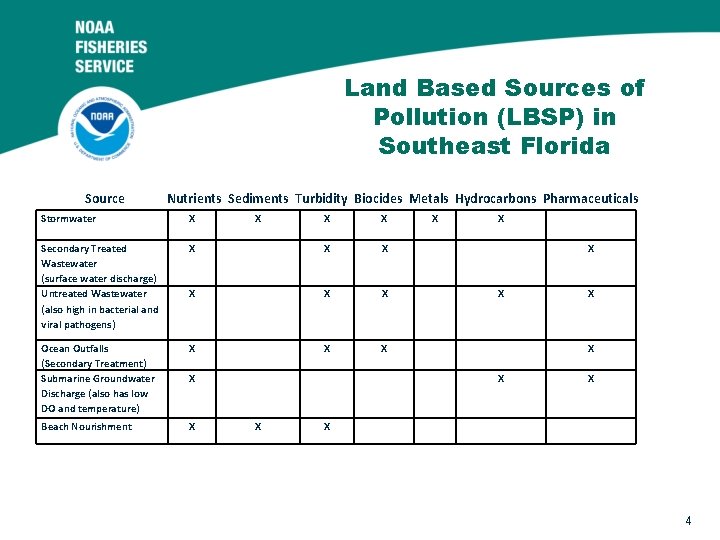
Land Based Sources of Pollution (LBSP) in Southeast Florida Source Nutrients Sediments Turbidity Biocides Metals Hydrocarbons Pharmaceuticals Stormwater X Secondary Treated Wastewater (surface water discharge) Untreated Wastewater (also high in bacterial and viral pathogens) X X X X X Ocean Outfalls (Secondary Treatment) Submarine Groundwater Discharge (also has low DO and temperature) X X X Beach Nourishment X X X 4
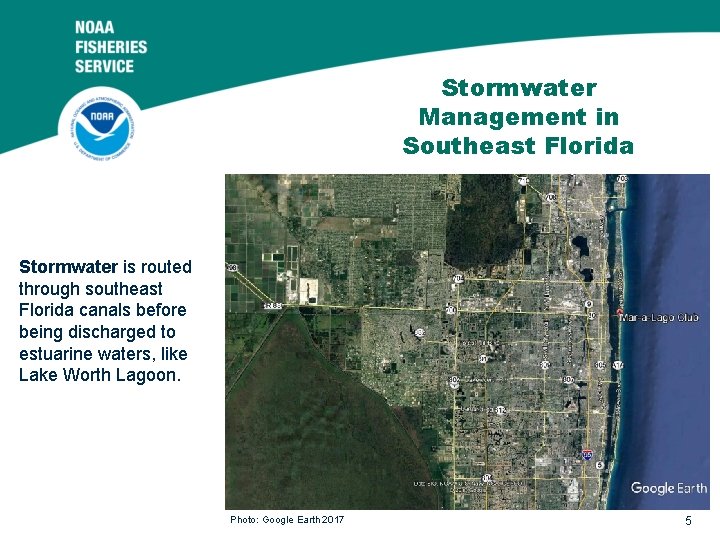
Stormwater Management in Southeast Florida Stormwater is routed through southeast Florida canals before being discharged to estuarine waters, like Lake Worth Lagoon. Photo: Google Earth 2017 5
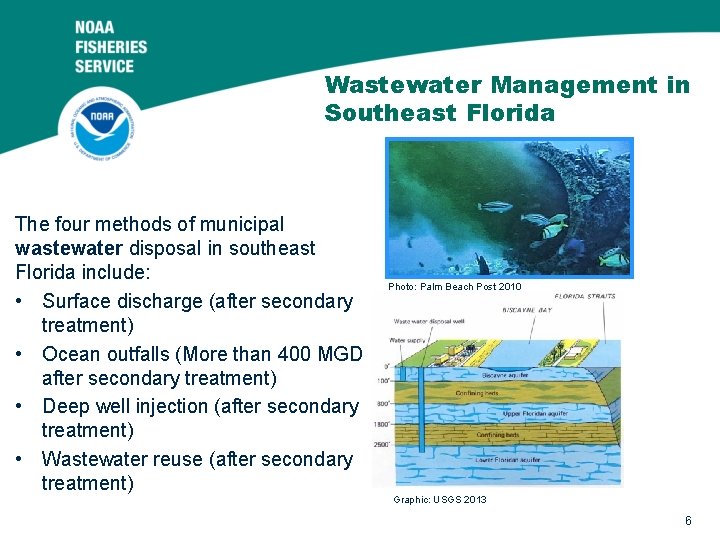
Wastewater Management in Southeast Florida The four methods of municipal wastewater disposal in southeast Florida include: • Surface discharge (after secondary treatment) • Ocean outfalls (More than 400 MGD after secondary treatment) • Deep well injection (after secondary treatment) • Wastewater reuse (after secondary treatment) Photo: Palm Beach Post 2010 Graphic: USGS 2013 6
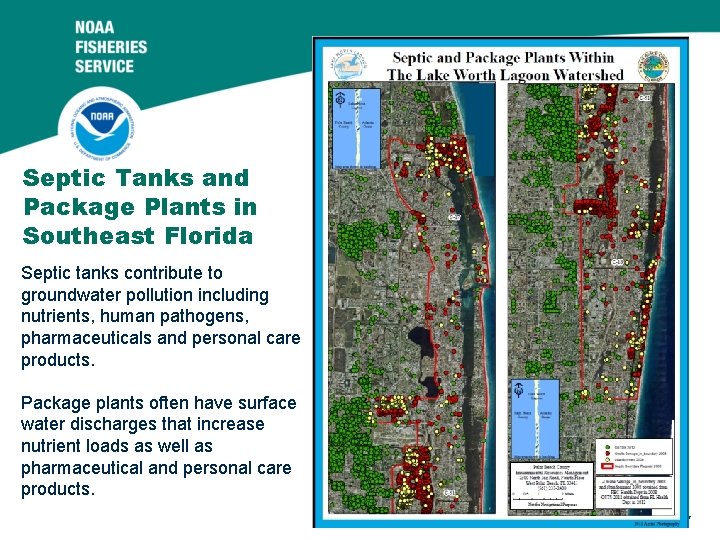
Septic Tanks and Package Plants in Southeast Florida Septic tanks contribute to groundwater pollution including nutrients, human pathogens, pharmaceuticals and personal care products. Package plants often have surface water discharges that increase nutrient loads as well as pharmaceutical and personal care products. 7
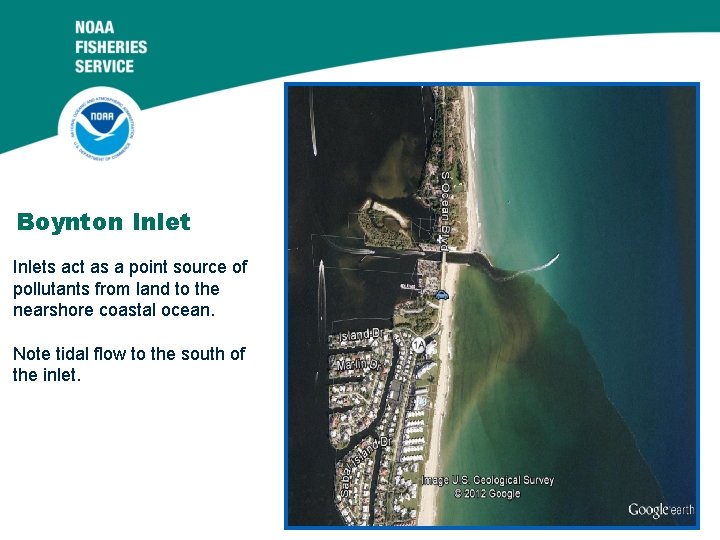
Boynton Inlets act as a point source of pollutants from land to the nearshore coastal ocean. Note tidal flow to the south of the inlet. 8
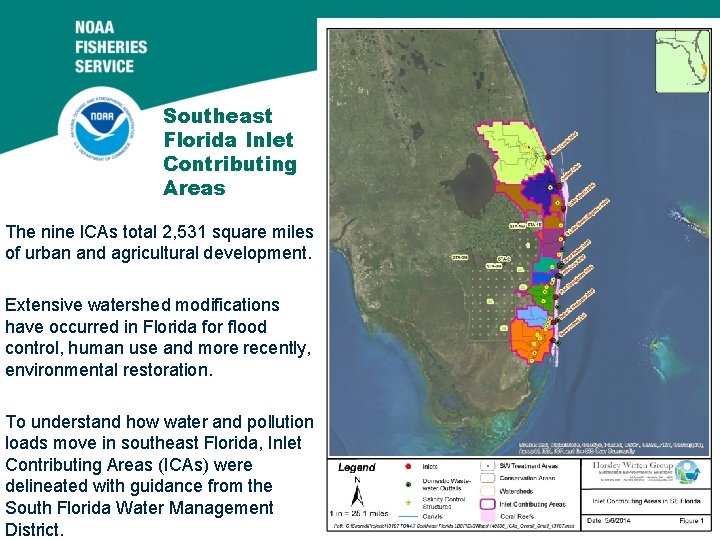
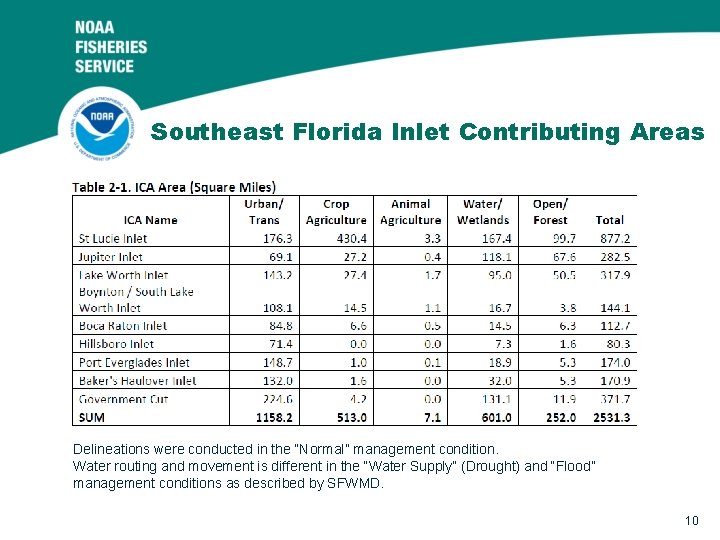
Southeast Florida Inlet Contributing Areas The nine ICAs total 2, 531 square miles of urban and agricultural development. Extensive watershed modifications have occurred in Florida for flood control, human use and more recently, environmental restoration. To understand how water and pollution loads move in southeast Florida, Inlet Contributing Areas (ICAs) were delineated with guidance from the South Florida Water Management District. 9
Southeast Florida Inlet Contributing Areas Delineations were conducted in the “Normal” management condition. Water routing and movement is different in the “Water Supply” (Drought) and “Flood” management conditions as described by SFWMD. 10
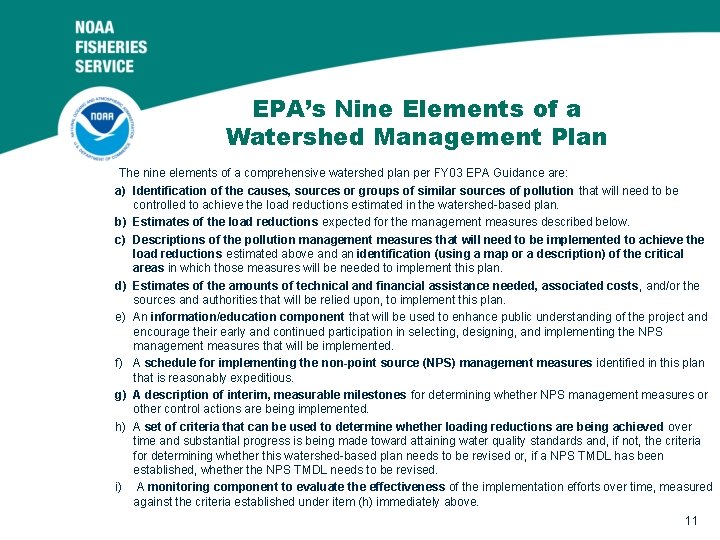
EPA’s Nine Elements of a Watershed Management Plan The nine elements of a comprehensive watershed plan per FY 03 EPA Guidance are: a) Identification of the causes, sources or groups of similar sources of pollution that will need to be controlled to achieve the load reductions estimated in the watershed-based plan. b) Estimates of the load reductions expected for the management measures described below. c) Descriptions of the pollution management measures that will need to be implemented to achieve the load reductions estimated above and an identification (using a map or a description) of the critical areas in which those measures will be needed to implement this plan. d) Estimates of the amounts of technical and financial assistance needed, associated costs, and/or the sources and authorities that will be relied upon, to implement this plan. e) An information/education component that will be used to enhance public understanding of the project and encourage their early and continued participation in selecting, designing, and implementing the NPS management measures that will be implemented. f) A schedule for implementing the non-point source (NPS) management measures identified in this plan that is reasonably expeditious. g) A description of interim, measurable milestones for determining whether NPS management measures or other control actions are being implemented. h) A set of criteria that can be used to determine whether loading reductions are being achieved over time and substantial progress is being made toward attaining water quality standards and, if not, the criteria for determining whether this watershed-based plan needs to be revised or, if a NPS TMDL has been established, whether the NPS TMDL needs to be revised. i) A monitoring component to evaluate the effectiveness of the implementation efforts over time, measured against the criteria established under item (h) immediately above. 11
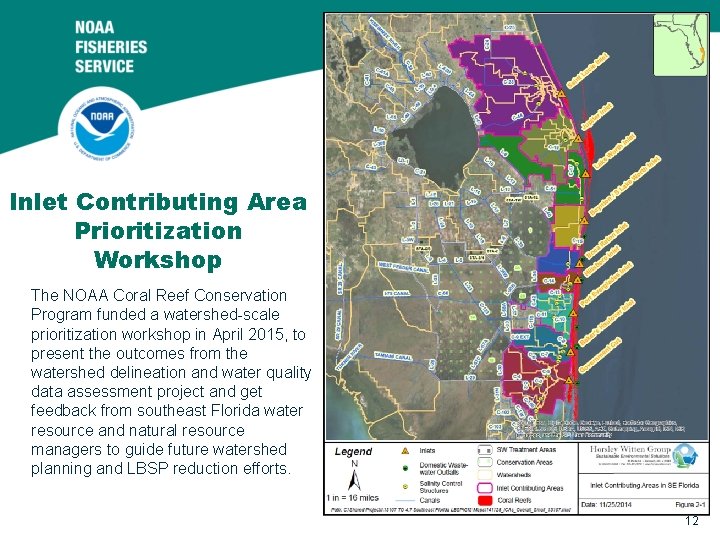
Inlet Contributing Area Prioritization Workshop The NOAA Coral Reef Conservation Program funded a watershed-scale prioritization workshop in April 2015, to present the outcomes from the watershed delineation and water quality data assessment project and get feedback from southeast Florida water resource and natural resource managers to guide future watershed planning and LBSP reduction efforts. 12
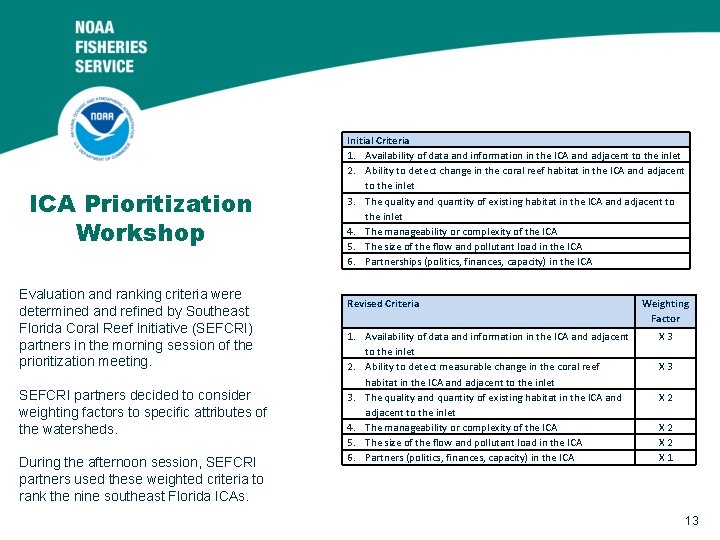
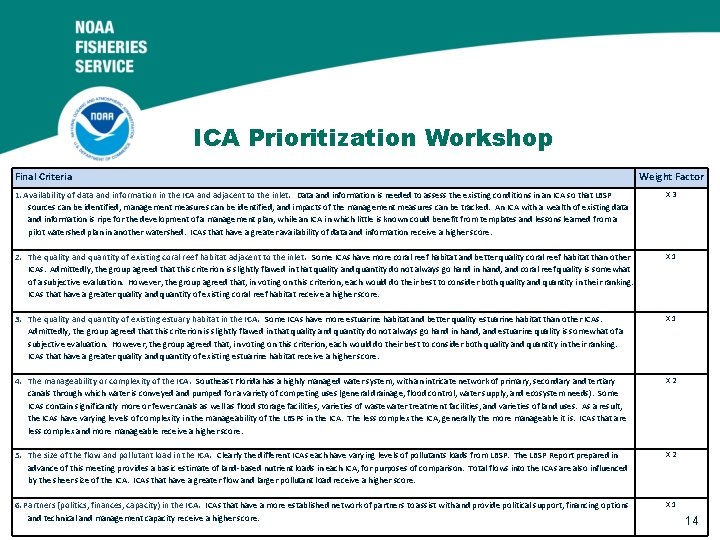
ICA Prioritization Workshop Evaluation and ranking criteria were determined and refined by Southeast Florida Coral Reef Initiative (SEFCRI) partners in the morning session of the prioritization meeting. SEFCRI partners decided to consider weighting factors to specific attributes of the watersheds. During the afternoon session, SEFCRI partners used these weighted criteria to rank the nine southeast Florida ICAs. Initial Criteria 1. Availability of data and information in the ICA and adjacent to the inlet 2. Ability to detect change in the coral reef habitat in the ICA and adjacent to the inlet 3. The quality and quantity of existing habitat in the ICA and adjacent to the inlet 4. The manageability or complexity of the ICA 5. The size of the flow and pollutant load in the ICA 6. Partnerships (politics, finances, capacity) in the ICA Revised Criteria 1. Availability of data and information in the ICA and adjacent to the inlet 2. Ability to detect measurable change in the coral reef habitat in the ICA and adjacent to the inlet 3. The quality and quantity of existing habitat in the ICA and adjacent to the inlet 4. The manageability or complexity of the ICA 5. The size of the flow and pollutant load in the ICA 6. Partners (politics, finances, capacity) in the ICA Weighting Factor X 3 X 2 X 2 X 1 13
ICA Prioritization Workshop Final Criteria Weight Factor 1. Availability of data and information in the ICA and adjacent to the inlet. Data and information is needed to assess the existing conditions in an ICA so that LBSP sources can be identified, management measures can be identified, and impacts of the management measures can be tracked. An ICA with a wealth of existing data and information is ripe for the development of a management plan, while an ICA in which little is known could benefit from templates and lessons learned from a pilot watershed plan in another watershed. ICAs that have a greater availability of data and information receive a higher score. X 3 2. The quality and quantity of existing coral reef habitat adjacent to the inlet. Some ICAs have more coral reef habitat and better quality coral reef habitat than other ICAs. Admittedly, the group agreed that this criterion is slightly flawed in that quality and quantity do not always go hand in hand, and coral reef quality is somewhat of a subjective evaluation. However, the group agreed that, in voting on this criterion, each would do their best to consider both quality and quantity in their ranking. ICAs that have a greater quality and quantity of existing coral reef habitat receive a higher score. X 1 3. The quality and quantity of existing estuary habitat in the ICA. Some ICAs have more estuarine habitat and better quality estuarine habitat than other ICAs. Admittedly, the group agreed that this criterion is slightly flawed in that quality and quantity do not always go hand in hand, and estuarine quality is somewhat of a subjective evaluation. However, the group agreed that, in voting on this criterion, each would do their best to consider both quality and quantity in their ranking. ICAs that have a greater quality and quantity of existing estuarine habitat receive a higher score. X 1 4. The manageability or complexity of the ICA. Southeast Florida has a highly managed water system, with an intricate network of primary, secondary and tertiary canals through which water is conveyed and pumped for a variety of competing uses (general drainage, flood control, water supply, and ecosystem needs). Some ICAs contain significantly more or fewer canals as well as flood storage facilities, varieties of wastewater treatment facilities, and varieties of land uses. As a result, the ICAs have varying levels of complexity in the manageability of the LBSPs in the ICA. The less complex the ICA, generally the more manageable it is. ICAs that are less complex and more manageable receive a higher score. X 2 5. The size of the flow and pollutant load in the ICA. Clearly the different ICAs each have varying levels of pollutants loads from LBSP. The LBSP Report prepared in advance of this meeting provides a basic estimate of land-based nutrient loads in each ICA, for purposes of comparison. Total flows into the ICAs are also influenced by the sheer size of the ICAs that have a greater flow and larger pollutant load receive a higher score. X 2 6. Partners (politics, finances, capacity) in the ICAs that have a more established network of partners to assist with and provide political support, financing options and technical and management capacity receive a higher score. X 1 14
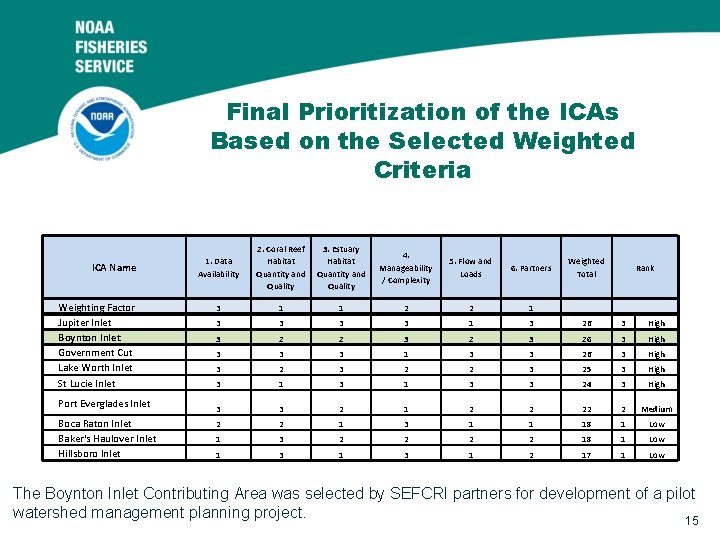
Final Prioritization of the ICAs Based on the Selected Weighted Criteria ICA Name Weighting Factor Jupiter Inlet Boynton Inlet Government Cut Lake Worth Inlet St Lucie Inlet Port Everglades Inlet Boca Raton Inlet Baker's Haulover Inlet Hillsboro Inlet 1. Data Availability 2. Coral Reef Habitat Quantity and Quality 3. Estuary Habitat Quantity and Quality 4. Manageability / Complexity 5. Flow and Loads 6. Partners 3 1 1 2 2 1 3 3 1 3 26 3 High 3 2 2 3 26 3 High 3 3 3 1 3 3 26 3 High 3 2 2 3 25 3 High 3 1 3 3 24 3 High 3 3 2 1 2 2 22 2 Medium 2 2 1 3 1 1 18 1 Low 1 3 2 2 18 1 Low 1 3 1 2 17 1 Low Weighted Total Rank The Boynton Inlet Contributing Area was selected by SEFCRI partners for development of a pilot watershed management planning project. 15
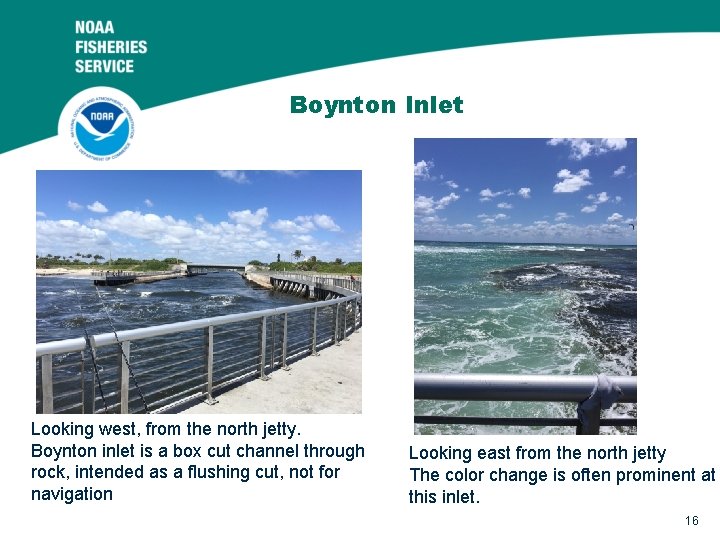
Boynton Inlet Looking west, from the north jetty. Boynton inlet is a box cut channel through rock, intended as a flushing cut, not for navigation Looking east from the north jetty The color change is often prominent at this inlet. 16
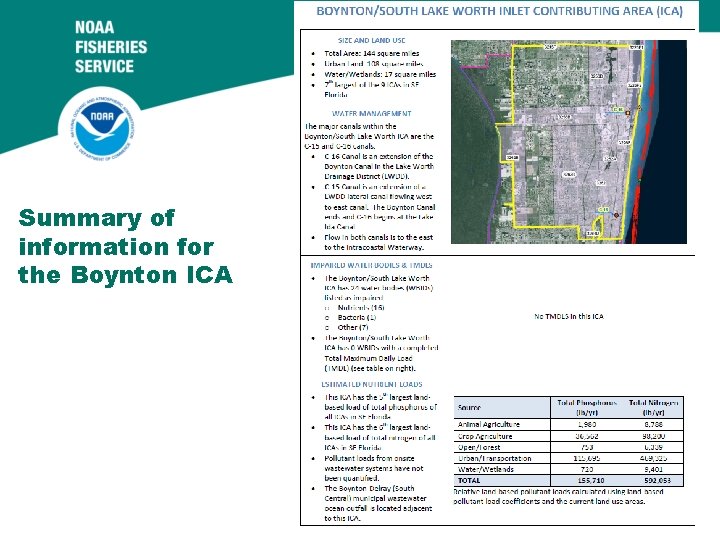
Summary of information for the Boynton ICA 17
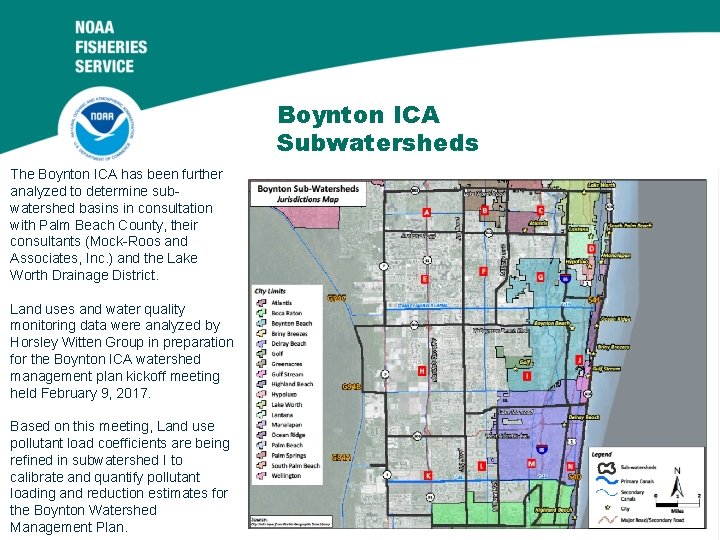
Boynton ICA Subwatersheds The Boynton ICA has been further analyzed to determine subwatershed basins in consultation with Palm Beach County, their consultants (Mock-Roos and Associates, Inc. ) and the Lake Worth Drainage District. Land uses and water quality monitoring data were analyzed by Horsley Witten Group in preparation for the Boynton ICA watershed management plan kickoff meeting held February 9, 2017. Based on this meeting, Land use pollutant load coefficients are being refined in subwatershed I to calibrate and quantify pollutant loading and reduction estimates for the Boynton Watershed Management Plan. 18
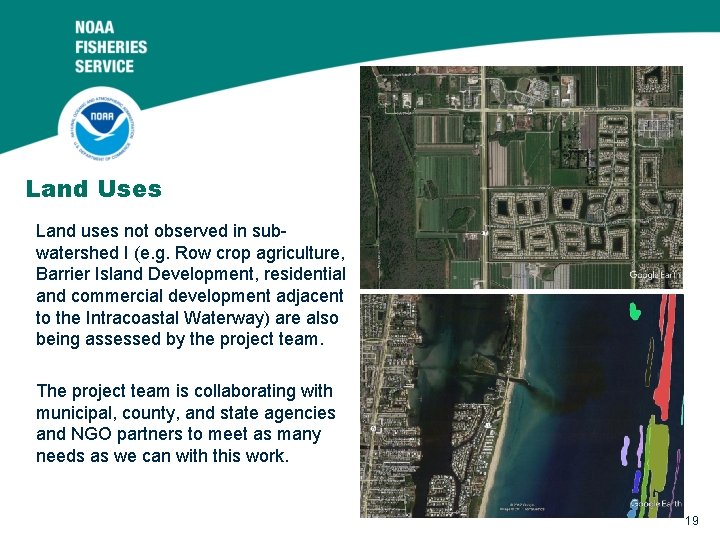
Land Uses Land uses not observed in subwatershed I (e. g. Row crop agriculture, Barrier Island Development, residential and commercial development adjacent to the Intracoastal Waterway) are also being assessed by the project team. The project team is collaborating with municipal, county, and state agencies and NGO partners to meet as many needs as we can with this work. 19
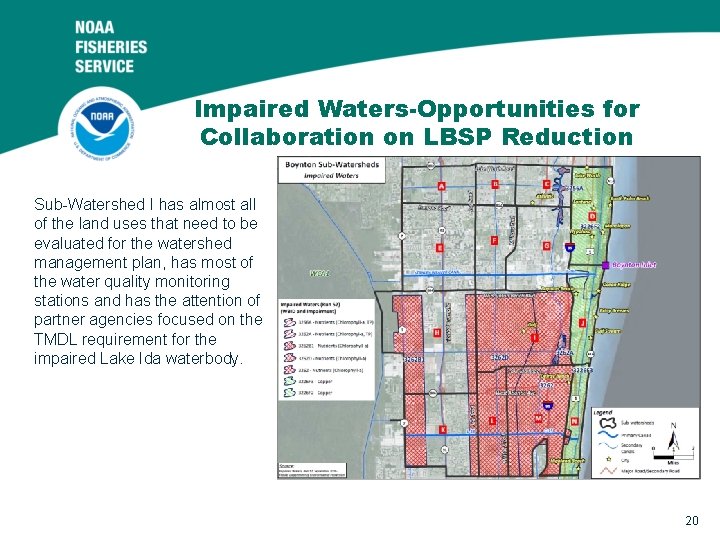
Impaired Waters-Opportunities for Collaboration on LBSP Reduction Sub-Watershed I has almost all of the land uses that need to be evaluated for the watershed management plan, has most of the water quality monitoring stations and has the attention of partner agencies focused on the TMDL requirement for the impaired Lake Ida waterbody. 20
Questions? Kurtis. Gregg@noaa. gov Credit: NOAA 2012 21