
Watershed Management for Urban Water Supply Why use
Watershed Management for Urban Water Supply
Why use NYC as a case study? • Comprehensive, long-range watershed protection program • Illustrates a multifaceted strategy to protect and improve water quality for a variety of stakeholders • Successfully integrates upstream/downstream users • Shows that voluntary partnerships can protect water quality as effectively as regulatory restrictions • Implements locally-based (community) watershed protection programs • Whole Farm management concept • Links water quality protection goals with economic objectives
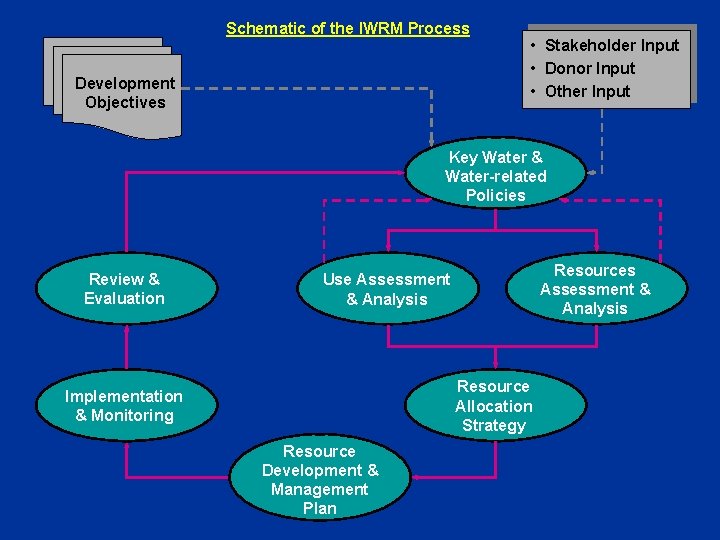
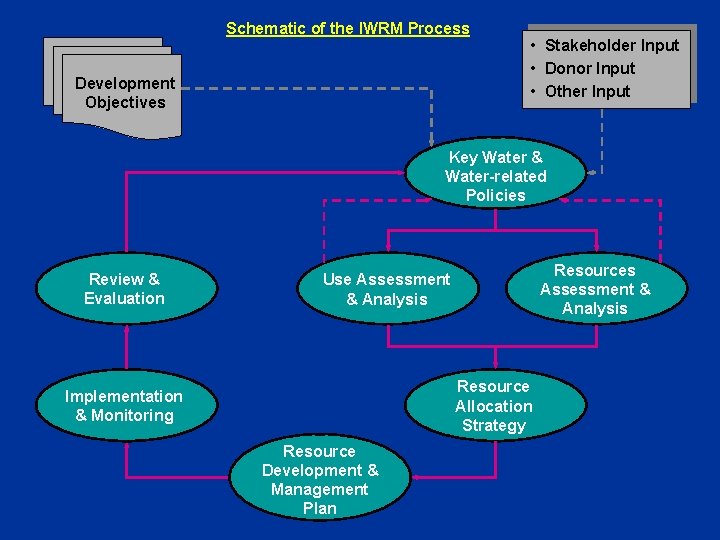
Schematic of the IWRM Process Development Objectives • Stakeholder Input • Donor Input • Other Input Key Water & Water-related Policies Review & Evaluation Resources Assessment & Analysis Use Assessment & Analysis Resource Allocation Strategy Implementation & Monitoring Resource Development & Management Plan
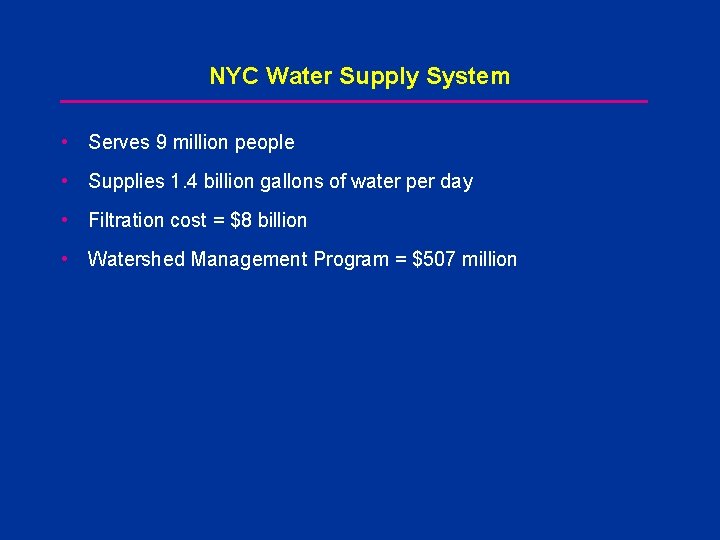
NYC Water Supply System • Serves 9 million people • Supplies 1. 4 billion gallons of water per day • Filtration cost = $8 billion • Watershed Management Program = $507 million
NYC Watershed • 1, 969 sq. miles (5, 041 sq. km) • An area the size of Delaware • 19 reservoirs • 3 controlled lakes • 550 billion gallon storage capacity • Croton System (serves 10%) • Catskill/Delaware System (serves 90%) • 500 farms • 60 towns • Majority of land is forested • 61% of forestland is privately owned

Involvement of US EPA • Safe Drinking Water Act requires filtration • Waived filtration requirement in 1993 • Formalized the NYC Dept. of Environmental Protection Watershed Protection Program • Provides oversight and technical assistance in watershed management • Provides grants for rebuilding treatment facilities
A Diversity of Stakeholders • Upstate users, the day-to-day stewards of water quality – dairy and livestock farmers – towns, villages – forestry industry – park visitors • Downstream users, NY City dwellers
Stakeholders • NY State Dept. of Environmental Conservation • NY State Dept. of Health Catskill Committee of the Sierra Club • Pure Water Alliance • City Club of New York • Putnam County Legislature • City of New York • Sierra Club - NYC group • Coalition of Watershed Towns (representing all towns in the five west of Hudson counties) • U. S. Environmental Protection Agency • Congressmen and congresswomen • Westchester County • Environmental Defense Fund • • Hudson Riverkeeper Woodstock Times/Huguenot and Highland Herald • Natural Resources Defense Council • Publisher New York City Water • NY State Bar Association, Environmental Law Committee • Others • Building Contractor Association of Westchester & the Mid-Hudson River • Catskill Center •
Major Water Quality Problems • Bacteria • Cryptosporidium • Giardia • fertilizers • pesticides
The Need to Mitigate at the Source Position Statements • Well-managed forests provide the most beneficial land cover for water quality protection – ability to capture nutrients – high filtration capacity • Agricultural lands can be managed to minimize nutrients, pollutants, and pathogens in runoff
Solutions (technical, environmental, institutional, social. . . ) • Septic system inspection and rehabilitation • Construction of new, centralized sewage systems to improve water quality • Extension of sewer systems to correct existing water quality problems • Stormwater management measures environmental education improved storage of sand, salt and de-icing materials • Stream corridor protection projects
Implementation • Upgrade water supply and wastewater treatment facilities • Land Acquisition and Stewardship programs • Watershed Protection and Partnership programs • Watershed regulations • $507 million
Land Acquisition and Stewardship Programs • NY Dept. of Env. Conservation issued permit for city to acquire via purchase: conservation easements, sensitive land near reservoirs, wetlands, or watercourses • $250 million in the Catskill/Delaware System • $17. 5 million in the Croton System • Incorporates a local consultation process which allows exclusion of parcels from acquisition
Watershed Protection and Partnership Programs • Promote and institutionalize watershed-wide cooperation and planning • Provide for the establishment of locally based watershed protection initiatives to build strong working relationships between the City and its upstate neighbors
Watershed Regulations • Replace 44 -year old standards • Establish standards for the design, construction and operation of wastewater treatment plants • Set design standards and setback requirements for septic systems • Require the implementation of stormwater control measures • Provide for City review and approval of certain activities having a potentially adverse impact on water quality • Impose strict time frames for City review and decision-making • Enable the need to expedite review procedures in case of emergency and rights of appeals • Research and monitoring
Watershed Regulations • Replace 44 -year old standards • Establish standards for the design, construction and operation of wastewater treatment plants • Set design standards and setback requirements for septic systems • Require the implementation of stormwater control measures • Provide for City review and approval of certain activities having a potentially adverse impact on water quality • Impose strict time frames for City review and decision-making • Enable the need to expedite review procedures in case of emergency and rights of appeals • Research and monitoring
Schematic of the IWRM Process Development Objectives • Stakeholder Input • Donor Input • Other Input Key Water & Water-related Policies Review & Evaluation Resources Assessment & Analysis Use Assessment & Analysis Resource Allocation Strategy Implementation & Monitoring Resource Development & Management Plan
- Slides: 17