
Watermelon Unit 4 Irrigation Fertilization Irrigation Watermelon needs
- Slides: 9
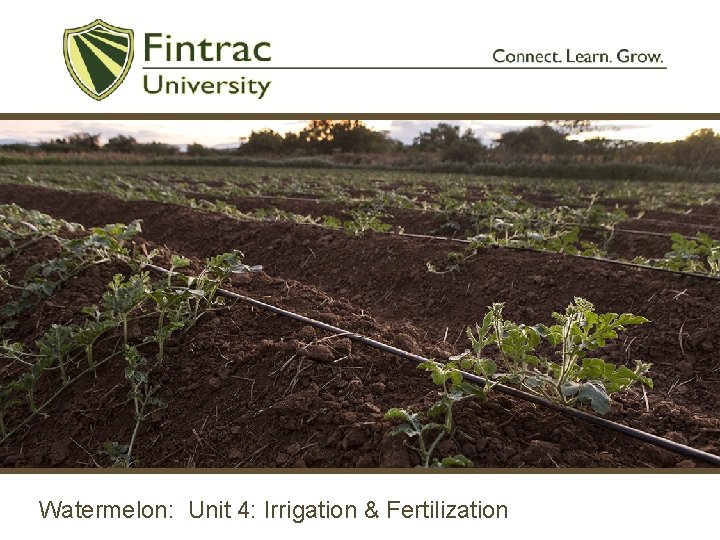
Watermelon: Unit 4: Irrigation & Fertilization
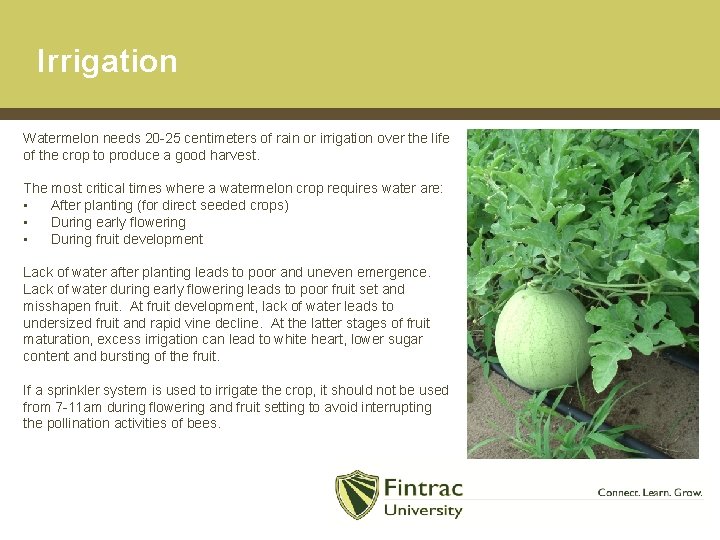
Irrigation Watermelon needs 20 -25 centimeters of rain or irrigation over the life of the crop to produce a good harvest. The most critical times where a watermelon crop requires water are: • After planting (for direct seeded crops) • During early flowering • During fruit development Lack of water after planting leads to poor and uneven emergence. Lack of water during early flowering leads to poor fruit set and misshapen fruit. At fruit development, lack of water leads to undersized fruit and rapid vine decline. At the latter stages of fruit maturation, excess irrigation can lead to white heart, lower sugar content and bursting of the fruit. If a sprinkler system is used to irrigate the crop, it should not be used from 7 -11 am during flowering and fruit setting to avoid interrupting the pollination activities of bees. Photo credit: Scot Nelson
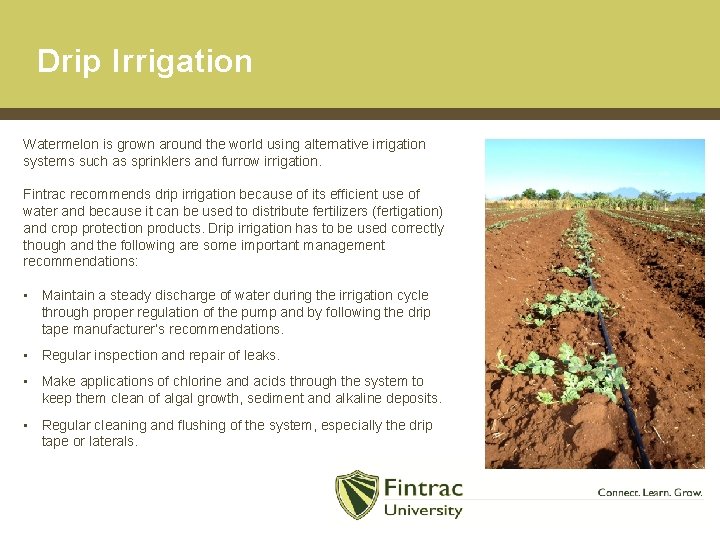
Drip Irrigation Watermelon is grown around the world using alternative irrigation systems such as sprinklers and furrow irrigation. Fintrac recommends drip irrigation because of its efficient use of water and because it can be used to distribute fertilizers (fertigation) and crop protection products. Drip irrigation has to be used correctly though and the following are some important management recommendations: • Maintain a steady discharge of water during the irrigation cycle through proper regulation of the pump and by following the drip tape manufacturer’s recommendations. • Regular inspection and repair of leaks. • Make applications of chlorine and acids through the system to keep them clean of algal growth, sediment and alkaline deposits. • Regular cleaning and flushing of the system, especially the drip tape or laterals. Photo credit: Scot Nelson
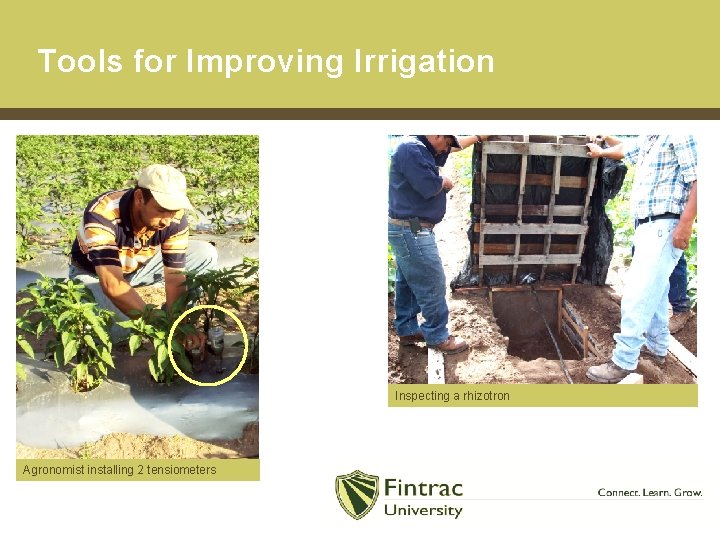
Irrigation: Frequency and Duration This depends on many factors such as climatic conditions, crop stage and soil type. Fundamentally, it comes down to ensuring that the water removed from the soil by evapotranspiration and leaching is replaced. Light but frequent irrigation cycles are recommended because this is the best way of keeping the soil close to field capacity without wasting water through drainage or leaching. Most farmers can determine the water needs of crops by just feeling the soil. There are other methods of determining the irrigation needs of a crop: • Tensiometers are instruments placed in the soil to measure soil moisture. They measure the pressure created by the movement of water in or out of the device depending on soil moisture levels. When the pressure is close to zero, the soil is flooded and the roots are getting no air. At readings above 20 centibars, plants are not getting enough water in coarse textured soils. Irrigation is needed for all soils at 40 -60 centibars and at 70 centibars, plants are water stressed. As indicated, exact readings depends on soil type. • Evaporation pans and crop coefficients (Kc) are used to determine how much water a crop has lost. This is then replaced by the irrigation system. • Rhizotrons are protected holes in the raised bed that allow us to see whether the duration and intensity of the irrigation cycle has produced the desired water bulb for optimal growth of the roots. Photo credit: Scot Nelson
Tools for Improving Irrigation Inspecting a rhizotron Agronomist installing 2 tensiometers Photo credit: Scot Nelson
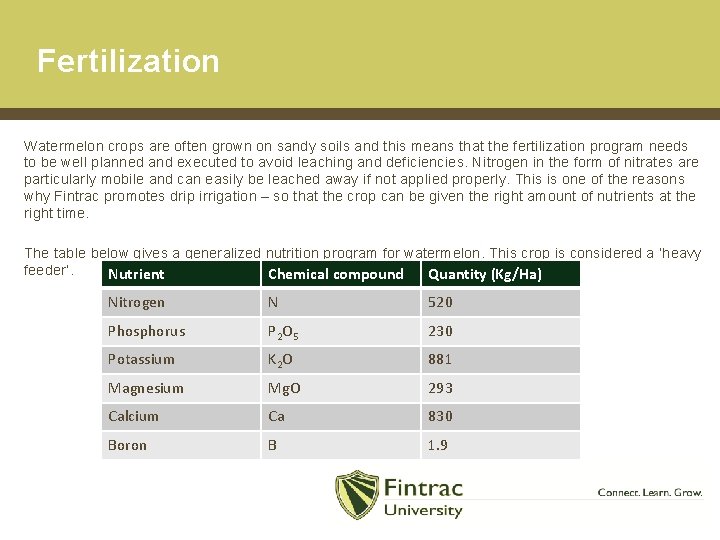
Fertilization Watermelon crops are often grown on sandy soils and this means that the fertilization program needs to be well planned and executed to avoid leaching and deficiencies. Nitrogen in the form of nitrates are particularly mobile and can easily be leached away if not applied properly. This is one of the reasons why Fintrac promotes drip irrigation – so that the crop can be given the right amount of nutrients at the right time. The table below gives a generalized nutrition program for watermelon. This crop is considered a ‘heavy feeder’. Nutrient Chemical compound Quantity (Kg/Ha) Nitrogen N 520 Phosphorus P 2 O 5 230 Potassium K 2 O 881 Magnesium Mg. O 293 Calcium Ca 830 Boron B 1. 9 Photo credit: Scot Nelson
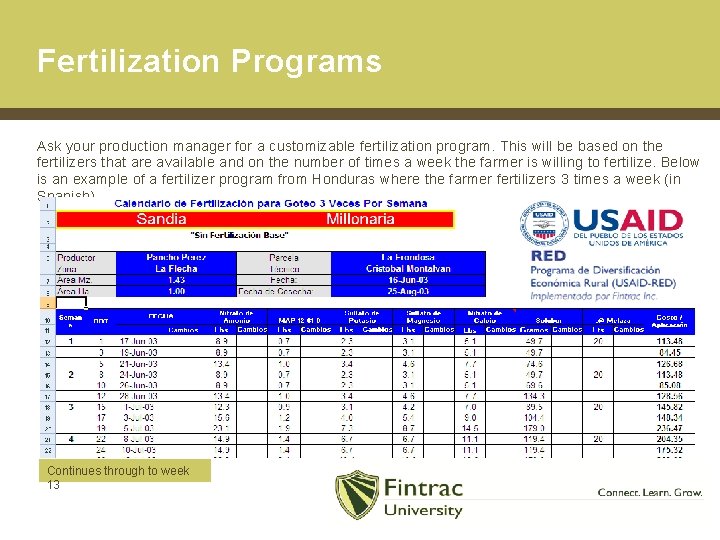
Fertilization Programs Ask your production manager for a customizable fertilization program. This will be based on the fertilizers that are available and on the number of times a week the farmer is willing to fertilize. Below is an example of a fertilizer program from Honduras where the farmer fertilizers 3 times a week (in Spanish). Continues through to week 13 Photo credit: Scot Nelson
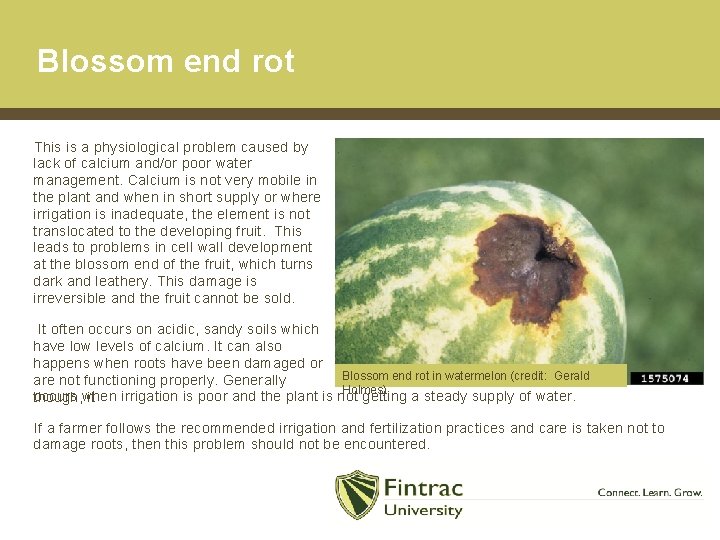
Blossom end rot This is a physiological problem caused by lack of calcium and/or poor water management. Calcium is not very mobile in the plant and when in short supply or where irrigation is inadequate, the element is not translocated to the developing fruit. This leads to problems in cell wall development at the blossom end of the fruit, which turns dark and leathery. This damage is irreversible and the fruit cannot be sold. It often occurs on acidic, sandy soils which have low levels of calcium. It can also happens when roots have been damaged or Blossom end rot in watermelon (credit: Gerald are not functioning properly. Generally Holmes) occurs when irrigation is poor and the plant is not getting a steady supply of water. though, it If a farmer follows the recommended irrigation and fertilization practices and care is taken not to damage roots, then this problem should not be encountered. Photo credit: Scot Nelson
Conclusion Ø Watermelon needs 20 -25 cms of water during its growth. Critical development phases are: • Before seedling emergence (too little affects germination & establishment) • During early flowering & fruit set (too little affects fruit setting) • During fruit development (too much reduces fruit quality & can lead to cracking) Ø Drip irrigation is recommended due to water use efficiency and ability to fertigate. Ø Can use tensiometers; evaporation pans & crop coefficients; and rhizotrons to determine water needs. Ø Watermelon extracts a relatively large amount of nutrients from the soil. Fertigation is an efficient way of replacing the needed nutrients and avoiding problems of leaching in sandy soils. Ø Blossom end rot is a problem in watermelon and occurs when calcium is lacking. It often occurs due to poor irrigation even when there is enough calcium in the soil. This concludes the unit on Irrigation and Fertilization. In the next unit, we will look the Cultural Practices of watermelon