
Watergate President Richard Nixons Downfall Election of 1972
- Slides: 20
Watergate President Richard Nixon’s Downfall
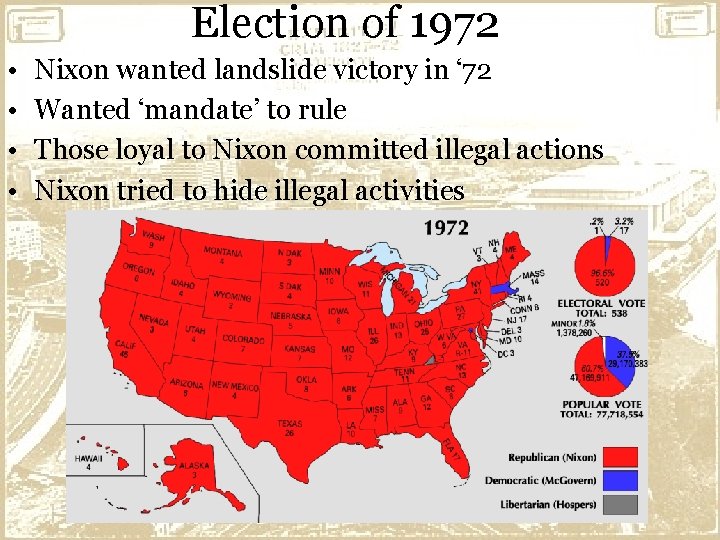
Election of 1972 • • Nixon wanted landslide victory in ‘ 72 Wanted ‘mandate’ to rule Those loyal to Nixon committed illegal actions Nixon tried to hide illegal activities
The Watergate Scandal • How did the Nixon White House battle its political enemies? • How did the Committee to Reelect the President conduct itself during Nixon’s reelection campaign? • What was the Watergate break-in, and how did the story of the scandal unfold? • What events led directly to Nixon’s resignation?
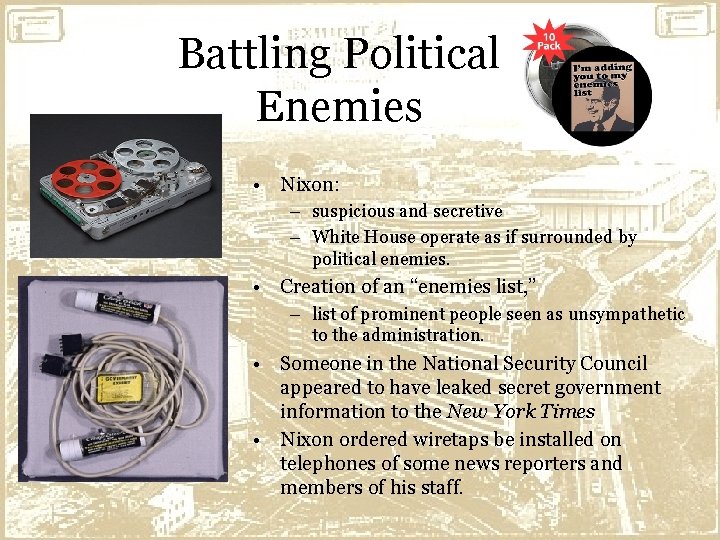
Battling Political Enemies • Nixon: – suspicious and secretive – White House operate as if surrounded by political enemies. • Creation of an “enemies list, ” – list of prominent people seen as unsympathetic to the administration. • Someone in the National Security Council appeared to have leaked secret government information to the New York Times • Nixon ordered wiretaps be installed on telephones of some news reporters and members of his staff.
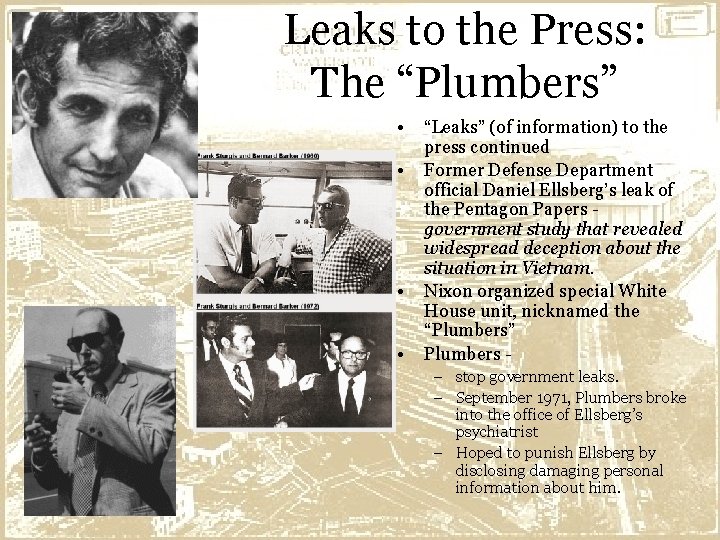
Leaks to the Press: The “Plumbers” • • “Leaks” (of information) to the press continued Former Defense Department official Daniel Ellsberg’s leak of the Pentagon Papers government study that revealed widespread deception about the situation in Vietnam. Nixon organized special White House unit, nicknamed the “Plumbers” Plumbers – stop government leaks. – September 1971, Plumbers broke into the office of Ellsberg’s psychiatrist – Hoped to punish Ellsberg by disclosing damaging personal information about him.
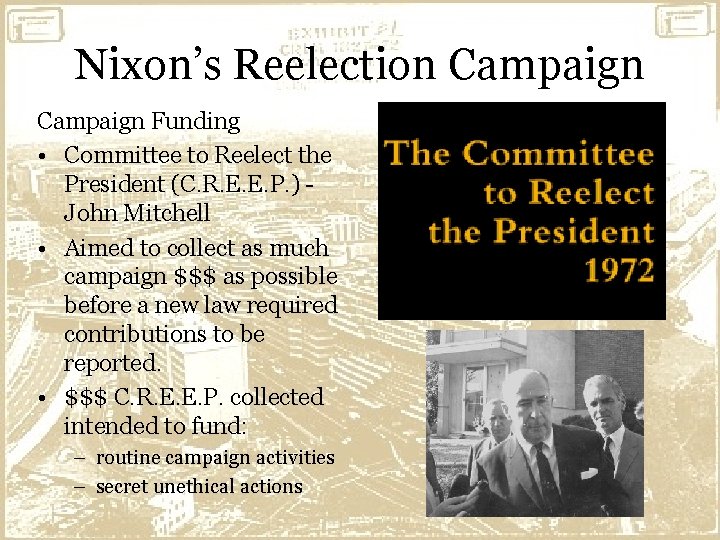
Nixon’s Reelection Campaign Funding • Committee to Reelect the President (C. R. E. E. P. ) John Mitchell • Aimed to collect as much campaign $$$ as possible before a new law required contributions to be reported. • $$$ C. R. E. E. P. collected intended to fund: – routine campaign activities – secret unethical actions
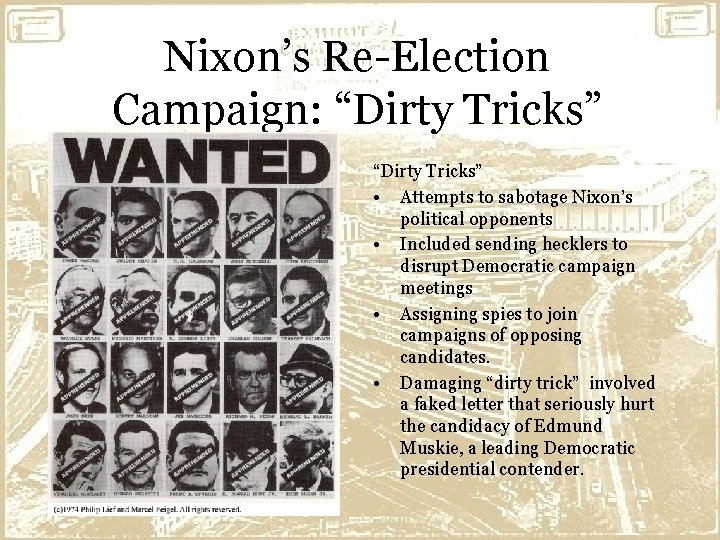
Nixon’s Re-Election Campaign: “Dirty Tricks” • Attempts to sabotage Nixon’s political opponents • Included sending hecklers to disrupt Democratic campaign meetings • Assigning spies to join campaigns of opposing candidates. • Damaging “dirty trick” involved a faked letter that seriously hurt the candidacy of Edmund Muskie, a leading Democratic presidential contender.
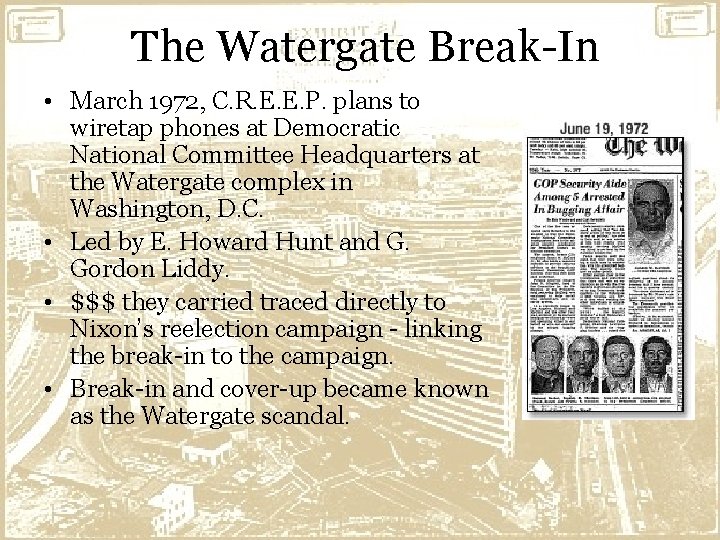
The Watergate Break-In • March 1972, C. R. E. E. P. plans to wiretap phones at Democratic National Committee Headquarters at the Watergate complex in Washington, D. C. • Led by E. Howard Hunt and G. Gordon Liddy. • $$$ they carried traced directly to Nixon’s reelection campaign - linking the break-in to the campaign. • Break-in and cover-up became known as the Watergate scandal.
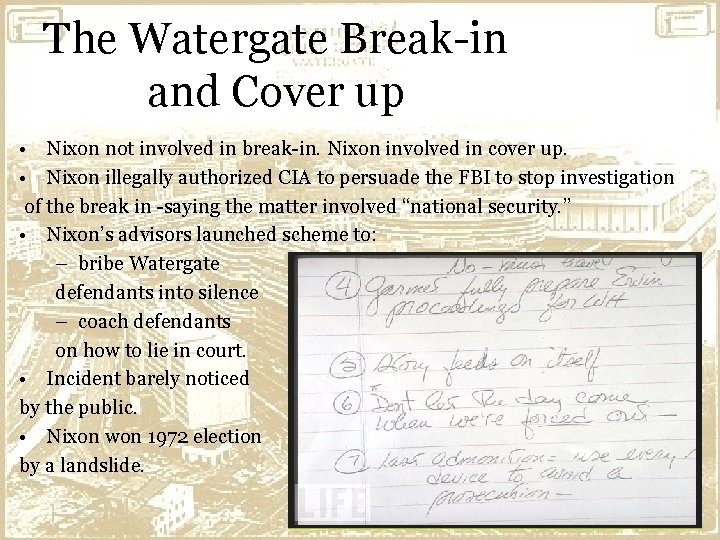
The Watergate Break-in and Cover up • Nixon not involved in break-in. Nixon involved in cover up. • Nixon illegally authorized CIA to persuade the FBI to stop investigation of the break in -saying the matter involved “national security. ” • Nixon’s advisors launched scheme to: – bribe Watergate defendants into silence – coach defendants on how to lie in court. • Incident barely noticed by the public. • Nixon won 1972 election by a landslide.
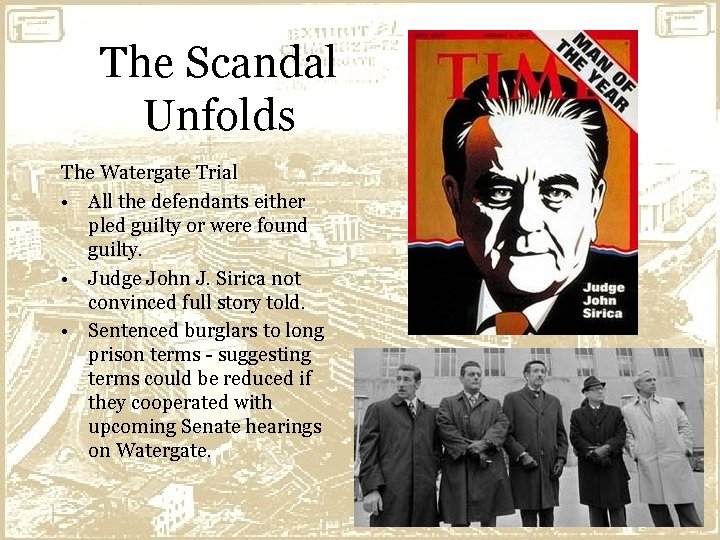
The Scandal Unfolds The Watergate Trial • All the defendants either pled guilty or were found guilty. • Judge John J. Sirica not convinced full story told. • Sentenced burglars to long prison terms - suggesting terms could be reduced if they cooperated with upcoming Senate hearings on Watergate.
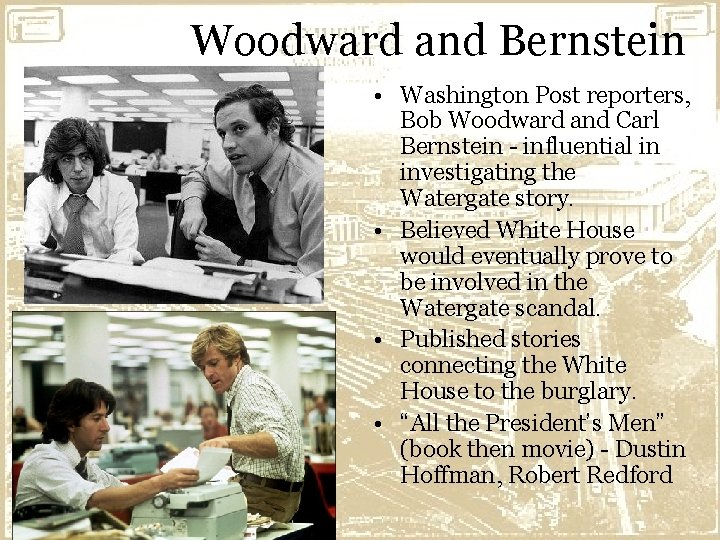
Woodward and Bernstein • Washington Post reporters, Bob Woodward and Carl Bernstein - influential in investigating the Watergate story. • Believed White House would eventually prove to be involved in the Watergate scandal. • Published stories connecting the White House to the burglary. • “All the President’s Men” (book then movie) - Dustin Hoffman, Robert Redford
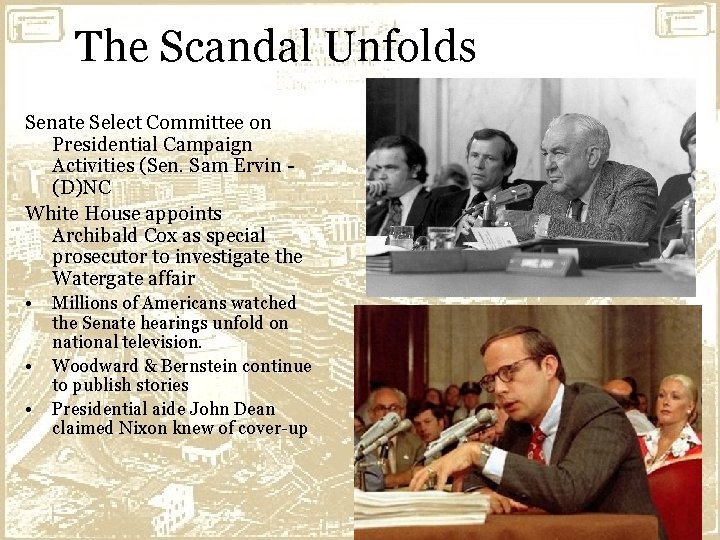
The Scandal Unfolds Senate Select Committee on Presidential Campaign Activities (Sen. Sam Ervin (D)NC White House appoints Archibald Cox as special prosecutor to investigate the Watergate affair • • • Millions of Americans watched the Senate hearings unfold on national television. Woodward & Bernstein continue to publish stories Presidential aide John Dean claimed Nixon knew of cover-up
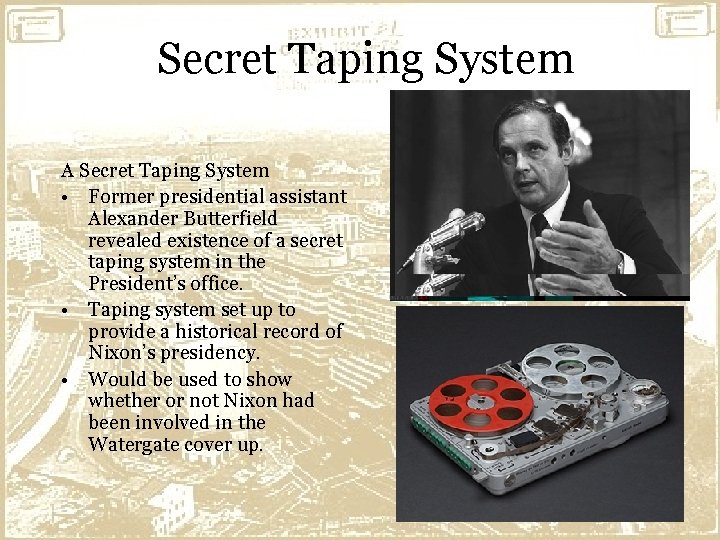
Secret Taping System A Secret Taping System • Former presidential assistant Alexander Butterfield revealed existence of a secret taping system in the President’s office. • Taping system set up to provide a historical record of Nixon’s presidency. • Would be used to show whether or not Nixon had been involved in the Watergate cover up.
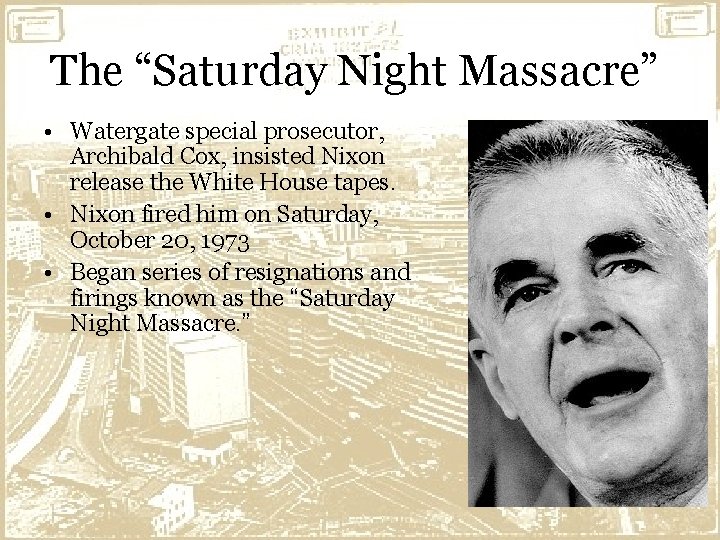
The “Saturday Night Massacre” • Watergate special prosecutor, Archibald Cox, insisted Nixon release the White House tapes. • Nixon fired him on Saturday, October 20, 1973 • Began series of resignations and firings known as the “Saturday Night Massacre. ”
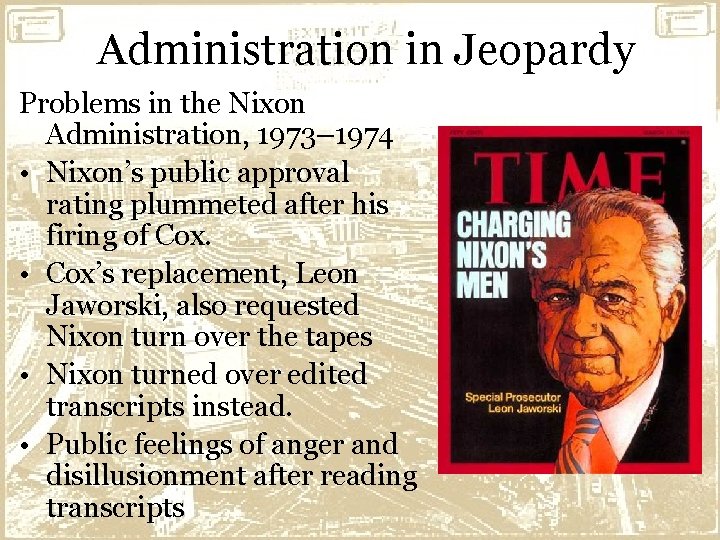
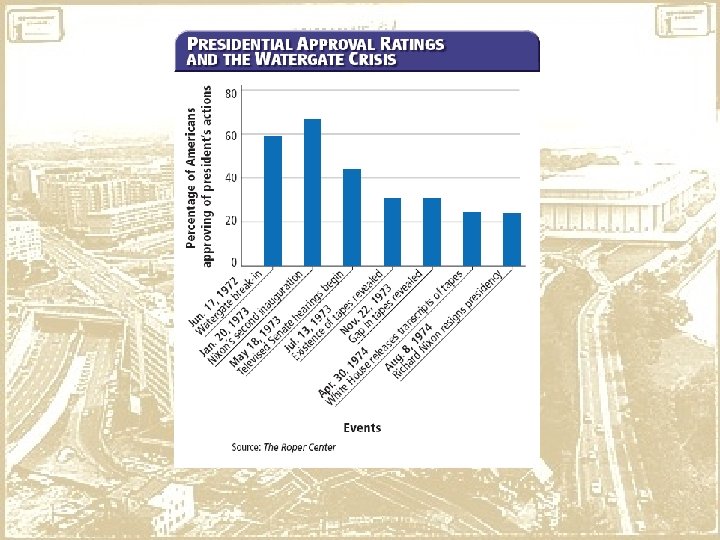
Administration in Jeopardy Problems in the Nixon Administration, 1973– 1974 • Nixon’s public approval rating plummeted after his firing of Cox. • Cox’s replacement, Leon Jaworski, also requested Nixon turn over the tapes • Nixon turned over edited transcripts instead. • Public feelings of anger and disillusionment after reading transcripts
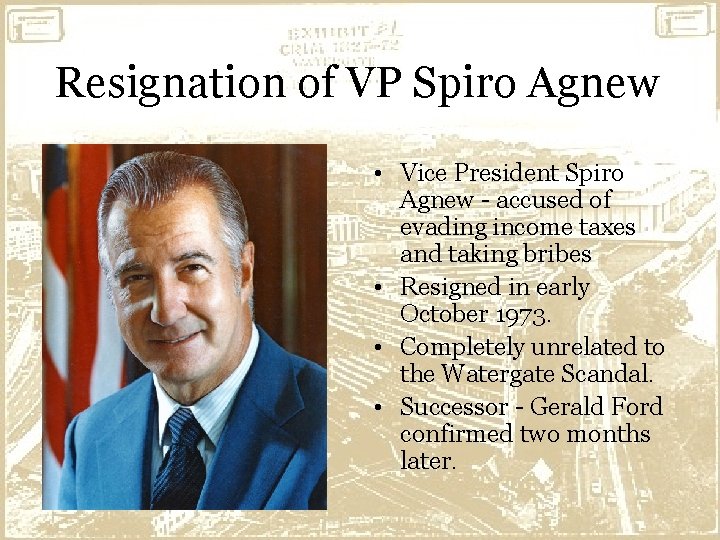
Resignation of VP Spiro Agnew • Vice President Spiro Agnew - accused of evading income taxes and taking bribes • Resigned in early October 1973. • Completely unrelated to the Watergate Scandal. • Successor - Gerald Ford confirmed two months later.
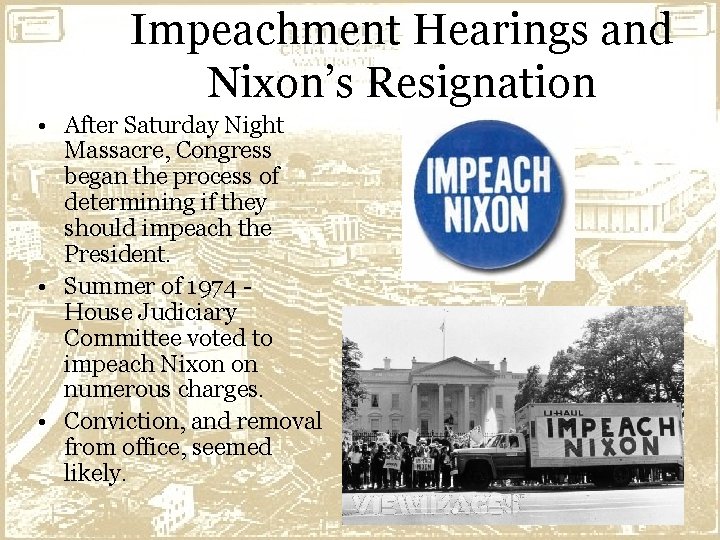
Impeachment Hearings and Nixon’s Resignation • After Saturday Night Massacre, Congress began the process of determining if they should impeach the President. • Summer of 1974 House Judiciary Committee voted to impeach Nixon on numerous charges. • Conviction, and removal from office, seemed likely.
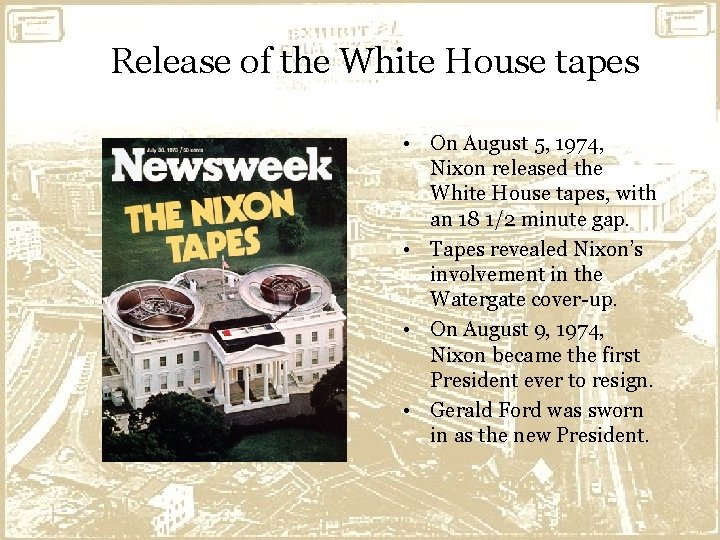
Release of the White House tapes • On August 5, 1974, Nixon released the White House tapes, with an 18 1/2 minute gap. • Tapes revealed Nixon’s involvement in the Watergate cover-up. • On August 9, 1974, Nixon became the first President ever to resign. • Gerald Ford was sworn in as the new President.
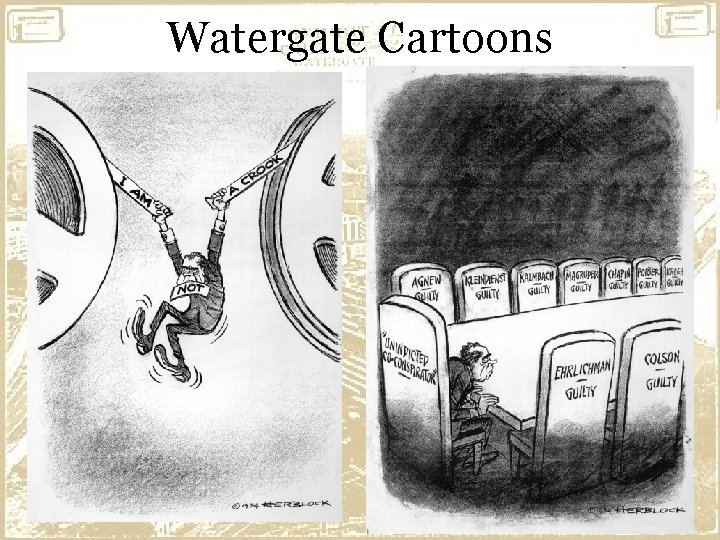
Watergate Cartoons