
Waterfall Life Cycle Model Requirements definition and analysis








![Example entry: date host prog [ bad ] user [ “from” host ] “to”](https://slidetodoc.com/presentation_image_h2/5ec55d2615c6239f426449146a939116/image-28.jpg "Example entry: date host prog [ bad ] user [ “from” host ] “to”")





- Slides: 44
Waterfall Life Cycle Model • Requirements definition and analysis – Functional and non-functional – General (for customer), specifications • • System and software design Implementation and unit testing Integration and system testing Operation and maintenance May 27, 2004 ECS 235 1
Relationship of Stages May 27, 2004 ECS 235 2
Models • Exploratory programming – Develop working system quickly – Used when detailed requirements specification cannot be formulated in advance, and adequacy is goal – No requirements or design specification, so low assurance • Prototyping – Objective is to establish system requirements – Future iterations (after first) allow assurance techniques May 27, 2004 ECS 235 3
Models • Formal transformation – Create formal specification – Translate it into program using correctness-preserving transformations – Very conducive to assurance methods • System assembly from reusable components – Depends on whether components are trusted – Must assure connections, composition as well – Very complex, difficult to assure May 27, 2004 ECS 235 4
Models • Extreme programming – – – Rapid prototyping and “best practices” Project driven by business decisions Requirements open until project complete Programmers work in teams Components tested, integrated several times a day Objective is to get system into production as quickly as possible, then enhance it – Evidence adduced after development needed for assurance May 27, 2004 ECS 235 5
Key Points • Assurance critical for determining trustworthiness of systems • Different levels of assurance, from informal evidence to rigorous mathematical evidence • Assurance needed at all stages of system life cycle May 27, 2004 ECS 235 6
Auditing • • • Overview What is auditing? What does an audit system look like? How do you design an auditing system? Auditing mechanisms Examples: NFSv 2, LAFS May 27, 2004 ECS 235 7
What is Auditing? • Logging – Recording events or statistics to provide information about system use and performance • Auditing – Analysis of log records to present information about the system in a clear, understandable manner May 27, 2004 ECS 235 8
Uses • Describe security state – Determine if system enters unauthorized state • Evaluate effectiveness of protection mechanisms – Determine which mechanisms are appropriate and working – Deter attacks because of presence of record May 27, 2004 ECS 235 9
Problems • What do you log? – Hint: looking for violations of a policy, so record at least what will show such violations • What do you audit? – Need not audit everything – Key: what is the policy involved? May 27, 2004 ECS 235 10
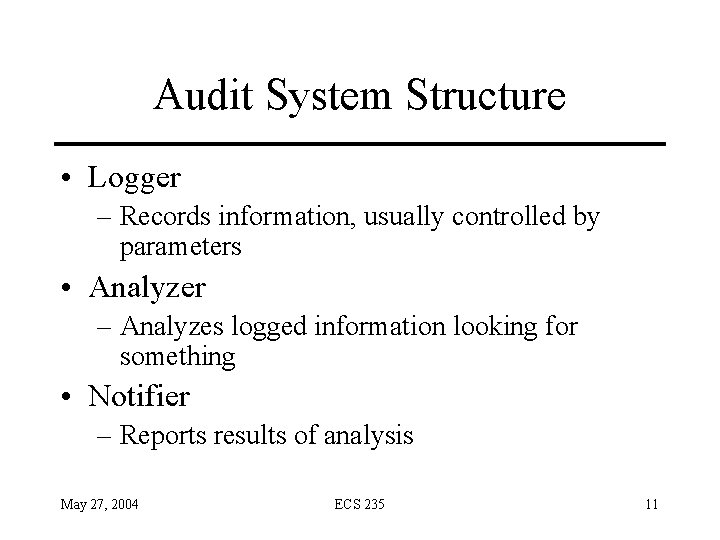
Audit System Structure • Logger – Records information, usually controlled by parameters • Analyzer – Analyzes logged information looking for something • Notifier – Reports results of analysis May 27, 2004 ECS 235 11
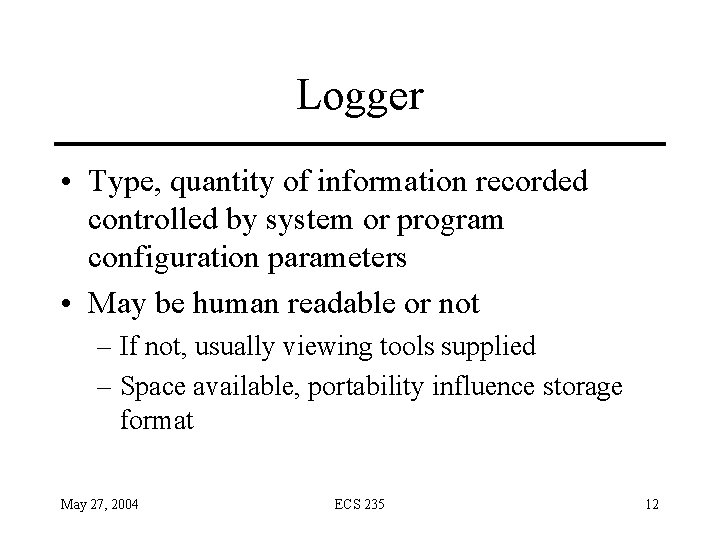
Logger • Type, quantity of information recorded controlled by system or program configuration parameters • May be human readable or not – If not, usually viewing tools supplied – Space available, portability influence storage format May 27, 2004 ECS 235 12
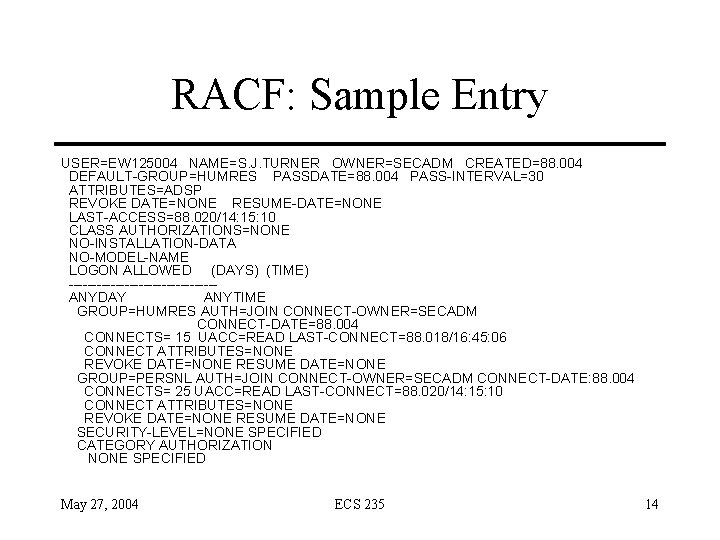
Example: RACF • Security enhancement package for IBM’s MVS/VM • Logs failed access attempts, use of privilege to change security levels, and (if desired) RACF interactions • View events with LISTUSERS commands May 27, 2004 ECS 235 13
RACF: Sample Entry USER=EW 125004 NAME=S. J. TURNER OWNER=SECADM CREATED=88. 004 DEFAULT-GROUP=HUMRES PASSDATE=88. 004 PASS-INTERVAL=30 ATTRIBUTES=ADSP REVOKE DATE=NONE RESUME-DATE=NONE LAST-ACCESS=88. 020/14: 15: 10 CLASS AUTHORIZATIONS=NONE NO-INSTALLATION-DATA NO-MODEL-NAME LOGON ALLOWED (DAYS) (TIME) ----------------ANYDAY ANYTIME GROUP=HUMRES AUTH=JOIN CONNECT-OWNER=SECADM CONNECT-DATE=88. 004 CONNECTS= 15 UACC=READ LAST-CONNECT=88. 018/16: 45: 06 CONNECT ATTRIBUTES=NONE REVOKE DATE=NONE RESUME DATE=NONE GROUP=PERSNL AUTH=JOIN CONNECT-OWNER=SECADM CONNECT-DATE: 88. 004 CONNECTS= 25 UACC=READ LAST-CONNECT=88. 020/14: 15: 10 CONNECT ATTRIBUTES=NONE REVOKE DATE=NONE RESUME DATE=NONE SECURITY-LEVEL=NONE SPECIFIED CATEGORY AUTHORIZATION NONE SPECIFIED May 27, 2004 ECS 235 14
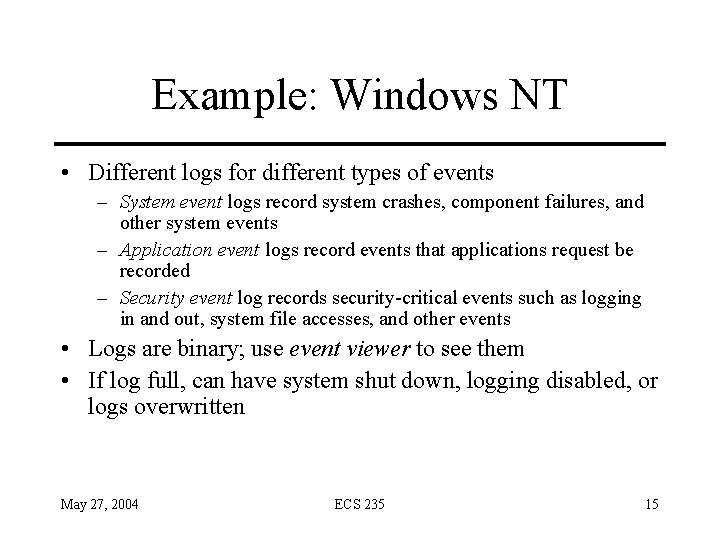
Example: Windows NT • Different logs for different types of events – System event logs record system crashes, component failures, and other system events – Application event logs record events that applications request be recorded – Security event log records security-critical events such as logging in and out, system file accesses, and other events • Logs are binary; use event viewer to see them • If log full, can have system shut down, logging disabled, or logs overwritten May 27, 2004 ECS 235 15
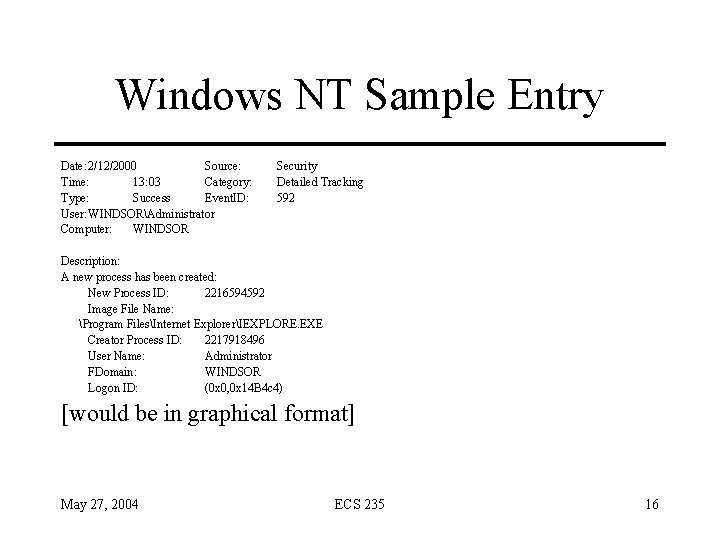
Windows NT Sample Entry Date: 2/12/2000 Source: Time: 13: 03 Category: Type: Success Event. ID: User: WINDSORAdministrator Computer: WINDSOR Security Detailed Tracking 592 Description: A new process has been created: New Process ID: 2216594592 Image File Name: Program FilesInternet ExplorerIEXPLORE. EXE Creator Process ID: 2217918496 User Name: Administrator FDomain: WINDSOR Logon ID: (0 x 0, 0 x 14 B 4 c 4) [would be in graphical format] May 27, 2004 ECS 235 16
Analyzer • Analyzes one or more logs – Logs may come from multiple systems, or a single system – May lead to changes in logging – May lead to a report of an event May 27, 2004 ECS 235 17
Examples • Using swatch to find instances of telnet from tcpd logs: /telnet/&!/localhost/&!/*. site. com/ • Query set overlap control in databases – If too much overlap between current query and past queries, do not answer • Intrusion detection analysis engine (director) – Takes data from sensors and determines if an intrusion is occurring May 27, 2004 ECS 235 18
Notifier • Informs analyst, other entities of results of analysis • May reconfigure logging and/or analysis on basis of results May 27, 2004 ECS 235 19
Examples • Using swatch to notify of telnets /telnet/&!/localhost/&!/*. site. com/ mail staff • Query set overlap control in databases – Prevents response from being given if too much overlap occurs • Three failed logins in a row disable user account – Notifier disables account, notifies sysadmin May 27, 2004 ECS 235 20
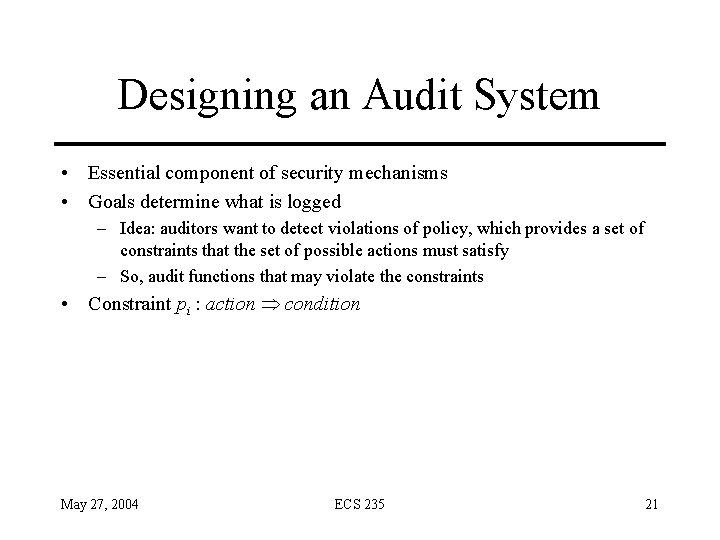
Designing an Audit System • Essential component of security mechanisms • Goals determine what is logged – Idea: auditors want to detect violations of policy, which provides a set of constraints that the set of possible actions must satisfy – So, audit functions that may violate the constraints • Constraint pi : action condition May 27, 2004 ECS 235 21
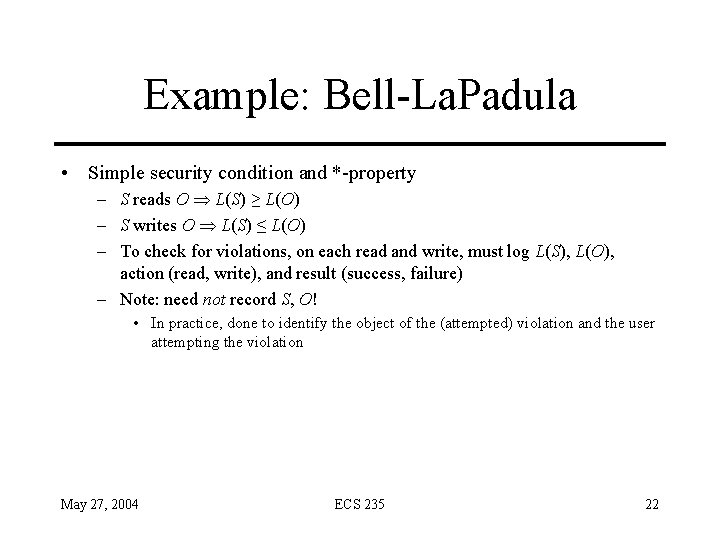
Example: Bell-La. Padula • Simple security condition and *-property – S reads O L(S) ≥ L(O) – S writes O L(S) ≤ L(O) – To check for violations, on each read and write, must log L(S), L(O), action (read, write), and result (success, failure) – Note: need not record S, O! • In practice, done to identify the object of the (attempted) violation and the user attempting the violation May 27, 2004 ECS 235 22
Remove Tranquility • New commands to manipulate security level must also record information – S reclassify O to L(O´) L(O) ≤ L(S) and L(O´) ≤ L(S) – Log L(O), L(O´), L(S), action (reclassify), and result (success, failure) – Again, need not record O or S to detect violation • But needed to follow up … May 27, 2004 ECS 235 23
Example: Chinese Wall • Subject S has COI(S) and CD(S) – CDH(S) is set of company datasets that S has accessed • Object O has COI(O) and CD(O) – san(O) iff O contains only sanitized information • Constraints – S reads O COI(O) ≠ COI(S) O´(CD(O´) CDH(S)) – S writes O (S canread O) O´(COI(O) = COI(O´) S canread O´ san(O´)) May 27, 2004 ECS 235 24
Recording • S reads O COI(O) ≠ COI(S) O´(CD(O´) CDH(S)) – Record COI(O), COI(S), CDH(S), CD(O´) if such an O´ exists, action (read), and result (success, failure) • S writes O (S canread O) O´(COI(O) = COI(O´) S canread O´ san(O´)) – Record COI(O), COI(S), CDH(S), plus COI(O´) and CD(O´) if such an O´ exists, action (write), and result (success, failure) May 27, 2004 ECS 235 25
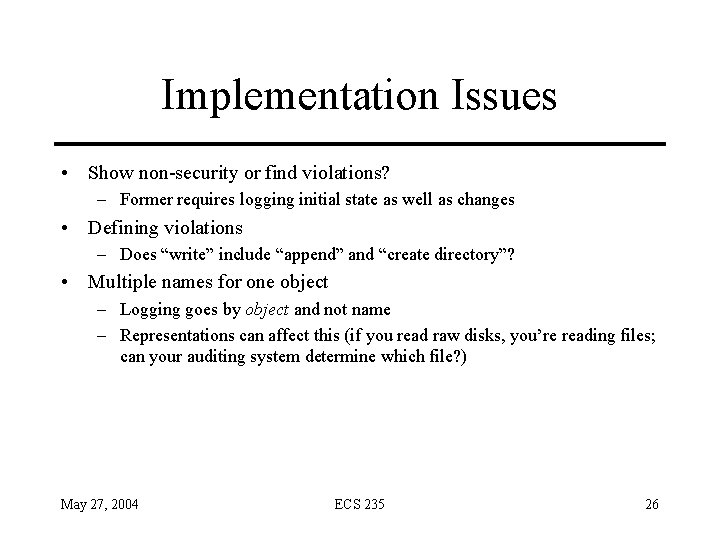
Implementation Issues • Show non-security or find violations? – Former requires logging initial state as well as changes • Defining violations – Does “write” include “append” and “create directory”? • Multiple names for one object – Logging goes by object and not name – Representations can affect this (if you read raw disks, you’re reading files; can your auditing system determine which file? ) May 27, 2004 ECS 235 26
Syntactic Issues • Data that is logged may be ambiguous – BSM: two optional text fields followed by two mandatory text fields – If three fields, which of the optional fields is omitted? • Solution: use grammar to ensure welldefined syntax of log files May 27, 2004 ECS 235 27
Example entry: date host prog [ bad ] user [ “from” host ] “to” user “on” tty date : daytime host : string prog : string “: ” bad : “FAILED” user : string tty : “/dev/” string • Log file entry format defined unambiguously • Audit mechanism could scan, interpret entries without confusion May 27, 2004 ECS 235 28
More Syntactic Issues • Context – Unknown user uses anonymous ftp to retrieve file “/etc/passwd” – Logged as such – Problem: which /etc/passwd file? • One in system /etc directory • One in anonymous ftp directory /var/ftp/etc, and as ftp thinks /var/ftp is the root directory, /etc/passwd refers to /var/ftp/etc/passwd May 27, 2004 ECS 235 29
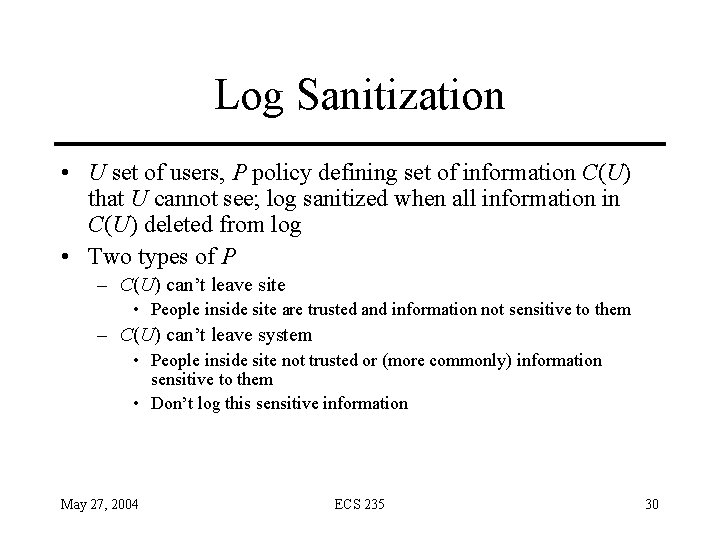
Log Sanitization • U set of users, P policy defining set of information C(U) that U cannot see; log sanitized when all information in C(U) deleted from log • Two types of P – C(U) can’t leave site • People inside site are trusted and information not sensitive to them – C(U) can’t leave system • People inside site not trusted or (more commonly) information sensitive to them • Don’t log this sensitive information May 27, 2004 ECS 235 30
Logging Organization • Top prevents information from leaving site – Users’ privacy not protected from system administrators, other administrative personnel • Bottom prevents information from leaving system – Data simply not recorded, or data scrambled before recording May 27, 2004 ECS 235 31
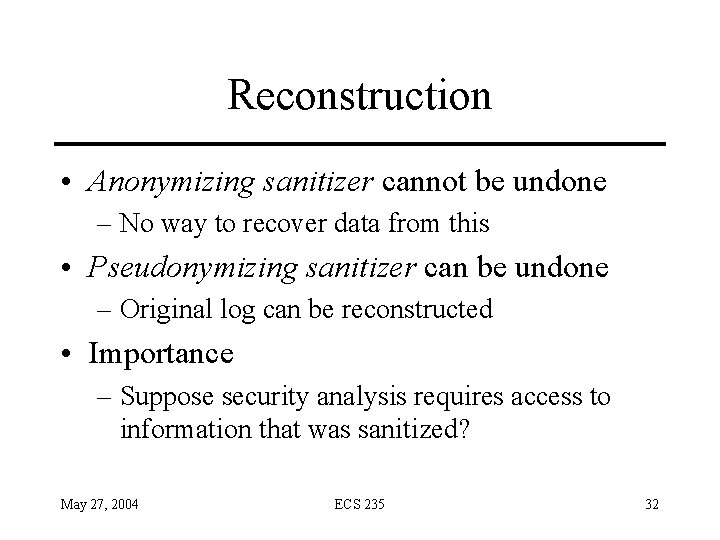
Reconstruction • Anonymizing sanitizer cannot be undone – No way to recover data from this • Pseudonymizing sanitizer can be undone – Original log can be reconstructed • Importance – Suppose security analysis requires access to information that was sanitized? May 27, 2004 ECS 235 32
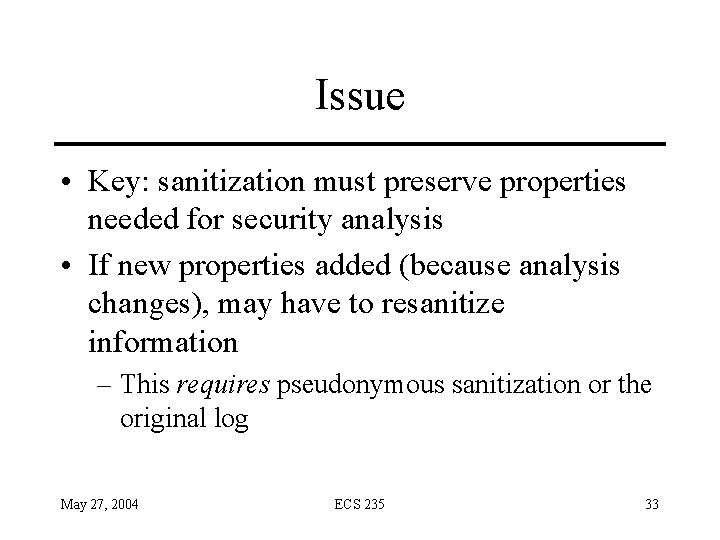
Issue • Key: sanitization must preserve properties needed for security analysis • If new properties added (because analysis changes), may have to resanitize information – This requires pseudonymous sanitization or the original log May 27, 2004 ECS 235 33
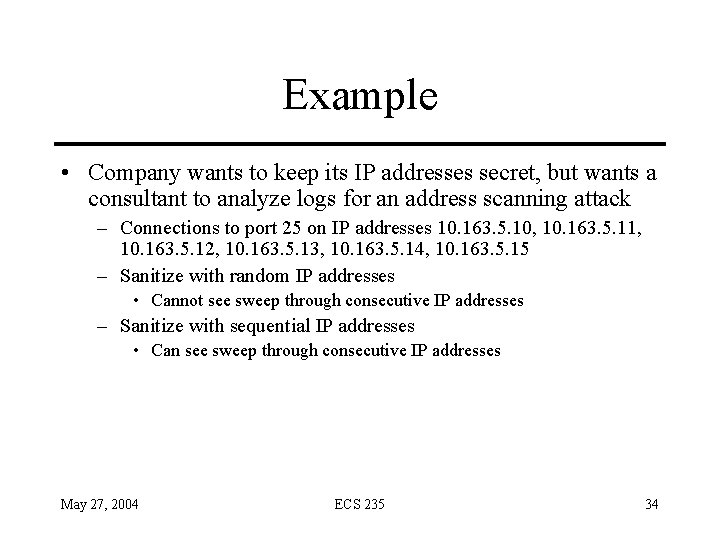
Example • Company wants to keep its IP addresses secret, but wants a consultant to analyze logs for an address scanning attack – Connections to port 25 on IP addresses 10. 163. 5. 10, 10. 163. 5. 11, 10. 163. 5. 12, 10. 163. 5. 13, 10. 163. 5. 14, 10. 163. 5. 15 – Sanitize with random IP addresses • Cannot see sweep through consecutive IP addresses – Sanitize with sequential IP addresses • Can see sweep through consecutive IP addresses May 27, 2004 ECS 235 34
Generation of Pseudonyms 1. Devise set of pseudonyms to replace sensitive information • • 2. Replace data with pseudonyms Maintain table mapping pseudonyms to data Use random key to encipher sensitive datum and use secret sharing scheme to share key • • May 27, 2004 Used when insiders cannot see unsanitized data, but outsiders (law enforcement) need to Requires t out of n people to read data ECS 235 35
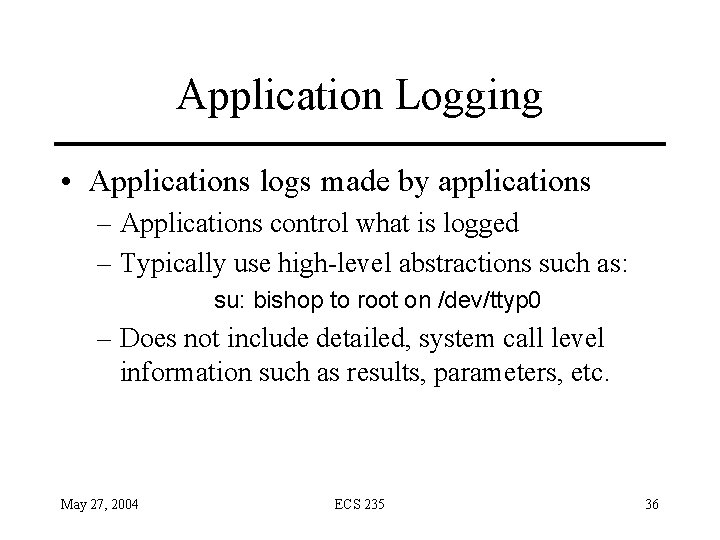
Application Logging • Applications logs made by applications – Applications control what is logged – Typically use high-level abstractions such as: su: bishop to root on /dev/ttyp 0 – Does not include detailed, system call level information such as results, parameters, etc. May 27, 2004 ECS 235 36
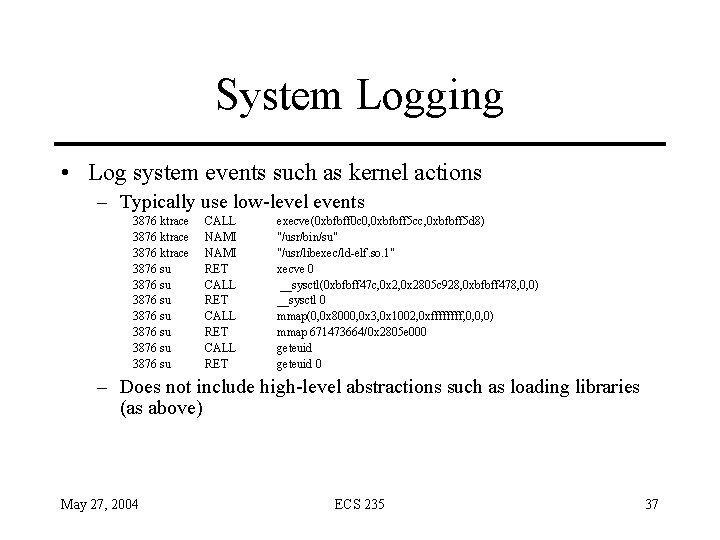
System Logging • Log system events such as kernel actions – Typically use low-level events 3876 ktrace 3876 su 3876 su CALL NAMI RET CALL RET execve(0 xbfbff 0 c 0, 0 xbfbff 5 cc, 0 xbfbff 5 d 8) "/usr/bin/su" "/usr/libexec/ld-elf. so. 1" xecve 0 __sysctl(0 xbfbff 47 c, 0 x 2805 c 928, 0 xbfbff 478, 0, 0) __sysctl 0 mmap(0, 0 x 8000, 0 x 3, 0 x 1002, 0 xffff, 0, 0, 0) mmap 671473664/0 x 2805 e 000 geteuid 0 – Does not include high-level abstractions such as loading libraries (as above) May 27, 2004 ECS 235 37
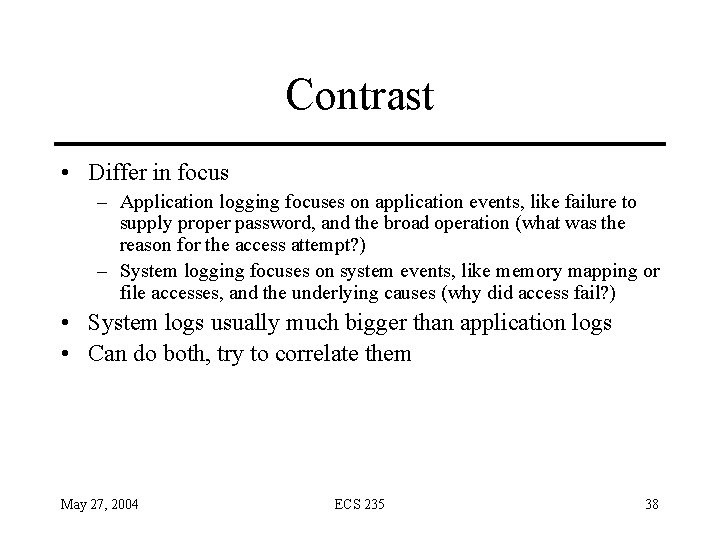
Contrast • Differ in focus – Application logging focuses on application events, like failure to supply proper password, and the broad operation (what was the reason for the access attempt? ) – System logging focuses on system events, like memory mapping or file accesses, and the underlying causes (why did access fail? ) • System logs usually much bigger than application logs • Can do both, try to correlate them May 27, 2004 ECS 235 38
Design • A posteriori design – Need to design auditing mechanism for system not built with security in mind • Goal of auditing – Detect any violation of a stated policy • Focus is on policy and actions designed to violate policy; specific actions may not be known – Detect actions known to be part of an attempt to breach security • Focus on specific actions that have been determined to indicate attacks May 27, 2004 ECS 235 39
Detect Violations of Known Policy • Goal: does system enter a disallowed state? • Two forms – State-based auditing • Look at current state of system – Transition-based auditing • Look at actions that transition system from one state to another May 27, 2004 ECS 235 40
State-Based Auditing • Log information about state and determine if state allowed – Assumption: you can get a snapshot of system state – Snapshot needs to be consistent – Non-distributed system needs to be quiescent – Distributed system can use Chandy-Lamport algorithm, or some other algorithm, to obtain this May 27, 2004 ECS 235 41
Example • File system auditing tools – Thought of as analyzing single state (snapshot) – In reality, analyze many slices of different state unless file system quiescent – Potential problem: if test at end depends on result of test at beginning, relevant parts of system state may have changed between the first test and the last • Classic TOCTTOU flaw May 27, 2004 ECS 235 42
Transition-Based Auditing • Log information about action, and examine current state and proposed transition to determine if new state would be disallowed – Note: just analyzing the transition may not be enough; you may need the initial state – Tend to use this when specific transitions always require analysis (for example, change of privilege) May 27, 2004 ECS 235 43
Example • TCP access control mechanism intercepts TCP connections and checks against a list of connections to be blocked – Obtains IP address of source of connection – Logs IP address, port, and result (allowed/blocked) in log file – Purely transition-based (current state not analyzed at all) May 27, 2004 ECS 235 44