
Water What do you know about its Structure
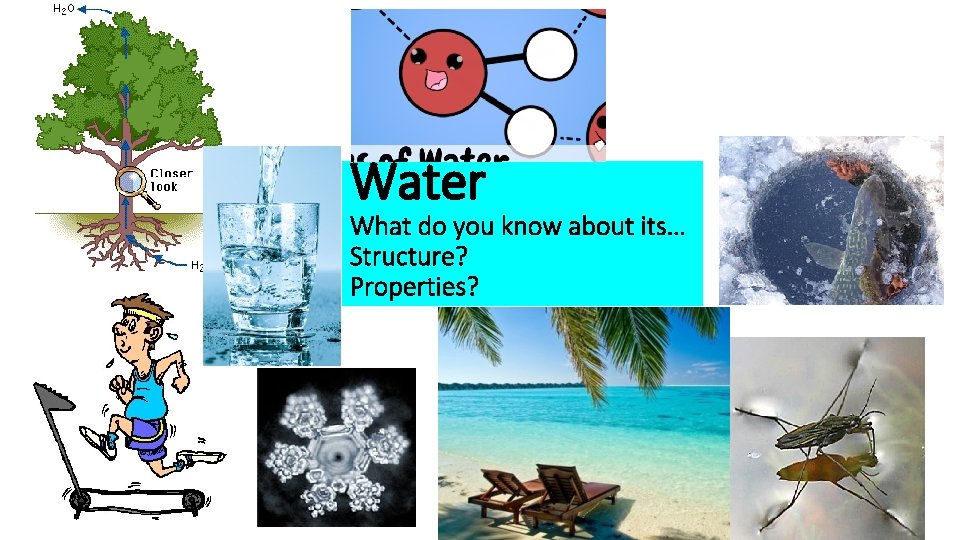
Water What do you know about its… Structure? Properties?
Properties of Water Learning objective Success Criteria • To know about the properties and bonding of water • Describe how hydrogen bonding occurs between water molecules • Relate this, and other properties of water, to the roles of water in living organisms
Polar molecule Lots of hydrogen bonds Cohesive Properties of water Cohesive Solvent Reactant Thermally stable High specific heat capacity High latent heat of evaporation Liquid at room temp (and up to 100 ºC) (liquid at higher temper Solid (Ice) is less dense than liquid water (floats)
What are the properties of water? Cohesive Solvent Reactant High specific heat capacity High latent heat of evaporation Liquid Floats
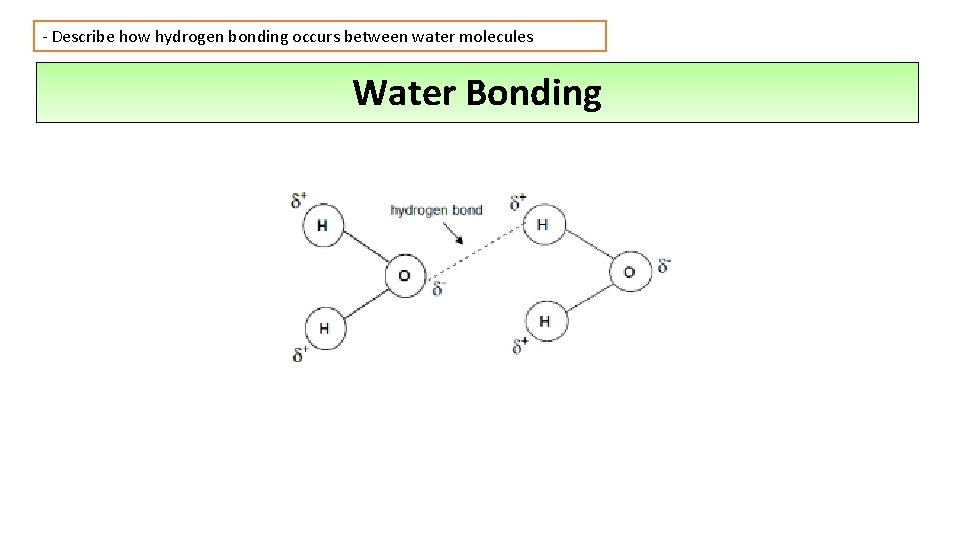
- Describe how hydrogen bonding occurs between water molecules Water Bonding
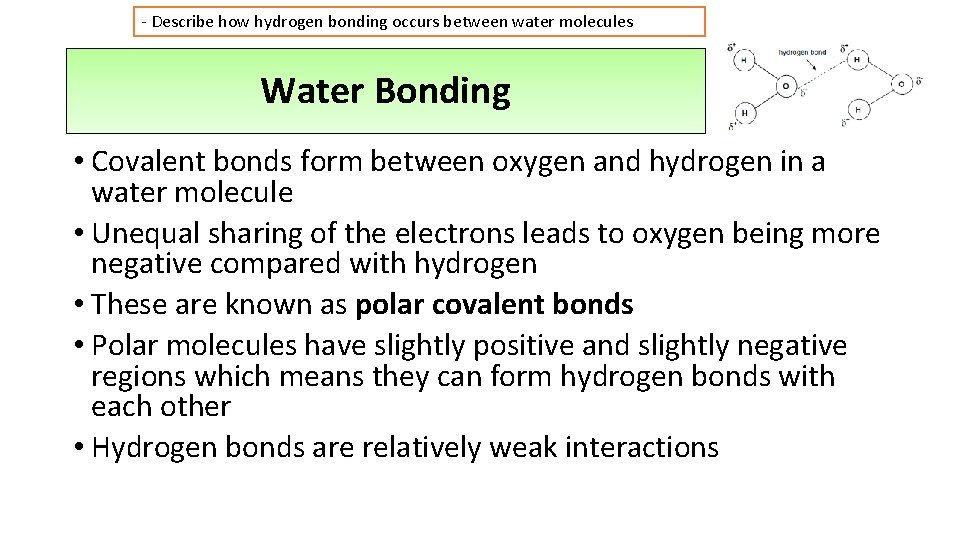
- Describe how hydrogen bonding occurs between water molecules Water Bonding • Covalent bonds form between oxygen and hydrogen in a water molecule • Unequal sharing of the electrons leads to oxygen being more negative compared with hydrogen • These are known as polar covalent bonds • Polar molecules have slightly positive and slightly negative regions which means they can form hydrogen bonds with each other • Hydrogen bonds are relatively weak interactions
Water – an unusual molecule that we our entire existence to! Compared to other similar molecules Polar molecule Forms lots of hydrogen bonds with other water molecules Cohesive Cohesion The attraction of water molecules to each other due to hydrogen bonds
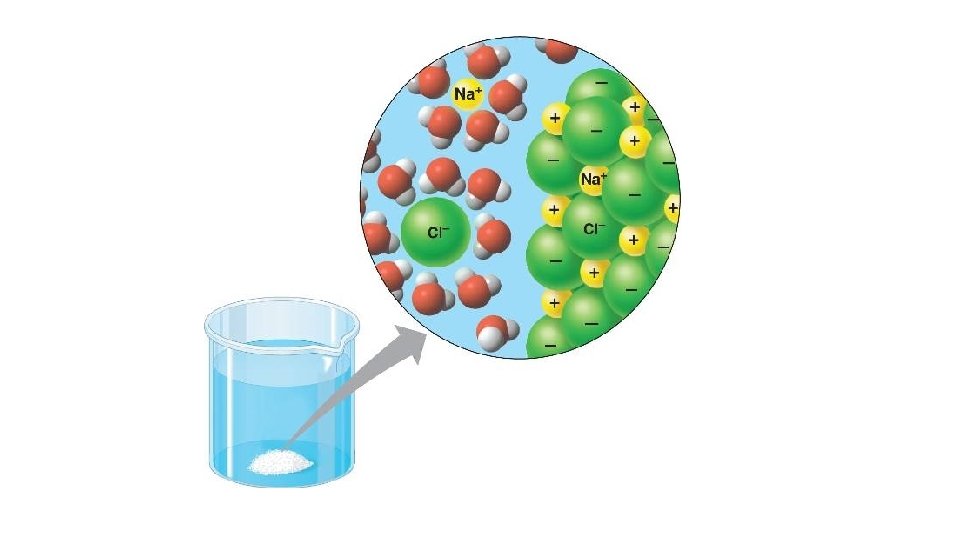
Reactant Water is a reactant in chemical reactions such as photosynthesis, and in hydrolysis reactions such as digestion of starch, proteins and lipids etc Solvent The negative and positive parts of a water molecule are attracted to the negative and positive parts of the solute The water molecules cluster around the charged parts of the solute, separating them, and forming a solution
High specific heat capacity This is the amount of energy required tp raise the temperature of 1 kg of water by 1ºC Lots of energy input is required to break the H bonds between water molecules Therefore water does not cool down or heat up easily, and provides a stable temperature environment High latent heat of evaporation For water to become a gas, the H bonds between molecules need to be broken Lots of energy is needed to break these bonds Water therefore helps to cool living organisms due to the transfer of heat energy away from the surface
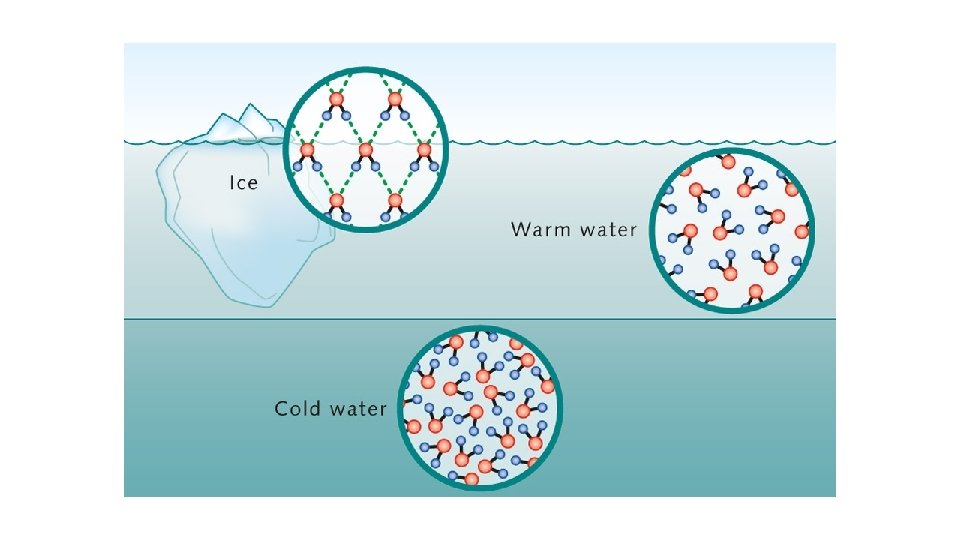
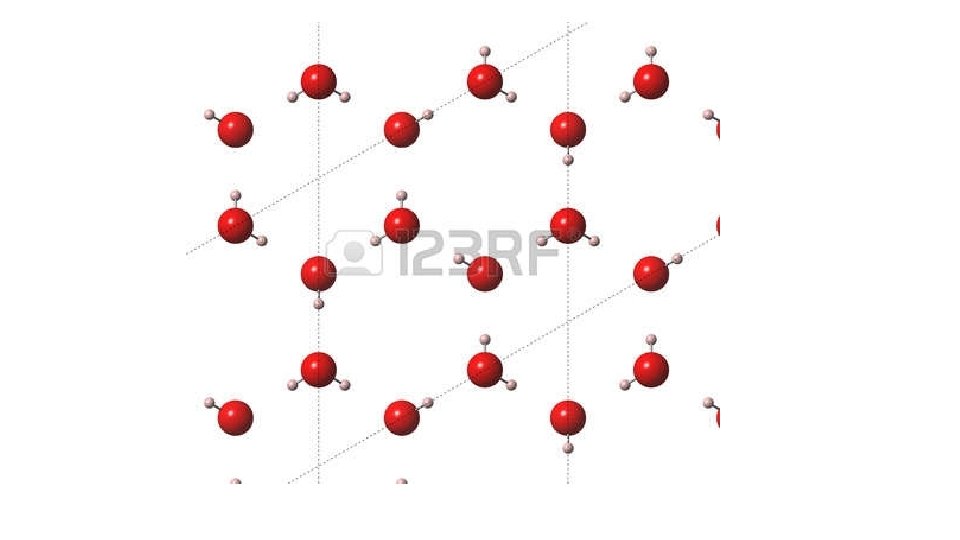
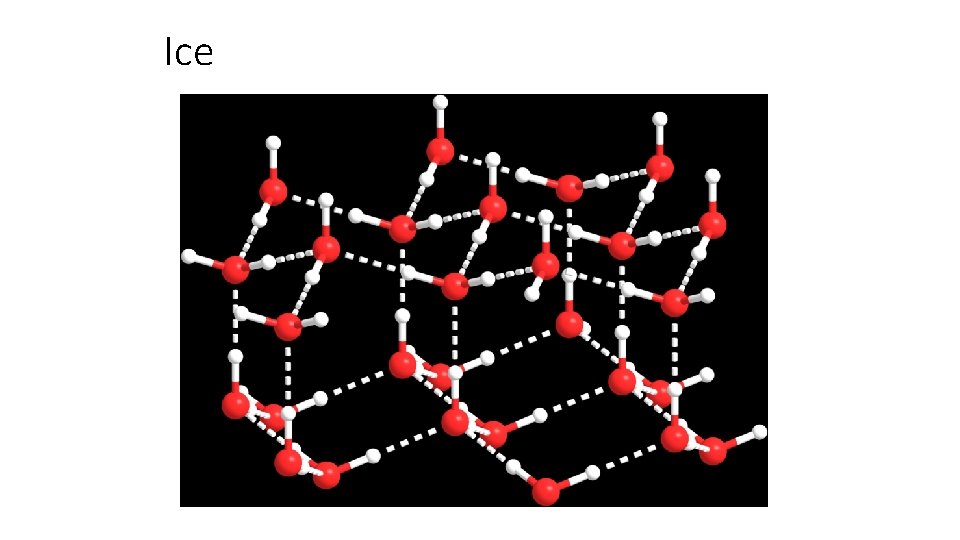
Ice
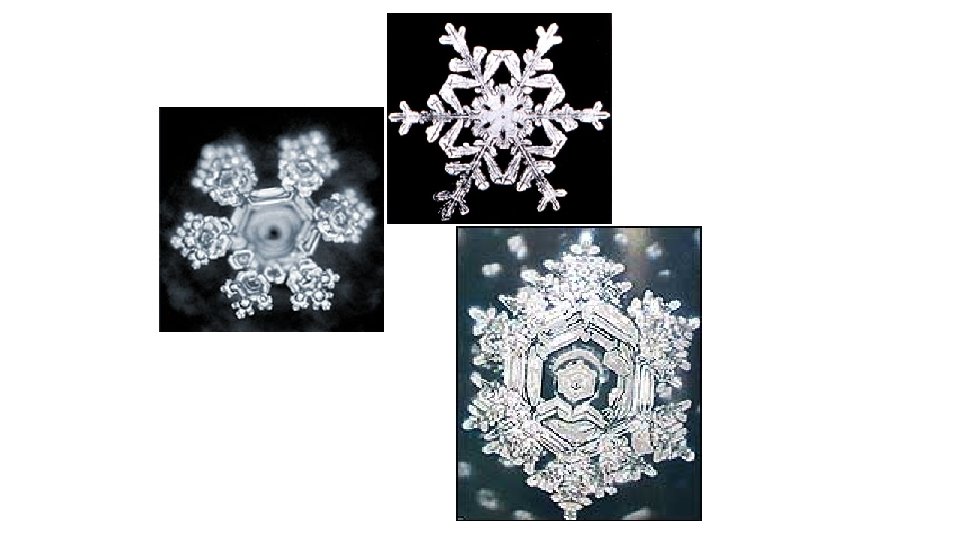
Task - Relate this, and other properties of water, to the roles of water in living organisms • Using video notes and textbooks, own research • Make a mind map of properties and role of water in living organisms OR • Complete the summary table Property of water Solid (Ice) is less dense than liquid water Liquid at room temp (and up to 100 ºC) Thermally stable High specific heat capacity High latent heat of evaporation Cohesive Solvent Reactant Why water has this property How this property aids organisms on Earth (Prokaryotic and Eukaryotic)
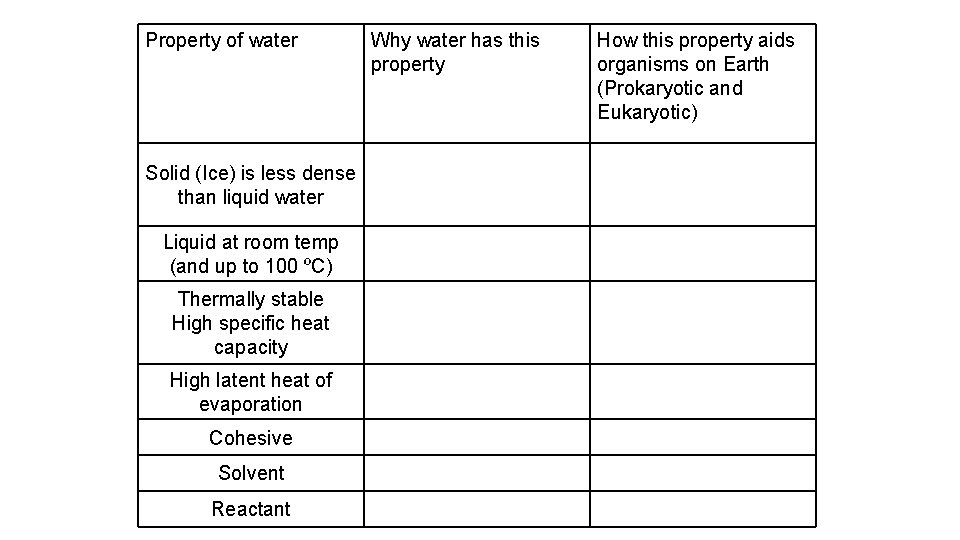
Property of water Solid (Ice) is less dense than liquid water Liquid at room temp (and up to 100 ºC) Thermally stable High specific heat capacity High latent heat of evaporation Cohesive Solvent Reactant Why water has this property How this property aids organisms on Earth (Prokaryotic and Eukaryotic)
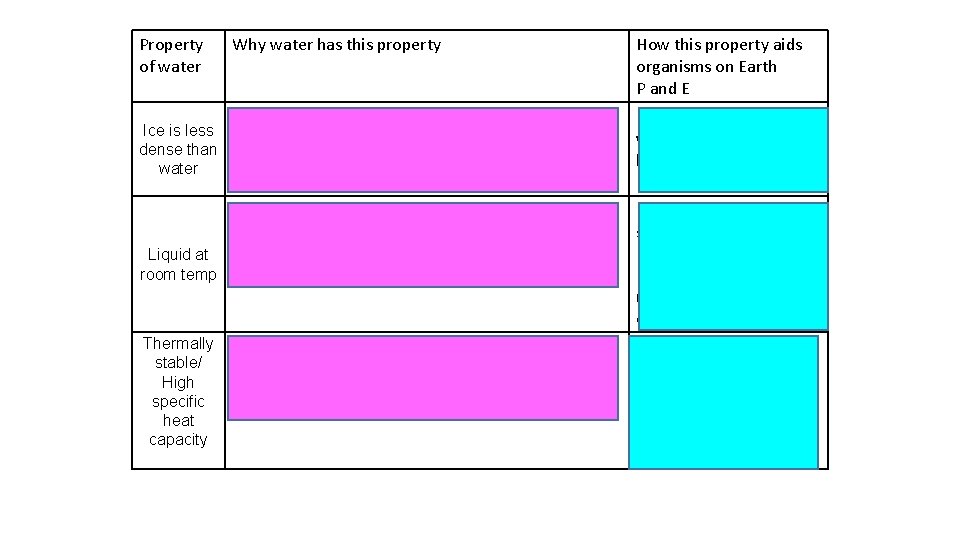
Property of water Why water has this property How this property aids organisms on Earth P and E Lower temp = more H bonds form Floats and insulates water beneath – remains liquid for orgs to live P and E Ice is less These hold molecules further apart dense than In a crystalline structure water Water is less dense below 4⁰C (esp when ice) Lots H bonds between molecules More heat energy needed to break these Liquid at (As well as to overcome intermolecular forces) room temp For molecules to evaporate Used to transport substances (e. g. Blood, Phloem, xylem) Provide habitats, reaction medium, component of tissues Thermally stable/ High specific heat capacity Large volumes water e. g. lakes stay at relatively stable temp and env Needed for enzymes controlled reaction P and E Lots H bonds between molecules More heat energy needed to break these To increase the temperature of the water
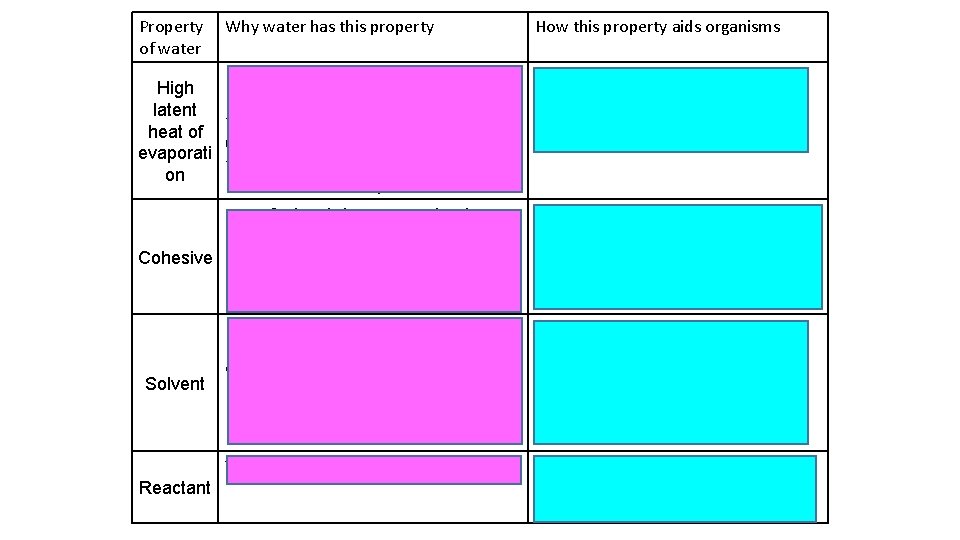
Property of water High latent heat of evaporati on Why water has this property How this property aids organisms Lots H bonds between molecules More heat energy needed to break these (As well as to overcome intermolecular forces) For molecules to evaporate Transfers lots of heat energy away from surface/ organism to reduce it’s temperature (e. g. sweating and transpiration) E Lots of H bonds between molecules Water columns strong and can be Molecules attracted to each other (‘stick pulled up (cohesion – tension) Surface tension for small orgs to walk on water Cohesive to each other’) and catch prey/ evade predators etc E Solvent Reactant Delta neg part attracted to pos particles Delta pos part attracted to neg particles Water molecules surround particles Holding them apart and dissolving them Water transports polar/ charged substances Many reactions occur in water so substances need to be dissolved Mineral can be absorbed from liquids P and E Take part in chemical reactions Photosynthesis, without which there would be no energy source for us Hydrolysis reactions P and E

Assessed Homework - MAT
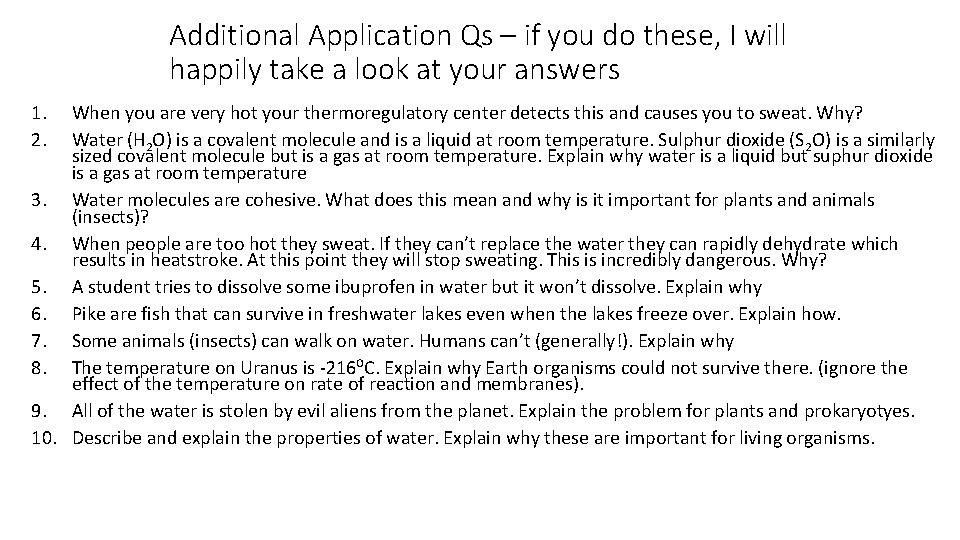
Additional Application Qs – if you do these, I will happily take a look at your answers 1. 2. When you are very hot your thermoregulatory center detects this and causes you to sweat. Why? Water (H 2 O) is a covalent molecule and is a liquid at room temperature. Sulphur dioxide (S 2 O) is a similarly sized covalent molecule but is a gas at room temperature. Explain why water is a liquid but suphur dioxide is a gas at room temperature 3. Water molecules are cohesive. What does this mean and why is it important for plants and animals (insects)? 4. When people are too hot they sweat. If they can’t replace the water they can rapidly dehydrate which results in heatstroke. At this point they will stop sweating. This is incredibly dangerous. Why? 5. A student tries to dissolve some ibuprofen in water but it won’t dissolve. Explain why 6. Pike are fish that can survive in freshwater lakes even when the lakes freeze over. Explain how. 7. Some animals (insects) can walk on water. Humans can’t (generally!). Explain why 8. The temperature on Uranus is -216⁰C. Explain why Earth organisms could not survive there. (ignore the effect of the temperature on rate of reaction and membranes). 9. All of the water is stolen by evil aliens from the planet. Explain the problem for plants and prokaryotyes. 10. Describe and explain the properties of water. Explain why these are important for living organisms.
- Slides: 20