
Water Wells for Yield and Health By Michael
Water Wells for Yield and Health By Michael L. Vaught EGIS PA 441 Northside Dr
Ground Water Atlas of the United States z. Map Segment 6 Geographical provinces Types of aquifers z. Map Segment 11 capp. water. usgs. gov/gwa. htm
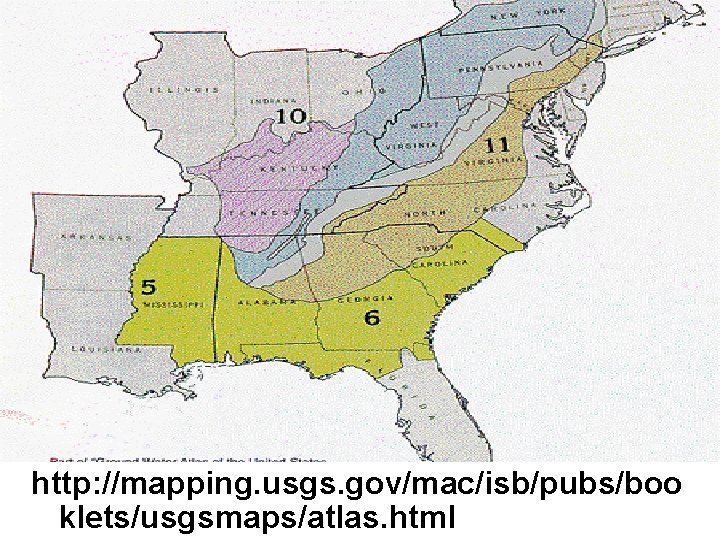
http: //mapping. usgs. gov/mac/isb/pubs/boo klets/usgsmaps/atlas. html
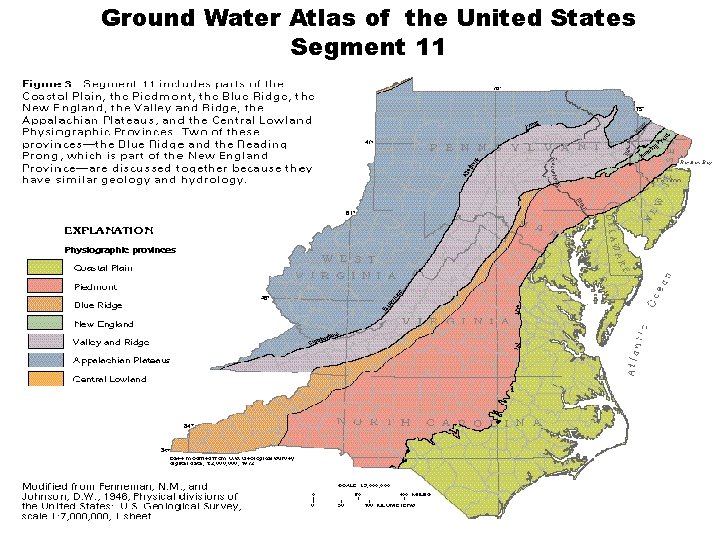
Ground Water Atlas of the United States Segment 11
Rock Type z. Sedimentary, Metamorphic, and Igneous rocks. z. Hard to crystalline rock verses unconsolidated granular aquifers. z. Reference the Ground Water Atlas of the United States and the Geological Surveys Maps.
Water Wells for Yield z Depth z Diameter z Screens z Test yield

Depth & Diameter z. Geographic or Physiographic location y. Coastal Plain y. Piedmont y. Mountains z. Type of Well yshallow or deep ylarge or small diameter ycased or “open hole”
Well Depth & Diameter Hard to crystalline rock z. Charles Daniel III, 1989, Geological Survey Water-Supply Paper 2341 -A. y. Wells below 400’ x. Large stress release fractures y 12” wells have 4 times yield of 6” wells
Well Depth & Diameter unconsolidated granular aquifers z. Ralph Heath, 1983, Geological Survey Water-Supply Paper 2220. y. Depth depends on lowest zone tapped x. Aquifer Thickness & Composition y. Diameter has little effect on yield x. Limits pump size
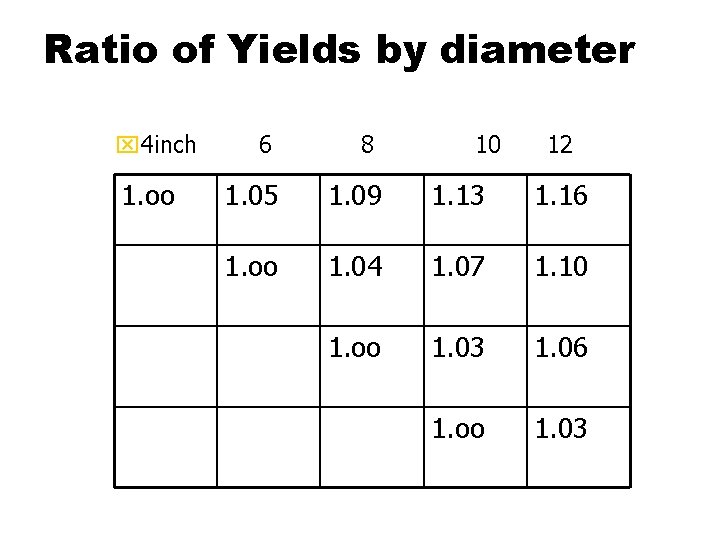
Ratio of Yields by diameter x 4 inch 1. oo 6 8 10 12 1. 05 1. 09 1. 13 1. 16 1. oo 1. 04 1. 07 1. 10 1. oo 1. 03 1. 06 1. oo 1. 03
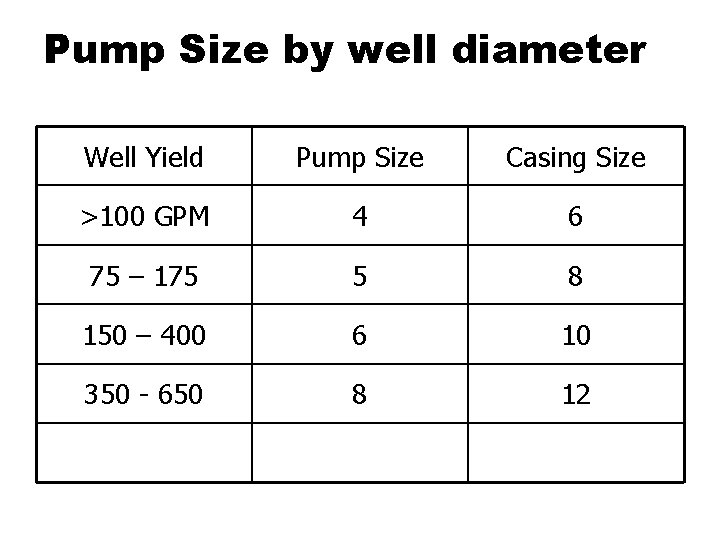
Pump Size by well diameter Well Yield Pump Size Casing Size >100 GPM 4 6 75 – 175 5 8 150 – 400 6 10 350 - 650 8 12
z
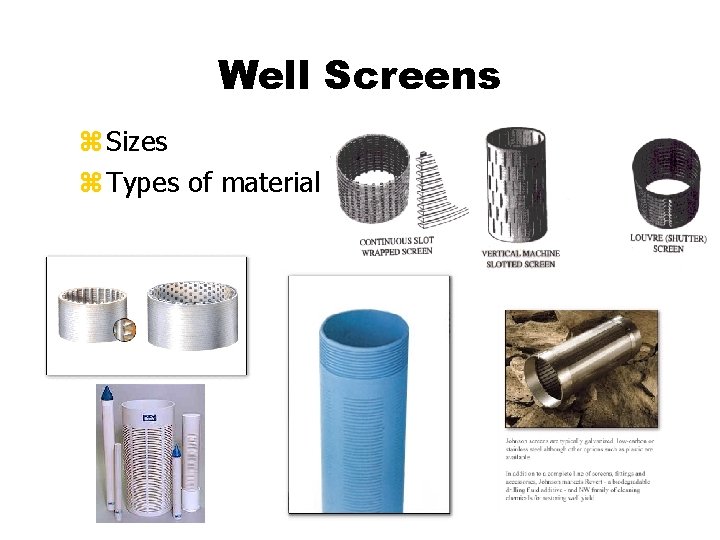
Well Screens z Sizes z Types of material
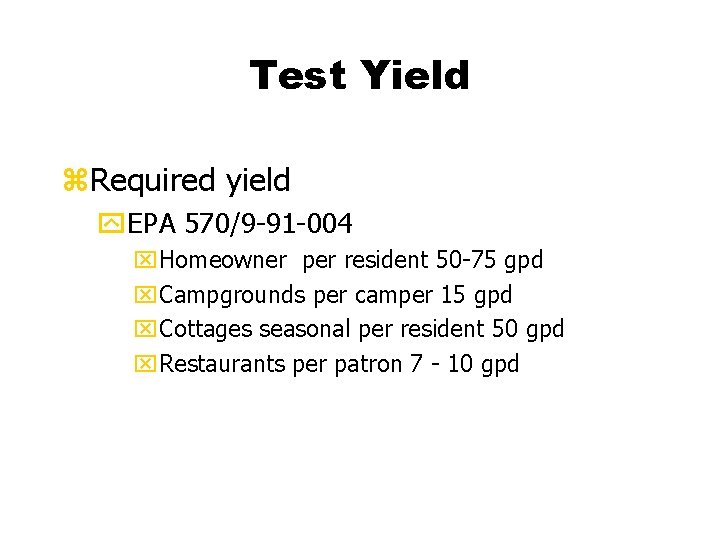
Test Yield z. Required yield y. EPA 570/9 -91 -004 x. Homeowner per resident 50 -75 gpd x. Campgrounds per camper 15 gpd x. Cottages seasonal per resident 50 gpd x. Restaurants per patron 7 - 10 gpd
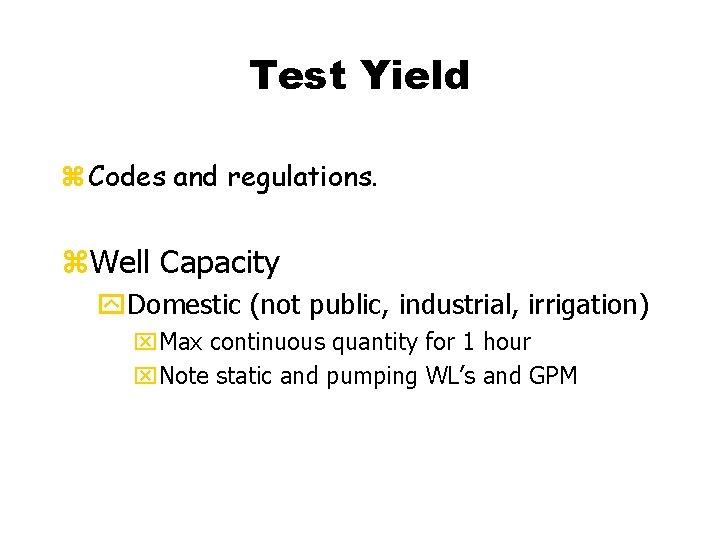
Test Yield z Codes and regulations. z. Well Capacity y. Domestic (not public, industrial, irrigation) x. Max continuous quantity for 1 hour x. Note static and pumping WL’s and GPM
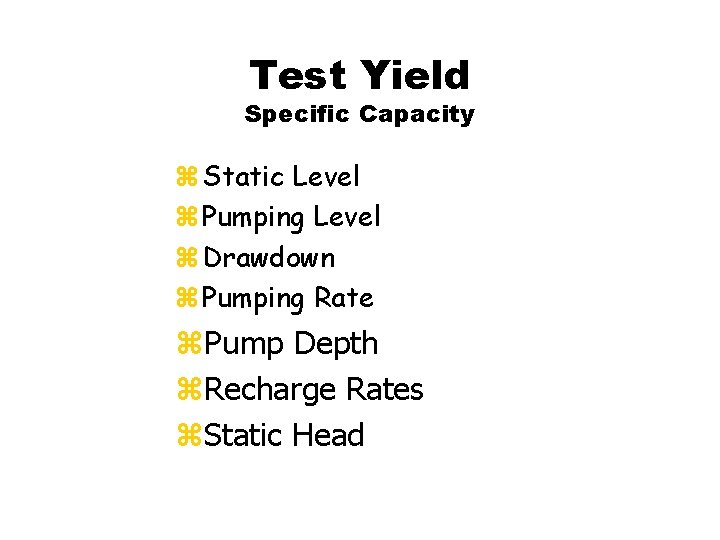
Test Yield Specific Capacity z Static Level z Pumping Level z Drawdown z Pumping Rate z. Pump Depth z. Recharge Rates z. Static Head
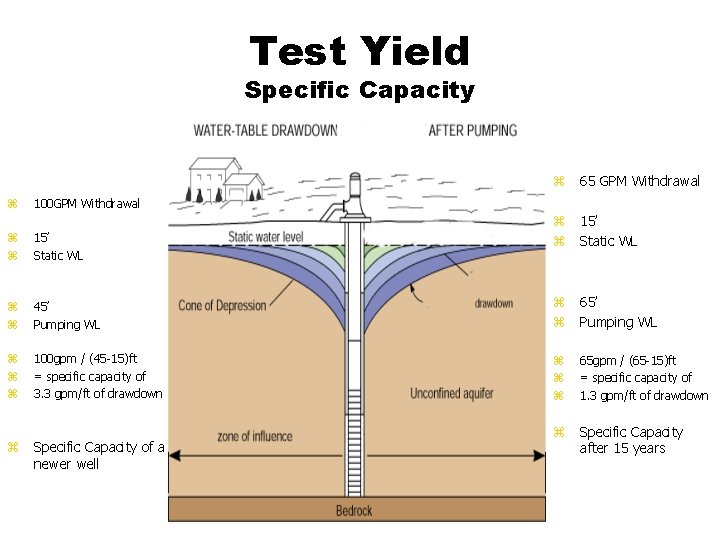
Test Yield Specific Capacity z 65 GPM Withdrawal z 100 GPM Withdrawal z 15’ z Static WL z z 15’ Static WL z z 45’ Pumping WL z 65’ z Pumping WL z z z 100 gpm / (45 -15)ft = specific capacity of 3. 3 gpm/ft of drawdown z z Specific Capacity of a newer well 65 gpm / (65 -15)ft = specific capacity of 1. 3 gpm/ft of drawdown z Specific Capacity after 15 years
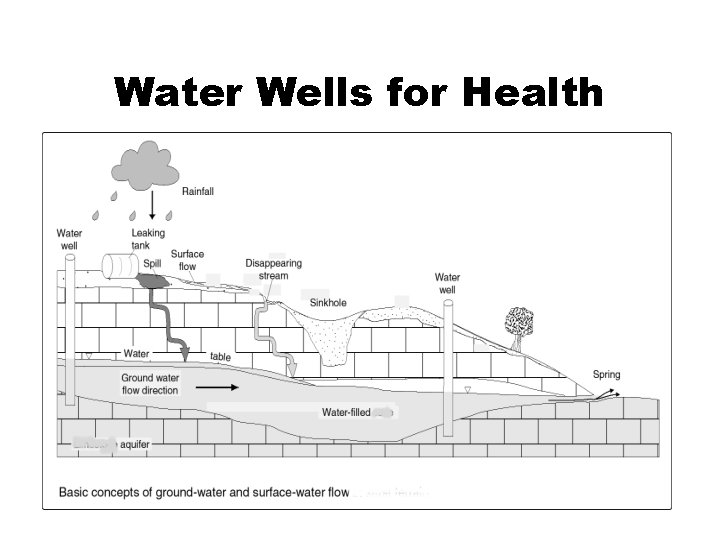
Water Wells for Health
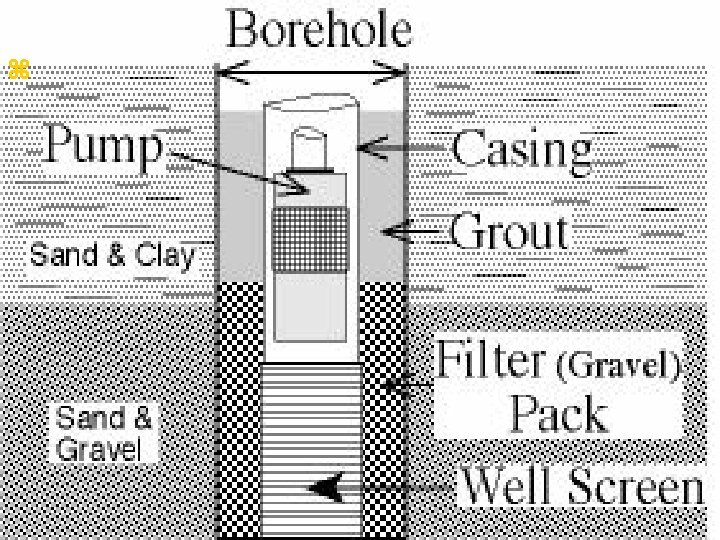
Well Health and Safety z. Casing y. Sealing the Annulus z. Wellhead Protection y. Air quality, drainage, and recharge z. Well Maintenance y. Flushing and circulation
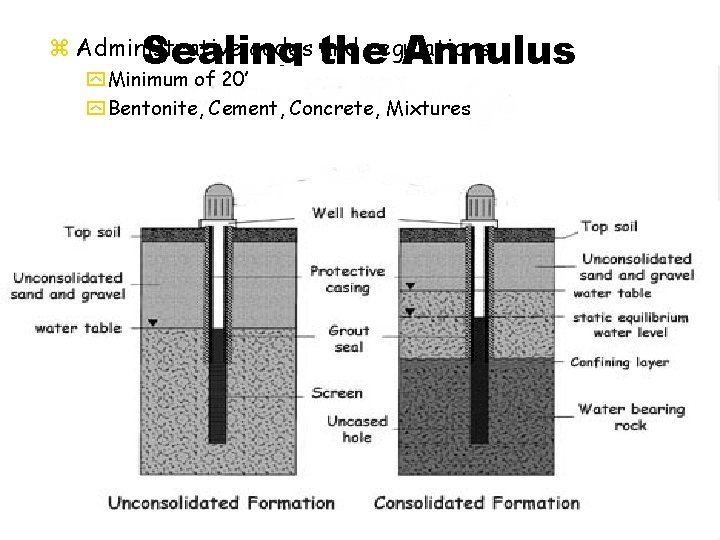
Sealing the Annulus z Administrative codes and regulations y Minimum of 20’ y Bentonite, Cement, Concrete, Mixtures
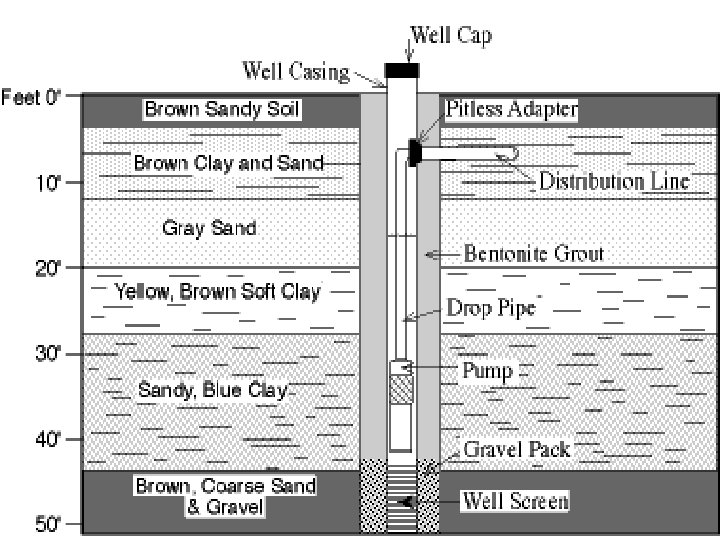

Wellhead Protection
Wellhead Protection z Wellhead Protection Guidebooks y. WHPA Delineation Methods x. Arbitrary fixed or calculated fixed radius method
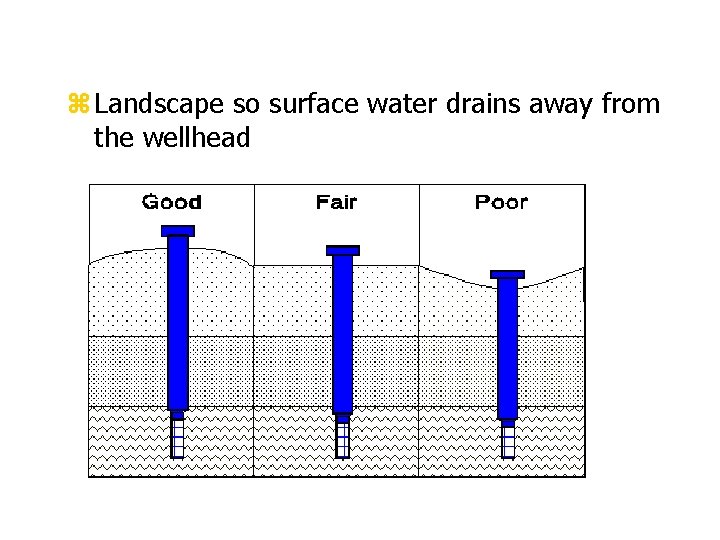
z Landscape so surface water drains away from the wellhead
Well Maintenance z. Homeowner z. Campgrounds z. Cottages z. Non-community & Public Systems
Well Maintenance z. Pump Depth z. Exercise (water usage) z. Chlorination y>200 ppm, 6 p. H z. Record keeping z. Annual Testing for Bacteria y. Chlorination not recommended for coliform
Set pump intake As Shallow As Possible (ASAP). z Pumping influences motion within the borehole column z Pumping oxygenates the well water from the top down. z Pumping draws shallow water downward. z Pumping utilizes water from two sources; Well Storage and Well Flow.
Well Storage z Stored water lies above the intake and the above the highest water zone z Well Storage- Zone of the water column within or draining to the borehole that is both above the pump and above the most shallow production zone, ( called the “ Storage Cell”). z In Storage Type Wells the pumping water level continuously falls during the stress test.
Well Flow z Flowing water moves between the production zones and the pump intake. z Well Flow – Zone of the water column between the pump and any contributing production zone (called the “Flowing Cell”). z In Flowing Type Wells the water level stabilizes during the stress test.
Flowing type wells generally remain cleaner. z Flowing type wells minimize the borehole Storage and maximize the Flowing Cells by the correct pumping depth. z Flowing Cells remain cleaner because of the borehole turbulence and lack of enrichment. z Flowing type wells = Long term reliability + controlled biofouling.
Storage type wells require periodic maintenance. z Typically Storage Cells become enriched and biofouled in the top of a water well. z Storage type wells must be exercised regularly to flush biofilm and enriched water from the cell. z Storage type wells = Short term maintenance + rapid biofouling.
Minimize Storage and Enlarge Flow Cells z Excess Storage generates uncontrolled growth of naturally occuring biofilms within the well. z Enrichment of the excess or recycled Storage accelerates biofouling from the top down. z Set the pumping depth in a well based on Actual Maximum Demand. z Set the pumping depth no more than twenty feet below the actual maximum demand level in the average Domestic size water well.
Set pump intake depth for actual maximum demand. z Actual Maximum Demand Water Level – Depth to water within the well during one hour of continuous pumping while hooked to the system under simulated intense usage. z Set the pumping depth no more than twenty feet below the actual maximum demand level in the average Domestic size water well.
Rehabilitating biofouled wells means controlled biofilms. z Recondition homeowners dirty wells by cleaning the biofouling and repositioning the pump (ASAP). z Repairs eliminate shallow water. z Borehole flow diverters change the Flowing Cells to eliminate turbidity.
Shallow Pump with Flow Sleeve
Deeper Pump with Flow Sleeve
Liner with Flow Sleeve
Well Abandonment z. Disinfecting z. Sealing z. Decommissioning
Responsibility for Well Abandonment z Codes and Regulations z Well owner z Well contractor z Pump installer z Forms ______
Abandonment of Bored Wells z. Large diameter, 18 -36 inches y. Remove plumbing or obstructions y. Disinfect with calcium hypochlorite y. Remove well casing (3’ BGL) y. Fill with cement, concrete, bentonite, dry clay, natural material. y. Cap with 1’ cement plug extending 1’.
Abandonment of Drilled Wells z. Gravel packed, screened, unconsolidated y. Remove or grout the casing y. Determine well depth y. Disinfect with calcium hypochlorite y. Fill with neat cement or Bentonite grout z. Cased open hole y. Same as above except……. . . y. Fill to 10’ below TOR or 5’ below CSG with cement, bentonite, sand, gravel, or cuttings. y. Fill to surface
Summary z Well characterization is essential for sustained quantity and quality. It is the first step in configuring a water supply system for long-term yields of consistent water. ” “Use-it-or-loose-it”, if the well is set up to supply more water than is routinely needed, maintenance must include maximum demand pumping either quarterly or monthly. “Private Water Systems Handbook” says; “A home water system must be able to supply the peak use rate continuously for one hour. ” z When the pump depth is set to maximize the well yield, the well may accumulate enriched water above the pump. Pump depth should be sufficient to allow only 10 to 20 feet of water above the pump during peak demand intervals. Adequate drawdown can stop oxygen enrichment and prevent biofouling.
References z. Web sites (yahoo search - water well drawdown) z. Books and Supplier Materials z. Professional Organizations y American Groundwater Trust y Groundwater Associations y Water Systems Council z. Government y EPA, USDA, USGS y State Agencies y Extension Service
- Slides: 43