
WATER WATER TREATMENT Objective In this lesson we
WATER & WATER TREATMENT
Objective In this lesson we will learn about the following concepts: n Removal of particles (particulates) n Removal of dissolved solids n Removal of pathogens (Disinfection) n The hydrologic cycle and how it is like nature's way of treating water n An introduction to water treatment
5. 1 Introduction All surface water and some groundwaters require treatment prior to consumption to ensure that n they do not represent a health risk to the user. Health risks to consumers from poor quality water can be due to microbiological, chemical, physical or radioactive contamination n
Water Treatment Objective: “ To supply clean and safe water for public demand” Clean – colourless, odourless, tasteless and no suspended solids Safe – no pathogen microorganism, no dangerous organic/inorganic and less mineral substances
Water Sources How do we obtain fresh water resources then? Where does drinkable water come from? To understand, we need to turn to the Hydrologic Cycle
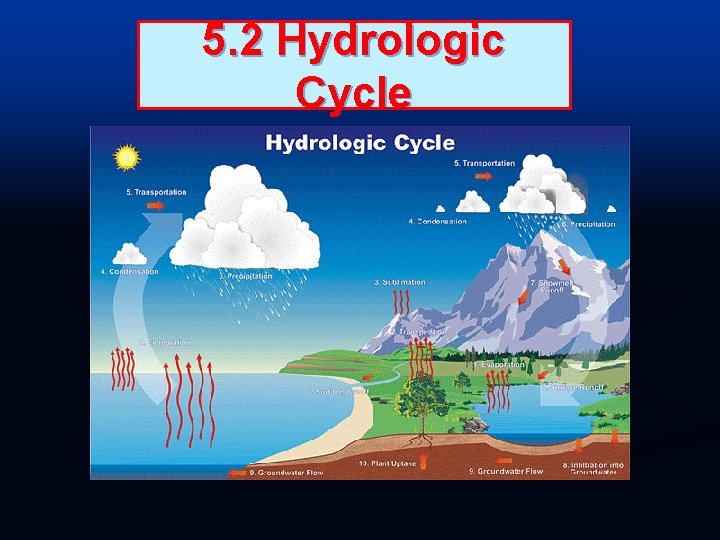
5. 2 Hydrologic Cycle

CATCHMENT AREA
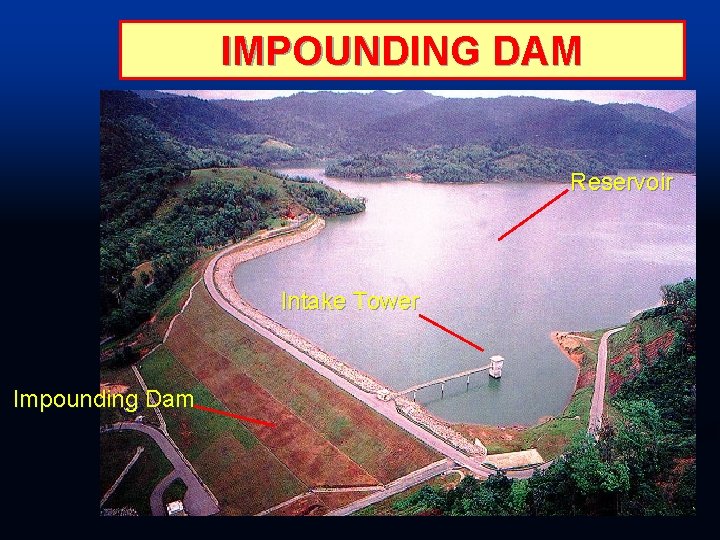
IMPOUNDING DAM Reservoir Intake Tower Impounding Dam
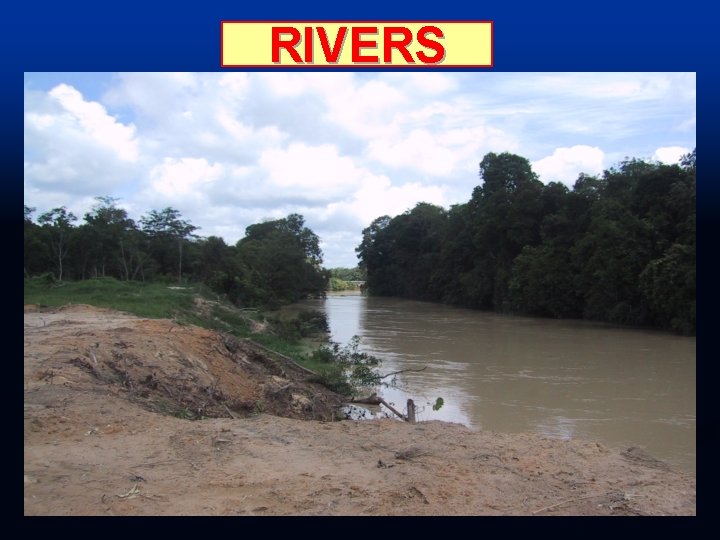
RIVERS
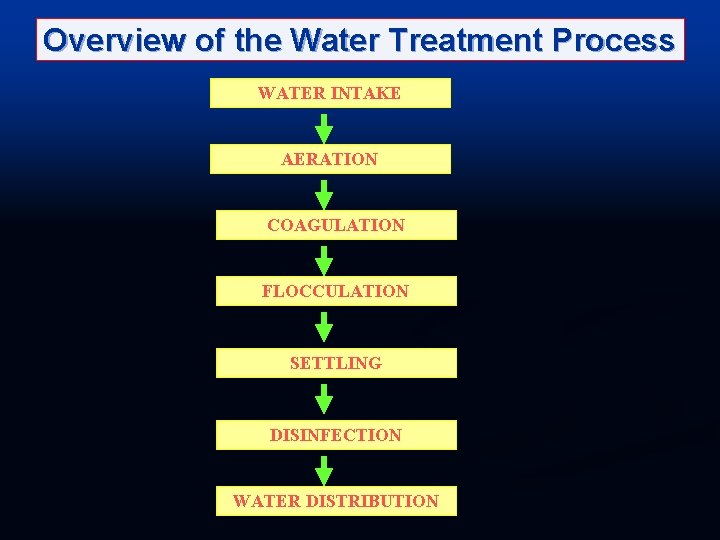
Overview of the Water Treatment Process WATER INTAKE AERATION COAGULATION FLOCCULATION SETTLING DISINFECTION WATER DISTRIBUTION
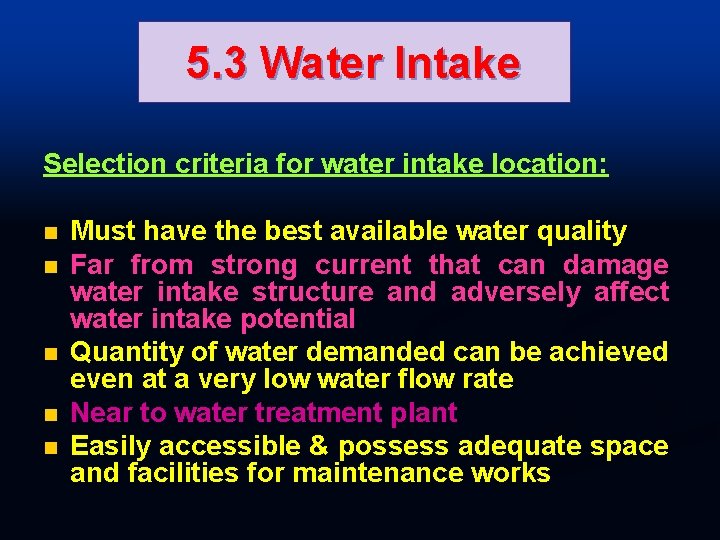
5. 3 Water Intake Selection criteria for water intake location: n n n Must have the best available water quality Far from strong current that can damage water intake structure and adversely affect water intake potential Quantity of water demanded can be achieved even at a very low water flow rate Near to water treatment plant Easily accessible & possess adequate space and facilities for maintenance works
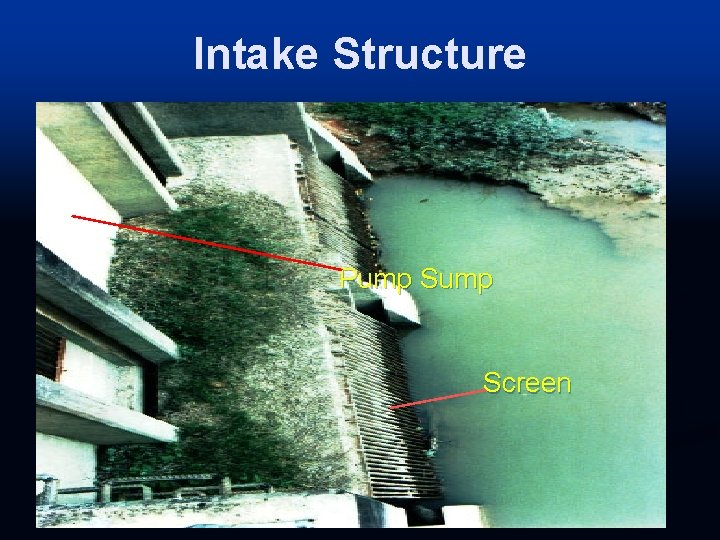
Intake Structure Pump Screen
Intake Structure: n n Pipes design must take into account the quantity of water to be sucked out Pipe position must consider the water level during dry season Must be fenced for security purposes Must have screens on pipe or intake structure to prevent entry of objects that might damage pumps and treatment facilities
Screens Purpose: n To remove suspended, huge and hard materials from water that can damage pumps & other mechanical devices; including leaves, debris and other sizable clogging material.
5. 4 Aeration Objectives: n To eliminate unneeded dissolved gases such as (CO 2, H 2 S, NH 3) n Remove unpleasant taste and odour-causing substances (H 2 S, NH 3) n Increase water p. H. This results to a decrease in water corrosive property (CO 2) n Remove substances that interfere with or add to the cost of subsequent water treatment processes (CO 2).
n To increase DO level in water primarily for oxidation of Fe 2+ and Mn 2+ to Fe 3+ and Mn 4+ respectively n increase the water freshness n n To remove VOC n hazardous to public health such as gasoline elements – benzene, toluene, xylene.
Types of Aeration Equipment n n n Cascade Aerator Multiple Platform Aerator Venturi Aerator Draft-Tube Aerator The object of all designs is to maximize the area of contact between the water and the air.
circular tray collection basin feed pipe ground level
Aerator Structure Aerator
Aerator
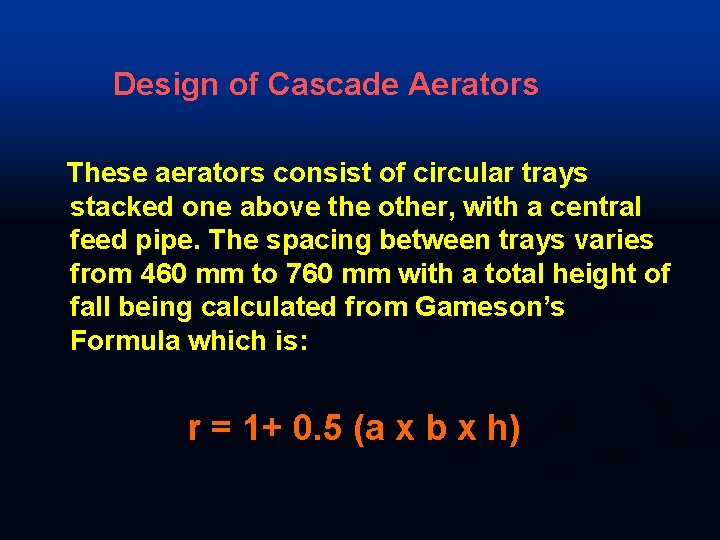
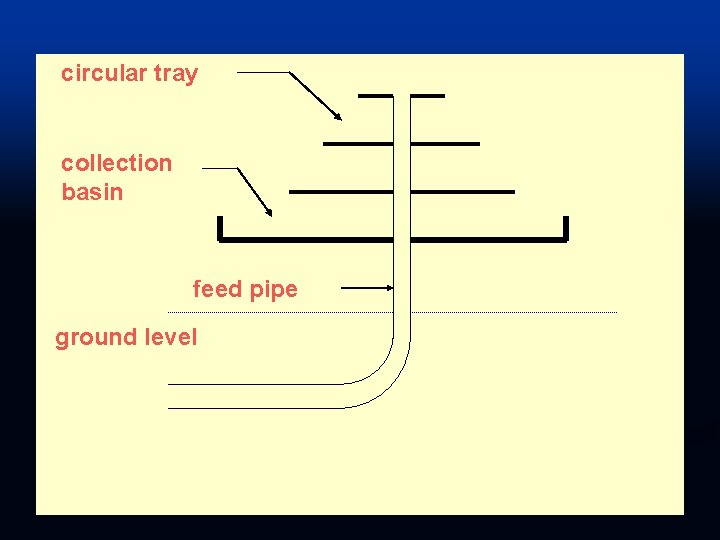
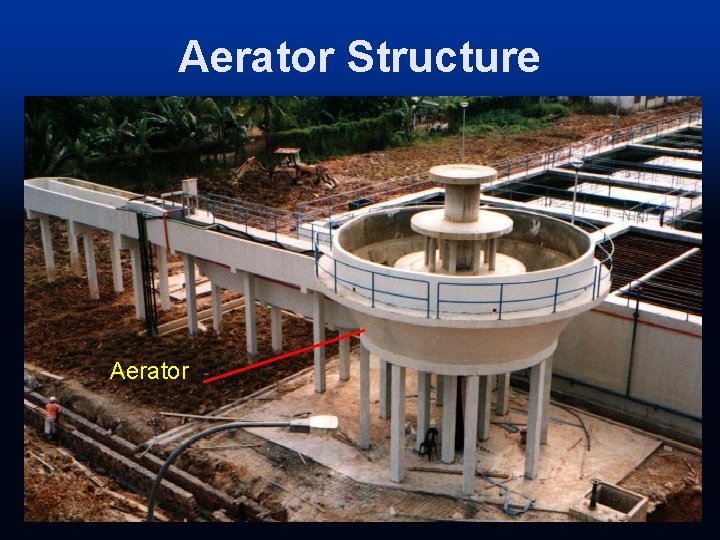
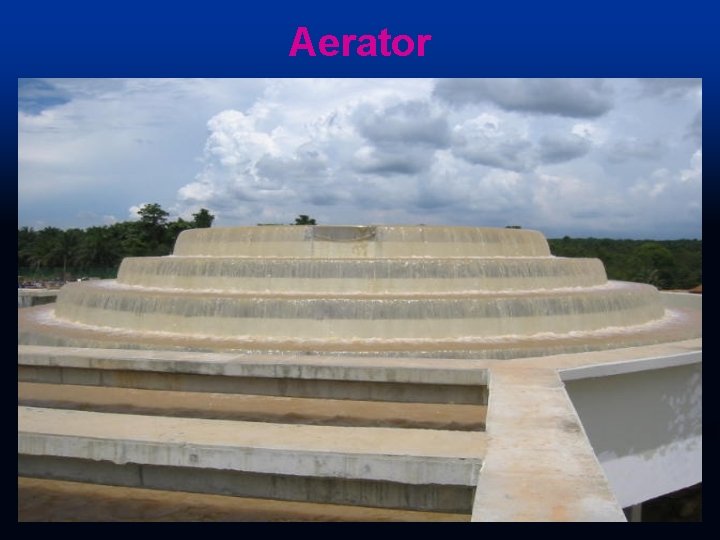
Design of Cascade Aerators These aerators consist of circular trays stacked one above the other, with a central feed pipe. The spacing between trays varies from 460 mm to 760 mm with a total height of fall being calculated from Gameson’s Formula which is: r = 1+ 0. 5 (a x b x h)
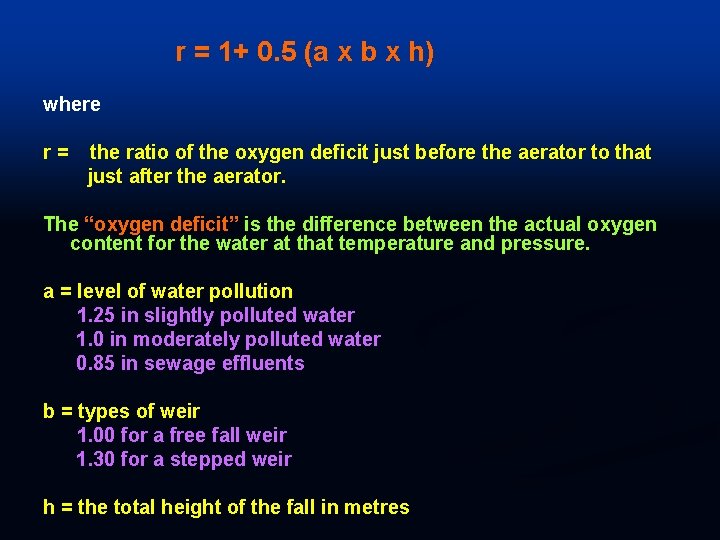
r = 1+ 0. 5 (a x b x h) where r= the ratio of the oxygen deficit just before the aerator to that just after the aerator. The “oxygen deficit” is the difference between the actual oxygen content for the water at that temperature and pressure. a = level of water pollution 1. 25 in slightly polluted water 1. 0 in moderately polluted water 0. 85 in sewage effluents b = types of weir 1. 00 for a free fall weir 1. 30 for a stepped weir h = the total height of the fall in metres
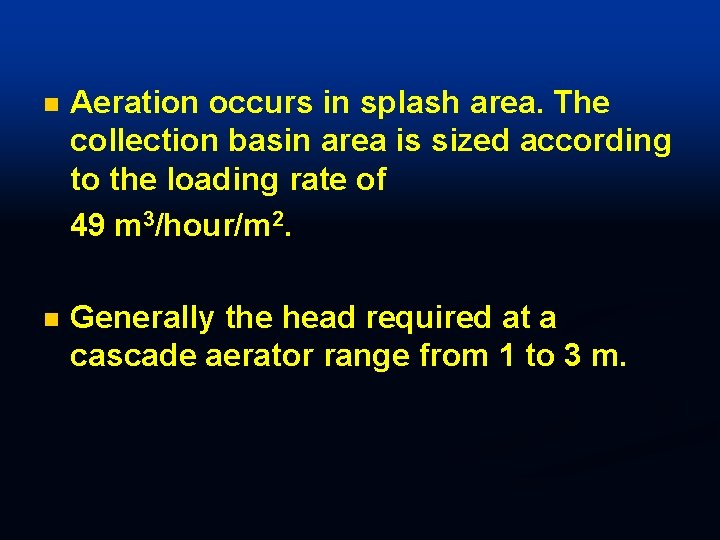
n Aeration occurs in splash area. The collection basin area is sized according to the loading rate of 49 m 3/hour/m 2. n Generally the head required at a cascade aerator range from 1 to 3 m.
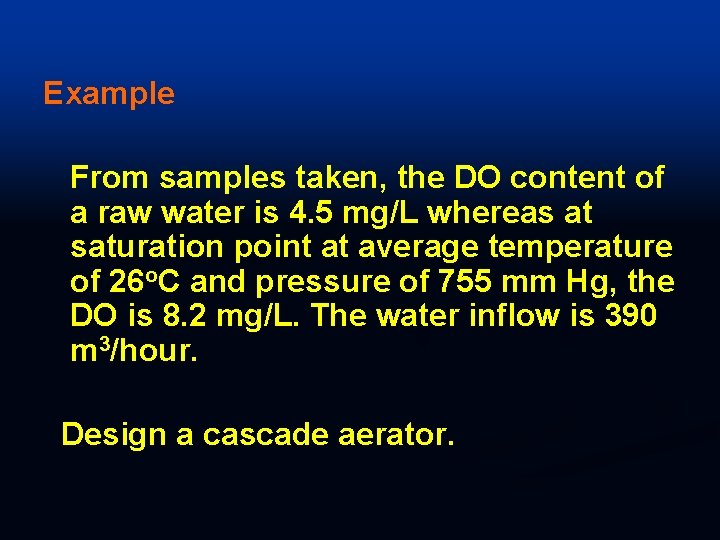
Example From samples taken, the DO content of a raw water is 4. 5 mg/L whereas at saturation point at average temperature of 26 o. C and pressure of 755 mm Hg, the DO is 8. 2 mg/L. The water inflow is 390 m 3/hour. Design a cascade aerator.
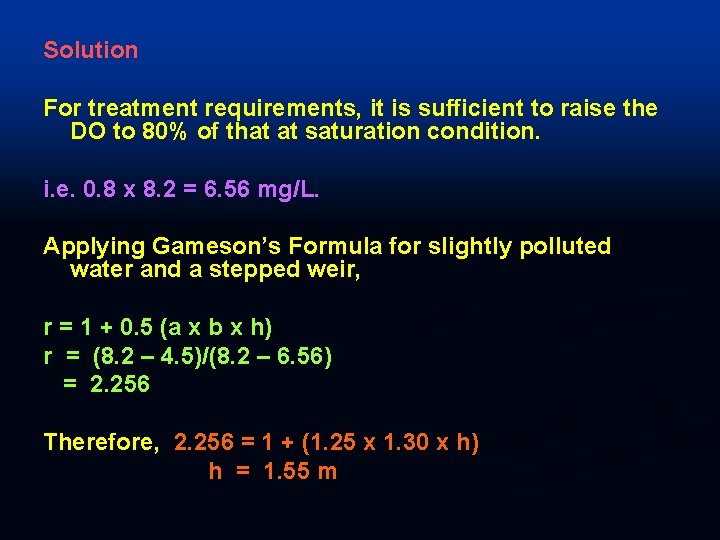
Solution For treatment requirements, it is sufficient to raise the DO to 80% of that at saturation condition. i. e. 0. 8 x 8. 2 = 6. 56 mg/L. Applying Gameson’s Formula for slightly polluted water and a stepped weir, r = 1 + 0. 5 (a x b x h) r = (8. 2 – 4. 5)/(8. 2 – 6. 56) = 2. 256 Therefore, 2. 256 = 1 + (1. 25 x 1. 30 x h) h = 1. 55 m
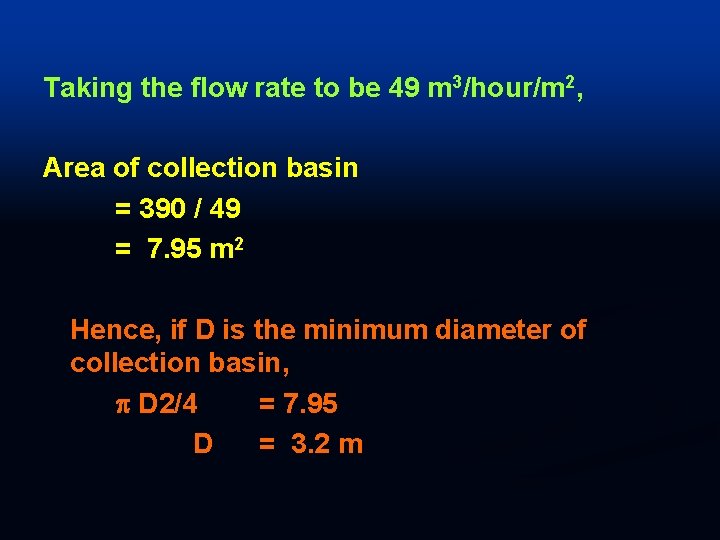
Taking the flow rate to be 49 m 3/hour/m 2, Area of collection basin = 390 / 49 = 7. 95 m 2 Hence, if D is the minimum diameter of collection basin, D 2/4 = 7. 95 D = 3. 2 m
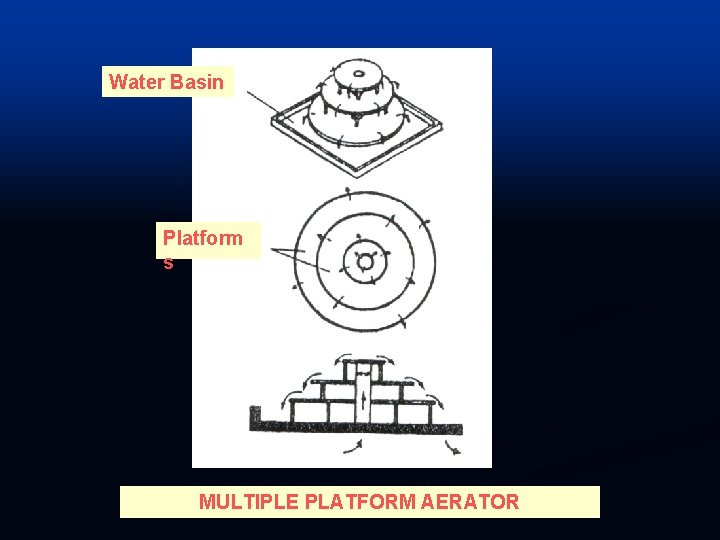
Water Basin Platform s MULTIPLE PLATFORM AERATOR
- Slides: 28