
Water Utility Challenges Progressive Actions Sustainable Future 1
Water Utility Challenges Progressive Actions Sustainable Future 1
Water Quality • • Lead and Copper Algae / Cyanotoxins Perfluoroalkyl Substances PFOA and PFOS Chlorine
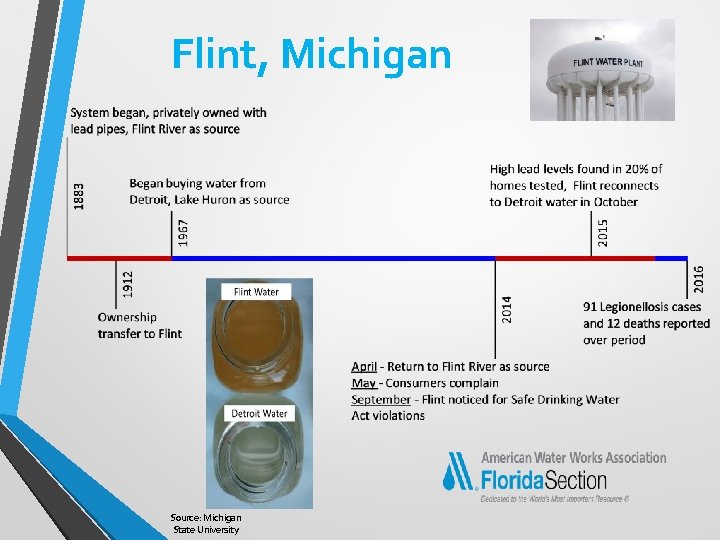
Flint, Michigan Source: Michigan State University
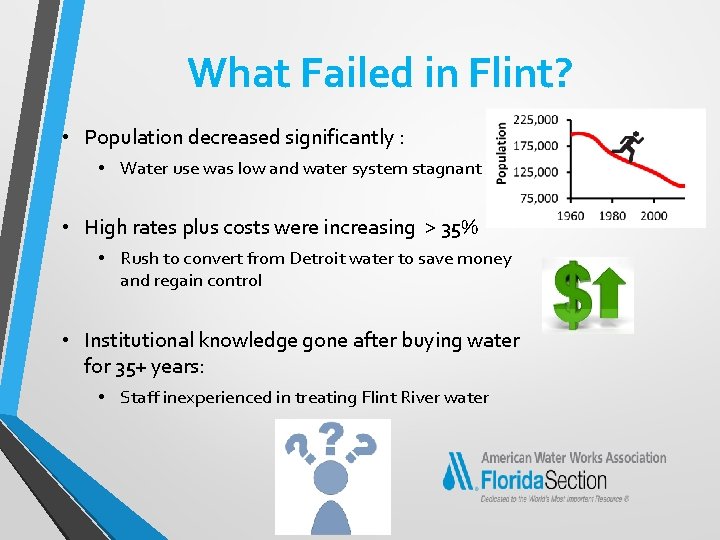
What Failed in Flint? • Population decreased significantly : • Water use was low and water system stagnant • High rates plus costs were increasing > 35% • Rush to convert from Detroit water to save money and regain control • Institutional knowledge gone after buying water for 35+ years: • Staff inexperienced in treating Flint River water
What Failed in Flint? • Corrosion control Corrosion Control • • Not in place State regulators missed signs of excessive corrosion • Communication: • • Citizens’ complaints went unaddressed before and after change in source Poor communication between city, county and state officials • Recommendations from studies were ignored
Potential Factors Affecting LCR Compliance • Change in water quality • Change in treatment process • • Installation of new processes Use of new chemicals Changes in p. H leaving the plant Changes associated with total organic carbon (TOC) removal, such as enhanced coagulation For any treatment process change we must notify the appropriate regulatory agency
Requirements • Utilities monitor distribution system corrosion and investigate customer issues • Specific to each water source and quality • Any treatment change requires new evaluation • May include addition of certain approved chemicals • Requires two six month monitoring periods and annually until reduced monitoring approved
Floridians Have Safe, Refreshing, and Reliable Drinking Water PUBLIC HEALTH is TOP PRIORITY! • Utility operations require certified professionals and fiscal responsibility • FSAWWA provides training opportunities ensuring members are aware of current regulations and treatment best practices • Investment in infrastructure repair and replacement a top priority • Utilities comply with Lead and Copper Rule requirements and proactively remove lead components • Utilities maintain open communication with state officials (elected officials, FDEP and DOH) • Traditional water sources have remained consistent and alternative water supplies are fully investigated
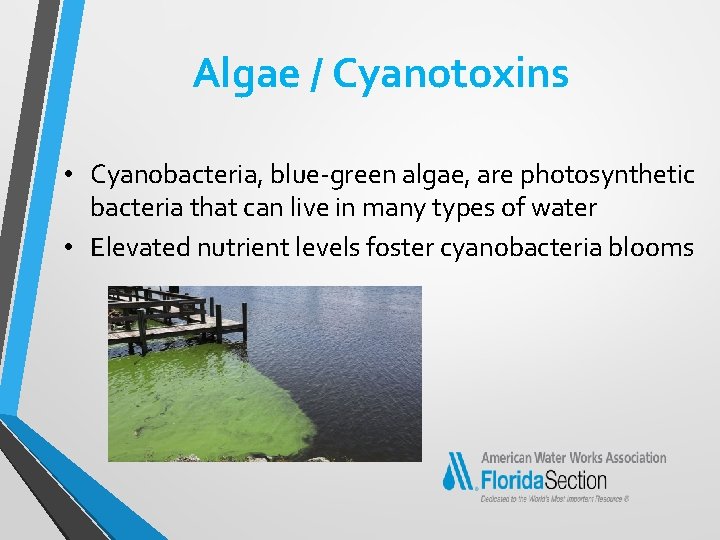
Algae / Cyanotoxins • Cyanobacteria, blue-green algae, are photosynthetic bacteria that can live in many types of water • Elevated nutrient levels foster cyanobacteria blooms
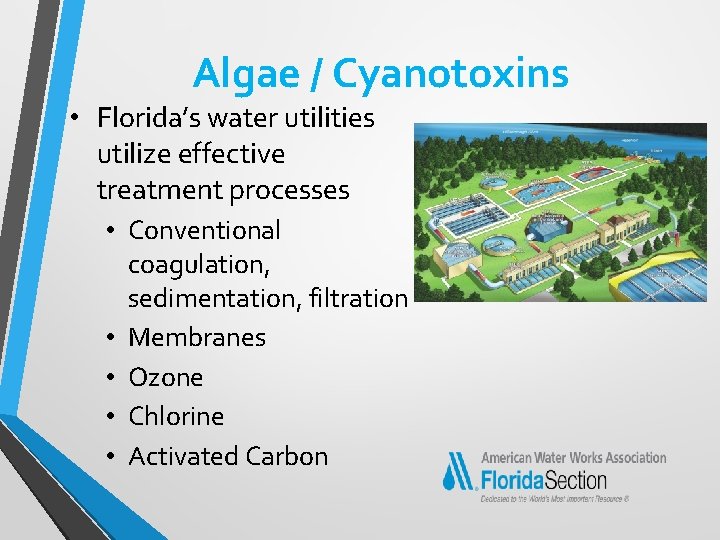
Algae / Cyanotoxins • Florida’s water utilities utilize effective treatment processes • Conventional coagulation, sedimentation, filtration • Membranes • Ozone • Chlorine • Activated Carbon
PFOA and PFOS • Man-made chemicals used for firefighting at airfields and a number of other industrial processes • Persistent in the environment and human body • EPA is evaluating PFOA and PFOS as drinking water contaminants in accordance with the process required by the Safe Drinking Water Act (SDWA)

PFOA and PFOS • Found in some Florida groundwater supplies • Removed with activated carbon and reverse osmosis treatment processes

Disinfection • Chlorination • Gas • Sodium Hypochlorite • Calcium Hypochlorite • Chloramine • Ozone • Ultraviolet (UV) Tampa Bay Ozone Disinfection
Disinfection By-Product Reduction • Strategies to overcome the challenges of disinfection by-product formation • Remove by-products after formation • Use alternative disinfectants • Reduce concentration of organics in water before disinfection
Workforce Issues Facing Utilities • Aging Workforce • 30 -40% of water and wastewater utility workers will be retiring in the next decade • Over 50% of licensed operators are over 50 years old • Recruiting workers • Retaining workers • Transfer of Institutional Knowledge • Succession Planning 18

Aging Workforce
Recruitment • Student Interns • High School & College • Career Path/Planning • Academies for Utilities • • St. Johns Technical High School, St. Augustine, FL Academy of Coastal and Water Resources Heritage High School, Palm Bay, FL Academy of Environmental Water Technology (AEWT) • Sim City • Northwest Florida State College

Retainage • Promote skill development and productivity • Pay for performance bonuses • Rewarding employees for new ideas • Develop leaders through management skills training • Keeping workforce engaged particularly with limited advancement
Non-traditional Utilities • Member-owned Utility Cooperatives - 501(c)12 • Funding Challenges: • Too big for small community for WIFIA, must compete with larger utilities • Must get a sponsor for CW SRF Projects • Staffing challenges: • Limited support operations: engineering, asset management • Depend on Contract Services for support? Or scale to what the utility can handle • Same requirements of large utility with limited money and available personnel
Florida Water Utilities Resilience: October 2018 Snapshot
What is Resilience? Pioneered by the Rockefeller Foundation http: //100 resilientcities. org/ 100 Resilient Cities’ definition: “the capacity of individuals, communities, institutions, businesses, and systems within a city to survive, adapt, and grow no matter what kinds of chronic stresses and acute shocks they experience. ” 24

Water is Critical to Community Resilience US Water Alliance’s One Water Approach http: //uswateralliance. org/one-water -roadmap-sustainable-management-lifes-mostessential-resource 25
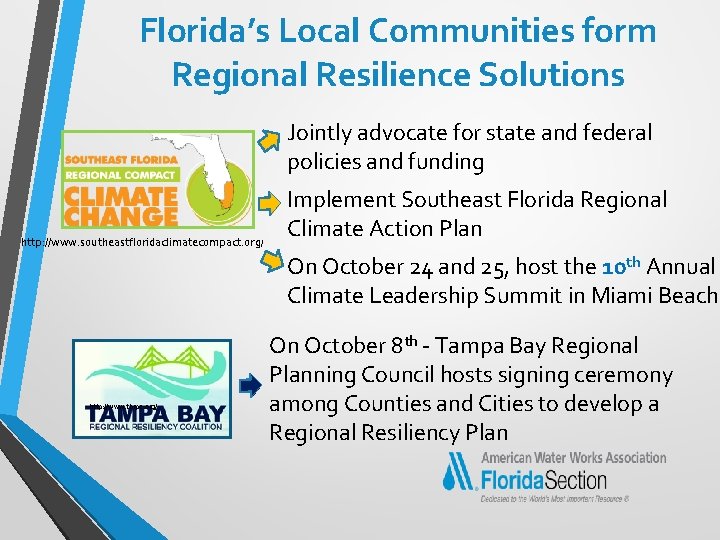
Florida’s Local Communities form Regional Resilience Solutions Jointly advocate for state and federal policies and funding http: //www. southeastfloridaclimatecompact. org/ Implement Southeast Florida Regional Climate Action Plan On October 24 and 25, host the 10 th Annual Climate Leadership Summit in Miami Beach http: //www. tbrpc. org/ On October 8 th - Tampa Bay Regional Planning Council hosts signing ceremony among Counties and Cities to develop a Regional Resiliency Plan
Statewide and Regional Resilience Organizations http: //resiliencyflorida. org/ http: //www. floridawca. org Resilient Utility Coalition https: //resilientutilities. org /
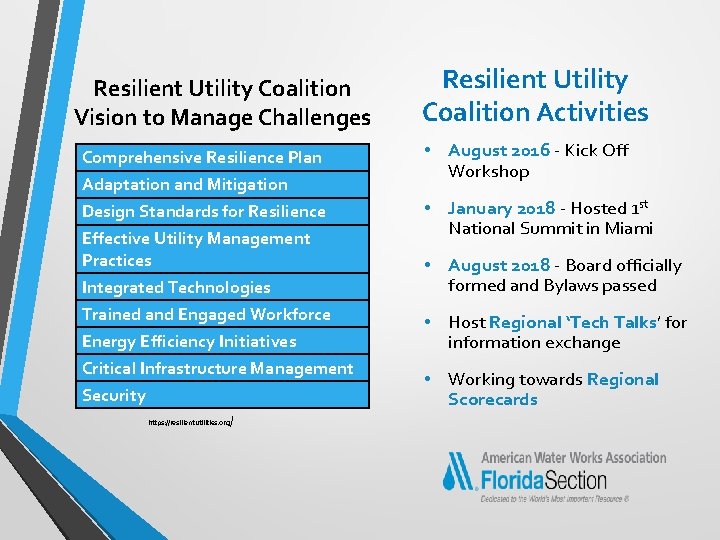
Resilient Utility Coalition Vision to Manage Challenges Comprehensive Resilience Plan Adaptation and Mitigation Design Standards for Resilience Effective Utility Management Practices Integrated Technologies Trained and Engaged Workforce Energy Efficiency Initiatives Critical Infrastructure Management Security https: //resilientutilities. org / Resilient Utility Coalition Activities • August 2016 - Kick Off Workshop • January 2018 - Hosted 1 st National Summit in Miami • August 2018 - Board officially formed and Bylaws passed • Host Regional ‘Tech Talks’ for information exchange • Working towards Regional Scorecards

Florida’s Water Utilities: Resilience Snapshot GRU: Intensive system assessment and rehabilitation OUC: Cybersecurity Protections Hillsborough County: Turning Back Saltwater Intrusion Toho Water Authority: Optimize Communication Networks Palm Beach County: Hurricane Hardening City of Boynton Beach: Dynamic Performance Modeling Florida Keys Aqueduct Authority: Post Irma Recovery Broward County: Onsite Energy Production Miami-Dade County: Storm Surge Design
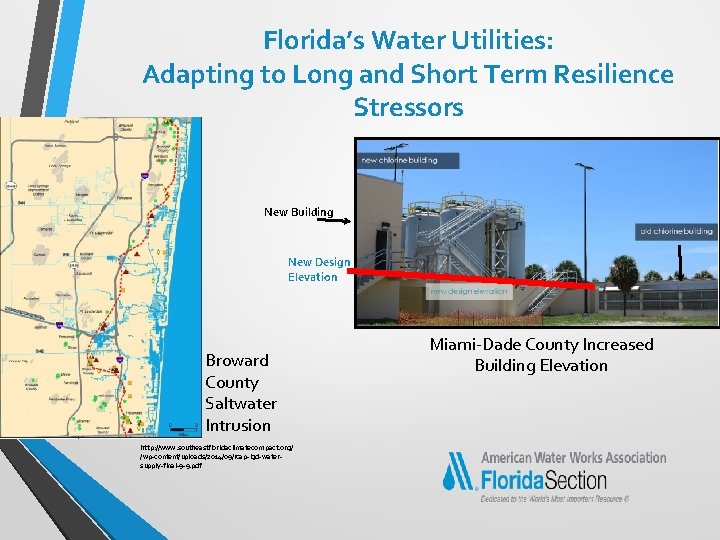
Florida’s Water Utilities: Adapting to Long and Short Term Resilience Stressors New Building New Design Elevation Broward County Saltwater Intrusion http: //www. southeastfloridaclimatecompact. org/ /wp-content/uploads/2014/09/rcap-igd-watersupply-final-9 -9. pdf Miami-Dade County Increased Building Elevation
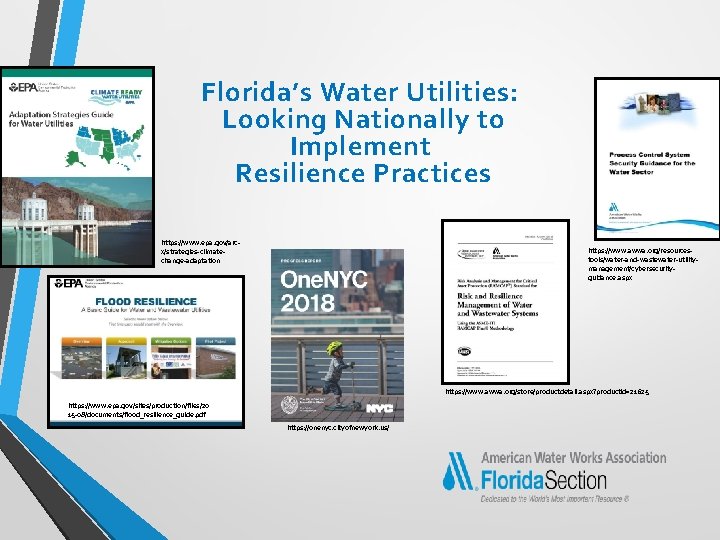
Florida’s Water Utilities: Looking Nationally to Implement Resilience Practices https: //www. epa. gov/arcx/strategies-climatechange-adaptation https: //www. awwa. org/resourcestools/water-and-wastewater-utilitymanagement/cybersecurityguidance. aspx https: //www. awwa. org/store/productdetail. aspx? productid=21625 https: //www. epa. gov/sites/production/files/20 15 -08/documents/flood_resilience_guide. pdf https: //onenyc. cityofnewyork. us/
National Resiliency: Looking Forward Federal Emergency Management Agency (FEMA) Pre-Disaster Mitigation Funding: Funds prepare communities before disasters strike • Congress increased 2018 funds to $230 million from $100 million nationwide • New Resilient Infrastructure project type; Increases single project funding cap to $10 million
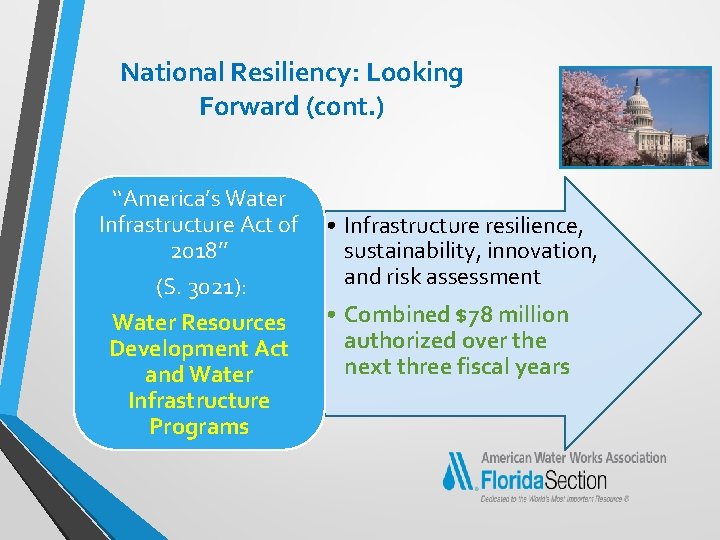
National Resiliency: Looking Forward (cont. ) ‘‘America’s Water Infrastructure Act of • Infrastructure resilience, 2018’’ sustainability, innovation, and risk assessment (S. 3021): • Combined $78 million Water Resources authorized over the Development Act next three fiscal years and Water Infrastructure Programs
- Slides: 31