
Water Treatment By Kaylee Atkocius Lucy Manfredi Ava
Water Treatment By: Kaylee Atkocius, Lucy Manfredi, Ava Gosset
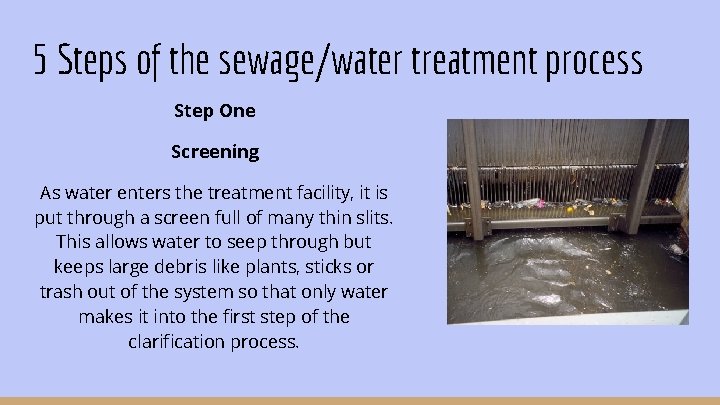
5 Steps of the sewage/water treatment process Step One Screening As water enters the treatment facility, it is put through a screen full of many thin slits. This allows water to seep through but keeps large debris like plants, sticks or trash out of the system so that only water makes it into the first step of the clarification process.
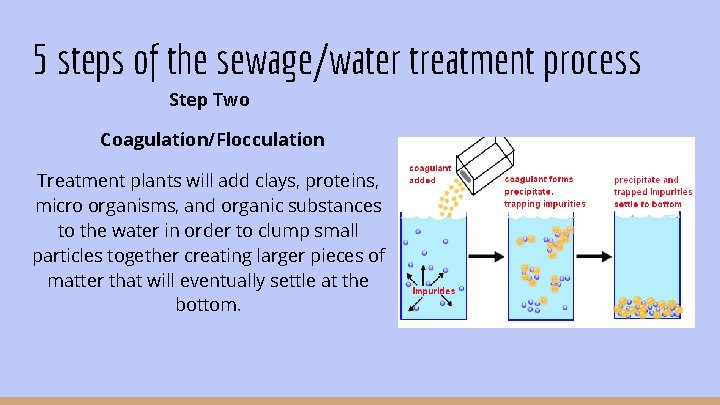
5 steps of the sewage/water treatment process Step Two Coagulation/Flocculation Treatment plants will add clays, proteins, micro organisms, and organic substances to the water in order to clump small particles together creating larger pieces of matter that will eventually settle at the bottom.
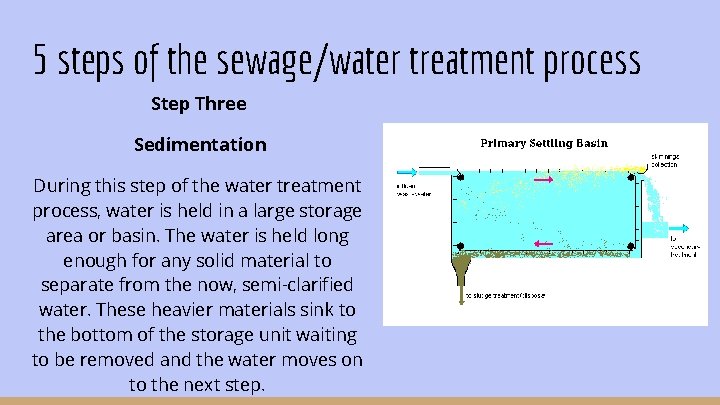
5 steps of the sewage/water treatment process Step Three Sedimentation During this step of the water treatment process, water is held in a large storage area or basin. The water is held long enough for any solid material to separate from the now, semi-clarified water. These heavier materials sink to the bottom of the storage unit waiting to be removed and the water moves on to the next step.
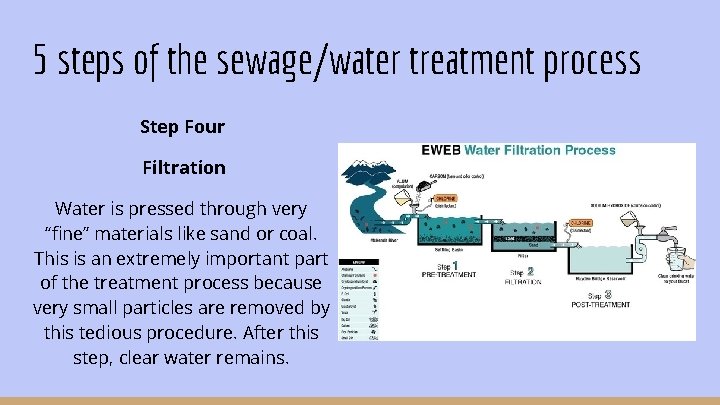
5 steps of the sewage/water treatment process Step Four Filtration Water is pressed through very “fine” materials like sand or coal. This is an extremely important part of the treatment process because very small particles are removed by this tedious procedure. After this step, clear water remains.
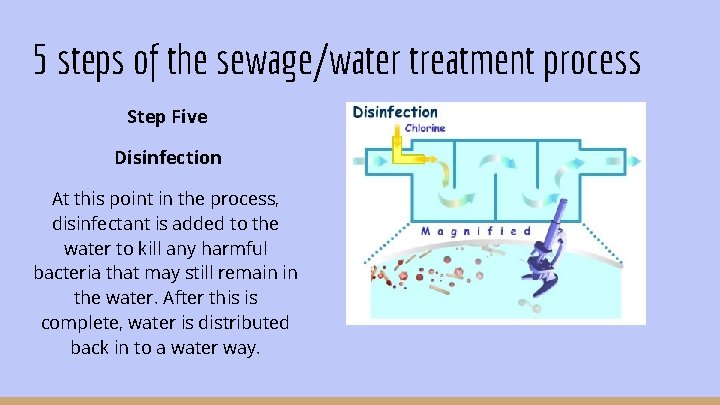
5 steps of the sewage/water treatment process Step Five Disinfection At this point in the process, disinfectant is added to the water to kill any harmful bacteria that may still remain in the water. After this is complete, water is distributed back in to a water way.
Septic System Water Treatment 1/3 What is a Septic system? A septic system is an underground water treatment system. Many rural homes use a septic system because they do not have access to a sewer system. There are many benefits to this type of water treatment system. It is much less expensive, a lot easier to manage, does not have as large of an impact on the environment, and treats wastewater onsite instead of at a facility. A septic system is typically made up of two parts- the septic tank and the drainfield. The septic tank is a waterproof box made of concrete or fiberglass with inlet and outlet pipes that allow water to move throughout the system. The drainfield is a series of ditches lined with gravel or sometimes course sand. The drainfield is normally located one to three feet under the ground's surface.
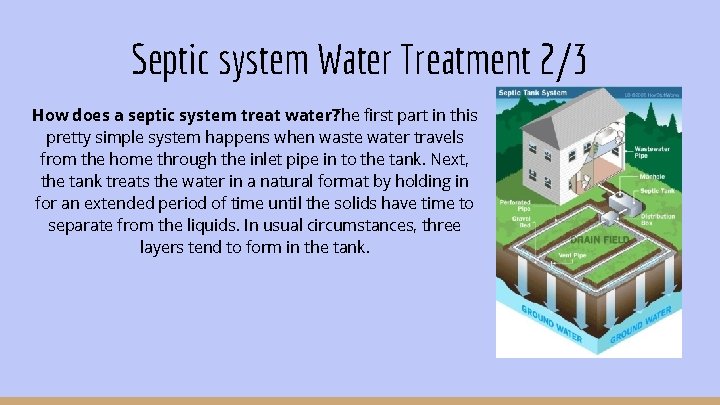
Septic system Water Treatment 2/3 How does a septic system treat water? The first part in this pretty simple system happens when waste water travels from the home through the inlet pipe in to the tank. Next, the tank treats the water in a natural format by holding in for an extended period of time until the solids have time to separate from the liquids. In usual circumstances, three layers tend to form in the tank.
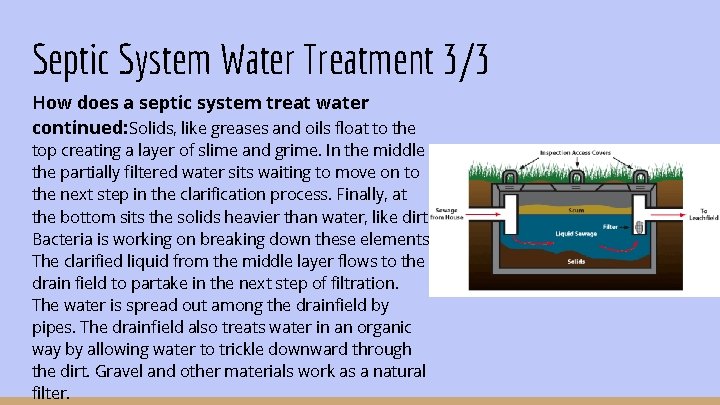
Septic System Water Treatment 3/3 How does a septic system treat water continued: Solids, like greases and oils float to the top creating a layer of slime and grime. In the middle the partially filtered water sits waiting to move on to the next step in the clarification process. Finally, at the bottom sits the solids heavier than water, like dirt. Bacteria is working on breaking down these elements. The clarified liquid from the middle layer flows to the drain field to partake in the next step of filtration. The water is spread out among the drainfield by pipes. The drainfield also treats water in an organic way by allowing water to trickle downward through the dirt. Gravel and other materials work as a natural filter.
Non-Point Source What is it? Non-point source pollution are things like fertilizers, oil, toxic chemicals, waste, and acid drainage. These pollutants get to water through runoff, precipitation, drainage, or seepage. Why is it nonpoint source pollution? It is non-point source because its a mix of pollutants from a large area. You can't tell where the pollution came from so it is non-point source. Why is it important? Non-point source pollution is important because it is the biggest cause of water quality problems.
Point Source Definition Point sources are factories and sewage treatment plants that release pollutants from trackable points like a discharge pipe. Importance Point source pollution spreads harmful chemicals into nature that harm the environment, humans, and animals by polluting our drinking water.
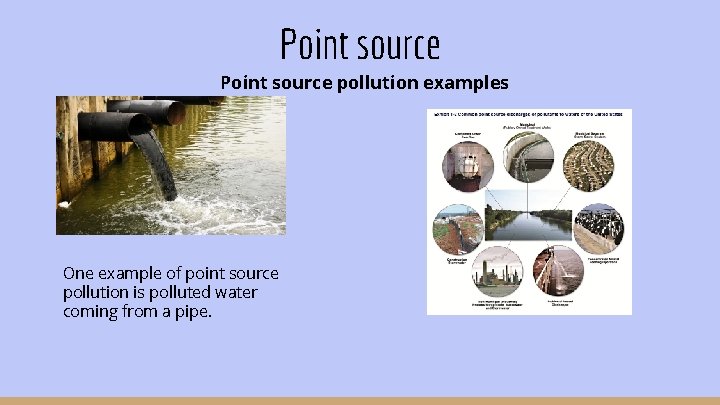
Point source pollution examples One example of point source pollution is polluted water coming from a pipe.
Is non-point source or point source pollution worse? Non-point source pollution is worse because it can't be traced back to where it was put out. Since you can’t trace it back, you can’t solve the problem to make sure it never happens again and you can’t hold whoever caused the problem responsible.
Open ended 1. Why do people have septic systems instead of sewage systems? 1. What are the five steps of water treatment?
Multiple choice questions 1. Which example is not a way non-point source pollution could get to water? A. Runoff B. Condensation C. Drainage D. precipitation
Answers Open ended 1. People have septic systems because they live in a rural area and sewer systems don't reach their house. 2. 1. screening 2. coagulation & flocculation 3. sedimentation 4. filtration 5. disinfection Multiple choice 1. B. Condensation
Sources 1. Water treatment process (5 steps) 2. 3. 4. 5. 6. 7. 8. 9. 10. 11. https: //www. livestrong. com/article/128483 -steps-water-purification/ https: //www. denverwater. org/your-water/treatment-process Septic system http: //www. nesc. wvu. edu/subpages/septic_defined. cfm Non-point source pollution www. epa. gov Comparing point source and non-point source www. watereducation. org Point source pollution www. watereducation. org
- Slides: 17