
Water supply system Ghada Kassab Ph D Civil
Water supply system Ghada Kassab, Ph. D Civil Engineering Department Faculty of Engineering and Technology
The availability of water is critical to maintaining ecosystems as well as for communities, industry, agriculture and commercial operations. The presence or lack of water at sufficient quantity and quality can significantly affect the sustainability of life. Water Resources Surface water; which is the water available on or above the earth’s surface. It encompasses all water in lakes, rivers and streams. Groundwater; which is the water available in the earth’s subsurface geological materials, such as sand rock or gravel

Groundwater fills the spaces between soil particles and fractured rock underground

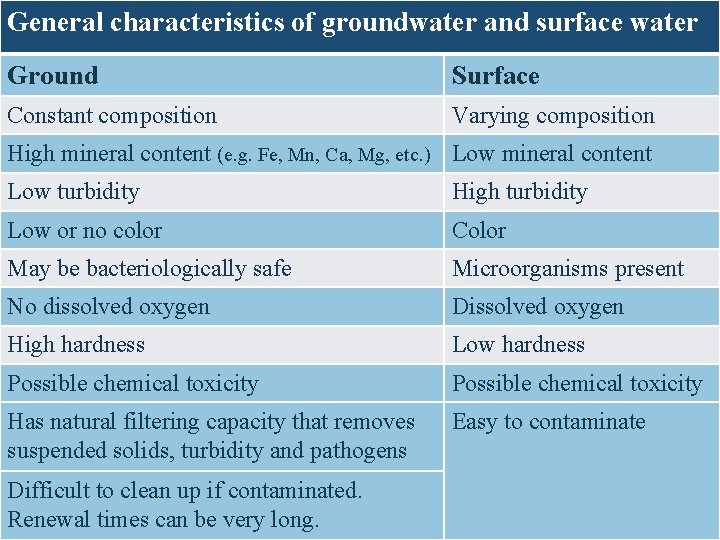
General characteristics of groundwater and surface water Ground Surface Constant composition Varying composition High mineral content (e. g. Fe, Mn, Ca, Mg, etc. ) Low mineral content Low turbidity High turbidity Low or no color Color May be bacteriologically safe Microorganisms present No dissolved oxygen Dissolved oxygen High hardness Low hardness Possible chemical toxicity Has natural filtering capacity that removes suspended solids, turbidity and pathogens Easy to contaminate Difficult to clean up if contaminated. Renewal times can be very long.
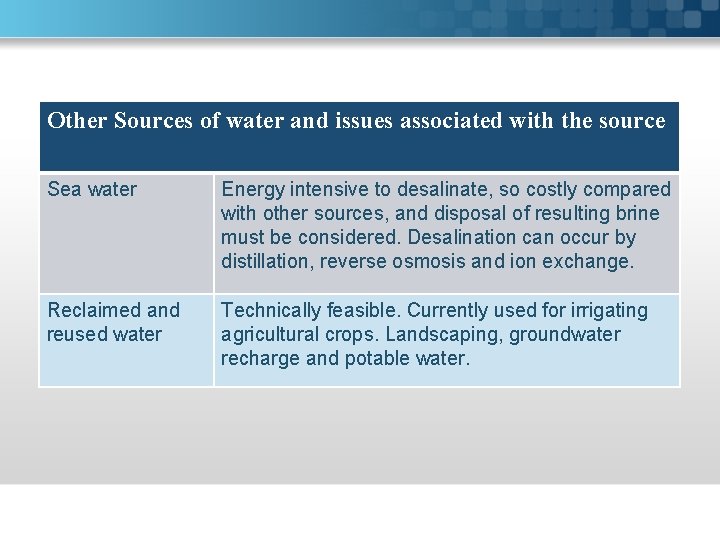
Other Sources of water and issues associated with the source Sea water Energy intensive to desalinate, so costly compared with other sources, and disposal of resulting brine must be considered. Desalination can occur by distillation, reverse osmosis and ion exchange. Reclaimed and reused water Technically feasible. Currently used for irrigating agricultural crops. Landscaping, groundwater recharge and potable water.
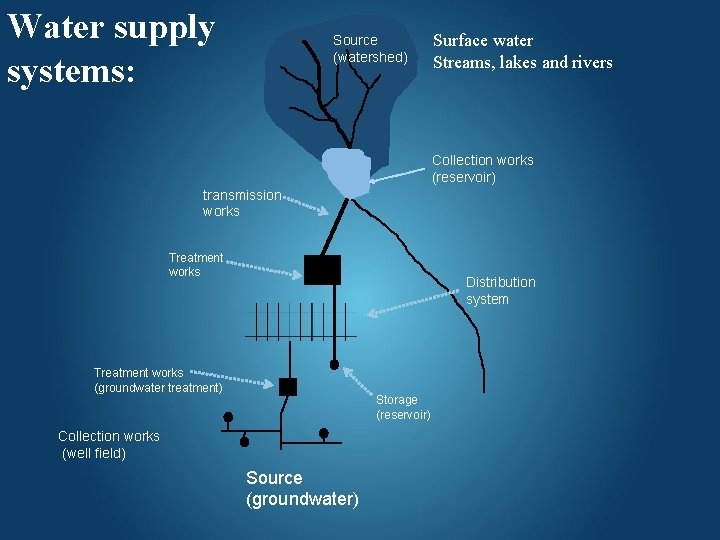
Water supply systems: Source (watershed) Surface water Streams, lakes and rivers Collection works (reservoir) transmission works Treatment works Distribution system Treatment works (groundwater treatment) Storage (reservoir) Collection works (well field) Source (groundwater)
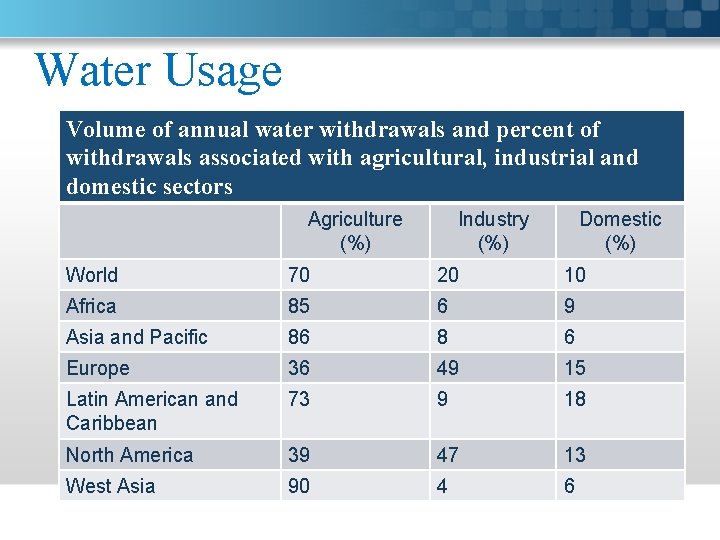
Water Usage Volume of annual water withdrawals and percent of withdrawals associated with agricultural, industrial and domestic sectors Agriculture (%) Industry (%) Domestic (%) World 70 20 10 Africa 85 6 9 Asia and Pacific 86 8 6 Europe 36 49 15 Latin American and Caribbean 73 9 18 North America 39 47 13 West Asia 90 4 6
Jordan’s water resources Refer to: 1. Water for Life Jordan’s Water Strategy 2008 -2022. 2. Jordan’s Water Sector, Facts and Figures- 2013
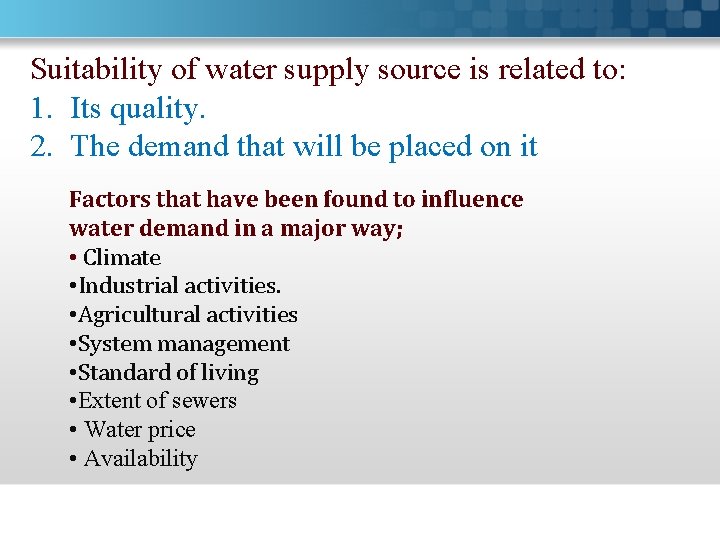
Suitability of water supply source is related to: 1. Its quality. 2. The demand that will be placed on it Factors that have been found to influence water demand in a major way; • Climate • Industrial activities. • Agricultural activities • System management • Standard of living • Extent of sewers • Water price • Availability
Obviously, water resources quality should be protected, to ensure that the water is suitable for its intended uses. Accordingly, pollution from human activities should be controlled “water quality management” The science of knowing how much waste is too much for a particular water body. To know how much waste can be tolerated (assimilated) by a water body.
Water pollutants and their sources Point sources: domestic sewage and industrial wastes act as point sources Non-Point sources: Leachate from cesspits and failed septic tanks and urban and agriculture runoff are characterized by multiple discharge points.
Pollutants 1. Oxygen demanding material: Any thing that can be oxidized in the receiving water resulting in the consumption of dissolved oxygen. These materials are usually biodegradable organic matter but also included certain inorganic compounds. The consumption of oxygen, poses a threat to fish and other higher forms of aquatic life. 2. Nutrients Nitrogen and phosphorous, two nutrients of primary concern, are considered pollutants when they become too much of a good things. Excessive nutrients often lead to eutrophication.
Eutrophication : is defined as the enrichment of water by nutrients, especially nitrogen and/or phosphorus, causing an accelerated growth of algae and higher forms of plant life to produce an undesirable disturbance to the balance of organisms present in the water and to the quality of water concerned. Major sources of nutrients are phosphorus based detergents, fertilizers, food processing wastes as well as animal and human excrement.
3. Pathogenic organisms 4. Suspended solids 5. Salts 6. Pesticides 7. Pharmaceuticals and personal care products (PPCPs) 8. Arsenic 9. Toxic metals 10. Heat
Water quality management, in rivers The effect of pollution depends both on the nature of the pollutant and the unique characteristics of the individual river. • Volume and speed of water flowing in the river • River's depth • Type of bottom • Surrounding vegetation • Climate of the region • Land use patterns • Types of aquatic life in the river
Pollutants that have such a profound effect on almost all types of rivers are the: • Oxygen demanding wastes • Nutrients
Oxygen demanding wastes When oxygen demanding waste is added to water, the rate at which oxygen is consumed in oxidizing that waste (deoxygenation) may exceed the rate at which oxygen is resupplied (aeration). This can lead to depletion of oxygen resources, with concentrations falling far below saturation levels.
One of the major tools of water quality management in rivers is assessing the capability of a stream to absorb a waste load. This is done by determining the profile of DO concentration downstream from a waste discharge. DO sag curve
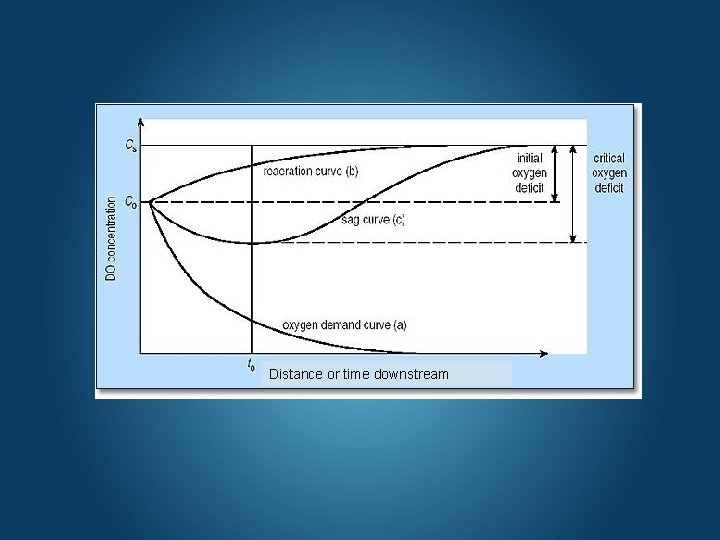
Distance or time downstream
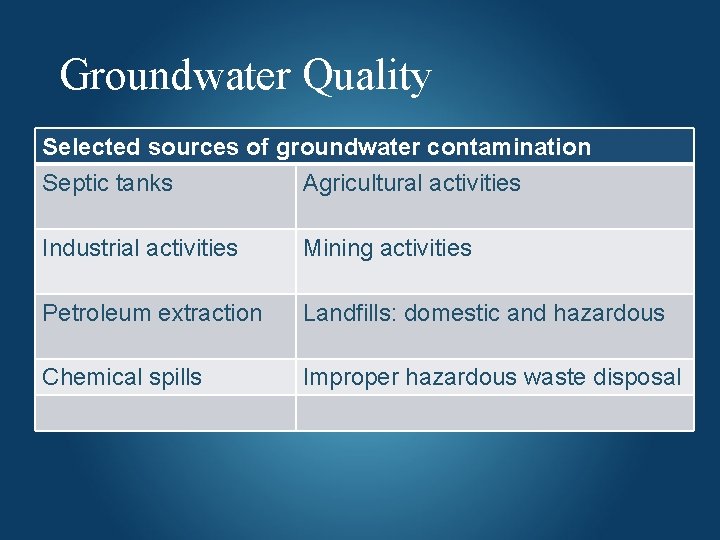
Groundwater Quality Selected sources of groundwater contamination Septic tanks Agricultural activities Industrial activities Mining activities Petroleum extraction Landfills: domestic and hazardous Chemical spills Improper hazardous waste disposal
Groundwater contaminants are transported by two processes: Advection; occurs when the contaminant is transported with the bulk flow, that is, moving groundwater. Dispersion; which results from the effects of two mechanisms: diffusion and mechanical mixing. Diffusion is driven by concentration gradients, while mechanical mixing results from interactions with aquifer’s solid matrix.
The migration of contaminants in soils and aquifers is very much dependent on the properties of the chemical and the geologic material. The more water soluble a chemical, the more likely it will move through the soil and migrate with the water.
Groundwater remediation may be accomplished by physical • biological, and • chemical means •
- Slides: 24