
Water Supply Planning Current and Future Water Demands


- Slides: 20
Water Supply Planning: Current and Future Water Demands Water Allocation Committee Environmental Management Commission September 12, 2018
Water Supply Planning: Current and Future Water Demands • Statutory Requirements • Water Use Registration • Water Use Management • Water Use Demand Outlook • Challenges • Q&A 2
Water Supply Planning • Assures the availability of adequate supplies of good quality water to protect public health and support economic growth. • Water supply planning and management requires an understanding of both available water resources (sources of supplies) and demands being placed on those resources. 3
Water Use Permitting & Registration • No State-wide Water Use Permitting Program • Limited Regional Permitting • Central Coastal Plain Capacity Use Area (CCPCUA) • Eno River Management (Voluntary) • Only State-wide Water Use Registration • Local Water Supply Plan (LWSP) • Water Withdrawal Registration (WWR) 4
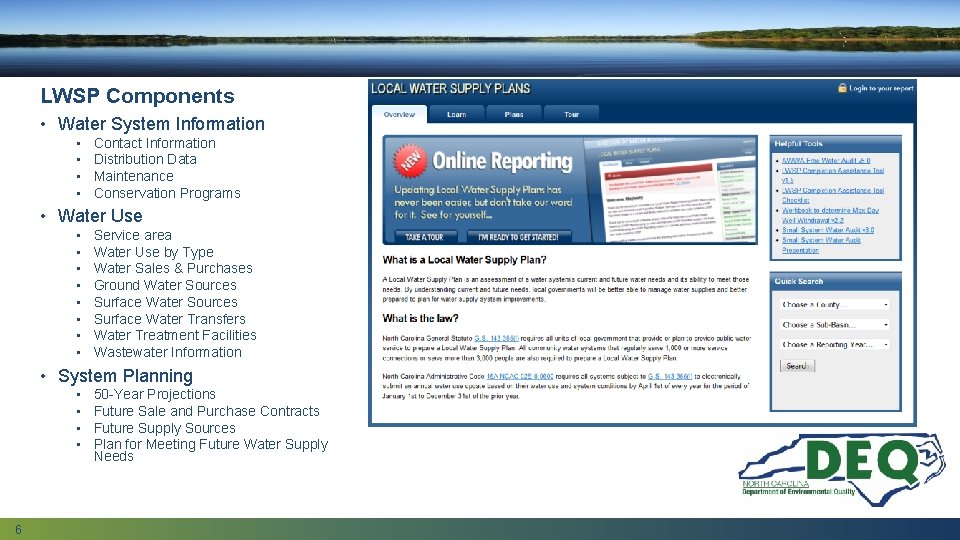
Local Water Supply Planning • Law was established in 1989 by § 143 -355(l) • Requires all unit of local governments and large community water systems to prepare a Local Water Supply Plan (LWSP) • Applies to systems with >1000 connections or >3000 people • A LWSP is an assessment of a water system's current and future water needs and its ability to meet those needs • A LWSP contains a systems water shortage response plan, water efficiency plan and surface water transfer worksheets (if needed) 5
LWSP Components • Water System Information • • Contact Information Distribution Data Maintenance Conservation Programs • Water Use • • Service area Water Use by Type Water Sales & Purchases Ground Water Sources Surface Water Transfers Water Treatment Facilities Wastewater Information • System Planning • • 6 50 -Year Projections Future Sale and Purchase Contracts Future Supply Sources Plan for Meeting Future Water Supply Needs
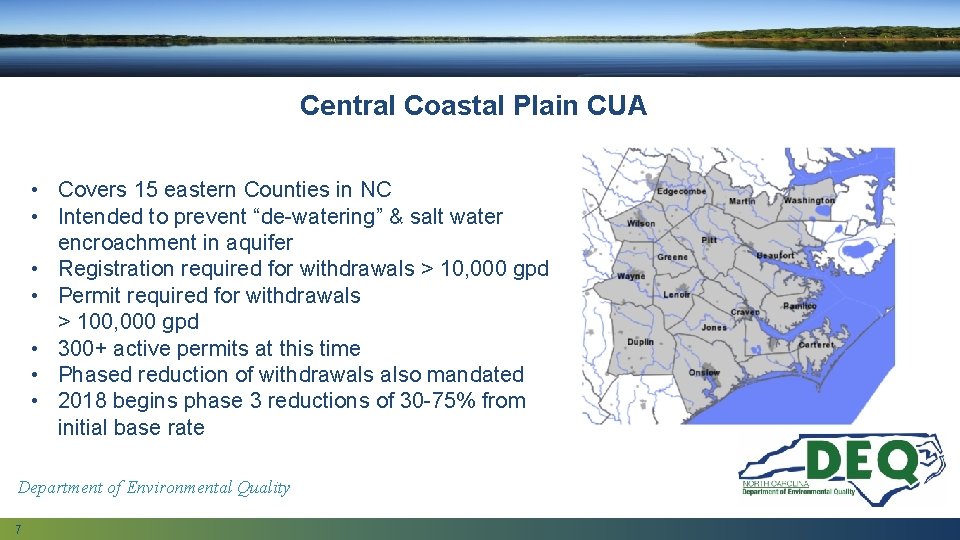
Central Coastal Plain CUA • Covers 15 eastern Counties in NC • Intended to prevent “de-watering” & salt water encroachment in aquifer • Registration required for withdrawals > 10, 000 gpd • Permit required for withdrawals > 100, 000 gpd • 300+ active permits at this time • Phased reduction of withdrawals also mandated • 2018 begins phase 3 reductions of 30 -75% from initial base rate Department of Environmental Quality 7
Water Withdrawal Registration Program Requirements: • • G. S. 143 -215. 22 H was established in 1991 Agricultural users > 1, 000 gallons any single day Non-agricultural users > 100, 000 gallons any single day Registered water users have until April 1 st to report water usage for the previous year • Completing the Agricultural Water Use Survey does not fulfill this reporting requirement > 1 mgd 8
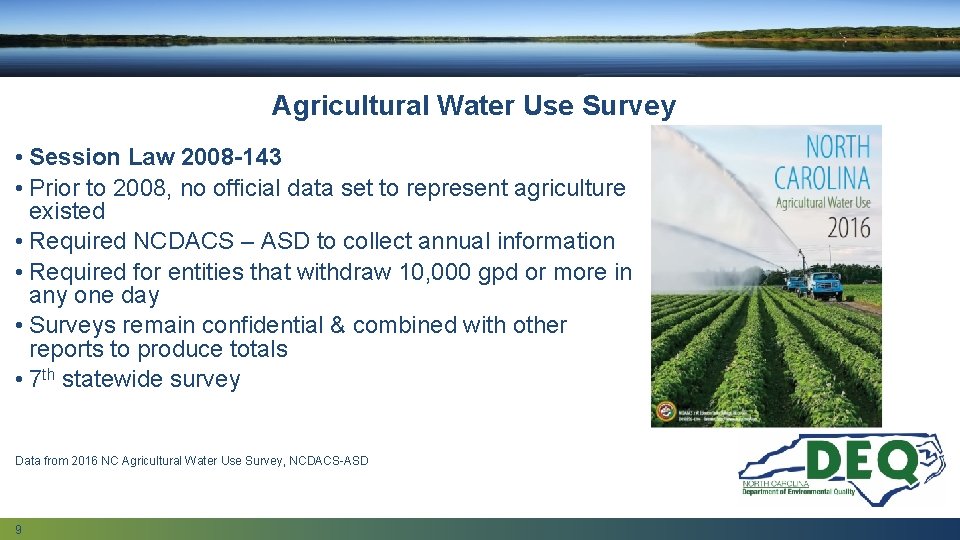
Agricultural Water Use Survey • Session Law 2008 -143 • Prior to 2008, no official data set to represent agriculture existed • Required NCDACS – ASD to collect annual information • Required for entities that withdraw 10, 000 gpd or more in any one day • Surveys remain confidential & combined with other reports to produce totals • 7 th statewide survey Data from 2016 NC Agricultural Water Use Survey, NCDACS-ASD 9
Water Use Management • Water Users • Agricultural • Domestic • Energy • Industrial • Mining • Public Water Supply Systems • Recreational (Golf, Snow making, Water sports, etc. ) • Aquatic Wildlife, Habitat, and Associated Floodplain • Future Water Users 10
Drought Planning • Minimize harmful impacts of drought and water supply emergencies on public health and safety, environmental quality, and the economy. • Establish minimum standards and practices for: • • water shortage response planning, water use reporting, water conservation, and water reuse during droughts and water supply emergencies. • Rules governing water use during droughts and water emergencies • New Water Withdrawal Reporting 11
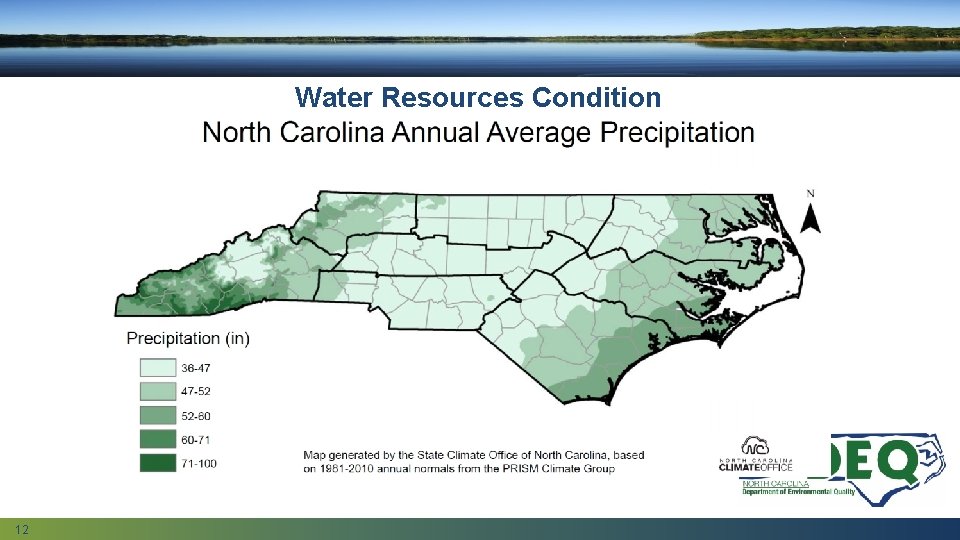
Water Resources Condition 12
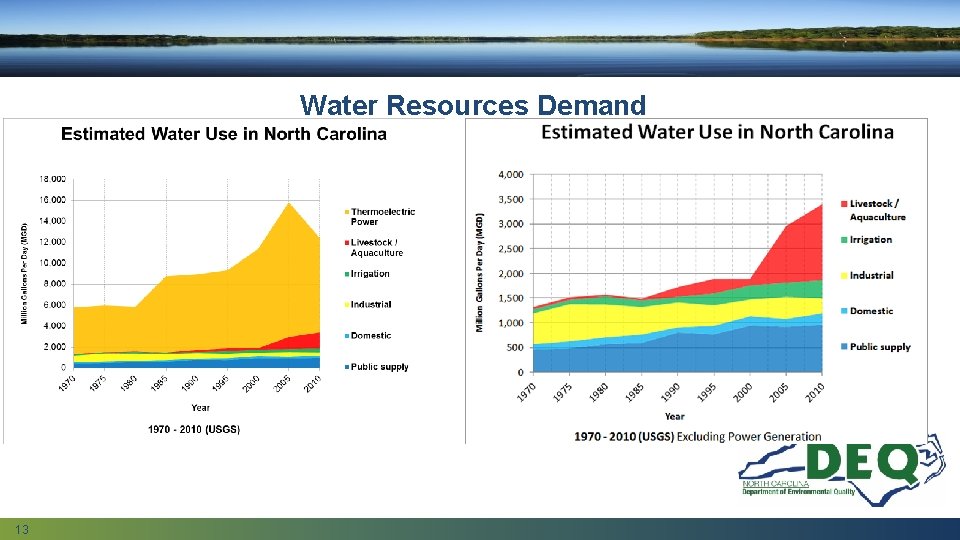
Water Resources Demand 13
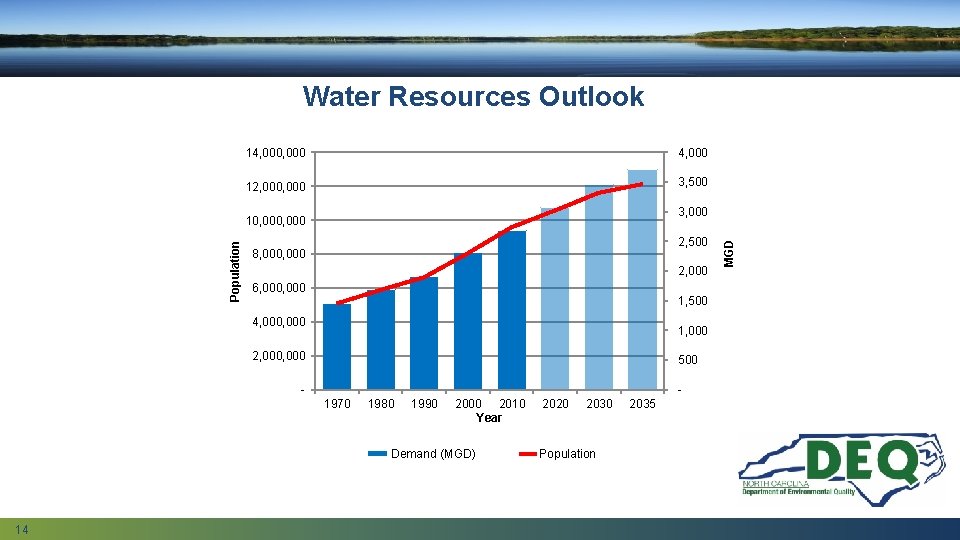
Water Resources Outlook 14, 000 12, 000 3, 500 Population 2, 500 8, 000 2, 000 6, 000 1, 500 4, 000 1, 000 2, 000 500 - 1970 1980 1990 2000 2010 Year Demand (MGD) 14 2020 2030 Population 2035 MGD 3, 000 10, 000
Challenges to NC Water Supply Planning NC Water Law – Riparian Rights State • No comprehensive plan for water quantity management in NC • No federal oversight of / nor federal requirements for water quantity management • No permitting program • Pros • Less government regulation & permitting • Equal right to the water for all “reasonable use” • Cons • No plan to ensure availability of water for future water supply, agriculture, industry, continued economic growth, & ecological health on NC’s water bodies • Courts would have to make the determination of reasonable use 15
Challenges to NC Water Supply Planning • Lack the ability to plan and manage all water uses • Water use must be reported (especially large users) • Need better agricultural data • Need to consider Ecological flows (Instream uses) • “Proper” documentation of water users’ needs • Growth and projections • Economical development • Coordination between other water users 16
Challenges to NC Water Supply Planning • Need more monitoring of ground and surface water sources • Difficult to quantify availability of water supply • How much surface water will be available? • How much ground water will be available? • Difficult to develop and utilize surface water sources • Onstream & offstream reservoirs, quarries, etc. • Some interbasin transfer issues may arise • Aging infrastructure (Lack of funds for maintenance and planning) • We must… 17
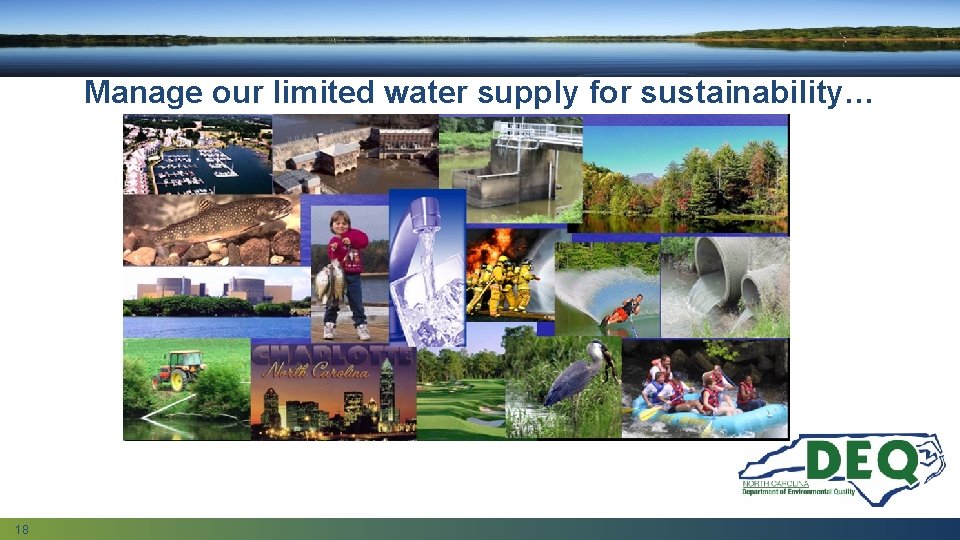
Manage our limited water supply for sustainability… 18
Questions? Linwood Peele, Supervisor Water Supply Planning Branch Division of Water Resources Linwood. Peele@ncdenr. gov 919 -707 -9024 19
Department of Environmental Quality 20