
Water Safety Education and Drowning Prevention in the
- Slides: 6
Water Safety Education and Drowning Prevention in the Clinical Setting SHABANA YUSUF MD, MED, DEPT OF PEDIATRICS, TCH, BCM, HOUSTON TRACY MCCALLIN MD, DEPT OF PEDIATRICS, CHOSA, BCM, SAN ANTONIO
Background In 2012, the Texas Drowning Prevention Alliance (TXDPA) created the Pediatrician Initiative to enlist pediatricians in educating families on drowning prevention practices. The TXDPA developed a variety of community education resources including videos on drowning prevention, posters, water safety brochures/checklists and water watcher tags as part of the initiative. In 2017, the TXDPA organization transitioned under the State Alliance of YMCAs, and this project has been taken over as a Texas Children’s Hospital (TCH) sponsored MOC part 4 activity. A resident pilot phase at Texas Tech, TCH, and CHof. SA was completed in 2017. The materials developed by the TXDPA are utilized as a major component of this quality initiative, and will further TXDPA’s mission which is to have a “safe and drown-free Texas”.
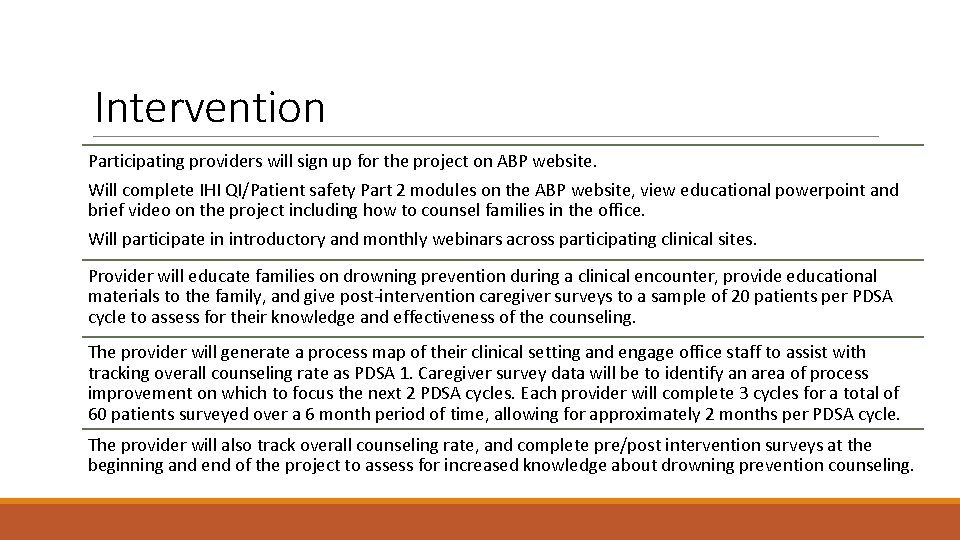
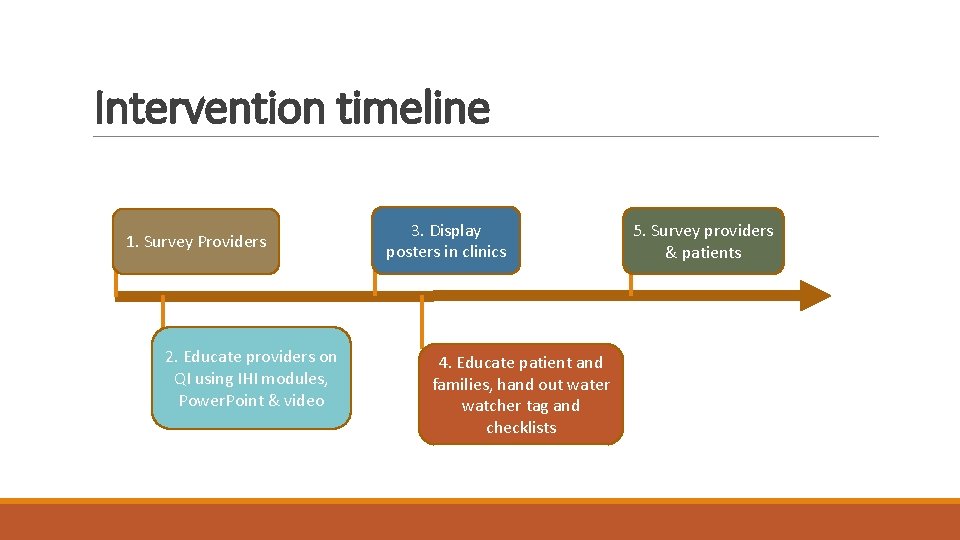
Intervention Participating providers will sign up for the project on ABP website. Will complete IHI QI/Patient safety Part 2 modules on the ABP website, view educational powerpoint and brief video on the project including how to counsel families in the office. Will participate in introductory and monthly webinars across participating clinical sites. Provider will educate families on drowning prevention during a clinical encounter, provide educational materials to the family, and give post-intervention caregiver surveys to a sample of 20 patients per PDSA cycle to assess for their knowledge and effectiveness of the counseling. The provider will generate a process map of their clinical setting and engage office staff to assist with tracking overall counseling rate as PDSA 1. Caregiver survey data will be to identify an area of process improvement on which to focus the next 2 PDSA cycles. Each provider will complete 3 cycles for a total of 60 patients surveyed over a 6 month period of time, allowing for approximately 2 months per PDSA cycle. The provider will also track overall counseling rate, and complete pre/post intervention surveys at the beginning and end of the project to assess for increased knowledge about drowning prevention counseling.
Intervention timeline 1. Survey Providers 2. Educate providers on QI using IHI modules, Power. Point & video 3. Display posters in clinics 4. Educate patient and families, hand out water watcher tag and checklists 5. Survey providers & patients
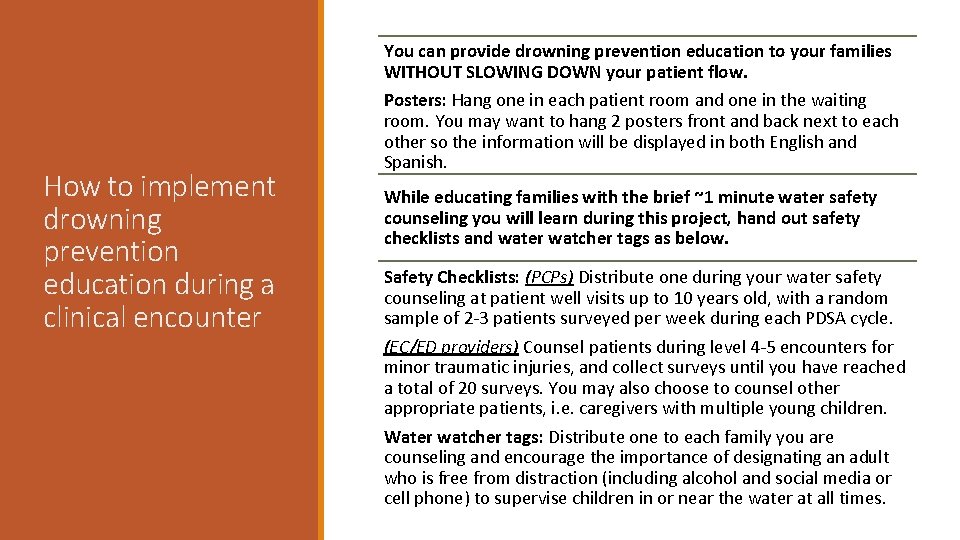
You can provide drowning prevention education to your families WITHOUT SLOWING DOWN your patient flow. How to implement drowning prevention education during a clinical encounter Posters: Hang one in each patient room and one in the waiting room. You may want to hang 2 posters front and back next to each other so the information will be displayed in both English and Spanish. While educating families with the brief ~1 minute water safety counseling you will learn during this project, hand out safety checklists and water watcher tags as below. Safety Checklists: (PCPs) Distribute one during your water safety counseling at patient well visits up to 10 years old, with a random sample of 2 -3 patients surveyed per week during each PDSA cycle. (EC/ED providers) Counsel patients during level 4 -5 encounters for minor traumatic injuries, and collect surveys until you have reached a total of 20 surveys. You may also choose to counsel other appropriate patients, i. e. caregivers with multiple young children. Water watcher tags: Distribute one to each family you are counseling and encourage the importance of designating an adult who is free from distraction (including alcohol and social media or cell phone) to supervise children in or near the water at all times.