
Water Rocket Modeling Sean Munson Ben Donaldson Alex
Water Rocket Modeling Sean Munson Ben Donaldson Alex Dillon
Design Goals • • • Range Accuracy Aesthetics These tell us little about how to build a rocket!
The Model
What happens to the rocket? Air Thrust Phase remaining air pressure leaves rocket Boost Phase Water leaving rocket under pressure Coast Phase Gravity, drag act on rocket until it smashes to the ground
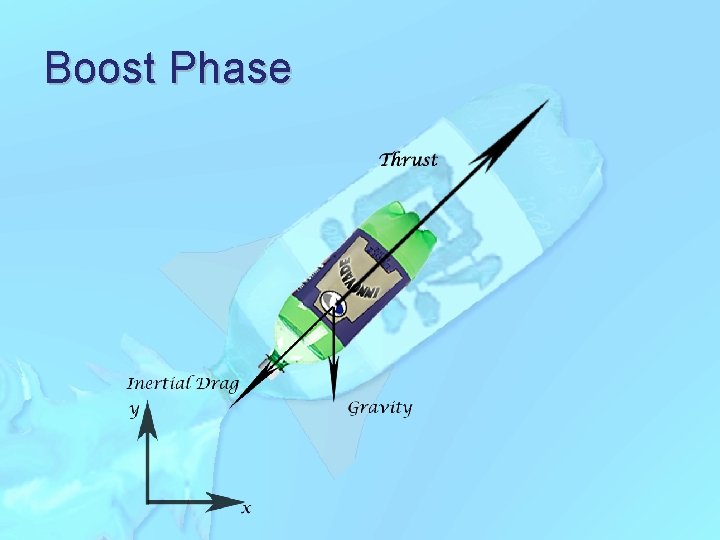
Boost Phase
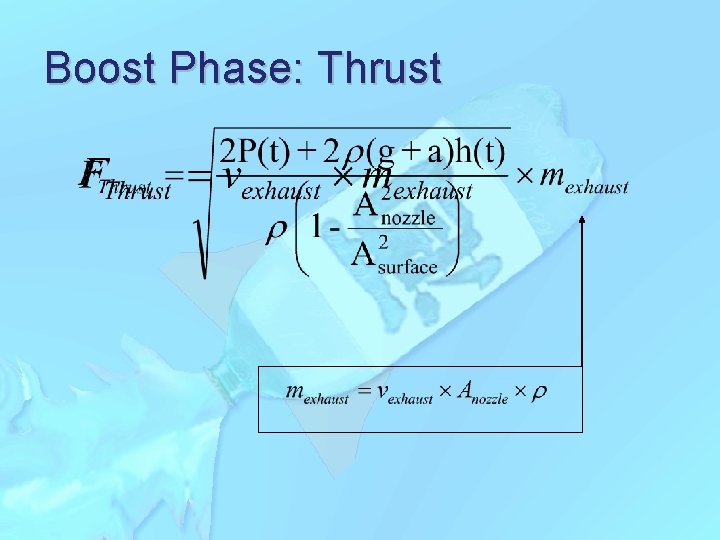
Boost Phase: Thrust
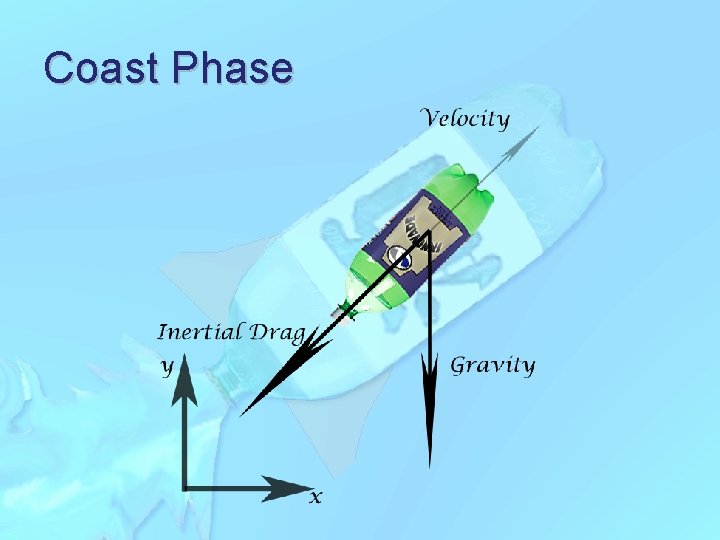
Coast Phase
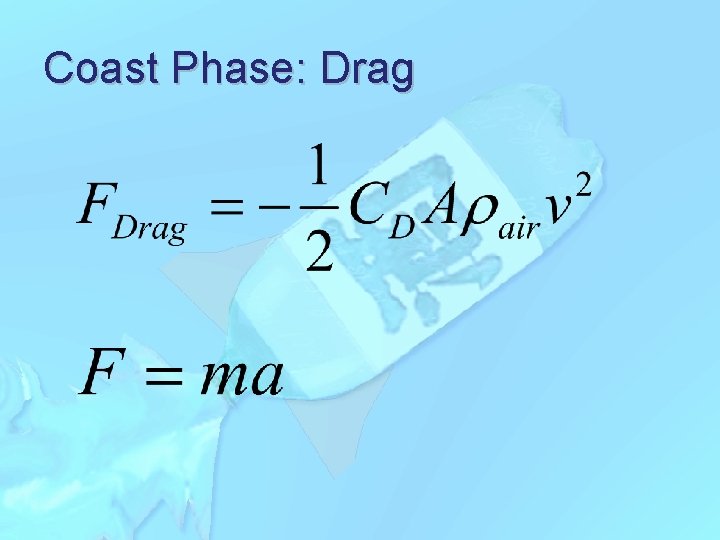
Coast Phase: Drag
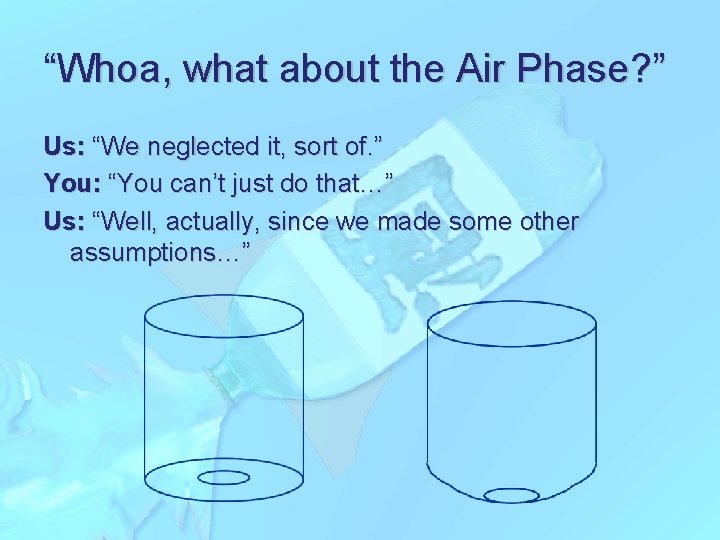
“Whoa, what about the Air Phase? ” Us: “We neglected it, sort of. ” You: “You can’t just do that…” Us: “Well, actually, since we made some other assumptions…”
What’s Important? • • • Cross Sectional Area (Nozzle, bottle) Coefficient of Drag (CD, Surface area) Mass of Rocket Pressure Volume of Water
Validation of the Model & Experiments
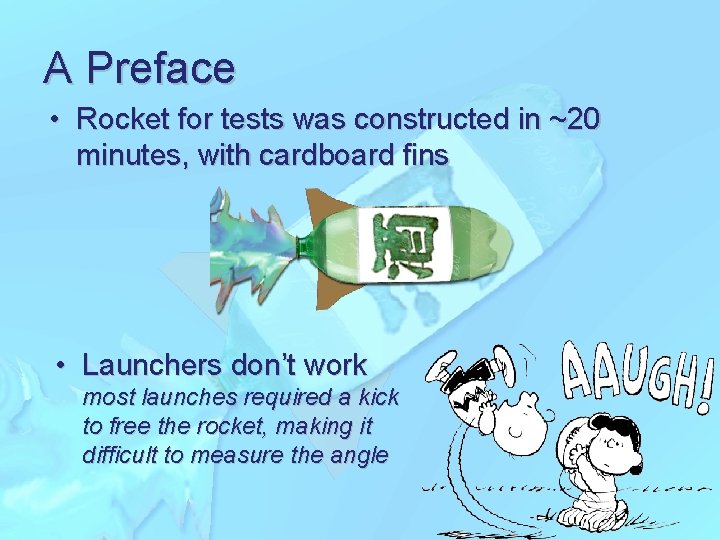
A Preface • Rocket for tests was constructed in ~20 minutes, with cardboard fins • Launchers don’t work most launches required a kick to free the rocket, making it difficult to measure the angle
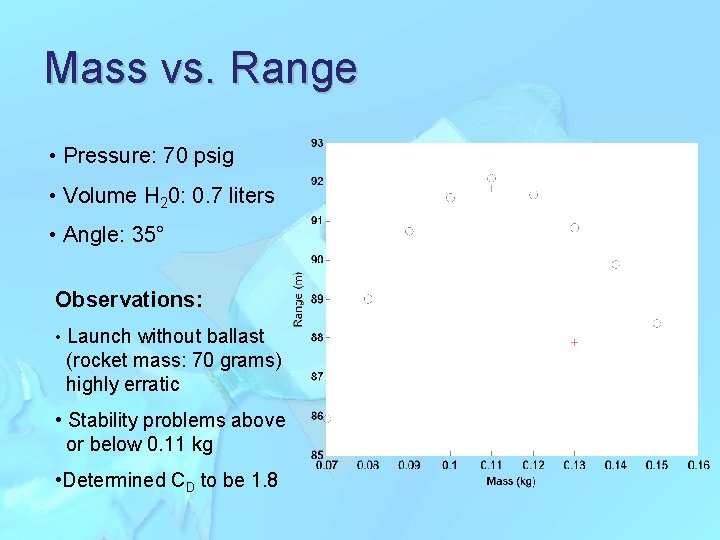
Mass vs. Range • Pressure: 70 psig • Volume H 20: 0. 7 liters • Angle: 35° Observations: • Launch without ballast (rocket mass: 70 grams) highly erratic • Stability problems above or below 0. 11 kg • Determined CD to be 1. 8
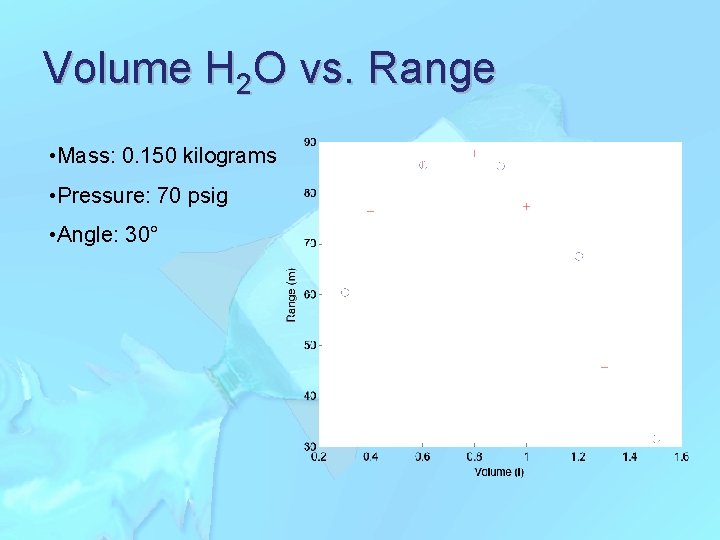
Volume H 2 O vs. Range • Mass: 0. 150 kilograms • Pressure: 70 psig • Angle: 30°
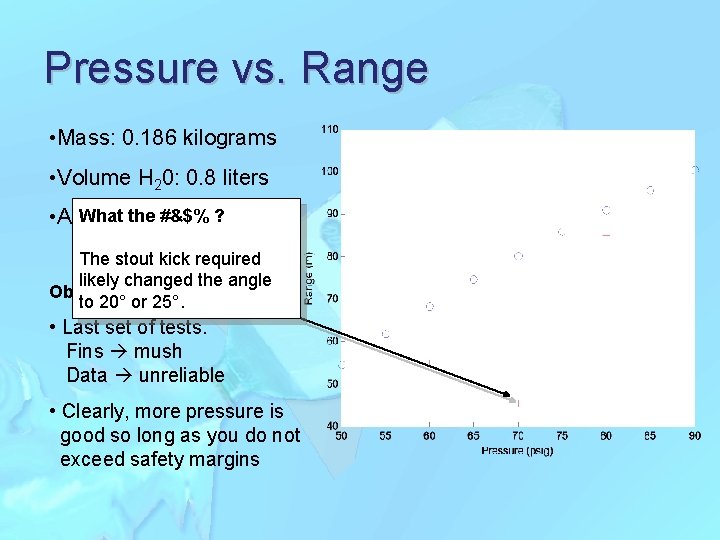
Pressure vs. Range • Mass: 0. 186 kilograms • Volume H 20: 0. 8 liters What 30° the #&$% ? • Angle The stout kick required likely changed the angle Observations: to 20° or 25°. • Last set of tests. Fins mush Data unreliable • Clearly, more pressure is good so long as you do not exceed safety margins
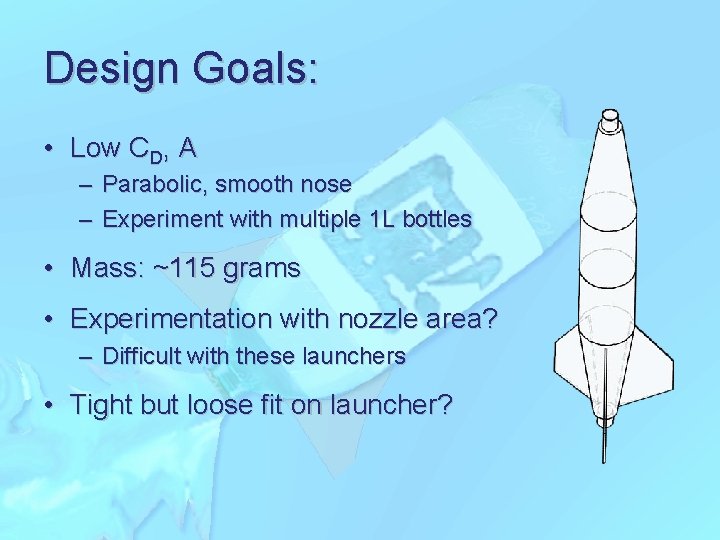
Design Goals: • Low CD, A – Parabolic, smooth nose – Experiment with multiple 1 L bottles • Mass: ~115 grams • Experimentation with nozzle area? – Difficult with these launchers • Tight but loose fit on launcher?
Questions?
- Slides: 17