
Water Resources Objective I will discuss the sustainability
Water Resources Objective: I will discuss the sustainability of freshwater resources and identify pros and cons of possible solutions. S
Importance of Freshwater S Necessary for life S 60% of our body is composed of water S Could only survive a few days without it S Takes huge amounts to supply us with food, energy etc. .
Management of Freshwater S Poorly managed S Charged less than its worth How would charging less than water’s worth contribute to the mismanagement of water?
Issues with water S Global – lack of access to safe drinking water in less developed countries S Economic – vital for reducing poverty and producing food and energy S National and global security issue – increasing tensions both within and between nations over access to limited water resources they share S Environmental S S Water loss and pollution Lower fish populations Species extinction Degradation of ecosystems

Availability of Freshwater S Only about 0. 024% of the planet’s water is available to us as liquid freshwater S Sources: S Groundwater deposits S Lakes S Rivers S Streams
Groundwater S Precipitation that seeps into the ground and moves downward through spaces in soil, gravel and rock until an impenetrable layer of rock stops it. S Spaces deep in the earth hold more water than at the top S Zone of saturation: Deep; Completely filled with water S Water zone: top of this groundwater zone S Aquifer: Deep; Groundwater flows through them; pumps used to bring water to surface; replenished mainly by precipitation
Groundwater S Surface water: freshwater from precipitation and melted snow that flows across the earth’s land surface and into lakes, wetlands, steams, rivers, estuaries, and into the ocean. S Surface runoff: precipitation that does not infiltrate the ground S Watershed (drainage basin): land from which surface water drains into a body of water
Reliable Runoff S Usable S 1/3 of surface runoff S 2/3 lost by seasonal flooding S World-wide averages S Domestic: 10% S Agriculture: 70% S Industrial use: 20%
Water Footprint S Volume of water we directly and indirectly use S Average American uses 260 liters per day S Flushing toilets, 27% S Washing clothes, 22% S Taking showers, 17% S Running faucets, 16% S Wasted from leaks, 14% S World’s poorest use 19 liters per day
Virtual Water S Water is used indirectly S Ex: Hamburger, 2400 liters S Virtual water often exported/imported S Grains and other foods
Water Shortages S Main factors S Dry climates S Drought S Too many people using a normal supply of water S Wasteful use of water
Water Shortages S More than 30 countries face water scarcity S Rapid urbanization, economic growth and drought are expected to put more stress on water resources in developing countries like China and India S 30% earth’s land area experiences severe drought S Will rise to 45% by 2059 from climate change S Potential conflicts/wars over water S Refugees from arid lands S Increased mortality
Think Box S What do you think we can do to increase freshwater supplies?
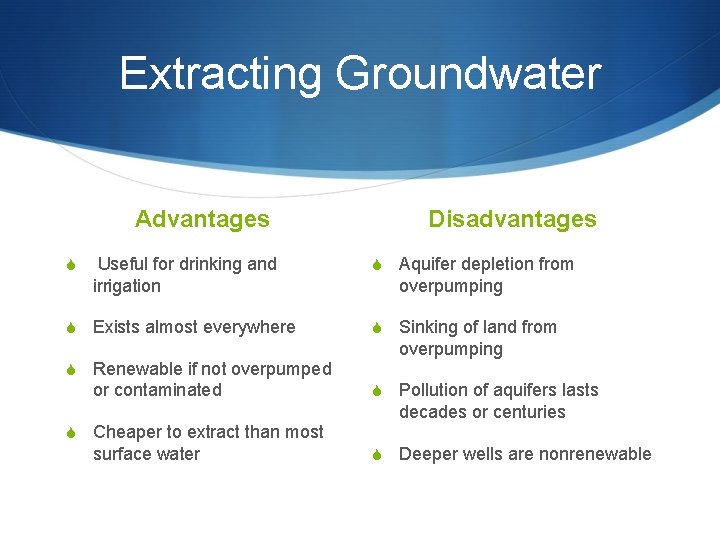
Extracting Groundwater Advantages S Useful for drinking and irrigation S Exists almost everywhere S Renewable if not overpumped or contaminated S Cheaper to extract than most surface water Disadvantages S Aquifer depletion from overpumping S Sinking of land from overpumping S Pollution of aquifers lasts decades or centuries S Deeper wells are nonrenewable
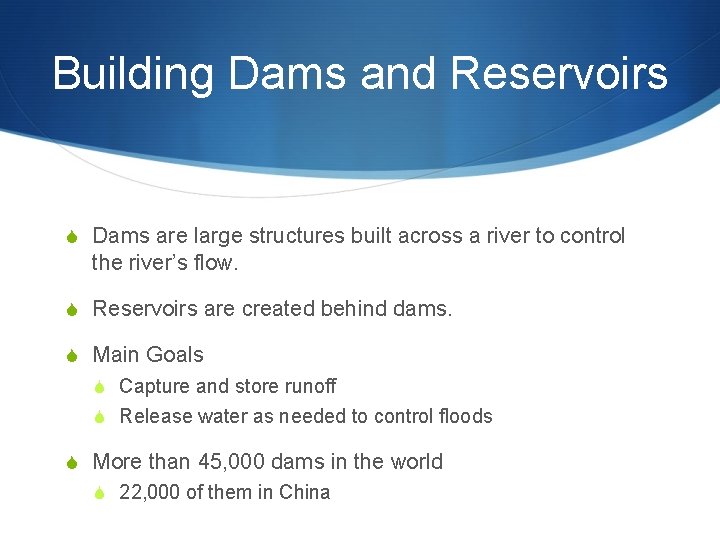
Building Dams and Reservoirs S Dams are large structures built across a river to control the river’s flow. S Reservoirs are created behind dams. S Main Goals S Capture and store runoff S Release water as needed to control floods S More than 45, 000 dams in the world S 22, 000 of them in China
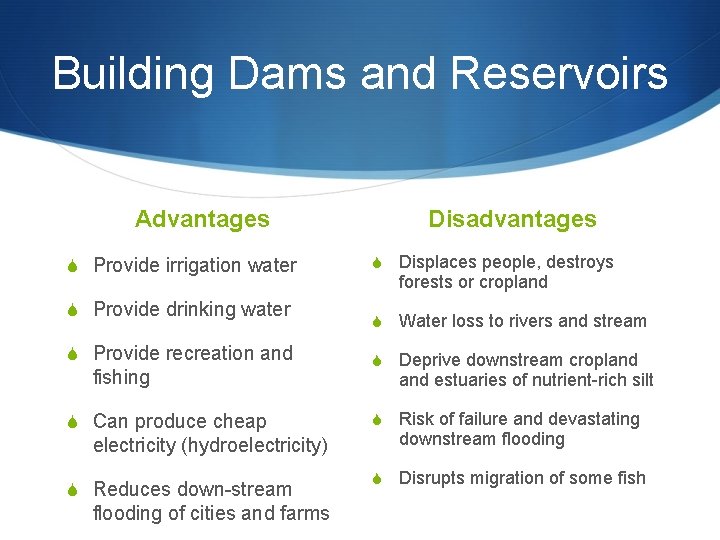
Building Dams and Reservoirs Advantages S Provide irrigation water S Provide drinking water S Provide recreation and fishing S Can produce cheap electricity (hydroelectricity) S Reduces down-stream flooding of cities and farms Disadvantages S Displaces people, destroys forests or cropland S Water loss to rivers and stream S Deprive downstream cropland estuaries of nutrient-rich silt S Risk of failure and devastating downstream flooding S Disrupts migration of some fish
Transferring Water S Transportation of water through aqueducts S California Water Project S Transports water from northern California to southern California Think Box: What do you think the effects of this might be on both parts of California?
Transferring Water Advantages S Supply water to areas that lack enough usable water S Allow farmers to grow water-intensive crops in area that lack sufficient water Disadvantages S Water waste S Degradation to the source S Subsidies for the cost of water transfers encourage overuse
Desalination S Removing of dissolved salts from ocean water or from brackish (slightly salty) water in aquifers or lakes. S Two widely used methods: S Distillation: involves heating saltwater until it evaporates leaving behind salts in solid form and then condenses as freshwater S Reverse osmosis: uses high pressure to force saltwater through a membrane filter with pores small enough to remove the salt
Desalination Advantages S More access to freshwater Disadvantages S High cost S Energy intensive S Pumping system kills many marine organisms S Produces huge quantities of salty wastewater that must go somewhere
- Slides: 20