
Water QualityBased Effluent Limits WQBELs Erika Crespo May
Water Quality-Based Effluent Limits (WQBELs) Erika Crespo May 2017
Permit limits apply to discharges. Water quality criteria apply to water bodies. In other words, criteria in the Texas Surface Water Quality Standards do not apply directly to a discharge.
What factors influence water qualitybased permit limits? 1. Numerical criteria (toxic pollutants) 2. Water body quality 3. Effluent fraction (mixing) 4. Bioavailable fraction

Texas has numerical criteria for aquatic life and human health protection. ◊ Found in Texas Surface Water Quality Standards (30 TAC Chapter 307 Section 6 – Toxic Materials)
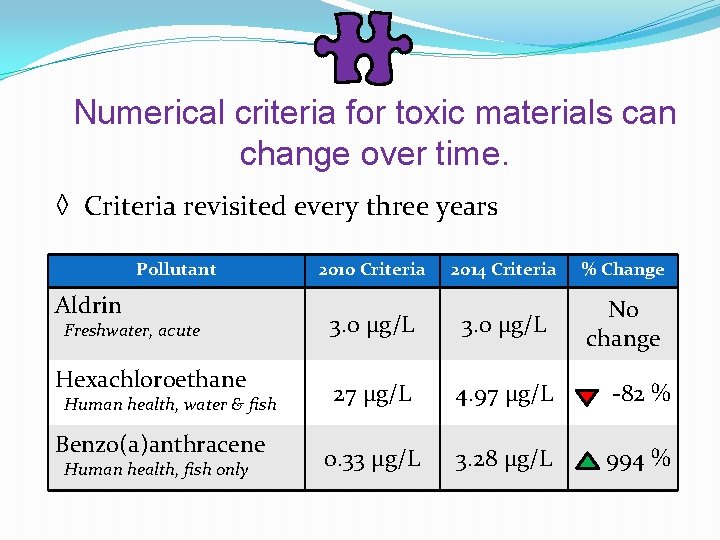
Numerical criteria for toxic materials can change over time. ◊ Criteria revisited every three years Pollutant Aldrin Freshwater, acute Hexachloroethane Human health, water & fish Benzo(a)anthracene Human health, fish only 2010 Criteria 2014 Criteria % Change 3. 0 μg/L No change 27 μg/L 4. 97 μg/L -82 % 0. 33 μg/L 3. 28 μg/L 994 %

Numerical criteria for aquatic life reflect an organism’s environment and exposure. Table 1. Criteria in Water for Specific Toxic Materials Aquatic Life Protection
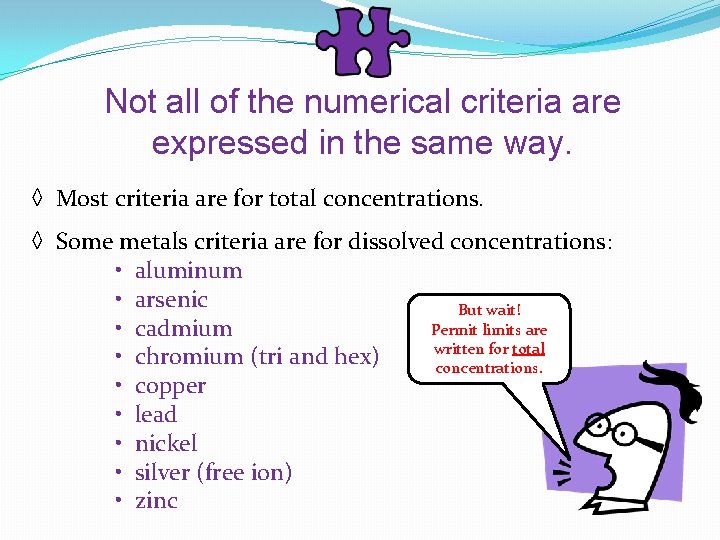
Not all of the numerical criteria are expressed in the same way. ◊ Most criteria are for total concentrations. ◊ Some metals criteria are for dissolved concentrations: • aluminum • arsenic But wait! Permit limits are • cadmium written for total • chromium (tri and hex) concentrations. • copper • lead • nickel • silver (free ion) • zinc
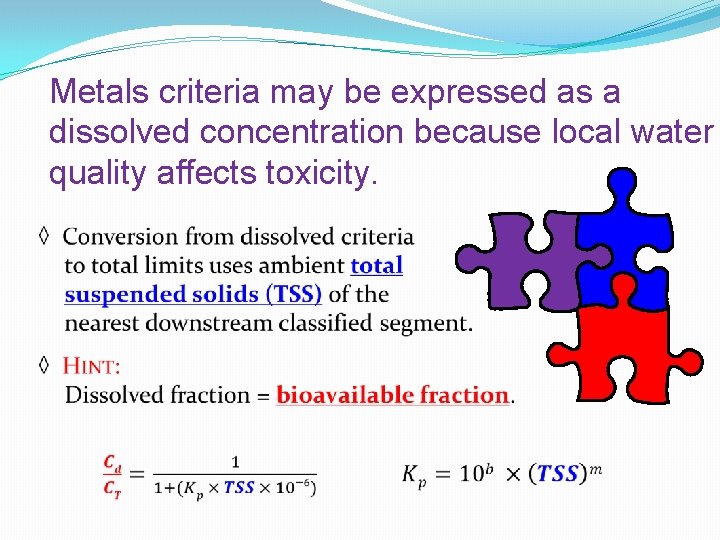
Metals criteria may be expressed as a dissolved concentration because local water quality affects toxicity.
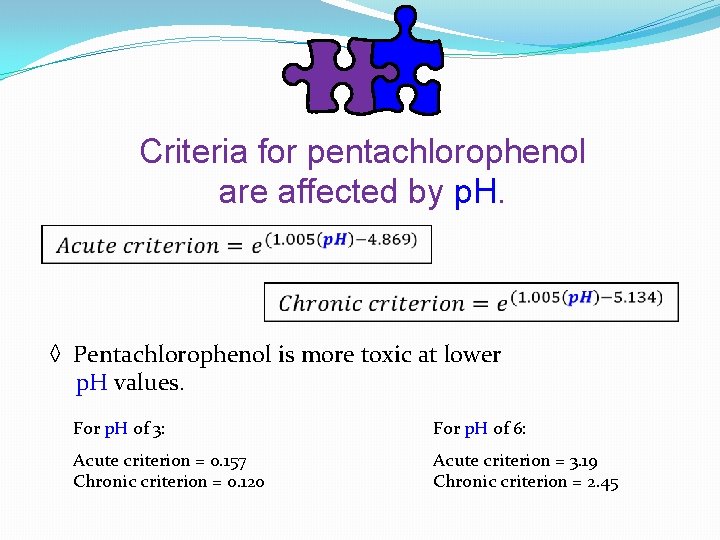
Criteria for pentachlorophenol are affected by p. H. ◊ Pentachlorophenol is more toxic at lower p. H values. For p. H of 3: For p. H of 6: Acute criterion = 0. 157 Chronic criterion = 0. 120 Acute criterion = 3. 19 Chronic criterion = 2. 45
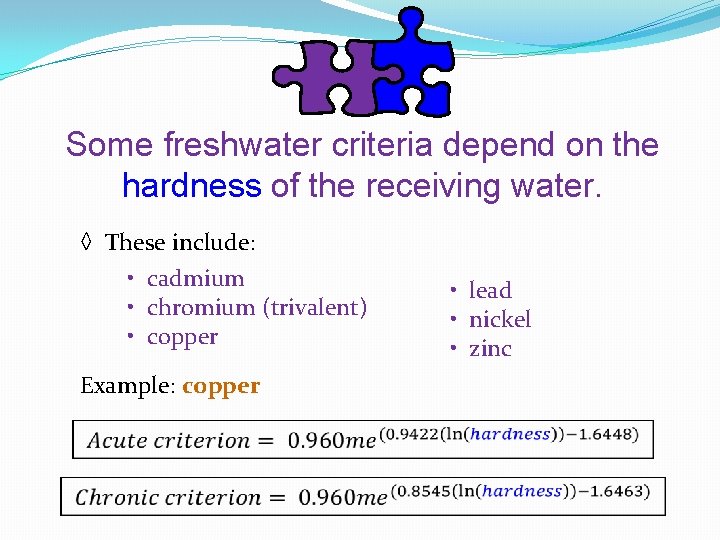
Some freshwater criteria depend on the hardness of the receiving water. ◊ These include: • cadmium • chromium (trivalent) • copper Example: copper • lead • nickel • zinc
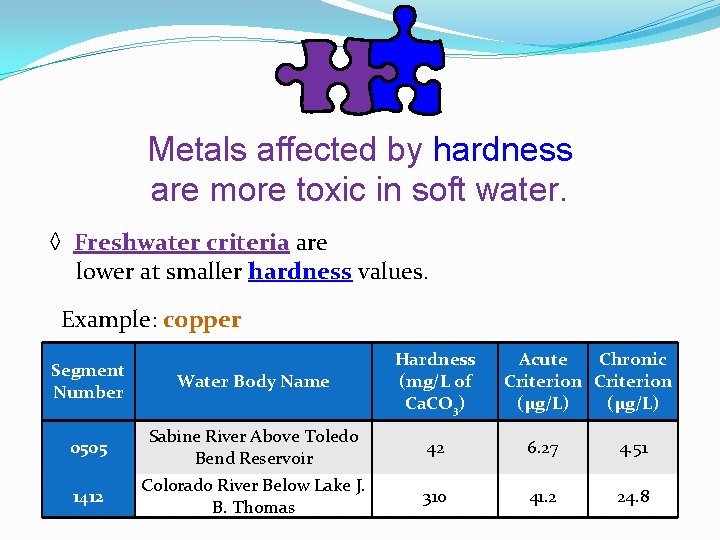
Metals affected by hardness are more toxic in soft water. ◊ Freshwater criteria are lower at smaller hardness values. Example: copper Segment Number Water Body Name Hardness (mg/L of Ca. CO 3) Acute Chronic Criterion (µg/L) 0505 Sabine River Above Toledo Bend Reservoir 42 6. 27 4. 51 1412 Colorado River Below Lake J. B. Thomas 310 41. 2 24. 8
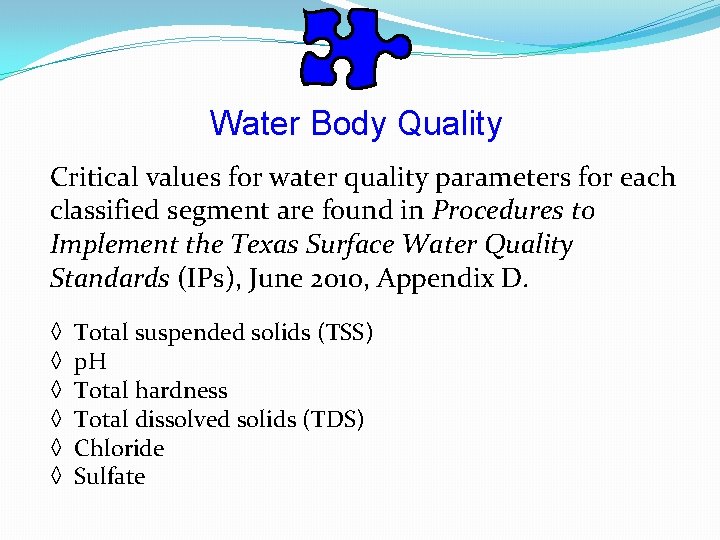
Water Body Quality Critical values for water quality parameters for each classified segment are found in Procedures to Implement the Texas Surface Water Quality Standards (IPs), June 2010, Appendix D. ◊ Total suspended solids (TSS) ◊ p. H ◊ Total hardness ◊ Total dissolved solids (TDS) ◊ Chloride ◊ Sulfate
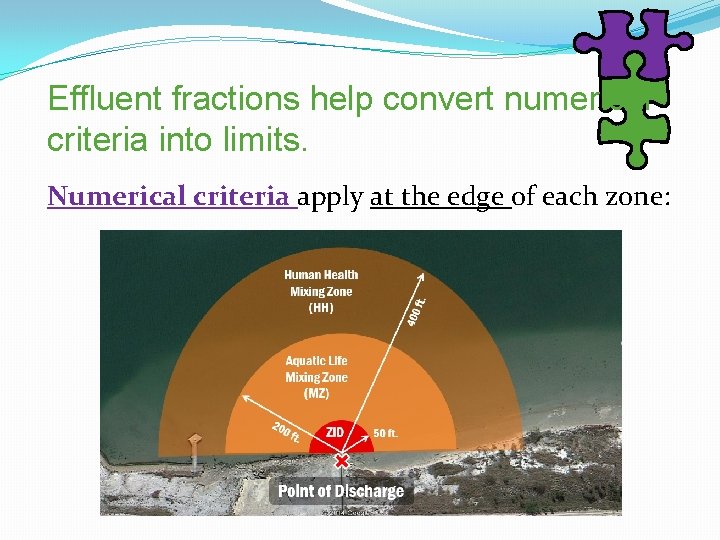
Effluent fractions help convert numerical criteria into limits. Numerical criteria apply at the edge of each zone:
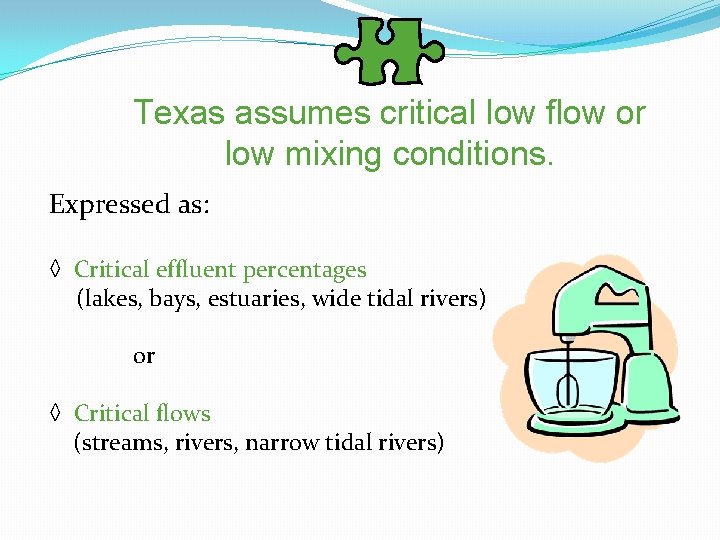
Texas assumes critical low flow or low mixing conditions. Expressed as: ◊ Critical effluent percentages (lakes, bays, estuaries, wide tidal rivers) or ◊ Critical flows (streams, rivers, narrow tidal rivers)
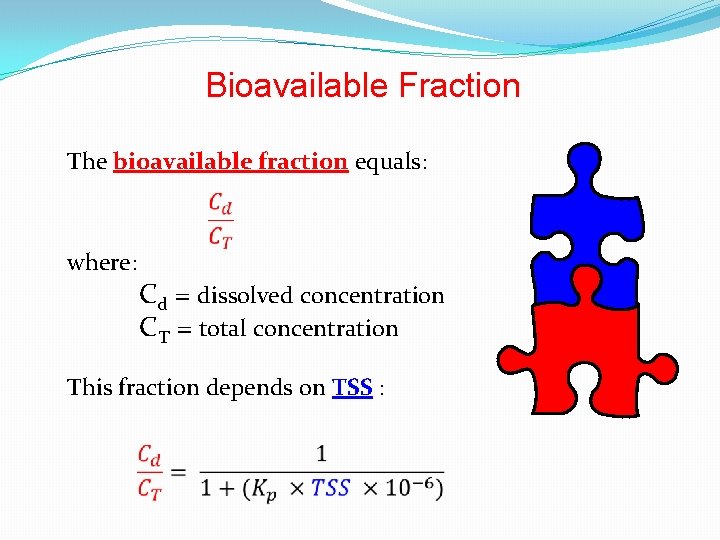
Bioavailable Fraction The bioavailable fraction equals: where: Cd = dissolved concentration CT = total concentration This fraction depends on TSS :
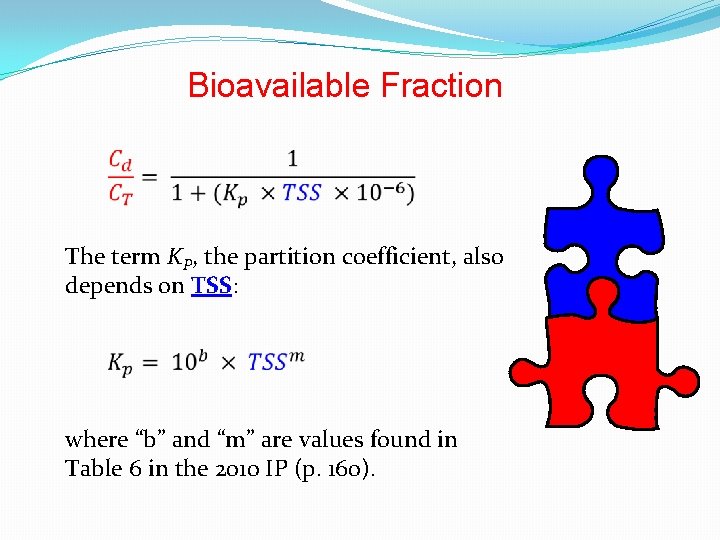
Bioavailable Fraction The term KP, the partition coefficient, also depends on TSS: where “b” and “m” are values found in Table 6 in the 2010 IP (p. 160).
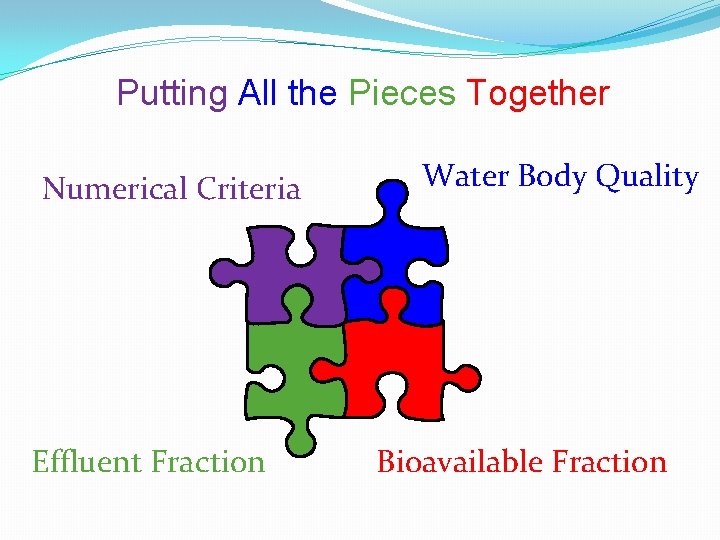
Putting All the Pieces Together Numerical Criteria Effluent Fraction Water Body Quality Bioavailable Fraction
Putting All the Pieces Together Four easy steps to calculate WQBELs for aquatic life and human health! ◊ Calculate waste load allocation – WLA ◊ Calculate long-term average – LTA ◊ Calculate effluent limits: • daily average (DLY AVG) • daily maximum (DLY MAX) ◊ Final permit limits are determined by comparison

Help! My draft permit includes a new or more stringent WQBEL – what can I do? Call your permit writer!
QUESTIONS Water Quality-Based Effluent Limits Erika Crespo May 2017
- Slides: 20