
Water QualityBased Effluent Limits WQBELs Dex D Dean

Water Quality-Based Effluent Limits WQBELs Dex D. Dean, P. E. October 13, 2016
Permit limits apply to discharges. Water quality criteria apply to water bodies. In other words, criteria in the Texas Surface Water Quality Standards do not apply directly to a discharge. Note: Stay tuned for an important exception.

Questions we will explore… 1. What factors influence water quality-based permit limits? 2. What should I do if there is a new limit in my draft permit? 3. How do I know whether a new limit is correct?
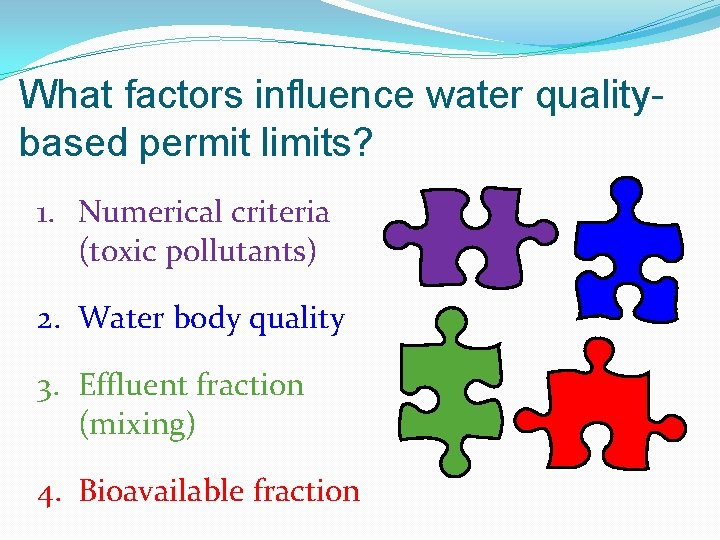
What factors influence water qualitybased permit limits? 1. Numerical criteria (toxic pollutants) 2. Water body quality 3. Effluent fraction (mixing) 4. Bioavailable fraction
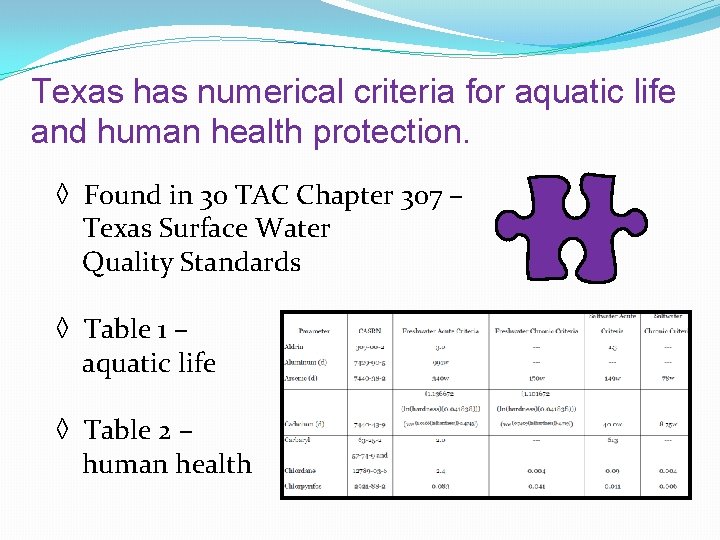
Texas has numerical criteria for aquatic life and human health protection. ◊ Found in 30 TAC Chapter 307 – Texas Surface Water Quality Standards ◊ Table 1 – aquatic life ◊ Table 2 – human health
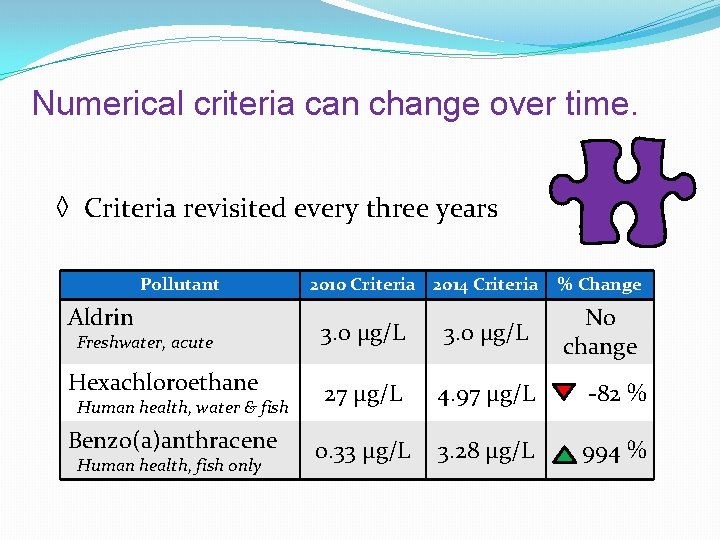
Numerical criteria can change over time. ◊ Criteria revisited every three years Pollutant Aldrin Freshwater, acute Hexachloroethane Human health, water & fish Benzo(a)anthracene Human health, fish only 2010 Criteria 2014 Criteria % Change No change 3. 0 μg/L 27 μg/L 4. 97 μg/L -82 % 0. 33 μg/L 3. 28 μg/L 994 %
Criteria for aquatic life reflect an organism’s environment and exposure. Table 1 in the Standards ◊ Freshwater • acute • chronic ◊ Saltwater • acute • chronic Note: Acute toxicity— exposures of ≤ 4 days. Chronic toxicity— exposures of ≥ 7 days.
Not all of the numerical criteria are expressed in the same way. ◊ Most criteria are for total concentrations. ◊ Some metals criteria are for dissolved concentrations: • aluminum But wait! • arsenic Permit limits are • cadmium written for total • chromium (tri and hex) concentrations. • copper • lead • nickel • silver (free ion) • zinc
Metals criteria may be expressed as a dissolved concentration because local water quality affects toxicity. ◊ Conversion from dissolved criteria to total limits uses ambient total suspended solids (TSS) of the nearest downstream classified segment. ◊ HINT: Dissolved fraction = bioavailable fraction.
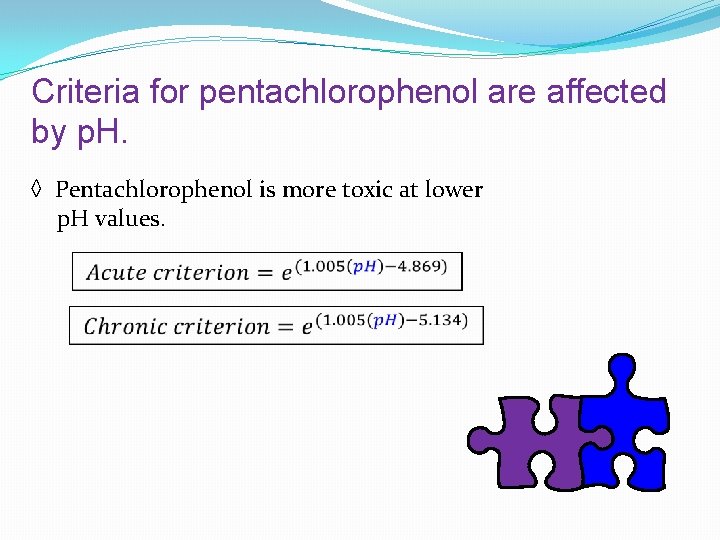
Criteria for pentachlorophenol are affected by p. H. ◊ Pentachlorophenol is more toxic at lower p. H values.
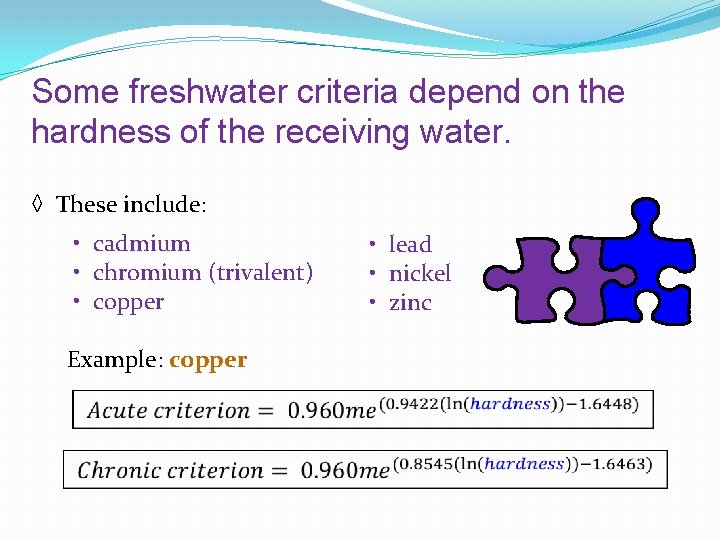
Some freshwater criteria depend on the hardness of the receiving water. ◊ These include: • cadmium • chromium (trivalent) • copper Example: copper • lead • nickel • zinc
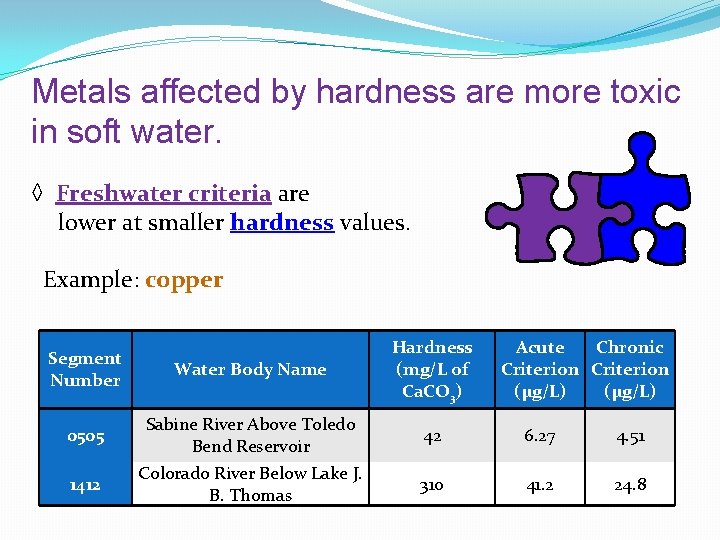
Metals affected by hardness are more toxic in soft water. ◊ Freshwater criteria are lower at smaller hardness values. Example: copper Segment Number Water Body Name Hardness (mg/L of Ca. CO 3) Acute Chronic Criterion (µg/L) 0505 Sabine River Above Toledo Bend Reservoir 42 6. 27 4. 51 1412 Colorado River Below Lake J. B. Thomas 310 41. 2 24. 8
Human health criteria reflect exposure routes and vulnerability. ◊ Table 2 (2014) – • Water and Fish • Fish Only • Water column–based criteria Note: Human health criteria based on Childhood exposure (non-carcinogens) Lifetime exposure (carcinogens).
Local water quality may affect pollutant criteria or bioavailability. ◊ TSS – used to calculate the bioavailable fraction of metals ◊ p. H – used to calculate the freshwater aquatic life criteria for pentachlorophenol ◊ Total hardness – used to calculate the freshwater aquatic life criteria for most metals ◊ Chloride – used to calculate the bioavailable fraction of silver in freshwater
Water quality data for each classified segment is provided in RG-194(1). Statistically-derived values include: ◊ TSS – 15 th percentile ◊ p. H – 15 th percentile ◊ Total hardness – 15 th percentile ◊ Chloride – 50 th percentile (1) RG-194: Procedures to Implement the Texas Surface Water Quality Standards (IPs), TCEQ, June 2010.
RECALL: Permit limits apply to discharges. Water quality criteria apply to water bodies. In other words, criteria in the Texas Surface Water Quality Standards do not apply directly to a discharge. Note: Stay tuned for an important exception.
Effluent fractions help convert numerical criteria into limits. Numerical criteria apply at the edge of each zone: Name of Zone of Initial Dilution Aquatic Life Mixing Zone Human Health Mixing Zone Acronym ZID MZ HHMZ Applicable Criteria Acute Aquatic Life Chronic Aquatic Life Human Health
Texas assumes critical low flow or low mixing conditions. Expressed as: ◊ Critical effluent percentages (lakes, bays, estuaries, wide tidal rivers) or ◊ Critical flows (streams, rivers, narrow tidal rivers)
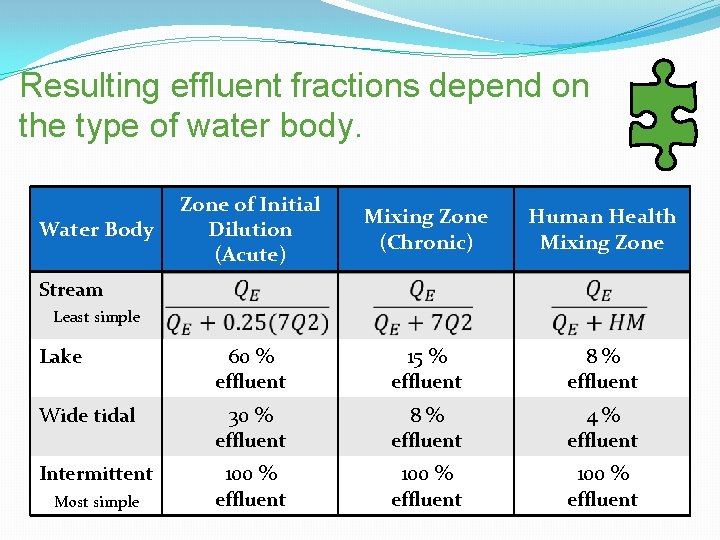
Resulting effluent fractions depend on the type of water body. Zone of Initial Dilution (Acute) Mixing Zone (Chronic) Human Health Mixing Zone Lake 60 % effluent 15 % effluent 8 % effluent Wide tidal 30 % effluent 8 % effluent 4 % effluent Intermittent 100 % effluent Water Body Stream Least simple Most simple
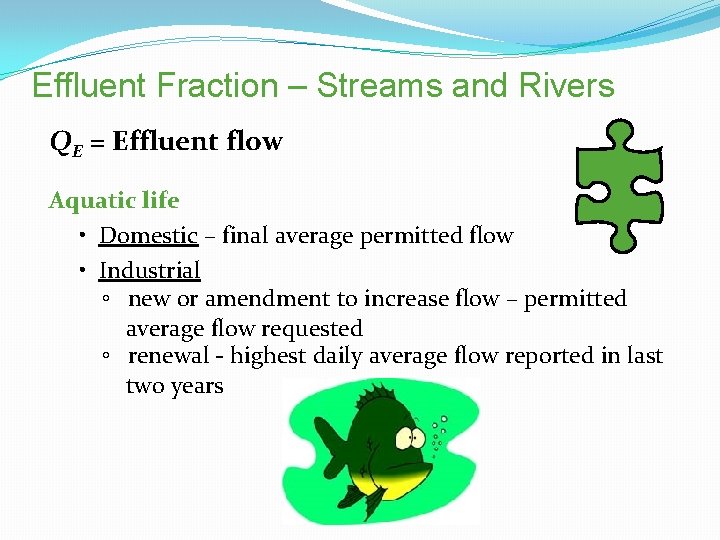
Effluent Fraction – Streams and Rivers QE = Effluent flow Aquatic life • Domestic – final average permitted flow • Industrial ◦ new or amendment to increase flow – permitted average flow requested ◦ renewal - highest daily average flow reported in last two years
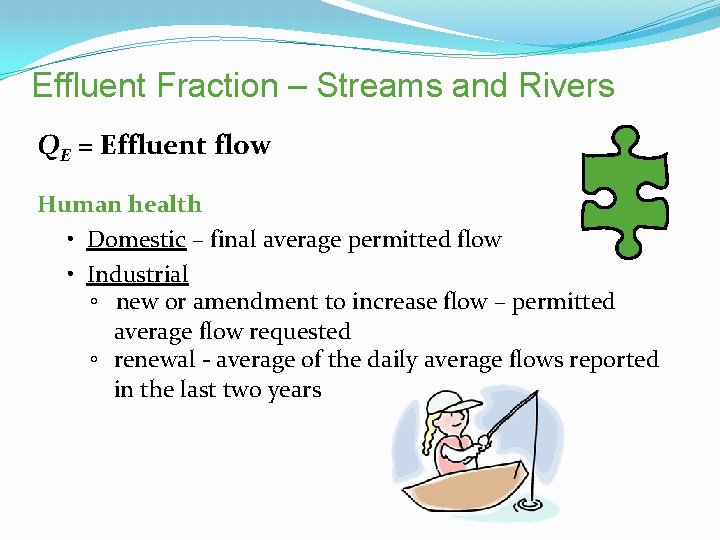
Effluent Fraction – Streams and Rivers QE = Effluent flow Human health • Domestic – final average permitted flow • Industrial ◦ new or amendment to increase flow – permitted average flow requested ◦ renewal - average of the daily average flows reported in the last two years
Most metals are not entirely bioavailable. Conversion is required. For most metals, numerical criteria for aquatic life are dissolved concentrations, but… effluent limits are expressed as total concentrations. The bioavailable fraction, which is a function of TSS, is used to make this translation.

Bioavailable Fraction The bioavailable fraction equals: Cd CT where: Cd = dissolved concentration CT = total concentration This fraction depends on TSS :

Bioavailable Fraction The term KP, the partition coefficient, also depends on TSS: where “b” and “m” are values found in Table 6 in the 2010 IP (p. 160).

Putting All the Pieces Together Numerical Criteria Effluent Fraction Water Body Quality Bioavailable Fraction
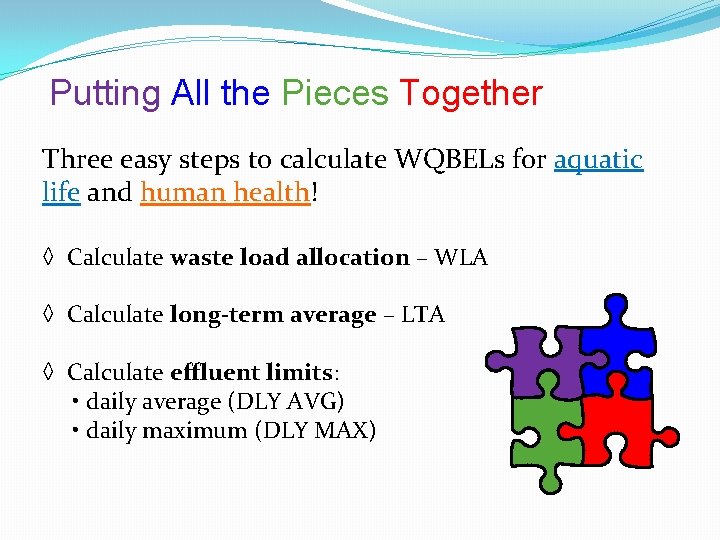
Putting All the Pieces Together Three easy steps to calculate WQBELs for aquatic life and human health! ◊ Calculate waste load allocation – WLA ◊ Calculate long-term average – LTA ◊ Calculate effluent limits: • daily average (DLY AVG) • daily maximum (DLY MAX)
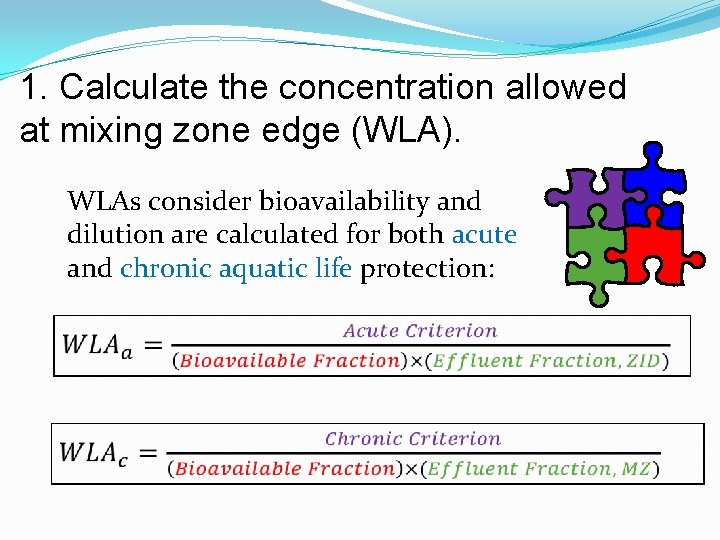
1. Calculate the concentration allowed at mixing zone edge (WLA). WLAs consider bioavailability and dilution are calculated for both acute and chronic aquatic life protection:
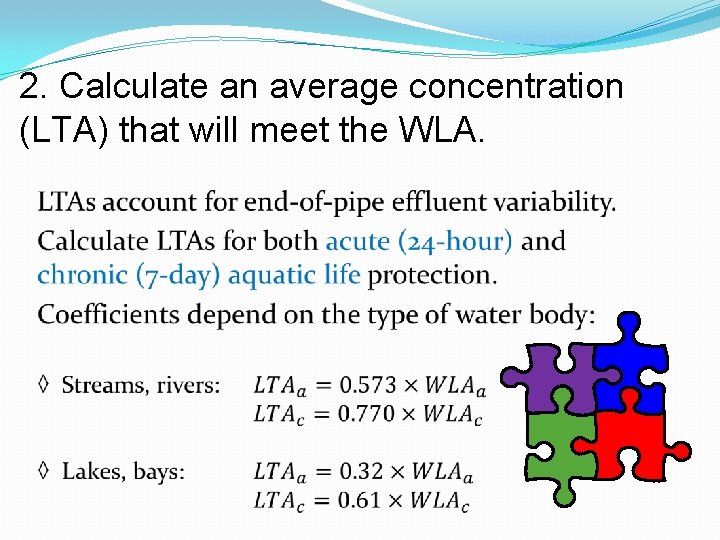
2. Calculate an average concentration (LTA) that will meet the WLA.
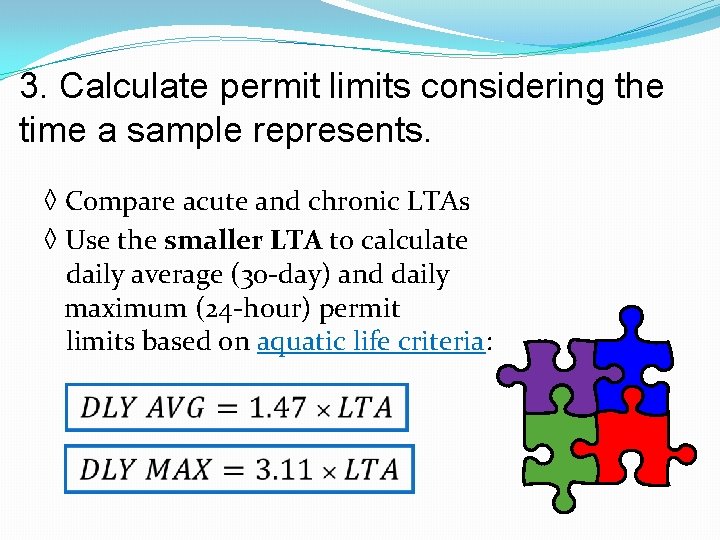
3. Calculate permit limits considering the time a sample represents. ◊ Compare acute and chronic LTAs ◊ Use the smaller LTA to calculate daily average (30 -day) and daily maximum (24 -hour) permit limits based on aquatic life criteria:
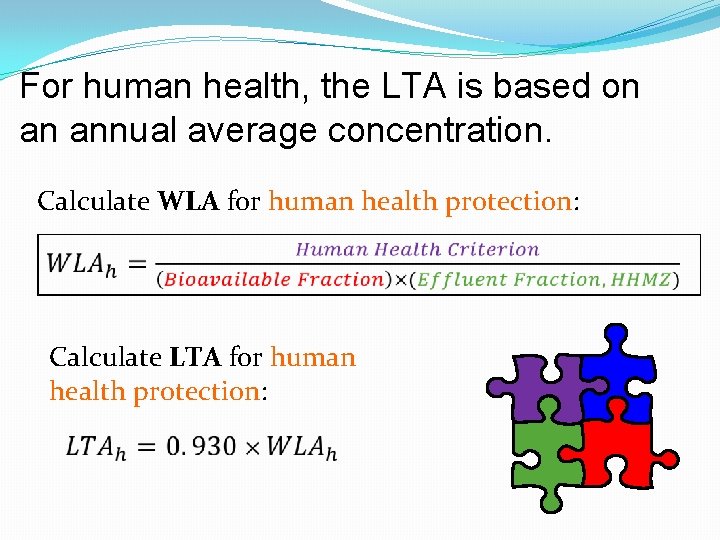
For human health, the LTA is based on an annual average concentration. Calculate WLA for human health protection: Calculate LTA for human health protection:
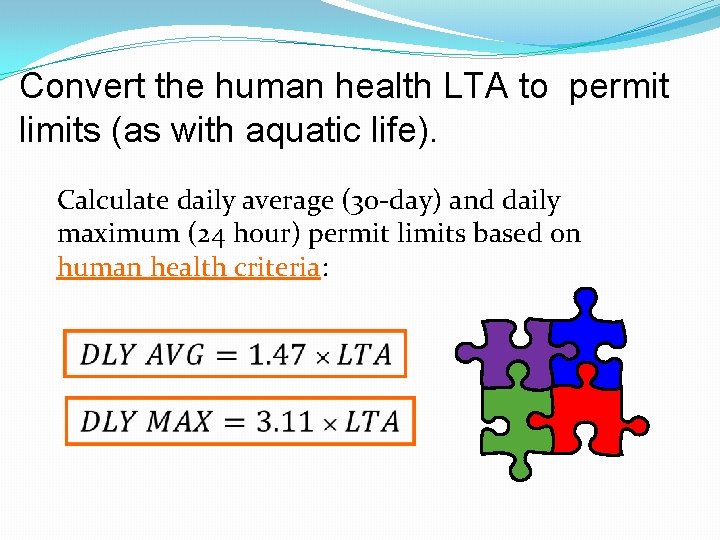
Convert the human health LTA to permit limits (as with aquatic life). Calculate daily average (30 -day) and daily maximum (24 hour) permit limits based on human health criteria:
FINAL STEP – Compare Aquatic Life and Human Health Limits Some pollutants have both aquatic life and human health criteria. ◊ Compare limits based on aquatic life with limits based on human health ◊ The lower limit goes in the permit

Help! My draft permit includes a new or more stringent WQBEL – what can I do? Call your permit writer!
Why did I get this limit? Big Picture: New limit Average concentration from application is ≥ 85% of calculated daily average WQBEL More stringent limit Calculated WQBELs are more stringent than existing limits It’s time to get down in the weeds: numerical criteria, water body quality, effluent fraction, bioavailable fraction
Double-check mixing assumptions. For a river or stream: ◊ Critical flows • Stream type – which criteria apply? ○ intermittent – acute (no dilution) ○ perennial – chronic, acute, HH ○ intermittent with perennial pools – chronic (no dilution), acute (no dilution), HH • Stream flows – 7 Q 2, harmonic mean, stream gauge data
Consider moving your outfall. Effluent fraction – lake or bay: ◊ Critical mixing conditions • Relocate outfall – ○ narrow arm smaller mixing zones = larger effluent fractions = lower permit limits ○ wider area larger mixing zones = smaller effluent fractions = higher permit limits
Consider developing a site-specific standard. Numerical Criteria: ◊ Site-specific standards change all of your limits – adopted in Appendix E of the Standards • Temporary variance – allows time for permittee to develop comprehensive information to support sitespecific standard. ○ Permittee must request a variance ○ Permit must show that existing standard may not be appropriate ○ Permittee must provide public notice of the request
Consider developing a site-specific standard. Numerical Criteria: ◊ Site-specific standard (cont. ) • Temporary variance (cont. ) ○ Must be approved by EPA ○ Three-year permit term ○ Permit language requires a study ○ Variance may be extended ○ Coordinate with TCEQ staff
For metals: is the TCEQ’s water effect ratio reasonable? (except mercury or selenium) Numerical criteria: ◊ Site-specific water-effect ratio (WER) • Use whole effluent toxicity testing to account for difference in toxicity in receiving water. ○ This is “w” or “m” factor in Table 1 of Standards ○ Saltwater: ~2; freshwater: ~3. 5 -8. 5 ○ Streamlined procedure for copper (freshwater) ○ Coordinate with TCEQ staff

For metals: is the TCEQ’s hardness data representative? Numerical criteria, water body quality ◊ Site-specific hardness: affects criteria for cadmium, trivalent chromium, copper, lead, nickel, and zinc • ≥ 30 samples from receiving water upstream of discharge and outside of MZ • ≥ 1 week between successive samples • Coordinate study design with TCEQ staff
For metals: does local TSS give a different bioavailable fraction? Water body quality, bioavailable fraction ◊ Site-specific TSS: affects bioavailable fraction • • • ≥ 30 samples from receiving water upstream of discharge and outside of MZ ≥ 1 week between successive samples Coordinate study design with TCEQ staff
For metals: does local TSS give a different bioavailable fraction? Bioavailable fraction ◊ Site-specific ratio of dissolved to total metal concentration • ≥ 30 samples from receiving water upstream of discharge and outside of MZ • ≥ 1 week between successive samples • Mix samples with effluent to equal critical dilution • If no water upstream, critical dilution is 100% effluent
For metals: does local TSS give a different bioavailable fraction? Bioavailable fraction ◊ Site-specific ratio of dissolved to total metal concentration (cont. ) • Measure total and dissolved metal concentrations • Measure TSS of receiving water and effluent each time a sample is collected and mixed with effluent (unless critical dilution is 100%) • Coordinate study design with TCEQ staff

QUESTIONS Water Quality-Based Effluent Limits Dex D. Dean, P. E. October 13, 2016
- Slides: 44