
WATER QUALITY LAB INSTRUMENTS AND THEIR SPECIFICATIONS By
WATER QUALITY LAB, INSTRUMENTS AND THEIR SPECIFICATIONS By. Dr. Raja Ram Purohit Sc-C, Mo. WR, RD & GR 09868887351 / rr. purohit@nic. in
UNIFORM PROTOCOL ON WATER QUALITY MONITORING (UPWQM) � WQAA has constituted Expert Group and a Task to recommend measures for optimum water quality observation network and coordinated data collection and dissemination with a view to maintain uniformity in the procedure for water quality monitoring mechanism by all monitoring agencies. � Based on the recommendations of Expert Group and Task force and a national level workshop (October, 2004 at Kolkata), Uniform Protocol on Water Quality Monitoring (UPWQM) was prepared and notified by Ministry of Environment & Forests in 2005. � The objective of UPWQM is to bring uniformity in process on water quality monitoring and to provide uniform frequency of monitoring, procedure for sampling, parameters for analysis, analytical techniques, quality assurance and quality control system, infrastructure requirement for laboratories, procedure for data processing, reporting and dissemination. � The UPWQM applies to all organizations, agencies and any other body monitoring surface and ground water quality for observance of uniform protocol on water quality monitoring. � However, as per the decision in the 10 th meeting of WQAA, the UPQWM (2005) is under revision. .
CLASSIFICATION OF WATER QUALITY MONITORING STATION In accordance with the definition given in the “Uniform Protocol on Water Quality Monitoring”(UPWQM)” issued by the Water Quality Assessment Authority, Ministry of Environment, Forests & Climate Change dated 17 th June, 2005 water quality monitoring stations are classified as follows: � Baseline Station: A Baseline Station means the monitoring location where there is no influence of human activities on water quality; � Trend Station: A Trend station means the monitoring location designed to show a particular point on a watercourse varies over time due, normally, to the influence of man’s activities; and � Flux Station or Impact Station: A Flux station or Impact station means the location for measuring the mass of particular pollutant on main river stem for measuring the extent of pollution due to human interference or geological feature at any point of time and is necessary for measuring impact of pollution control measures adopted;

TYPES OF WATER QUALITY LAB
THREE TIER LABORATORY SYSTEM � Level - I Laboratories: These Labs are the field laboratories which are located at field water quality monitoring stations on various rivers of India where in -situ values of five (05) physical parameters and one biological parameter (Dissolved Oxygen) are monitored. � Level - II Laboratories: These Labs are normally located at division offices to analyze 25 physicochemical and bacteriological parameters. � Level - III/II+ Laboratories: These Labs are normally located in the regional level for the analysis of 41 parameters including heavy metals / toxic parameters and pesticides.
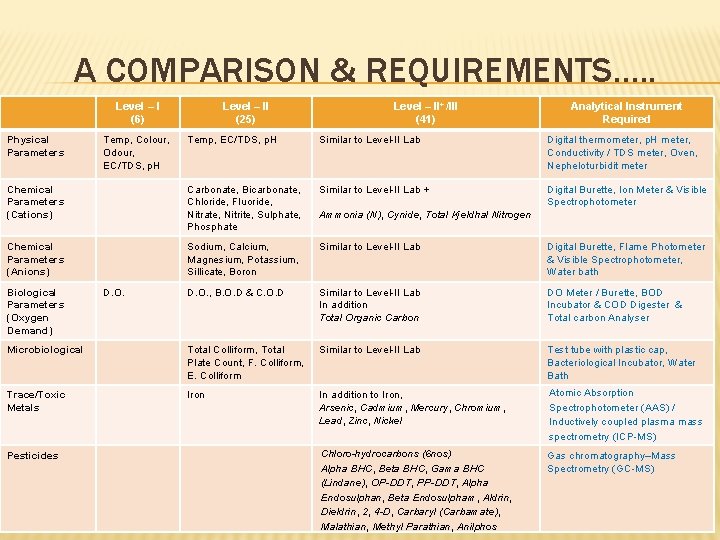
A COMPARISON & REQUIREMENTS…. . Level – I (6) Physical Parameters Level – II+ /III (41) Analytical Instrument Required Temp, EC/TDS, p. H Similar to Level-II Lab Digital thermometer, p. H meter, Conductivity / TDS meter, Oven, Nepheloturbidit meter Chemical Parameters (Cations) Carbonate, Bicarbonate, Chloride, Fluoride, Nitrate, Nitrite, Sulphate, Phosphate Similar to Level-II Lab + Digital Burette, Ion Meter & Visible Spectrophotometer Chemical Parameters (Anions) Sodium, Calcium, Magnesium, Potassium, Sillicate, Boron Similar to Level-II Lab Digital Burette, Flame Photometer & Visible Spectrophotometer, Water bath D. O. , B. O. D & C. O. D Similar to Level-II Lab In addition Total Organic Carbon DO Meter / Burette, BOD Incubator & COD Digester & Total carbon Analyser Microbiological Total Colliform, Total Plate Count, F. Colliform, E. Colliform Similar to Level-II Lab Test tube with plastic cap, Bacteriological Incubator, Water Bath Trace/Toxic Metals Iron In addition to Iron, Arsenic, Cadmium, Mercury, Chromium, Lead, Zinc, Nickel Atomic Absorption Spectrophotometer (AAS) / Inductively coupled plasma mass spectrometry (ICP-MS) Chloro-hydrocarbons (6 nos) Alpha BHC, Beta BHC, Gama BHC (Lindane), OP-DDT, PP-DDT, Alpha Endosulphan, Beta Endosulpham, Aldrin, Dieldrin, 2, 4 -D, Carbaryl (Carbamate), Malathian, Methyl Parathian, Anilphos Gas chromatography–Mass Spectrometry (GC-MS) Biological Parameters (Oxygen Demand) Pesticides Temp, Colour, Odour, EC/TDS, p. H Level – II (25) D. O. Ammonia (N), Cynide, Total Kjeldhal Nitrogen
COST ANALYSIS FOR SETTING-UP OF A WATER QUALITY LAB
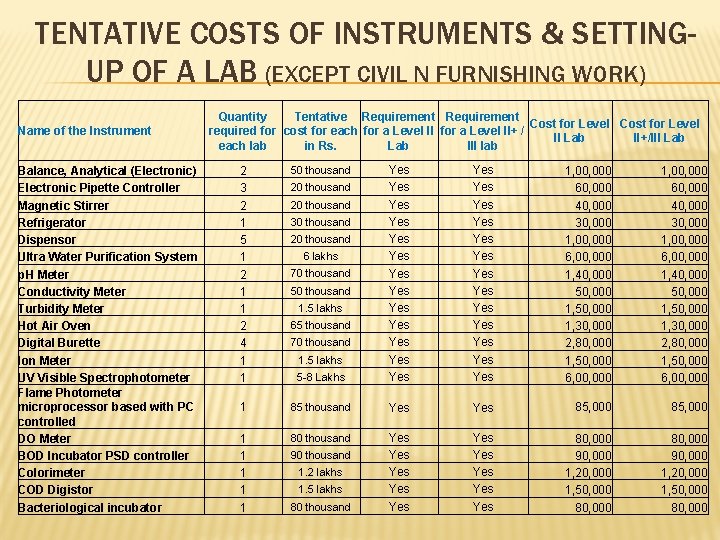
TENTATIVE COSTS OF INSTRUMENTS & SETTINGUP OF A LAB (EXCEPT CIVIL N FURNISHING WORK) Name of the Instrument Balance, Analytical (Electronic) Electronic Pipette Controller Magnetic Stirrer Refrigerator Dispensor Ultra Water Purification System p. H Meter Conductivity Meter Turbidity Meter Hot Air Oven Digital Burette Ion Meter UV Visible Spectrophotometer Flame Photometer microprocessor based with PC controlled DO Meter BOD Incubator PSD controller Colorimeter COD Digistor Bacteriological incubator Quantity Tentative Requirement Cost for Level required for cost for each for a Level II+ / II Lab II+/III Lab each lab in Rs. Lab III lab 5 -8 Lakhs Yes Yes Yes Yes Yes Yes Yes 1, 00, 000 60, 000 40, 000 30, 000 1, 00, 000 6, 00, 000 1, 40, 000 50, 000 1, 30, 000 2, 80, 000 1, 50, 000 6, 00, 000 1 85 thousand Yes 85, 000 1 1 1 80 thousand Yes Yes Yes 80, 000 90, 000 1, 20, 000 1, 50, 000 80, 000 2 3 2 1 5 1 2 1 1 2 4 1 1 50 thousand 20 thousand 30 thousand 20 thousand 6 lakhs 70 thousand 50 thousand 1. 5 lakhs 65 thousand 70 thousand 1. 5 lakhs 90 thousand 1. 2 lakhs 1. 5 lakhs 80 thousand
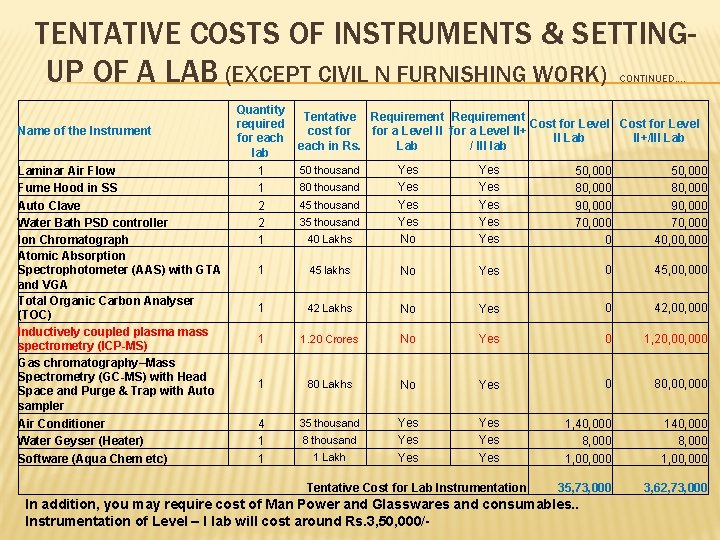
TENTATIVE COSTS OF INSTRUMENTS & SETTINGUP OF A LAB (EXCEPT CIVIL N FURNISHING WORK) CONTINUED…. Name of the Instrument Quantity required for each lab Tentative Requirement Cost for Level cost for a Level II+ II Lab II+/III Lab each in Rs. Lab / III lab 40 Lakhs Yes Yes No Yes Yes Yes 50, 000 80, 000 90, 000 70, 000 0 50, 000 80, 000 90, 000 70, 000 40, 000 1 45 lakhs No Yes 0 45, 000 1 42 Lakhs No Yes 0 42, 000 1 1. 20 Crores No Yes 0 1, 20, 000 1 80 Lakhs No Yes 0 80, 000 4 1 1 35 thousand Yes Yes Yes 1, 40, 000 8, 000 1, 000 140, 000 8, 000 1, 000 35, 73, 000 3, 62, 73, 000 Laminar Air Flow Fume Hood in SS Auto Clave Water Bath PSD controller Ion Chromatograph Atomic Absorption Spectrophotometer (AAS) with GTA and VGA Total Organic Carbon Analyser (TOC) Inductively coupled plasma mass spectrometry (ICP-MS) Gas chromatography–Mass Spectrometry (GC-MS) with Head Space and Purge & Trap with Auto sampler 1 1 2 2 1 50 thousand Air Conditioner Water Geyser (Heater) Software (Aqua Chem etc) 80 thousand 45 thousand 35 thousand 8 thousand 1 Lakh Tentative Cost for Lab Instrumentation In addition, you may require cost of Man Power and Glasswares and consumables. . Instrumentation of Level – I lab will cost around Rs. 3, 50, 000/-
GENERAL SPECIFICATION OF THE ANALYTICAL INSTUMENTS
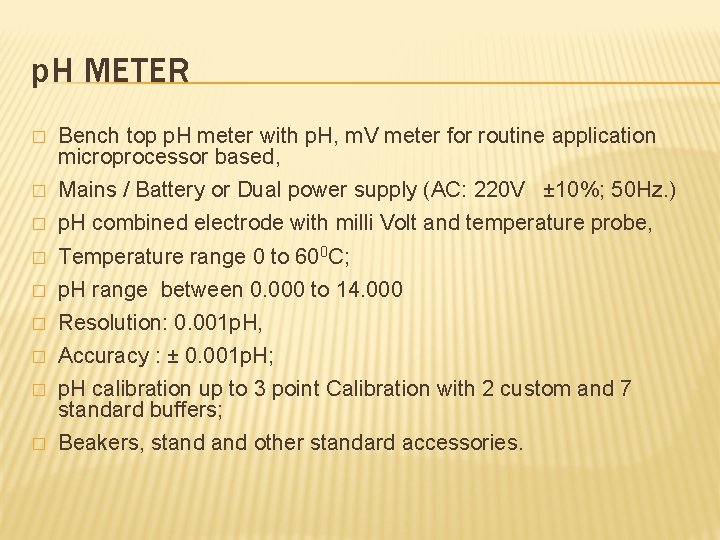
p. H METER � Bench top p. H meter with p. H, m. V meter for routine application microprocessor based, � Mains / Battery or Dual power supply (AC: 220 V ± 10%; 50 Hz. ) � p. H combined electrode with milli Volt and temperature probe, � Temperature range 0 to 600 C; � p. H range between 0. 000 to 14. 000 � Resolution: 0. 001 p. H, � Accuracy : ± 0. 001 p. H; � p. H calibration up to 3 point Calibration with 2 custom and 7 standard buffers; � Beakers, stand other standard accessories.
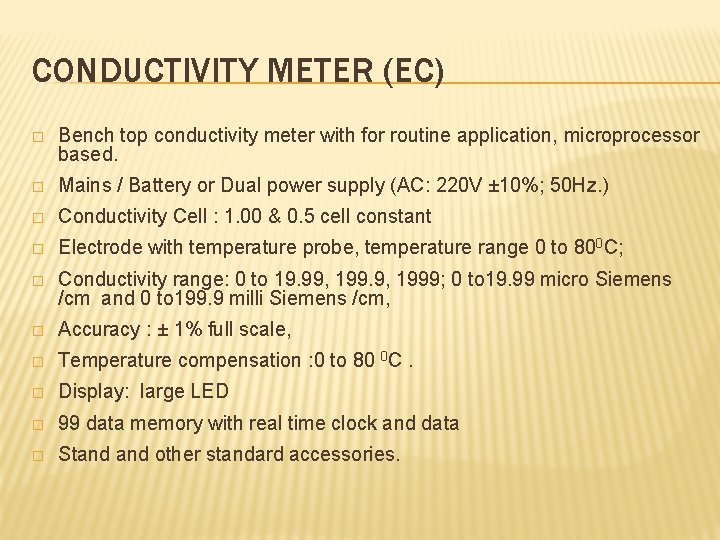
CONDUCTIVITY METER (EC) � Bench top conductivity meter with for routine application, microprocessor based. � Mains / Battery or Dual power supply (AC: 220 V ± 10%; 50 Hz. ) � Conductivity Cell : 1. 00 & 0. 5 cell constant � Electrode with temperature probe, temperature range 0 to 800 C; � Conductivity range: 0 to 19. 99, 1999; 0 to 19. 99 micro Siemens /cm and 0 to 199. 9 milli Siemens /cm, � Accuracy : ± 1% full scale, � Temperature compensation : 0 to 80 0 C. � Display: large LED � 99 data memory with real time clock and data � Stand other standard accessories.
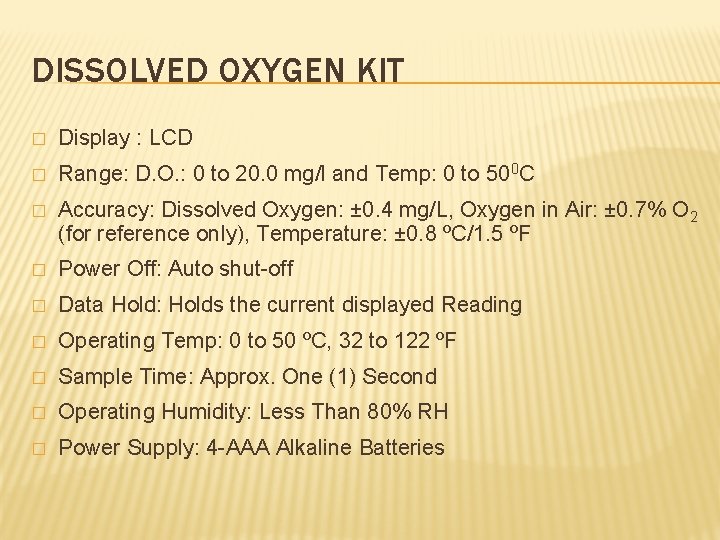
DISSOLVED OXYGEN KIT � Display : LCD � Range: D. O. : 0 to 20. 0 mg/l and Temp: 0 to 500 C � Accuracy: Dissolved Oxygen: ± 0. 4 mg/L, Oxygen in Air: ± 0. 7% O 2 (for reference only), Temperature: ± 0. 8 ºC/1. 5 ºF � Power Off: Auto shut-off � Data Hold: Holds the current displayed Reading � Operating Temp: 0 to 50 ºC, 32 to 122 ºF � Sample Time: Approx. One (1) Second � Operating Humidity: Less Than 80% RH � Power Supply: 4 -AAA Alkaline Batteries
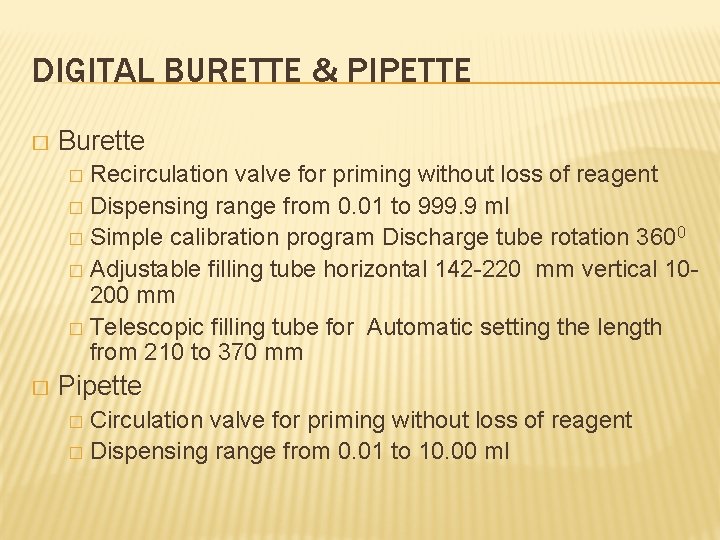
DIGITAL BURETTE & PIPETTE � Burette Recirculation valve for priming without loss of reagent � Dispensing range from 0. 01 to 999. 9 ml � Simple calibration program Discharge tube rotation 3600 � Adjustable filling tube horizontal 142 -220 mm vertical 10200 mm � Telescopic filling tube for Automatic setting the length from 210 to 370 mm � � Pipette Circulation valve for priming without loss of reagent � Dispensing range from 0. 01 to 10. 00 ml �
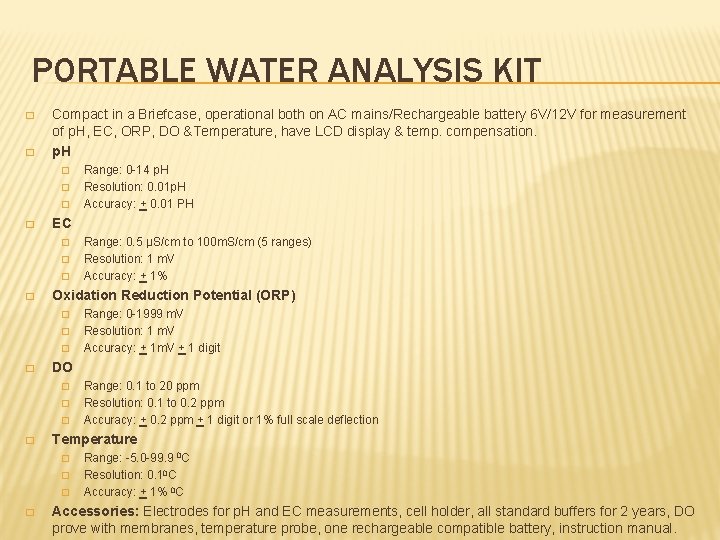
PORTABLE WATER ANALYSIS KIT � � Compact in a Briefcase, operational both on AC mains/Rechargeable battery 6 V/12 V for measurement of p. H, EC, ORP, DO &Temperature, have LCD display & temp. compensation. p. H � � EC � � � � Range: 0. 1 to 20 ppm Resolution: 0. 1 to 0. 2 ppm Accuracy: + 0. 2 ppm + 1 digit or 1% full scale deflection Temperature � � Range: 0 -1999 m. V Resolution: 1 m. V Accuracy: + 1 m. V + 1 digit DO � � Range: 0. 5 µS/cm to 100 m. S/cm (5 ranges) Resolution: 1 m. V Accuracy: + 1% Oxidation Reduction Potential (ORP) � � Range: 0 -14 p. H Resolution: 0. 01 p. H Accuracy: + 0. 01 PH Range: -5. 0 -99. 9 0 C Resolution: 0. 10 C Accuracy: + 1% 0 C Accessories: Electrodes for p. H and EC measurements, cell holder, all standard buffers for 2 years, DO prove with membranes, temperature probe, one rechargeable compatible battery, instruction manual.
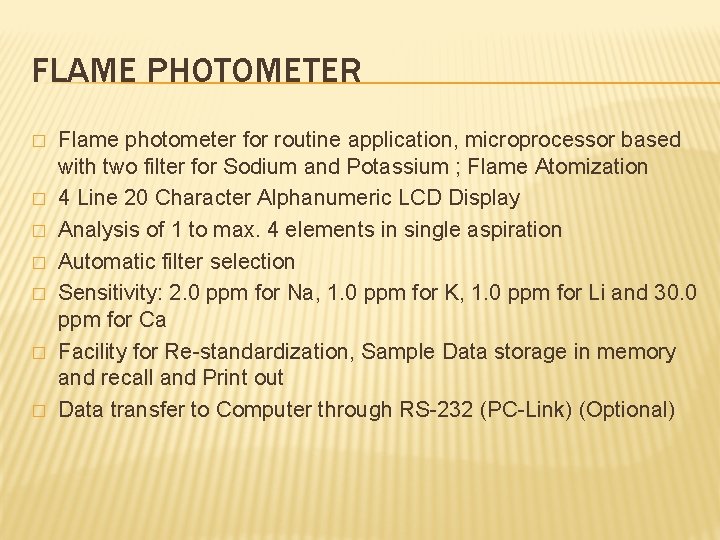
FLAME PHOTOMETER � � � � Flame photometer for routine application, microprocessor based with two filter for Sodium and Potassium ; Flame Atomization 4 Line 20 Character Alphanumeric LCD Display Analysis of 1 to max. 4 elements in single aspiration Automatic filter selection Sensitivity: 2. 0 ppm for Na, 1. 0 ppm for K, 1. 0 ppm for Li and 30. 0 ppm for Ca Facility for Re-standardization, Sample Data storage in memory and recall and Print out Data transfer to Computer through RS-232 (PC-Link) (Optional)
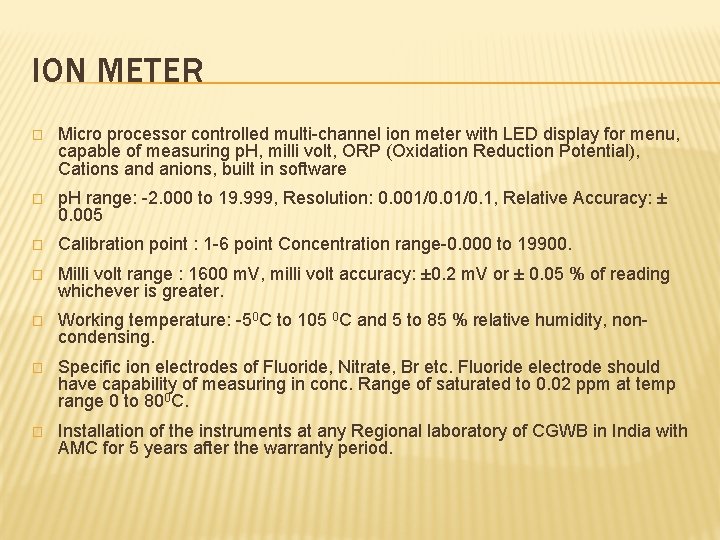
ION METER � Micro processor controlled multi-channel ion meter with LED display for menu, capable of measuring p. H, milli volt, ORP (Oxidation Reduction Potential), Cations and anions, built in software � p. H range: -2. 000 to 19. 999, Resolution: 0. 001/0. 1, Relative Accuracy: ± 0. 005 � Calibration point : 1 -6 point Concentration range-0. 000 to 19900. � Milli volt range : 1600 m. V, milli volt accuracy: ± 0. 2 m. V or ± 0. 05 % of reading whichever is greater. � Working temperature: -50 C to 105 0 C and 5 to 85 % relative humidity, noncondensing. � Specific ion electrodes of Fluoride, Nitrate, Br etc. Fluoride electrode should have capability of measuring in conc. Range of saturated to 0. 02 ppm at temp range 0 to 800 C. � Installation of the instruments at any Regional laboratory of CGWB in India with AMC for 5 years after the warranty period.
PC BASED UV-VIS SPECTROPHOTOMETER � � � � � Double beam, fully automatic UV-VIS Spectrophotometer and should also have a facility to connect with latest PC configuration for latest Windows XP base operation and compact with a fast laser printer LCD display, 220 V AC, Stray Light better than 0. 02% T at 220 nm (Na. I) and 340 nm (Na. NO 2) Better baseline flatness less than + 0. 0006 Abs. over the entire range of 190 to 1100 nm. Scan speed: Variable options of 3000 nm/min to 2 nm/min so as to capture maximum data points, hence to increase the resolution. Noise level less than 0. 00005 Abs. at 700 nm. Baseline stability less than 0. 0003 Abs/Hour at 700 nm Multi-wavelength Photometric Measurement mode as standard Abs / %T measurement possible at 6 wavelengths simultaneously in Photometric mode Photometric, Multi-Wavelength Photometric, Spectrum, Quantitation, Kinetics and Multi-Component measurement modes should be provided. Expanded Photometric range up to -4 to +4 Abs / 0 to 400%, enables high concentration measurement. Photometric repeatability less than +/- 0. 001 Abs at 1 Abs. Detector : Dual silicone photodiode Monochromator having High end optics feature with Czerny-Turner mounting for high energy though put and high sensitivity Spectrophotometer should have facility for 5 USB ports for data communication with PC and Printer compatibility. Two sets of Quartz cell (optional) USB Pen drive compatibility for data storage and transfer Built-in- hardware validation for the parameters such as: Wavelength Accuracy, Wavelength Repeatability, Spectral Bandwidth, Baseline Flatness, Baseline Stability, Noise Level, Photometric Accuracy, Photometric repeatability & Stray Light Semi-automatic testing: Interactive display for simplified testing of test items Automatic Testing : Automatic measurement and pass/fail evaluation and printing of results
WATER DOUBLE DISTILLATION APPARATUS � � � � Quartz double distillation apparatus with automatic cut off system Main boiler A built-in heater enclosed in quartz glass tube Housing auto water level adjuster Bottom outlet for cleaning waste discharge which is fitted with Teflon screw cap valve A coil condenser fitted on top for condensing vapors Whole unit is mounted on epoxy coated metal box stand covered with acrylic sheet cover for protection Features: � � � Temperature resistant Saving of electrical energy in every start Convenient bottom drain for easy drainage as accumulated solids impair the efficiency, cleaning is also possible Distilled water in cold condition Automatic start, cut-off & re-start in synchrony with water pressure/opening by electronic circuit
TOTAL ORGANIC CARBON ANALYSER (TOC) � � � � Compact PC controlled TOC analyzer for the determination of TOC, TIC, TC, NPOC and POC in water samples. The system should comply with DIN, ASTM and USEPA standards. The system should have high temperature combustion unit of up to 950 Deg C to ensure complete digestion of even stable compounds. Sample feed should be through valve and septum free direct injection. The injection volume should be variable from 50 ul to 500 ul. The system should have high sensitive focused beam NDIR detector. The measurement range should be from 50 ppb to 30000 ppm without sample dilution. The system should have facility to do multipoint calibration with single standard using different injection volumes. The system should have provision to select automatically the optimum calibration curve for sample measurement. The instrument should have self check system to control all parameters for device safety as well to ensure quality of results. The quoted software should be FDA 21 CFR PART 11 compliance. The system should be upgradeable for solid sample analysis with either integrated double furnace or with High temperature combustion module (1300 deg C temperature ). The system should also have provision to upgrade for Total Nitrogen measurement using either electrochemical detector or chemiluminiscence detector. The supplier should optionally offer Auto sampler with 60 positions and optional tray of more than 100 positions. Complete set of spares and consumables necessary for operation should be offered.
FOUR CHANNEL WET CHEMISTRY ANALYSER � � � (Four parameters to be analyzed simultaneously) The analyser should be modular with the following modules; Auto sampler, module holder, module with flow cell and filter, detector, interface and software. The system should be up gradable into more simultaneous analysis possibility, and capable of adding more parameters in future. The sample is to have continuous flow with air bubble Segmentation and the detection is colorimetric, Provision for other detectors like IR and UV and flame photometer should be available. Auto sampler: � � � Chemistry Unit : � � � � � Each parameter should have separate module and each module to have its own filter and flow cell. All components of analysis like dialyser, reactor etc (wherever applicable) should be provided within each module. Parameter for analysis: Chloride, Total Hardness, Calcium, Phosphate and Bicarbonate. Nitrate + Nitrite, Fluoride, Total Nitrogen, The analysis module should have its own flow cell and filter. Flow cell to be supplied with black coating to avoid interference of external light in the analysis. Flow cell is to be part of the chemistry module and should not be inside the photometer. Detector: Two Dual channel Digital detector with high degree of accuracy and wide dynamic range; capable of measuring four parameters simultaneously. The photometer detector head is to have an insert board and cable � � � Should have capacity to hold upto 5 chemistry modules Should have two multi speed proportioning pumps, The two pumps should provide 32 tubings for reagent transportation to the analytical module. Should have air pump. Air pump should have built-in compressor. The multi speed pump should have speed adjustments for normal (analysis), fast (washing) and slow (stand by position, to save reagents). Chemistry modules: � � Random access sampler; should have more than 100 sample cups; should have built in rinsing pump, for day-to-day easy maintenance. Sample cup capacity is to be up to 10 ml Optional built-in dilutor. Separate cups for working standards. Digital detector with high degree of accuracy and wide dynamic range. Capable of measuring four parameters simultaneously. Wavelength selection by insert of interference filters. Wavelength range 340 -1050 nm. Accommodation for 2 flow cells of 5 upto 50 mm path length each Software controlled automatic baseline and peak height settings. Software controlled lamp switching on / off 32 bits high resolution absorption recording Detecting range up to 6. 5 AU Signal / noise ratio <0. 0003 AU Software : The software is to be windows based and user friendly. Provision should be there for raw data storage. Automatic back ground correction should be possible;
ATOMIC ABSORPTION SPECTROPHOTOMETER (AAS) � � � � Computer operated double beam Atomic Absorption Spectrophotometer with high sensitivity, capability to analyze Flame Atomization with Air-Acetylene and Nitrous Oxide Acetylene Flame with Hydride Vapour Generator and future upgradeable to Graphite Furnace. Wavelength range from 185 nm to 900 nm. , Slit width 0. 2 to 2. 0 mm in steps. High efficiency atomization achieved through new design Polypropylene nebulizer with Platinum-Iridium orifice and Ceramic impact bead for high sensitivity. High-end automation with fully motorized burner head up-down motion with automatic optimum height setting. Deuterium and background correction modes (preferably Self-Reversal) should be available as standard. Standard measurement modes include Flame continuous. Auto selection of Hollow Cathode lamps with motorized 8 lamp turret. Fully computerized gas flow control system with automatic setting of optimum fuel and oxidant flow rates. Hallow Cathode lamp for each single elements to ensure maximum sensitivity, Cathode Lamps-Fe, Mn, Pb, Zn, Cu, Co, Cd, Cr, As, Ni, Hg, Se, Bi and Au. Regulators- Nitrogen, Nitrous oxide and Air Acetylene. Compressor- Oil Free. VGA- Continuous flow base automatic vapour generation for hydride forming elements with peristaltic pump Incorporates all safety measures as standard including the unique leak check on power 'ON', flame monitor, gas pressure monitor, inter-lock for wrong burner head use, Air - Acetylene / N 2 O - Acetylene automatic change- over with flow rate monitor using optical sensor and drain tank level monitor to prevent flash-back. Advanced 32 -bit Windows 2000 based software for complete instruments control, data acquisition and
ION CHROMATOGRAPH (IC) Electronics Type Microprocessor controlled digital signal processing, autoranging Cell Drive Linearity Resolution Filter Sampling Rate 8 k. Hz square wave 1% 0. 00238 n. S/cm Digital Signal Range: 0 -15, 000 µS/cm, Analog Signal Range: 0 -15, 000 µS/cm <0. 2 n. S at 23 µS/cm background <0. 1 n. S at 1 µS/cm background Rise times 0 to 10 s, programmable 1 to 100 Hz, user settable or automatic Cell Temperature 5 °C above DC upper zone temperature to 60 °C maximum. User settable, working range is identical to settable range. Cell Temperature Stability Cell Temperature Compensation Flow Cell Maximum Pressure Flow Cell Volume Cell Electrodes Cell Body Heat Exchanger <0. 001 °C Default 1. 7% per °C ; programmable from 0– 3% per °C 10 MPa (1500 psi) 0. 7 µL (Analytical); 0. 02 µL (capillary) Passivated 316 stainless steel. Compatible with MSA Chemically inert polymeric material Inert, tortuous-path for low axial dispersion Software Chromatography Management Software, requires Microsoft Windows® 2000, Windows 7, 8. 1 or 10 Automated Procedure Wizards System Smart Startup and Shutdown Yes, standard feature System Wellness and Predictive Performance Yes, standard feature Application Templates Yes, standard feature Multivendor Automation Support of 3 rd Party Yes, fully controls over 300 different instruments from more than 30 manufacturers, including GC, HPLC, and MS. Customizable System Control Panels Signal Channels Data Trending System Status Virtual Channels Power Failure Protection Yes, standard feature Conductivity, Total Conductivity Yes, all detector numerical parameters Yes, standard feature System Trigger Commands and Conditionals Yes, standard feature Daily & Sample Audit Trail Yes, standard feature System Calibration Storage Yes, factory, present, and previous. Completely user selectable Output Range Noise, Wet
INDUCTIVELY COUPLED PLASMA MASS SPECTROMETER (ICP-MS) � � � � � � � � � � � Mass spectrometry unit : (1) Spectrometry unit Quadru-pole mass spectrometer Hyperbolic rod made of molybdenum (main rod) Cylindrical rod made of molybdenum (pre-rod) Power supply frequency: 2. 5 MHz Mass number range 2 to 250 Resolution Max. 2 M is possible. Mass number stability 0. 1 a. m. u (2) Detector Channel Thoron detector Must be installed perpendicular to the quadrupole rod (3) Counting method Analog/Pulse selection Pulse measurement 24 bit counter Max. Frequency 10 8 cps Analog measurement: Gain 2 step selection Integration time can be set for each element Plasma ion source (1) Torch unit Spray chamber Plasma mini-torch Coaxial type nebulizer Peristaltic pump Equipped with adjustment function of X, Y, Z, three axes torch position CPU control for direction of torch axis (2) RF power matching unit : Equipped with automatic matching circuit (3) Gas controller 3 -flowline method for plasma Coolant gas 7. 9 L/min Plasma gas 1. 5 L/min Carrier gas 0. 2 to 1. 4 L/min CPU controls carrier gas RF power supply : (1) Oscillator Quartz oscillator (2) Frequency 27. 120 MHz 0. 05% (3) RF output 0. 2, 0. 8, 1. 0, 1. 2 k. W (4) Output stability Within 0. 3% (5) RF circuit element Power MOS FET (6) Control system Controlled by using CPU (7) Lighting unit Full automatic ignition start (8) PA unit cooling Water-cooling (9) Equipped with safety function Vacuum container and exhaust unit (1) Vacuum container 3 -stage differential exhaust system (2) Exhaust system 1 st stage Rotary pump 2 nd stage Air-cooling type turbo molecular pump 3 rd stage Air-cooling type turbo molecular pump
INDUCTIVELY COUPLED PLASMA MASS SPECTROMETER (ICP-MS) CONTINUED…. . � � � � � � � Data processing unit-hardware CPU : Branded Core Duo with 2 GHZ or more Memory capacity : 1 GB RAM External memory : Hard disk 120 GB : CD-R / W and USB Display : 17 -inch color Flat LCD display OS : Microsoft Windows XP LAN interface : 10 BASE-T Mouse : Optical Scroll mouse Printer : Hp Laser Jet Data processing unit-software (1) Qualitative analysis Semi-quantitative determination value calculation Isotopic pattern comparison function (2) Quantitative analysis Calibration curve standard, standard addition method, single-point calibration curve method Drift correction Concomitant element correction Internal calibration standard correction Blank deletion Weighing amount correction Judgment of standards (3) Isotopic ratio measurement Isotopic ratio calculation (4) Report function (5) File function Analysis data can be filed in the format that can be used on commercial spreadsheet software. (6) Time axis measurement (7) Wide range scan (8) Start-up adjustment Lens voltage, mass axis, and resolution setting � � � Power supply 3 -phase, 220/200 V± 10%, 60/50 Hz, 20 A Cooling water 2 -system ・ Temperature : 300 C or less ・ Flow rate : 2. 0 L/min. or more ・ Outer diameter of faucet : 15. 5 mm Argon gas : minimum 3 cylinders with regulators should be supplied having Purity of 99. 95% or more Important Information : Instrument should be supplied on working platform wherein all the other items which are not mentioned above like working standards, Fume hood, etc. should be quoted separately. Installation of the instruments and Training at Regional lab. of CGWB in India with AMC for 5 years after the warranty period.
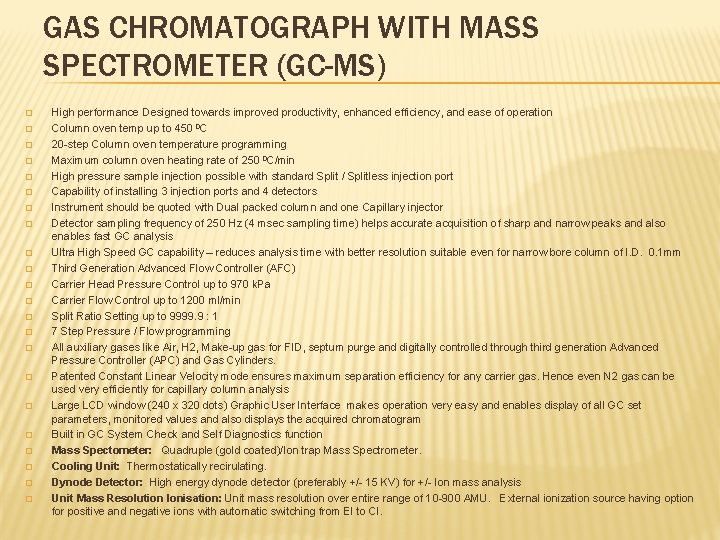
GAS CHROMATOGRAPH WITH MASS SPECTROMETER (GC-MS) � � � � � � High performance Designed towards improved productivity, enhanced efficiency, and ease of operation Column oven temp up to 450 0 C 20 -step Column oven temperature programming Maximum column oven heating rate of 250 0 C/min High pressure sample injection possible with standard Split / Splitless injection port Capability of installing 3 injection ports and 4 detectors Instrument should be quoted with Dual packed column and one Capillary injector Detector sampling frequency of 250 Hz (4 msec sampling time) helps accurate acquisition of sharp and narrow peaks and also enables fast GC analysis Ultra High Speed GC capability – reduces analysis time with better resolution suitable even for narrow bore column of I. D. 0. 1 mm Third Generation Advanced Flow Controller (AFC) Carrier Head Pressure Control up to 970 k. Pa Carrier Flow Control up to 1200 ml/min Split Ratio Setting up to 9999. 9 : 1 7 Step Pressure / Flow programming All auxiliary gases like Air, H 2, Make-up gas for FID, septum purge and digitally controlled through third generation Advanced Pressure Controller (APC) and Gas Cylinders. Patented Constant Linear Velocity mode ensures maximum separation efficiency for any carrier gas. Hence even N 2 gas can be used very efficiently for capillary column analysis Large LCD window (240 x 320 dots) Graphic User Interface makes operation very easy and enables display of all GC set parameters, monitored values and also displays the acquired chromatogram Built in GC System Check and Self Diagnostics function Mass Spectometer: Quadruple (gold coated)/Ion trap Mass Spectrometer. Cooling Unit: Thermostatically recirulating. Dynode Detector: High energy dynode detector (preferably +/- 15 KV) for +/- Ion mass analysis Unit Mass Resolution Ionisation: Unit mass resolution over entire range of 10 -900 AMU. External ionization source having option for positive and negative ions with automatic switching from El to Cl.
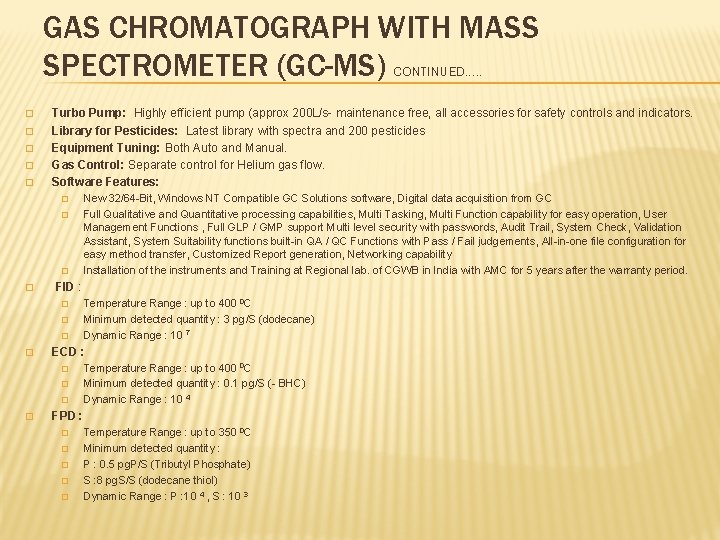
GAS CHROMATOGRAPH WITH MASS SPECTROMETER (GC-MS) CONTINUED…. . � � � Turbo Pump: Highly efficient pump (approx 200 L/s- maintenance free, all accessories for safety controls and indicators. Library for Pesticides: Latest library with spectra and 200 pesticides Equipment Tuning: Both Auto and Manual. Gas Control: Separate control for Helium gas flow. Software Features: � � FID : � � Temperature Range : up to 400 0 C Minimum detected quantity : 3 pg/S (dodecane) Dynamic Range : 10 7 ECD : � � New 32/64 -Bit, Windows NT Compatible GC Solutions software, Digital data acquisition from GC Full Qualitative and Quantitative processing capabilities, Multi Tasking, Multi Function capability for easy operation, User Management Functions , Full GLP / GMP support Multi level security with passwords, Audit Trail, System Check, Validation Assistant, System Suitability functions built-in QA / QC Functions with Pass / Fail judgements, All-in-one file configuration for easy method transfer, Customized Report generation, Networking capability Installation of the instruments and Training at Regional lab. of CGWB in India with AMC for 5 years after the warranty period. Temperature Range : up to 400 0 C Minimum detected quantity : 0. 1 pg/S (- BHC) Dynamic Range : 10 4 FPD : � � � Temperature Range : up to 350 0 C Minimum detected quantity : P : 0. 5 pg. P/S (Tributyl Phosphate) S : 8 pg. S/S (dodecane thiol) Dynamic Range : P : 10 4 , S : 10 3
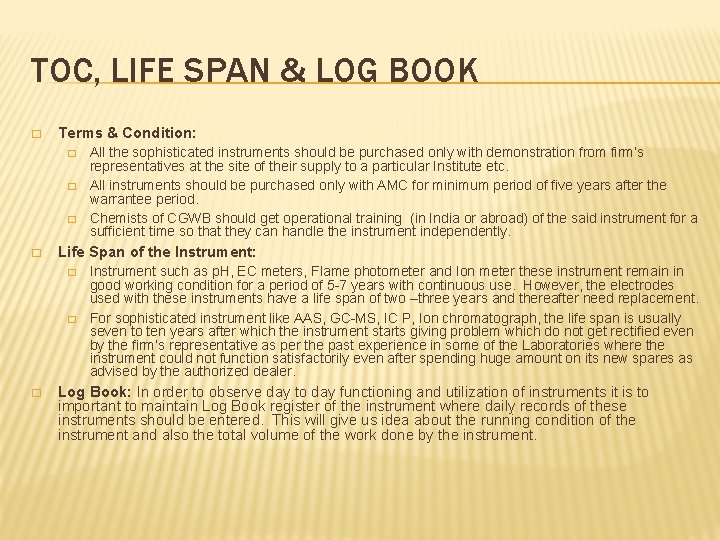
TOC, LIFE SPAN & LOG BOOK � Terms & Condition: � � Life Span of the Instrument: � � � All the sophisticated instruments should be purchased only with demonstration from firm’s representatives at the site of their supply to a particular Institute etc. All instruments should be purchased only with AMC for minimum period of five years after the warrantee period. Chemists of CGWB should get operational training (in India or abroad) of the said instrument for a sufficient time so that they can handle the instrument independently. Instrument such as p. H, EC meters, Flame photometer and Ion meter these instrument remain in good working condition for a period of 5 -7 years with continuous use. However, the electrodes used with these instruments have a life span of two –three years and thereafter need replacement. For sophisticated instrument like AAS, GC-MS, IC P, Ion chromatograph, the life span is usually seven to ten years after which the instrument starts giving problem which do not get rectified even by the firm’s representative as per the past experience in some of the Laboratories where the instrument could not function satisfactorily even after spending huge amount on its new spares as advised by the authorized dealer. Log Book: In order to observe day to day functioning and utilization of instruments it is to important to maintain Log Book register of the instrument where daily records of these instruments should be entered. This will give us idea about the running condition of the instrument and also the total volume of the work done by the instrument.

Thank You
- Slides: 29