
Water Quality Causal factors Urban Impact Water Resource
Water Quality Causal factors & Urban Impact Water Resource Management Agency Michael Skeete
What is Water Quality?
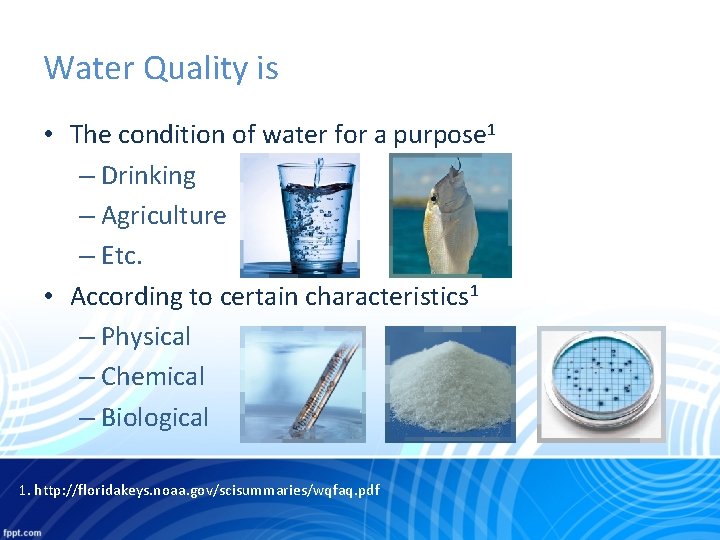
Water Quality is • The condition of water for a purpose 1 – Drinking – Agriculture – Etc. • According to certain characteristics 1 – Physical – Chemical – Biological 1. http: //floridakeys. noaa. gov/scisummaries/wqfaq. pdf
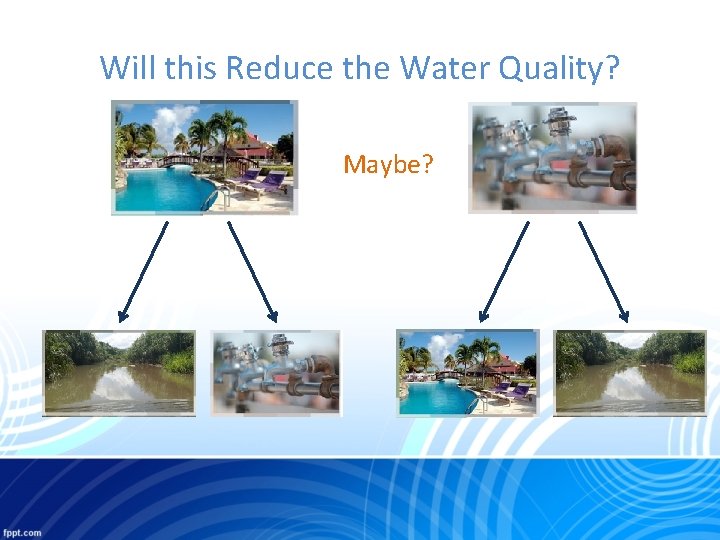
Will this Reduce the Water Quality? Maybe? YES!
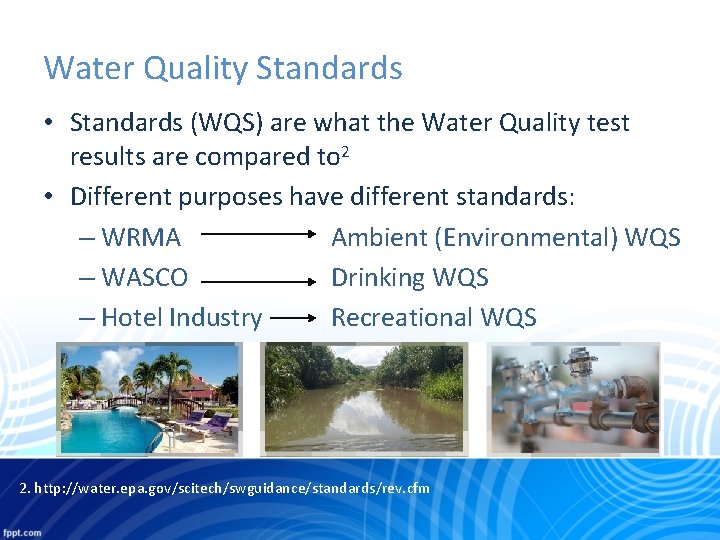
Water Quality Standards • Standards (WQS) are what the Water Quality test results are compared to 2 • Different purposes have different standards: – WRMA Ambient (Environmental) WQS – WASCO Drinking WQS – Hotel Industry Recreational WQS 2. http: //water. epa. gov/scitech/swguidance/standards/rev. cfm
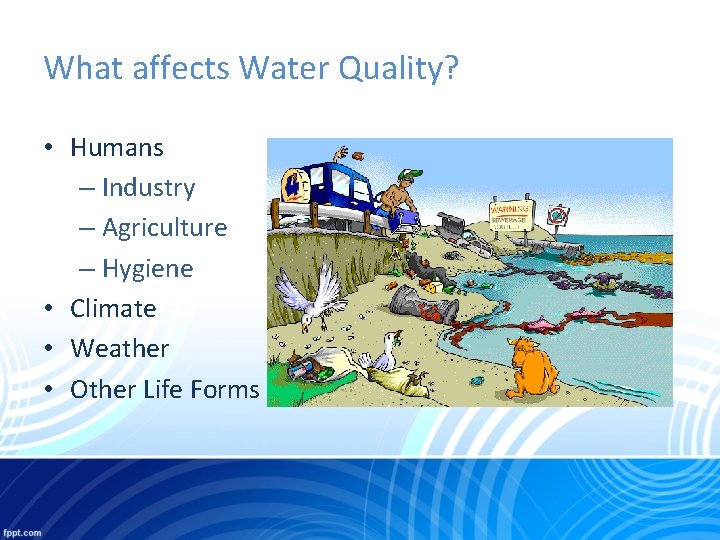
What affects Water Quality? • Humans – Industry – Agriculture – Hygiene • Climate • Weather • Other Life Forms
Testing Water Quality Physical Parameters 3 • • • Temperature Total Suspended Solids Turbidity Odour Taste Flow (in the case of rivers) 3. Davis et al. (2005)
How to test Physical Parameters • Temperature – Testing the temperature is always done in situ using analogue or digital thermometer • Odour – Should be done in situ or within 5 mins. of sample collection • Taste – Do this at your own risk – Often done at treatment plants

How to test Physical Parameters • Total Suspended Solids – Water is filtered, then the residue is dried and weighed then compared to the original sample • Turbidity 4 – Is measured by the amount of light that is scattered by the sample 4. http: //learnweb. harvard. edu/ent/gallery/pop 4/Turbidi ty_MWRA. pdf
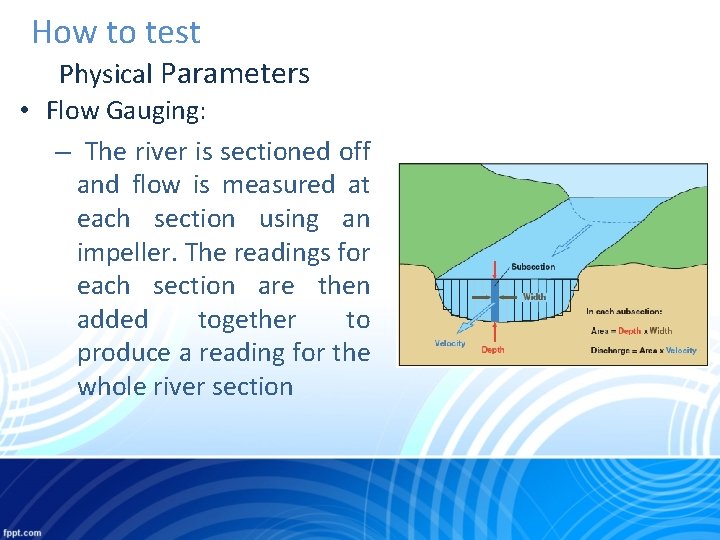
How to test Physical Parameters • Flow Gauging: – The river is sectioned off and flow is measured at each section using an impeller. The readings for each section are then added together to produce a reading for the whole river section
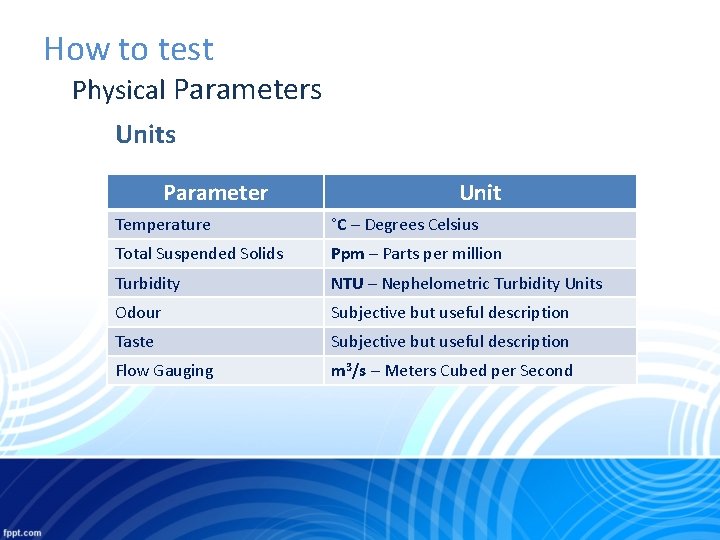
How to test Physical Parameters Units Parameter Unit Temperature °C – Degrees Celsius Total Suspended Solids Ppm – Parts per million Turbidity NTU – Nephelometric Turbidity Units Odour Subjective but useful description Taste Subjective but useful description Flow Gauging m 3/s – Meters Cubed per Second
Testing Water Quality Chemical Parameters 3 • p. H • Specific Conductance • Nutrients – Nitrates – Phosphates • Heavy Metals • Pesticides • Herbicides 3. Davis et al. (2005) • • • Industrial Wastes Alkalinity Pharmaceuticals Surfactants Oxygen Etc……. .
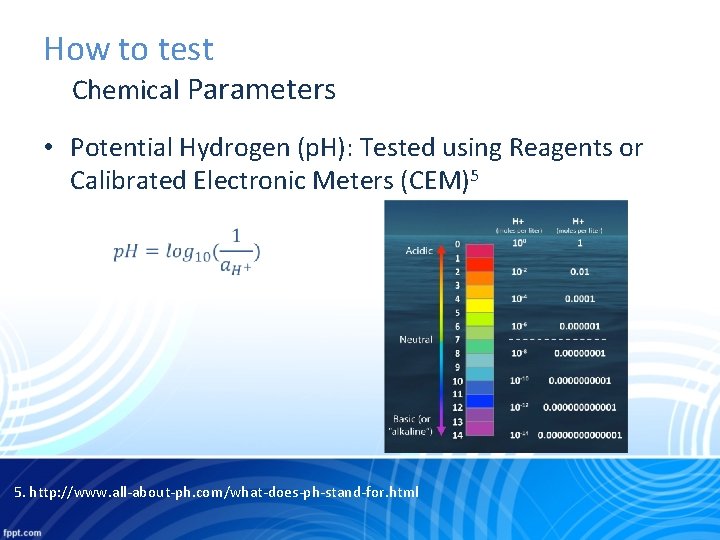
How to test Chemical Parameters • Potential Hydrogen (p. H): Tested using Reagents or Calibrated Electronic Meters (CEM)5 5. http: //www. all-about-ph. com/what-does-ph-stand-for. html
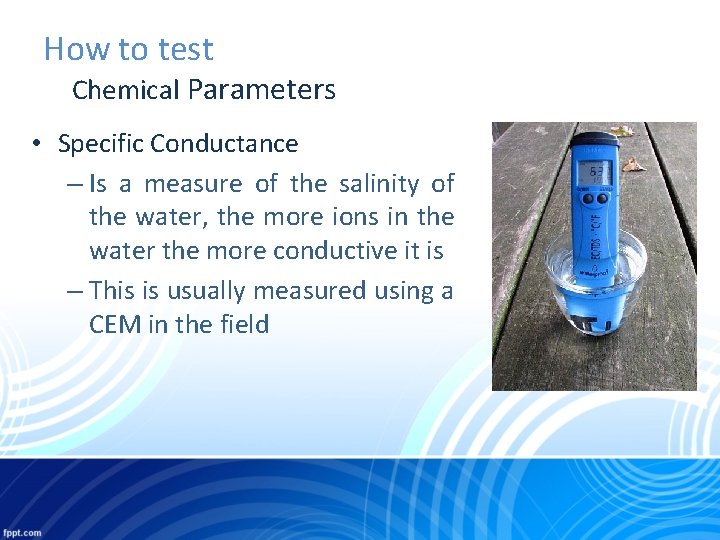
How to test Chemical Parameters • Specific Conductance – Is a measure of the salinity of the water, the more ions in the water the more conductive it is – This is usually measured using a CEM in the field
How to test Chemical Parameters • Nutrients: Tested for in a Spectrophotometer – Nitrates – Phosphates • Samples of water are taken back to a lab (or mobile lab) where specific volumes of the sample reacts with a measured amount of reagent and the change between the original samples light scattering capacity and the regent mixed sample gives the concentration of nutrients
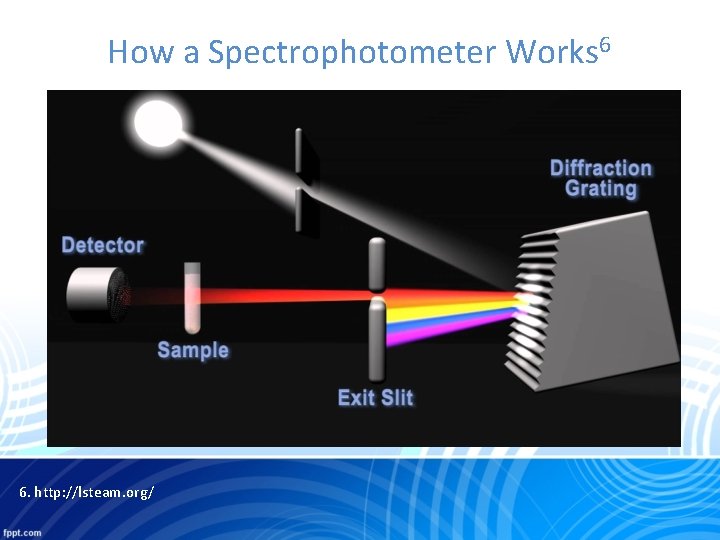
How a Spectrophotometer Works 6 6. http: //lsteam. org/
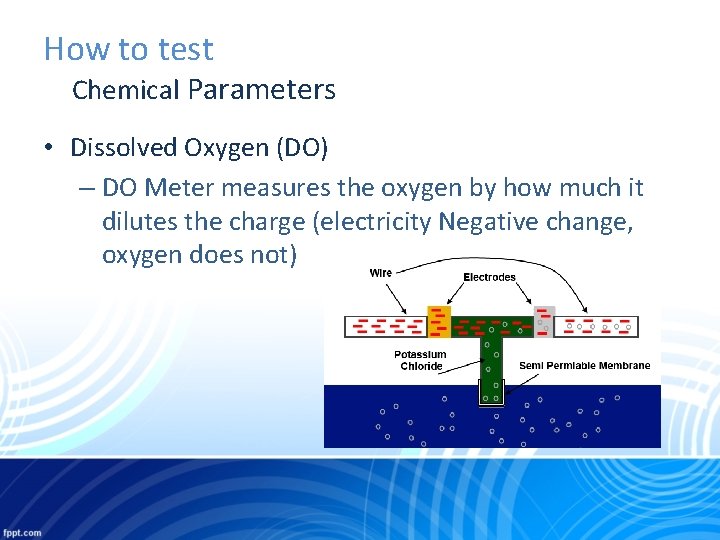
How to test Chemical Parameters • Dissolved Oxygen (DO) – DO Meter measures the oxygen by how much it dilutes the charge (electricity Negative change, oxygen does not)
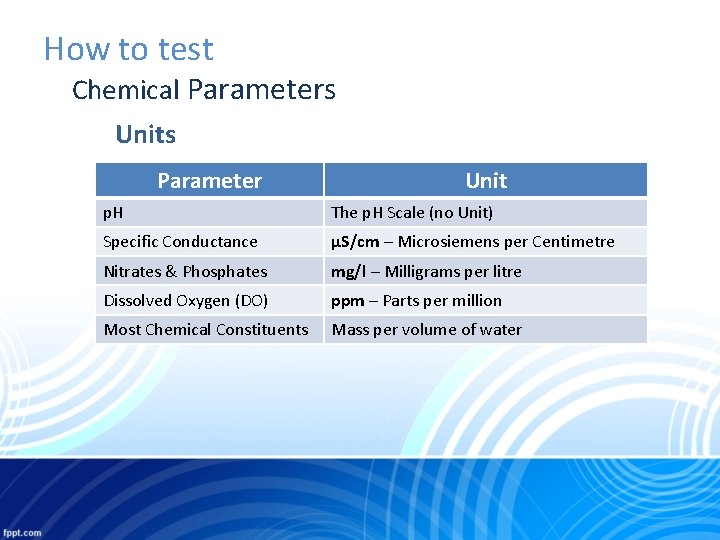
How to test Chemical Parameters Units Parameter Unit p. H The p. H Scale (no Unit) Specific Conductance μS/cm – Microsiemens per Centimetre Nitrates & Phosphates mg/l – Milligrams per litre Dissolved Oxygen (DO) ppm – Parts per million Most Chemical Constituents Mass per volume of water
Testing Water Quality Biological Parameters 3 • bio-indicators – These are large insects and animals that live in the water body, if they are present then the water must be of a certain quality • Bacterial Life (health concerns) – E Coli – Coliform Bacteria 3. Davis et al. (2005)
Testing Water Quality Biological Parameters • Bio-Indicators 7 – Stratified locations of fish could mean • A Thermocline layer (temperature boundary) • A Hypoxic layer (Oxygen boundary) • A Eutrophication layer (Nutrient boundary) – No presence of previously present animals • Water quality has dropped and either moved the animals away or killed them off NB: These are all indicators, they do not produce numbers but they show the water has changed and can provide clues to the problems 7. Barbour, M. T et al (1999)
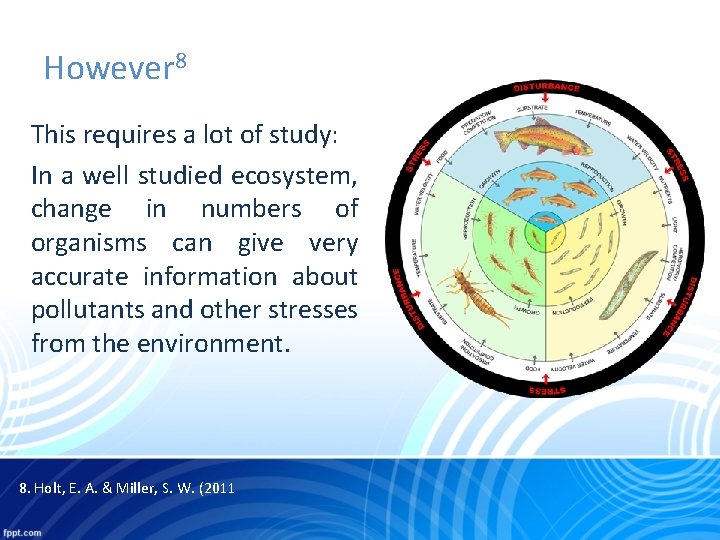
However 8 This requires a lot of study: In a well studied ecosystem, change in numbers of organisms can give very accurate information about pollutants and other stresses from the environment. 8. Holt, E. A. & Miller, S. W. (2011
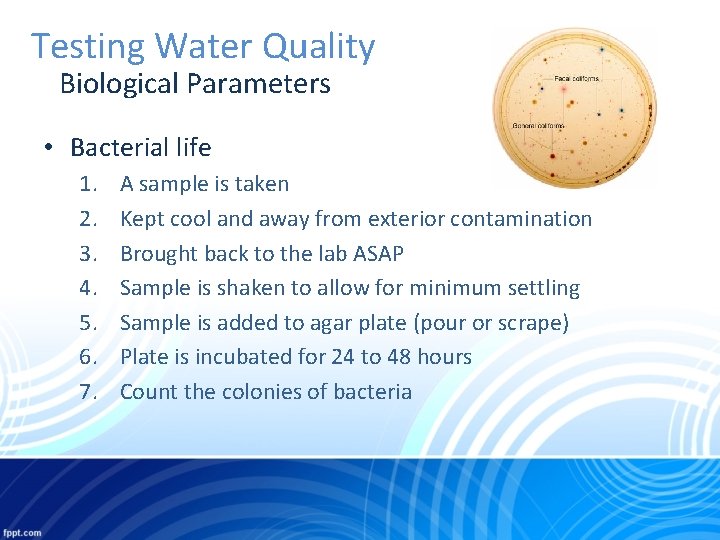
Testing Water Quality Biological Parameters • Bacterial life 1. 2. 3. 4. 5. 6. 7. A sample is taken Kept cool and away from exterior contamination Brought back to the lab ASAP Sample is shaken to allow for minimum settling Sample is added to agar plate (pour or scrape) Plate is incubated for 24 to 48 hours Count the colonies of bacteria
Urban Contribution 9 • Runoff contributions due to impervious surfaces: – – – Driving and Vehicle Maintenance Gardening Waste Disposal Hygiene (Poor or failed septic systems) Construction sites 9. http: //www. nrdc. org/water/pollution/storm/chap 3. asp
Urban Impacts 9 • • • Riverbank/bed erosion Increased siltation Aesthetic degradation Disruption of aquatic life Harm to coastal environments (Coral etc. ) – Fisheries – Tourism • Increased water temperature • Human health 9. http: //www. nrdc. org/water/pollution/storm/chap 3. asp
Thank You for Listening Any Questions?
References 1. 2. 3. 4. 5. 6. 7. 8. 9. NATIONAL OCEANIC AND ATMOSPHERIC ADMINISTRATION. (2009). Water Quality: Frequently Asked Questions. <http: //floridakeys. noaa. gov/scisummaries/wqfaq. pdf> UNITED STATES ENVIRONMENTAL PROTECTION AGENCY (nd). Water Quality Standards Review and Revision. Available at: United States EPA Website. <http: //water. epa. gov/scitech/swguidance/standards/rev. cfm> (updated October 2012, accessed 20 th November 2013). DAVIS, ALLEN P. , MCCUEN, RICHARD H. (2005). Stormwater Management for Smart Growth. Maryland: Springer. HARVARD ENT GALLARY. (nd). Turbidity Test 7. Available at: Harvard ENT learnweb website <http: //learnweb. harvard. edu/ent/gallery/pop 4/Turbidity_MWRA. pdf> (Accessed 20 th October 2013) ALL ABOUT PH. (nd). What does p. H stand for and calculating p. H. Available at All About p. H Website <http: //www. all-about-ph. com/what-does-ph-stand-for. html> (Accessed 20 th October 2013) LEARNING SOLUTIONS NC COMMUNITY COLLEGES. (2013). How does a spectrophotometer work. Available at Learning Solutions website <http: //lsteam. org/projects/videos/how-doesspectrophotometer-work> (Accessed 20 th October 2013) Barbour, M. T. , J. Gerritsen, B. D. Snyder, and J. B. Stribling (1999). Rapid Bioassessment Protocols for Use in Streams and Wadeable Rivers: Periphyton, Benthic Macroinvertebrates and Fish. 2 nd Edition. EPA 841 B-99 -002. U. S. Environmental Protection Agency; Office of Water; Washington, D. C. Holt, E. A. & Miller, S. W. (2011) Bioindicators: Using Organisms to Measure Environmental Impacts. Nature Education Knowledge 3(10): 8 NATURAL RESOURCE DEFENCE COUNCIL (nd). Stormwater Strategies , Community Responses to Runoff Pollution. Available at NRDC Website. <http: //www. nrdc. org/water/pollution/storm/chap 3. asp> (Accessed 3 rd March 2015).
- Slides: 26