
Water Purification and Wastewater Treatment Water Purification Screening
- Slides: 32
Water Purification and Wastewater Treatment
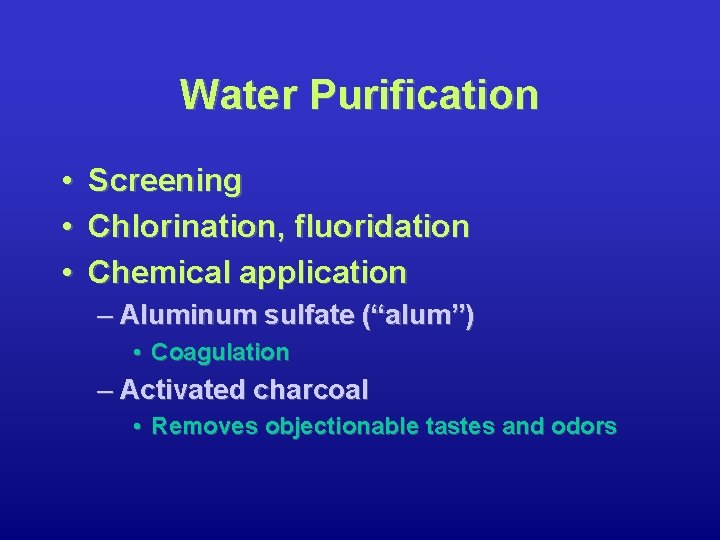
Water Purification • • • Screening Chlorination, fluoridation Chemical application – Aluminum sulfate (“alum”) • Coagulation – Activated charcoal • Removes objectionable tastes and odors
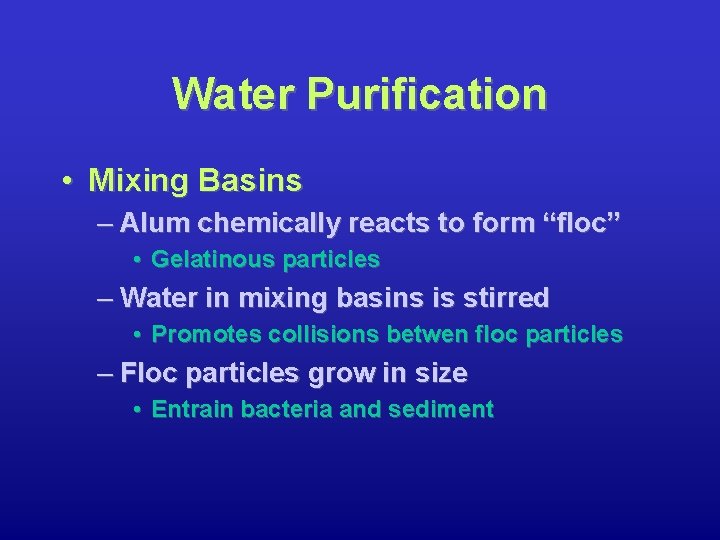
Water Purification • Mixing Basins – Alum chemically reacts to form “floc” • Gelatinous particles – Water in mixing basins is stirred • Promotes collisions betwen floc particles – Floc particles grow in size • Entrain bacteria and sediment
Water Purification • Settling Basins – Flocculated material settles out and is piped to wastewater treatment plant • Sand Filters – Hydrated lime added to minimize corrosion – Polishing operation
Water Purification • Temporary storage in clear wells • Filtered-water reservoir – Chlorination – Caustic soda to minimize corrosiveness of polished water – Gravity flow to pumping stations
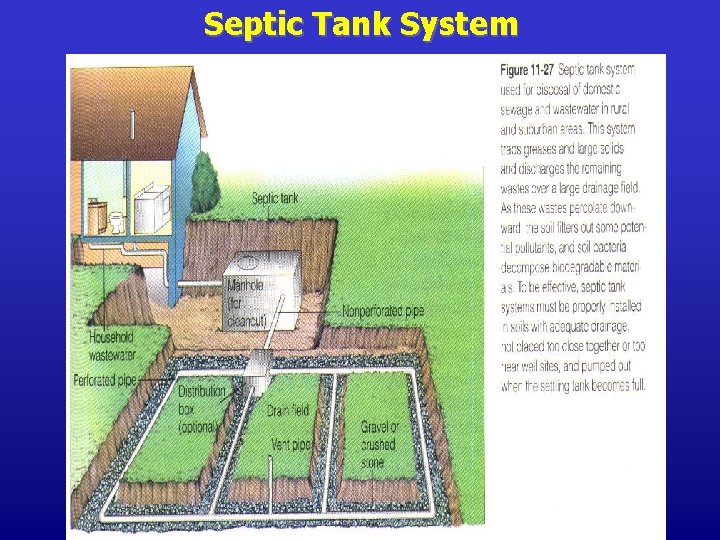
Wastewater Treatment • Septic Tanks – Bacteria in sewage degrade organic matter – Tank buried in ground to treat sewage from an individual home – Wastewater flows into tank
Septic Tank System
Wastewater Treatment • Septic Tanks – Solid material (“sludge”) settles to bottom of tank – Cleaner water flows out of tank into ground through subsurface drains
Wastewater Treatment • Lagoons (Stabilization Ponds) – 3 -5’ deep – Sunlight, algae, oxygen interact to clean wastewater
Wastewater Treatment • Conventional Sewage Treatment – Processes • Collection • Treatment
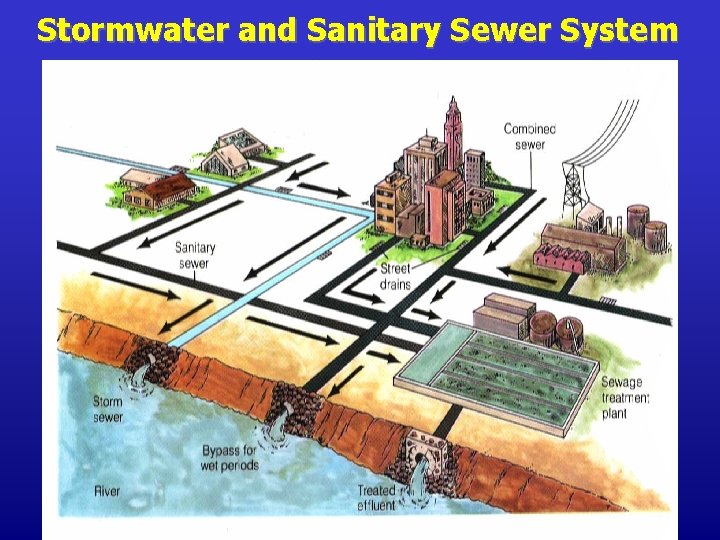
Wastewater Treatment • Conventional Sewage Treatment – Processes • Collection – Sewers • Combined • Separate
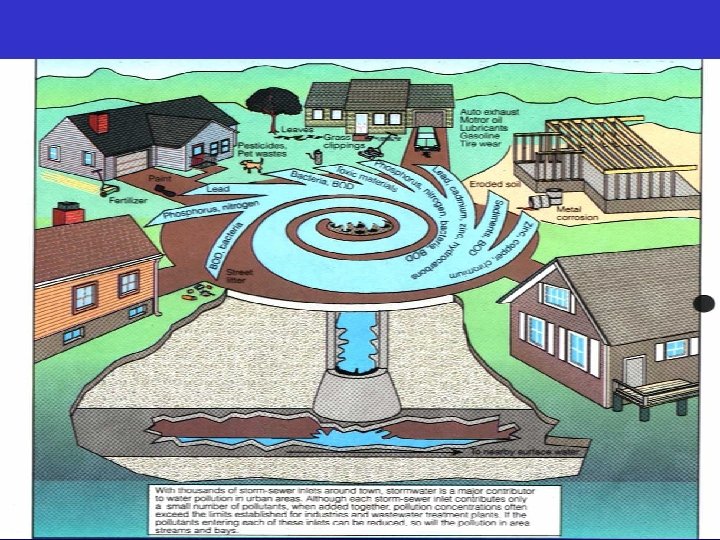
Stormwater and Sanitary Sewer System
Wastewater Treatment • Conventional Sewage Treatment – Processes • Collection – Combined Sewers • Carry stormwater and wastewater – Separated Sewers • Sanitary Sewers • Storm Sewers
Wastewater Treatment • Conventional Sewage Treatment – Processes • Collection – Household sewer – Lateral sewer – Main sewers – Interceptors – Wastewater treatment plant
Wastewater Treatment • Conventional Sewage Treatment – Processes • Collection – High rainfall events • Some wastewater may be diverted to receiving streams
Wastewater Treatment • Conventional Sewage Treatment – Processes • Treatment – Function • To speed up natural processes by which water purifies itself • DO is the key!
Wastewater Treatment • Conventional Sewage Treatment – Processes • Primary • Secondary • Advanced
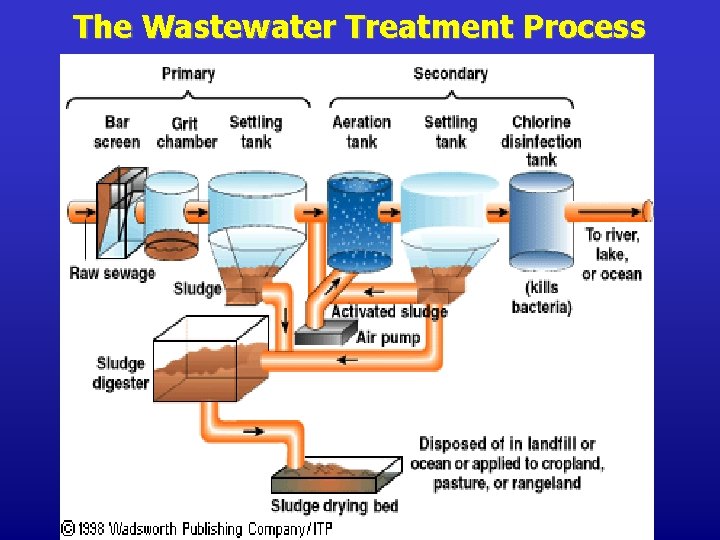
The Wastewater Treatment Process
Wastewater Treatment • Conventional Sewage Treatment – Processes • Primary Treatment – Mechanical process • Screening • Grinding • Grit Chamber (heavy particles - “grit”) • Sedimentation Tank (suspended solids “sludge”) • Chlorination of effluent
Wastewater Treatment • Conventional Sewage Treatment – Processes • Secondary Treatment – Biological process • Uses bacteria to removed ODW and lower BOD – Types • Trickling Filter • Activated Sludge
Wastewater Treatment • Conventional Sewage Treatment – Processes • Secondary Treatment With Trickling Filters – Effluent leaves sedimentation tank and flows through trickling filters • Bed of stones 3 -10’ deep through which sewage passes • Bacteria gather on stones and multiply, consuming ODW • Cleaner water trickles through pipes at bottom of filter for additional treatment
Wastewater Treatment • Conventional Sewage Treatment – Processes • Secondary Treatment With Activated Sludge – Effluent leaves sedimentation tank and is pumped to an aeration tank – Effluent is mixed with air and sludge loaded with bacteria (“activated sludge”) – Sludge contacts with raw sewage, and bacteria in the sludge then decompose the raw sewage, lowering ODW and BOD
Wastewater Treatment • Conventional Sewage Treatment – Processes • Secondary Treatment With Activated Sludge – Activated sludge-sewage mixture is called mixed liquor – Mixed liquor leaves aeration tank and flows to another sedimentation tank where suspended solids settle out for reuse as activated sludge – Effluent is chlorinated – Activated sludge in sedimentation tank is reused
Wastewater Treatment • Conventional Sewage Treatment – Processes • Advanced (Tertiary) Wastewater Treatment – Physical and chemical processes that specific pollutants left in wastewater after primary and secondary treatment – Extremely costly! • It cost twice as much to build a tertiary treatment plant compared to a secondary treatment plant
Wastewater Treatment • Conventional Sewage Treatment – Processes • Advanced (Tertiary) Wastewater Treatment – Processes • Bleaching to remove coloration • Disinfection to kill pathogens • Coagulation-sedimentation with alum • Adsorption using activated charcoal • Electrodialysis for salt removal
Wastewater Treatment • Conventional Sewage Treatment – Processes • Sludge Disposal – Landfills – Incineration – Land application – Anaerobic digestion
Wastewater Treatment • Water Quality Protection – Federal Laws • • • Clean Water Act (1977) Water Quality Act (1987) U. S. Safe Drinking Water Act (1974)
Wastewater Treatment • Water Quality Protection – Clean Water Act • To restore and/or maintain the chemical, physical, and biological integrity of the nation’s surface waters
Wastewater Treatment • Water Quality Protection – Safe Drinking Water Act • Required USEPA to establish drinking water standards (“Maximum Contaminant Levels”) for any pollutant that MAY have adverse effects on human health • No MCLs established for some SOCs, radioactive materials, toxic metals, and ptahogens
Wastewater Treatment • Water Quality Protection – Natural Resources Defense Council Study • Drinking water of > 50 million Americans exceeds one or more MCL standards • Most people have not been notified when their drinking water was contaminated • Contaminated drinking water is responsible for > 7 million ilnesses and 1200 deaths per year
Wastewater Treatment • U. S. Water Quality Facts – 44% of lakes, 37% rivers, 32% estuaries still unsafe for fishing, swimming, other recreational uses