
Water Power Peer Review Cycloidal Wave Energy Converter

- Slides: 5
Water Power Peer Review Cycloidal Wave Energy Converter TRL Advancement to Level 4 1 | Program Name or Ancillary Text Dr. Stefan G. Siegel, PI Atargis Energy Corporation Stefan. siegel@atargis. com 09/22/2011 eere. energy. gov
Purpose, Objectives, & Integration • Wave Energy extraction a difficult fluid dynamic problem: – Unsteady, fluctuating nature of wave energy – Slow velocities (O~1 m/s) » large devices if buoyancy / drag based – Large energy density » huge forces • Many existing devices inefficient by design: ‒ Symmetric point absorbers limited to 25 – 50% of wave energy absorption based on first principles (Falnes, 2002) – While the energy is “free”, the device to extract it needs to be larger if it is less efficient » more costly to build and maintain • Many existing devices unable to survive storms ‒ Cannot be feathered like wind turbines • Costly, inefficient power takeoff systems (pneumatics, hydraulics) • High Cost of Electricity due to large converters, poor overall conversion efficiency All of these shortcomings are addressed by the Cycloidal Wave Energy converter detailed on the next slide 2 | Wind and Water Power Program eere. energy. gov
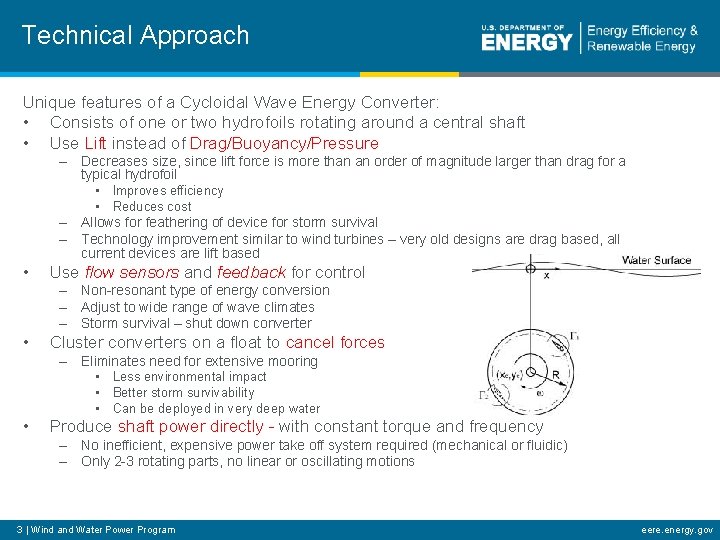
Technical Approach Unique features of a Cycloidal Wave Energy Converter: • Consists of one or two hydrofoils rotating around a central shaft • Use Lift instead of Drag/Buoyancy/Pressure – Decreases size, since lift force is more than an order of magnitude larger than drag for a typical hydrofoil – – • • Improves efficiency • Reduces cost Allows for feathering of device for storm survival Technology improvement similar to wind turbines – very old designs are drag based, all current devices are lift based Use flow sensors and feedback for control – Non-resonant type of energy conversion – Adjust to wide range of wave climates – Storm survival – shut down converter • Cluster converters on a float to cancel forces – Eliminates need for extensive mooring • Less environmental impact • Better storm survivability • Can be deployed in very deep water • Produce shaft power directly - with constant torque and frequency – No inefficient, expensive power take off system required (mechanical or fluidic) – Only 2 -3 rotating parts, no linear or oscillating motions 3 | Wind and Water Power Program eere. energy. gov
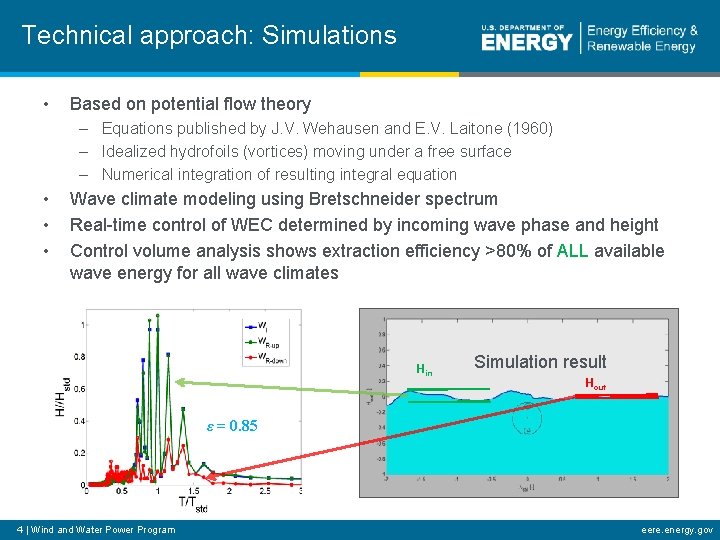
Technical approach: Simulations • Based on potential flow theory – Equations published by J. V. Wehausen and E. V. Laitone (1960) – Idealized hydrofoils (vortices) moving under a free surface – Numerical integration of resulting integral equation • • • Wave climate modeling using Bretschneider spectrum Real-time control of WEC determined by incoming wave phase and height Control volume analysis shows extraction efficiency >80% of ALL available wave energy for all wave climates Hin Simulation result Hout ε = 0. 85 4 | Wind and Water Power Program eere. energy. gov
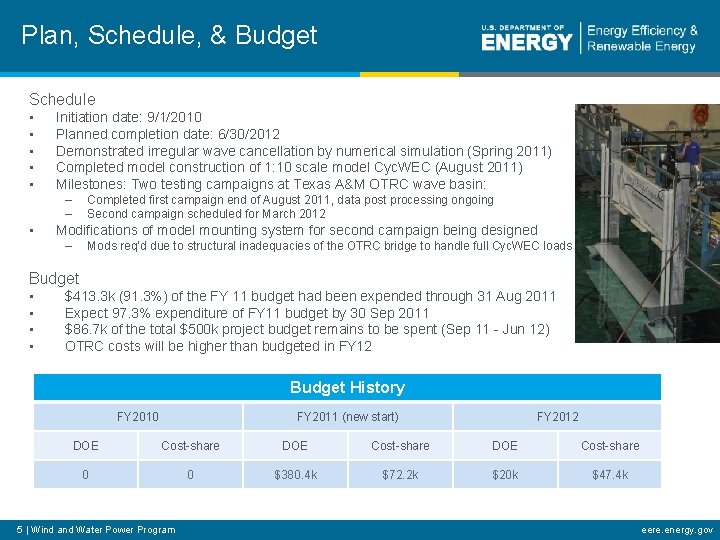
Plan, Schedule, & Budget Schedule • • • Initiation date: 9/1/2010 Planned completion date: 6/30/2012 Demonstrated irregular wave cancellation by numerical simulation (Spring 2011) Completed model construction of 1: 10 scale model Cyc. WEC (August 2011) Milestones: Two testing campaigns at Texas A&M OTRC wave basin: – – • Completed first campaign end of August 2011, data post processing ongoing Second campaign scheduled for March 2012 Modifications of model mounting system for second campaign being designed – Mods req’d due to structural inadequacies of the OTRC bridge to handle full Cyc. WEC loads Budget • • $413. 3 k (91. 3%) of the FY 11 budget had been expended through 31 Aug 2011 Expect 97. 3% expenditure of FY 11 budget by 30 Sep 2011 $86. 7 k of the total $500 k project budget remains to be spent (Sep 11 - Jun 12) OTRC costs will be higher than budgeted in FY 12 Budget History FY 2010 FY 2011 (new start) FY 2012 DOE Cost-share 0 0 $380. 4 k $72. 2 k $20 k $47. 4 k 5 | Wind and Water Power Program eere. energy. gov