
Water Pollution Mercury D 24 Explain how the

- Slides: 19
Water Pollution Mercury
D 24 Explain how the accumulation of mercury, phosphates and nitrates affects the quality of water and the organisms that live in rivers, lakes and oceans.
Learning Targets �I can explain why mercury pollution is a problem. � I can differentiate between bioaccumulation and biomagnification.
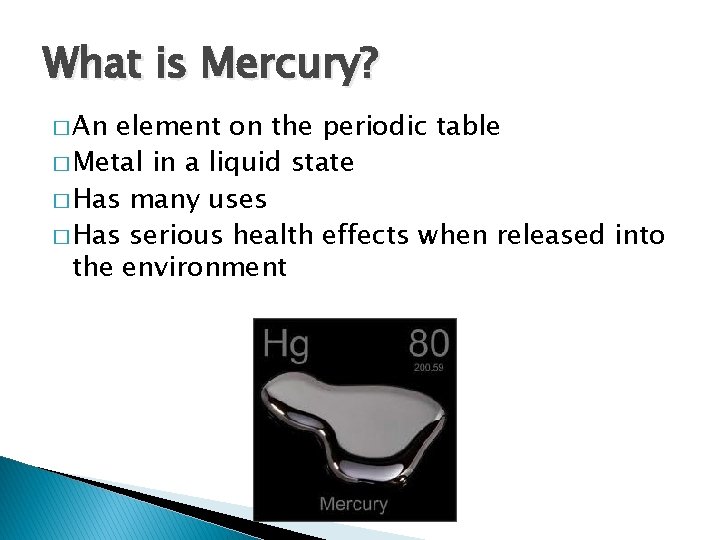
What is Mercury? � An element on the periodic table � Metal in a liquid state � Has many uses � Has serious health effects when released into the environment
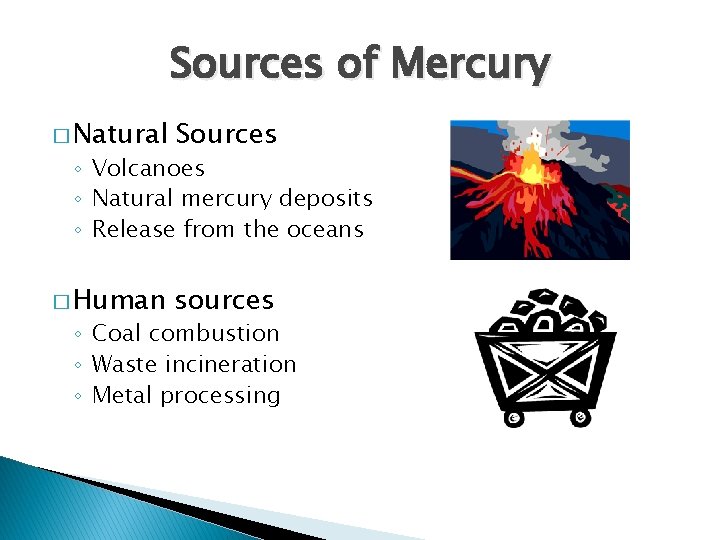
Sources of Mercury � Natural Sources � Human sources ◦ Volcanoes ◦ Natural mercury deposits ◦ Release from the oceans ◦ Coal combustion ◦ Waste incineration ◦ Metal processing
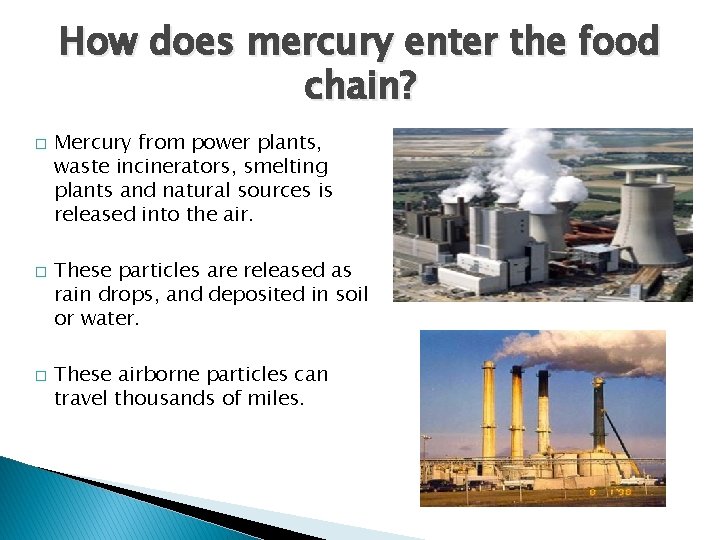
How does mercury enter the food chain? � � � Mercury from power plants, waste incinerators, smelting plants and natural sources is released into the air. These particles are released as rain drops, and deposited in soil or water. These airborne particles can travel thousands of miles.
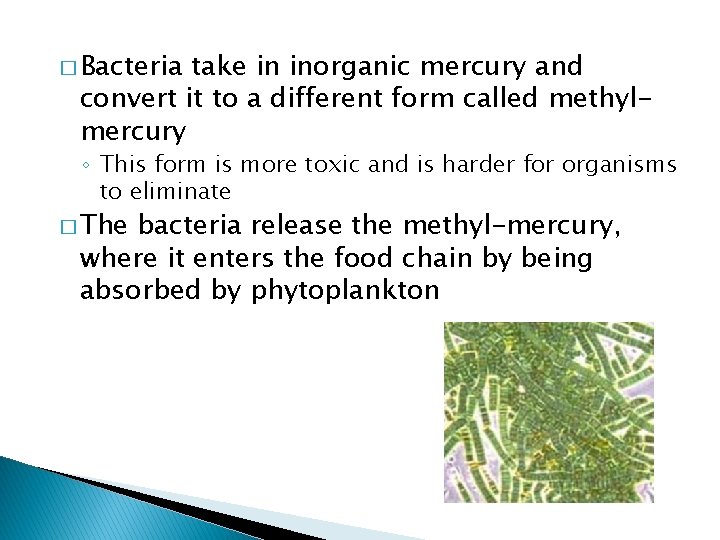
� Bacteria take in inorganic mercury and convert it to a different form called methylmercury ◦ This form is more toxic and is harder for organisms to eliminate � The bacteria release the methyl-mercury, where it enters the food chain by being absorbed by phytoplankton
What organism is most likely to be contaminated with Hg? � Fish
How are these fish becoming so contaminated when the atmospheric levels of mercury are so low? Or How do fish in remote lakes become contaminated?
Mercury undergoes Bioaccumulation � What � This does this mean? is the process by which organisms build up mercury in their bodies. They take in mercury more quickly than they can get rid of it. � Over time, the organism will accumulate mercury, until it can even reach toxic levels.
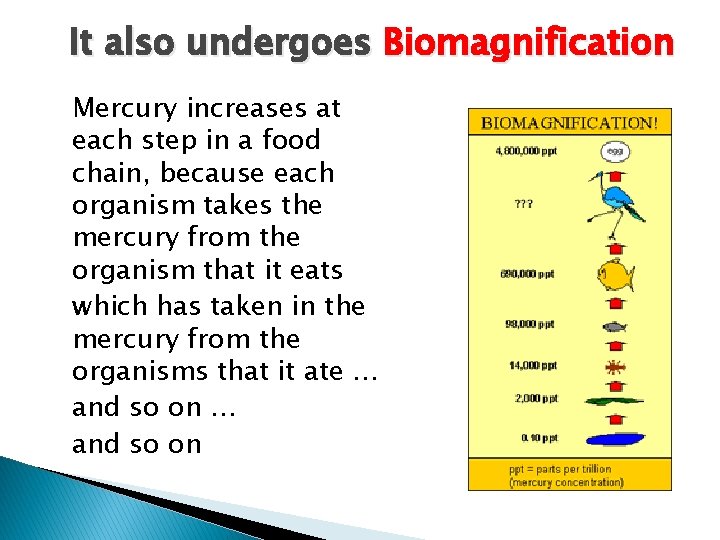
It also undergoes Biomagnification Mercury increases at each step in a food chain, because each organism takes the mercury from the organism that it eats which has taken in the mercury from the organisms that it ate … and so on
Biomagnification � The highest levels of mercury are found at the highest levels of the food chain. � Bigger fish, older fish, and carnivorous fish will have the highest levels of mercury. � And, the mercury concentrates in the muscles of the fish, which is the part that humans eat
Mercury Poisoning in Humans � Mild cases have the following symptoms: ◦ Reduction in motor skills ◦ Dulled sense of touch, taste and sight � Pregnant women should avoid ingesting mercury at all costs, as unborn babies are very sensitive to mercury poisoning.
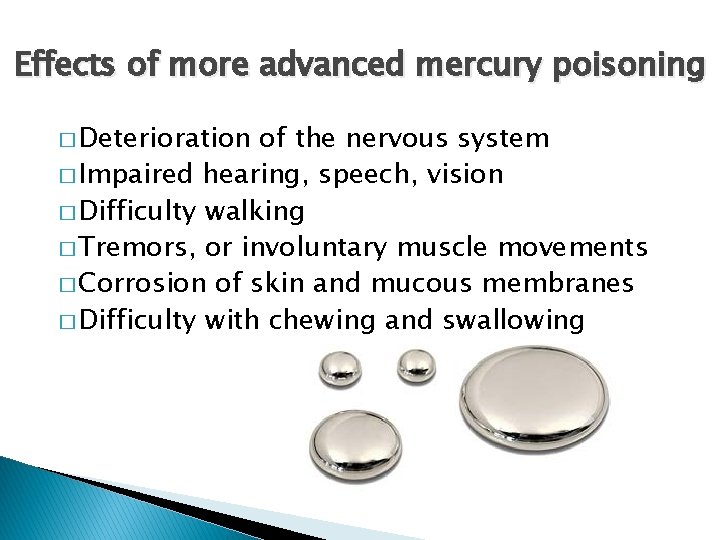
Effects of more advanced mercury poisoning � Deterioration of the nervous system � Impaired hearing, speech, vision � Difficulty walking � Tremors, or involuntary muscle movements � Corrosion of skin and mucous membranes � Difficulty with chewing and swallowing
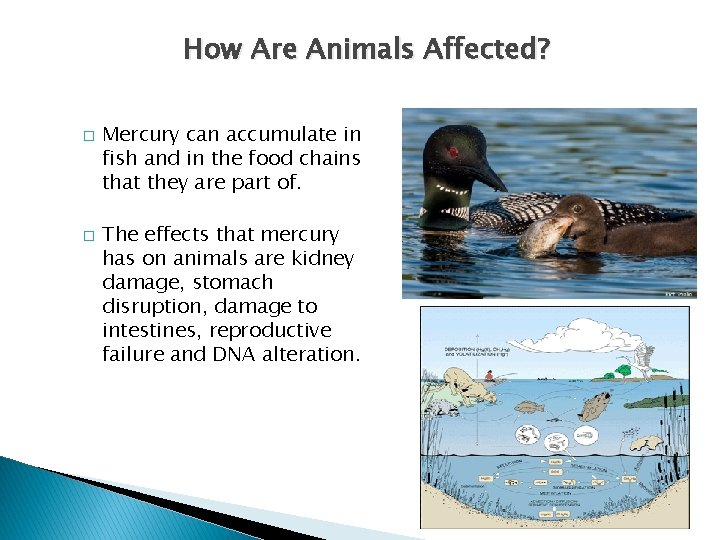
How Are Animals Affected? � � Mercury can accumulate in fish and in the food chains that they are part of. The effects that mercury has on animals are kidney damage, stomach disruption, damage to intestines, reproductive failure and DNA alteration.
Current levels of Mercury � Human activities have doubled or tripled mercury levels. � This also is increasing by about 1. 5% per year
What can we do to help? � Reduced � Take the amount of coal use part in Hazardous Household Waste Disposal days
Learning Target Checkpoint � Why is Hg pollution a problem? � What is the difference between bioaccumulation and biomagnification?
Reference Krabbenhoft, D. P. , & Rickert, D. A. (2008). Retrieved from U. S. Geological Survey website: http: //pubs. usgs. gov/fs/1995/fs 216 -95