
Water Pollution Chapter 20 The Seattle Washington Area
- Slides: 62
Water Pollution Chapter 20
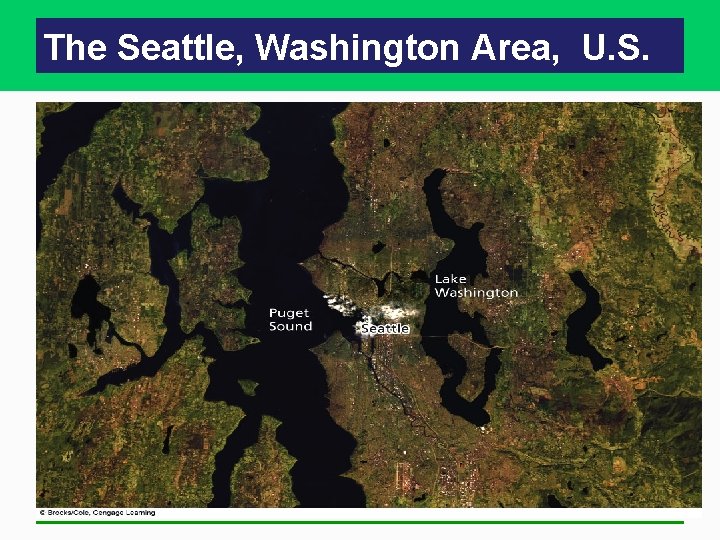
The Seattle, Washington Area, U. S.
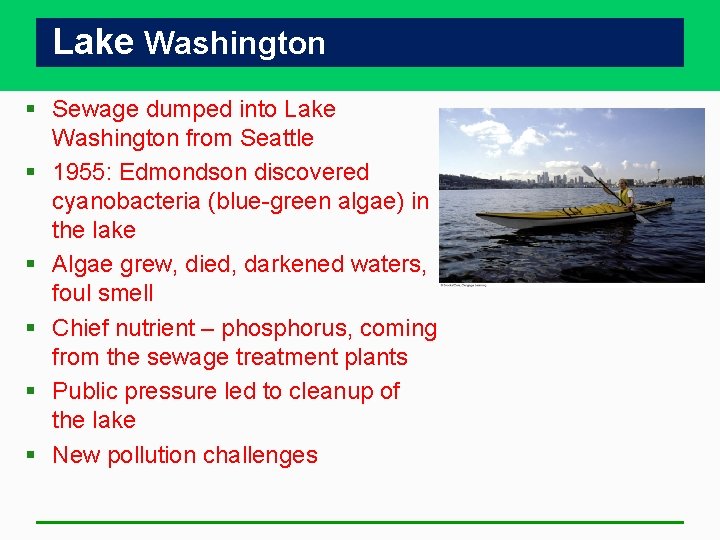
Lake Washington § Sewage dumped into Lake Washington from Seattle § 1955: Edmondson discovered cyanobacteria (blue-green algae) in the lake § Algae grew, died, darkened waters, foul smell § Chief nutrient – phosphorus, coming from the sewage treatment plants § Public pressure led to cleanup of the lake § New pollution challenges
Causes and Effects of Water Pollution Water pollution causes illness and death in humans and other species and disrupts ecosystems. The chief sources of water pollution are agricultural activities, industrial facilities, and mining, but growth in population and resource use make it increasingly worse.
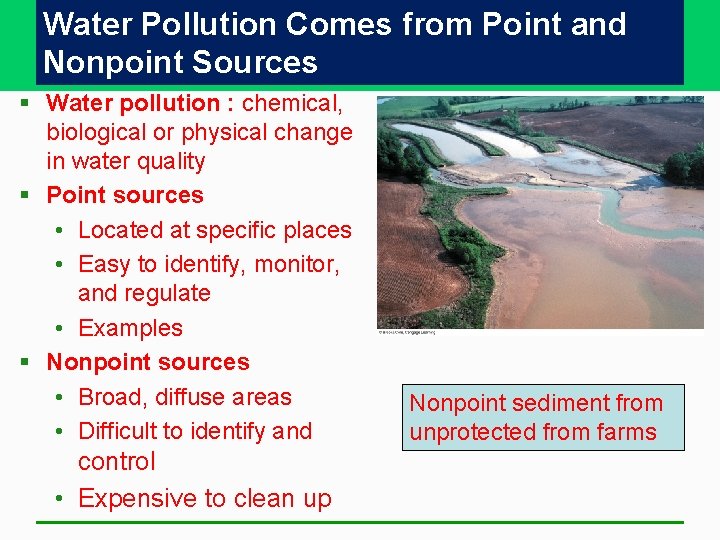
Water Pollution Comes from Point and Nonpoint Sources § Water pollution : chemical, biological or physical change in water quality § Point sources • Located at specific places • Easy to identify, monitor, and regulate • Examples § Nonpoint sources • Broad, diffuse areas • Difficult to identify and control • Expensive to clean up Nonpoint sediment from unprotected from farms
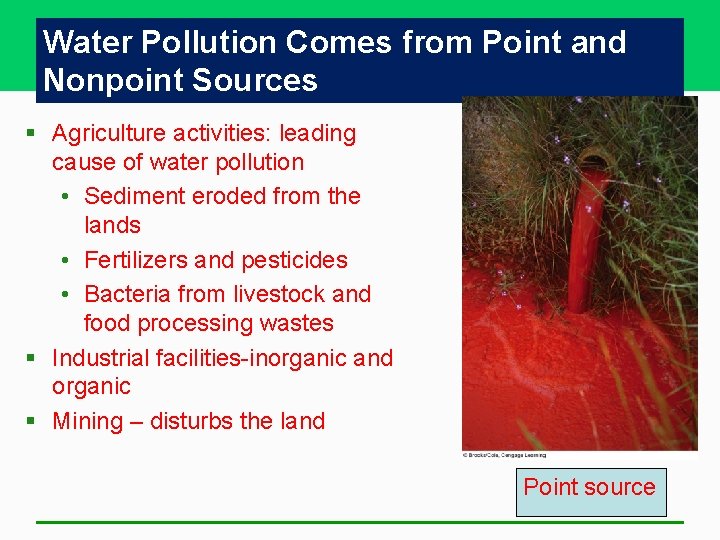
Water Pollution Comes from Point and Nonpoint Sources § Agriculture activities: leading cause of water pollution • Sediment eroded from the lands • Fertilizers and pesticides • Bacteria from livestock and food processing wastes § Industrial facilities-inorganic and organic § Mining – disturbs the land Point source
Water Pollution Comes from Point and Nonpoint Sources § Other sources of water pollution • Parking lots-grease, toxic materials and sediments that collect on their impervious surface • Prevents rain from soaking in, worsens flooding • Human-made materials • E. g. , plastics – polymers break down very slowly • Climate change due to global warming • some areas get more precipitation than others • Intense downpours flushes more harmful chemicals • Prolonged drought reduces river flows that dilute waste
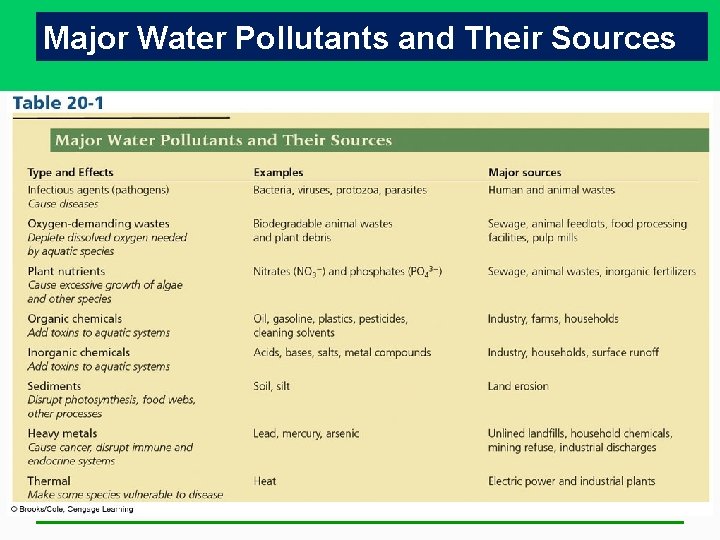
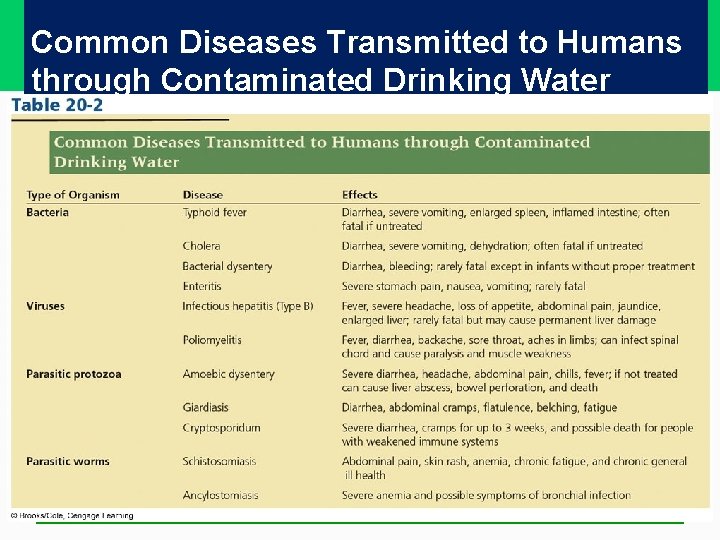
Harmful Effects of Major Water Pollutants § Infectious disease organisms: contaminated drinking water • 500 disease causing bacteria that can be transferred from wastes of human and animal waste § The World Health Organization (WHO) • 3 Million people die every year, mostly under the age of 5, from drinking contaminated water • 1. 2 billion people have no access to drinking water • Diarrhea caused mostly by polluted water – kills a young child every 18 seconds
Major Water Pollutants and Their Sources
Common Diseases Transmitted to Humans through Contaminated Drinking Water
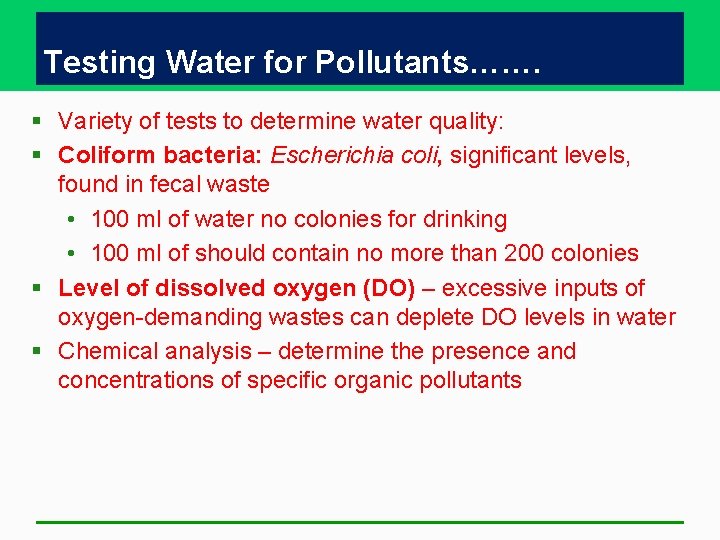
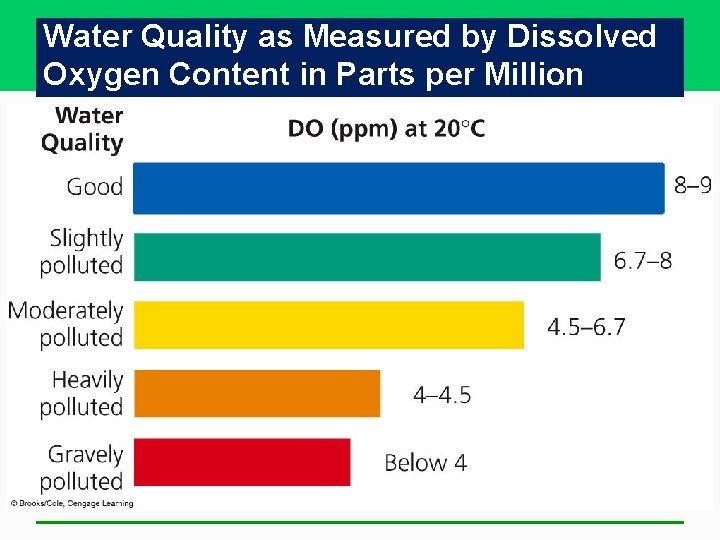
Testing Water for Pollutants……. § Variety of tests to determine water quality: § Coliform bacteria: Escherichia coli, significant levels, found in fecal waste • 100 ml of water no colonies for drinking • 100 ml of should contain no more than 200 colonies § Level of dissolved oxygen (DO) – excessive inputs of oxygen-demanding wastes can deplete DO levels in water § Chemical analysis – determine the presence and concentrations of specific organic pollutants
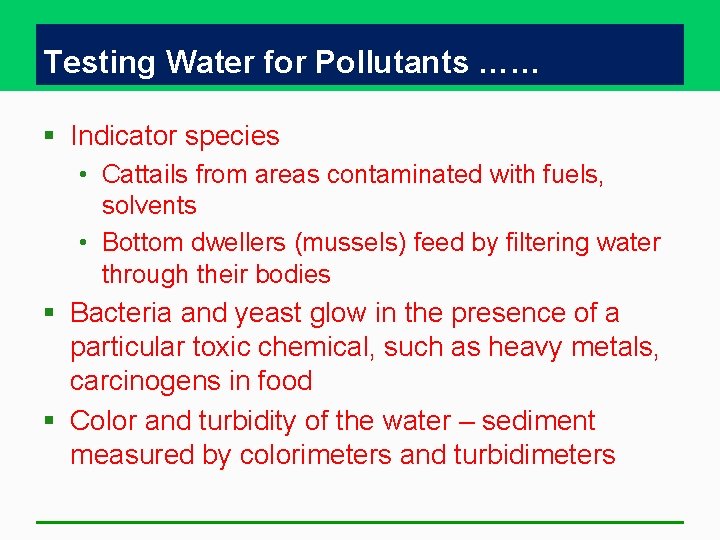
Testing Water for Pollutants …… § Indicator species • Cattails from areas contaminated with fuels, solvents • Bottom dwellers (mussels) feed by filtering water through their bodies § Bacteria and yeast glow in the presence of a particular toxic chemical, such as heavy metals, carcinogens in food § Color and turbidity of the water – sediment measured by colorimeters and turbidimeters
Water Quality as Measured by Dissolved Oxygen Content in Parts per Million
Major Water Pollution Problems in Streams and Lakes § While streams are extensively polluted worldwide by human activities, they can cleanse themselves of many pollutants if we do not overload them or reduce their flows. § Addition of excessive nutrients to lakes from human activities can disrupt lake ecosystems, and prevention of such pollution is more effective and less costly than cleaning it up.
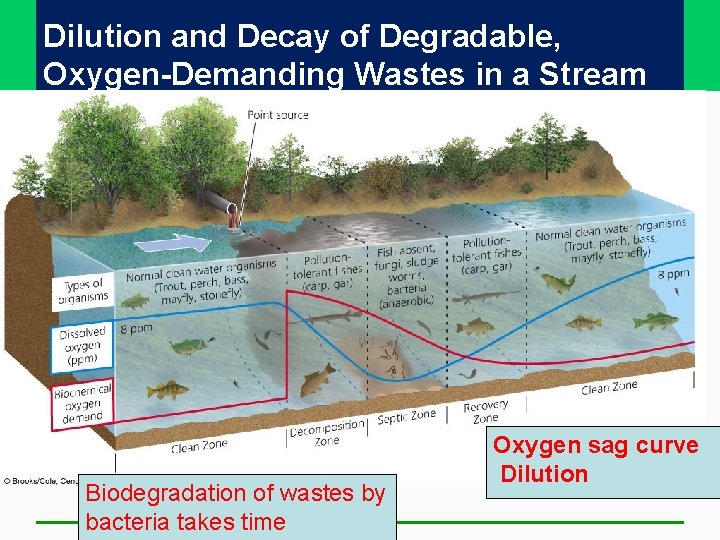
Dilution and Decay of Degradable, Oxygen-Demanding Wastes in a Stream Biodegradation of wastes by bacteria takes time Oxygen sag curve Dilution
Stream Pollution in Developed Countries § 1970 s: Water pollution control laws have increased the number and quality of waste water treatment plants • Reduce or eliminate point sources of pollution § Successful water clean-up stories • Ohio Cuyahoga River, U. S. - flammable chemicals, burning river for a week in 1969. clean today • Thames River, Great Britain – 1950, flowing, smelly sewer, today - clean § Contamination of toxic inorganic and organic chemicals by industries and mines
Individuals Matter: The Man Who Planted Trees to Restore a Stream § John Beal: restoration of Hamm Creek, Seattle, WA, U. S. – 15 year clean up. § Planted trees § Persuaded companies to stop dumping § Removed garbage
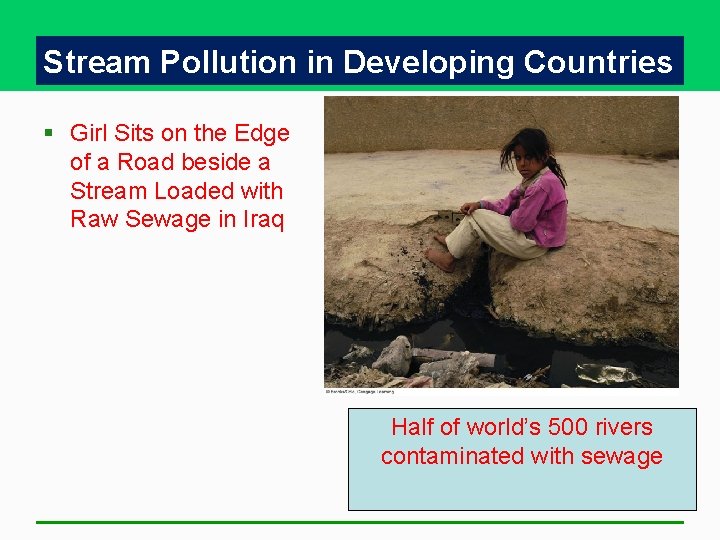
Stream Pollution in Developing Countries § Girl Sits on the Edge of a Road beside a Stream Loaded with Raw Sewage in Iraq Half of world’s 500 rivers contaminated with sewage
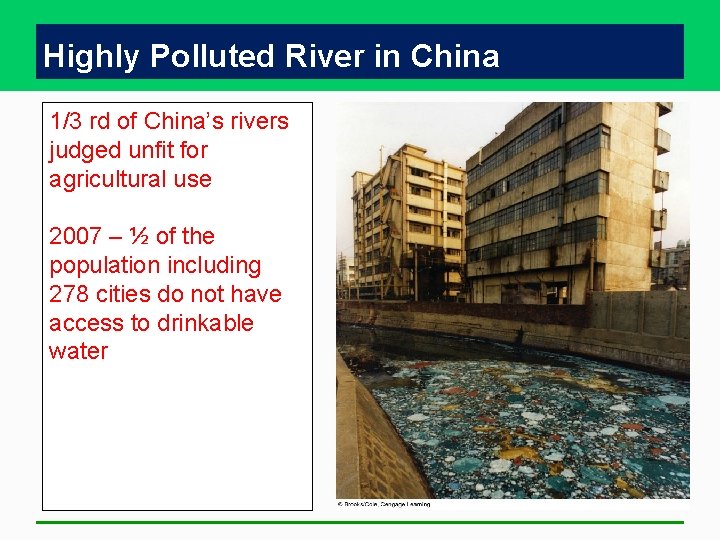
Highly Polluted River in China 1/3 rd of China’s rivers judged unfit for agricultural use 2007 – ½ of the population including 278 cities do not have access to drinkable water
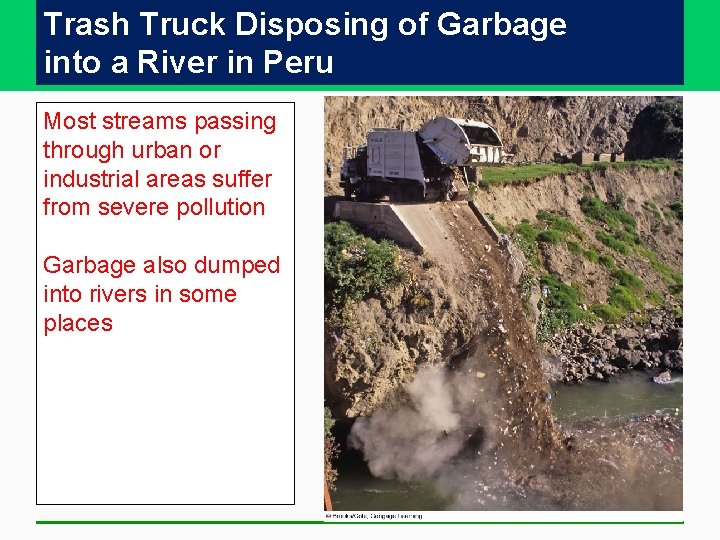
Trash Truck Disposing of Garbage into a River in Peru Most streams passing through urban or industrial areas suffer from severe pollution Garbage also dumped into rivers in some places
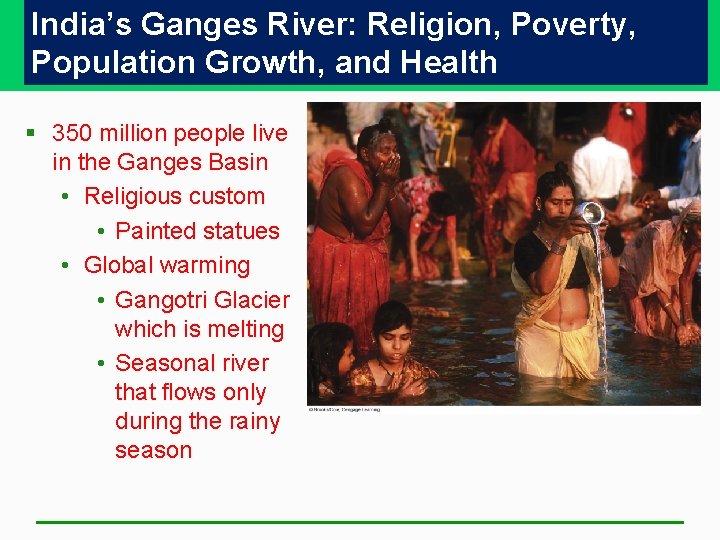
India’s Ganges River: Religion, Poverty, Population Growth, and Health § 350 million people live in the Ganges Basin • Religious custom • Painted statues • Global warming • Gangotri Glacier which is melting • Seasonal river that flows only during the rainy season
Low Water Flow and Too Little Mixing Makes Lakes Vulnerable to Water Pollution § Lakes and Reservoirs less effective at diluting pollutants than streams, more vulnerable than streams • Stratified layers • Little vertical mixing • Little of no water flow • Flushing and changing of water in lakes and large reservoirs can take from 1 to 100 years, days or weeks for streams • Concentration in food webs biomagnifiation
Cultural Eutrophication Is Too Much of a Good Thing § Eutrophication – natural nutrient enrichment of a shallow lake, estuary, slow moving stream, from runoff from plant nutrients-nutrients and phosphates § Oligotrophic lake • Low nutrients, clear water, § Cultural eutrophication – humans activities accelerates the input from agriculture , animal feedlots, urban areas, mining sites, sewage waste, some nitrogen by deposition from the atmosphere
Cultural Eutrophication Is Too Much of a Good Thing § During hot weather or droughts • Algal blooms- algae and cyanobacteria, thick growths of water hyacinth, duckweed • Dense plant colonies reduces lake productivity and fish growth by decreasing the input of solar energy required for photosynthesis • When algae die, decomposed by aerobic bacteria depletes oxygen in surface waters. Fish kills • Excess nutrient input, anaerobic bacteria take over, produce smelly, highly toxic hydrogen sulfide and flammable methane
Cultural Eutrophication Is Too Much of a Good Thing § Prevent or reduce cultural eutrophication • Remove nitrates and phosphates by advanced waste water treatment • Banning phosphates in detergents • Soil conservation to control nutrient run off • Diversion of lake water § Clean up lakes • Remove excess weeds mechanically • Use herbicides and algaecides; down-side? • Pump in air to prevent oxygen depletion
Revisiting Lake Washington and Puget Sound § Severe water pollution can be reversed § Citizen action combined with scientific research § Good solutions may not work forever • Wastewater treatment plant effluents sent into Puget Sound § Now what’s happening? • Puget Sound Partnership – healthy Sound by 2020
Pollution in the Great Lakes § 1960 s: Many areas with cultural eutrophication, particularly Lake Erie-shallow § 1972: Canada and the United States: Great Lakes pollution control program - $20 billion spent • What was done? § Problems still exist • Raw sewage – 100 olympic swimming pool size • Nonpoint runoff of pesticides and fertilizers • Biological pollution – zebra mussels, 180 alien species • Atmospheric deposition of pesticides and Hg from coal burning plants
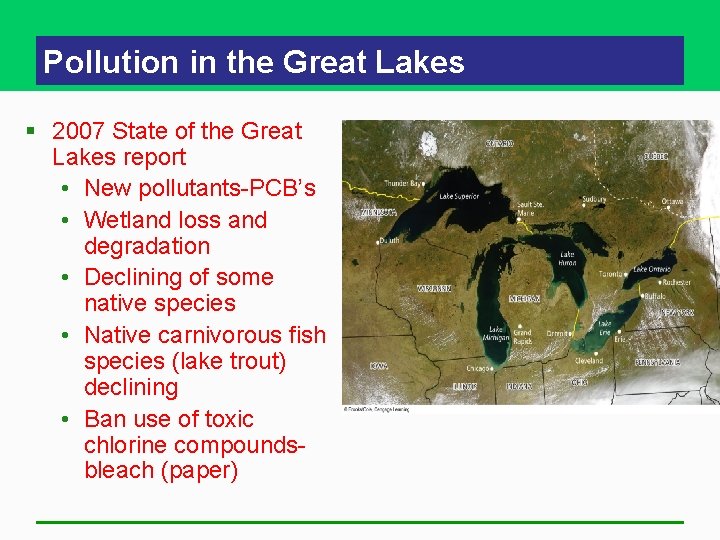
Pollution in the Great Lakes § 2007 State of the Great Lakes report • New pollutants-PCB’s • Wetland loss and degradation • Declining of some native species • Native carnivorous fish species (lake trout) declining • Ban use of toxic chlorine compoundsbleach (paper)
Pollution Problems Affecting Groundwater, Other Water Sources § Chemicals used in agriculture, industry, transportation, and homes can spill and leak into groundwater and make it undrinkable. § There are simple ways and complex ways to purify drinking water, but protecting it through pollution prevention is the least expensive and most effective strategy.
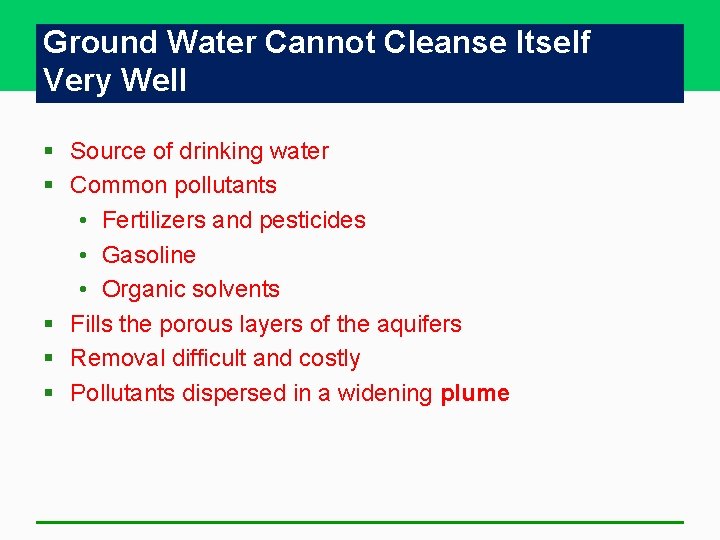
Ground Water Cannot Cleanse Itself Very Well § Source of drinking water § Common pollutants • Fertilizers and pesticides • Gasoline • Organic solvents § Fills the porous layers of the aquifers § Removal difficult and costly § Pollutants dispersed in a widening plume
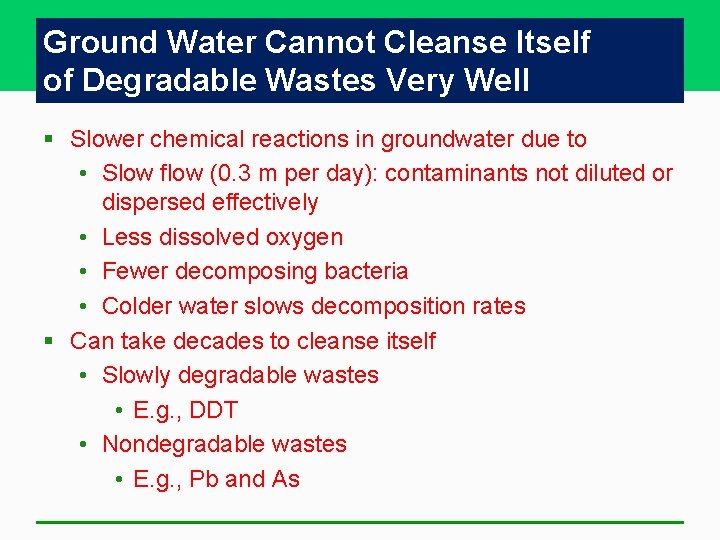
Ground Water Cannot Cleanse Itself of Degradable Wastes Very Well § Slower chemical reactions in groundwater due to • Slow flow (0. 3 m per day): contaminants not diluted or dispersed effectively • Less dissolved oxygen • Fewer decomposing bacteria • Colder water slows decomposition rates § Can take decades to cleanse itself • Slowly degradable wastes • E. g. , DDT • Nondegradable wastes • E. g. , Pb and As
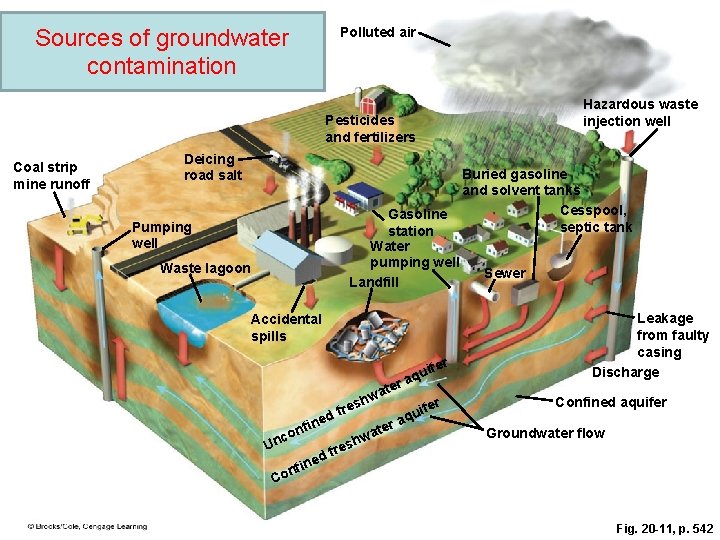
Sources of groundwater contamination Polluted air Hazardous waste injection well Pesticides and fertilizers Coal strip mine runoff Deicing road salt Gasoline station Water pumping well Landfill Pumping well Waste lagoon Accidental spills ifer u aq r ate w h res ifer f u d q e a fin ter n a o c shw Un e r f ed n i nf Co Buried gasoline and solvent tanks Cesspool, septic tank Sewer Leakage from faulty casing Discharge Confined aquifer Groundwater flow Fig. 20 -11, p. 542
Groundwater Pollution Is a Serious Threat § China: many contaminated or overexploited aquifers – huge population § U. S. : FDA reports of toxins found in many aquifers § What about leaking underground storage tanks: • Gasoline • Oil • Methyl tertiary butyl ether (MTBE) • Nitrate ions – infants under 6 months can get the fatal “blue baby syndrome”
Case Study: A Natural Threat from Arsenic in Groundwater § Source of As in the groundwater – naturally occurring, mining and ore processing § Accepted standard -10 parts per billion § 140 million people in 70 countries have drinking water with 5 -100 times that level § Human health hazards: • Cancer of Skin , Lungs , Bladder § 2006 research: Rice University, TX, U. S. • Purification system to remove As
Pollution Prevention Is the Only Effective Way to Protect Groundwater § Prevent contamination of groundwater • Drilling monitoring wells to determine how far, in what direction and how fast the contaminated plume is moving • Computer model projects future dispersion • Develop and Implement strategy to clean up § Cleanup: expensive and time consuming
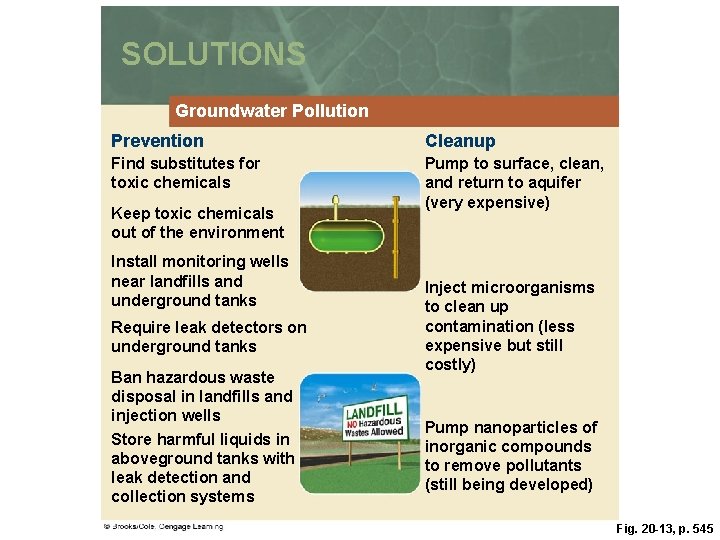
SOLUTIONS Groundwater Pollution Prevention Cleanup Find substitutes for toxic chemicals Pump to surface, clean, and return to aquifer (very expensive) Keep toxic chemicals out of the environment Install monitoring wells near landfills and underground tanks Require leak detectors on underground tanks Ban hazardous waste disposal in landfills and injection wells Store harmful liquids in aboveground tanks with leak detection and collection systems Inject microorganisms to clean up contamination (less expensive but still costly) Pump nanoparticles of inorganic compounds to remove pollutants (still being developed) Fig. 20 -13, p. 545
Ways to Purify Drinking Water § Developed countries – people depend on surface water § Water stored in a reservoir for several days- this improves clarity and taste by increasing dissolved oxygen levels, allowing suspended matter to settle § Water pumped to a purification plant, treated to meet govt. drinking water standards § Japan- process sewer water into drinking water § El Paso, Texas (USA), gets 40% -sewage water § 2007 – Orange County, CA – world’s largest plant to make sewer water as pure as distilled water • Used for drinking water, recharge aquifers
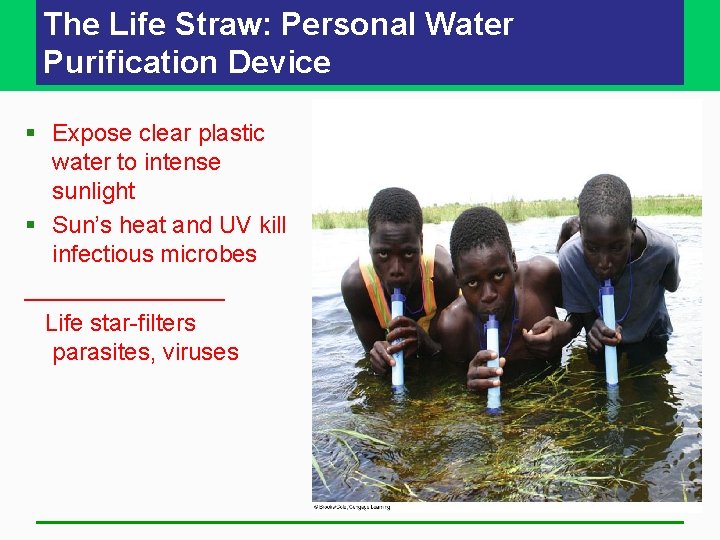
The Life Straw: Personal Water Purification Device § Expose clear plastic water to intense sunlight § Sun’s heat and UV kill infectious microbes ________ Life star-filters parasites, viruses
Protecting Watersheds Instead of Building Water Purification Plants § New York City water • Reservoirs in the Catskill Mountains § Protect the watershed instead of water purification plants • Spend $1. 5 billion
Using Laws to Protect Drinking Water Quality § 1974: U. S. Safe Drinking Water Act • Sets maximum contaminant levels for any pollutants that affect human health • Despite passage of The Clean Water Act (1972), the UN estimates that 5. 6 million Americans drink water that does not meet EPA safety standards for one or more contaminants § Health scientists: strengthen the law • ban toxic lead pipes • enforce public notification about violating drinking water standards § Water-polluting companies: weaken the law • eliminate national tests
Is Bottled Water the Answer? § U. S. : some of the cleanest drinking water § Bottled water – person consumption increased from 7. 5 liters in 1976 to 113 liters in 2006 • Some from tap water • 40% bacterial contamination • Government testing standards not as high as those for tap water • Fuel cost to manufacture the plastic bottles • Recycling of the plastic – number of bottles thrown away will circle the earth 8 times § Growing back-to-the-tap movement
Major Water Pollution Problems Affecting Oceans § The great majority of ocean pollution originates on land includes oil and other toxic chemicals and solid wastes, which threaten aquatic species and other wildlife and disrupt marine ecosystems. § The key to protecting the oceans is to reduce the flow of pollutants from land air and from streams emptying into these waters.
Ocean Pollution Is a Growing and Poorly Understood Problem § 2006: State of the Marine Environment • 80% of marine pollution originates on land • Sewage • Coastal areas most affected because of population • Coast line of China choked with algae § Deeper ocean waters……………… • Dilution , Dispersion , Degradation
Ocean Pollution Is a Growing and Poorly Understood Problem § Cruise line pollution: what is being dumped? • Perchloroethylene from dry cleaning, benzene from paints and solvents • Plastic garbage, waste oil • US – illegal to dump, millions of dollars in fine, illegal dumping at night § U. S. coastal waters • Raw sewage – colonies of viruses • Sewage and agricultural runoff: NO 3 - and PO 43 • Harmful algal blooms – fish kills , bird kills • Oxygen-depleted zones – 200 world wide – temperate waters and locked seas Ex. Baltic and Black Seas
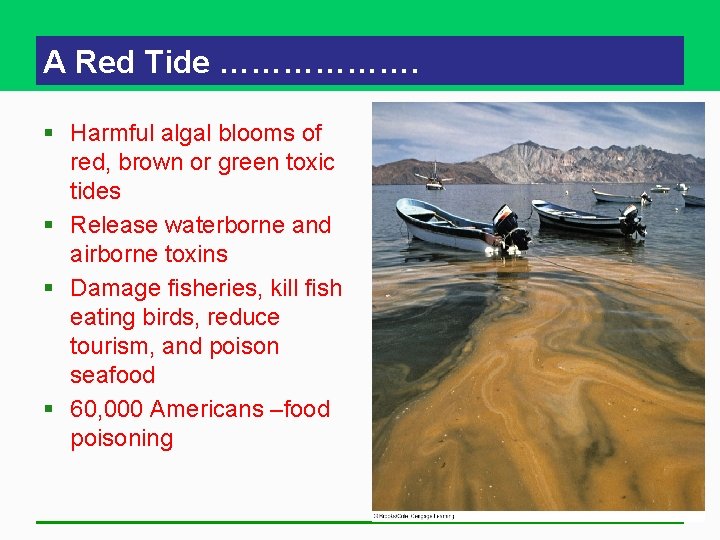
A Red Tide ………………. § Harmful algal blooms of red, brown or green toxic tides § Release waterborne and airborne toxins § Damage fisheries, kill fish eating birds, reduce tourism, and poison seafood § 60, 000 Americans –food poisoning
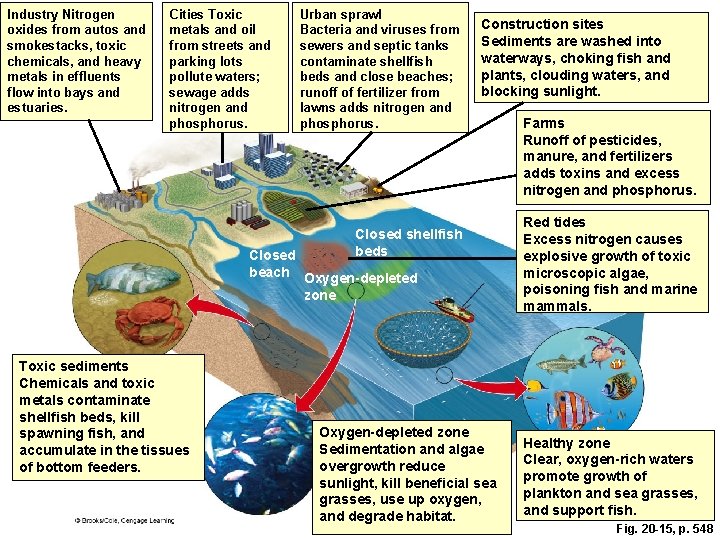
Industry Nitrogen oxides from autos and smokestacks, toxic chemicals, and heavy metals in effluents flow into bays and estuaries. Cities Toxic metals and oil from streets and parking lots pollute waters; sewage adds nitrogen and phosphorus. Urban sprawl Bacteria and viruses from sewers and septic tanks contaminate shellfish beds and close beaches; runoff of fertilizer from lawns adds nitrogen and phosphorus. Construction sites Sediments are washed into waterways, choking fish and plants, clouding waters, and blocking sunlight. Closed shellfish beds Closed beach Oxygen-depleted zone Toxic sediments Chemicals and toxic metals contaminate shellfish beds, kill spawning fish, and accumulate in the tissues of bottom feeders. Oxygen-depleted zone Sedimentation and algae overgrowth reduce sunlight, kill beneficial sea grasses, use up oxygen, and degrade habitat. Farms Runoff of pesticides, manure, and fertilizers adds toxins and excess nitrogen and phosphorus. Red tides Excess nitrogen causes explosive growth of toxic microscopic algae, poisoning fish and marine mammals. Healthy zone Clear, oxygen-rich waters promote growth of plankton and sea grasses, and support fish. Fig. 20 -15, p. 548
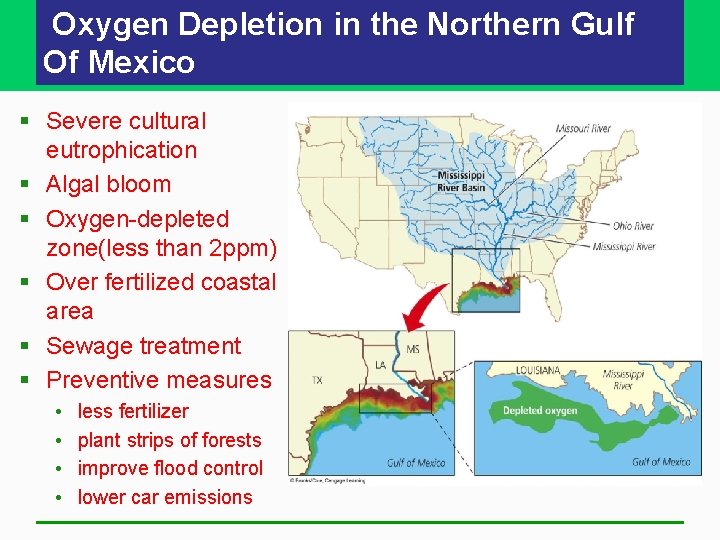
Oxygen Depletion in the Northern Gulf Of Mexico § Severe cultural eutrophication § Algal bloom § Oxygen-depleted zone(less than 2 ppm) § Over fertilized coastal area § Sewage treatment § Preventive measures • • less fertilizer plant strips of forests improve flood control lower car emissions
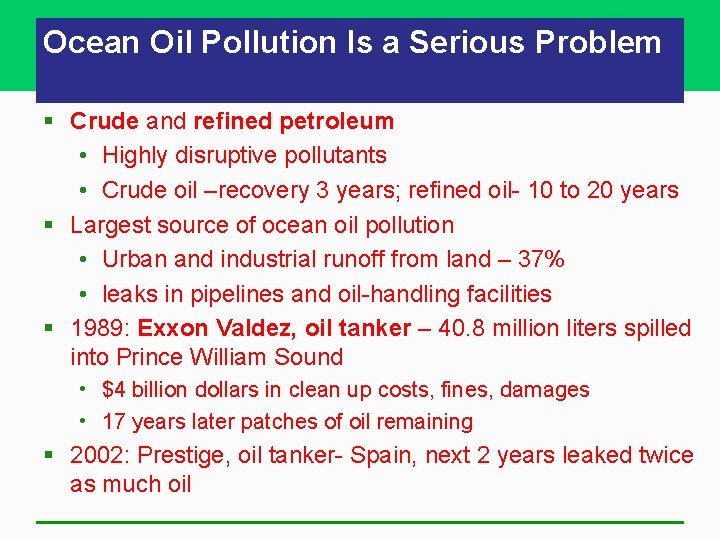
Ocean Oil Pollution Is a Serious Problem § Crude and refined petroleum • Highly disruptive pollutants • Crude oil –recovery 3 years; refined oil- 10 to 20 years § Largest source of ocean oil pollution • Urban and industrial runoff from land – 37% • leaks in pipelines and oil-handling facilities § 1989: Exxon Valdez, oil tanker – 40. 8 million liters spilled into Prince William Sound • $4 billion dollars in clean up costs, fines, damages • 17 years later patches of oil remaining § 2002: Prestige, oil tanker- Spain, next 2 years leaked twice as much oil
Ocean Oil Pollution Is a Serious Problem § Volatile organic hydrocarbons • Kill many aquatic organisms § Tar-like globs on the ocean’s surface • Coat animals § Heavy oil components sink • Affect the bottom dwellers
Ocean Oil Pollution Is a Serious Problem § Mechanical clean up procedures – • floating booms, skimmer boats, absorbent devices such as large pillows filled with feathers or hair § Chemical Cleanup procedures • bacteria to speed up decomposition § Current cleanup methods can recover no more than 15% from a spill § Preventing Oil Pollution most effective • Oil tankers with double hulls • Ban ocean dumping of sludge and hazardous dredged waste • Regulate coastal development, oil drilling, oil shipping
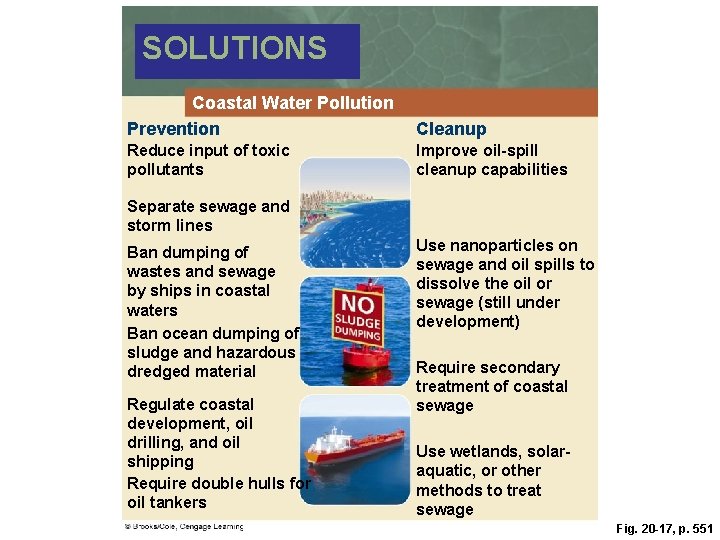
SOLUTIONS Coastal Water Pollution Prevention Cleanup Reduce input of toxic pollutants Improve oil-spill cleanup capabilities Separate sewage and storm lines Ban dumping of wastes and sewage by ships in coastal waters Ban ocean dumping of sludge and hazardous dredged material Regulate coastal development, oil drilling, and oil shipping Require double hulls for oil tankers Use nanoparticles on sewage and oil spills to dissolve the oil or sewage (still under development) Require secondary treatment of coastal sewage Use wetlands, solaraquatic, or other methods to treat sewage Fig. 20 -17, p. 551
Dealing with water pollution …………. § Reducing water pollution requires preventing it, working with nature to treat sewage, cutting resource use and waste, reducing poverty, and slowing population growth.
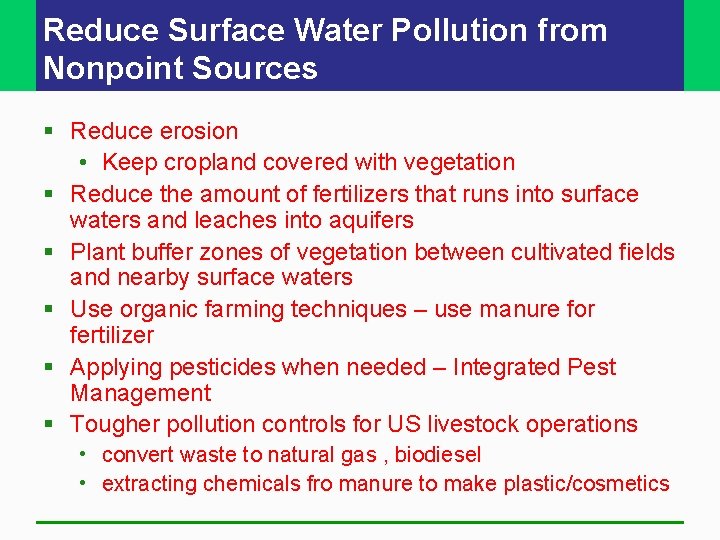
Reduce Surface Water Pollution from Nonpoint Sources § Reduce erosion • Keep cropland covered with vegetation § Reduce the amount of fertilizers that runs into surface waters and leaches into aquifers § Plant buffer zones of vegetation between cultivated fields and nearby surface waters § Use organic farming techniques – use manure for fertilizer § Applying pesticides when needed – Integrated Pest Management § Tougher pollution controls for US livestock operations • convert waste to natural gas , biodiesel • extracting chemicals fro manure to make plastic/cosmetics
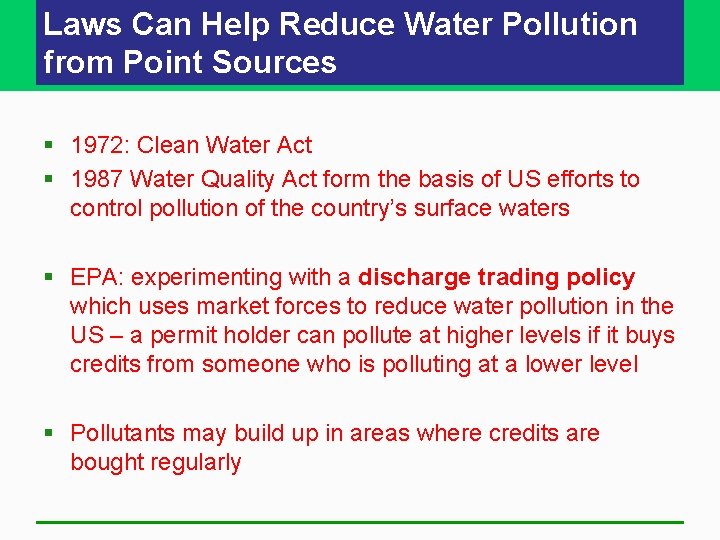
Laws Can Help Reduce Water Pollution from Point Sources § 1972: Clean Water Act § 1987 Water Quality Act form the basis of US efforts to control pollution of the country’s surface waters § EPA: experimenting with a discharge trading policy which uses market forces to reduce water pollution in the US – a permit holder can pollute at higher levels if it buys credits from someone who is polluting at a lower level § Pollutants may build up in areas where credits are bought regularly
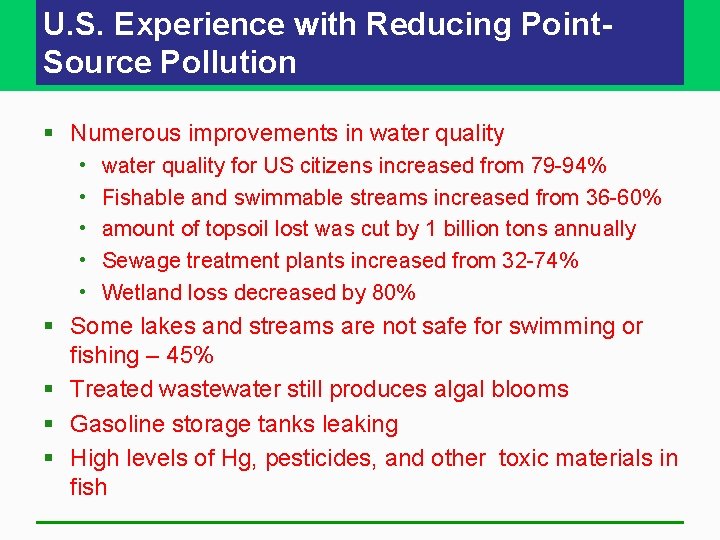
U. S. Experience with Reducing Point. Source Pollution § Numerous improvements in water quality • • • water quality for US citizens increased from 79 -94% Fishable and swimmable streams increased from 36 -60% amount of topsoil lost was cut by 1 billion tons annually Sewage treatment plants increased from 32 -74% Wetland loss decreased by 80% § Some lakes and streams are not safe for swimming or fishing – 45% § Treated wastewater still produces algal blooms § Gasoline storage tanks leaking § High levels of Hg, pesticides, and other toxic materials in fish
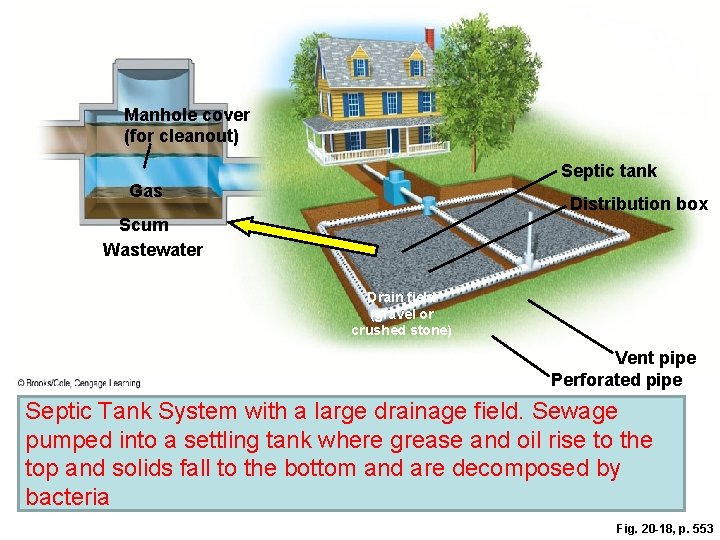
Manhole cover (for cleanout) Septic tank Gas Distribution box Scum Wastewater Sludge Drain field (gravel or crushed stone) Vent pipe Perforated pipe Septic Tank System with a large drainage field. Sewage pumped into a settling tank where grease and oil rise to the top and solids fall to the bottom and are decomposed by bacteria Fig. 20 -18, p. 553
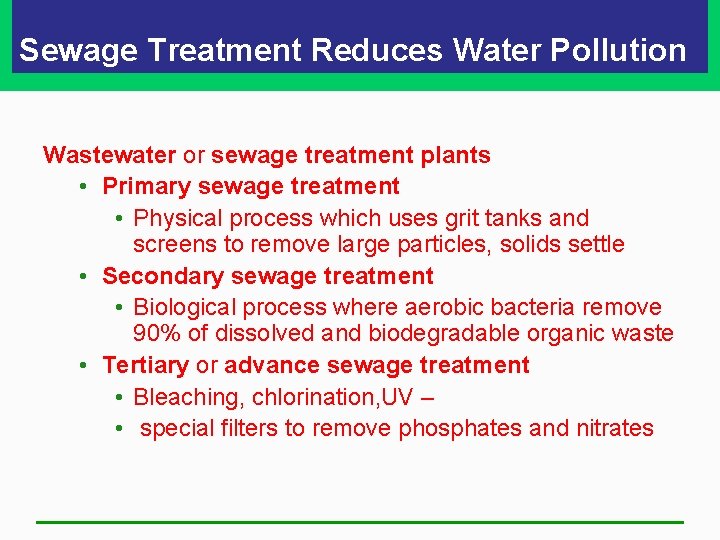
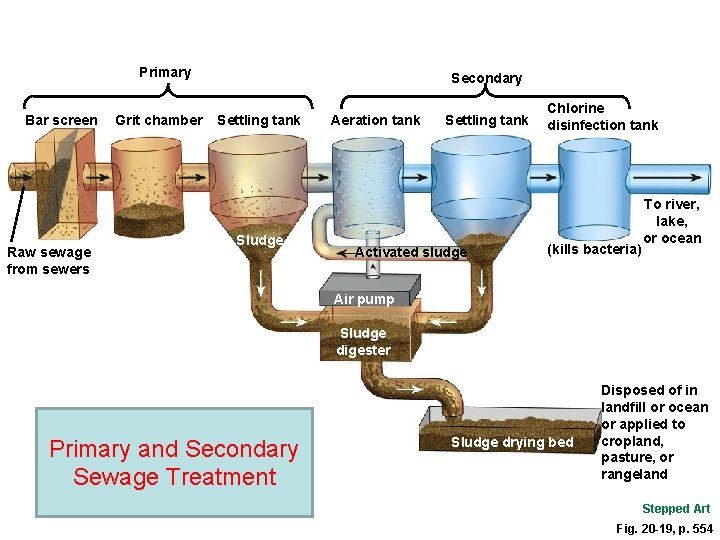
Sewage Treatment Reduces Water Pollution Wastewater or sewage treatment plants • Primary sewage treatment • Physical process which uses grit tanks and screens to remove large particles, solids settle • Secondary sewage treatment • Biological process where aerobic bacteria remove 90% of dissolved and biodegradable organic waste • Tertiary or advance sewage treatment • Bleaching, chlorination, UV – • special filters to remove phosphates and nitrates
Primary Bar screen Raw sewage from sewers Grit chamber Secondary Settling tank Sludge Aeration tank Settling tank Activated sludge Chlorine disinfection tank (kills bacteria) To river, lake, or ocean Air pump Sludge digester Primary and Secondary Sewage Treatment Sludge drying bed Disposed of in landfill or ocean or applied to cropland, pasture, or rangeland Stepped Art Fig. 20 -19, p. 554
Improve Conventional Sewage Treatment § Peter Montague: environmental scientist • Remove toxic wastes before water goes to the municipal sewage treatment plants • Reduce or eliminate use and waste of toxic chemicals • Use composting toilet systems § Wetland-based sewage treatment systems
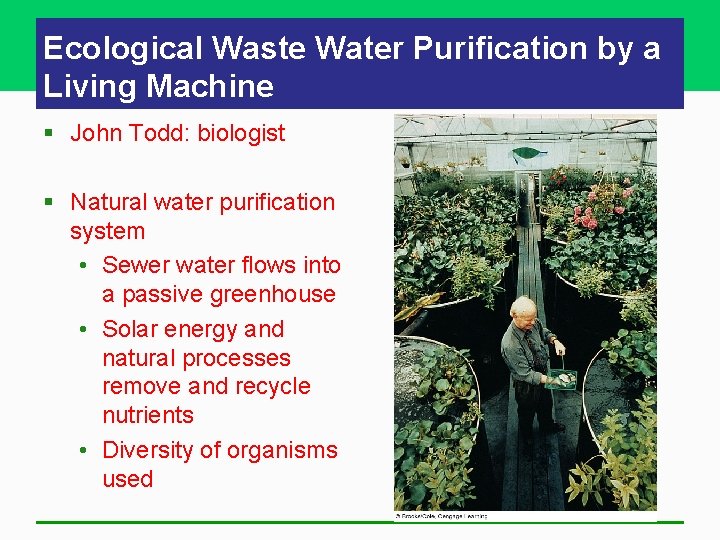
Ecological Waste Water Purification by a Living Machine § John Todd: biologist § Natural water purification system • Sewer water flows into a passive greenhouse • Solar energy and natural processes remove and recycle nutrients • Diversity of organisms used
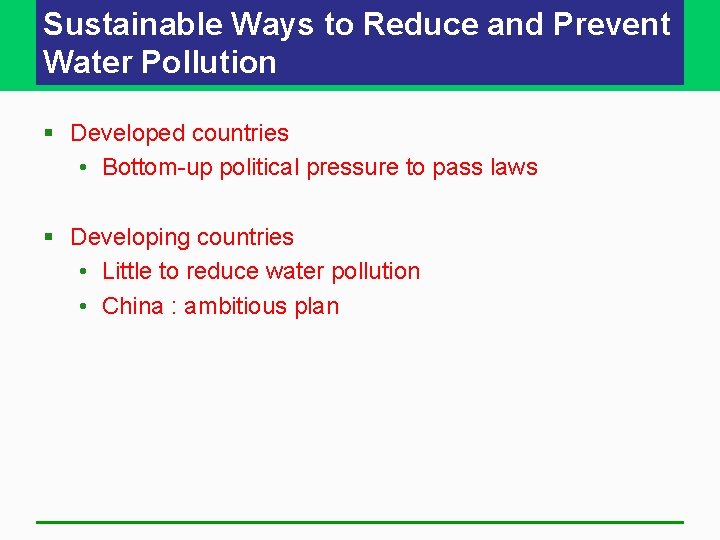
Sustainable Ways to Reduce and Prevent Water Pollution § Developed countries • Bottom-up political pressure to pass laws § Developing countries • Little to reduce water pollution • China : ambitious plan