
WATER POLLUTION ASSESSMENT Environmental Standards and Discharge Consents

- Slides: 26
WATER POLLUTION ASSESSMENT Environmental Standards and Discharge Consents. 1
Environmental Regulation • Regulation of impacts on the environment is now a crucial area of public policy. • Over $500 billion p. a. is spent globally on compliance. • Environmental impact without any regulation would cost many times that sum. 2
Setting Standards. • Scientific Understanding – The starting point for setting environmental standards. – Essential to determine dose-effect relationships. – Uncertainties and limitations in the data must be recognised. – the science must provide a firm basis for policy decisions • Precautionary Principle • Mechanism* – identify problem, policy, set standard, monitor *see 21 st Report of Royal Commission on Environmental Pollution “Setting environmental standards” 3
Environmental Standards • Forms of Environmental Standard. – Biological. Limits of physiological change. e. g. lead in blood. • Biomarkers of exposure, not effect. • Inform after exposure has occurred, hence do not prevent the effect. • Exposure from a number of routes, hence no indication of course of action. 4
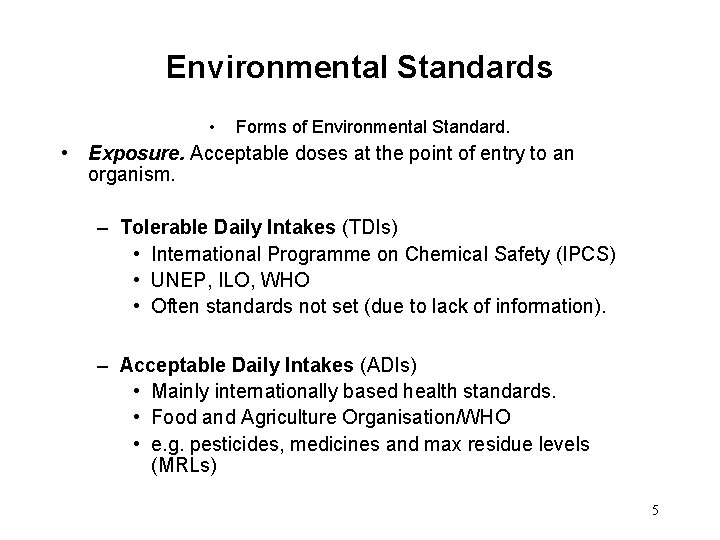
Environmental Standards • Forms of Environmental Standard. • Exposure. Acceptable doses at the point of entry to an organism. – Tolerable Daily Intakes (TDIs) • International Programme on Chemical Safety (IPCS) • UNEP, ILO, WHO • Often standards not set (due to lack of information). – Acceptable Daily Intakes (ADIs) • Mainly internationally based health standards. • Food and Agriculture Organisation/WHO • e. g. pesticides, medicines and max residue levels (MRLs) 5
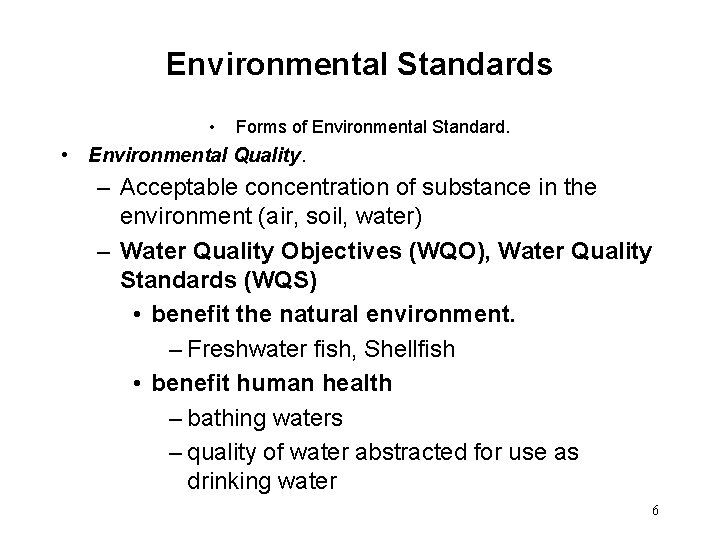
Environmental Standards • Forms of Environmental Standard. • Environmental Quality. – Acceptable concentration of substance in the environment (air, soil, water) – Water Quality Objectives (WQO), Water Quality Standards (WQS) • benefit the natural environment. – Freshwater fish, Shellfish • benefit human health – bathing waters – quality of water abstracted for use as drinking water 6
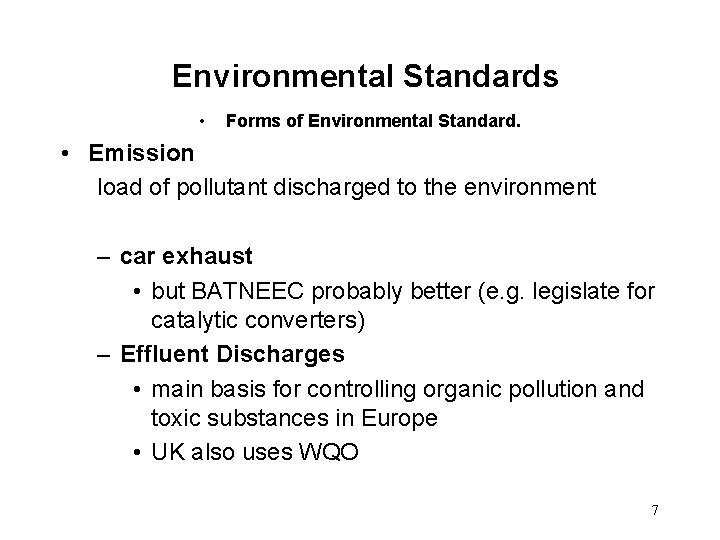
Environmental Standards • Forms of Environmental Standard. • Emission load of pollutant discharged to the environment – car exhaust • but BATNEEC probably better (e. g. legislate for catalytic converters) – Effluent Discharges • main basis for controlling organic pollution and toxic substances in Europe • UK also uses WQO 7
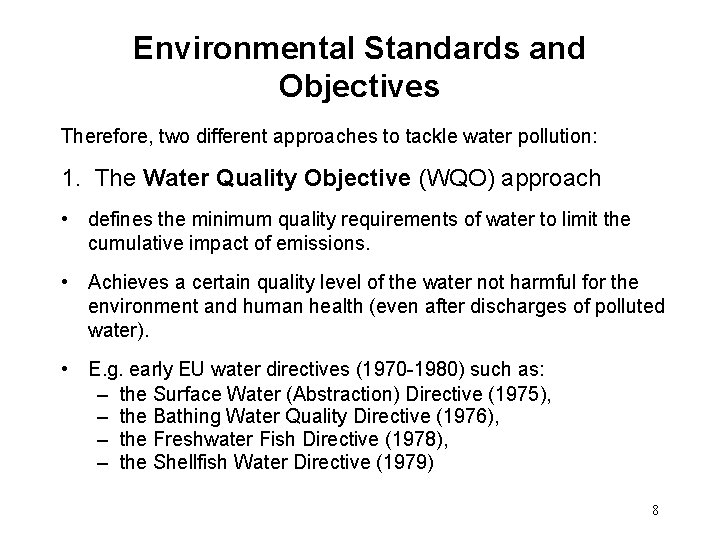
Environmental Standards and Objectives Therefore, two different approaches to tackle water pollution: 1. The Water Quality Objective (WQO) approach • defines the minimum quality requirements of water to limit the cumulative impact of emissions. • Achieves a certain quality level of the water not harmful for the environment and human health (even after discharges of polluted water). • E. g. early EU water directives (1970 -1980) such as: – the Surface Water (Abstraction) Directive (1975), – the Bathing Water Quality Directive (1976), – the Freshwater Fish Directive (1978), – the Shellfish Water Directive (1979) 8
Environmental Standards and Objectives • 2. The Emission Limits Value (ELV) approach • maximum quantities of pollutants allowed to be discharged from a particular source into the aquatic environment. • Specifies the efficiency of wastewater treatment • Specifies what quantities of pollutants may be released • Subsequent EU directives (1990 s) – the Urban Waste Water Treatment Directive (1991) – the Nitrates Directive (1991) – the IPPC Directive (Integrated Pollution Prevention and Control, 1996) 9
Future - Environmental Standards and Objectives 3. Future approach • Water Framework Directive (2000/86/EEC) • aims – expanding the scope of water protection to all waters, surface waters and groundwater – achieving "good status" for all waters by a set deadline (2015) – water management based on River Basins – “combined approach" of emission limit values and quality standards – getting the prices right – getting the citizen involved more closely – streamlining legislation 10
Reviewing Standards. • Key Changes in the Policy process. – Numerical standards. • Maturity of toxicology and ecotoxicology • Advances in measurement science. • Improved understanding of the behaviour of substances in the environment. – Pan European Policies 11
Discharge Consents • basis for setting discharge consents. – water quality objectives (WQO) • river ecosystem classification scheme (RE 1 - 5) – Statutory Water Quality Objectives (SWQO) (currently under consideration in UK for use in planning) – Statutory Emission Standards • UWWT Directive 1991 • Dangerous Substances Directive 1976 12
Discharge Consents Aim - provide adequate monitoring of compliance with standard – Numerical standards should always incorporate protocols for sampling and measurement. – Laboratories should be accredited to appropriate proficiency testing schemes. – Numerical standards should consider the extent of statistical variation (look-up tables) – Self regulation - EA has passed sampling responsibility to water undertaker 13
Discharge Consents • History – mid 19 C Typhoid, TB, Cholera – epidemics , mortality 46/1000 • Royal Commission on Sewage Disposal – nine reports 1901 -1915 – recommended a discharge standard – 20 mg/l BOD, 30 mg/l SS 14
Discharge Consents Recent legislation • Water Industry Act (1991) – water undertakers can charge, and set consents to sewer • Water Resources Act (1991) – EA authorised to set discharge consents to watercourses • Urban Wastewater Treatment Directive (1991) i. e UWWTD – pan-european standards 15
Discharge Consents • Apply to “Controlled Waters” – virtually all freshwaters, groundwaters, tidal and coastal waters 1. Descriptive consents – Discharges that are small, have a low potential to impact the environment (c. 50, 000 in UK) 2. Numeric Consents – Discharges having most potential to affect the quality of the receiving water (i. e. large flows, Industrial, STW) – may apply to an individual substance or group of substances (c. 30, 000 in UK) – based on Royal Commission Standards, and EU Directives (UWWT Directive) 16
Discharge Consents Water Companies • Water plc’s set their own consents for sewer discharges – For Commercial and Industrial discharges – Ensures the performance of Municipal WWT Plant (compliance) – Review of existing consents • appeals – Granting of new consents 17
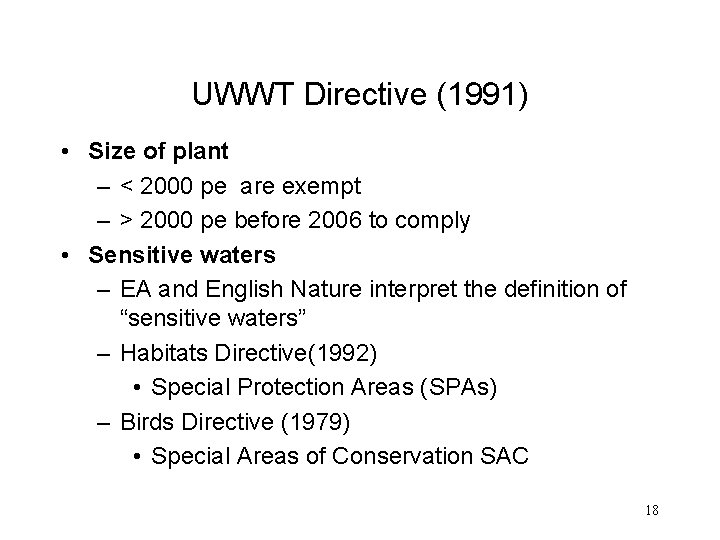
UWWT Directive (1991) • Size of plant – < 2000 pe are exempt – > 2000 pe before 2006 to comply • Sensitive waters – EA and English Nature interpret the definition of “sensitive waters” – Habitats Directive(1992) • Special Protection Areas (SPAs) – Birds Directive (1979) • Special Areas of Conservation SAC 18
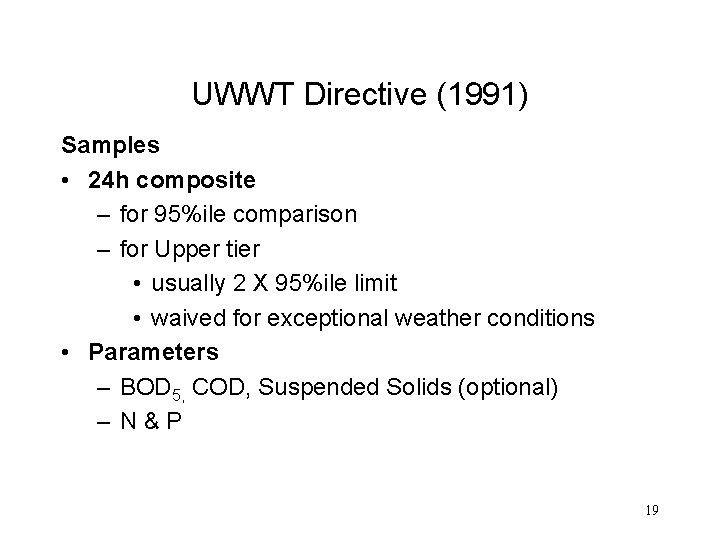
UWWT Directive (1991) Samples • 24 h composite – for 95%ile comparison – for Upper tier • usually 2 X 95%ile limit • waived for exceptional weather conditions • Parameters – BOD 5, COD, Suspended Solids (optional) – N&P 19
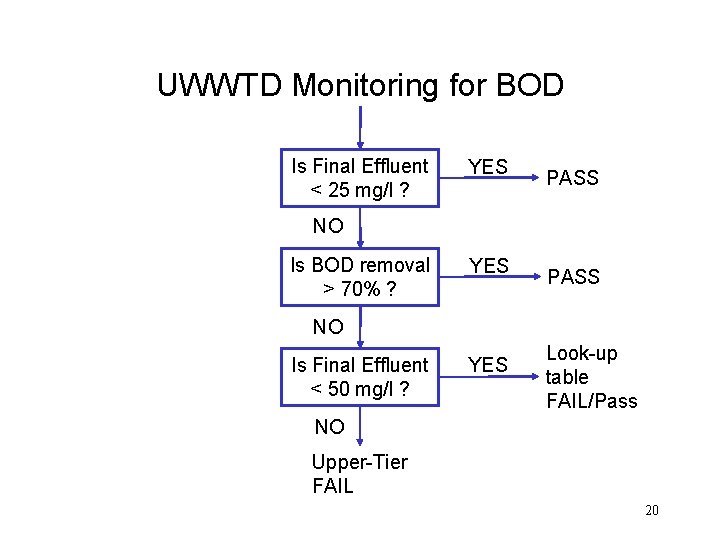
UWWTD Monitoring for BOD Is Final Effluent < 25 mg/l ? YES PASS NO Is BOD removal > 70% ? YES PASS NO Is Final Effluent < 50 mg/l ? YES Look-up table FAIL/Pass NO Upper-Tier FAIL 20
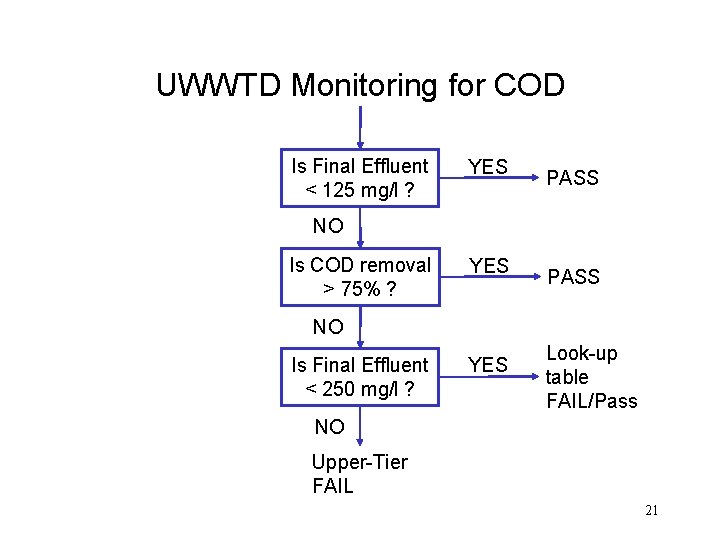
UWWTD Monitoring for COD Is Final Effluent < 125 mg/l ? YES PASS NO Is COD removal > 75% ? YES PASS NO Is Final Effluent < 250 mg/l ? YES Look-up table FAIL/Pass NO Upper-Tier FAIL 21
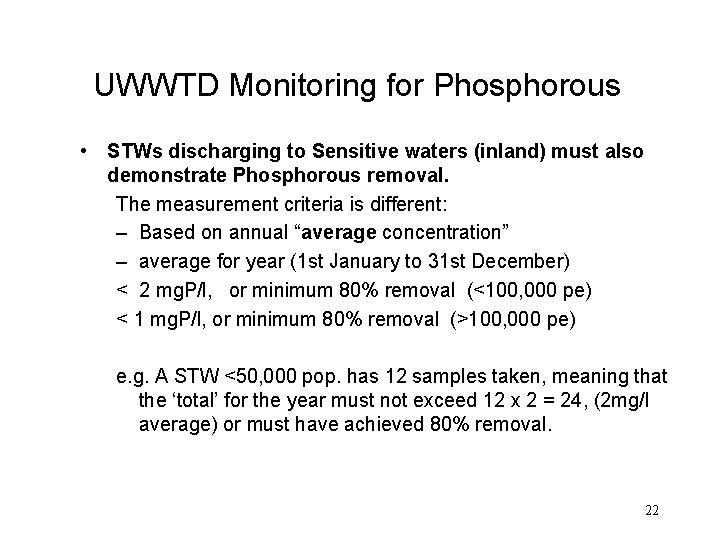
UWWTD Monitoring for Phosphorous • STWs discharging to Sensitive waters (inland) must also demonstrate Phosphorous removal. The measurement criteria is different: – Based on annual “average concentration” – average for year (1 st January to 31 st December) < 2 mg. P/l, or minimum 80% removal (<100, 000 pe) < 1 mg. P/l, or minimum 80% removal (>100, 000 pe) e. g. A STW <50, 000 pop. has 12 samples taken, meaning that the ‘total’ for the year must not exceed 12 x 2 = 24, (2 mg/l average) or must have achieved 80% removal. 22
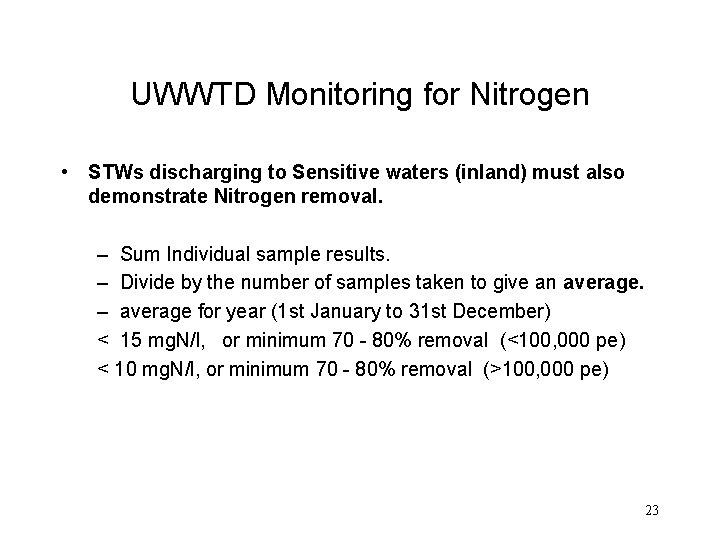
UWWTD Monitoring for Nitrogen • STWs discharging to Sensitive waters (inland) must also demonstrate Nitrogen removal. – Sum Individual sample results. – Divide by the number of samples taken to give an average. – average for year (1 st January to 31 st December) < 15 mg. N/l, or minimum 70 - 80% removal (<100, 000 pe) < 10 mg. N/l, or minimum 70 - 80% removal (>100, 000 pe) 23
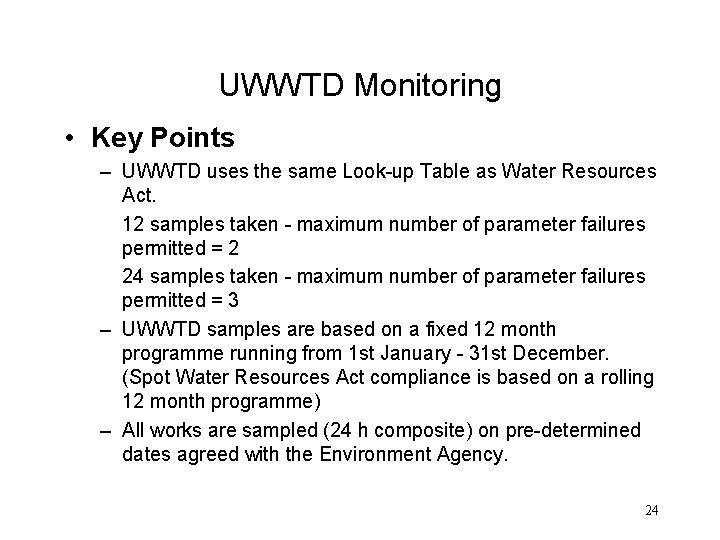
UWWTD Monitoring • Key Points – UWWTD uses the same Look-up Table as Water Resources Act. 12 samples taken - maximum number of parameter failures permitted = 2 24 samples taken - maximum number of parameter failures permitted = 3 – UWWTD samples are based on a fixed 12 month programme running from 1 st January - 31 st December. (Spot Water Resources Act compliance is based on a rolling 12 month programme) – All works are sampled (24 h composite) on pre-determined dates agreed with the Environment Agency. 24
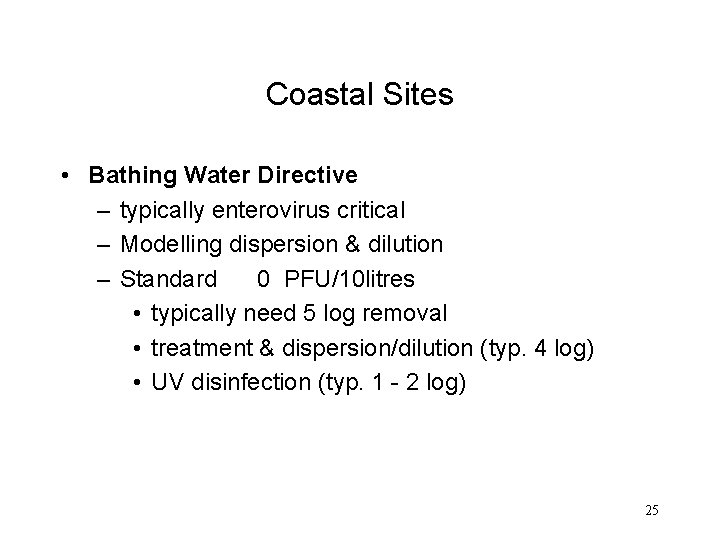
Coastal Sites • Bathing Water Directive – typically enterovirus critical – Modelling dispersion & dilution – Standard 0 PFU/10 litres • typically need 5 log removal • treatment & dispersion/dilution (typ. 4 log) • UV disinfection (typ. 1 - 2 log) 25
Future Improvements • WQOs Continually Reviewed – LEAPs – Asset management Plans (AMP 4, 2005) • Undertaker / EA / DEFRA • capital investment for “best ecological effect” • Upgrading works – Relaxation of Consent (typ. 6 months) – interim measures • better primary settlement • supplementary oxygen 26