
Water Pollution and Treatment Unit 5 AP Environmental














- Slides: 36
Water Pollution and Treatment Unit 5: AP Environmental Science (Chapter 21)
Water Pollution • Pollution refers to a degradation from a normal state • Analysis of pollution includes: • Intended use • Departure from the norm • Effects on the public health • Ecological impacts • Some materials can be considered pollutants in one situation but be considered beneficial in another
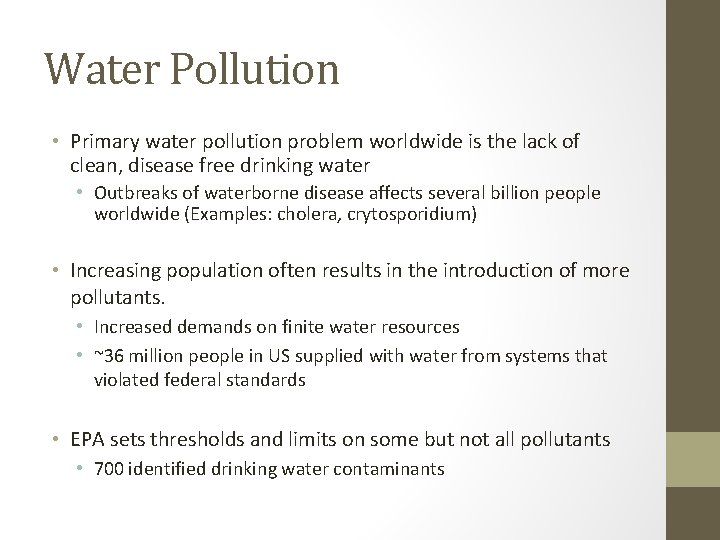
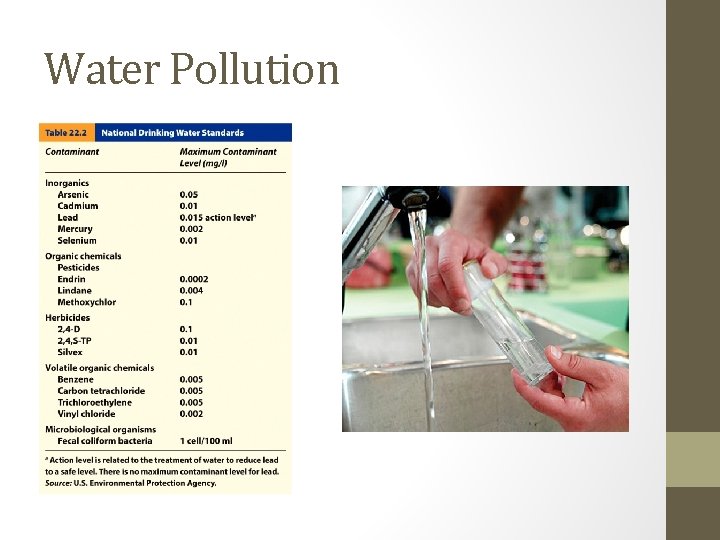
Water Pollution • Primary water pollution problem worldwide is the lack of clean, disease free drinking water • Outbreaks of waterborne disease affects several billion people worldwide (Examples: cholera, crytosporidium) • Increasing population often results in the introduction of more pollutants. • Increased demands on finite water resources • ~36 million people in US supplied with water from systems that violated federal standards • EPA sets thresholds and limits on some but not all pollutants • 700 identified drinking water contaminants
Water Pollution
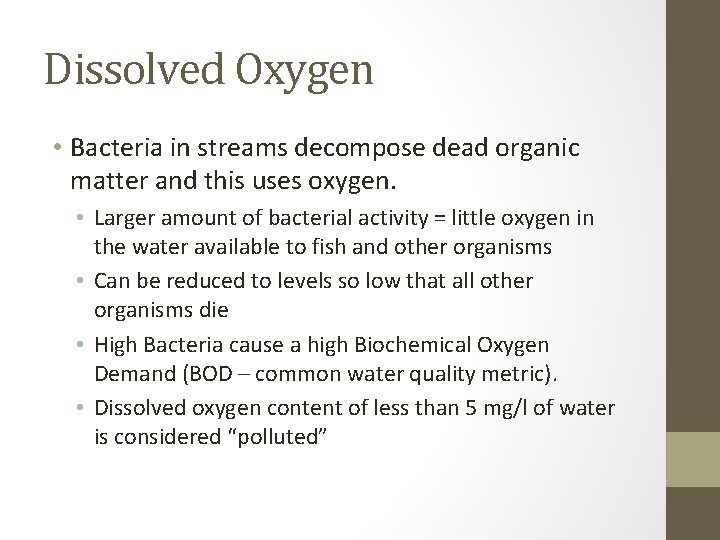
Dissolved Oxygen • Bacteria in streams decompose dead organic matter and this uses oxygen. • Larger amount of bacterial activity = little oxygen in the water available to fish and other organisms • Can be reduced to levels so low that all other organisms die • High Bacteria cause a high Biochemical Oxygen Demand (BOD – common water quality metric). • Dissolved oxygen content of less than 5 mg/l of water is considered “polluted”
Biochemical Oxygen Demand • When a spill takes place three zones are identified: • 1. A pollution zone, where a high BOD exists. • 2. An active decomposition zone, where the dissolved oxygen content reaches a minimum. • 3. A recovery zone, where the dissolved oxygen increases and the BOD is reduced.
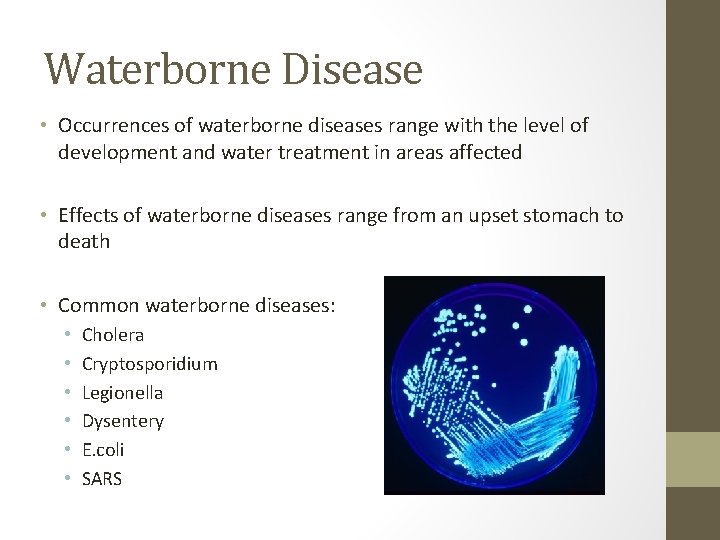
Waterborne Disease • Occurrences of waterborne diseases range with the level of development and water treatment in areas affected • Effects of waterborne diseases range from an upset stomach to death • Common waterborne diseases: • • • Cholera Cryptosporidium Legionella Dysentery E. coli SARS
Waterborne Disease • Fecal Coliform – Intestinal bacteria • we use fecal coliform bacteria as a standard measure and indicator of disease potential • Indicates that fecal matter is present • Normal constituent of human and animal intestines • Escherichia coli (E. coli) • Responsible for human illness and death • Eating contaminated food or drink • Presence of fecal coliforms may also indicate presence of • Virus like hepatitis
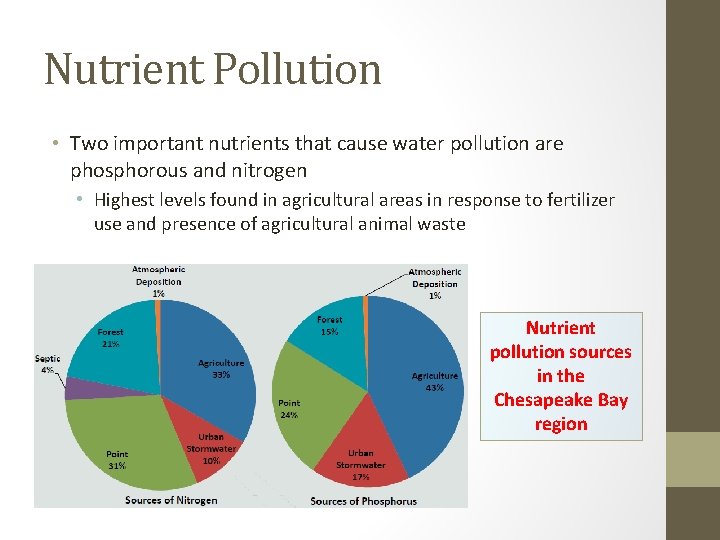
Nutrient Pollution • Two important nutrients that cause water pollution are phosphorous and nitrogen • Highest levels found in agricultural areas in response to fertilizer use and presence of agricultural animal waste Nutrient pollution sources in the Chesapeake Bay region
Eutrophication • The process by which a body of water develops a high concentration of nutrients. • Causes a large growth in aquatic plants and photosynthetic bacteria and algae. • The bacteria and algae then die • As they decompose BOD increases • Oxygen content becomes low and all other organisms die
Eutrophication • Cultural eutrophication • Human processes that add nutrients to water • Solution is to ensure that high concentrations of nutrients do not enter water • Accomplished by • use of phosphate-free detergents • controlling nitrogen runoff • disposing or reusing treated wastewater • advanced water treatment methods
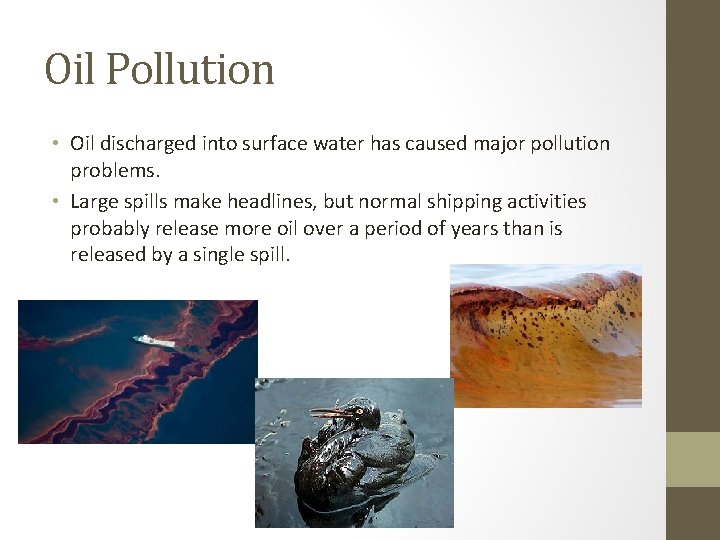
Oil Pollution • Oil discharged into surface water has caused major pollution problems. • Large spills make headlines, but normal shipping activities probably release more oil over a period of years than is released by a single spill.
Sediment Pollution • By volume and weight is the greatest water pollutant • Two fold problem • Results from erosion, which depletes a land resource (soil) at its site of origin • Reduces the quality of water resource it enters • Land use changes result in erosion and sedimentation • Forested areas more stable • Agricultural practices can lead to large soil erosion loss • Large quantities of sedimentation during construction phase of urbanization – notice straw booms at sites
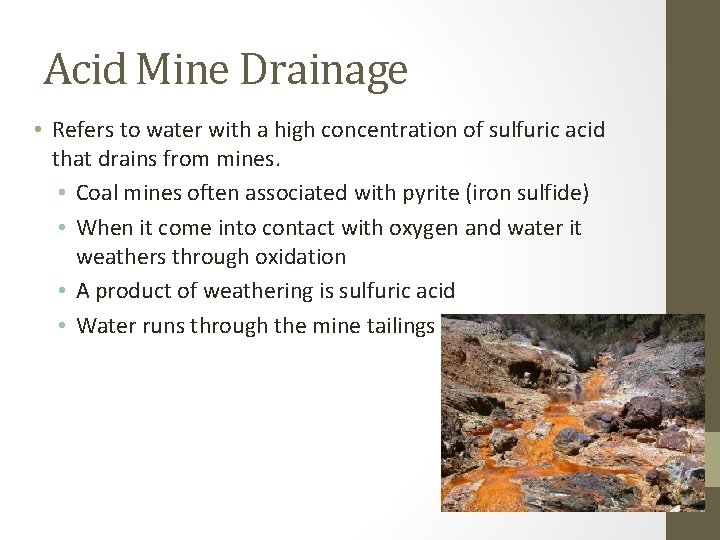
Acid Mine Drainage • Refers to water with a high concentration of sulfuric acid that drains from mines. • Coal mines often associated with pyrite (iron sulfide) • When it come into contact with oxygen and water it weathers through oxidation • A product of weathering is sulfuric acid • Water runs through the mine tailings
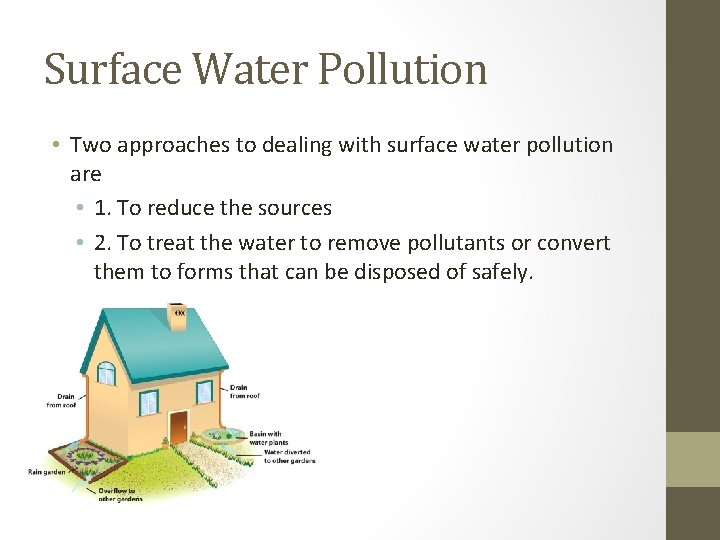
Surface Water Pollution • Two approaches to dealing with surface water pollution are • 1. To reduce the sources • 2. To treat the water to remove pollutants or convert them to forms that can be disposed of safely.
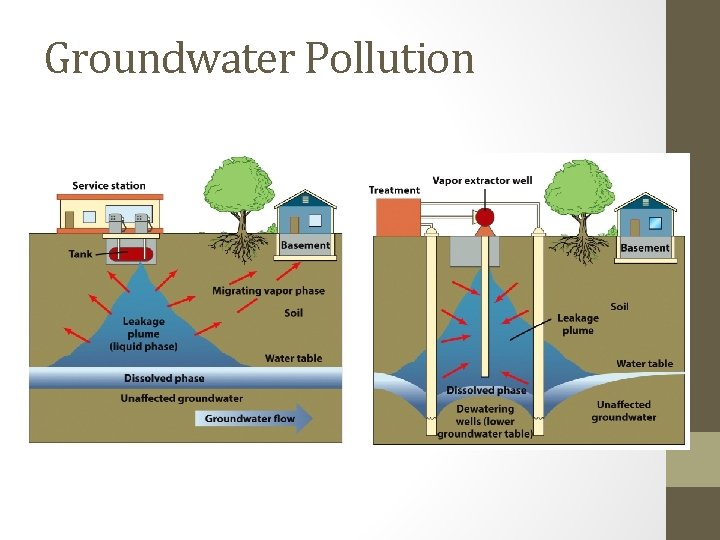
Groundwater Pollution • Pollution leaking from buried gasoline tanks from service stations • Wide spread problem • Many thousands of old tanks removed and surrounding groundwater and soil treated • Disposal of soil, vapor extraction of water and use of microorganisms (bioremediation) • Some pollutants, such as gasoline, are lighter than water and thus float on the groundwater. • Some pollutants are heavier than water and sink or move downward through groundwater.
Groundwater Pollution
Groundwater vs. Surface water Pollution • Pollution in groundwater differs from surface water pollution in several ways • Groundwater lacks oxygen but may provide environment for anaerobic bacteria • Channels through which groundwater moves often small and variable • Rate of movement is low and opportunity for dispersion and dilution limited
Groundwater vs. Surface water Pollution • Saltwater intrusion has become a problem for some coastal communities • Must pump water from a deeper aquifer • Below and isolated from saltwater • Most serious problem is shallow aquifer pollution associated with urbanization • Pollutants enter surface waters then migrate downward
Wastewater Treatment • Water used for industrial and municipal purposes is often degraded during use • Addition of suspended solids, salts, nutrients, bacteria, and oxygen demanding material. • Water must be treated before released • Wastewater treatment • $20 billion a year industry • Conventional methods; septic tanks and centralized treatment
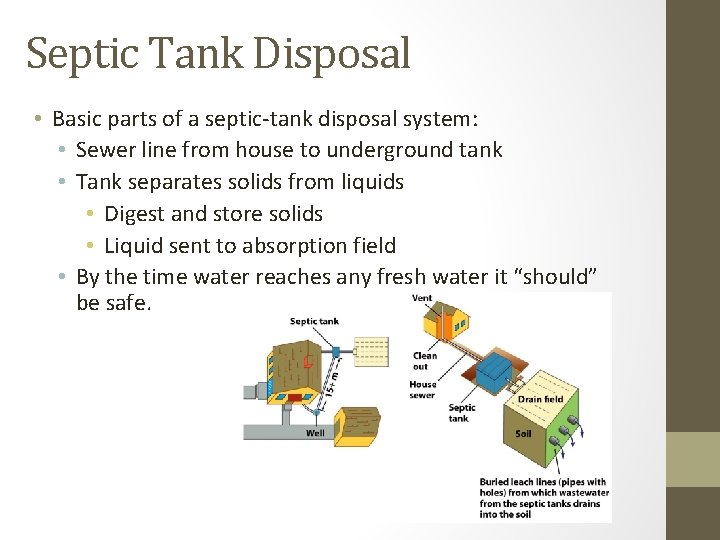
Septic Tank Disposal • Basic parts of a septic-tank disposal system: • Sewer line from house to underground tank • Tank separates solids from liquids • Digest and store solids • Liquid sent to absorption field • By the time water reaches any fresh water it “should” be safe.
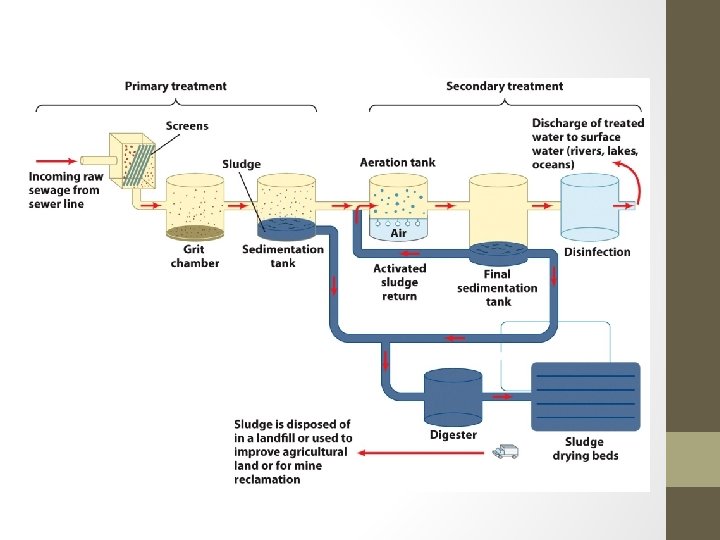
Wastewater Treatment Plants • Specially designed plants that accept municipal sewage from homes, businesses and industrial sites. • Delivered to plant by network of pipes • Following treatment, they discharged into surface water • Main purpose is to breakdown and reduce BOD and kill bacteria with chlorine • Methods usually divided into three categories: • Primary treatment • Secondary treatment • Advanced wastewater treatment • Primary and secondary required by law
Primary Treatment • Incoming raw sewage enters plant • Passes through series of screens • Remove large floating organic material • Next enters a grit chamber • Sand, small stones and grit removed • Then enters sedimentation tank • Particulate matter settles out to form a sludge • Sludge is removed and transported to a digester • Primary treatment removes ~35% of BOD
Secondary Treatment • Most common treatment, activated sludge. • Wastewater from primary sedimentation tank enters the tank • Then enters the final sedimentation tank • Sludge settles out • Some activated sludge used again in aeration • Most of the sludge transported to digester • Wastewater from final tank is disinfected with chlorine and discharged • Secondary treatment removes ~90% of BOD • Sludge from the digester is dried and disposed of in a landfill or applied to improve soil.
Advanced Treatment Plants • Additional pollutants can be removed by adding more treatment steps. • Sand filters, carbon filters and chemicals applied to assist removal process. • Treated water can then be used for agricultural or municipal irrigation (referred to as “Grey Water” – most of this is currently discharged to sea) • Chlorine Concerns • Chlorine is very effective in killing the pathogens that historically caused outbreaks • Chlorine treatment byproducts may pose hazard to fish and cancer risk to humans. • (This is a HUGE risk and benefit issue)
Waste Renovation and Conservation Cycle • Major steps in the cycle: • 1. Return of treated wastewater to crops via a sprinkler or other irrigation system. • 2. Renovation, or natural purification by slow percolation of the wastewater into the soil, to eventually recharge the groundwater resource with clean water. • 3. Reuse of the treated water, which is pumped out of the ground for municipal, industrial, institutional, or agricultural purposes.
Waste Renovation and Conservation Cycle • Technology for wastewater treatment is rapidly evolving. • Resource recovery wastewater treatment plant • Refers to the production of resources such as methane and ornamental plants. • The process • 1. The wastewater is run through filters to remove large objects. • 2. The water undergoes anaerobic processing. • Produces methane • 3. The nutrient rich water flows over an incline surface containing plants
Wastewater and Wetlands • Wastewater applied to wetlands can be an effective management tool for naturally filtering: • Stormwater runoff (metals, nitrate, BOD, pesticides, oils). • Industrial wastewater (metals, acids, oils, solvents). • Agricultural wastewater and runoff (BOD, nitrate, pesticides, suspended solids). • Mining waters (metals, acidic water, sulfates). • Groundwater seeping from landfills (BOD, metals, oils, pesticides).
Water Reuse • Water reuse can be inadvertent, indirect or direct. • Inadvertent • Results when water is withdrawn, treated, used, treated, and returned to the environment. • Followed by further withdrawal and use. • Common for people who live along large rivers. • Indirect water reuse • A planned endeavor. • Several thousand cubic meters of treated water per day applied to surface recharge areas. • Eventually enters the groundwater.
Water Reuse • Direct water reuse • Refers to use of treated wastewater that is piped directly from a treatment plant to the next user. • Normal for industrial processes. Also used for fountain and other water displays in Las Vegas. • Little direct use for human consumption. • Orange County, CA developing program to process 70 million gal/day
Water Reuse • Risks associated with inadvertent reuse: • 1. Inadequate treatment facilities may deliver contaminated or poor-quality water to downstream users. • 2. Environmental health hazards of treated water remain uncertain. • 3. Every year, new potentially hazardous chemicals are introduced into the environment. Ingested in low concentrations over many years, effects on humans difficult to evaluate.