
Water Penetration Testing Device Portland State Capstone Project


- Slides: 20
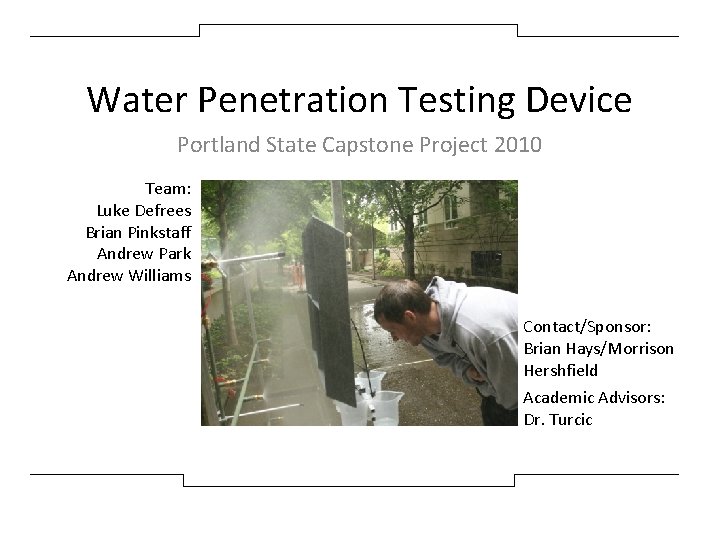
Water Penetration Testing Device Portland State Capstone Project 2010 Team: Luke Defrees Brian Pinkstaff Andrew Park Andrew Williams Contact/Sponsor: Brian Hays/Morrison Hershfield Academic Advisors: Dr. Turcic
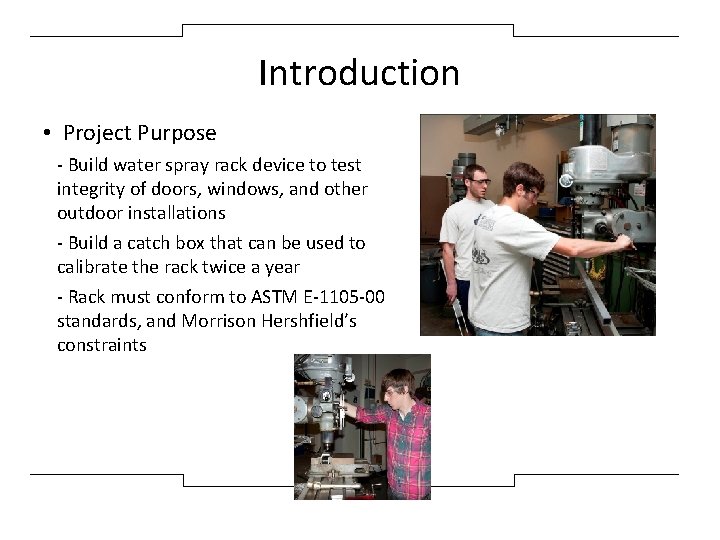
Introduction • Project Purpose - Build water spray rack device to test integrity of doors, windows, and other outdoor installations - Build a catch box that can be used to calibrate the rack twice a year - Rack must conform to ASTM E-1105 -00 standards, and Morrison Hershfield’s constraints
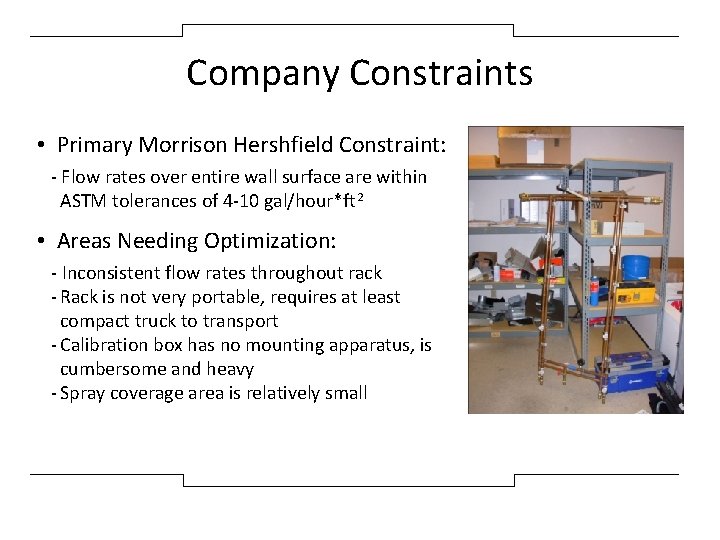
Company Constraints • Primary Morrison Hershfield Constraint: - Flow rates over entire wall surface are within ASTM tolerances of 4 -10 gal/hour*ft 2 • Areas Needing Optimization: - Inconsistent flow rates throughout rack - Rack is not very portable, requires at least compact truck to transport - Calibration box has no mounting apparatus, is cumbersome and heavy - Spray coverage area is relatively small
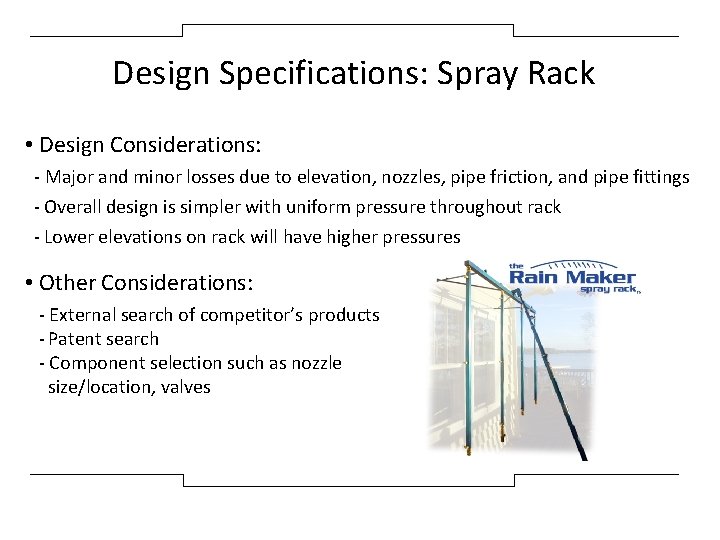
Design Specifications: Spray Rack • Design Considerations: - Major and minor losses due to elevation, nozzles, pipe friction, and pipe fittings - Overall design is simpler with uniform pressure throughout rack - Lower elevations on rack will have higher pressures • Other Considerations: - External search of competitor’s products - Patent search - Component selection such as nozzle size/location, valves
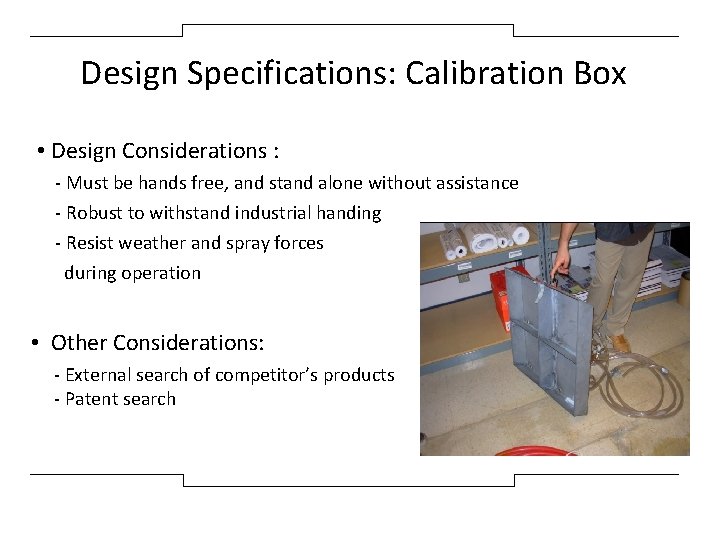
Design Specifications: Calibration Box • Design Considerations : - Must be hands free, and stand alone without assistance - Robust to withstand industrial handing - Resist weather and spray forces during operation • Other Considerations: - External search of competitor’s products - Patent search
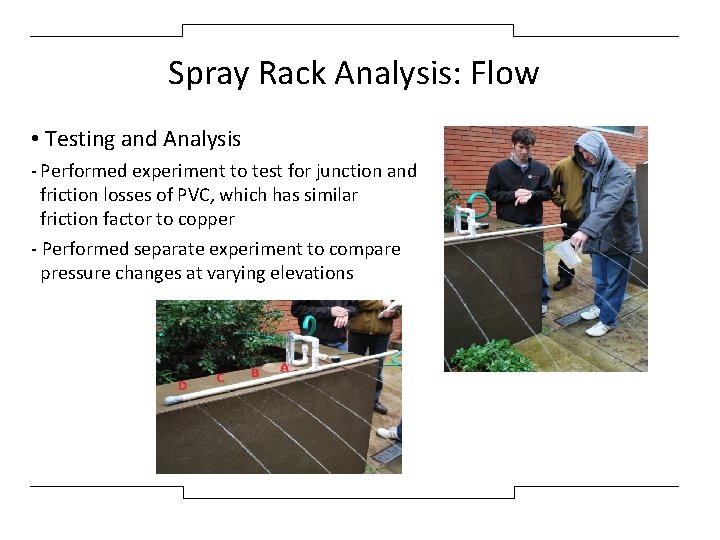
Spray Rack Analysis: Flow • Testing and Analysis - Performed experiment to test for junction and friction losses of PVC, which has similar friction factor to copper - Performed separate experiment to compare pressure changes at varying elevations
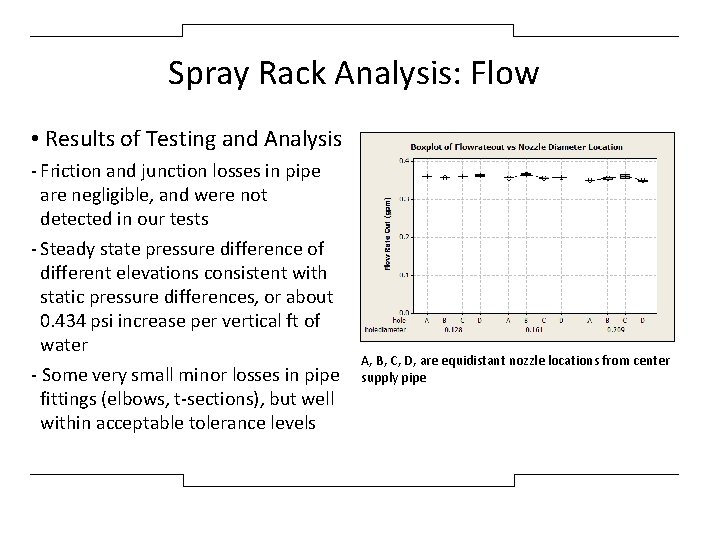
Spray Rack Analysis: Flow • Results of Testing and Analysis - Friction and junction losses in pipe are negligible, and were not detected in our tests - Steady state pressure difference of different elevations consistent with static pressure differences, or about 0. 434 psi increase per vertical ft of water - Some very small minor losses in pipe fittings (elbows, t-sections), but well within acceptable tolerance levels A, B, C, D, are equidistant nozzle locations from center supply pipe
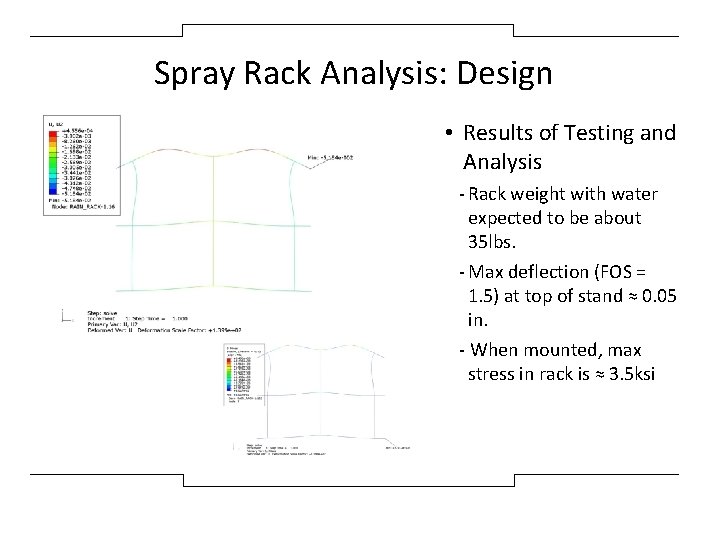
Spray Rack Analysis: Design • Results of Testing and Analysis - Rack weight with water expected to be about 35 lbs. - Max deflection (FOS = 1. 5) at top of stand ≈ 0. 05 in. - When mounted, max stress in rack is ≈ 3. 5 ksi
Spray Rack Analysis: Design • Results of Testing and Analysis - Box weighs approximately 6 lbs - We expect max stress in hanging mounts to be ≈ 3. 5 ksi. (FOS = 1. 5) - We expect max displacement in mounts to be ≈ 0. 00054 in.
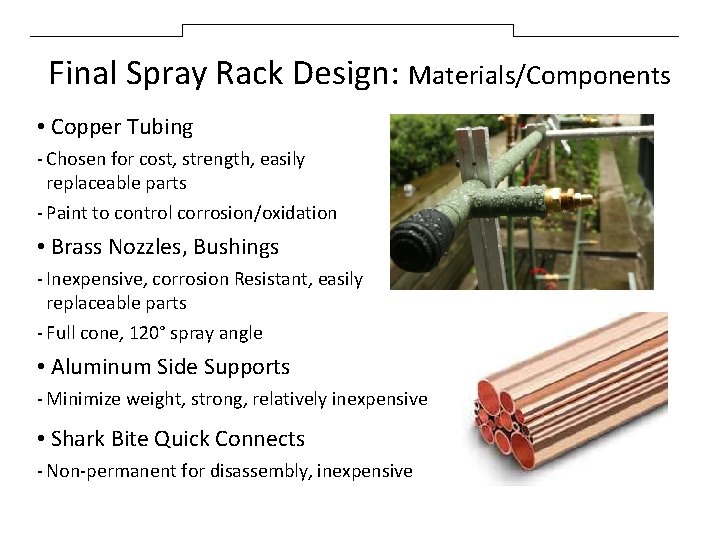
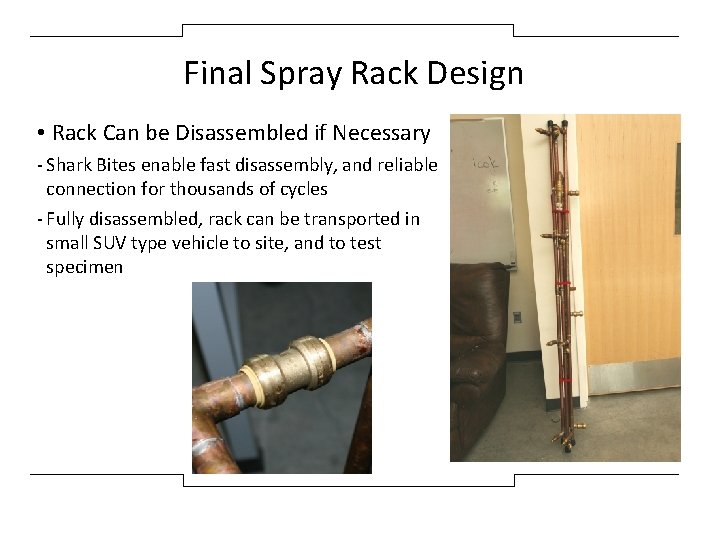
Final Spray Rack Design: Materials/Components • Copper Tubing - Chosen for cost, strength, easily replaceable parts - Paint to control corrosion/oxidation • Brass Nozzles, Bushings - Inexpensive, corrosion Resistant, easily replaceable parts - Full cone, 120° spray angle • Aluminum Side Supports - Minimize weight, strong, relatively inexpensive • Shark Bite Quick Connects - Non-permanent for disassembly, inexpensive
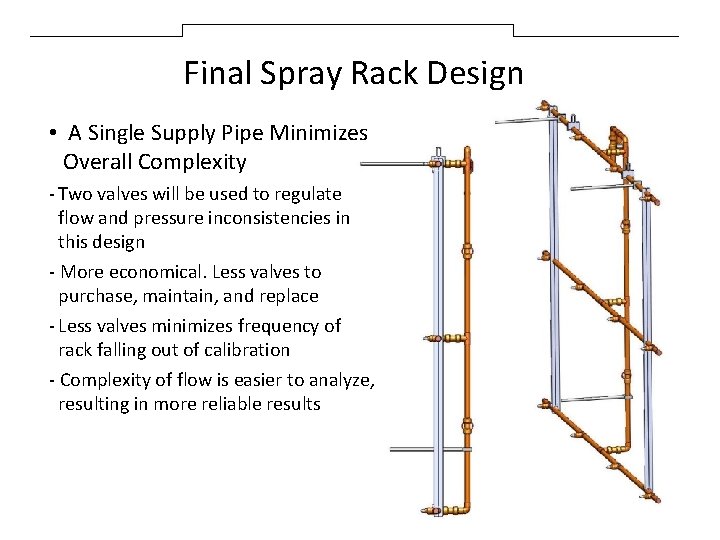
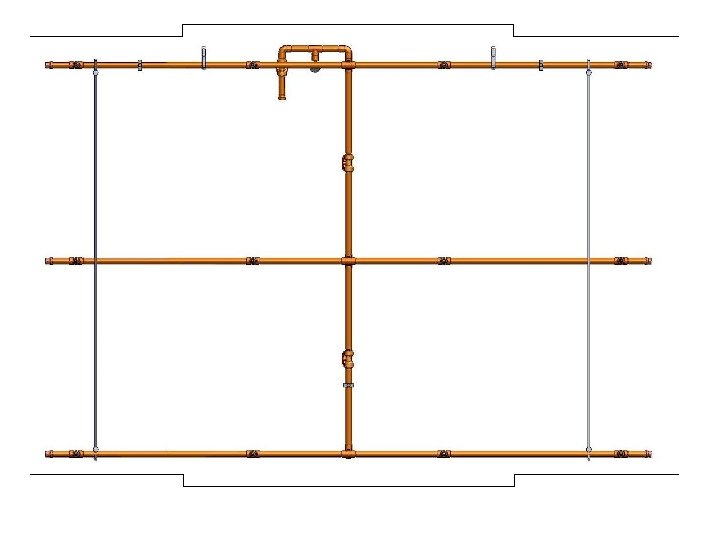
Final Spray Rack Design • A Single Supply Pipe Minimizes Overall Complexity - Two valves will be used to regulate flow and pressure inconsistencies in this design - More economical. Less valves to purchase, maintain, and replace - Less valves minimizes frequency of rack falling out of calibration - Complexity of flow is easier to analyze, resulting in more reliable results
Final Spray Rack Design • Rack Can be Disassembled if Necessary - Shark Bites enable fast disassembly, and reliable connection for thousands of cycles - Fully disassembled, rack can be transported in small SUV type vehicle to site, and to test specimen
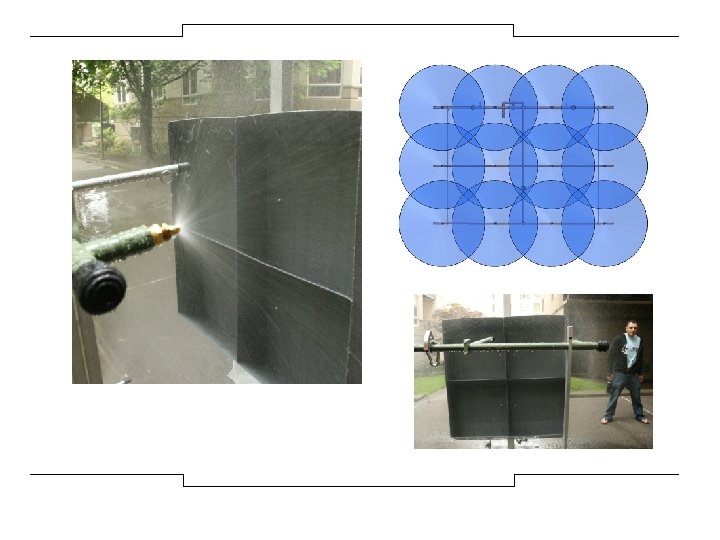
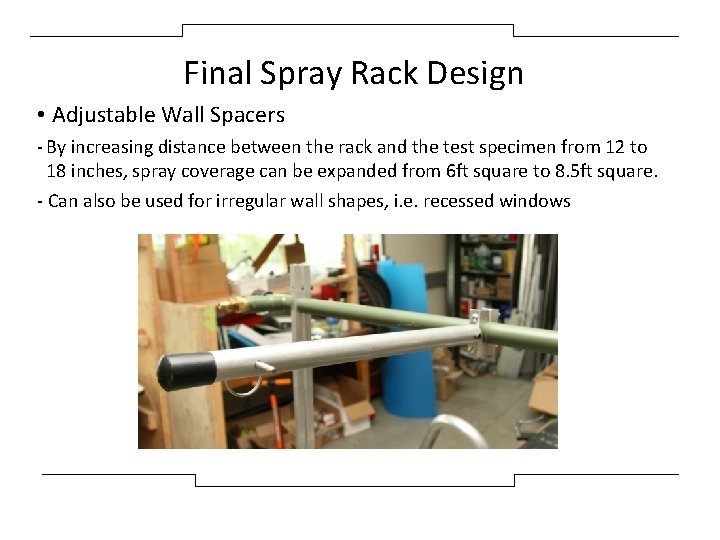
Final Spray Rack Design • Adjustable Wall Spacers - By increasing distance between the rack and the test specimen from 12 to 18 inches, spray coverage can be expanded from 6 ft square to 8. 5 ft square. - Can also be used for irregular wall shapes, i. e. recessed windows
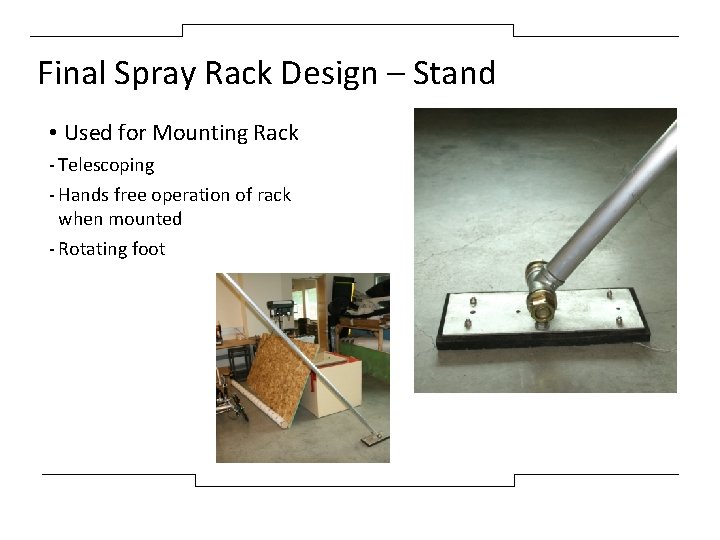
Final Spray Rack Design – Stand • Used for Mounting Rack - Telescoping - Hands free operation of rack when mounted - Rotating foot
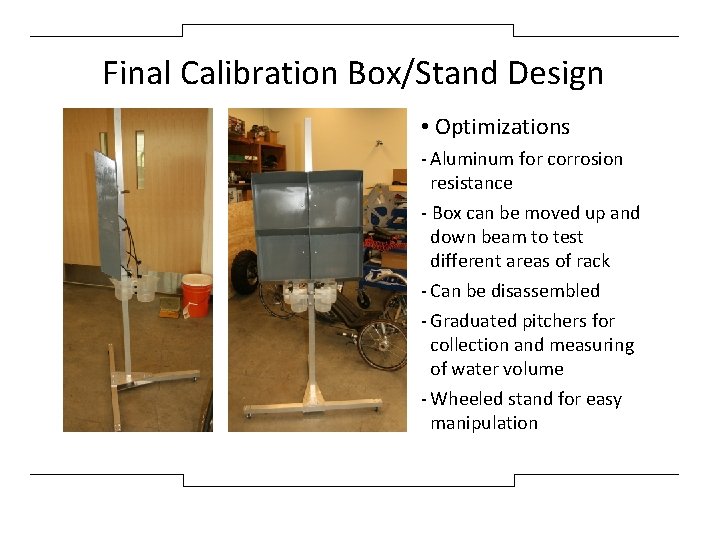
Final Calibration Box/Stand Design • Optimizations - Aluminum for corrosion resistance - Box can be moved up and down beam to test different areas of rack - Can be disassembled - Graduated pitchers for collection and measuring of water volume - Wheeled stand for easy manipulation
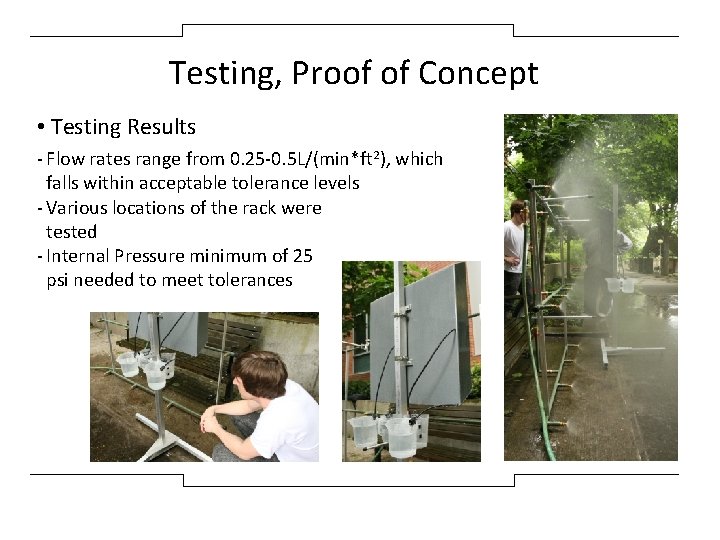
Testing, Proof of Concept • Testing Results - Flow rates range from 0. 25 -0. 5 L/(min*ft 2), which falls within acceptable tolerance levels - Various locations of the rack were tested - Internal Pressure minimum of 25 psi needed to meet tolerances
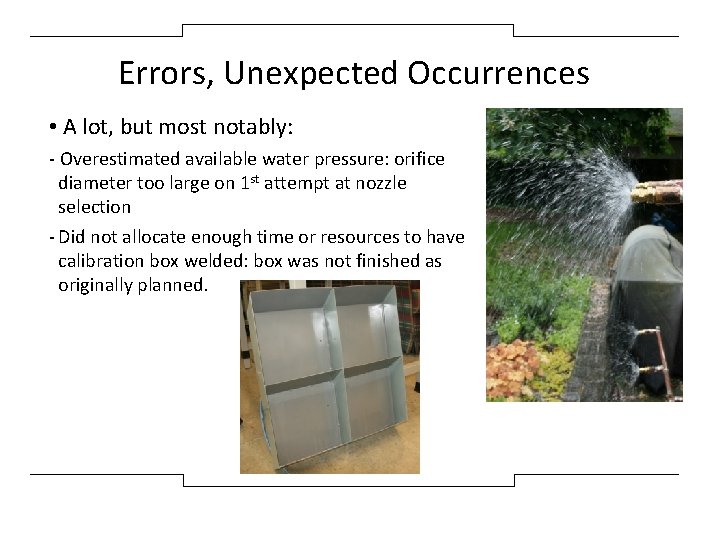
Errors, Unexpected Occurrences • A lot, but most notably: - Overestimated available water pressure: orifice diameter too large on 1 st attempt at nozzle selection - Did not allocate enough time or resources to have calibration box welded: box was not finished as originally planned.
Questions/Comments ?