
Water Measurement Brady S Mc Elroy P E
Water Measurement Brady S. Mc. Elroy, P. E. USDA-NRCS Lamar, Colorado
Objectives • Why is water measurement important to IWM? • Explain some of the mathematics of water measurement • Discuss some of the common measuring devices encountered in NRCS work • Discuss other opportunities for measurement • Work some example problems
Why is water measurement important? • Difficult to effectively manage irrigation without measurement • Positive aspects – Maximize use of available water supply – Reduced cost due to leached nutrients – Reduced environmental impact from overirrigation
Why is water measurement important? • Some measurement may have a negative connotation – Regulatory (mandated by state, etc. ) – Billing
Why is water measurement important? • Water is one of the most precious resources in the West – Increased competition among water users

“Whiskey is for drinking. Water is for fighting over. ” Mark Twain
References Primary reference for NRCS is Chapter 9 of Part 623 (Irrigation) of the National Engineering Handbook • States that NRCS’ reference shall be the Bureau of Reclamation’s Water Measurement Manual, 3 rd edition, published in 1997 • Available online at http: //www. usbr. gov/pmts/hydraulics_lab/pubs/wmm/
References Other useful references • • Other NRCS documents Irrigator’s Guides Extension publications Hydraulic texts – King’s Handbook of Hydraulics
Definitions Volume: length 3 Flow Rate (Q): volume/time Velocity: length/time Area: length 2
Definitions Head- measurement of the energy in a fluid. Units are typically length. • Total head at a given point is the sum of three components – Elevation head, which is equal to the elevation of the point above a datum – Pressure head, which is the height of a column of static water that can be supported by the static pressure at the point – Velocity head, which is the height to which the kinetic energy of the liquid is capable of lifting the liquid
Definitions Pressure- measurement of the force acting on a surface. Units are force/length 2 Often convenient to express in terms of feet of fluid (pressure head) h=p/γ (multiply psi x 2. 31 for feet of H 20)
Units • Typically in U. S. Customary units for irrigation work. • Units vary depending on type of measurement – Q vs. volume – Open channel vs. pipe flow
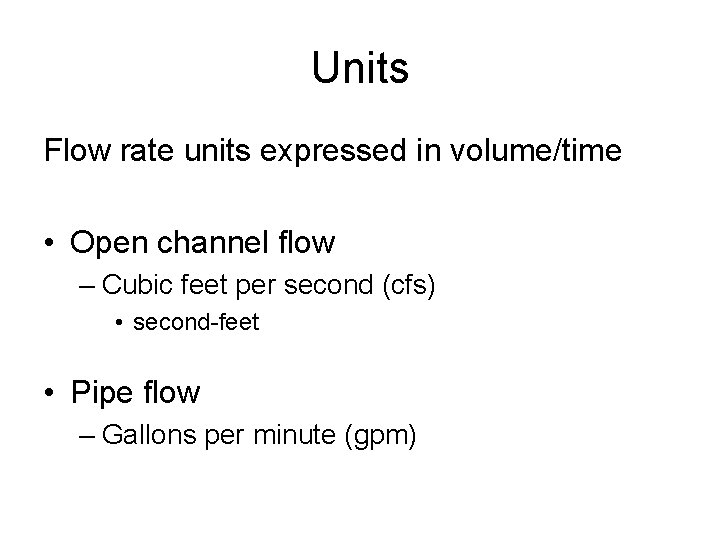
Units Flow rate units expressed in volume/time • Open channel flow – Cubic feet per second (cfs) • second-feet • Pipe flow – Gallons per minute (gpm)
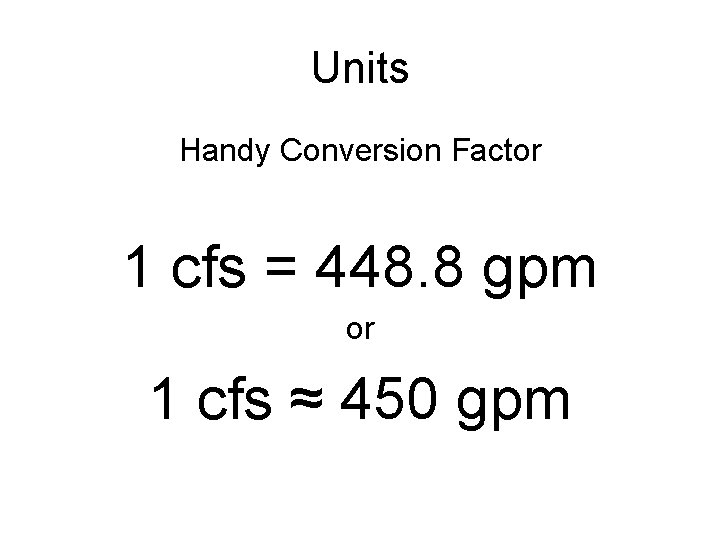
Units Handy Conversion Factor 1 cfs = 448. 8 gpm or 1 cfs ≈ 450 gpm
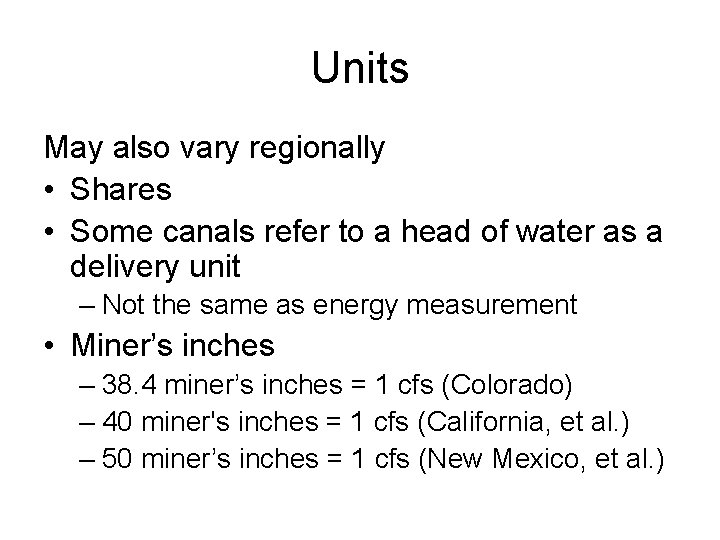
Units May also vary regionally • Shares • Some canals refer to a head of water as a delivery unit – Not the same as energy measurement • Miner’s inches – 38. 4 miner’s inches = 1 cfs (Colorado) – 40 miner's inches = 1 cfs (California, et al. ) – 50 miner’s inches = 1 cfs (New Mexico, et al. )
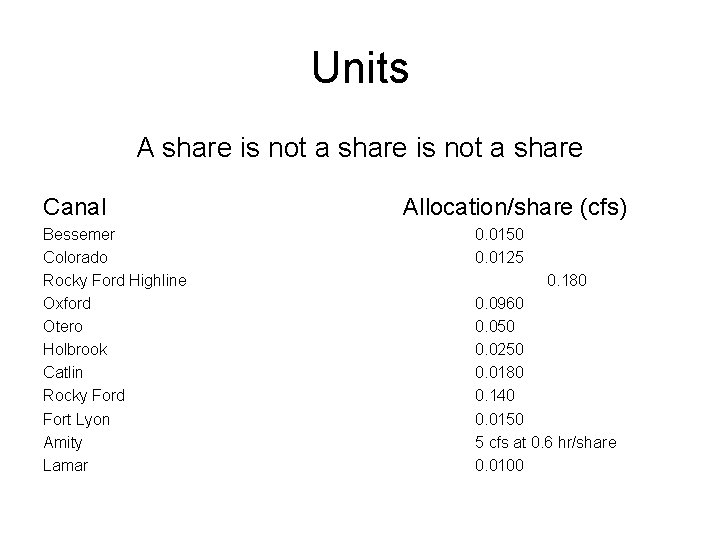
Units A share is not a share Canal Bessemer Colorado Rocky Ford Highline Oxford Otero Holbrook Catlin Rocky Ford Fort Lyon Amity Lamar Allocation/share (cfs) 0. 0150 0. 0125 0. 180 0. 0960 0. 050 0. 0250 0. 0180 0. 140 0. 0150 5 cfs at 0. 6 hr/share 0. 0100
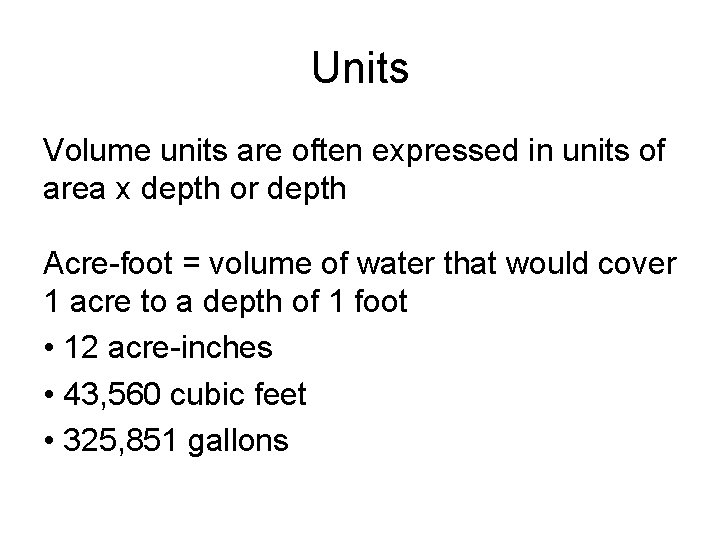
Units Volume units are often expressed in units of area x depth or depth Acre-foot = volume of water that would cover 1 acre to a depth of 1 foot • 12 acre-inches • 43, 560 cubic feet • 325, 851 gallons
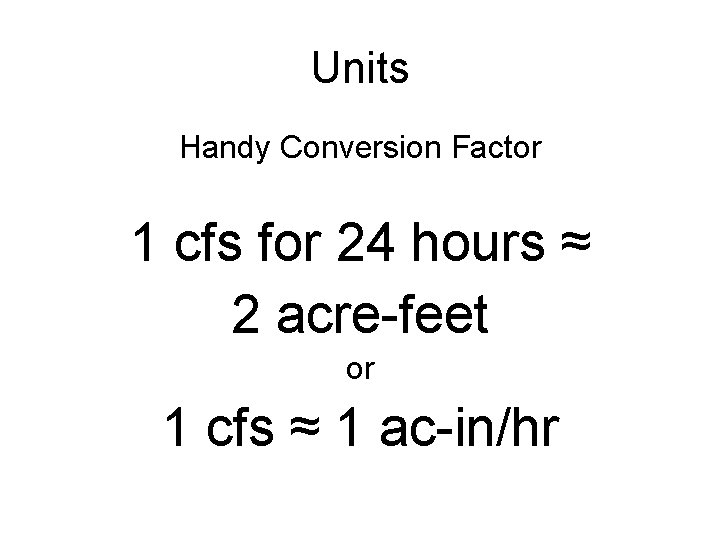
Units Handy Conversion Factor 1 cfs for 24 hours ≈ 2 acre-feet or 1 cfs ≈ 1 ac-in/hr
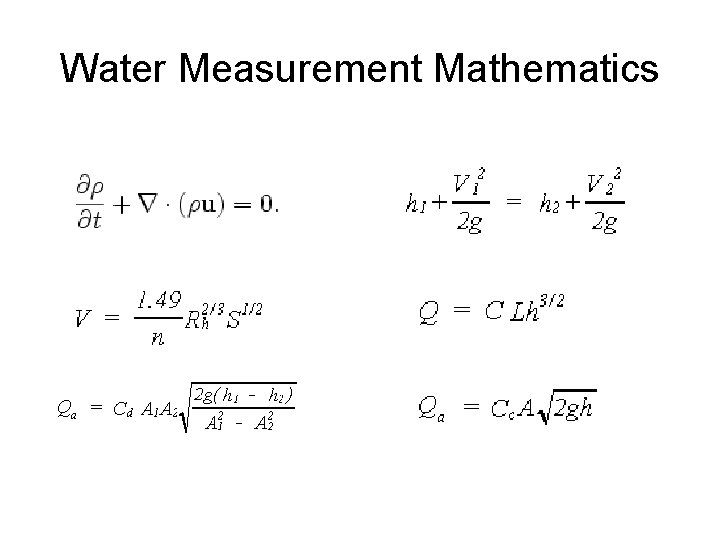
Water Measurement Mathematics
Water Measurement Mathematics
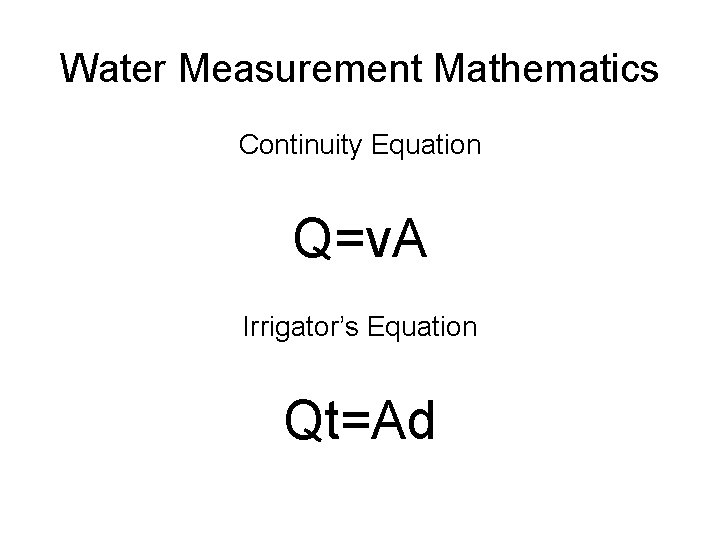
Water Measurement Mathematics Continuity Equation Q=v. A Irrigator’s Equation Qt=Ad
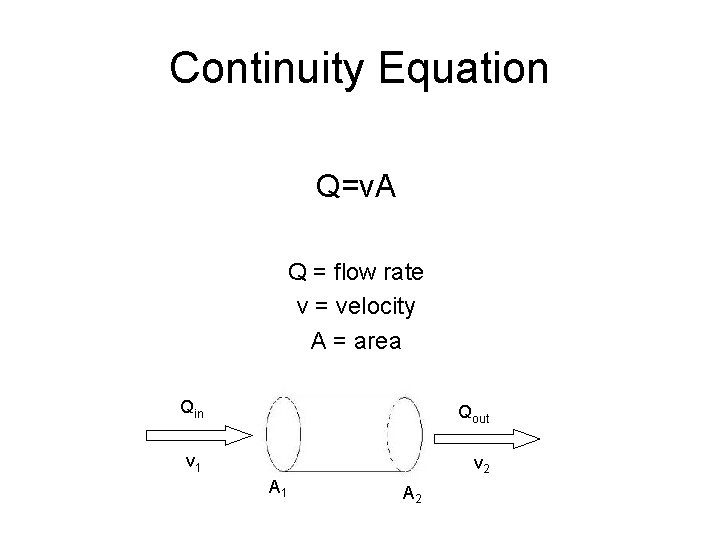
Continuity Equation Q=v. A Q = flow rate v = velocity A = area Qin Qout v 1 v 2 A 1 A 2
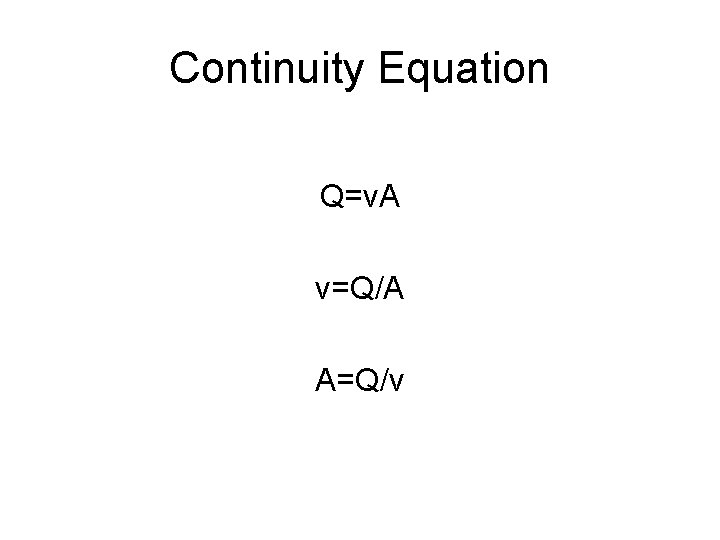
Continuity Equation Q=v. A v=Q/A A=Q/v
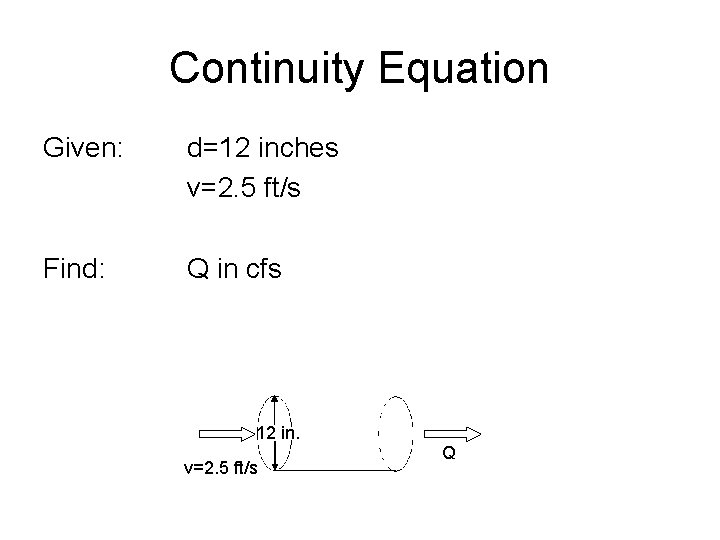
Continuity Equation Given: d=12 inches v=2. 5 ft/s Find: Q in cfs 12 in. v=2. 5 ft/s Q
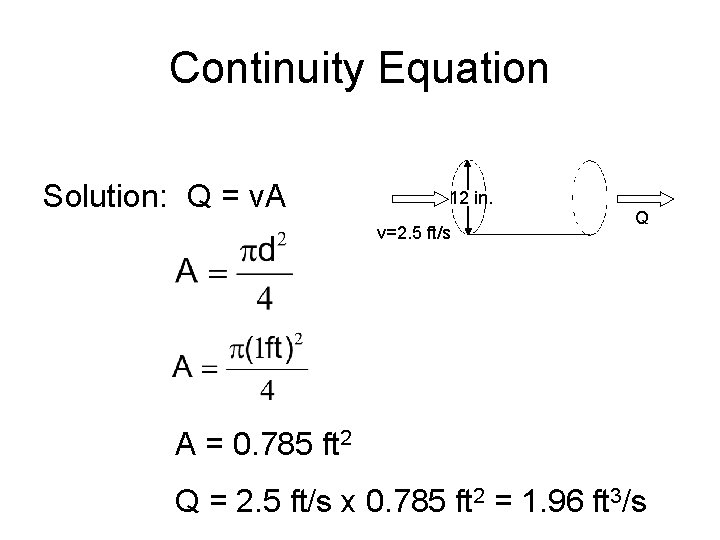
Continuity Equation Solution: Q = v. A 12 in. v=2. 5 ft/s Q A = 0. 785 ft 2 Q = 2. 5 ft/s x 0. 785 ft 2 = 1. 96 ft 3/s
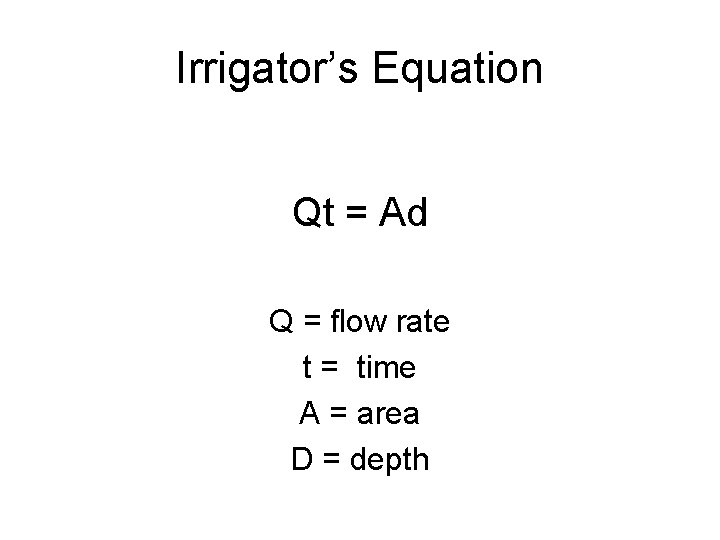
Irrigator’s Equation Qt = Ad Q = flow rate t = time A = area D = depth
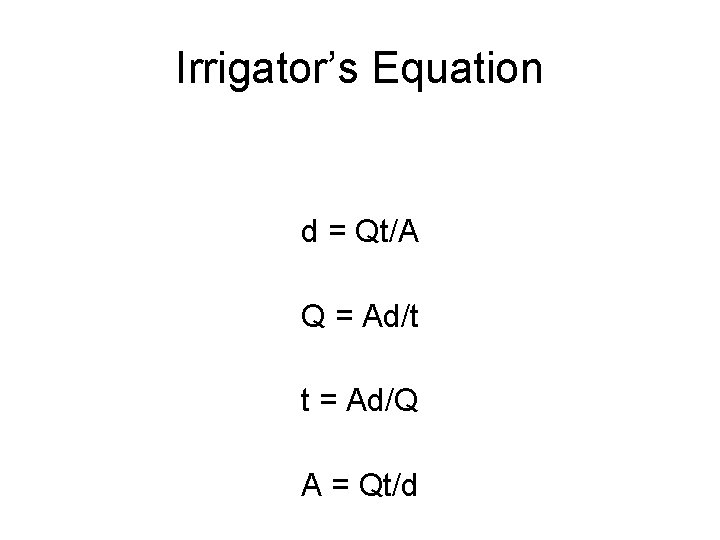
Irrigator’s Equation d = Qt/A Q = Ad/t t = Ad/Q A = Qt/d
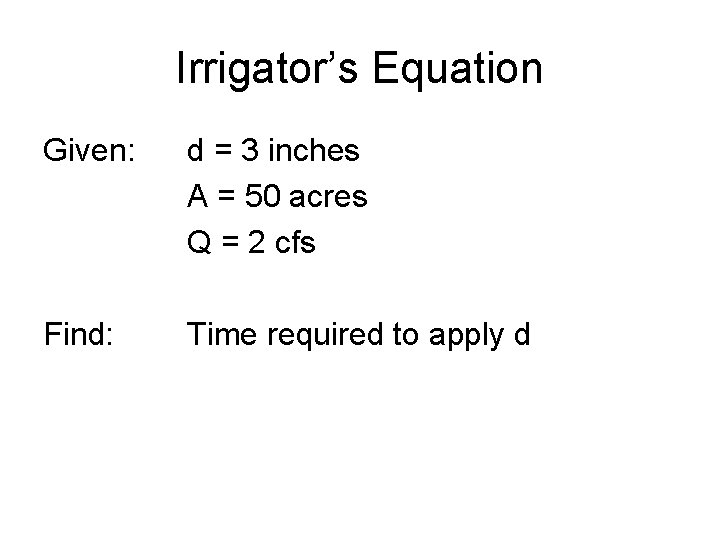
Irrigator’s Equation Given: d = 3 inches A = 50 acres Q = 2 cfs Find: Time required to apply d
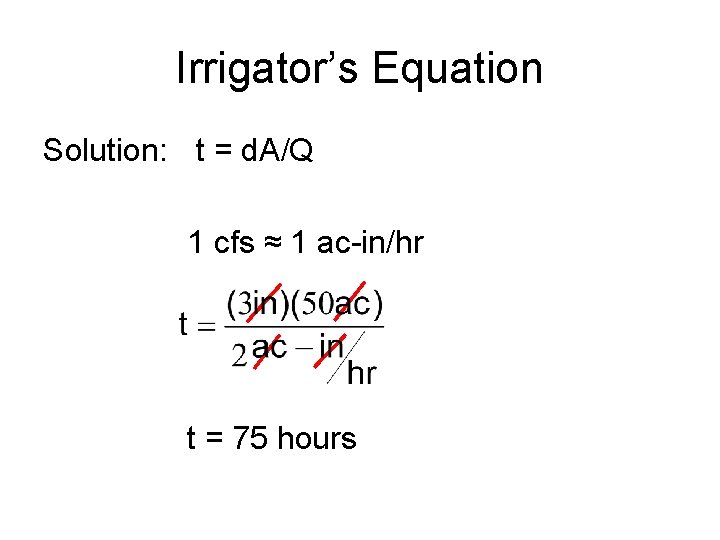
Irrigator’s Equation Solution: t = d. A/Q 1 cfs ≈ 1 ac-in/hr t = 75 hours
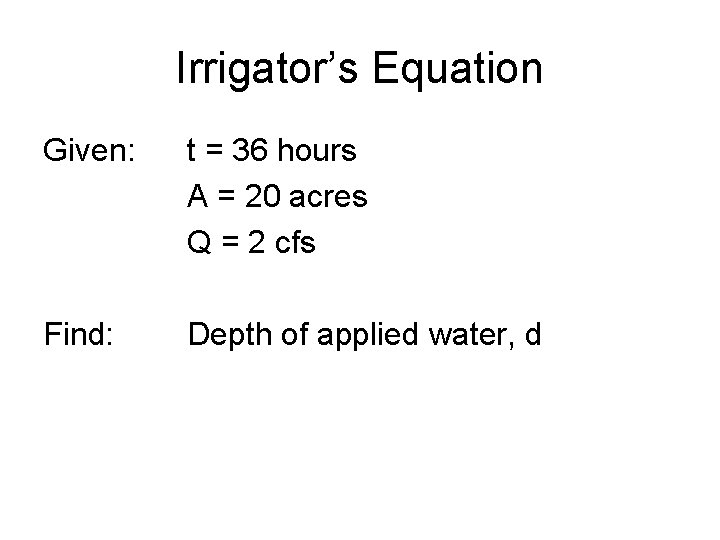
Irrigator’s Equation Given: t = 36 hours A = 20 acres Q = 2 cfs Find: Depth of applied water, d
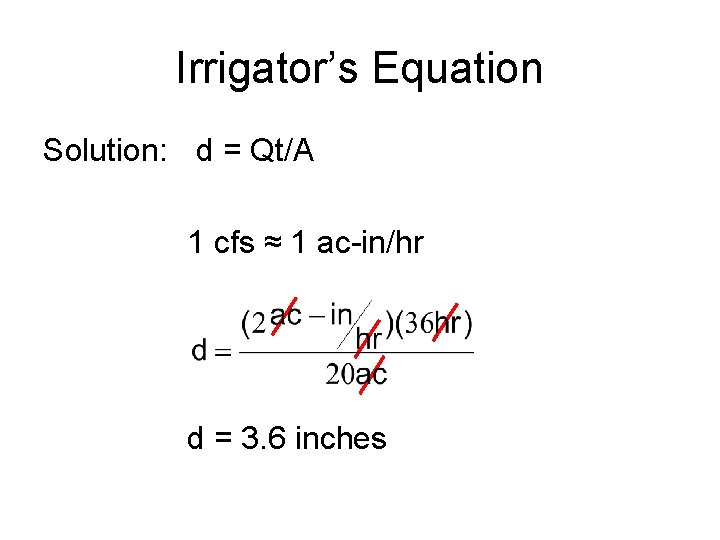
Irrigator’s Equation Solution: d = Qt/A 1 cfs ≈ 1 ac-in/hr d = 3. 6 inches
Water Measurement Devices Most water measurement devices either sense or measure velocity, or measure either pressure or head. Tables, charts, or equations are then used to calculate the corresponding discharge
Water Measurement Devices that sample or sense velocity • Current meters • Propeller meters • Vane deflection meters • Float and stopwatch
Water Measurement Devices that measure head or pressure – Open channel devices commonly use h – Pipeline devices may use p • Flumes • Orifices • Venturi meters • Weirs – Velocity is computed from h, so weirs are classifed as head measuring devices
Open Channel Devices • • Weirs Flumes Submerged Orifices Other devices
Weirs A weir is an overflow structure installed perpendicular to open channel flow • Has a unique depth of water at an upstream measuring point for each discharge • If the water springs clear of downstream face, acts as sharp-crested weir • A long, raised channel control crest is a broad-crested weir
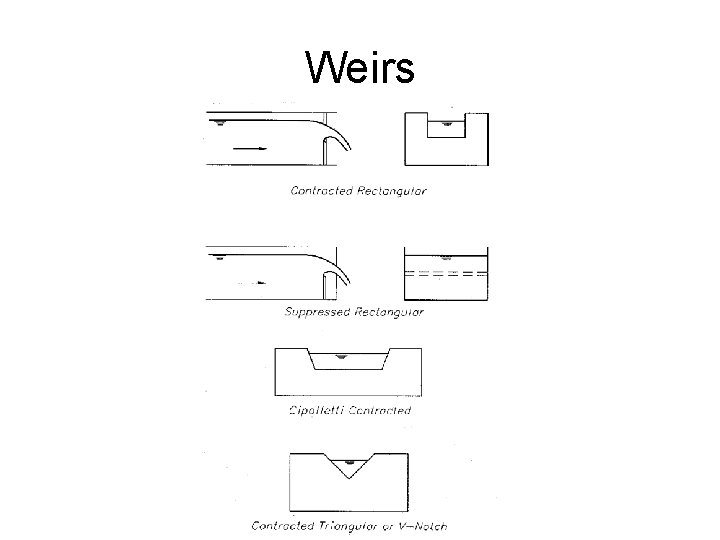
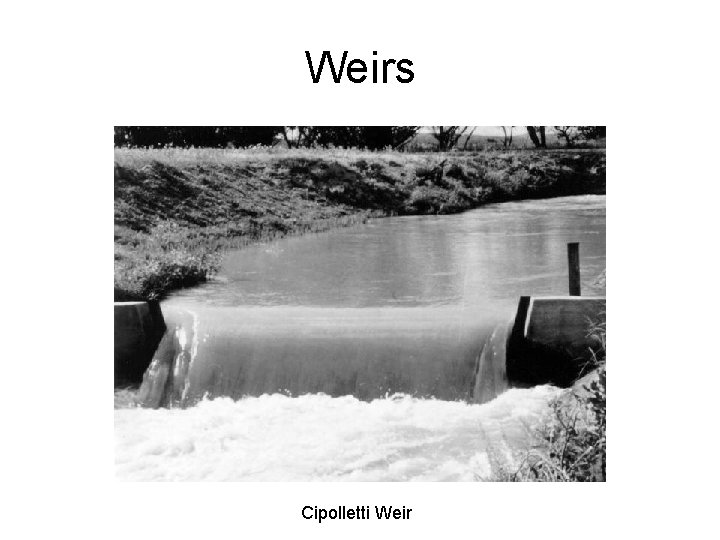
Weirs • Usually named for the shape of the overflow opening – Rectangular – Triangular – Cipolletti • Lowest elevation on overflow is zero reference elevation for measuring h
Weirs Rectangular weirs can be either contracted or suppressed • Suppressed weirs use side of flow channel for weir ends – No side contraction occurs – Often used in divide boxes • Canal overshot gates can act as weirs
Weirs
Weirs Cipolletti Weir
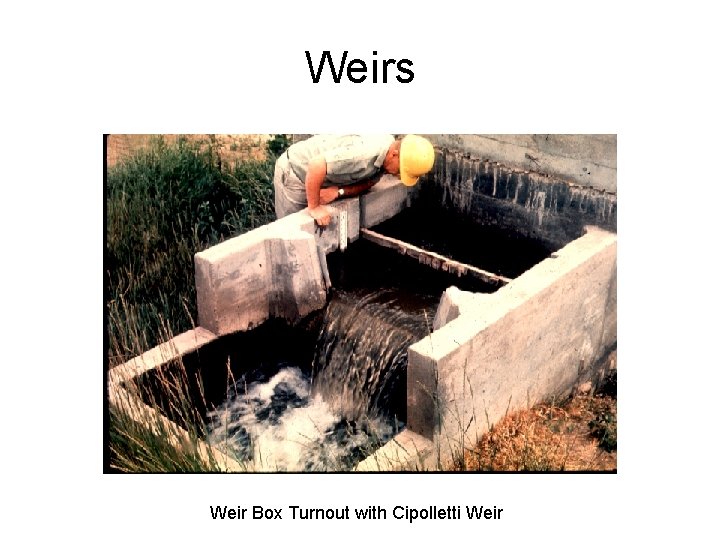
Weirs Weir Box Turnout with Cipolletti Weir
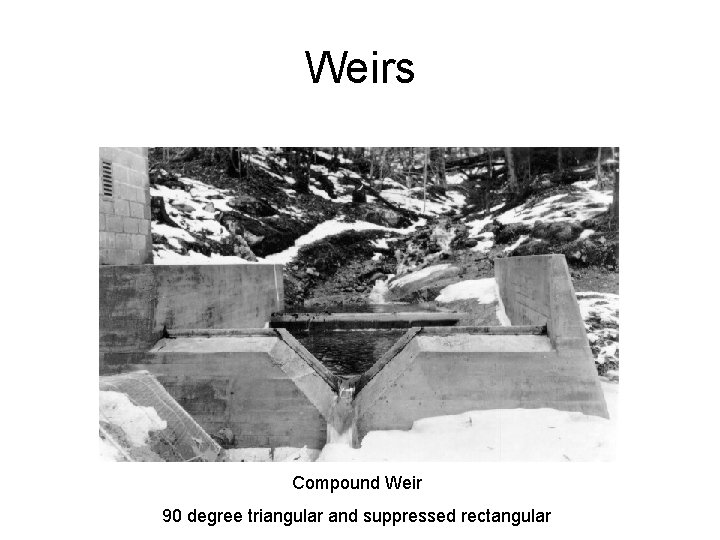
Weirs Compound Weir 90 degree triangular and suppressed rectangular
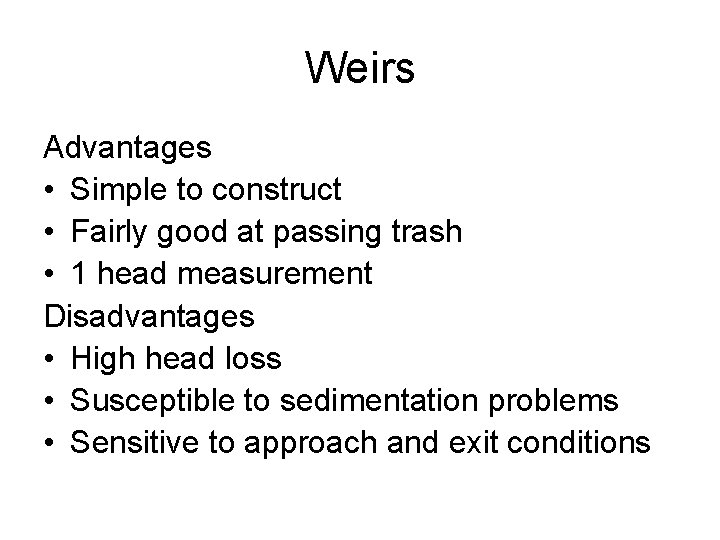
Weirs Advantages • Simple to construct • Fairly good at passing trash • 1 head measurement Disadvantages • High head loss • Susceptible to sedimentation problems • Sensitive to approach and exit conditions
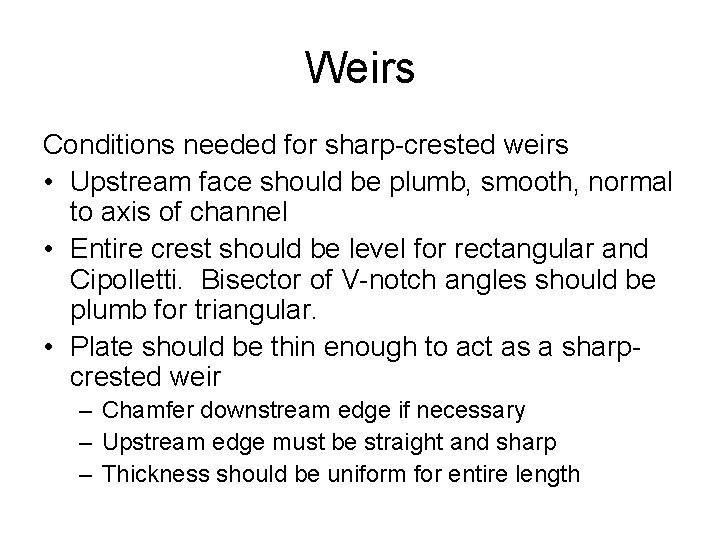
Weirs Conditions needed for sharp-crested weirs • Upstream face should be plumb, smooth, normal to axis of channel • Entire crest should be level for rectangular and Cipolletti. Bisector of V-notch angles should be plumb for triangular. • Plate should be thin enough to act as a sharpcrested weir – Chamfer downstream edge if necessary – Upstream edge must be straight and sharp – Thickness should be uniform for entire length
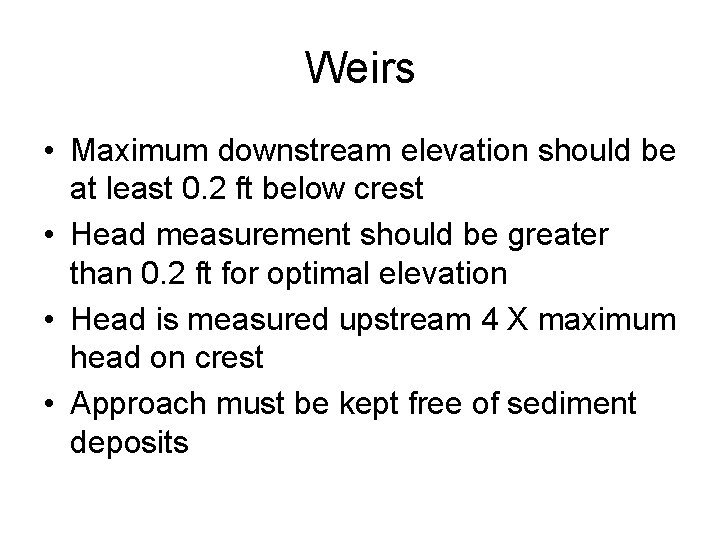
Weirs • Maximum downstream elevation should be at least 0. 2 ft below crest • Head measurement should be greater than 0. 2 ft for optimal elevation • Head is measured upstream 4 X maximum head on crest • Approach must be kept free of sediment deposits
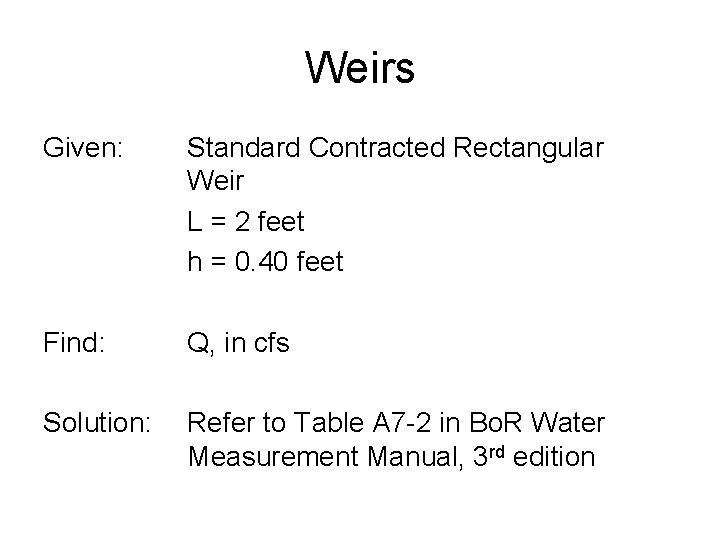
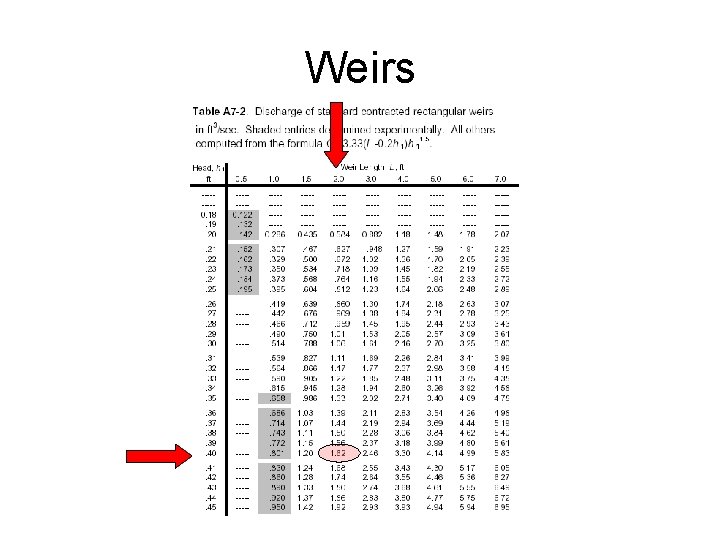
Weirs Given: Standard Contracted Rectangular Weir L = 2 feet h = 0. 40 feet Find: Q, in cfs Solution: Refer to Table A 7 -2 in Bo. R Water Measurement Manual, 3 rd edition
Weirs
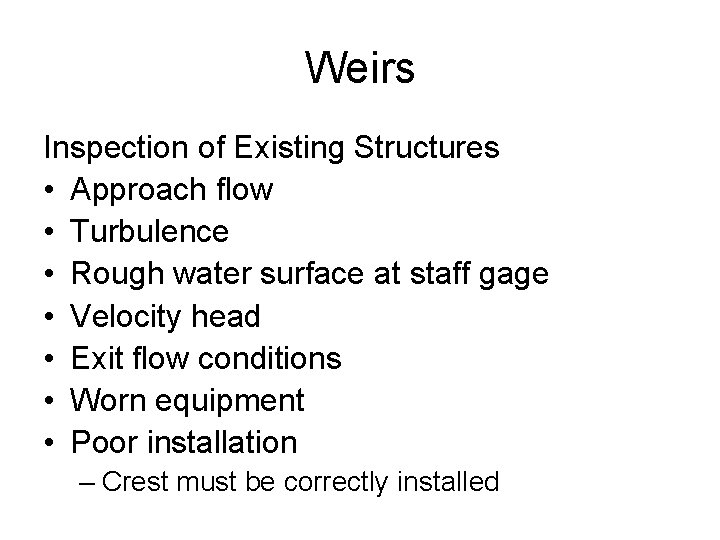
Weirs Inspection of Existing Structures • Approach flow • Turbulence • Rough water surface at staff gage • Velocity head • Exit flow conditions • Worn equipment • Poor installation – Crest must be correctly installed
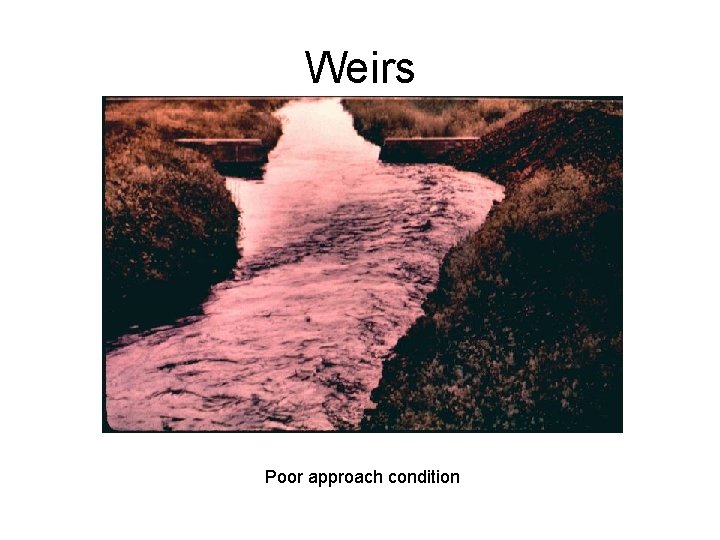
Weirs Poor approach condition
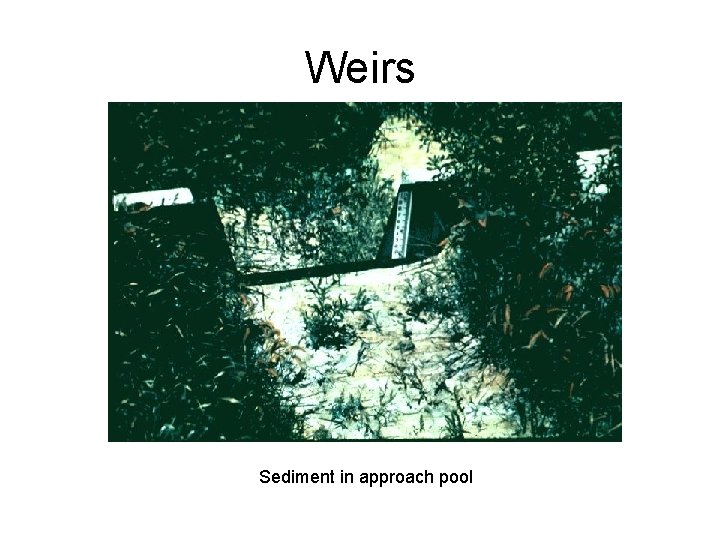
Weirs Sediment in approach pool
Flumes are shaped open channel flow sections. • Force flow to accelerate – Converging sidewalls – Raised bottom – Combination • Force flow to pass through critical depth – Unique relationship between water surface profile and discharge
Flumes Two basic classes of flumes • Long throated flumes – Parallel flow lines in control section – Accurately rate with fluid flow analysis • Short throated flumes – Curvilinear flow in control section – Calibrated with more precise measurement devices
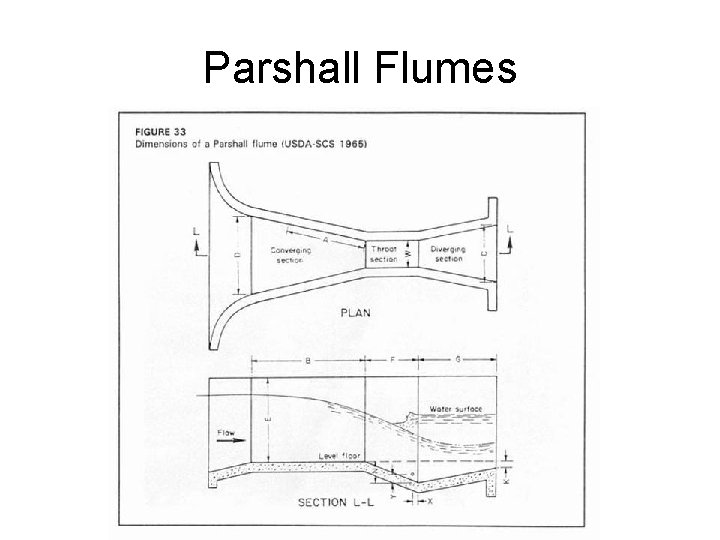
Short Throated Flumes Parshall Flume is most well-known example of short throated flumes • Developed by Ralph Parshall at Colorado Agricultural College (now Colorado State University) • ASAE Historic Landmark
Parshall Flumes Since the beginning of irrigated agriculture, it has been important to measure flows of irrigation water. Accuracy of early water measurement methods often suffered because of trash or sediment in the water, or unusual flow conditions. Ralph L. Parshall saw this problem when he began working for the USDA in 1915, as an irrigation research engineer. In 1922 he invented the flume now known by his name. When this flume is placed in a channel, flow is uniquely related to the water depth. By 1953 Parshall had developed the depth-flow relationships for flumes with throat widths from 3 inches to 50 feet. The Parshall flume has had a major influence on the equitable distribution and proper management of irrigation water. Thousands of flumes have been used to measure irrigation water, as well as industrial and municipal liquid flows throughout the world. This plaque marks the site of the original Colorado Agricultural College Hydraulics Laboratory, where Parshall carried out historic experiments. DEDICATED BY THE AMERICAN SOCIETY OF AGRICULTURAL ENGINEERS 1985
Parshall Flumes
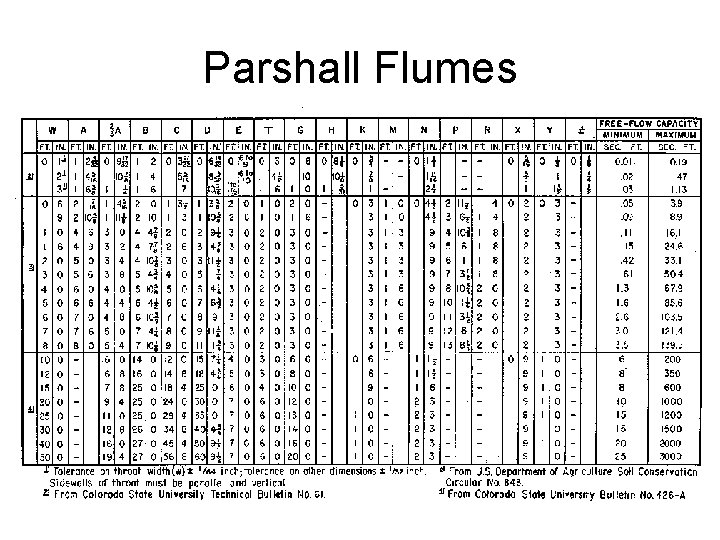
Parshall Flumes • Designated by throat width – Measure 0. 01 cfs with 1 inch flume – Measure 3000 cfs with 50 foot flume • Dimensions are standardized for each flume – Not geometrically proportionate • A 12 ft flume is not simply 3 x a 4 ft flume • Relate Ha (or Ha and Hb ) to discharge with rating equation, or consult appropriate chart
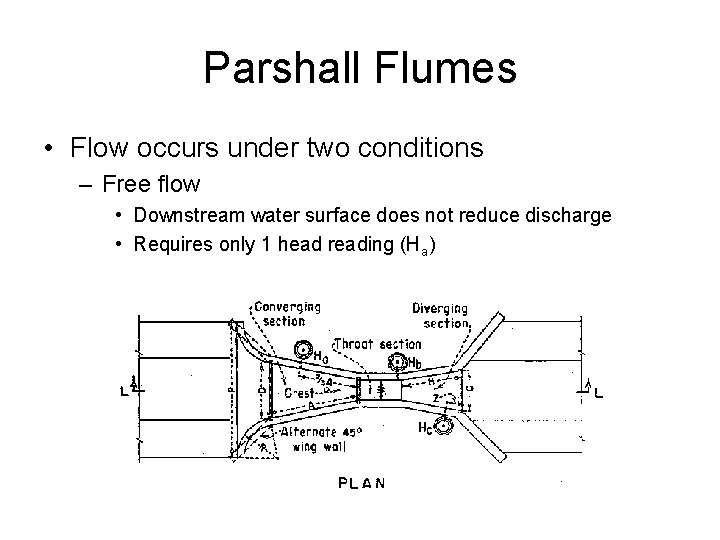
Parshall Flumes • Flow occurs under two conditions – Free flow • Downstream water surface does not reduce discharge • Requires only 1 head reading (Ha)
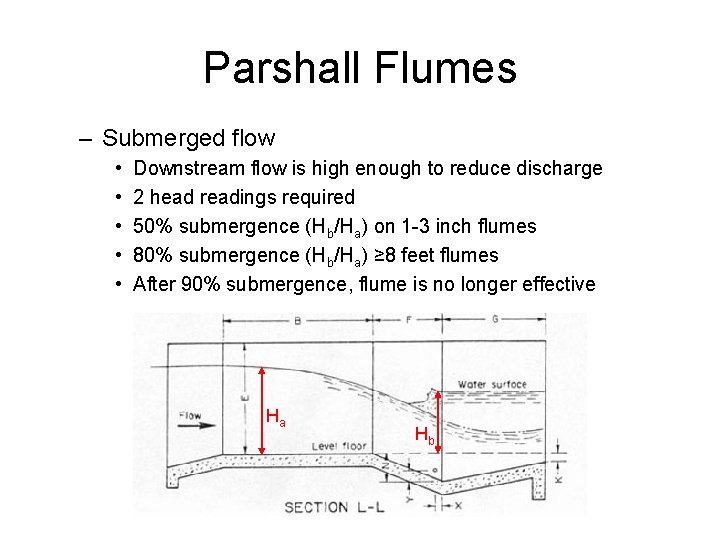
Parshall Flumes – Submerged flow • • • Downstream flow is high enough to reduce discharge 2 head readings required 50% submergence (Hb/Ha) on 1 -3 inch flumes 80% submergence (Hb/Ha) ≥ 8 feet flumes After 90% submergence, flume is no longer effective Ha Hb
Parshall Flumes Advantages • Relatively low head loss (1/4 of sharp crested weir) • Handle some trash and sediment • Well accepted – May be mandated • Many sizes are commercially available
Parshall Flumes Disadvantages • Complicated geometry for construction • Tight construction tolerances • Aren’t amenable to fluid flow analysis • Bo. R does not recommend for new construction
Parshall Flumes
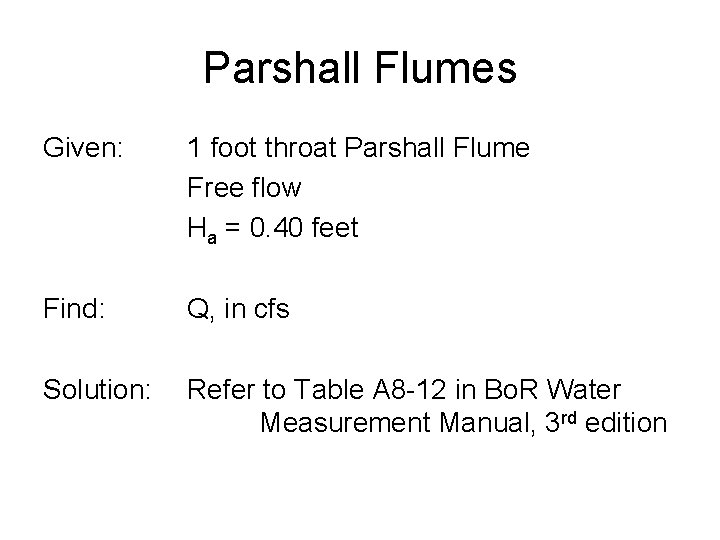
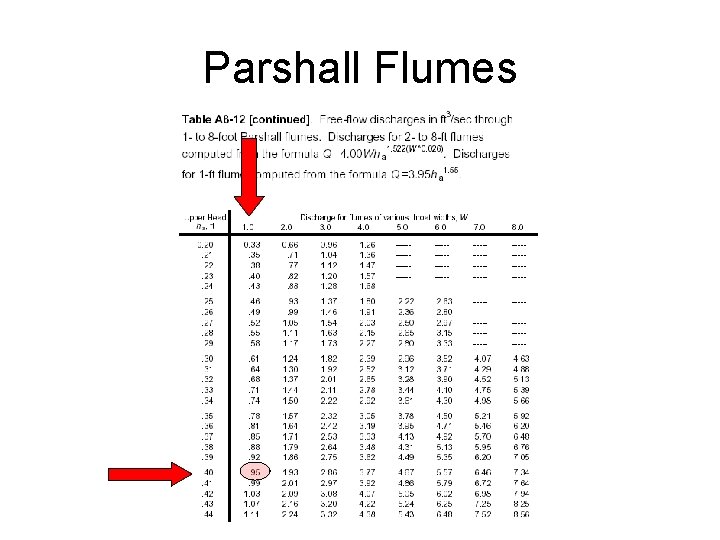
Parshall Flumes Given: 1 foot throat Parshall Flume Free flow Ha = 0. 40 feet Find: Q, in cfs Solution: Refer to Table A 8 -12 in Bo. R Water Measurement Manual, 3 rd edition
Parshall Flumes
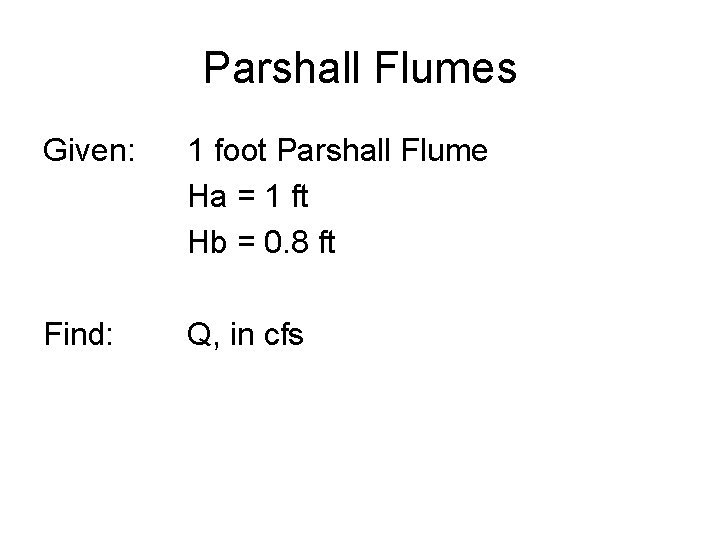
Parshall Flumes Given: 1 foot Parshall Flume Ha = 1 ft Hb = 0. 8 ft Find: Q, in cfs
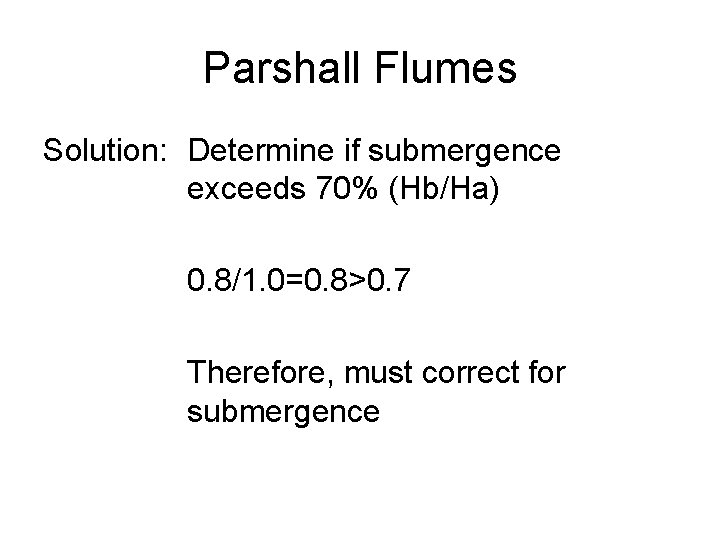
Parshall Flumes Solution: Determine if submergence exceeds 70% (Hb/Ha) 0. 8/1. 0=0. 8>0. 7 Therefore, must correct for submergence
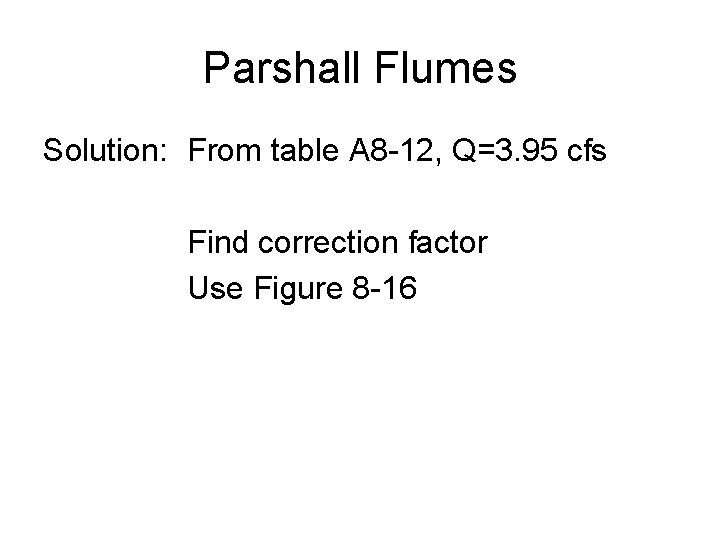
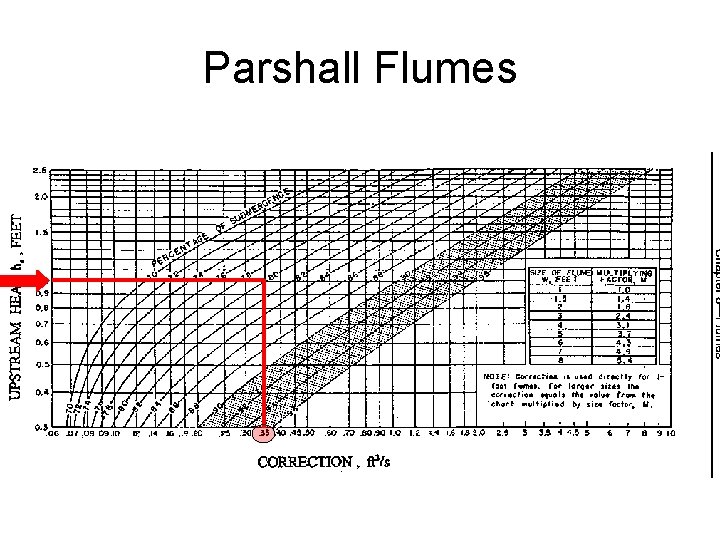
Parshall Flumes Solution: From table A 8 -12, Q=3. 95 cfs Find correction factor Use Figure 8 -16
Parshall Flumes
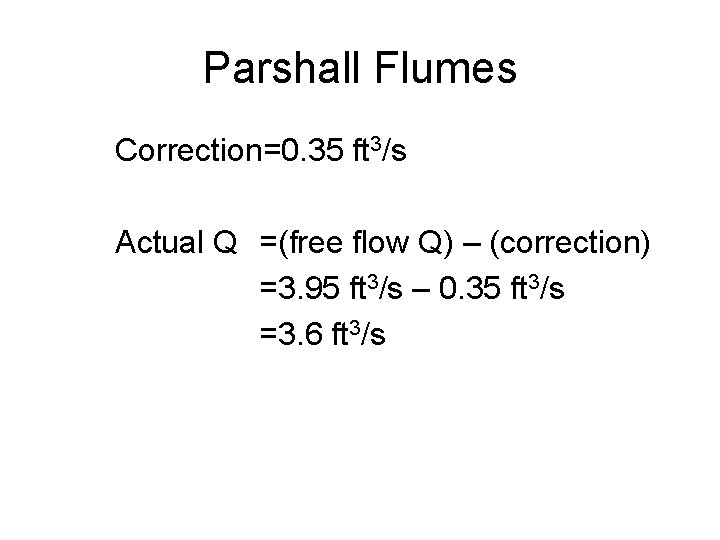
Parshall Flumes Correction=0. 35 ft 3/s Actual Q =(free flow Q) – (correction) =3. 95 ft 3/s – 0. 35 ft 3/s =3. 6 ft 3/s
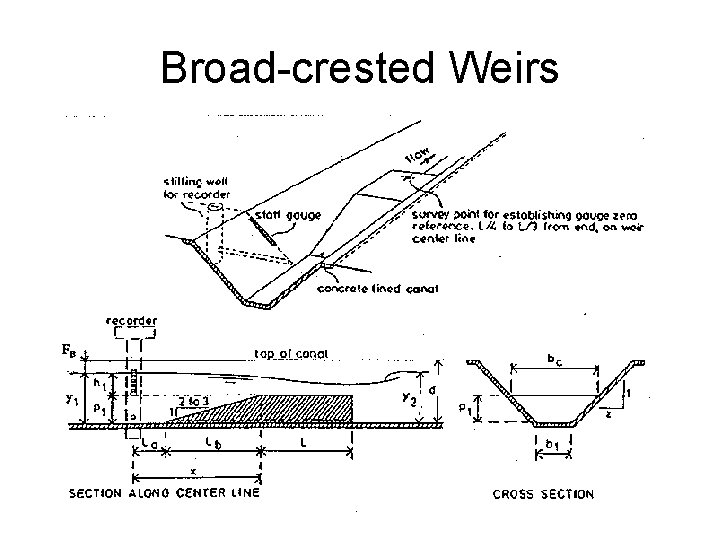
Broad-crested Weirs Long throated flume where only the bottom is raised. No side contractions • Also called ramp flumes, Replogle flumes
Broad-crested Weirs
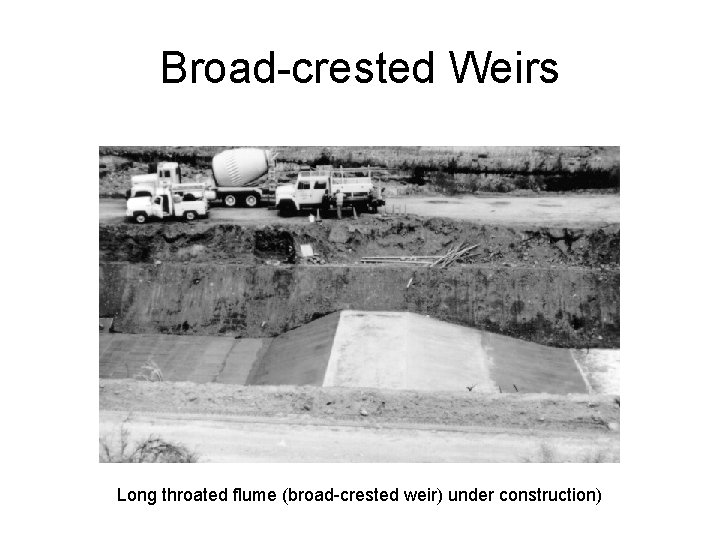
Broad-crested Weirs Long throated flume (broad-crested weir) under construction)
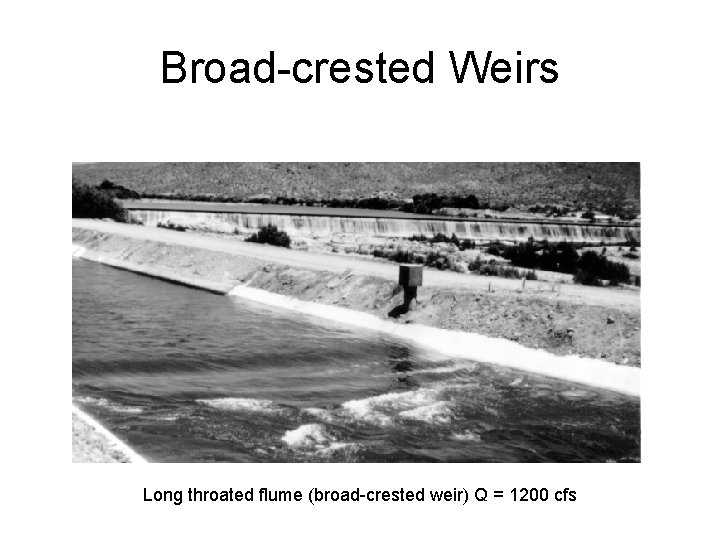
Broad-crested Weirs Long throated flume (broad-crested weir) Q = 1200 cfs
Broad-crested Weirs Advantages • Easily constructed, especially in existing concrete lined channels • Win. Flume software available to quickly design and rate structures • Less expensive construction • Low head loss • Handle trash and sediment well
Broad-crested Weirs Disadvantages • Some state laws or compacts may preclude use • Not readily accepted by some water users – Not what they’re used to using
Other Flumes Several other types of flumes are used • H-flumes • Cutthroat flumes • Palmer-Bowles

Other Flumes
Flumes Inspection of Existing Structures • Approach flow – Flumes are in-line structures – Should have smooth flow across width and depth of cross section – Length of straight approach varies depending on control width, channel width, and velocity • • Turbulence Level both along and perpendicular to flow Excessive submergence Exit flow conditions
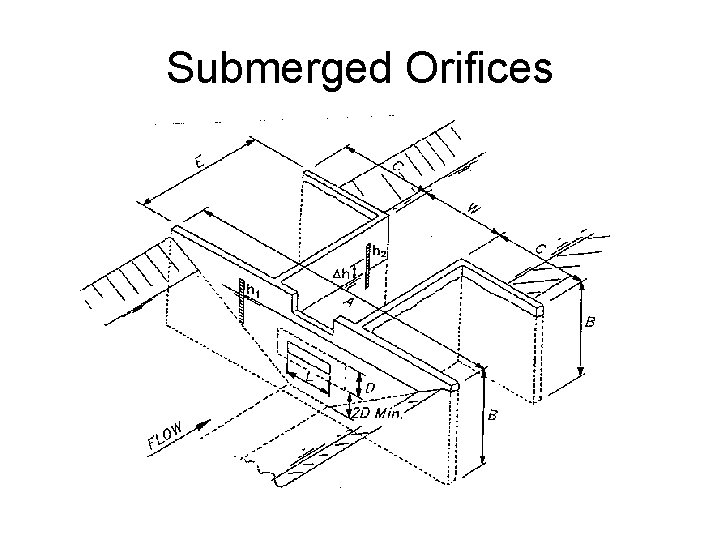
Submerged Orifices A well defined sharp-edged opening in a wall or bulkhead through which flow occurs • When size and shape of the orifice and the heads acting on it are known, flow measurement is possible • Orifices are typically circular or rectangular in shape • Can be used to regulate and measure water in a turnout structure • Radial gates can act as submerged orifices
Submerged Orifices
Submerged Orifices Advantages • Less head required than for weirs • Used where space limitations prevent weir or flume Disadvantages • Sediment and debris accumulation will prevent accurate measuring • Typically not used if conditions permit flumes which handle trash better
Current Meters Velocity measuring devices • Sample velocity at one point – Point sample isn’t representative of average velocity in flow are • Develop relationship between observed and average velocity, or • Take multiple velocity readings • Use continuity equation (Q=v. A) to compute discharge
Current Meters Types of current meters • Anemometer • Propeller • Electromagnetic • Doppler • Optical strobe Anemometer and propeller are most common for irrigation work
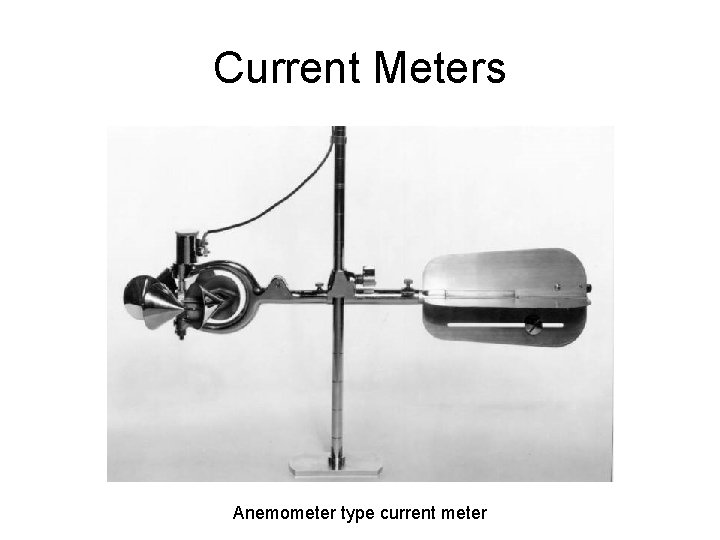
Current Meters Anemometer type current meter
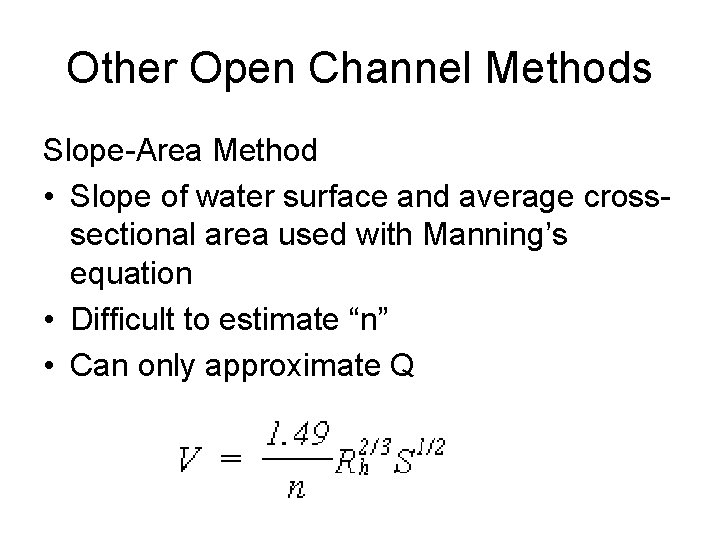
Other Open Channel Methods Slope-Area Method • Slope of water surface and average crosssectional area used with Manning’s equation • Difficult to estimate “n” • Can only approximate Q
Float Method Similar in concept to current meters • Velocity is estimated by timing how long a floating object takes to travel a predetermined distance • Observed velocity is adjusted by some factor to estimate average velocity • Determine cross-sectional flow area • Use continuity equation to estimate Q • Provides only a rough estimate
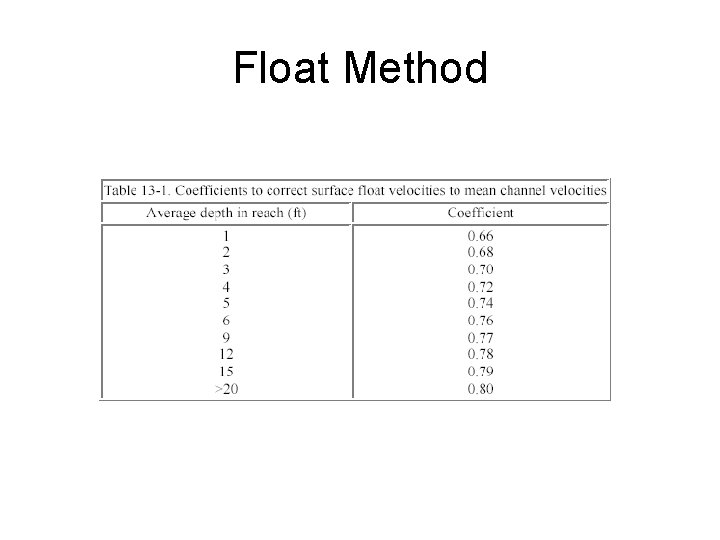
Float Method
Pressurized Conduit Devices Pipeline devices are usually classified by their basic operation • Calibrated velocity sensing meters • Differential head meters • Positive volume displacement summing meters (municipal water) • Measured proportional or calibrated bypass meters • Acoustic meters
Differential Head Meters Include venturi, nozzle, and orifice meters • When properly installed, accuracy ± 1% – Some irrigation operating conditions probably limit accuracy to ± 3 -5% • No moving parts – Uses principle of accelerating flow through a constriction – Resulting pressure difference is related to discharge using tables or curves, or a suitable coefficient and the proper equation
Venturi Meter Common differential head meter • Minimal head loss • Full pipe flow required • Also used to inject chemicals into an irrigation system – Pressure reduction is used to pull chemicals into the system • Examples of venturi meters constructed of standard plastic pipe fittings
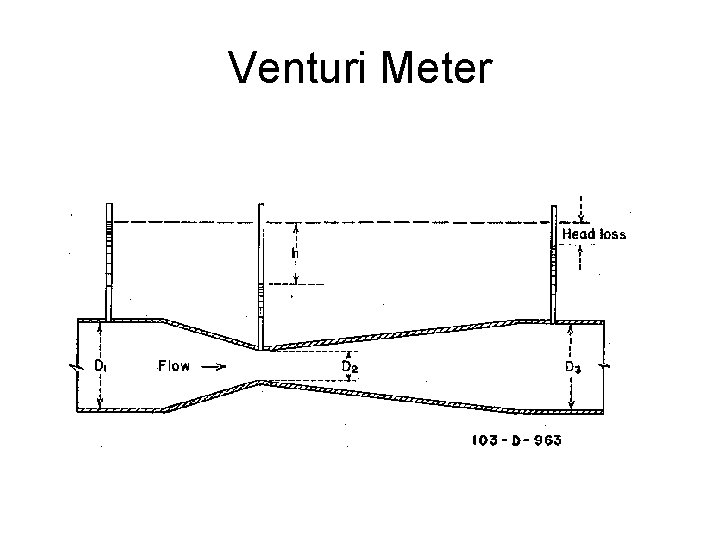
Venturi Meter
Nozzle Meter Simplified form of venturi meter • Gradual downstream expansion of venturi is eliminated • Higher head loss than venturi • Full pipe flow required • Not used extensively in irrigation
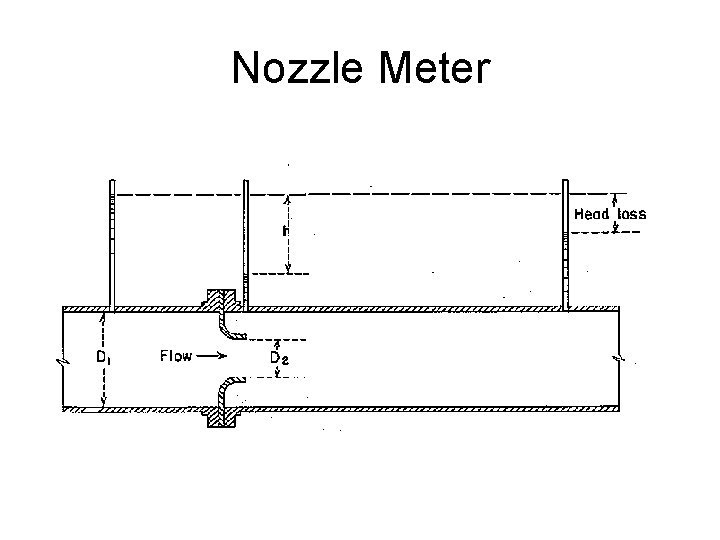
Nozzle Meter
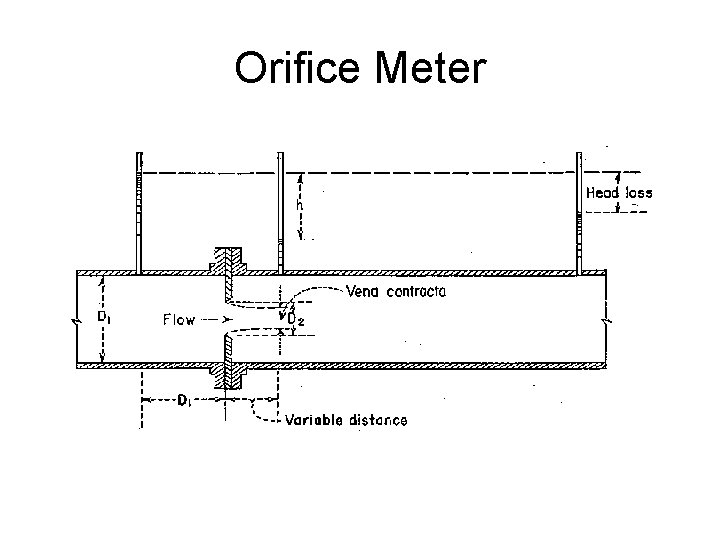
Orifice Meter Another differential pressure meter • Often used for measuring well discharge • Also used to measure chemical injections – Typically small meters with details provided by manufacturer • Requires long straight pipe lengths • Full pipe flow required • Limited discharge ratio
Orifice Meter
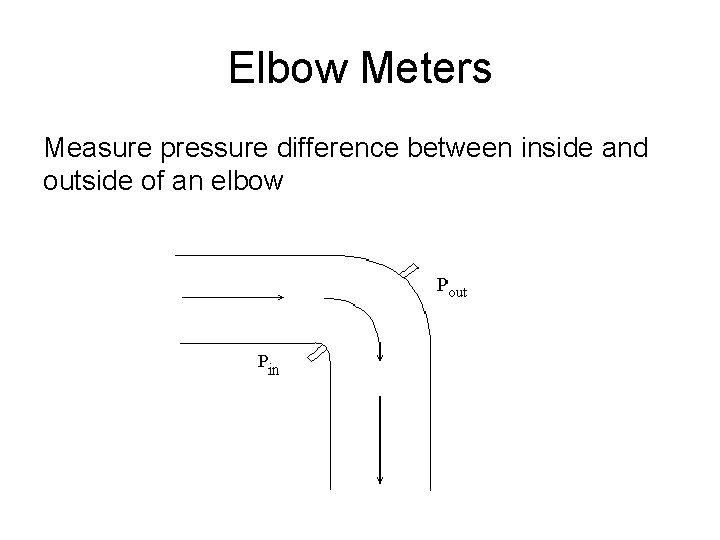
Elbow Meters Measure pressure difference between inside and outside of an elbow
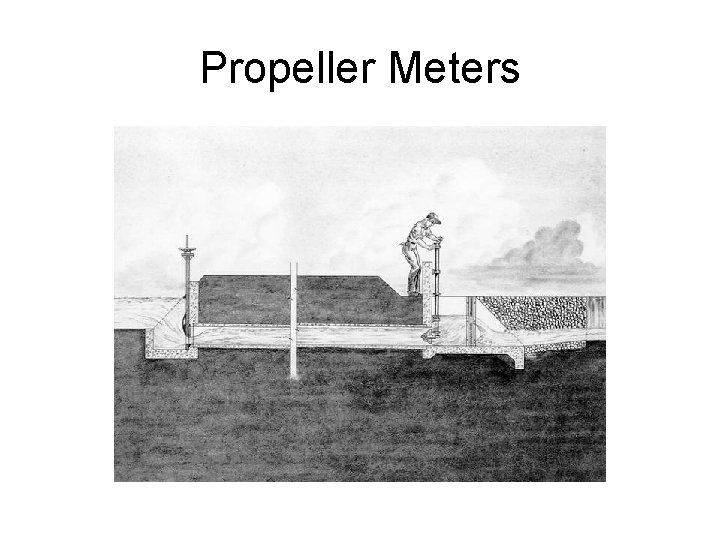
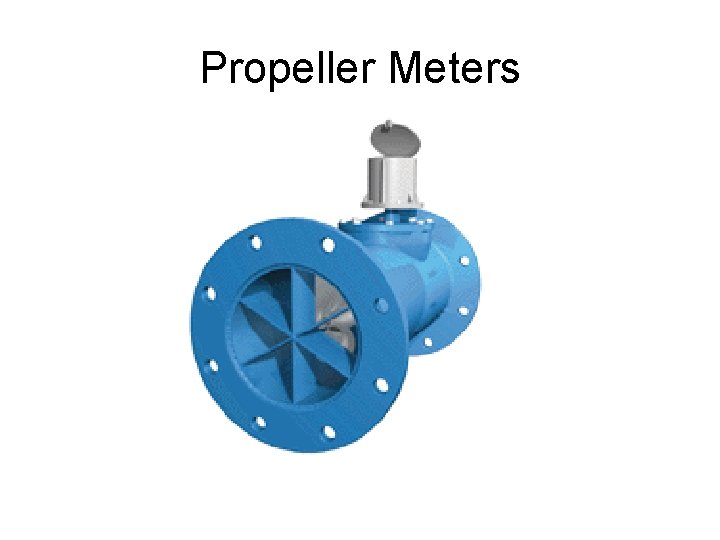
Propeller Meters Used at end of pipes and in conduits flowing full • Multiple blades that rotate on horizontal axle • Must have full pipe flow • Basically operate on Q=v. A principle • Usually have totalizer plus instantaneous discharge display • Accuracy can be ± 2 -5% of actual flow
Propeller Meters
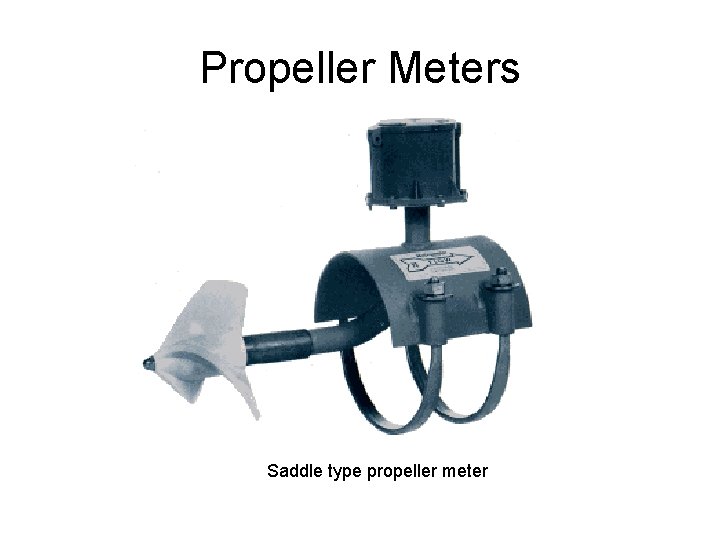
Propeller Meters Saddle type propeller meter
Propeller Meters
Propeller Meters • Should be selected to operate near middle of design discharge range – If system has oversized pipes, some sections may need replaced with smaller pipes to provide correct velocity and approach • Must be installed to manufacturer’s specifications for accurate measurement • Must have full pipe flow
Propeller Meters Advantages • Commercially available • Totalizing meter • Can achieve good accuracy
Propeller Meters Disadvantages • Operating conditions different from manufacturer’s calibration conditions will affect accuracy • Only tolerate small amount of weeds and debris • Moving parts operating underwater • Can require a good deal of maintenance and inspection
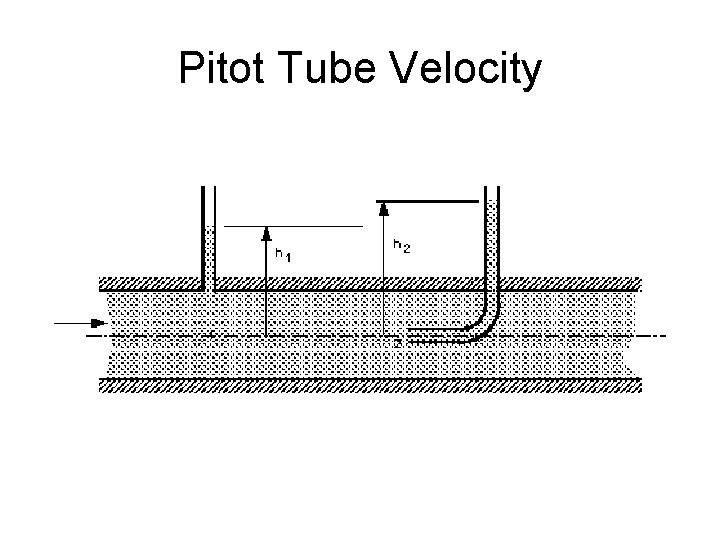
Other Conduit Devices Pitot Tube Velocity Measurements • Piezometer – Straight tube attached flush to wall and perpendicular – Senses pressure head in pipe • Pitot Tube – Right angle bend inserted with horizontal leg pointed upstream and parallel to flow – Senses both velocity and pressure head • Velocity head, flow area, and coefficient can then be used to calculate flow rate
Pitot Tube Velocity
Other Conduit Devices • Magnetic Flowmeters – Use the principle that voltage is induced in an electrical conductor moving through a magnetic field. Conductor is flowing water – For a given field strength, the magnitude of the induced voltage is proportional to velocity • Deflection Meters – Vane or plate projecting into flow and a sensing element to measure deflection – Calibrated to indicate flow in desired units • Vortex Flowmeters – Obstructions in flow generate vortex shedding trails • Properly shaped obstructions create vortices that can be sensed and related to velocity
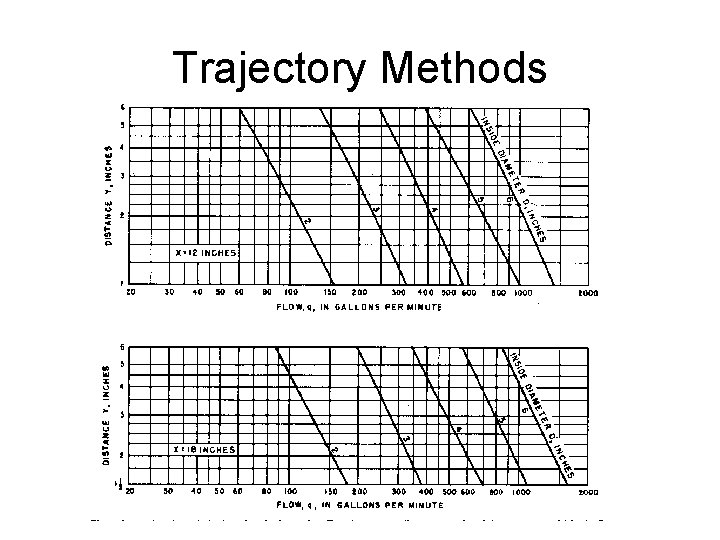
Other Conduit Methods Trajectory Method • Measure the horizontal and vertical coordinates of a point in the jet of water issuing from the end of a pipe • Accurate ± 15% • Coordinates can be difficult to accurately measure
Trajectory Method • Vertical Pipe • Two kinds of flow occur, depending on how high water rises – <0. 37 d, circular weir – Transistional region between – >1. 4 d, jet flow • Horizontal Pipe – Pipe must be truly horizontal; slope will skew results • Vertical component can be difficult to measure
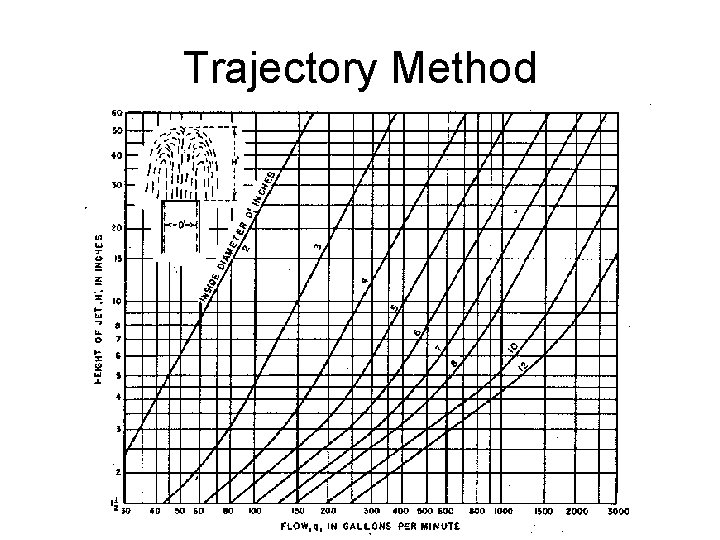
Trajectory Method
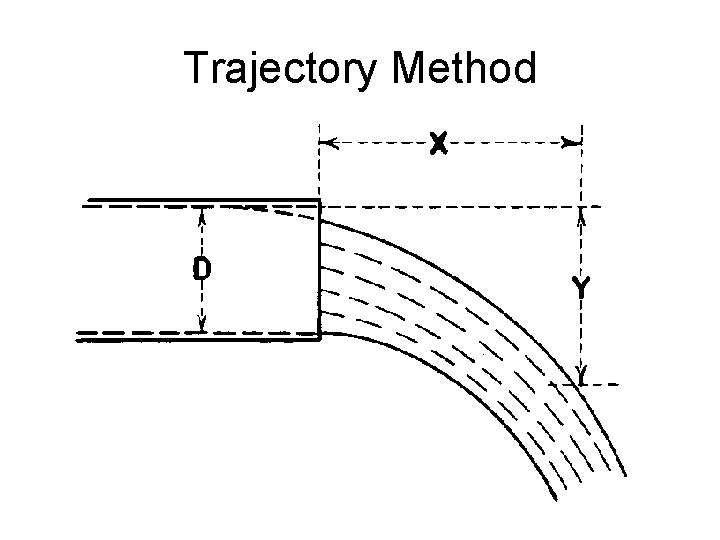
Trajectory Method
Trajectory Methods
Other Conduit Methods Power Consumption Coefficients • Volume discharged from wells can be estimated using power consumption records – Wells must be analyzed to determine the energy needed to pump a certain volume of water – Relationship can then be used to estimate discharge volume – Only certified well testers can perform the tests and develop the power consumption coefficient – Must recalibrate every 4 years, or more often depending on conditions
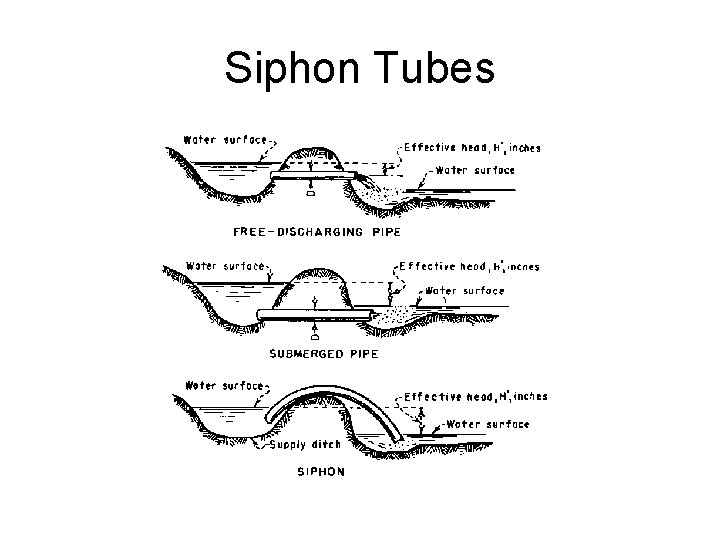
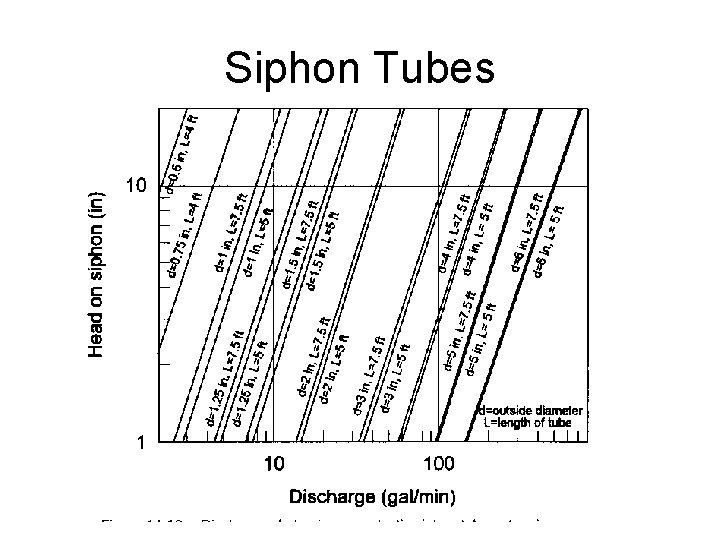
Other Conduit Methods Siphon Tubes • Estimate discharge based on head, diameter, and length of siphon tubes • Accuracy ± 10 -15% • Provides an in-field method of estimating flow • Information also available in irrigator’s guides and NRCS Engineering Field Manual, Chapter 15
Siphon Tubes
Siphon Tubes
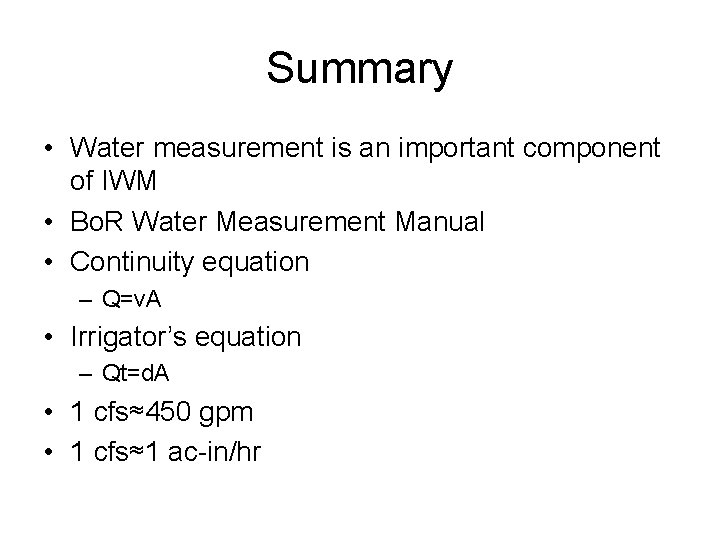
Summary • Water measurement is an important component of IWM • Bo. R Water Measurement Manual • Continuity equation – Q=v. A • Irrigator’s equation – Qt=d. A • 1 cfs≈450 gpm • 1 cfs≈1 ac-in/hr
Summary • Open channel devices – Flumes – Weirs – Submerged orifices • Pressurized conduit devices – Propeller meters – Differential head meters
Summary • Installation requirements – Examine existing structures • Other opportunities for measurement – Canal gates – Float method – Power consumption coefficient – Pipe trajectory – Siphon tubes

Questions?

- Slides: 120