
Water Management in Process Plants David Puckett Dbora
Water Management in Process Plants David Puckett Débora Campos de Faria Miguel J. Bagajewicz
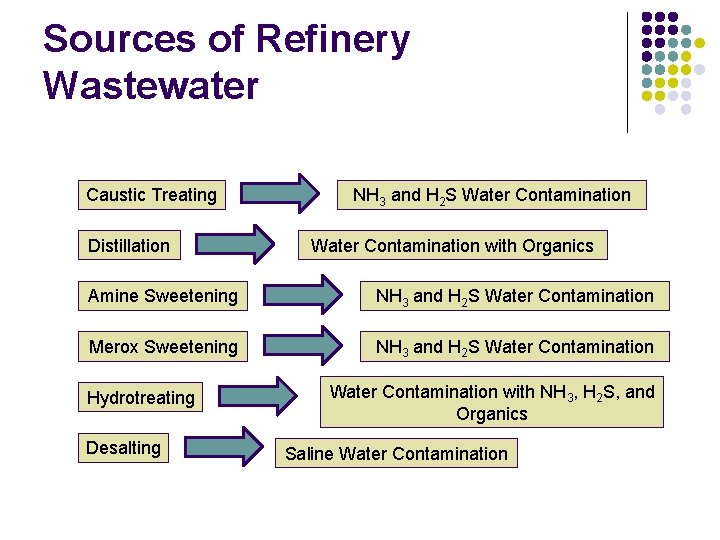
Sources of Refinery Wastewater Caustic Treating Distillation NH 3 and H 2 S Water Contamination with Organics Amine Sweetening NH 3 and H 2 S Water Contamination Merox Sweetening NH 3 and H 2 S Water Contamination Hydrotreating Desalting Water Contamination with NH 3, H 2 S, and Organics Saline Water Contamination
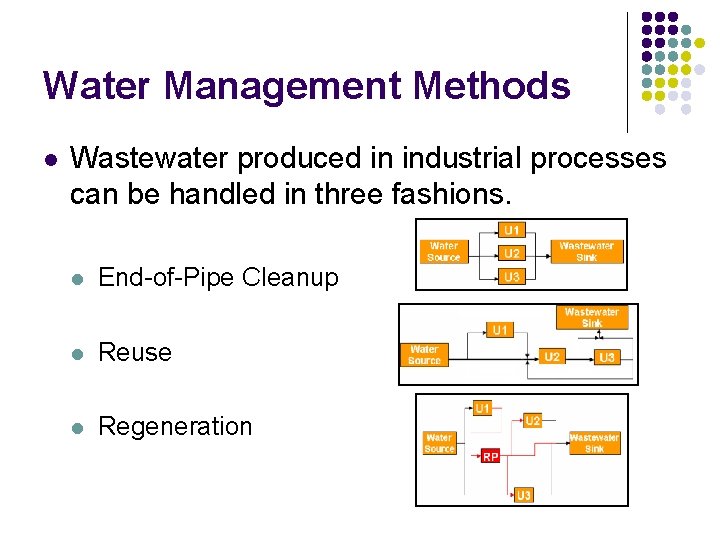
Water Management Methods l Wastewater produced in industrial processes can be handled in three fashions. l End-of-Pipe Cleanup l Reuse l Regeneration
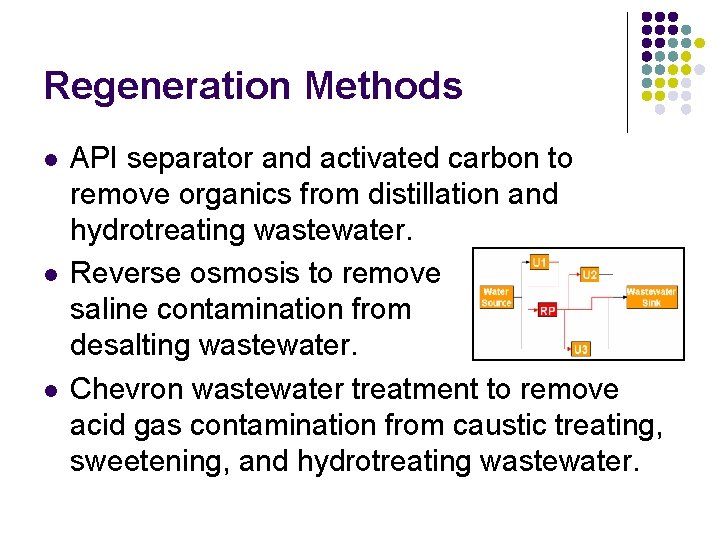
Regeneration Methods l l l API separator and activated carbon to remove organics from distillation and hydrotreating wastewater. Reverse osmosis to remove saline contamination from desalting wastewater. Chevron wastewater treatment to remove acid gas contamination from caustic treating, sweetening, and hydrotreating wastewater.

Wastewater Optimization l Current methods of optimizing water reuse and regeneration rely on several assumptions. l Operating and capital costs are functions solely of treated water flow rate. l Fixed process outlet concentrations.
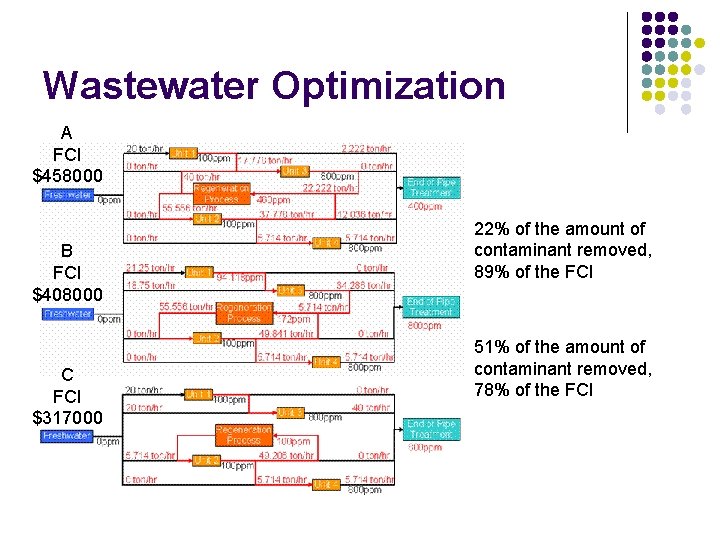
Wastewater Optimization A FCI $458000 B FCI $408000 C FCI $317000 22% of the amount of contaminant removed, 89% of the FCI 51% of the amount of contaminant removed, 78% of the FCI
Wastewater Optimization l Depending on the contaminants present and the treatment processes used, the assumption that regeneration costs are dependent solely on flow rate may not be valid. l The optimum solution for a water allocation problem must take into account factors other than flow rate.
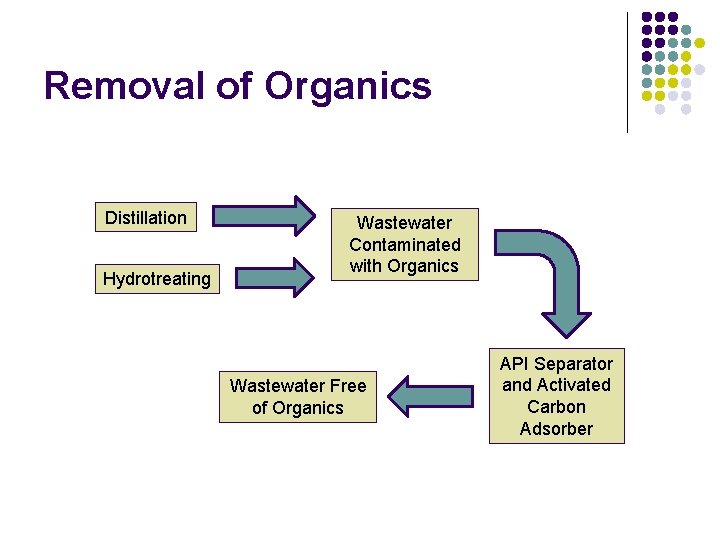
Removal of Organics Distillation Hydrotreating Wastewater Contaminated with Organics Wastewater Free of Organics API Separator and Activated Carbon Adsorber
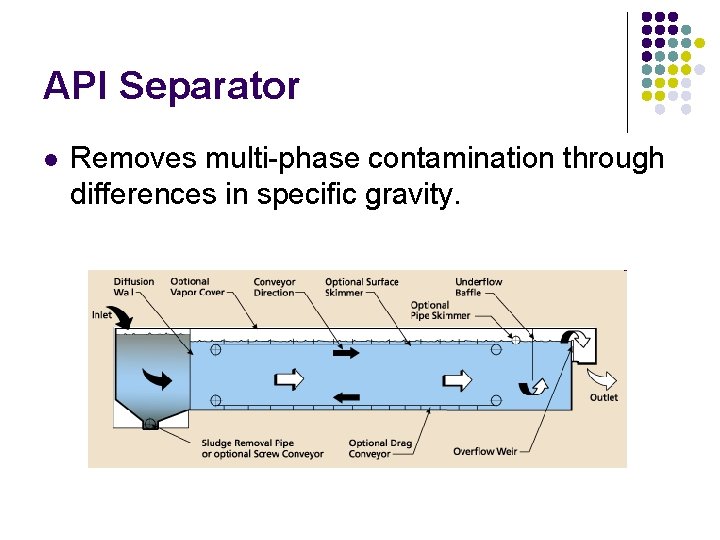
API Separator l Removes multi-phase contamination through differences in specific gravity.
API Separator l Appropriate for use with any contaminant that forms a distinct phase in the process water. l Oil and Light Organics l Organic and Inorganic Sediment
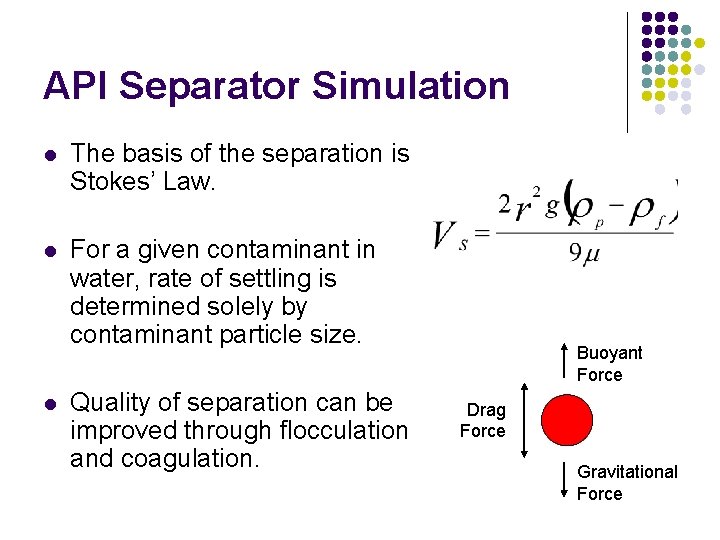
API Separator Simulation l The basis of the separation is Stokes’ Law. l For a given contaminant in water, rate of settling is determined solely by contaminant particle size. l Quality of separation can be improved through flocculation and coagulation. Buoyant Force Drag Force Gravitational Force

API Separator Simulation l l Process water contaminant concentration does not change quality of separation. Percentage of contaminants removed on a volume basis determined based on a normal distribution of particle radii.
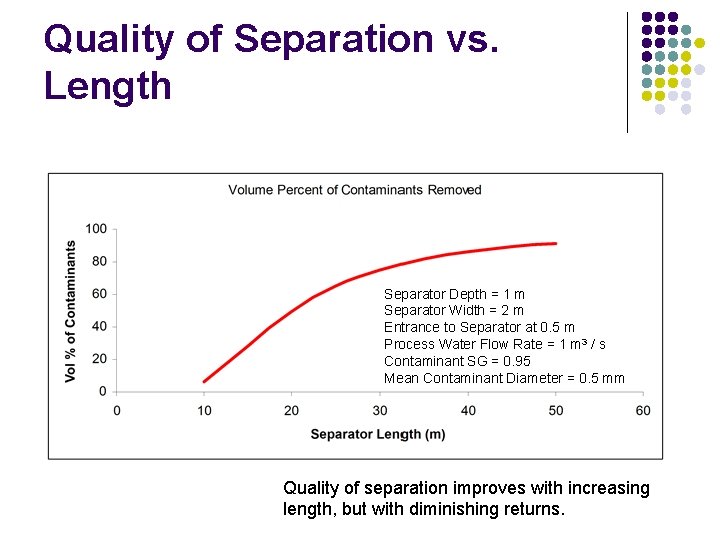
Quality of Separation vs. Length Separator Depth = 1 m Separator Width = 2 m Entrance to Separator at 0. 5 m Process Water Flow Rate = 1 m 3 / s Contaminant SG = 0. 95 Mean Contaminant Diameter = 0. 5 mm Quality of separation improves with increasing length, but with diminishing returns.
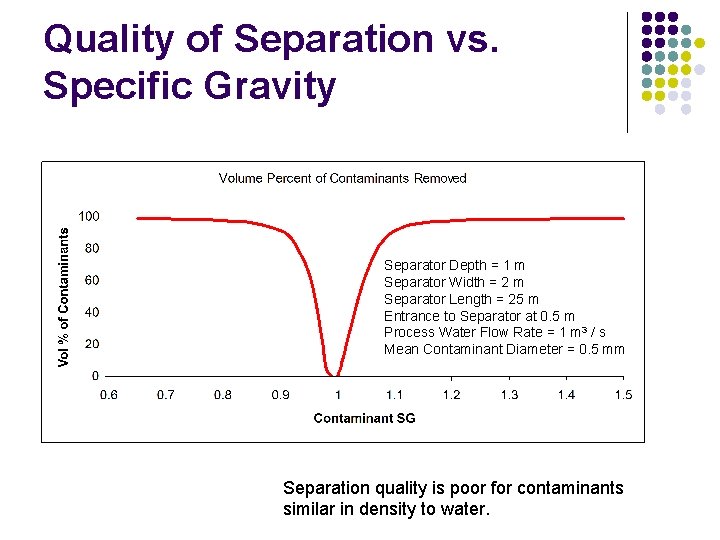
Quality of Separation vs. Specific Gravity Separator Depth = 1 m Separator Width = 2 m Separator Length = 25 m Entrance to Separator at 0. 5 m Process Water Flow Rate = 1 m 3 / s Mean Contaminant Diameter = 0. 5 mm Separation quality is poor for contaminants similar in density to water.
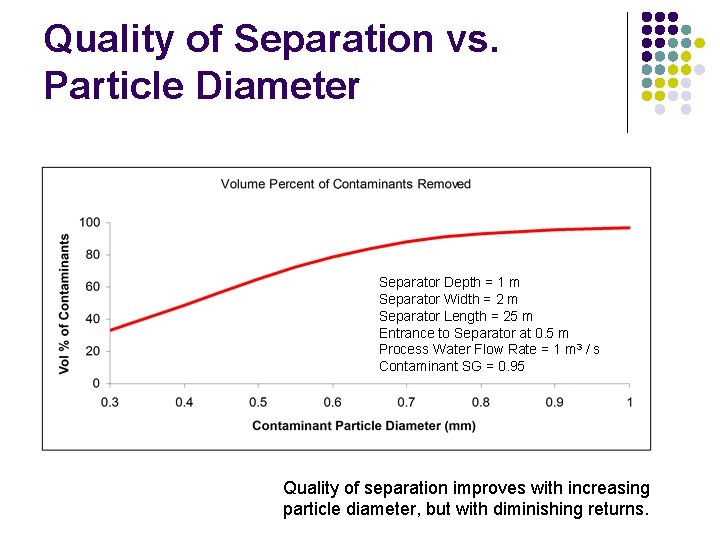
Quality of Separation vs. Particle Diameter Separator Depth = 1 m Separator Width = 2 m Separator Length = 25 m Entrance to Separator at 0. 5 m Process Water Flow Rate = 1 m 3 / s Contaminant SG = 0. 95 Quality of separation improves with increasing particle diameter, but with diminishing returns.
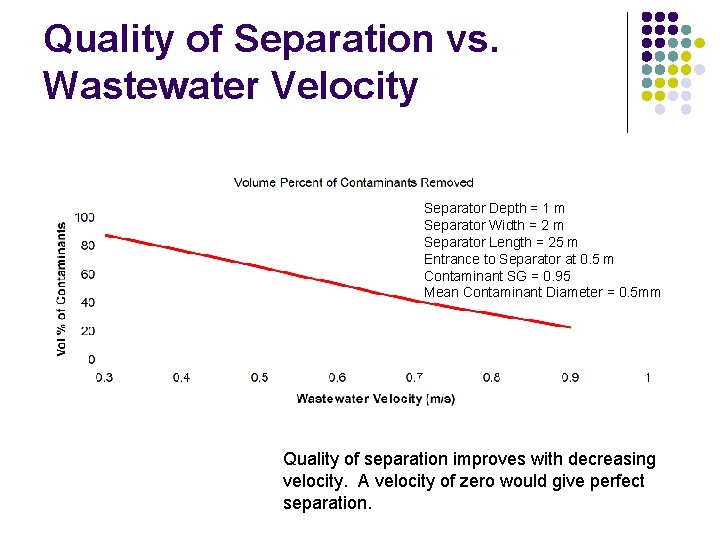
Quality of Separation vs. Wastewater Velocity Separator Depth = 1 m Separator Width = 2 m Separator Length = 25 m Entrance to Separator at 0. 5 m Contaminant SG = 0. 95 Mean Contaminant Diameter = 0. 5 mm Quality of separation improves with decreasing velocity. A velocity of zero would give perfect separation.
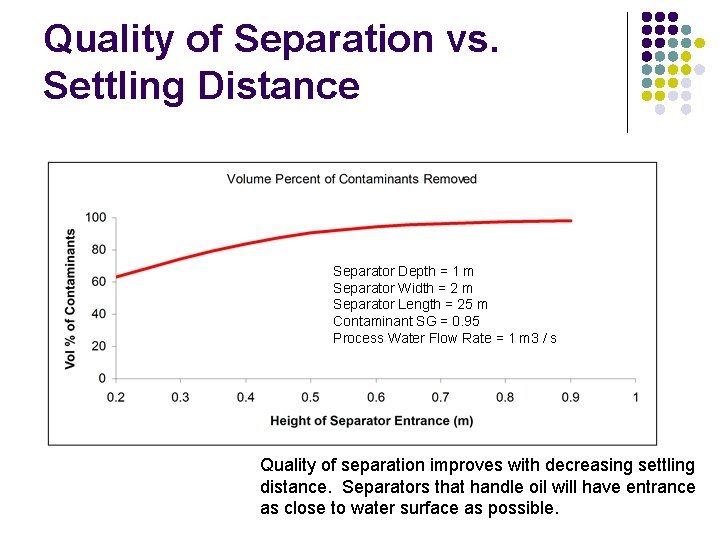
Quality of Separation vs. Settling Distance Separator Depth = 1 m Separator Width = 2 m Separator Length = 25 m Contaminant SG = 0. 95 Process Water Flow Rate = 1 m 3 / s Quality of separation improves with decreasing settling distance. Separators that handle oil will have entrance as close to water surface as possible.
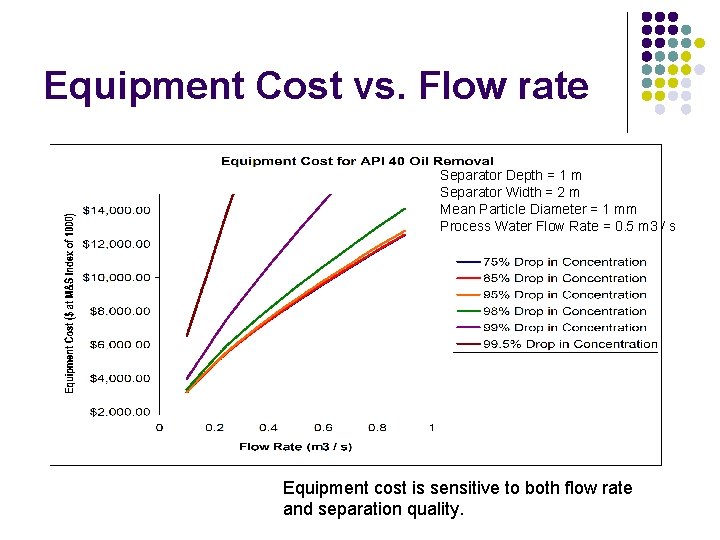
Equipment Cost vs. Flow rate Separator Depth = 1 m Separator Width = 2 m Mean Particle Diameter = 1 mm Process Water Flow Rate = 0. 5 m 3 / s Equipment cost is sensitive to both flow rate and separation quality.
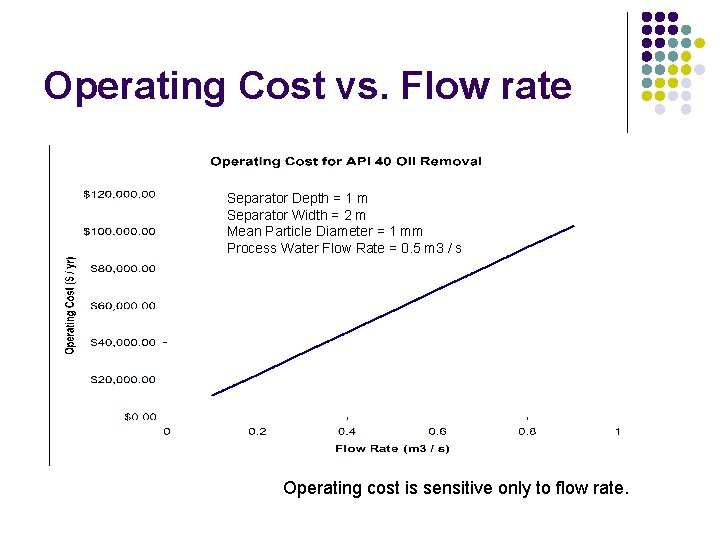
Operating Cost vs. Flow rate Separator Depth = 1 m Separator Width = 2 m Mean Particle Diameter = 1 mm Process Water Flow Rate = 0. 5 m 3 / s Operating cost is sensitive only to flow rate.
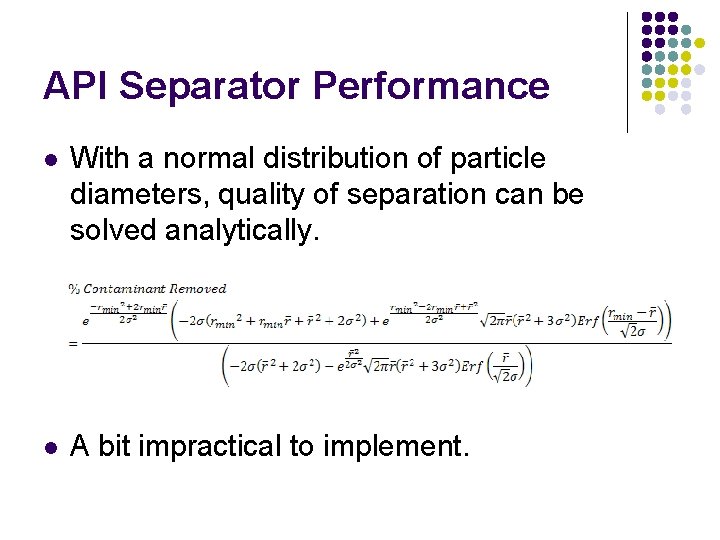
API Separator Performance l With a normal distribution of particle diameters, quality of separation can be solved analytically. l A bit impractical to implement.
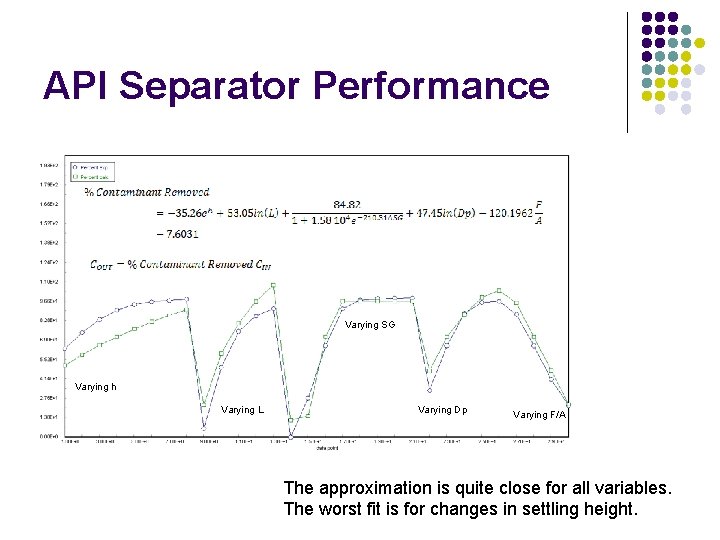
API Separator Performance Varying SG Varying h Varying L Varying Dp Varying F/A The approximation is quite close for all variables. The worst fit is for changes in settling height.
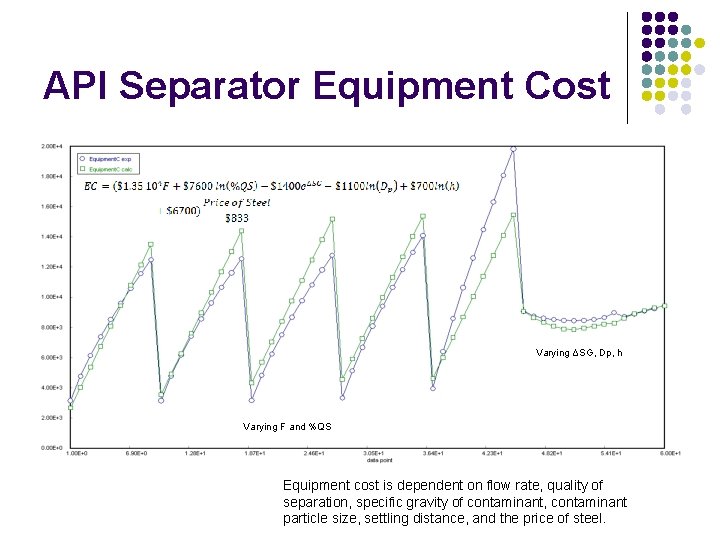
API Separator Equipment Cost Varying ΔSG, Dp, h Varying F and %QS Equipment cost is dependent on flow rate, quality of separation, specific gravity of contaminant, contaminant particle size, settling distance, and the price of steel.
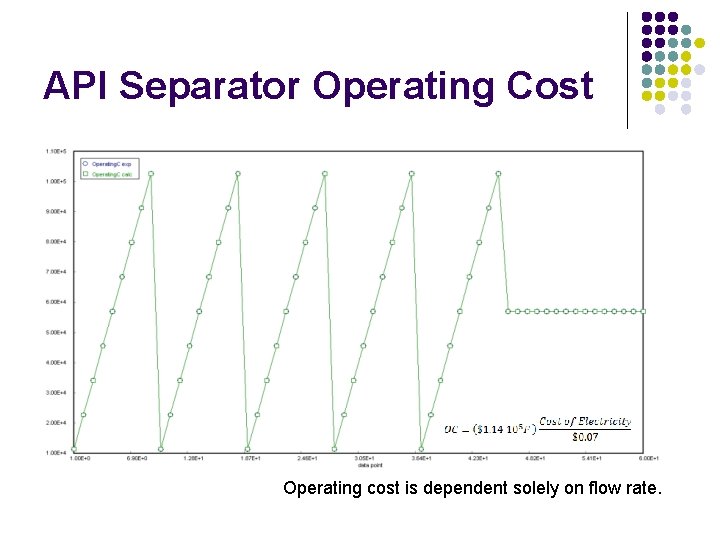
API Separator Operating Cost Operating cost is dependent solely on flow rate.
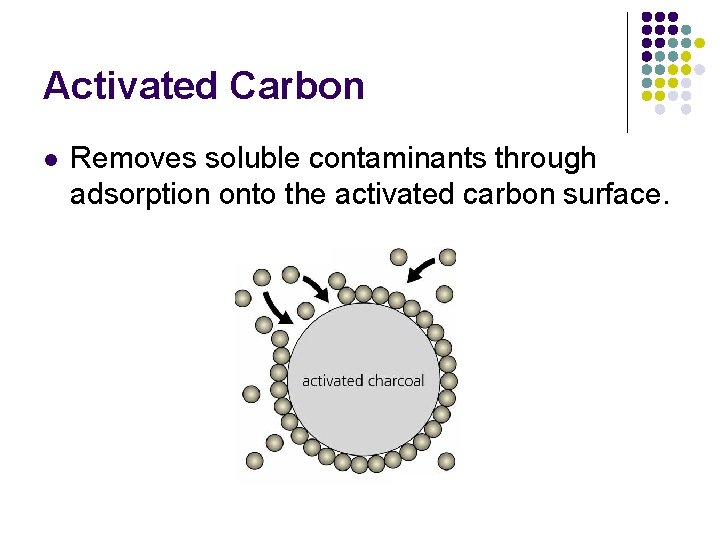
Activated Carbon l Removes soluble contaminants through adsorption onto the activated carbon surface.
Activated Carbon l Appropriate for use with liquid or gaseous contaminants that are water soluble or form emulsions. l Dissolved Organics l Insoluble Organics of < 150 microns Droplet Size l Dissolved Gases
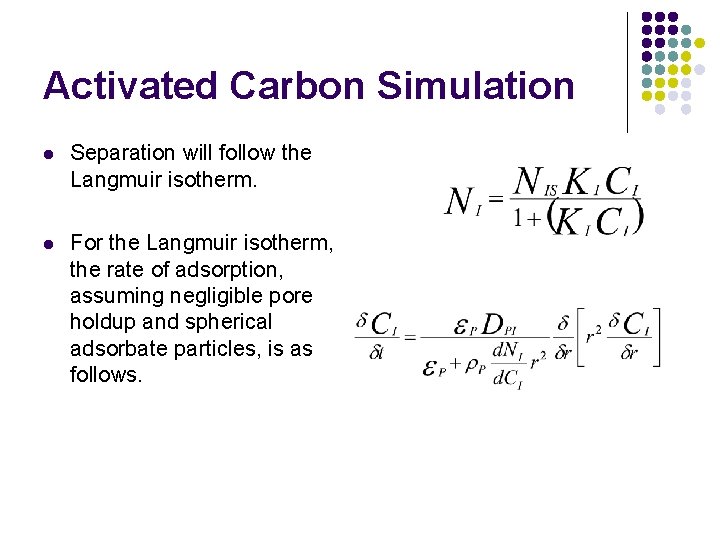
Activated Carbon Simulation l Separation will follow the Langmuir isotherm. l For the Langmuir isotherm, the rate of adsorption, assuming negligible pore holdup and spherical adsorbate particles, is as follows.
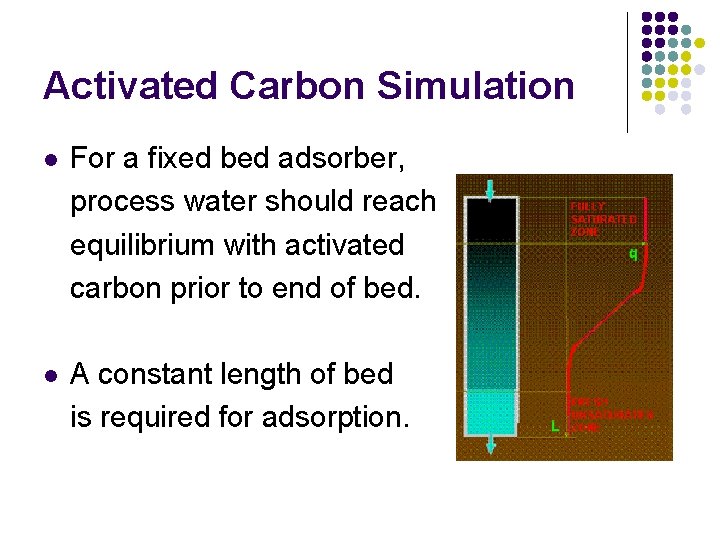
Activated Carbon Simulation l For a fixed bed adsorber, process water should reach equilibrium with activated carbon prior to end of bed. l A constant length of bed is required for adsorption.
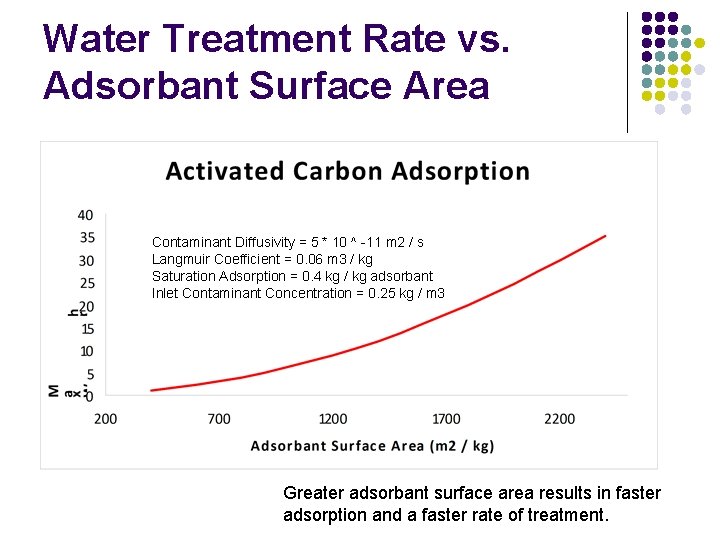
Water Treatment Rate vs. Adsorbant Surface Area Contaminant Diffusivity = 5 * 10 ^ -11 m 2 / s Langmuir Coefficient = 0. 06 m 3 / kg Saturation Adsorption = 0. 4 kg / kg adsorbant Inlet Contaminant Concentration = 0. 25 kg / m 3 Greater adsorbant surface area results in faster adsorption and a faster rate of treatment.
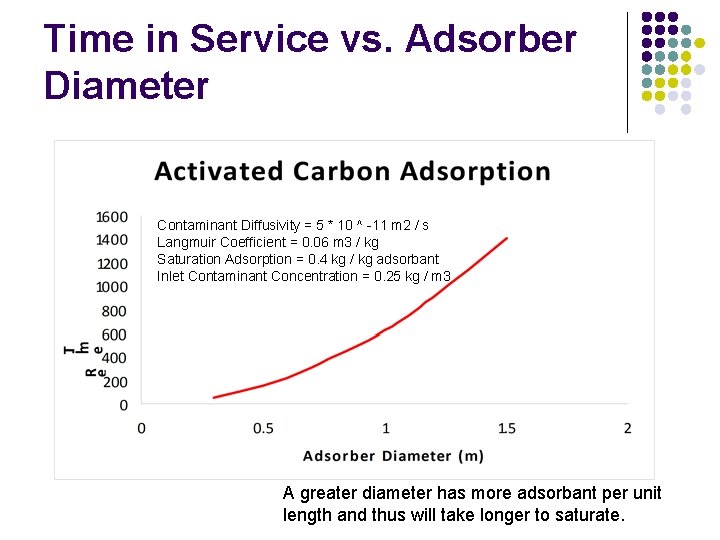
Time in Service vs. Adsorber Diameter Contaminant Diffusivity = 5 * 10 ^ -11 m 2 / s Langmuir Coefficient = 0. 06 m 3 / kg Saturation Adsorption = 0. 4 kg / kg adsorbant Inlet Contaminant Concentration = 0. 25 kg / m 3 A greater diameter has more adsorbant per unit length and thus will take longer to saturate.
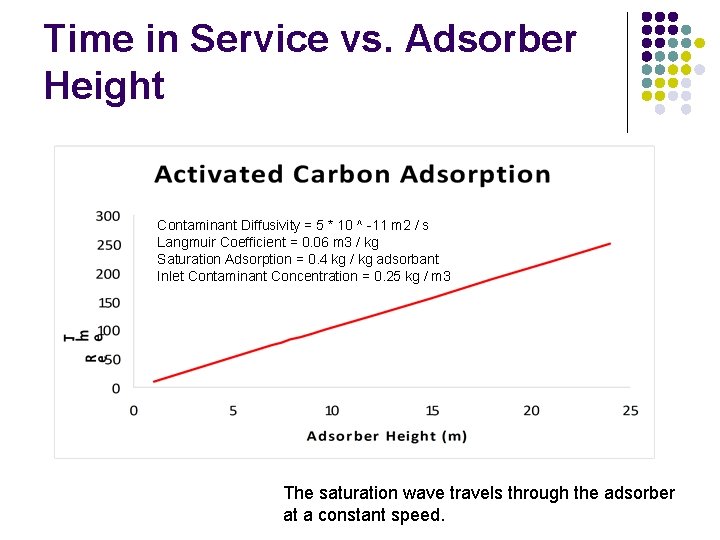
Time in Service vs. Adsorber Height Contaminant Diffusivity = 5 * 10 ^ -11 m 2 / s Langmuir Coefficient = 0. 06 m 3 / kg Saturation Adsorption = 0. 4 kg / kg adsorbant Inlet Contaminant Concentration = 0. 25 kg / m 3 The saturation wave travels through the adsorber at a constant speed.
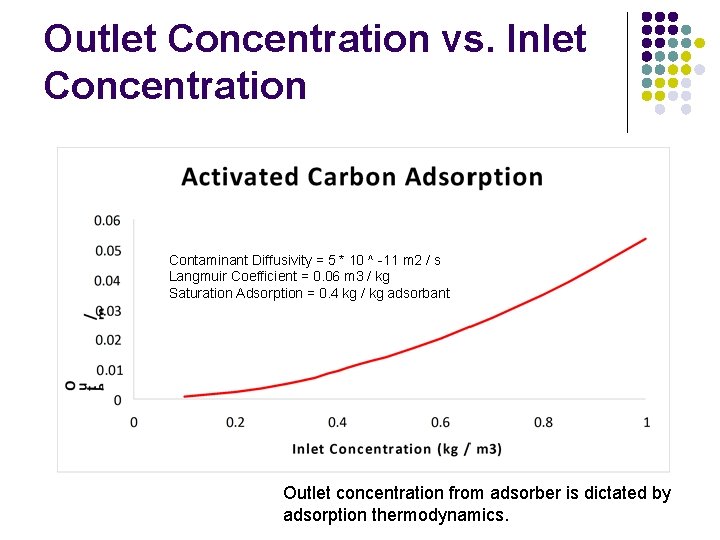
Outlet Concentration vs. Inlet Concentration Contaminant Diffusivity = 5 * 10 ^ -11 m 2 / s Langmuir Coefficient = 0. 06 m 3 / kg Saturation Adsorption = 0. 4 kg / kg adsorbant Outlet concentration from adsorber is dictated by adsorption thermodynamics.
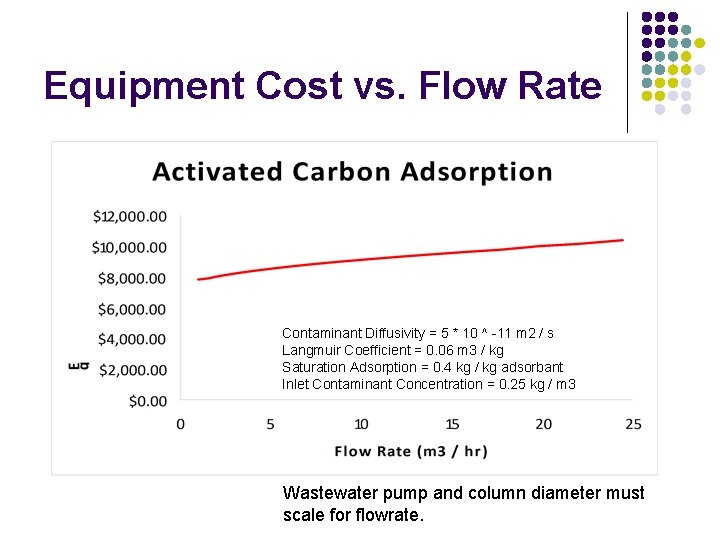
Equipment Cost vs. Flow Rate Contaminant Diffusivity = 5 * 10 ^ -11 m 2 / s Langmuir Coefficient = 0. 06 m 3 / kg Saturation Adsorption = 0. 4 kg / kg adsorbant Inlet Contaminant Concentration = 0. 25 kg / m 3 Wastewater pump and column diameter must scale for flowrate.
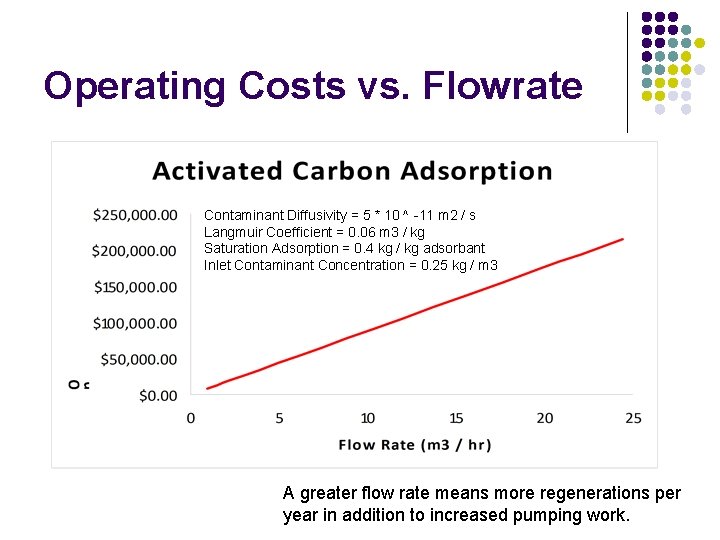
Operating Costs vs. Flowrate Contaminant Diffusivity = 5 * 10 ^ -11 m 2 / s Langmuir Coefficient = 0. 06 m 3 / kg Saturation Adsorption = 0. 4 kg / kg adsorbant Inlet Contaminant Concentration = 0. 25 kg / m 3 A greater flow rate means more regenerations per year in addition to increased pumping work.
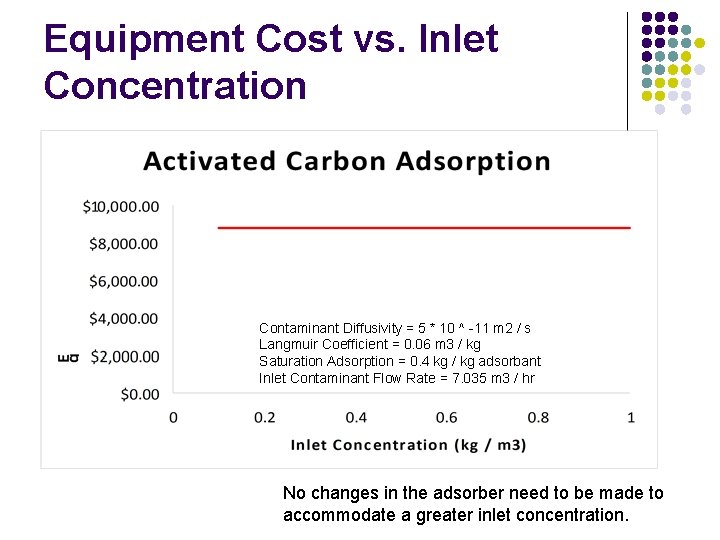
Equipment Cost vs. Inlet Concentration Contaminant Diffusivity = 5 * 10 ^ -11 m 2 / s Langmuir Coefficient = 0. 06 m 3 / kg Saturation Adsorption = 0. 4 kg / kg adsorbant Inlet Contaminant Flow Rate = 7. 035 m 3 / hr No changes in the adsorber need to be made to accommodate a greater inlet concentration.
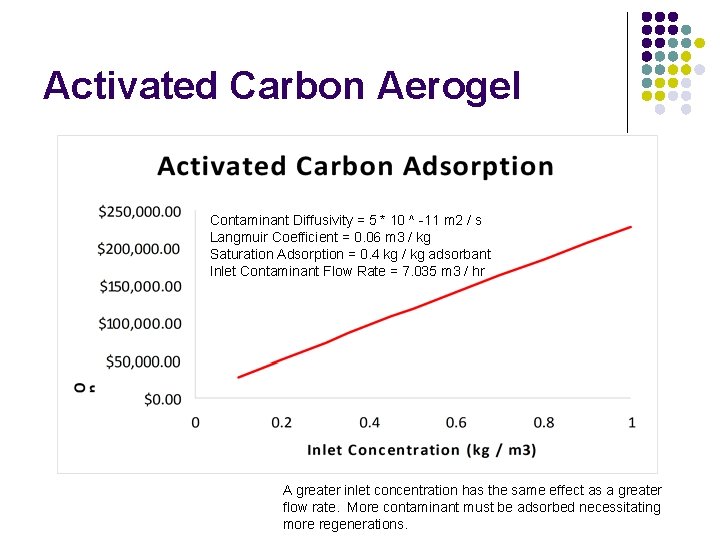
Activated Carbon Aerogel Contaminant Diffusivity = 5 * 10 ^ -11 m 2 / s Langmuir Coefficient = 0. 06 m 3 / kg Saturation Adsorption = 0. 4 kg / kg adsorbant Inlet Contaminant Flow Rate = 7. 035 m 3 / hr A greater inlet concentration has the same effect as a greater flow rate. More contaminant must be adsorbed necessitating more regenerations.
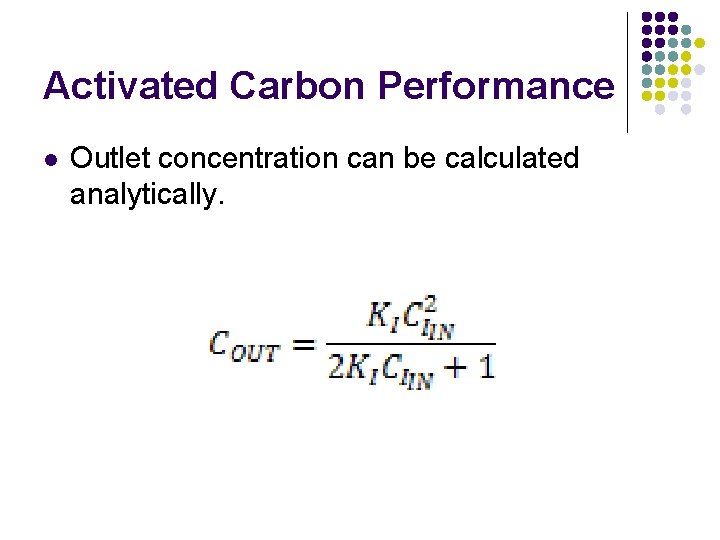
Activated Carbon Performance l Outlet concentration can be calculated analytically.
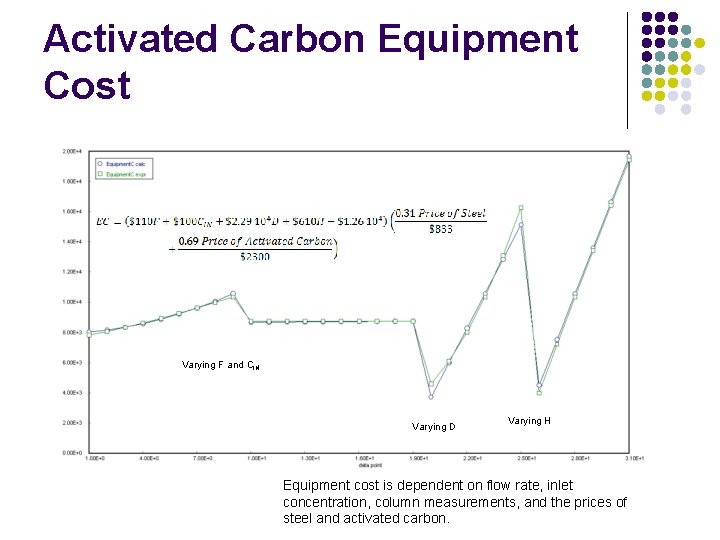
Activated Carbon Equipment Cost Varying F and CIN Varying D Varying H Equipment cost is dependent on flow rate, inlet concentration, column measurements, and the prices of steel and activated carbon.
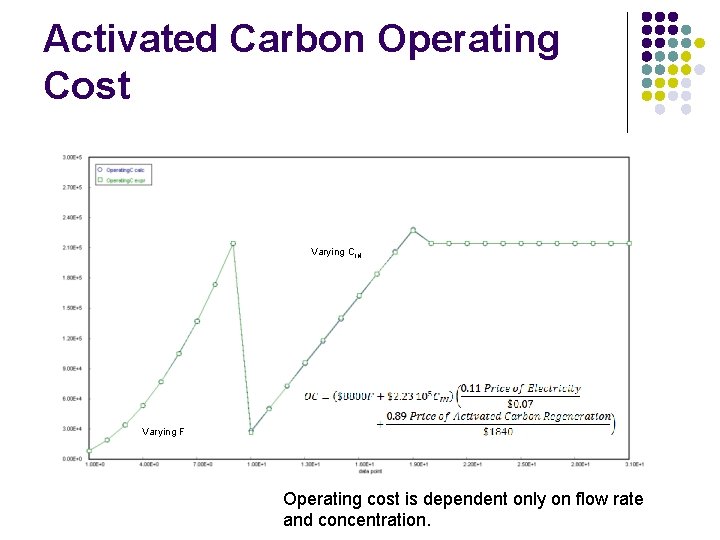
Activated Carbon Operating Cost Varying CIN Varying F Operating cost is dependent only on flow rate and concentration.
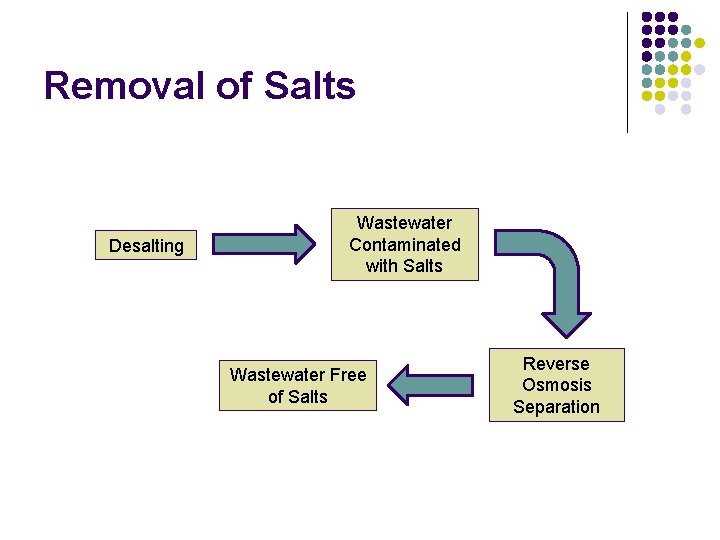
Removal of Salts Desalting Wastewater Contaminated with Salts Wastewater Free of Salts Reverse Osmosis Separation
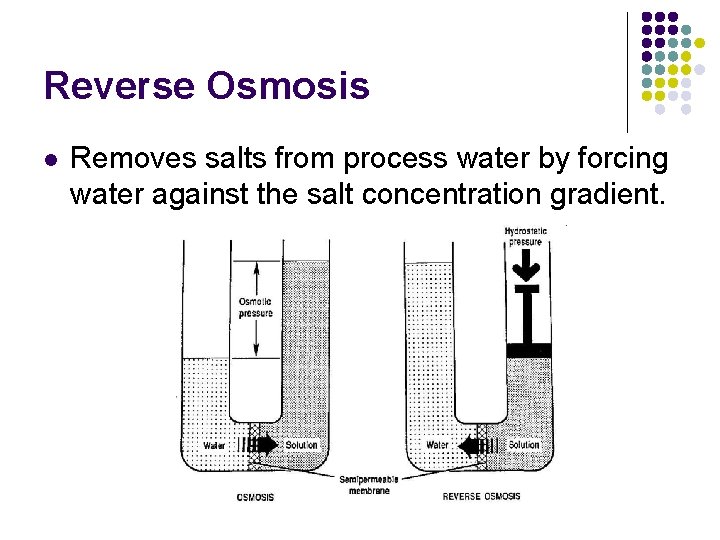
Reverse Osmosis l Removes salts from process water by forcing water against the salt concentration gradient.
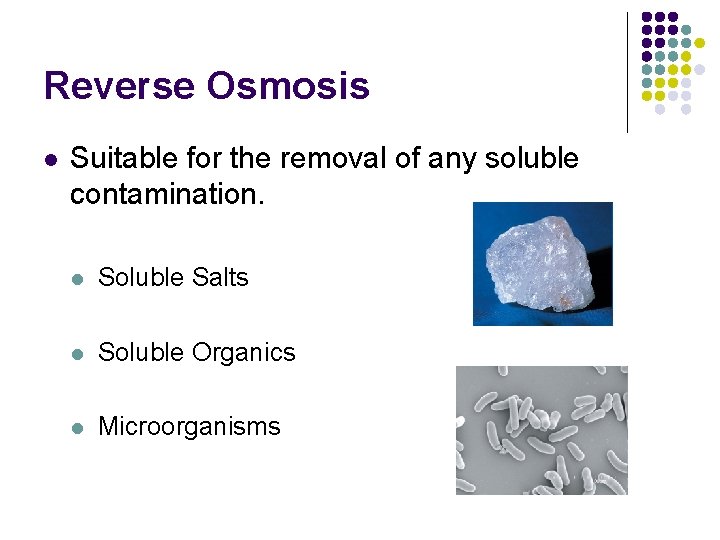
Reverse Osmosis l Suitable for the removal of any soluble contamination. l Soluble Salts l Soluble Organics l Microorganisms
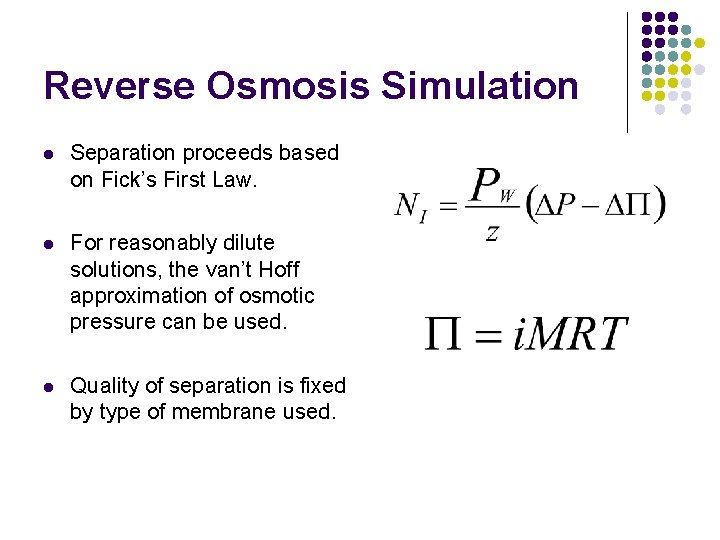
Reverse Osmosis Simulation l Separation proceeds based on Fick’s First Law. l For reasonably dilute solutions, the van’t Hoff approximation of osmotic pressure can be used. l Quality of separation is fixed by type of membrane used.
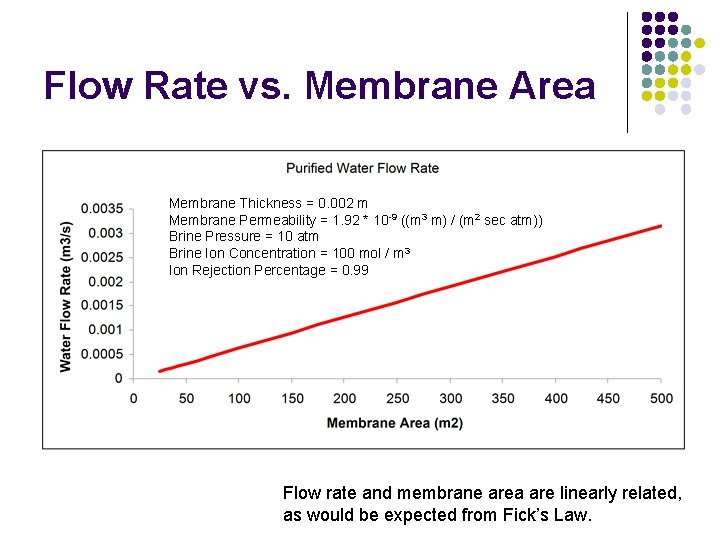
Flow Rate vs. Membrane Area Membrane Thickness = 0. 002 m Membrane Permeability = 1. 92 * 10 -9 ((m 3 m) / (m 2 sec atm)) Brine Pressure = 10 atm Brine Ion Concentration = 100 mol / m 3 Ion Rejection Percentage = 0. 99 Flow rate and membrane area are linearly related, as would be expected from Fick’s Law.
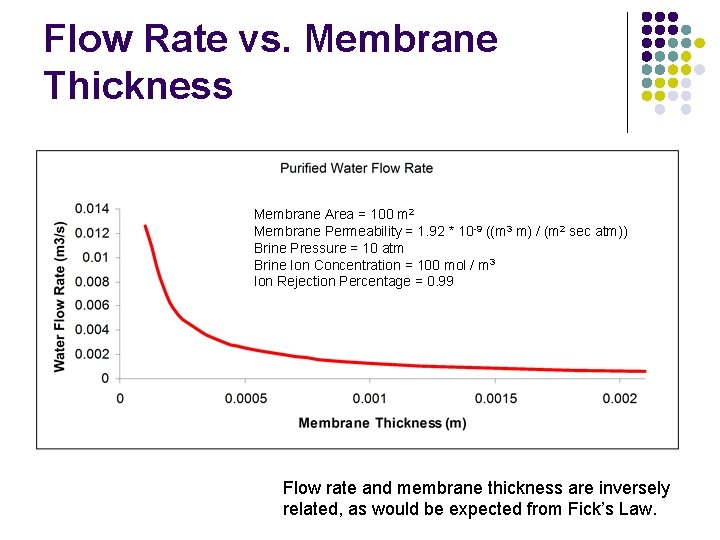
Flow Rate vs. Membrane Thickness Membrane Area = 100 m 2 Membrane Permeability = 1. 92 * 10 -9 ((m 3 m) / (m 2 sec atm)) Brine Pressure = 10 atm Brine Ion Concentration = 100 mol / m 3 Ion Rejection Percentage = 0. 99 Flow rate and membrane thickness are inversely related, as would be expected from Fick’s Law.
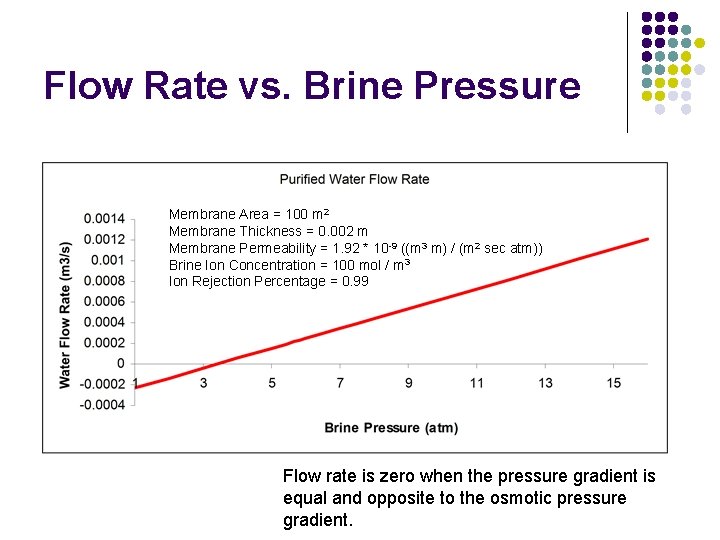
Flow Rate vs. Brine Pressure Membrane Area = 100 m 2 Membrane Thickness = 0. 002 m Membrane Permeability = 1. 92 * 10 -9 ((m 3 m) / (m 2 sec atm)) Brine Ion Concentration = 100 mol / m 3 Ion Rejection Percentage = 0. 99 Flow rate is zero when the pressure gradient is equal and opposite to the osmotic pressure gradient.
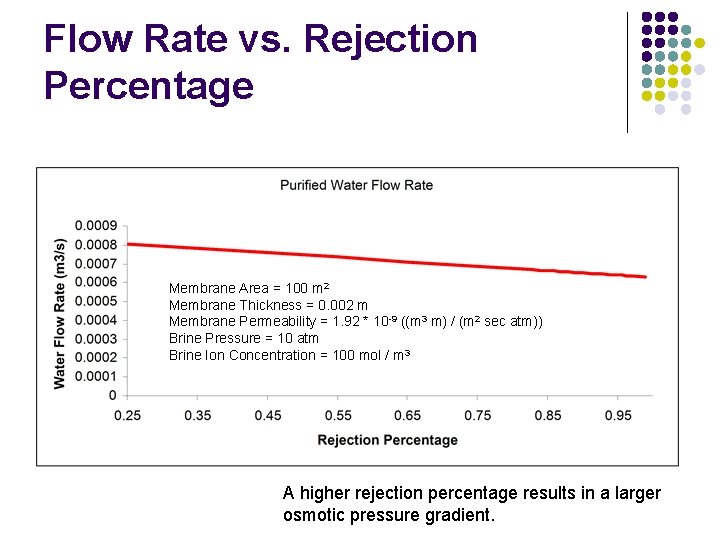
Flow Rate vs. Rejection Percentage Membrane Area = 100 m 2 Membrane Thickness = 0. 002 m Membrane Permeability = 1. 92 * 10 -9 ((m 3 m) / (m 2 sec atm)) Brine Pressure = 10 atm Brine Ion Concentration = 100 mol / m 3 A higher rejection percentage results in a larger osmotic pressure gradient.
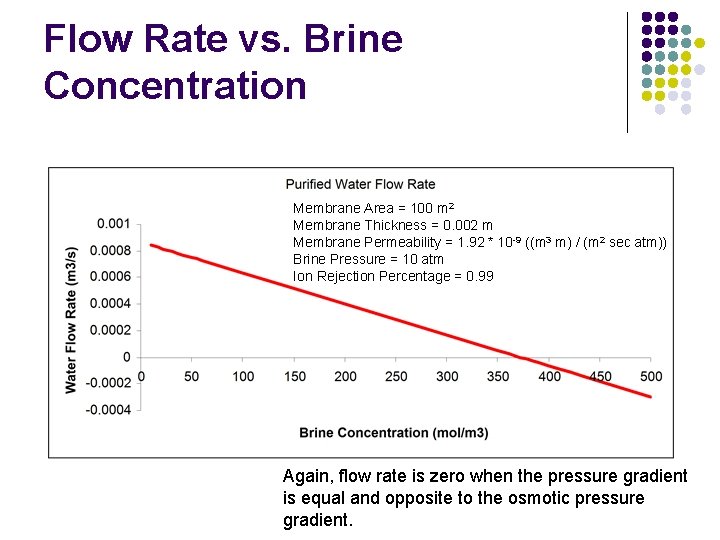
Flow Rate vs. Brine Concentration Membrane Area = 100 m 2 Membrane Thickness = 0. 002 m Membrane Permeability = 1. 92 * 10 -9 ((m 3 m) / (m 2 sec atm)) Brine Pressure = 10 atm Ion Rejection Percentage = 0. 99 Again, flow rate is zero when the pressure gradient is equal and opposite to the osmotic pressure gradient.
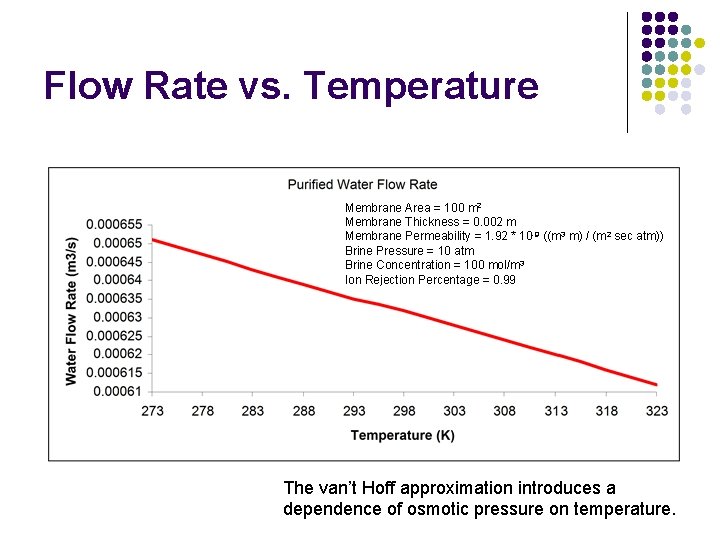
Flow Rate vs. Temperature Membrane Area = 100 m 2 Membrane Thickness = 0. 002 m Membrane Permeability = 1. 92 * 10 -9 ((m 3 m) / (m 2 sec atm)) Brine Pressure = 10 atm Brine Concentration = 100 mol/m 3 Ion Rejection Percentage = 0. 99 The van’t Hoff approximation introduces a dependence of osmotic pressure on temperature.
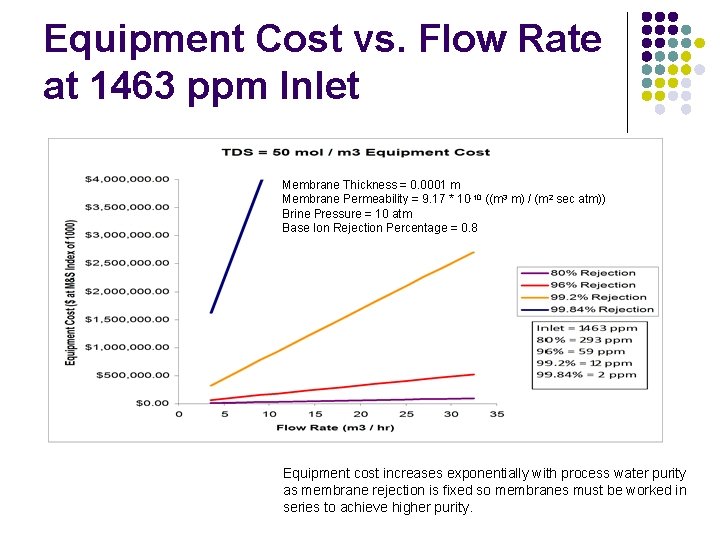
Equipment Cost vs. Flow Rate at 1463 ppm Inlet Membrane Thickness = 0. 0001 m Membrane Permeability = 9. 17 * 10 -10 ((m 3 m) / (m 2 sec atm)) Brine Pressure = 10 atm Base Ion Rejection Percentage = 0. 8 Equipment cost increases exponentially with process water purity as membrane rejection is fixed so membranes must be worked in series to achieve higher purity.
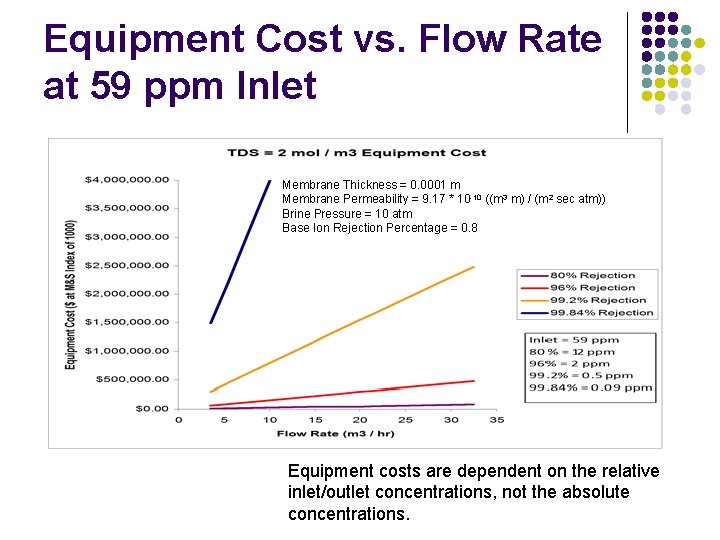
Equipment Cost vs. Flow Rate at 59 ppm Inlet Membrane Thickness = 0. 0001 m Membrane Permeability = 9. 17 * 10 -10 ((m 3 m) / (m 2 sec atm)) Brine Pressure = 10 atm Base Ion Rejection Percentage = 0. 8 Equipment costs are dependent on the relative inlet/outlet concentrations, not the absolute concentrations.
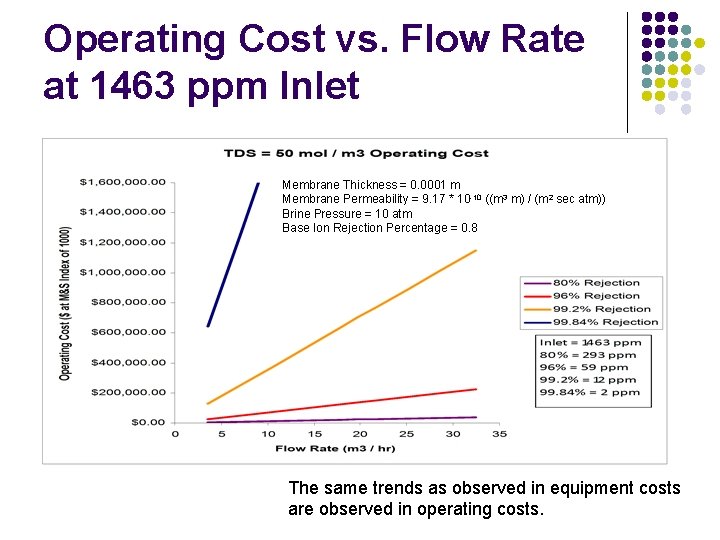
Operating Cost vs. Flow Rate at 1463 ppm Inlet Membrane Thickness = 0. 0001 m Membrane Permeability = 9. 17 * 10 -10 ((m 3 m) / (m 2 sec atm)) Brine Pressure = 10 atm Base Ion Rejection Percentage = 0. 8 The same trends as observed in equipment costs are observed in operating costs.
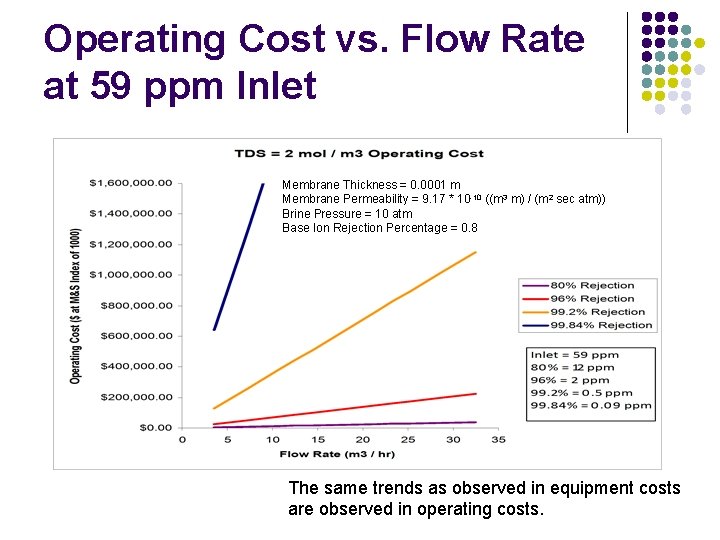
Operating Cost vs. Flow Rate at 59 ppm Inlet Membrane Thickness = 0. 0001 m Membrane Permeability = 9. 17 * 10 -10 ((m 3 m) / (m 2 sec atm)) Brine Pressure = 10 atm Base Ion Rejection Percentage = 0. 8 The same trends as observed in equipment costs are observed in operating costs.
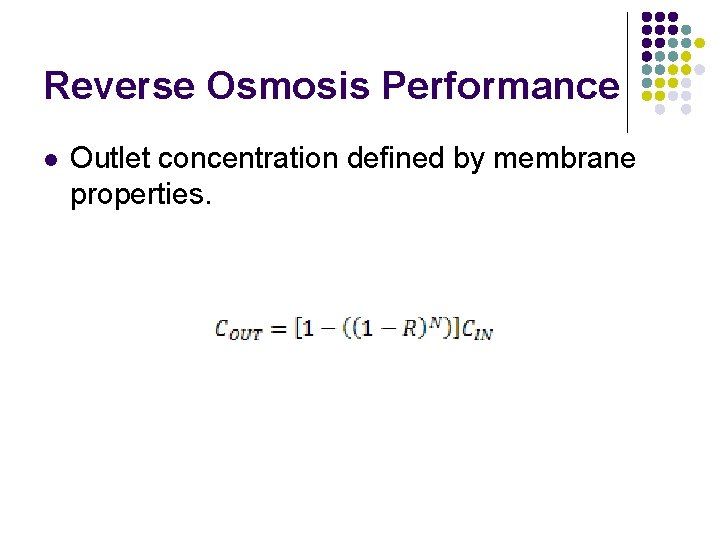
Reverse Osmosis Performance l Outlet concentration defined by membrane properties.
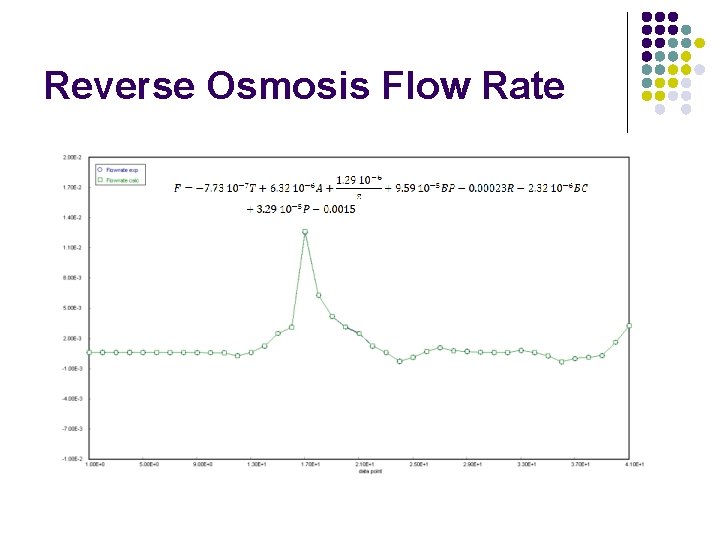
Reverse Osmosis Flow Rate
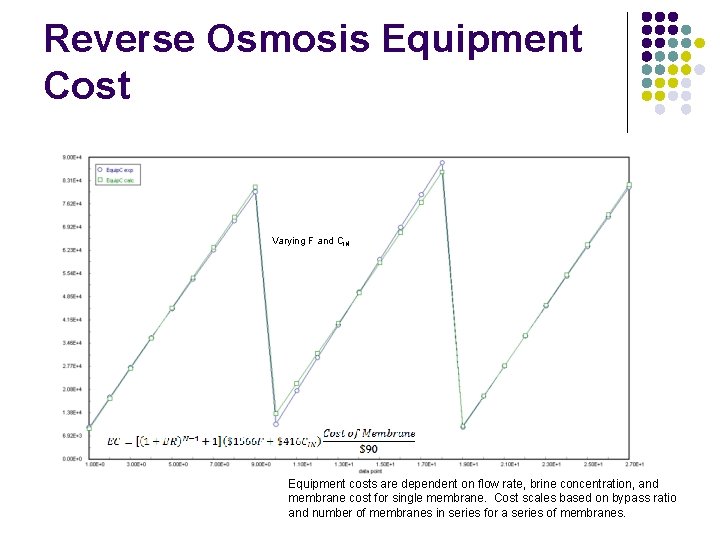
Reverse Osmosis Equipment Cost Varying F and CIN Equipment costs are dependent on flow rate, brine concentration, and membrane cost for single membrane. Cost scales based on bypass ratio and number of membranes in series for a series of membranes.
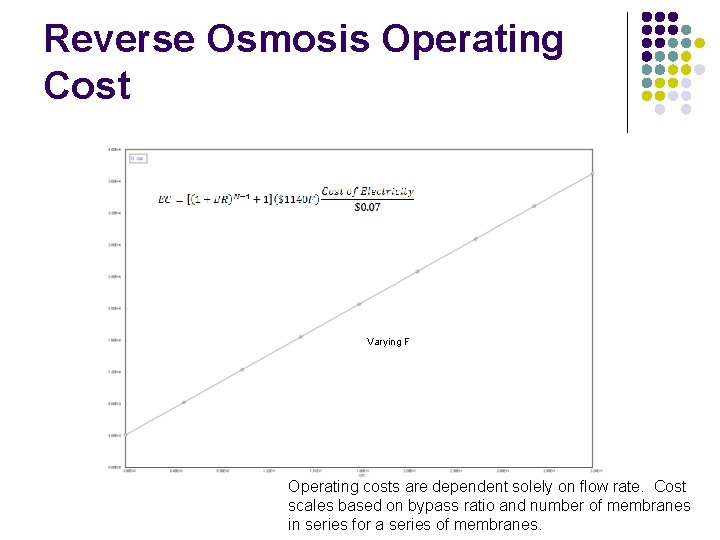
Reverse Osmosis Operating Cost Varying F Operating costs are dependent solely on flow rate. Cost scales based on bypass ratio and number of membranes in series for a series of membranes.
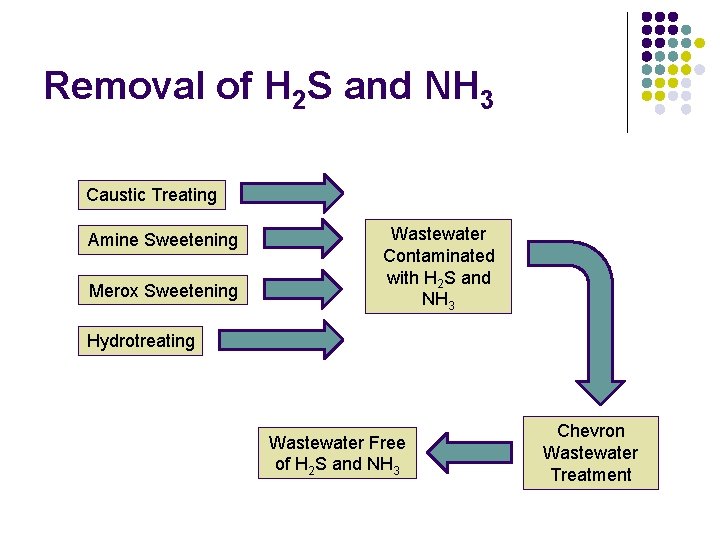
Removal of H 2 S and NH 3 Caustic Treating Amine Sweetening Merox Sweetening Wastewater Contaminated with H 2 S and NH 3 Hydrotreating Wastewater Free of H 2 S and NH 3 Chevron Wastewater Treatment
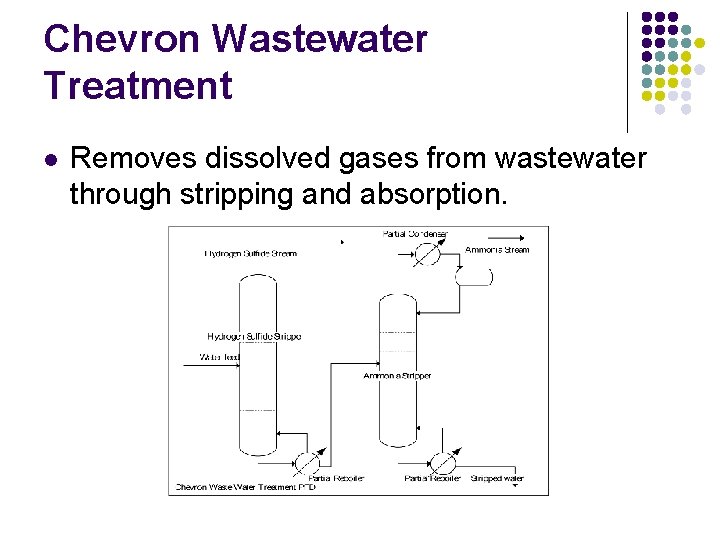
Chevron Wastewater Treatment l Removes dissolved gases from wastewater through stripping and absorption.
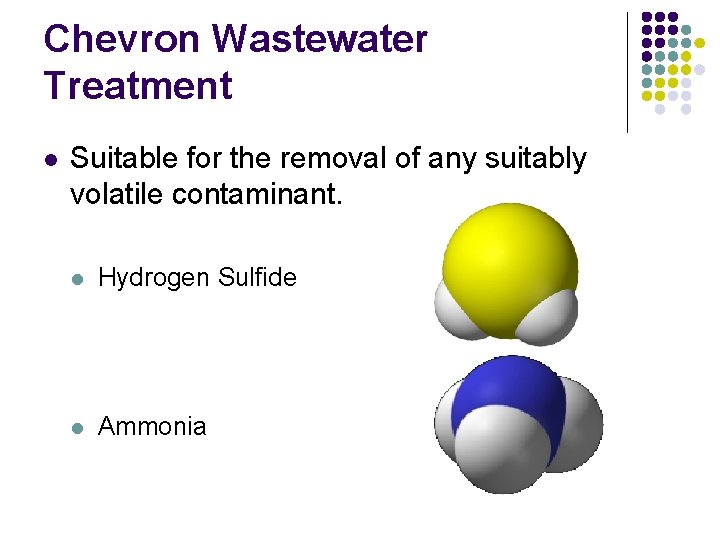
Chevron Wastewater Treatment l Suitable for the removal of any suitably volatile contaminant. l Hydrogen Sulfide l Ammonia
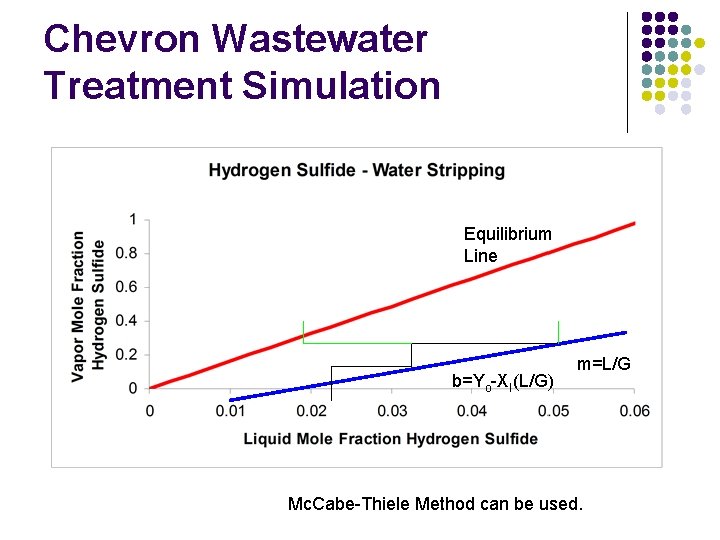
Chevron Wastewater Treatment Simulation Equilibrium Line b=Yo-XI(L/G) m=L/G Mc. Cabe-Thiele Method can be used.
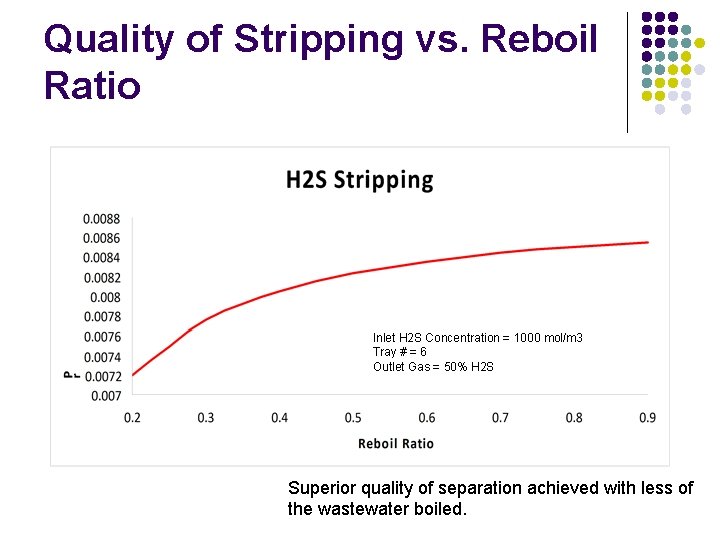
Quality of Stripping vs. Reboil Ratio Inlet H 2 S Concentration = 1000 mol/m 3 Tray # = 6 Outlet Gas = 50% H 2 S Superior quality of separation achieved with less of the wastewater boiled.
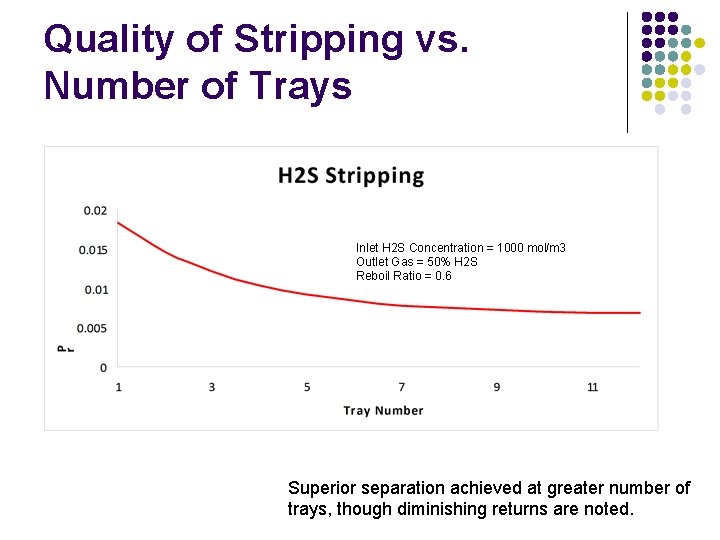
Quality of Stripping vs. Number of Trays Inlet H 2 S Concentration = 1000 mol/m 3 Outlet Gas = 50% H 2 S Reboil Ratio = 0. 6 Superior separation achieved at greater number of trays, though diminishing returns are noted.
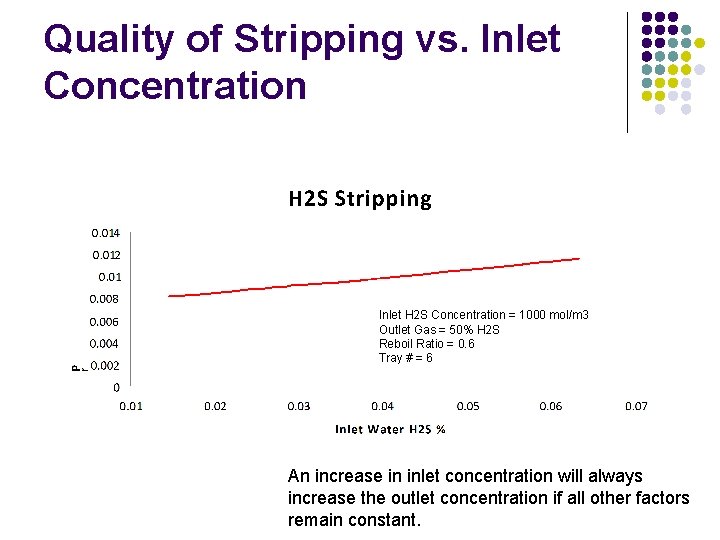
Quality of Stripping vs. Inlet Concentration Inlet H 2 S Concentration = 1000 mol/m 3 Outlet Gas = 50% H 2 S Reboil Ratio = 0. 6 Tray # = 6 An increase in inlet concentration will always increase the outlet concentration if all other factors remain constant.
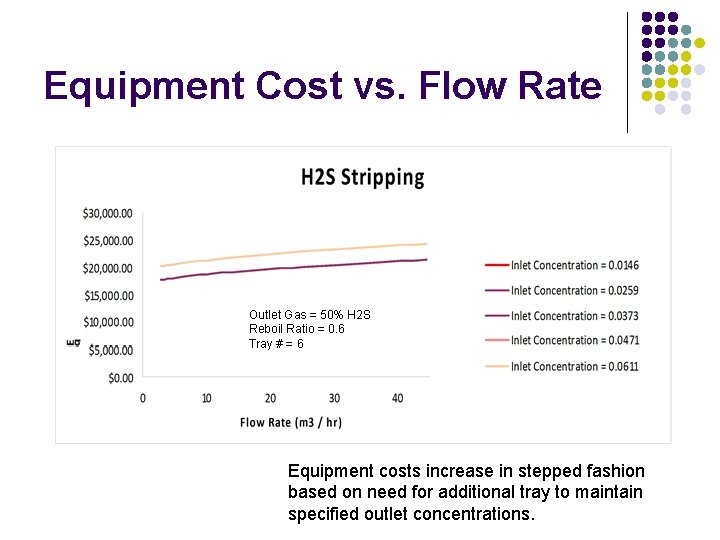
Equipment Cost vs. Flow Rate Outlet Gas = 50% H 2 S Reboil Ratio = 0. 6 Tray # = 6 Equipment costs increase in stepped fashion based on need for additional tray to maintain specified outlet concentrations.
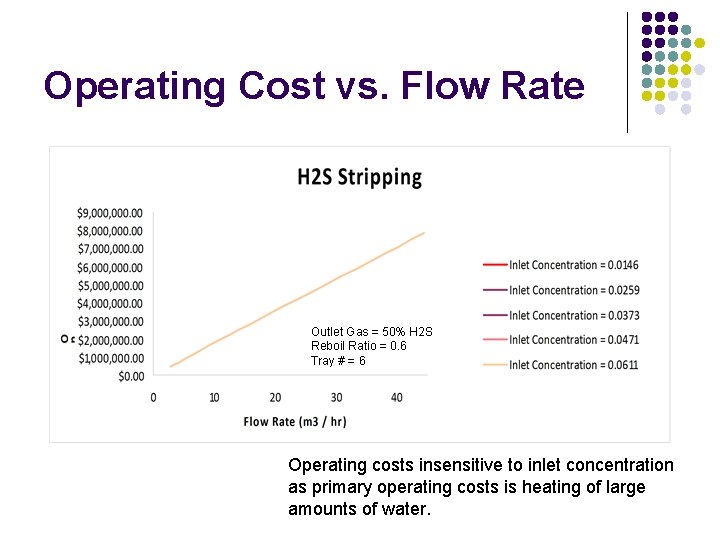
Operating Cost vs. Flow Rate Outlet Gas = 50% H 2 S Reboil Ratio = 0. 6 Tray # = 6 Operating costs insensitive to inlet concentration as primary operating costs is heating of large amounts of water.
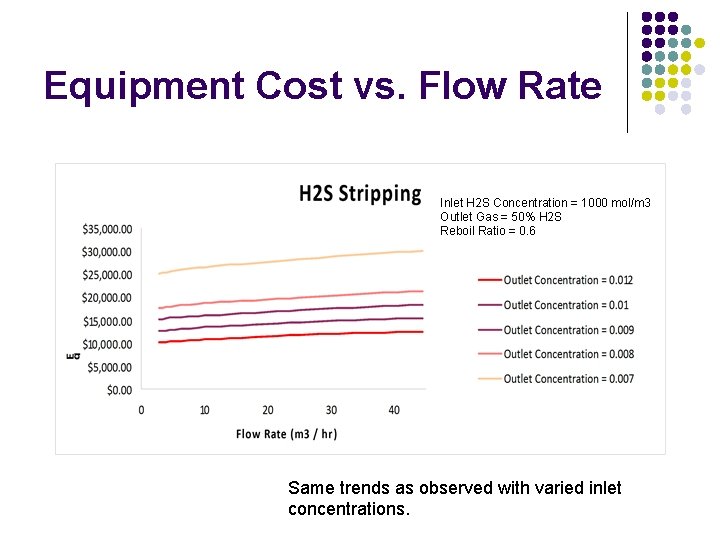
Equipment Cost vs. Flow Rate Inlet H 2 S Concentration = 1000 mol/m 3 Outlet Gas = 50% H 2 S Reboil Ratio = 0. 6 Same trends as observed with varied inlet concentrations.
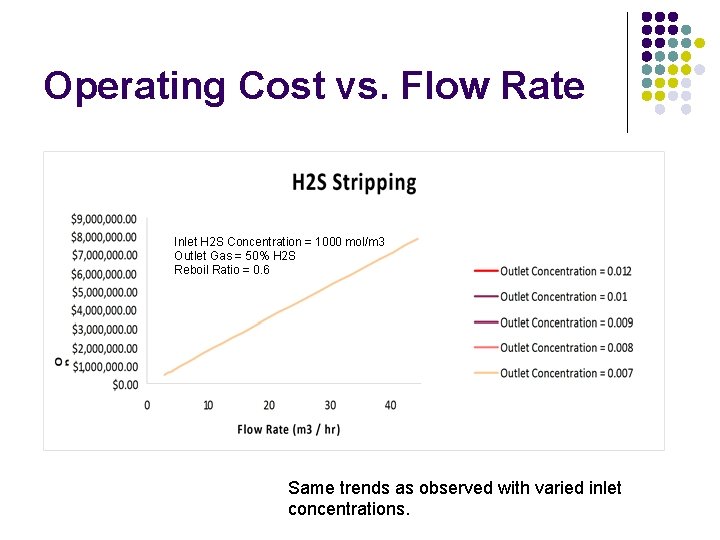
Operating Cost vs. Flow Rate Inlet H 2 S Concentration = 1000 mol/m 3 Outlet Gas = 50% H 2 S Reboil Ratio = 0. 6 Same trends as observed with varied inlet concentrations.
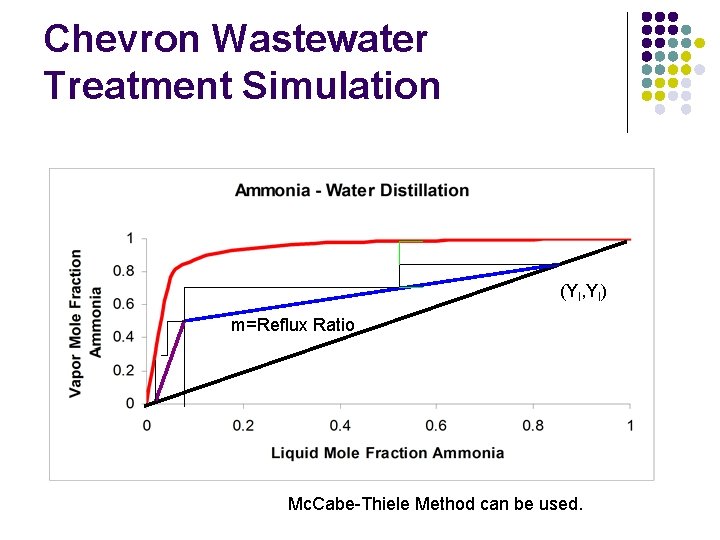
Chevron Wastewater Treatment Simulation (YI, YI) m=Reflux Ratio Mc. Cabe-Thiele Method can be used.
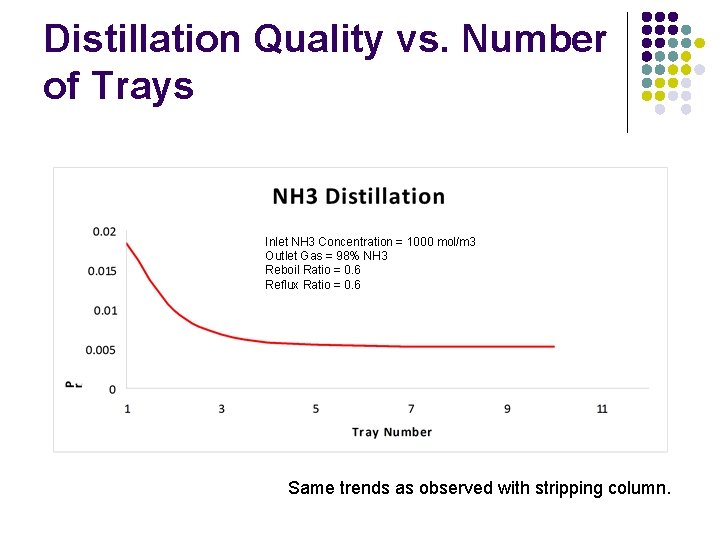
Distillation Quality vs. Number of Trays Inlet NH 3 Concentration = 1000 mol/m 3 Outlet Gas = 98% NH 3 Reboil Ratio = 0. 6 Reflux Ratio = 0. 6 Same trends as observed with stripping column.
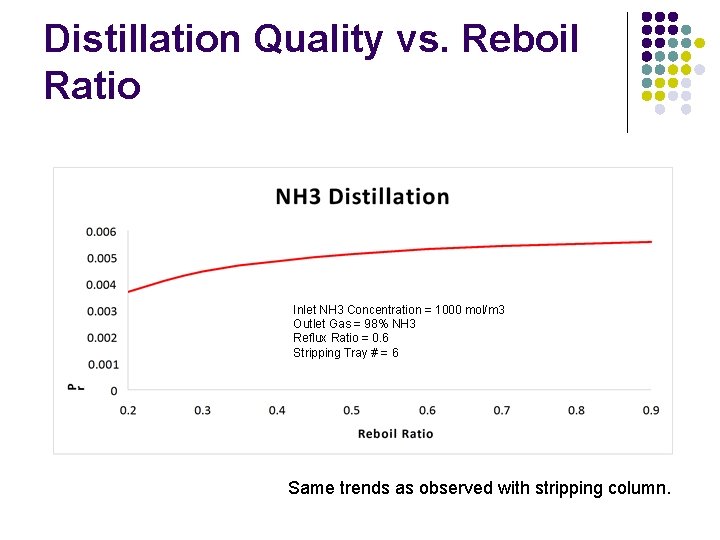
Distillation Quality vs. Reboil Ratio Inlet NH 3 Concentration = 1000 mol/m 3 Outlet Gas = 98% NH 3 Reflux Ratio = 0. 6 Stripping Tray # = 6 Same trends as observed with stripping column.
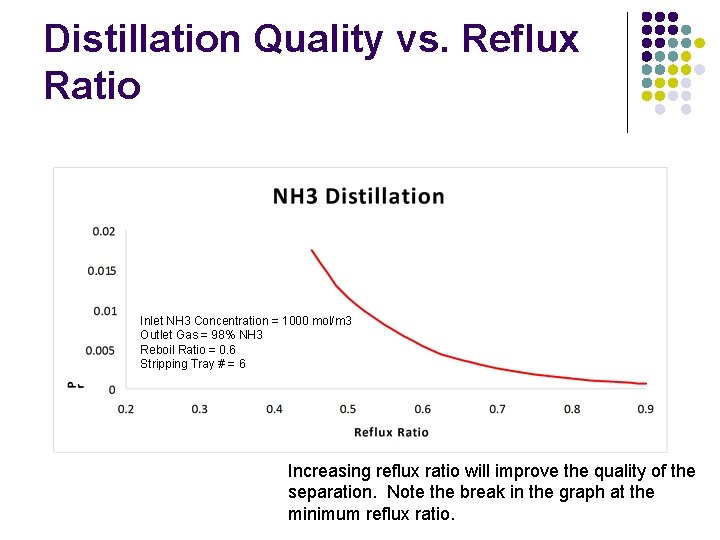
Distillation Quality vs. Reflux Ratio Inlet NH 3 Concentration = 1000 mol/m 3 Outlet Gas = 98% NH 3 Reboil Ratio = 0. 6 Stripping Tray # = 6 Increasing reflux ratio will improve the quality of the separation. Note the break in the graph at the minimum reflux ratio.
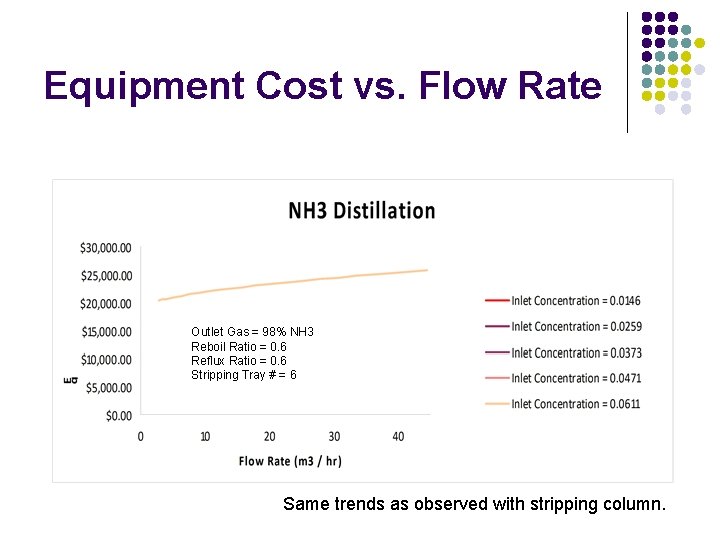
Equipment Cost vs. Flow Rate Outlet Gas = 98% NH 3 Reboil Ratio = 0. 6 Reflux Ratio = 0. 6 Stripping Tray # = 6 Same trends as observed with stripping column.
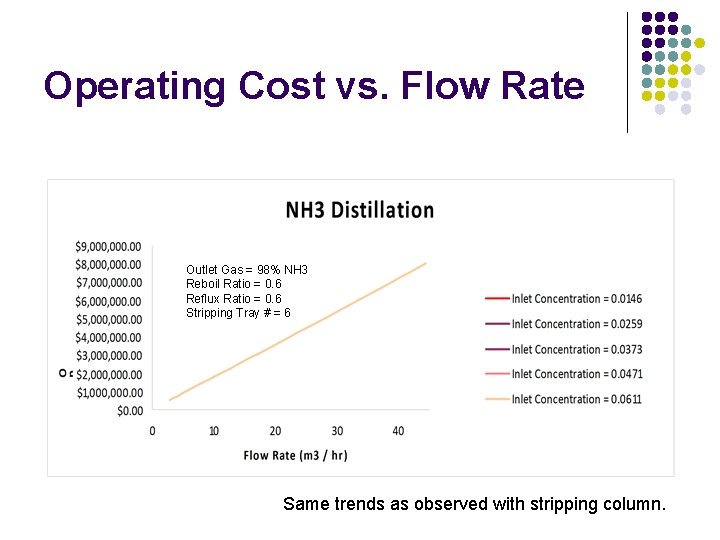
Operating Cost vs. Flow Rate Outlet Gas = 98% NH 3 Reboil Ratio = 0. 6 Reflux Ratio = 0. 6 Stripping Tray # = 6 Same trends as observed with stripping column.
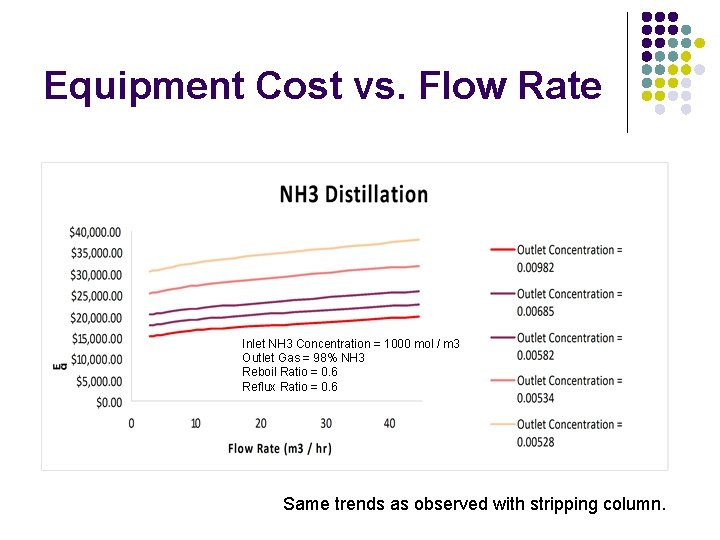
Equipment Cost vs. Flow Rate Inlet NH 3 Concentration = 1000 mol / m 3 Outlet Gas = 98% NH 3 Reboil Ratio = 0. 6 Reflux Ratio = 0. 6 Same trends as observed with stripping column.
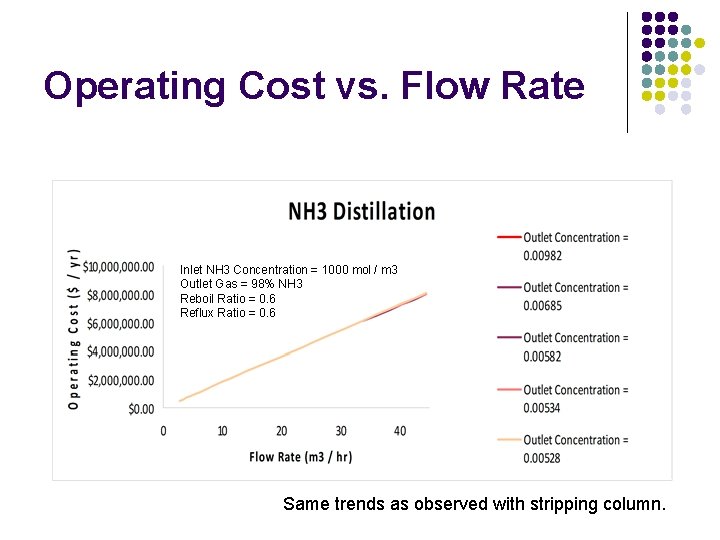
Operating Cost vs. Flow Rate Inlet NH 3 Concentration = 1000 mol / m 3 Outlet Gas = 98% NH 3 Reboil Ratio = 0. 6 Reflux Ratio = 0. 6 Same trends as observed with stripping column.
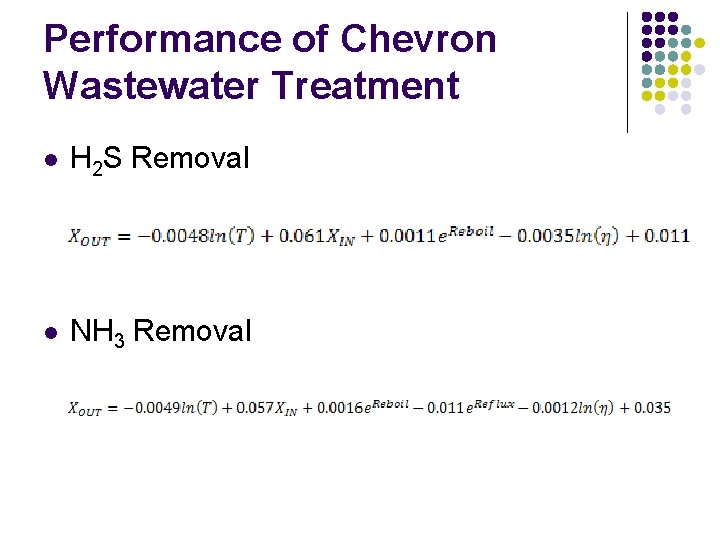
Performance of Chevron Wastewater Treatment l H 2 S Removal l NH 3 Removal
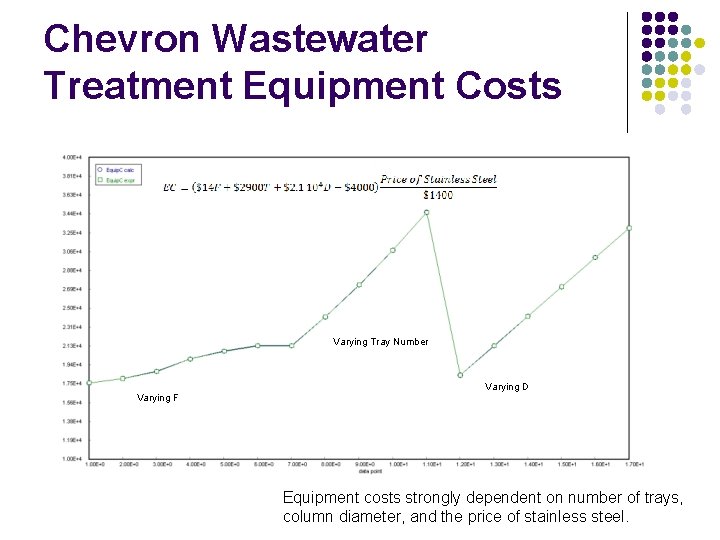
Chevron Wastewater Treatment Equipment Costs Varying Tray Number Varying D Varying F Equipment costs strongly dependent on number of trays, column diameter, and the price of stainless steel.
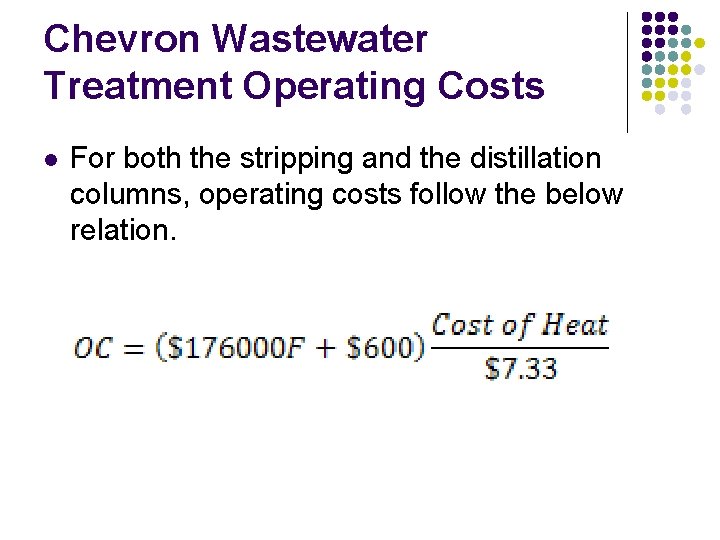
Chevron Wastewater Treatment Operating Costs l For both the stripping and the distillation columns, operating costs follow the below relation.
Conclusions l Capital costs for API separators are heavily dependent on inlet/outlet concentration ratio. Operating costs for API separators are independent of concentration. l Capital costs for activated carbon adsorption are independent of concentration. Operating costs for activated carbon adsorption are heavily dependent on concentration.
Conclusions l Both capital costs and operating costs for reverse osmosis are heavily dependent on inlet/outlet concentration ratio. l Capital costs for Chevron Wastewater Treatment are dependent on concentration. Operating costs for Chevron Wastewater Treatment are nearly independent of concentration.

Water Management l Questions?
- Slides: 81