
WATER IN THE BODY WATER IN THE BODY
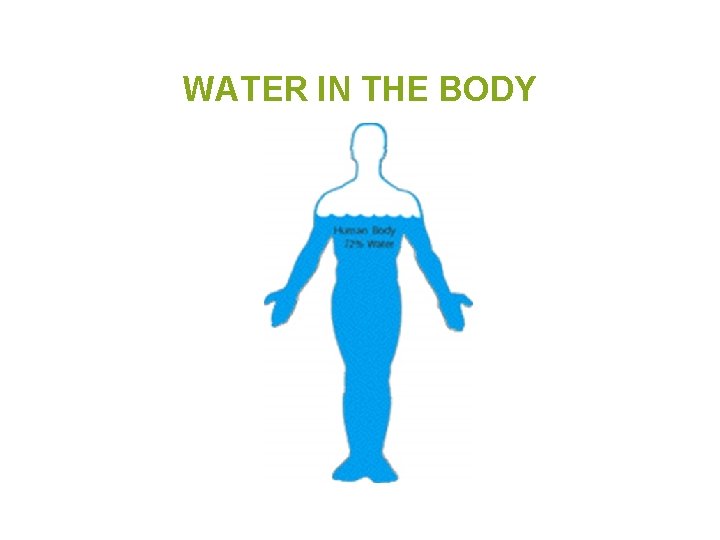
WATER IN THE BODY

WATER IN THE BODY The body contains two fluid “compartments. ” ▪ Intracellular compartment, refers to fluid inside cells ▪ Extracellular compartment includes ▪ (1) blood plasma (_20% of total extracellular fluid) ▪ (2) interstitial fluids, which primarily comprise fluid flowing in microscopic spaces between cells.

SOURCES OF INTERSTITIAL FLUID INCLUDE: ▪ 1. Lymph ▪ 2. Saliva ▪ 3. Fluids in the eyes ▪ 4. Fluids secreted by glands and the digestive tract ▪ 5. Fluids that bathe nerves of the spinal cord ▪ 6. Fluids excreted from the skin and kidneys ▪ Much of the fluid lost through sweating comes from extracellular fluid, predominantly blood plasma
FUNCTIONS OF BODY WATER ▪ 1. Provides the body’s transport and reactive medium. ▪ 2. Diffusion of gases occurs across moist body surfaces. ▪ 3. Waste products leave the body through the water in urine and feces. ▪ 4. Absorbs considerable heat with only minimal changes in temperature from its heat stabilizing qualities. ▪ 5. Watery fluids lubricate joints, keeping bon surfaces from grinding against each other. ▪ 6. Being non compressible, water provides structure and form through the turgor it imparts to the body’s tissues.
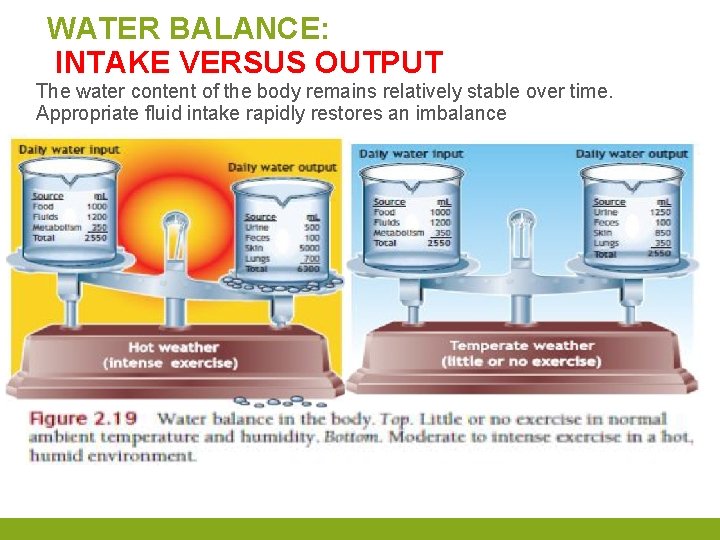
WATER BALANCE: INTAKE VERSUS OUTPUT The water content of the body remains relatively stable over time. Appropriate fluid intake rapidly restores an imbalance
WATER INTAKE ▪ In a normal environment, a sedentary adult requires about 2. 5 L of water daily. ▪ For an active person in a warm environment, the water requirement often increases to between 5 and 10 L daily.
THE SOURCES OF WATER INTAKE: ▪ 1. Liquids ▪ 2. Foods ▪ 3. Metabolic processes
▪ Metabolizing food molecules for energy forms carbon dioxide and water. ▪ For a sedentary person, metabolic water provides about 25% of the daily water requirement. ▪ Additionally, each gram of glycogen joins with 2. 7 g of water as the glucose units link together thus making glycogen a heavy energy fuel. ▪ Glycogen subsequently releases this water during its catabolism for energy.
WATER OUTPUT ▪ The body loses water in four ways: ▪ 1. In urine ▪ 2. Through the skin ▪ 3. As water vapor in expired air ▪ 4. In feces
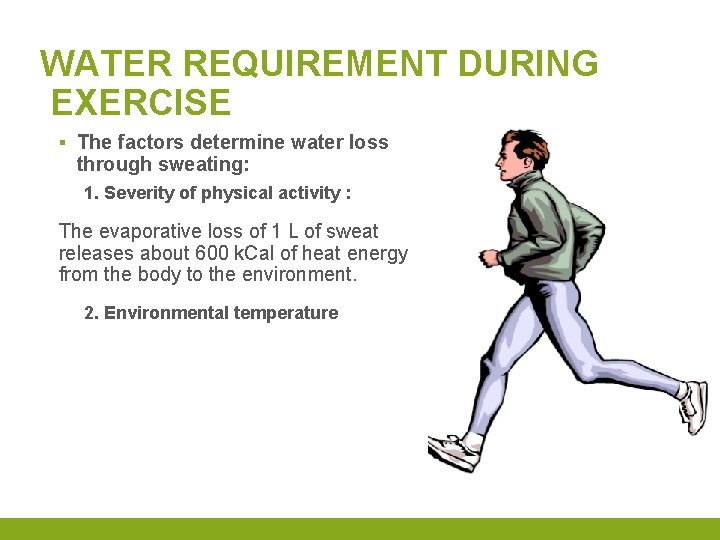
WATER REQUIREMENT DURING EXERCISE ▪ The factors determine water loss through sweating: 1. Severity of physical activity : The evaporative loss of 1 L of sweat releases about 600 k. Cal of heat energy from the body to the environment. 2. Environmental temperature
3. Humidity: ▪ Relative humidity, which refers to the water content of the ambient air, impacts the efficiency of the sweating mechanism in temperature regulation. ▪ At 100% relative humidity, the ambient air is completely saturated with water vapor. ▪ This blocks evaporation of fluid from the skin surface to the air, thus minimizing this important avenue for body cooling. ▪ When this happens, sweat beads on the skin and eventually rolls off without generating a cooling effect.
The major physiologic defense against overheating comes from evaporation of sweat from the skin’s surface. ▪ sweat loss equal to 2% to 3% of body mass decreases plasma volume. This amount of fluid loss strains circulatory functions and ultimately impairs exercise capacity and diminishes thermoregulatory control.
PRACTICAL RECOMMENDATIONS FOR FLUID REPLACEMENT IN EXERCISE: Pre-exercise hyperhydration ▪ (1) delays dehydration. ▪ (2) increases sweating during exercise. ▪ (3) blunts the increase in body temperature compared with exercising without prior fluids. ▪ As a practical step, a person should consume 400 to 600 m. L (13– 20 oz) of cold water 10 to 20 minutes before exercising.
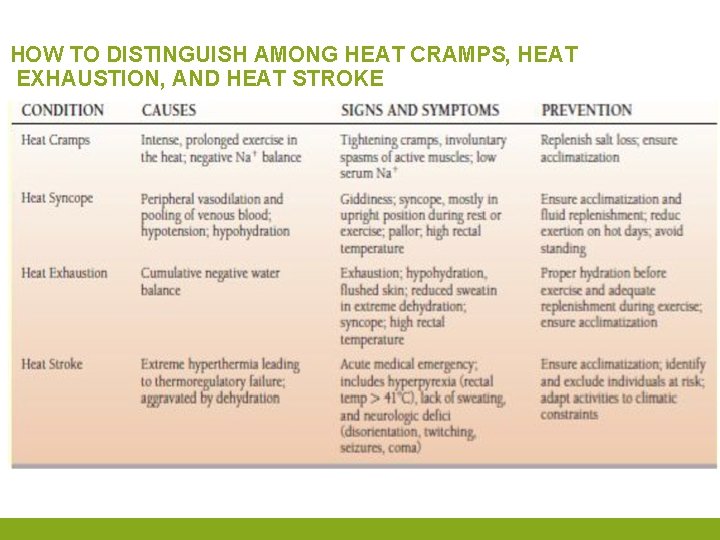
HOW TO DISTINGUISH AMONG HEAT CRAMPS, HEAT EXHAUSTION, AND HEAT STROKE
- Slides: 14