
Water in the Atmosphere Water Cycle 3 States
- Slides: 31
Water in the Atmosphere
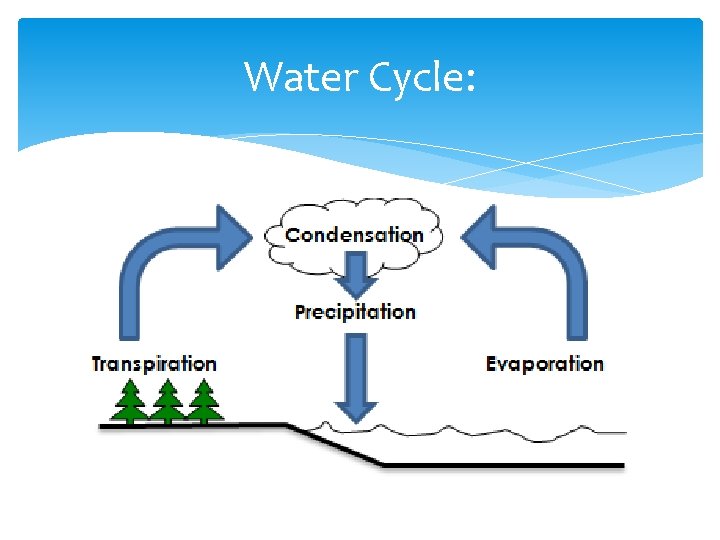
Water Cycle:
3 States of Water in Atmosphere a) Ice – solid b) Water – liquid c) Water Vapor – gas
Humidity Water in the atmosphere
Key Points to Remember: Warm air can hold more water than cold air Dew point and relative humidity are related
Relative Humidity Measure of how close the air is to reaching the dew point
Relative Humidity: What we call “humidity” Measured as a percent At 75% relative humidity, the air has ¾ of the water vapor it can hold As relative humidity goes up, the temperature/dew point spread decreases
Dew Point The temperature where the condensation point equals the evaporation point, under this temperature and water droplets form Dew Point of 50 degrees – comfortable Dew Point of 60 degrees – humid Dew Point of 70 degrees - uncomfortable
Dew Point: The temperature to which the present air would have to be lowered to become saturated The greater the temperature/dew point spread, the less amount of water in the air compared to how much it could hold
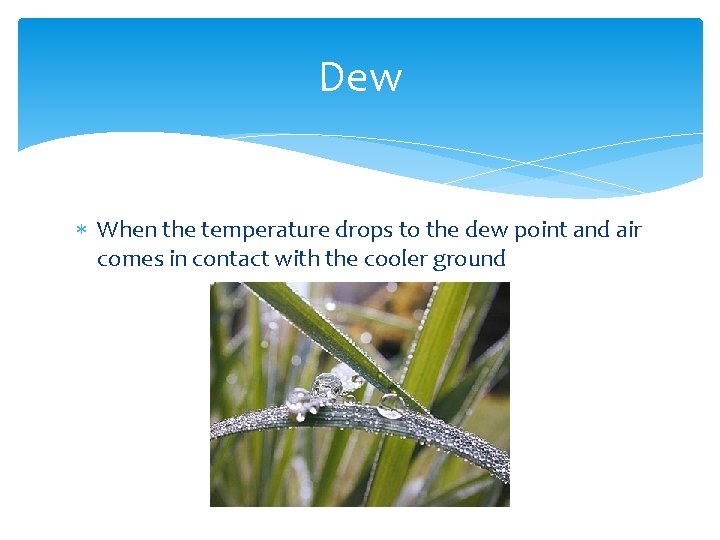
Dew When the temperature drops to the dew point and air comes in contact with the cooler ground
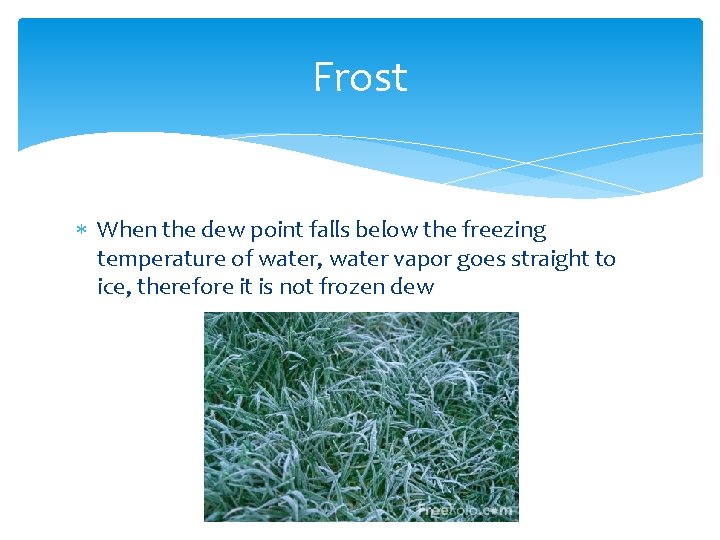
Frost When the dew point falls below the freezing temperature of water, water vapor goes straight to ice, therefore it is not frozen dew
Summing it Up: If the dew point = current temperature = 100% relative humidity = water vapor condenses forming dew
Absolute Humidity Measure of the actual amount of water vapor in the air
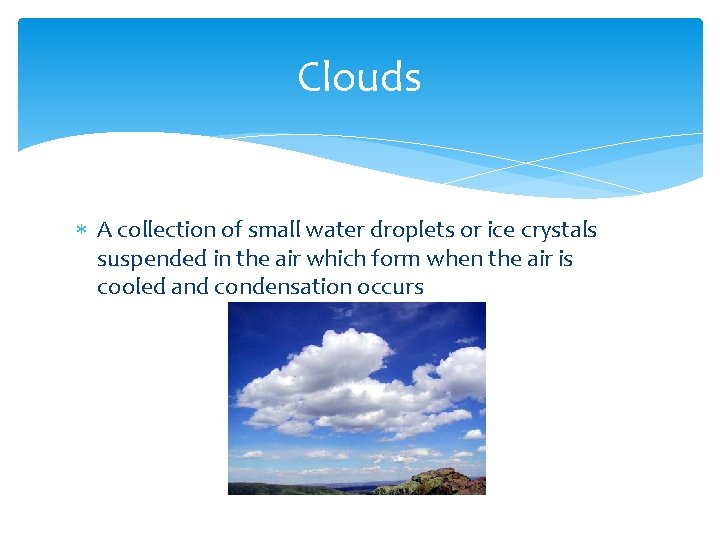
Clouds A collection of small water droplets or ice crystals suspended in the air which form when the air is cooled and condensation occurs
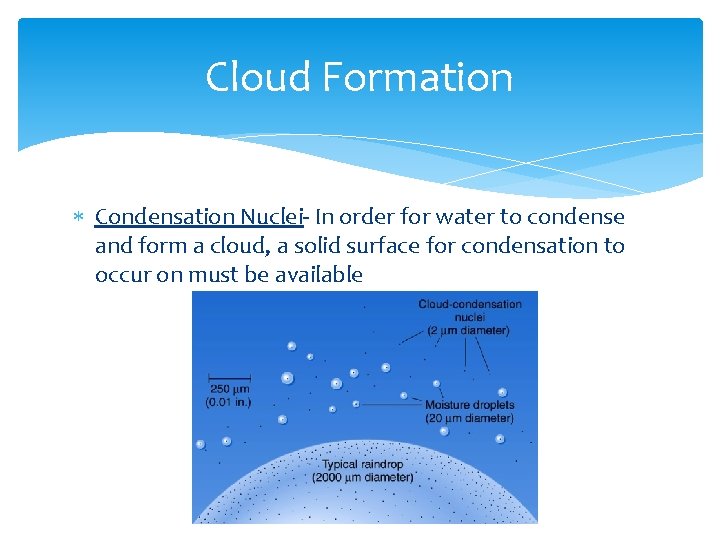
Cloud Formation Condensation Nuclei- In order for water to condense and form a cloud, a solid surface for condensation to occur on must be available
Cloud Formation: Evaporation rate must be in equilibrium with condensation, “saturated air” (temperature at dew point) As temperature of the saturated air drops, condensation occurs more than evaporation, and clouds form
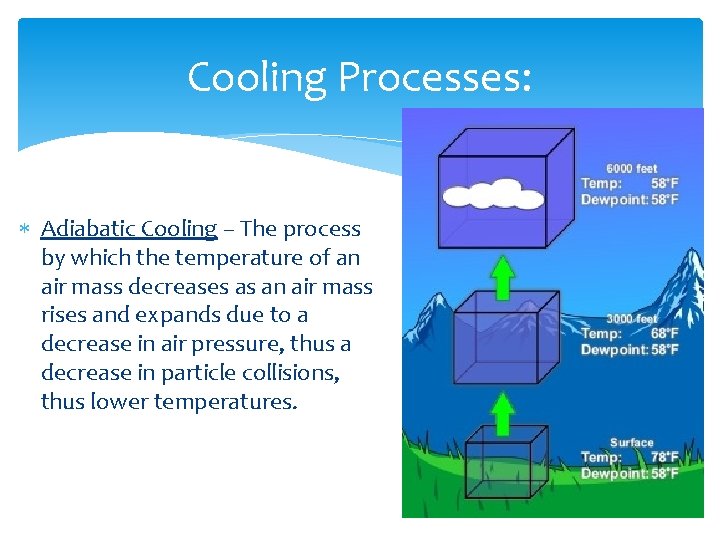
Cooling Processes: Adiabatic Cooling – The process by which the temperature of an air mass decreases as an air mass rises and expands due to a decrease in air pressure, thus a decrease in particle collisions, thus lower temperatures.
Cooling Processes: Mixing – When a body of moist air mixes with another body of moist air that is cooler
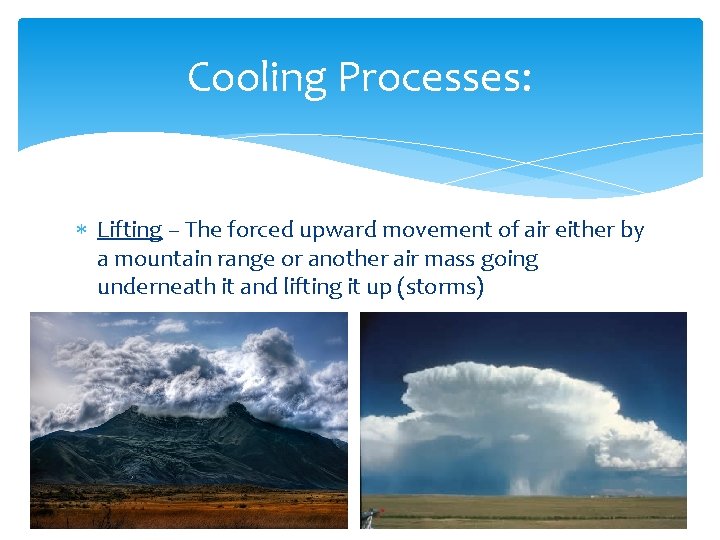
Cooling Processes: Lifting – The forced upward movement of air either by a mountain range or another air mass going underneath it and lifting it up (storms)
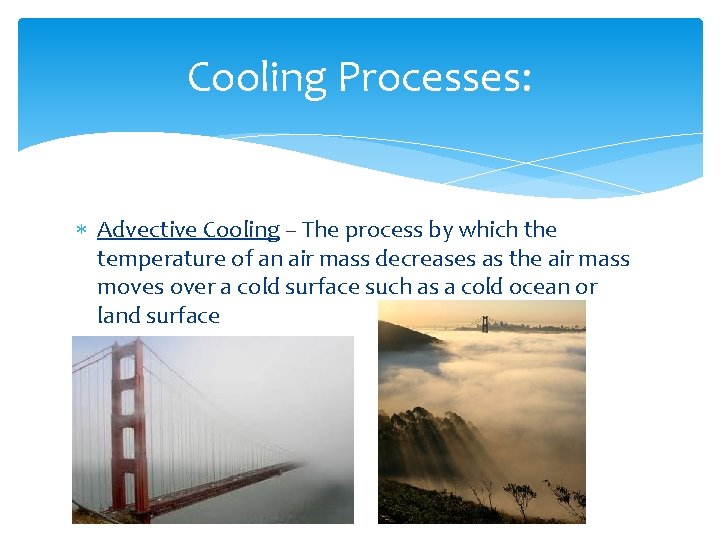
Cooling Processes: Advective Cooling – The process by which the temperature of an air mass decreases as the air mass moves over a cold surface such as a cold ocean or land surface
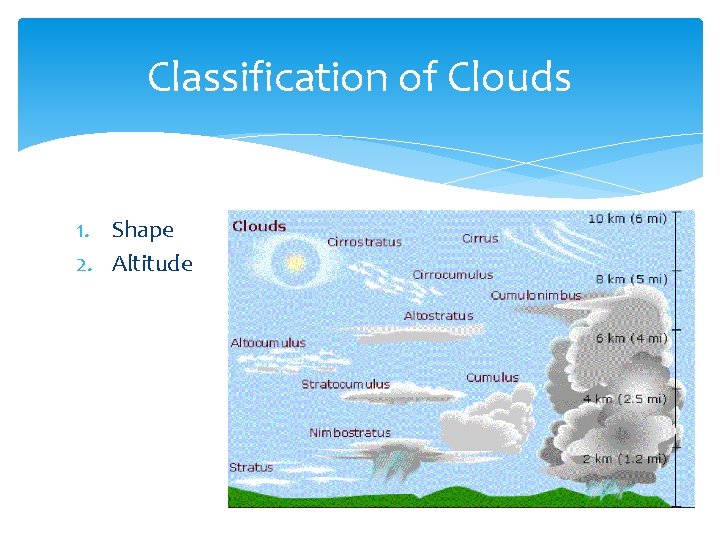
Classification of Clouds 1. Shape 2. Altitude
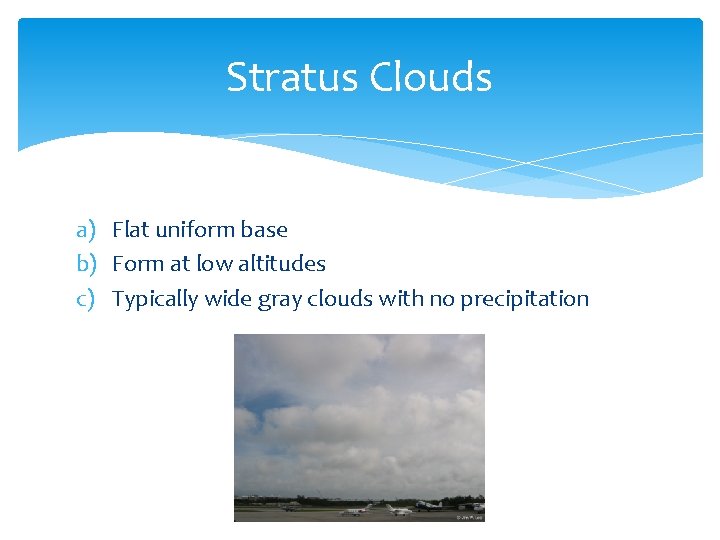
Stratus Clouds a) Flat uniform base b) Form at low altitudes c) Typically wide gray clouds with no precipitation
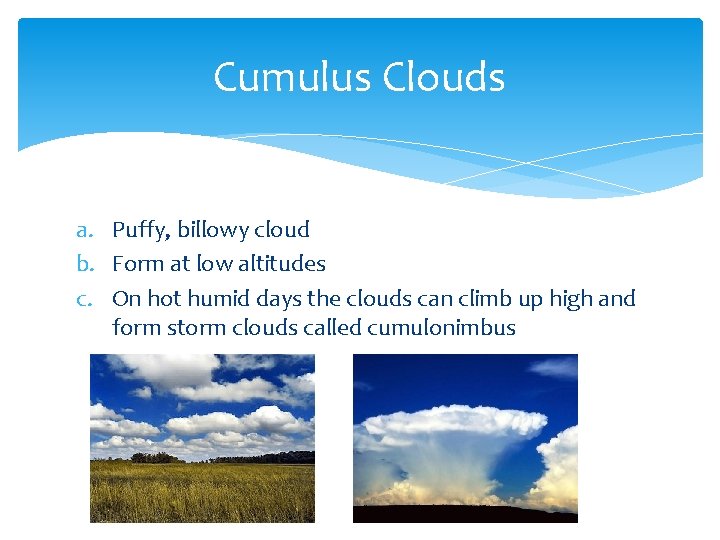
Cumulus Clouds a. Puffy, billowy cloud b. Form at low altitudes c. On hot humid days the clouds can climb up high and form storm clouds called cumulonimbus
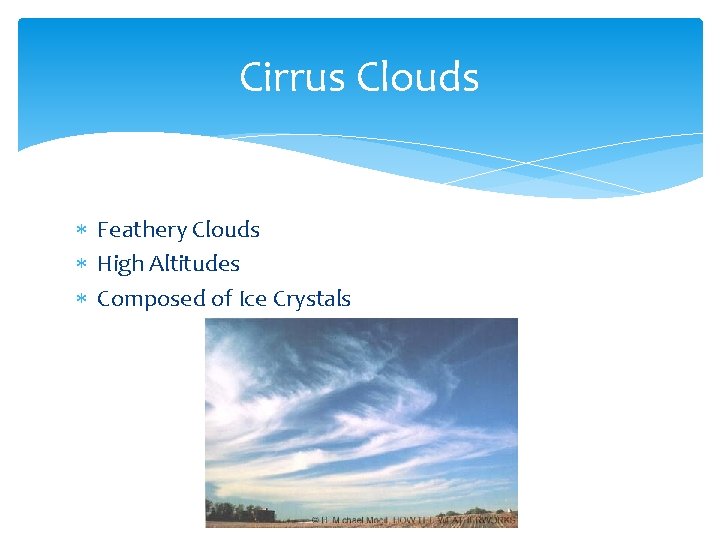
Cirrus Clouds Feathery Clouds High Altitudes Composed of Ice Crystals
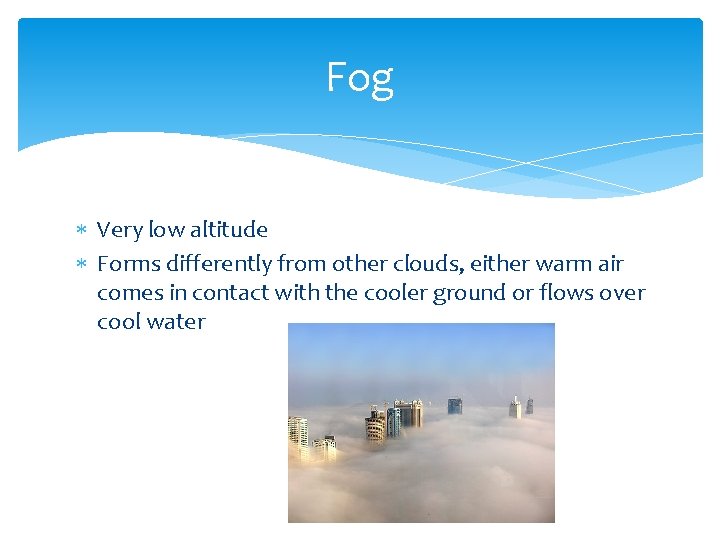
Fog Very low altitude Forms differently from other clouds, either warm air comes in contact with the cooler ground or flows over cool water
Precipitation Any form of water that falls to Earth’s surface from the clouds including rain, snow, sleet, hail and freezing rain
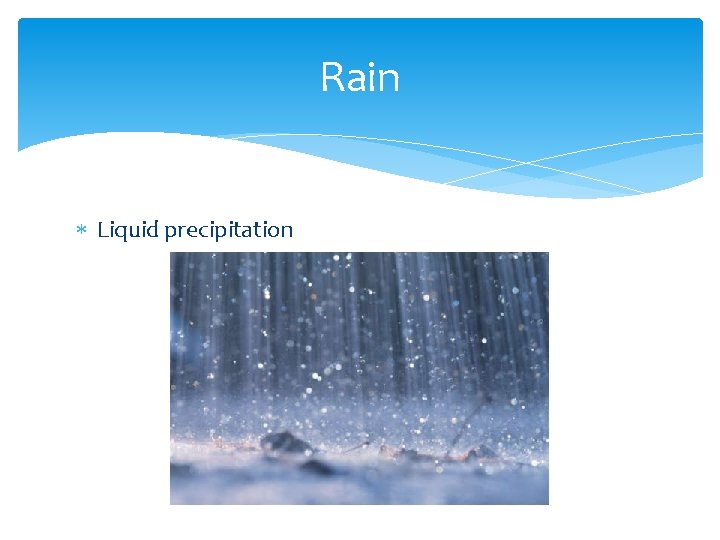
Rain Liquid precipitation
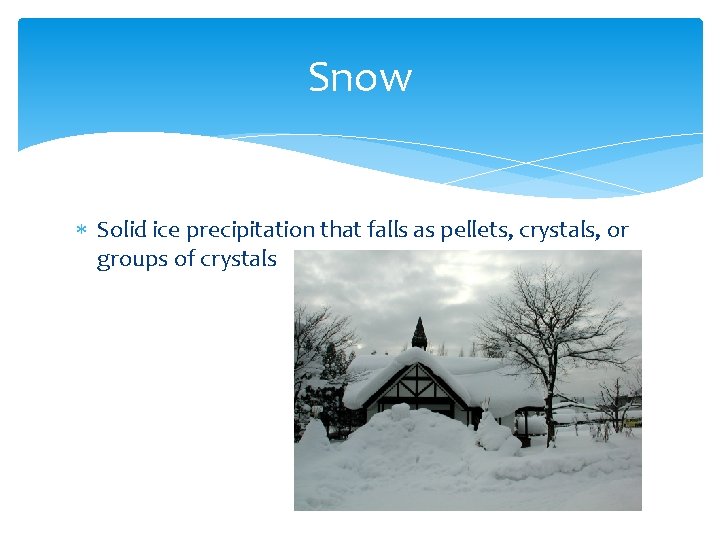
Snow Solid ice precipitation that falls as pellets, crystals, or groups of crystals
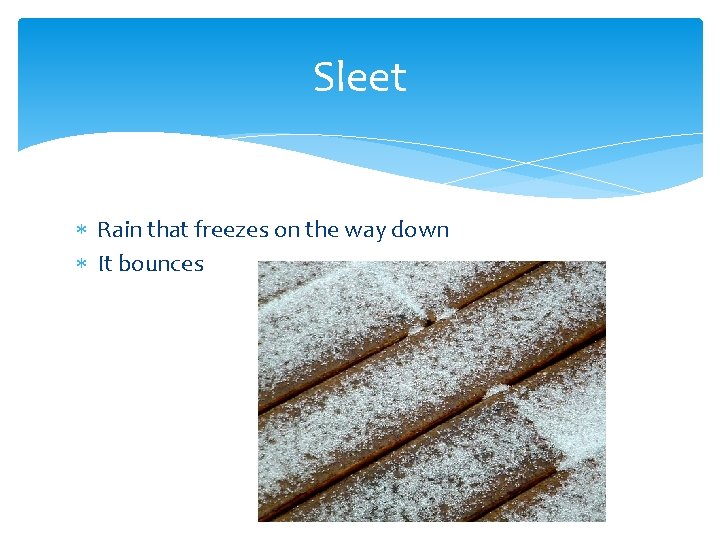
Sleet Rain that freezes on the way down It bounces
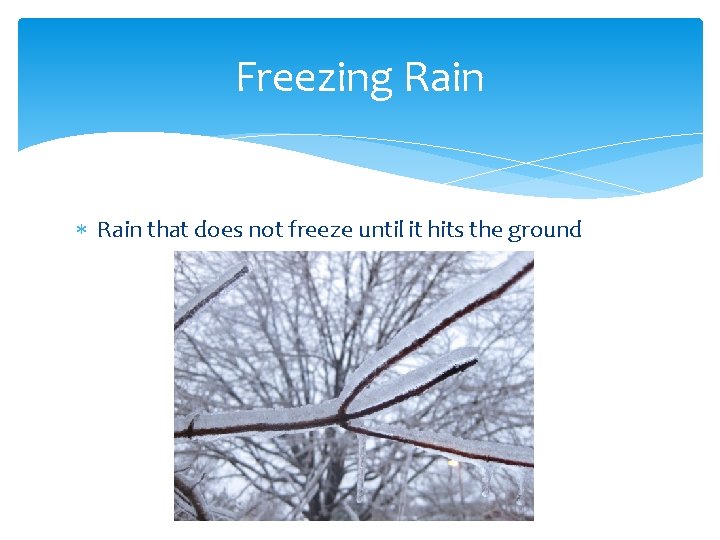
Freezing Rain that does not freeze until it hits the ground
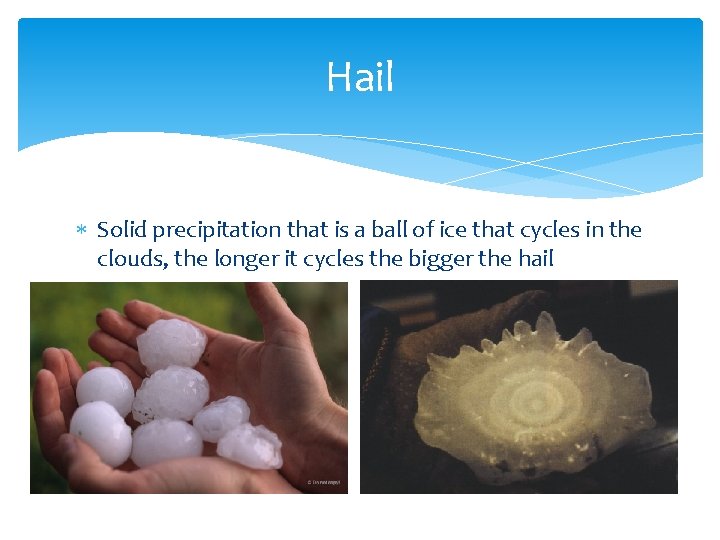
Hail Solid precipitation that is a ball of ice that cycles in the clouds, the longer it cycles the bigger the hail