
Water Global Water Distribution 71 of Earths surface
Water
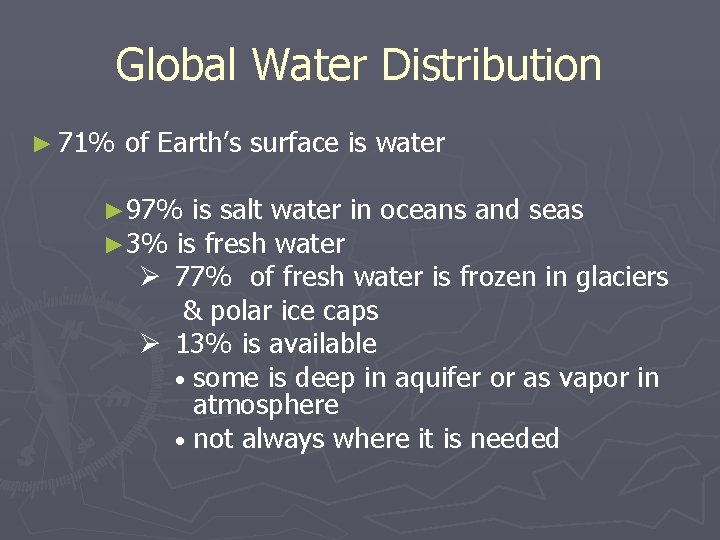
Global Water Distribution ► 71% of Earth’s surface is water ► 97% is salt water in ► 3% is fresh water oceans and seas Ø 77% of fresh water is frozen in glaciers & polar ice caps Ø 13% is available • some is deep in aquifer or as vapor in atmosphere • not always where it is needed
Watersheds ►Area of land drained by a river
Porosity of Soils ► For water to get into groundwater, it must pass through soil ► Porosity- the amount of space between the particles that make up soil or a rock
Water Quality ►Pollution anywhere in watershed can pollute river ►Ex: Plastic blow out of trash cans in city, goes into drainage and rain washes them into ocean.
Permeability of Soils § Permeable Øthe ability of soil or rock to allow water to flow through • Sandstone, limestone, sand, gravel are permeable • Clay & Granite are impermeable üImpermeable soils are reason why LV has flash floods
Recharge Zone ► The area of the Earth’s surface where water percolates down Subsidence in LV- we were drawing water out of groundwater causing valley to sink - 10 feet in downtown • Now they recharge groundwater in Winter from Lake Mead
Water Uses ► Vast differences between countries • US uses 300 L/day (80 gallons) vonly half used inside home, rest used outdoors for lawns, etc • India uses 41 L/day ü See Table 1 p. 277
Water Pollution ► The introduction of chemical, physical or biological agents into water that degrade water quality and adversely affects the organisms that depend on that water
Main Causes ►Industrialization ►Rapid Human Growth
Prevention ► Point Source • Source can be identified and origin located • Enforcing clean up is difficult, ex: Perchlorates ► Non-Point Source • Controlling is difficult • Ex: highway construction & maintenance storm water runoff, litter
Pollution Types and Sources for Point Source Pollution ► 23 million septic tank systems ► 190, 000 storage lagoons for polluted waste ► 9, 000 municipal landfills ► About 2 million underground storage tanks containing pollutants such as gasoline ► Thousands of public and industrial wastewater treatment plants
Pollution Types and Sources for Non-Point Source Pollution ► Pesticides from crop land ► 50 million tons of fertilizer applied to crops and golf courses each year ► 10 million tons of dry salt applied to highways for snow & ice removal every yr.
Thermal Pollution ► Increase in temperature of a body of water ► Decreases the amount of oxygen the water can hold ► Fish and aquatic organisms may suffocate and die ► Below Dam- decrease in temp cause native fish to be endangered species
Groundwater Pollution ► Pollutants enter when surface water percolates down from the Earth’s surface ► Pollution can enter & affect groundwater • Clean up -recharge is slow (can take hundreds to thousands of years) -difficult to decontaminate
Ocean Pollution q Activities on land cause 85% of ocean pollution ex: oil, toxic wastes, medical wastes q Ships can legally dump wastewater & garbage overboard in some parts of ocean ex: Cruise ship pollution
Read: Ecofact on Cruise Ship Pollution
River Comes from same root word as Rival Wars fought over water sources
Issues for Water Conservation ► Conservation may not be enough to prevent water shortages § Desalinization ►Problems • changes salinity in ocean area • expensive § Transporting Fresh Water ►Problems § Expensive § Greek Islands

Solutions For the Future
Water Conservation ►In Agriculture § use of drip irrigation & computer programs to coordinate watering times § Know why the water savings from Math Practice: Israeli Agriculture
Water Conservation ►In Industry § Golf courses use “gray water” in LV; takes less energy § Recycling of cooling and wastewater
Water Conservation ►In Home § Low flow toilet & shower heads § Landscaping-water at night to prevent evaporation and/or use xeriscaping

Homework ►Study for the TEST
- Slides: 24