
Water Essential Questions Whats so great about water
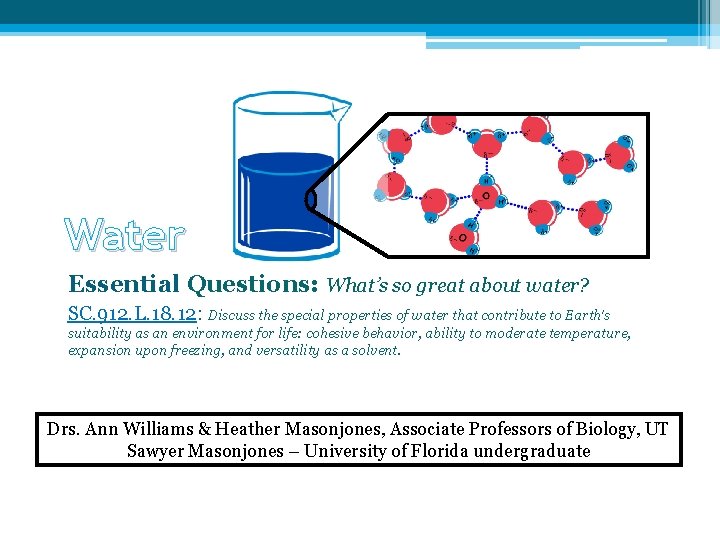
Water Essential Questions: What’s so great about water? SC. 912. L. 18. 12: Discuss the special properties of water that contribute to Earth's suitability as an environment for life: cohesive behavior, ability to moderate temperature, expansion upon freezing, and versatility as a solvent. Drs. Ann Williams & Heather Masonjones, Associate Professors of Biology, UT Sawyer Masonjones – University of Florida undergraduate
Additional Standards SC. 912. P. 8. 4 Explore the scientific theory of atoms (also known as atomic theory) by describing the structure of atoms in terms of protons, neutrons and electrons, and differentiate among these particles in terms of their mass, electrical charges and locations within the atom. SC. 912. P. 8. 5 Relate properties of atoms and their position in the periodic table to the arrangement of their electrons. SC. 912. P. 8. 8 Characterize types of chemical reactions, for example: redox, acidbase, synthesis, and single and double replacement reactions. SC. 912. P. 8. 11 Relate acidity and basicity to hydronium and hydroxyl ion concentration and p. H. SC. 912. N. 3. 5 Describe the function of models in science, and identify the wide range of models used in science.

UT Bio Majors Head Back to High School to Teach
Water Kit + http: //www. 3 dmoleculardesigns. com/ Molecular Twister
Objectives *Description of the structure of water molecules *Description of intra and inter molecular bonds of water and other molecules *Discussion of the 4 unique properties of water making it crucial for life on earth *Discussion and review of chemical bonding & electronegativity Modeling & Questioning

Student Materials/Equipment *3 D Molecular Designs Water Kit – (each kit includes 12 water molecules (24 red pieces & 24 white pieces), 1 sodium (smaller blue atom), 1 chloride (larger green atom), 1 ethane, and 1 hydroxyl group (an oxygen and hydrogen molecule - OH) *Na. Cl Lattice Kit *Molecular Twister Kit *Activity sheet – Water, Water Everywhere – But How Does it Sustain Life? -Instructor version – includes answers to guided questions and addition resources and tips -Student version – can be given directly out the to the students as an activity
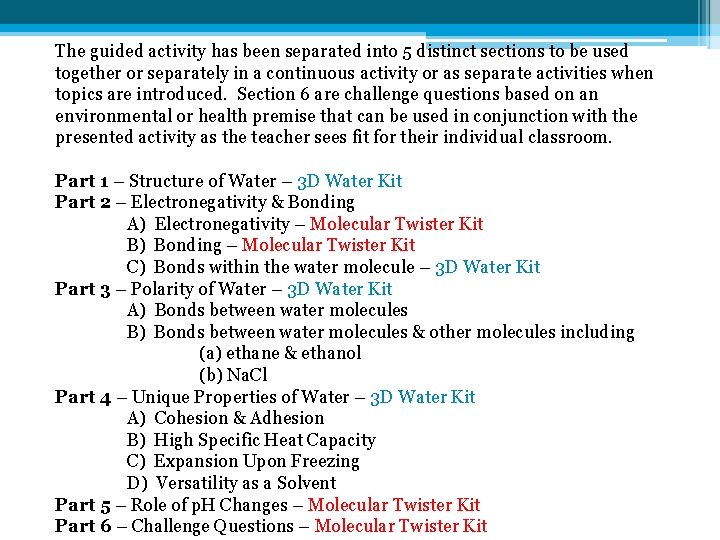
The guided activity has been separated into 5 distinct sections to be used together or separately in a continuous activity or as separate activities when topics are introduced. Section 6 are challenge questions based on an environmental or health premise that can be used in conjunction with the presented activity as the teacher sees fit for their individual classroom. Part 1 – Structure of Water – 3 D Water Kit Part 2 – Electronegativity & Bonding A) Electronegativity – Molecular Twister Kit B) Bonding – Molecular Twister Kit C) Bonds within the water molecule – 3 D Water Kit Part 3 – Polarity of Water – 3 D Water Kit A) Bonds between water molecules B) Bonds between water molecules & other molecules including (a) ethane & ethanol (b) Na. Cl Part 4 – Unique Properties of Water – 3 D Water Kit A) Cohesion & Adhesion B) High Specific Heat Capacity C) Expansion Upon Freezing D) Versatility as a Solvent Part 5 – Role of p. H Changes – Molecular Twister Kit Part 6 – Challenge Questions – Molecular Twister Kit
Introduction – Water • • • Why is water so important to studying biology? Life began in water Living cells = 70 -95% water ¾ of earth 3 physical states : ice, liquid, vapor
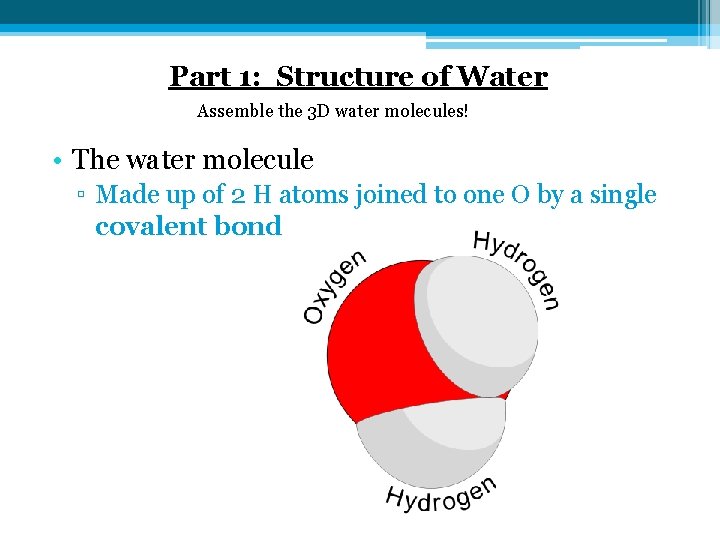
Part 1: Structure of Water Assemble the 3 D water molecules! • The water molecule ▫ Made up of 2 H atoms joined to one O by a single covalent bond
Water Kit Water Activity Part 1: Activity Assemble a water molecule http: //www. 3 dmoleculardesigns. com/ Within your Group Spend some time exploring the water kits by creating the water molecules following Activity on Page 2 -3 (Student version) Also, use the flip cards to further explore how the water kit can be used in your classroom
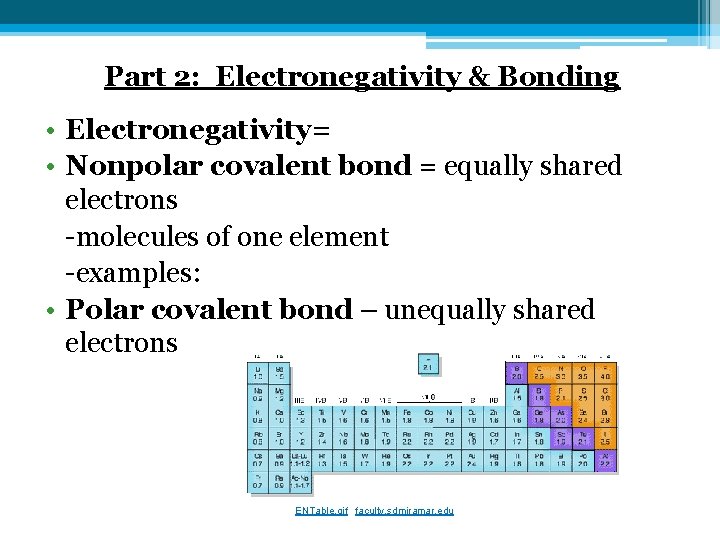
Part 2: Electronegativity & Bonding • Electronegativity= • Nonpolar covalent bond = equally shared electrons -molecules of one element -examples: • Polar covalent bond – unequally shared electrons ENTable. gif faculty. sdmiramar. edu

Tug of war – With These Guys? ? Who will win? Connection to sharing versus stealing electrons Covalent vs. Ionic bonds gunnston. com

• Electronegativity’s Connection to Water! Fig. 2. 13 Water Activity Part 2: Electronegativity Molecular Twister Kit
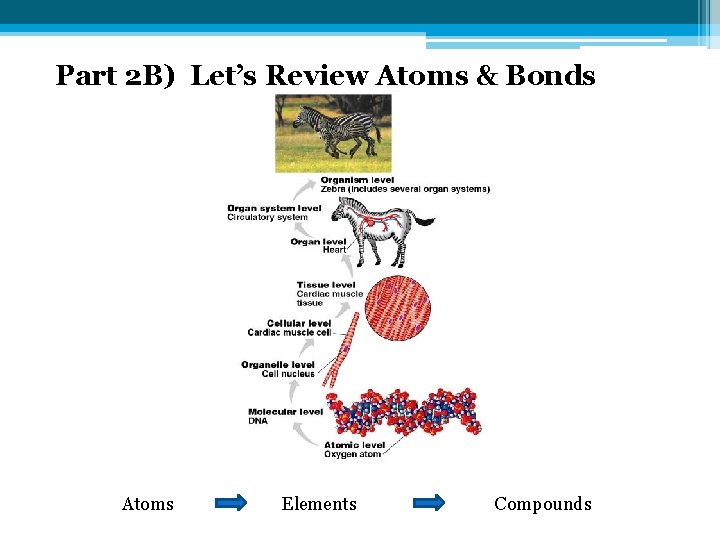
Part 2 B) Let’s Review Atoms & Bonds Atoms Elements Compounds
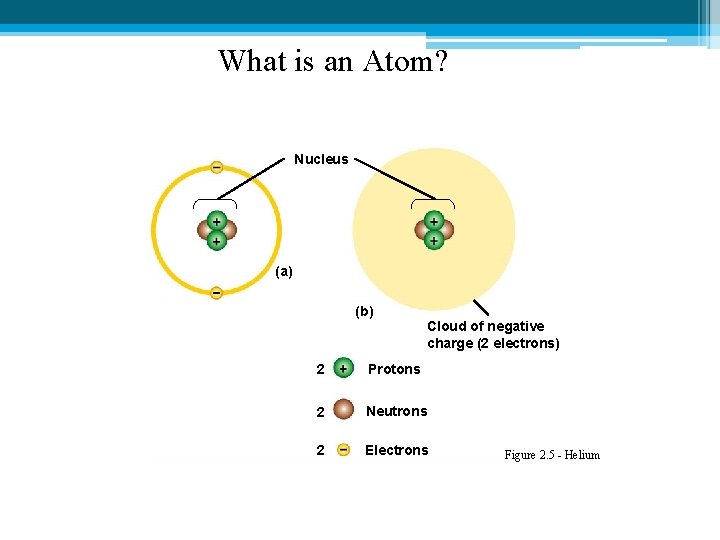
What is an Atom? Nucleus (a) (b) Cloud of negative charge (2 electrons) 2 Protons 2 Neutrons 2 Electrons Figure 2. 5 - Helium
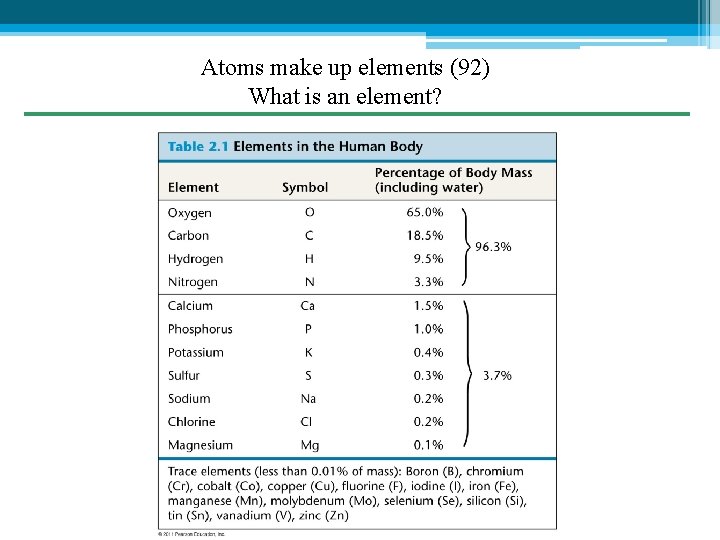
Atoms make up elements (92) What is an element?
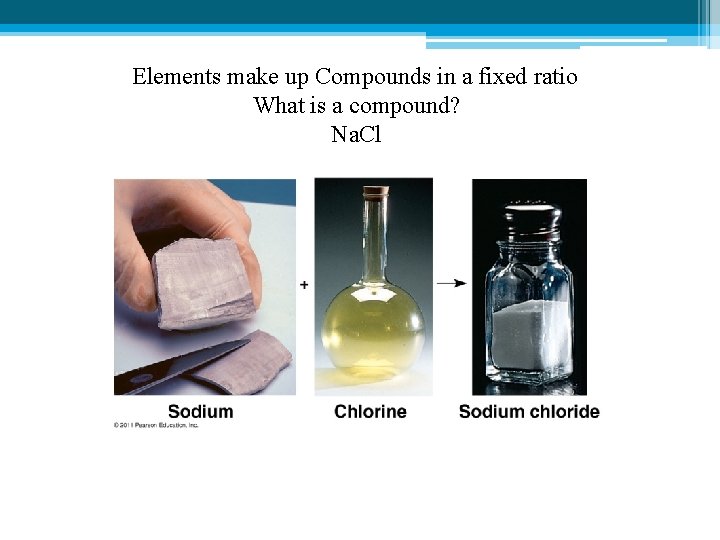
Elements make up Compounds in a fixed ratio What is a compound? Na. Cl
Atoms combine by chemical bonding to form molecules • Atoms interact by chemical bonding! Types of bonds Strong - Covalent – sharing electrons Weak - Ionic – steals electron & then bond forms due to charges – Hydrogen – unequal sharing of electrons & then bond forms due to charges
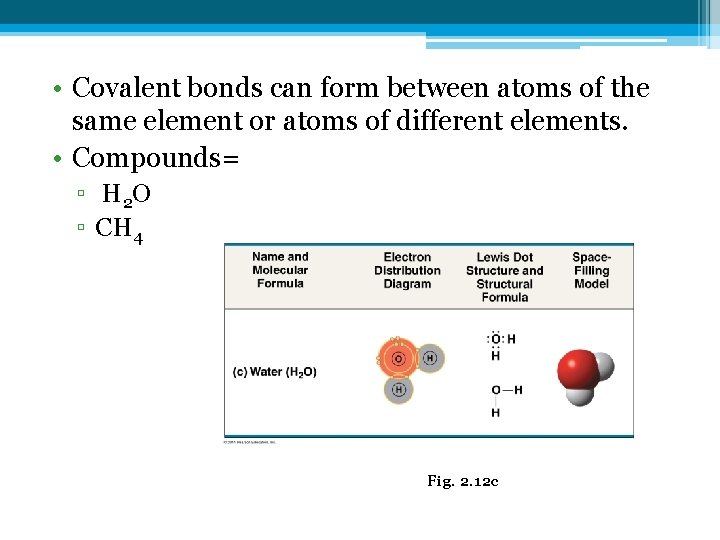
• Covalent bonds can form between atoms of the same element or atoms of different elements. • Compounds= ▫ H 2 O ▫ CH 4 Fig. 2. 12 c
Weak chemical bonds • Within a cell, weak, brief bonds between molecules are important to a variety of processes. ▫ hydrogen bonds, ▫ ionic bonds,
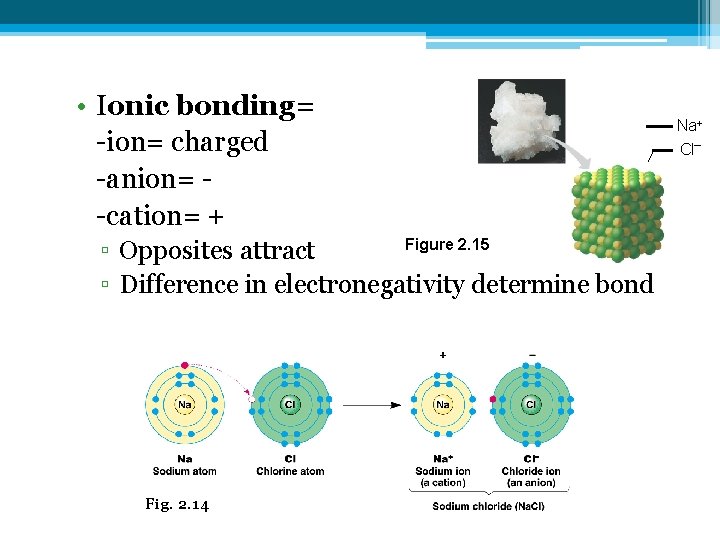
• Ionic bonding= -ion= charged -anion= -cation= + Figure 2. 15 ▫ Opposites attract ▫ Difference in electronegativity determine bond Fig. 2. 14 Na+ Cl–
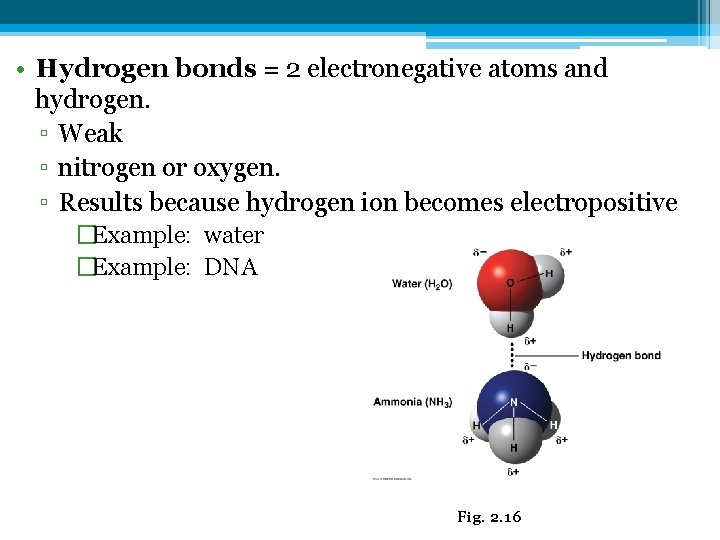
• Hydrogen bonds = 2 electronegative atoms and hydrogen. ▫ Weak ▫ nitrogen or oxygen. ▫ Results because hydrogen ion becomes electropositive �Example: water �Example: DNA Fig. 2. 16
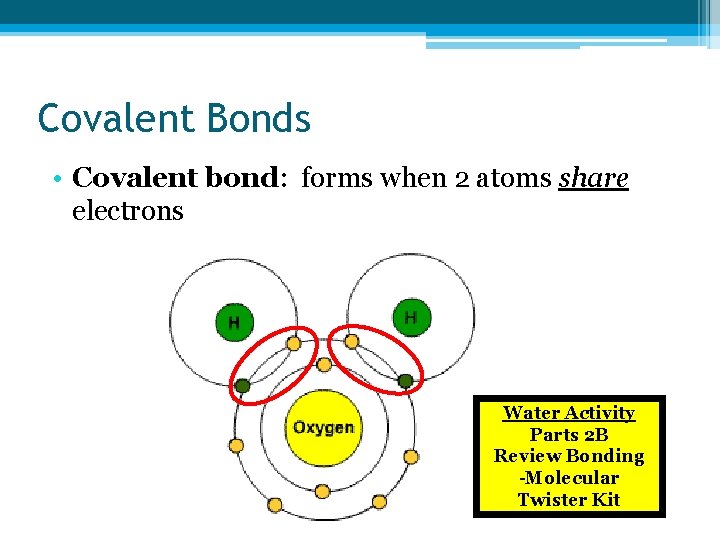
Covalent Bonds • Covalent bond: forms when 2 atoms share electrons Water Activity Parts 2 B Review Bonding -Molecular Twister Kit
Water Activity Parts 2 C Bonds within Water -Water Kit Let’s do the activity on Page 6 (Student Version)
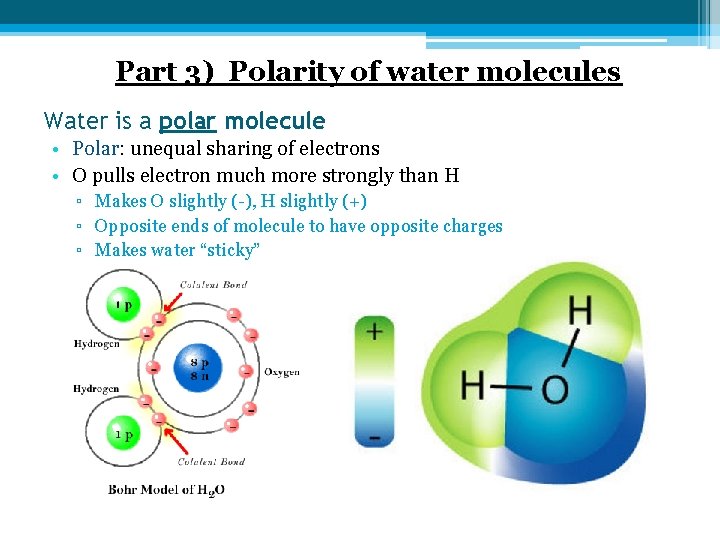
Part 3) Polarity of water molecules Water is a polar molecule • Polar: unequal sharing of electrons • O pulls electron much more strongly than H ▫ Makes O slightly (-), H slightly (+) ▫ Opposite ends of molecule to have opposite charges ▫ Makes water “sticky”
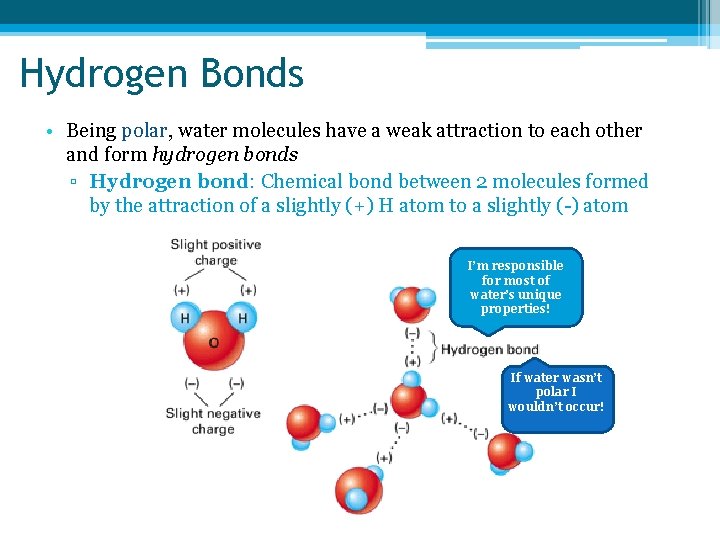
Hydrogen Bonds • Being polar, water molecules have a weak attraction to each other and form hydrogen bonds ▫ Hydrogen bond: Chemical bond between 2 molecules formed by the attraction of a slightly (+) H atom to a slightly (-) atom I’m responsible for most of water’s unique properties! If water wasn’t polar I wouldn’t occur!
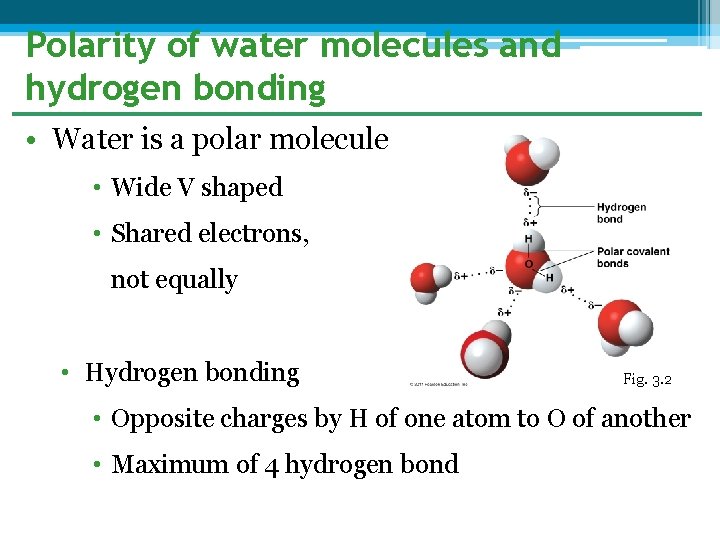
Polarity of water molecules and hydrogen bonding • Water is a polar molecule • Wide V shaped • Shared electrons, not equally • Hydrogen bonding Fig. 3. 2 • Opposite charges by H of one atom to O of another • Maximum of 4 hydrogen bond
Water Activity Parts 3 A: Bonds Between Water Molecules -Water Kit Let’s do the activity on Page 8 -10 (Student Version)
Water Activity Parts 3 B: Bonds Between Water & Other Molecules -Water Kit Show Ethane & Ethanol Show Na. Cl on Page 10 -13 (Student Version)
Which of the following makes up a water molecule? 1. 1 atom of hydrogen and 1 atom of oxygen 2. 1 atom of hydrogen and 2 atoms of oxygen 3. 2 atoms of hydrogen and 1 atom of oxygen 4. 2 atoms of hydrogen and 2 atoms of oxygen
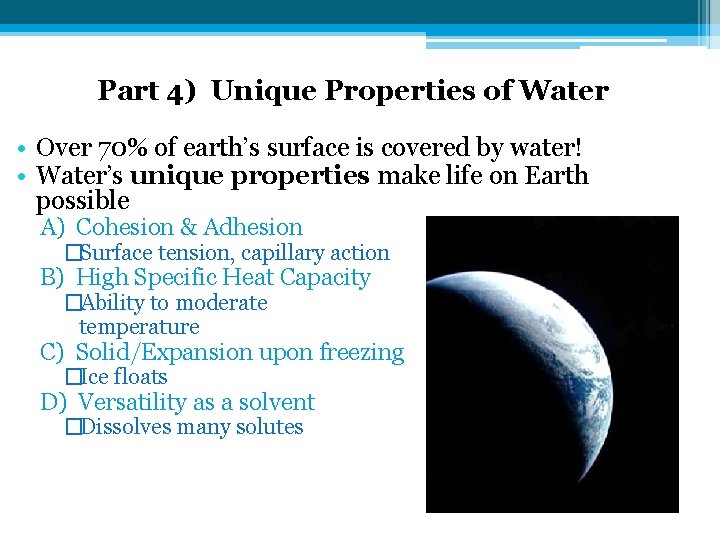
Part 4) Unique Properties of Water • Over 70% of earth’s surface is covered by water! • Water’s unique properties make life on Earth possible A) Cohesion & Adhesion �Surface tension, capillary action B) High Specific Heat Capacity �Ability to moderate temperature C) Solid/Expansion upon freezing �Ice floats D) Versatility as a solvent �Dissolves many solutes
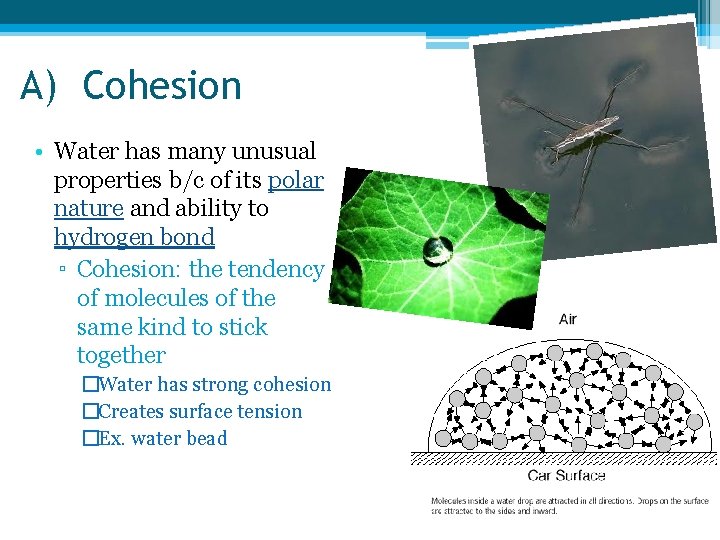
A) Cohesion • Water has many unusual properties b/c of its polar nature and ability to hydrogen bond ▫ Cohesion: the tendency of molecules of the same kind to stick together �Water has strong cohesion �Creates surface tension �Ex. water bead
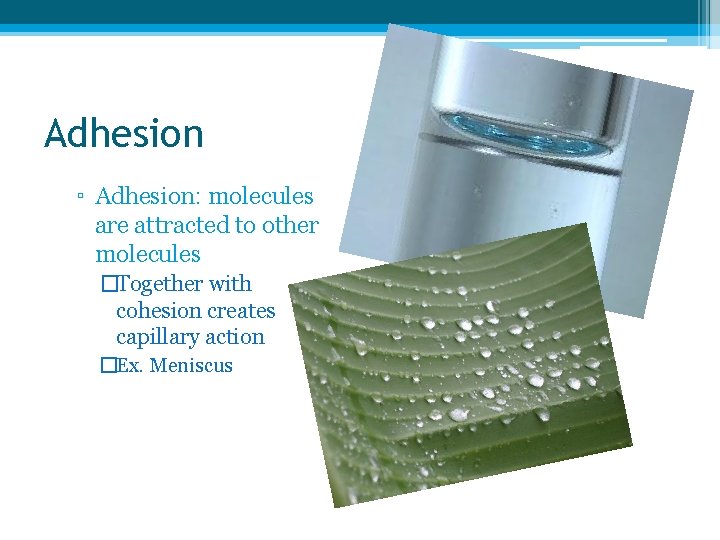
Adhesion ▫ Adhesion: molecules are attracted to other molecules �Together with cohesion creates capillary action �Ex. Meniscus
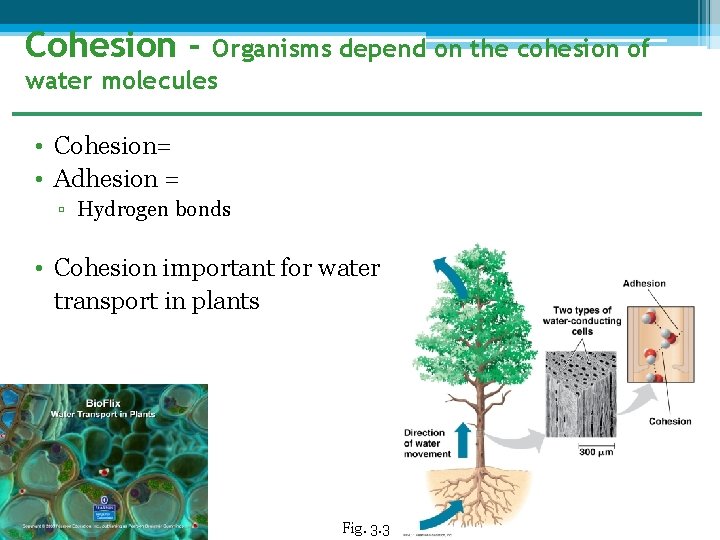
Cohesion - Organisms depend on the cohesion of water molecules • Cohesion= • Adhesion = ▫ Hydrogen bonds • Cohesion important for water transport in plants Fig. 3. 3
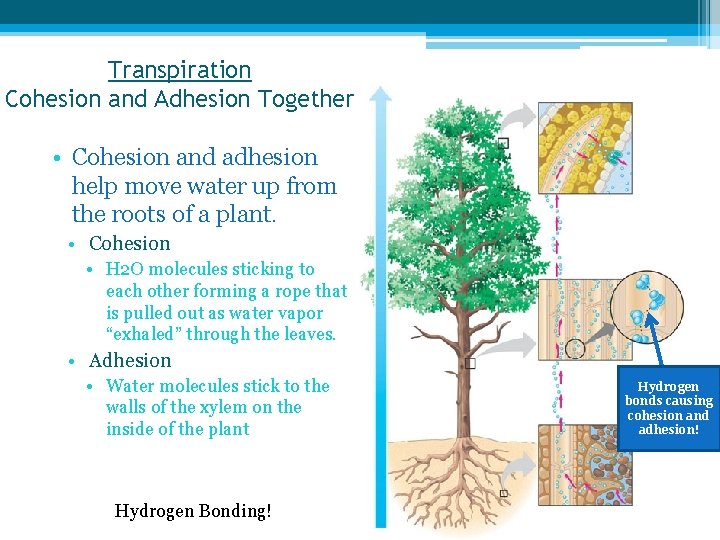
Transpiration Cohesion and Adhesion Together • Cohesion and adhesion help move water up from the roots of a plant. • Cohesion • H 2 O molecules sticking to each other forming a rope that is pulled out as water vapor “exhaled” through the leaves. • Adhesion • Water molecules stick to the walls of the xylem on the inside of the plant Hydrogen Bonding! Hydrogen bonds causing cohesion and adhesion!
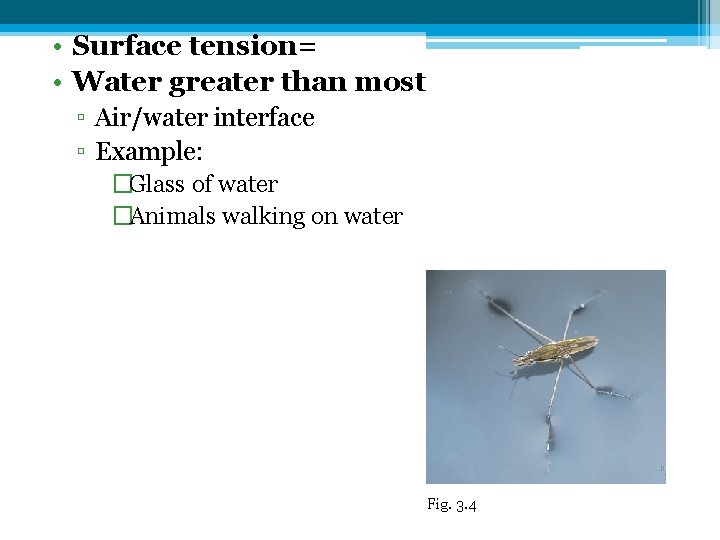
• Surface tension= • Water greater than most ▫ Air/water interface ▫ Example: �Glass of water �Animals walking on water Fig. 3. 4
Water Activity Parts 4 A: Properties of Water Cohesion & Adhesion Capillary Action Walk on Water -Water Kit Perform both activities on Page 14 (Student Version) Perform activity on Page 16 (Student Version)
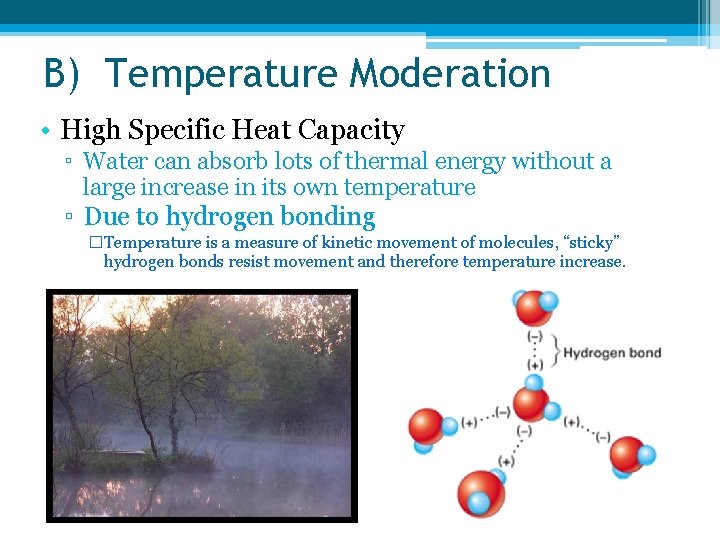
B) Temperature Moderation • High Specific Heat Capacity ▫ Water can absorb lots of thermal energy without a large increase in its own temperature ▫ Due to hydrogen bonding �Temperature is a measure of kinetic movement of molecules, “sticky” hydrogen bonds resist movement and therefore temperature increase.
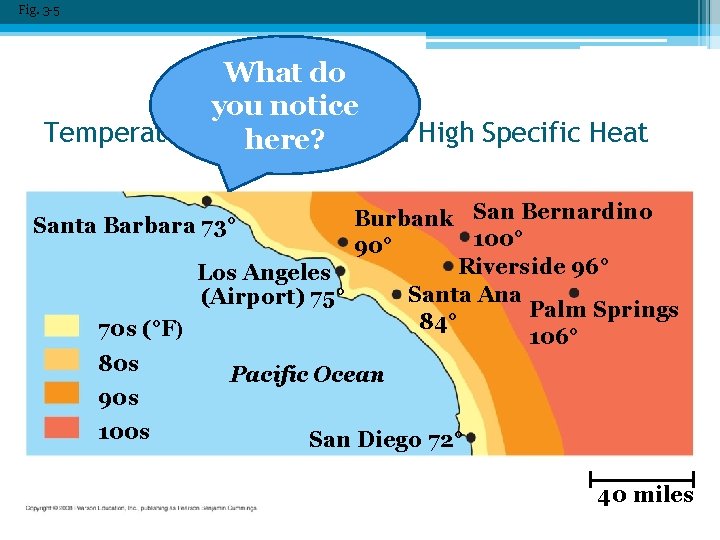
Fig. 3 -5 What do you notice Temperature Moderation here? and High Specific Heat San Bernardino Burbank Santa Barbara 73° 100° 90° Riverside 96° Los Angeles Santa Ana (Airport) 75° Palm Springs 84° 70 s (°F) 106° 80 s Pacific Ocean 90 s 100 s San Diego 72° 40 miles
• How does water stabilize temperature ▫ Specific heat = amn’t of heat needed for 1 g of substance to change its temp by 1 C. � 1 cal/g/o. C. (unusually high) ▫ Water resists changes in temperature because of hydrogen bonding �absorbed = break hydrogen bonds �released = hydrogen bonds form �Disrupt bonds not move molecules, so can resist temp changes. • Impact on environment ▫ Keep temperature range suitable for life ▫ Coastal have milder climates ▫ Marine environment stable. ▫ Impact on organisms (resist changes in internal temp).
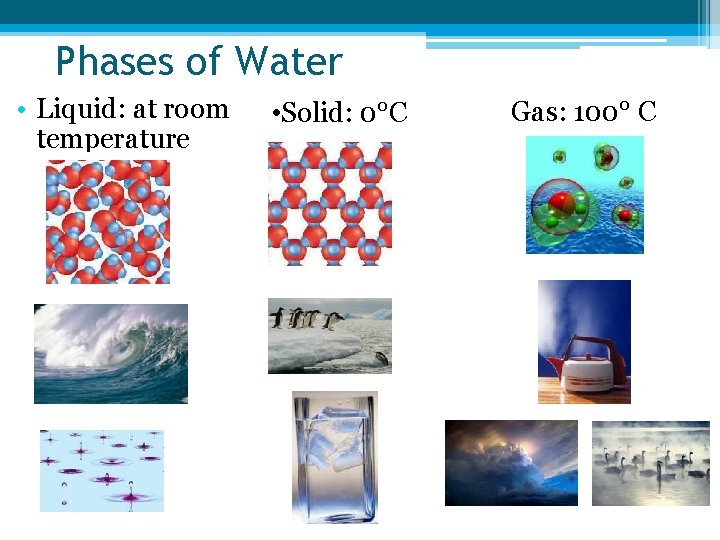
Phases of Water • Liquid: at room temperature • Solid: 0°C Gas: 100° C
Water Activity Parts 4 B: Properties of Water High Specific Heat Capacity Evaporation & Condensation -Water Kit Perform activity on Page 19 (Student Version)
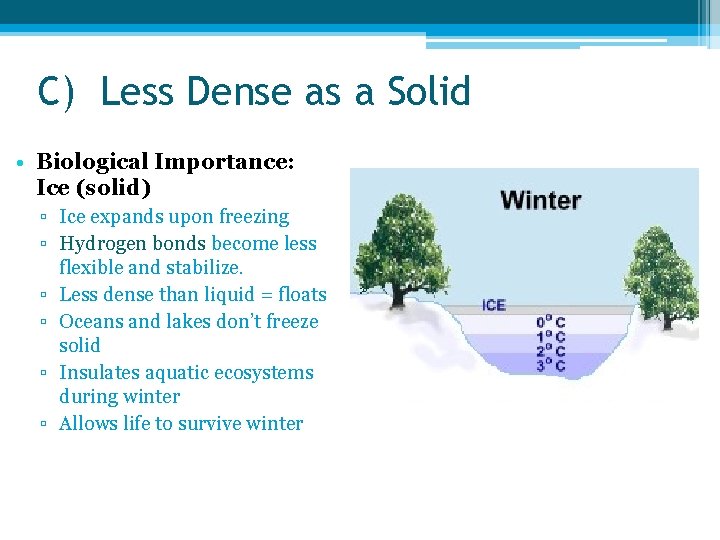
C) Less Dense as a Solid • Biological Importance: Ice (solid) ▫ Ice expands upon freezing ▫ Hydrogen bonds become less flexible and stabilize. ▫ Less dense than liquid = floats ▫ Oceans and lakes don’t freeze solid ▫ Insulates aquatic ecosystems during winter ▫ Allows life to survive winter
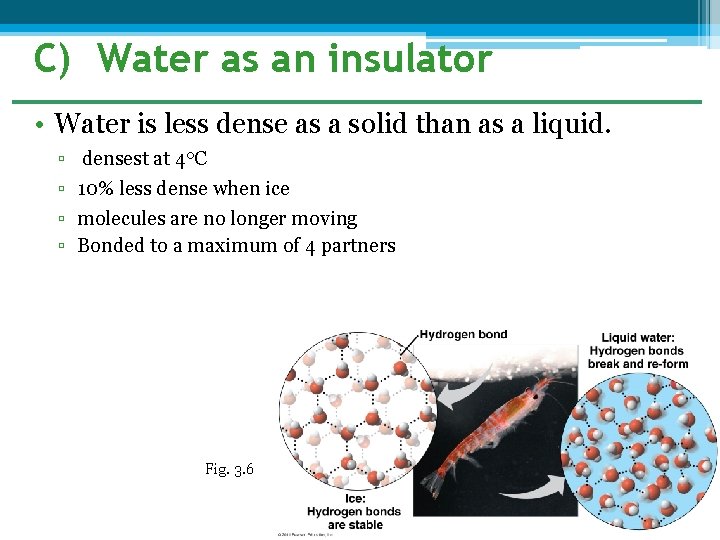
C) Water as an insulator • Water is less dense as a solid than as a liquid. ▫ ▫ densest at 4 o. C 10% less dense when ice molecules are no longer moving Bonded to a maximum of 4 partners Fig. 3. 6
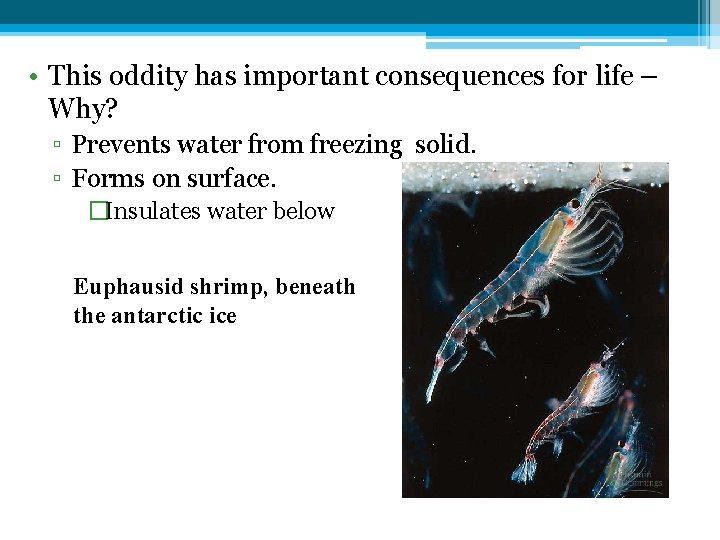
• This oddity has important consequences for life – Why? ▫ Prevents water from freezing solid. ▫ Forms on surface. �Insulates water below Euphausid shrimp, beneath the antarctic ice
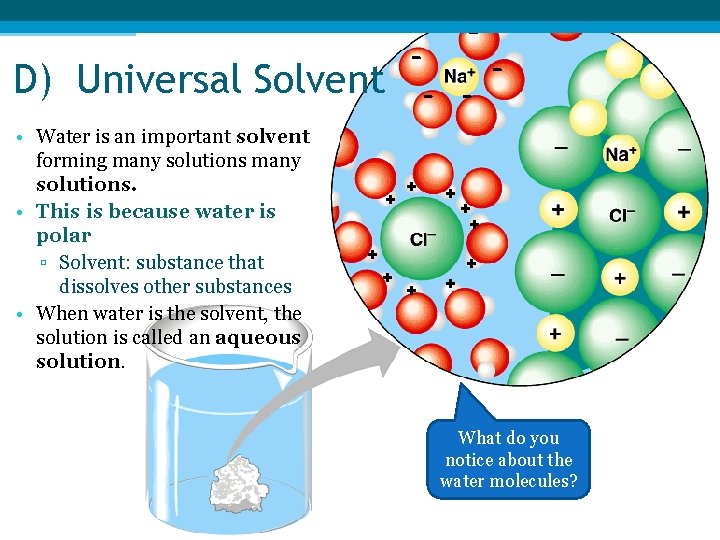
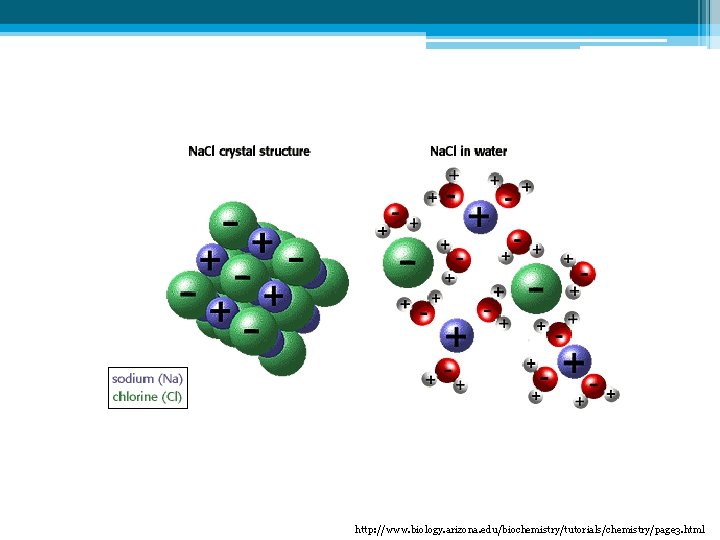
- - D) Universal Solvent - • Water is an important solvent forming many solutions. • This is because water is polar ▫ Solvent: substance that dissolves other substances • When water is the solvent, the solution is called an aqueous solution. + + + + - + + + What do you notice about the water molecules?
http: //www. biology. arizona. edu/biochemistry/tutorials/chemistry/page 3. html
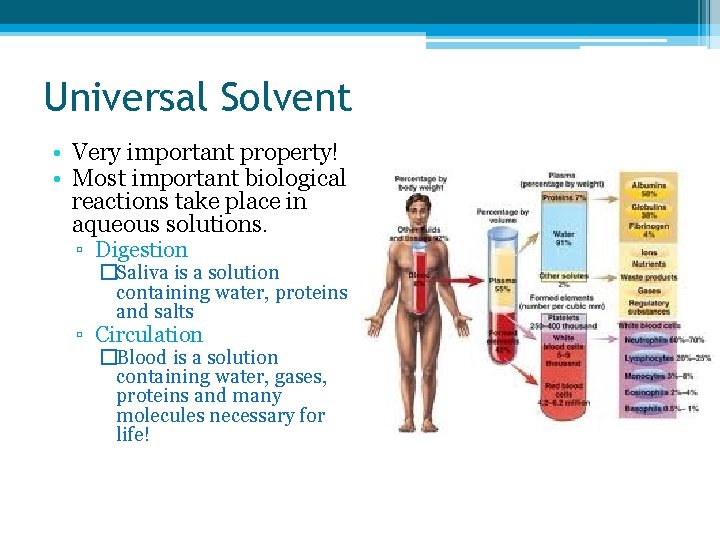
Universal Solvent • Very important property! • Most important biological reactions take place in aqueous solutions. ▫ Digestion �Saliva is a solution containing water, proteins and salts ▫ Circulation �Blood is a solution containing water, gases, proteins and many molecules necessary for life!
Water Activity Parts 4 D: Properties of Water Versatility as a Solvent -Water Kit & Na. Cl Lattice Kit Perform activity on Page 20 (Student Version)
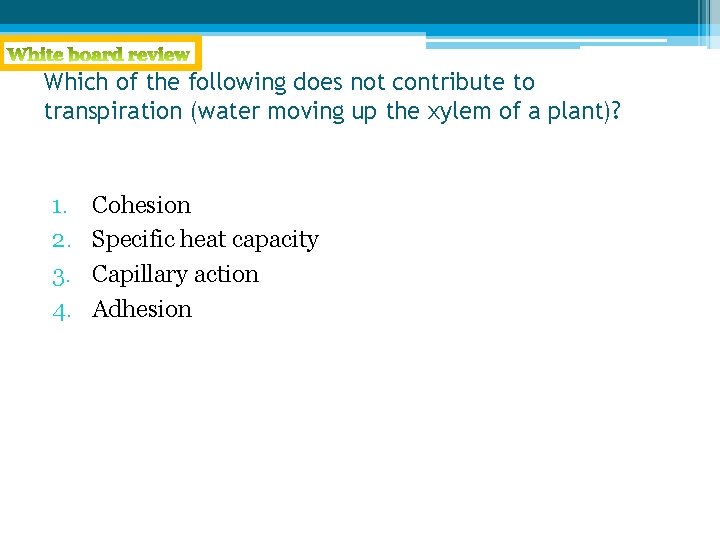
Which of the following does not contribute to transpiration (water moving up the xylem of a plant)? 1. 2. 3. 4. Cohesion Specific heat capacity Capillary action Adhesion
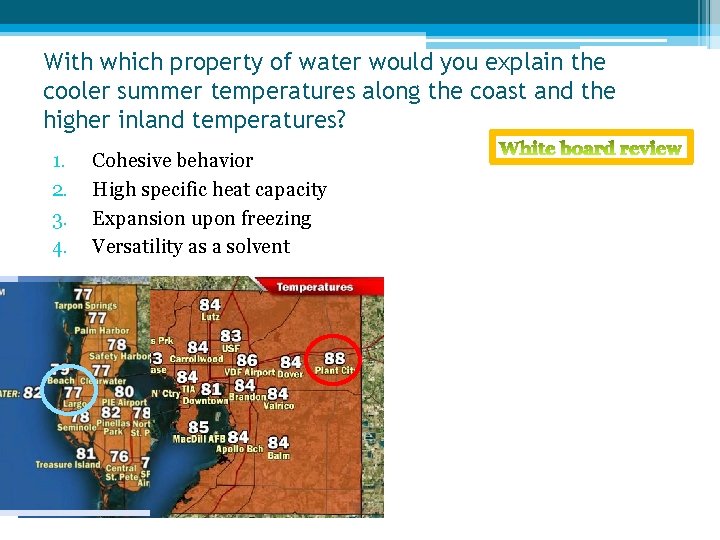
With which property of water would you explain the cooler summer temperatures along the coast and the higher inland temperatures? 1. 2. 3. 4. Cohesive behavior High specific heat capacity Expansion upon freezing Versatility as a solvent
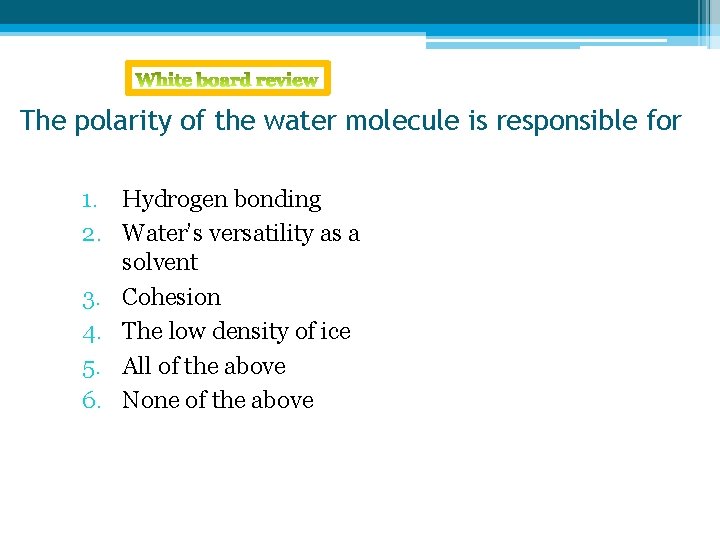
The polarity of the water molecule is responsible for 1. Hydrogen bonding 2. Water’s versatility as a solvent 3. Cohesion 4. The low density of ice 5. All of the above 6. None of the above
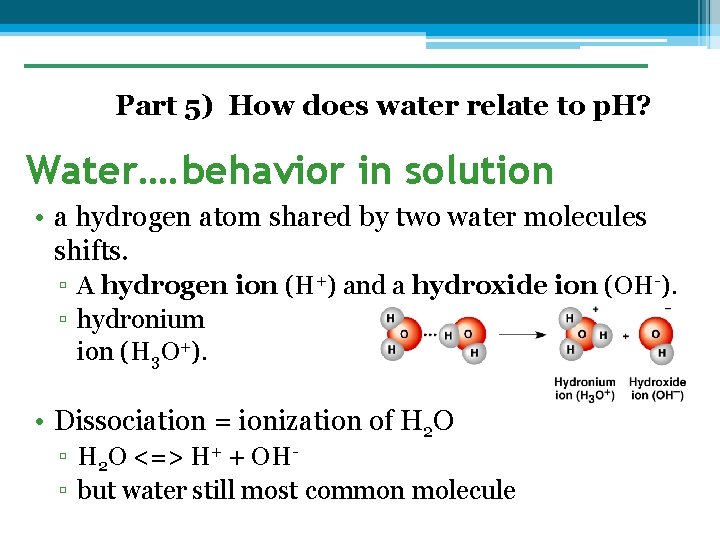
Part 5) How does water relate to p. H? Water…. behavior in solution • a hydrogen atom shared by two water molecules shifts. ▫ A hydrogen ion (H+) and a hydroxide ion (OH-). ▫ hydronium ion (H 3 O+). • Dissociation = ionization of H 2 O ▫ H 2 O <=> H+ + OH▫ but water still most common molecule
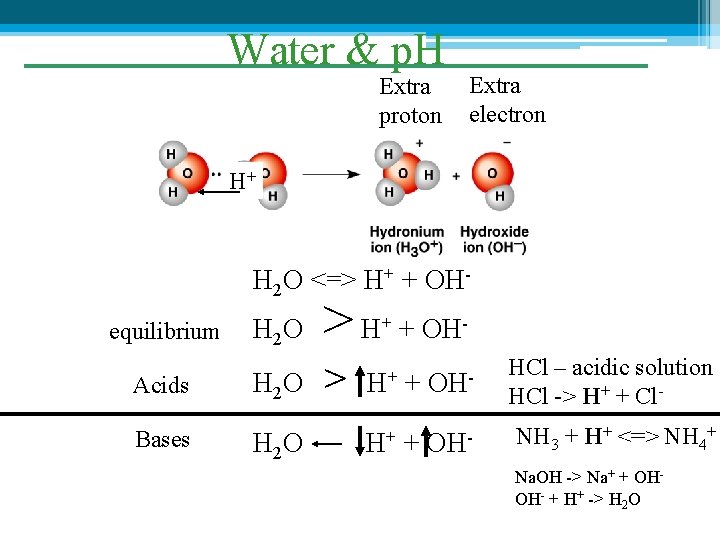
Water & p. H Extra proton Extra electron H+ H 2 O <=> H+ + OHH 2 O >H Acids H 2 O > Bases H 2 O equilibrium + + OHOH- HCl – acidic solution HCl -> H+ + Cl- H+ + OH- NH 3 + H+ <=> NH 4+ H+ + Na. OH -> Na+ + OHOH- + H+ -> H 2 O
Biological systems are sensitive to changes in p. H • Acid = increases H+ in solution �HCl -> H+ + Cl�Or decreases OH- by formation of H 2 O • Base = reduces the H+ concentration ▫ Some bases reduce H+ directly. �NH 3 + H+ <=> NH 4+ ▫ Some bases reduce H+ indirectly �Na. OH -> Na+ + OH- + H+ -> H 2 O
![Values for p. H decline as [H+] increases. ▫ Slight change in p. H](http://slidetodoc.com/presentation_image_h2/a5b66435b89a179b0e83edea286132f0/image-56.jpg "Values for p. H decline as [H+] increases. ▫ Slight change in p. H")
Values for p. H decline as [H+] increases. ▫ Slight change in p. H represents large change in [H+]. Copyright © 2002 Pearson Education, Inc. , publishing as Benjamin Cummings Fig. 3. 10
Part 6: Challenge Questions 1. Environmentally Related 2. Health Related
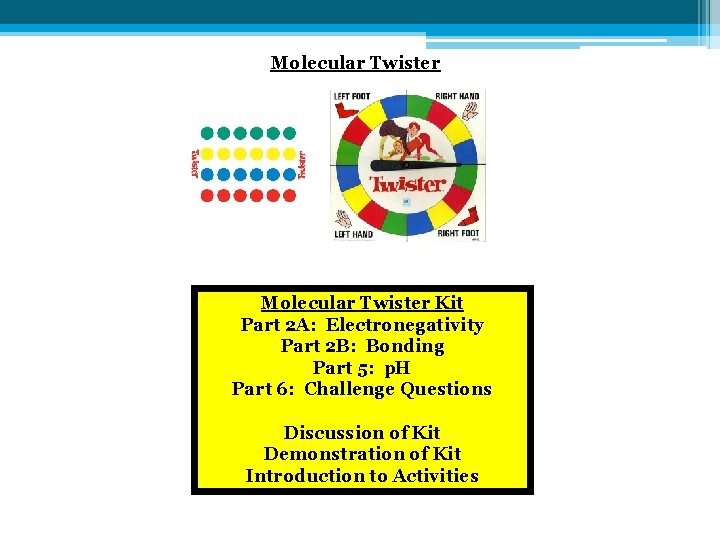
Molecular Twister Kit Part 2 A: Electronegativity Part 2 B: Bonding Part 5: p. H Part 6: Challenge Questions Discussion of Kit Demonstration of Kit Introduction to Activities
- Slides: 58