
Water Electrolyte and p H BALANCE You are
Water, Electrolyte and p. H BALANCE You are responsible for learning the material in this power point. Along the way answer the questions and take notes. There will be a class discussion so be prepared to share.
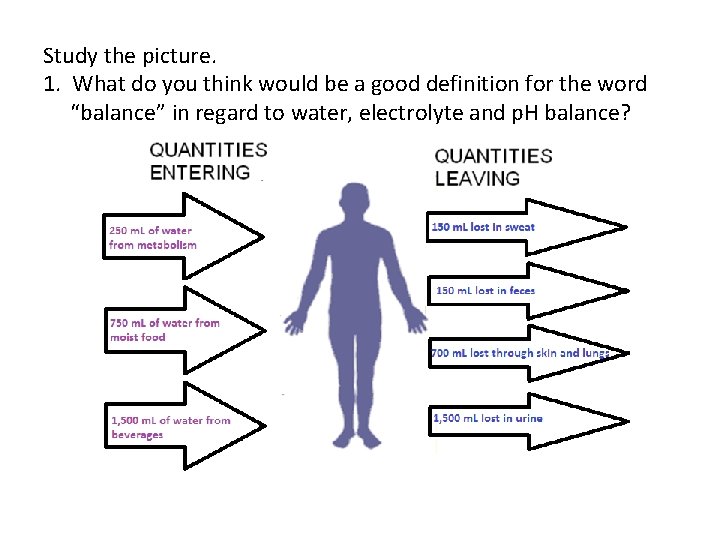
Study the picture. 1. What do you think would be a good definition for the word “balance” in regard to water, electrolyte and p. H balance?
Balance Two important balance concepts: *To maintain homeostasis, the quantities of water and electrolytes must be in balance. *Because electrolytes are dissolved in the water of the body fluids, water balance and electrolyte balance are interdependent.
Water balance • Use your text to answer the following. 2. How is water intake regulated? 3. How is water output regulated?
Examples of water balance Study the diagram on the next page. Carefully complete this diagram as it is likely to be on the test.
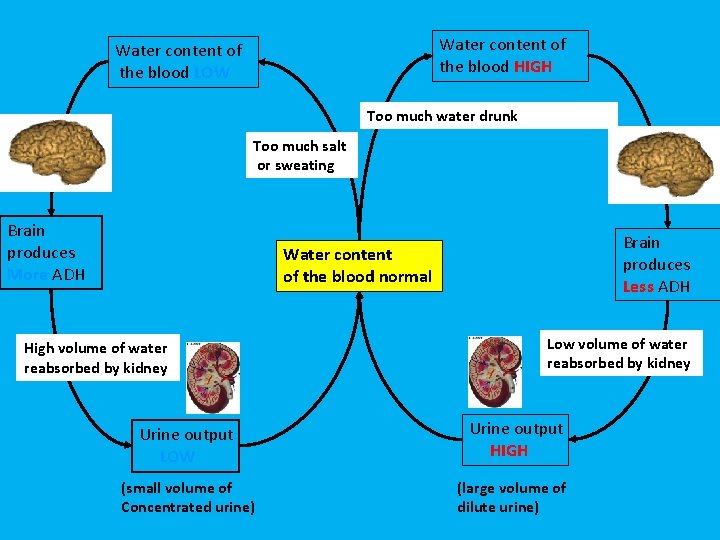
Water content of the blood HIGH Water content of the blood LOW Too much water drunk Too much salt or sweating Brain produces More ADH Brain produces Less ADH Water content of the blood normal High volume of water reabsorbed by kidney Low volume of water reabsorbed by kidney Urine output LOW Urine output HIGH (small volume of Concentrated urine) (large volume of dilute urine)
4. What does ADH stand for? 5. How does ADH work?
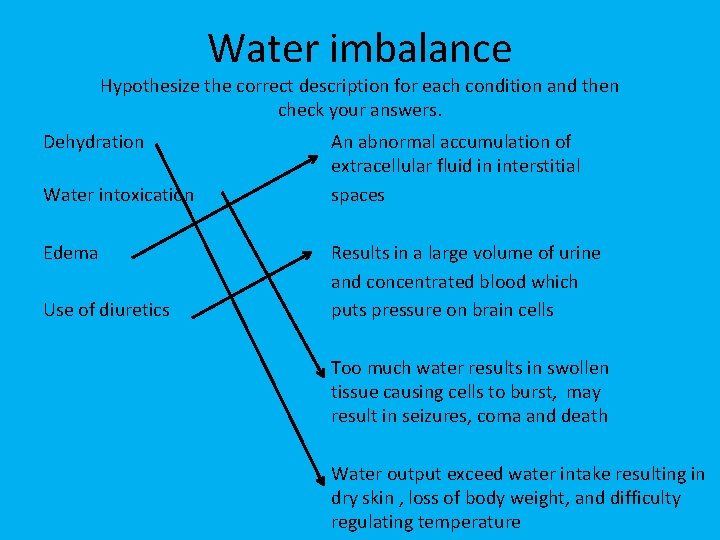
Water imbalance Hypothesize the correct description for each condition and then check your answers. Dehydration Water intoxication Edema Use of diuretics An abnormal accumulation of extracellular fluid in interstitial spaces Results in a large volume of urine and concentrated blood which puts pressure on brain cells Too much water results in swollen tissue causing cells to burst, may result in seizures, coma and death Water output exceed water intake resulting in dry skin , loss of body weight, and difficulty regulating temperature
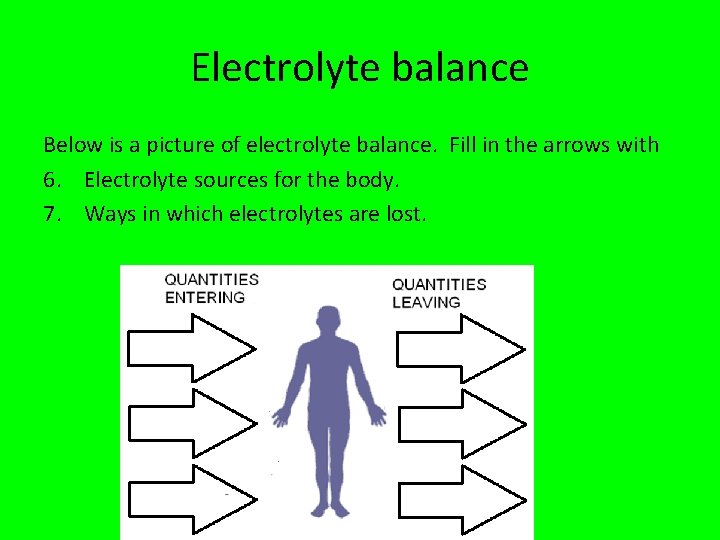
Electrolyte balance Below is a picture of electrolyte balance. Fill in the arrows with 6. Electrolyte sources for the body. 7. Ways in which electrolytes are lost.
Electrolyte balance 8. What is aldosterone? 9. How does aldosterone help regulate electrolyte balance?
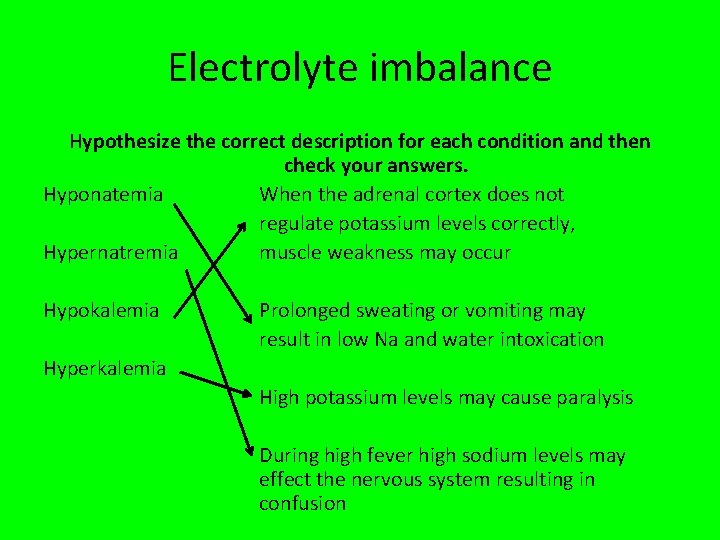
Electrolyte imbalance Hypothesize the correct description for each condition and then check your answers. Hyponatemia When the adrenal cortex does not regulate potassium levels correctly, Hypernatremia muscle weakness may occur Hypokalemia Prolonged sweating or vomiting may result in low Na and water intoxication Hyperkalemia High potassium levels may cause paralysis During high fever high sodium levels may effect the nervous system resulting in confusion
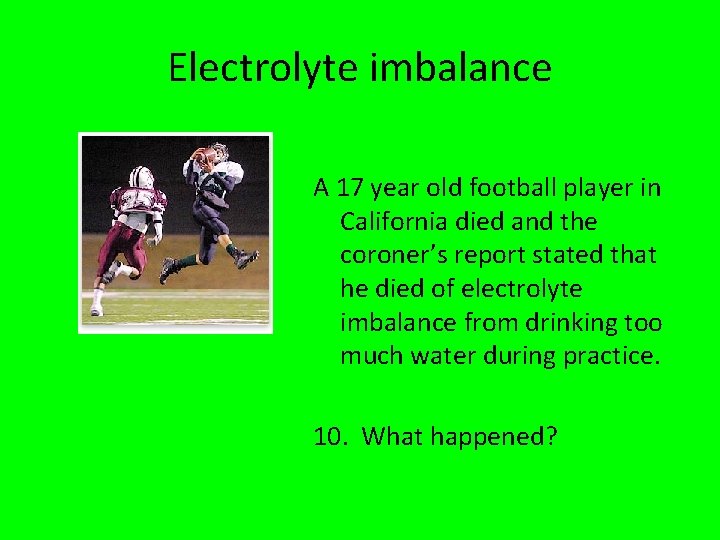
Electrolyte imbalance A 17 year old football player in California died and the coroner’s report stated that he died of electrolyte imbalance from drinking too much water during practice. 10. What happened?
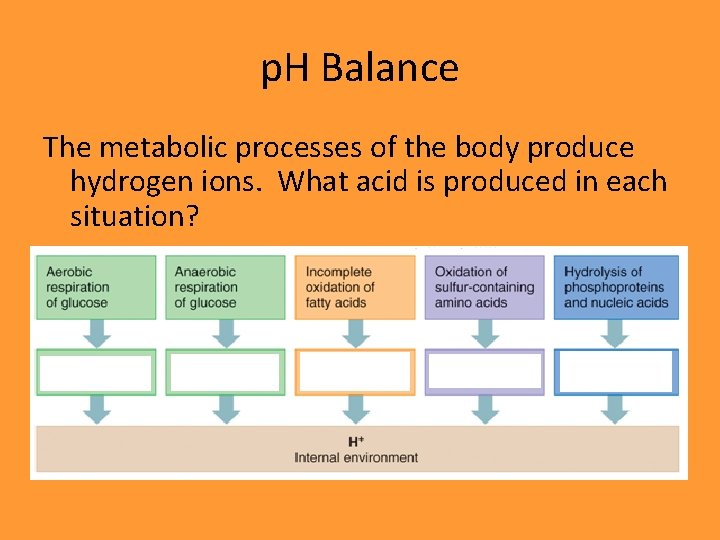
p. H Balance The metabolic processes of the body produce hydrogen ions. What acid is produced in each situation?
p. H Balance 11. Hydrogen ions are regulated by: a. An acid-base buffer system b. The respiratory center in the brain stem which increases or decreases the rate of breathing c. Nephrons in the kidneys which excrete excess H+ ions
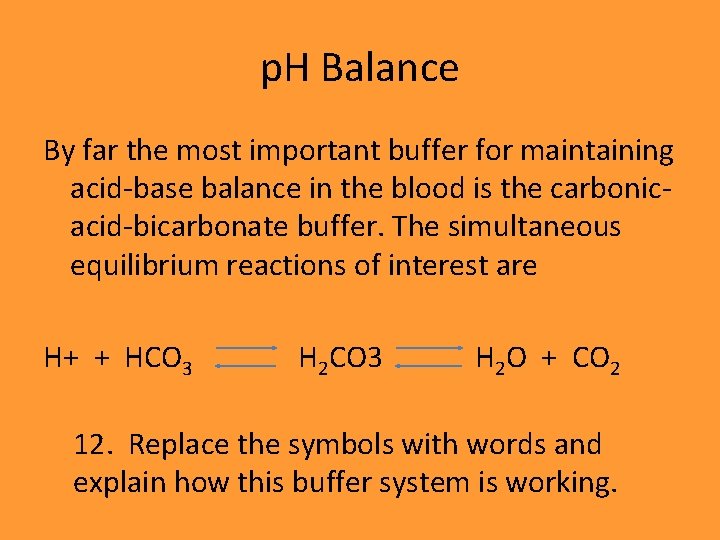
p. H Balance By far the most important buffer for maintaining acid-base balance in the blood is the carbonicacid-bicarbonate buffer. The simultaneous equilibrium reactions of interest are H+ + HCO 3 H 2 O + CO 2 12. Replace the symbols with words and explain how this buffer system is working.
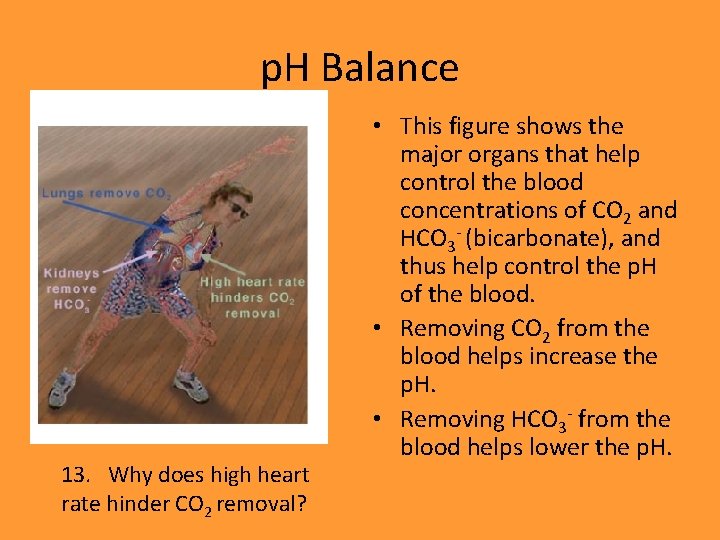
p. H Balance 13. Why does high heart rate hinder CO 2 removal? • This figure shows the major organs that help control the blood concentrations of CO 2 and HCO 3 - (bicarbonate), and thus help control the p. H of the blood. • Removing CO 2 from the blood helps increase the p. H. • Removing HCO 3 - from the blood helps lower the p. H.
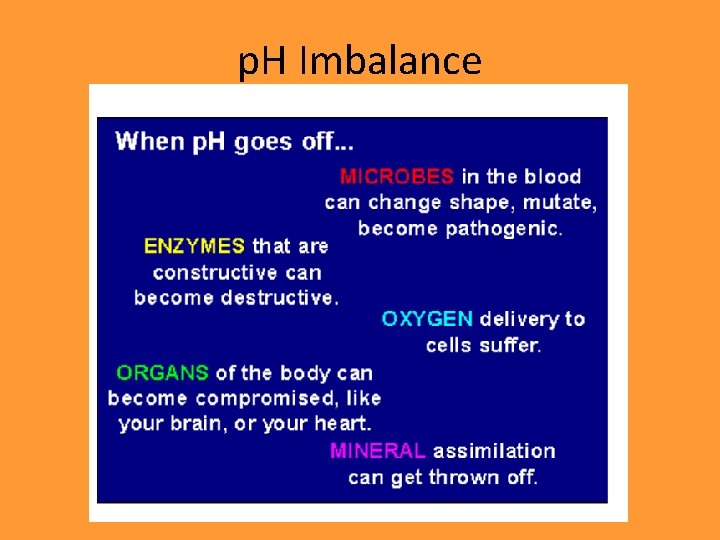
p. H Imbalance
- Slides: 17