
WATER CYCLE LESSON 6 B Could You Be
WATER CYCLE LESSON 6 B Could You Be Drinking the Same Water That George Washington Used to Wash His Boots? Explain Your Thinking.
The Three-Bottles Experiment In the last lesson, we investigated what happens in a closed system when water changes from one state to another. We looked at sample data and measured the mass of three bottles of water in the liquid, solid, and gas states. What did we discover?
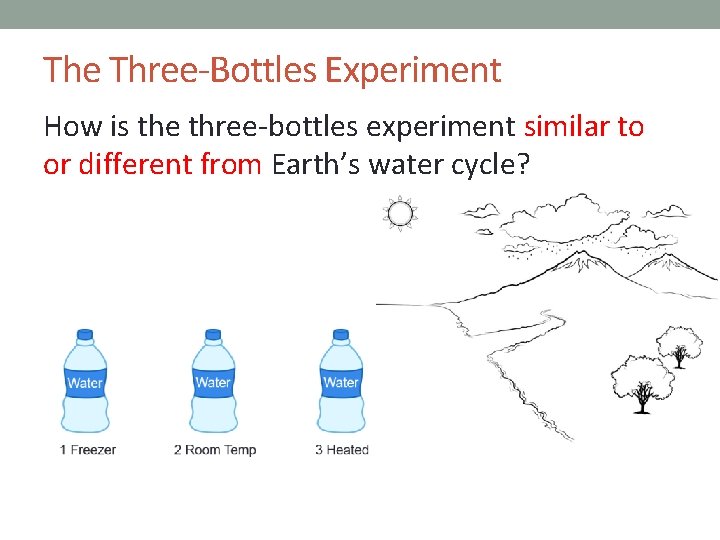
The Three-Bottles Experiment How is the three-bottles experiment similar to or different from Earth’s water cycle?
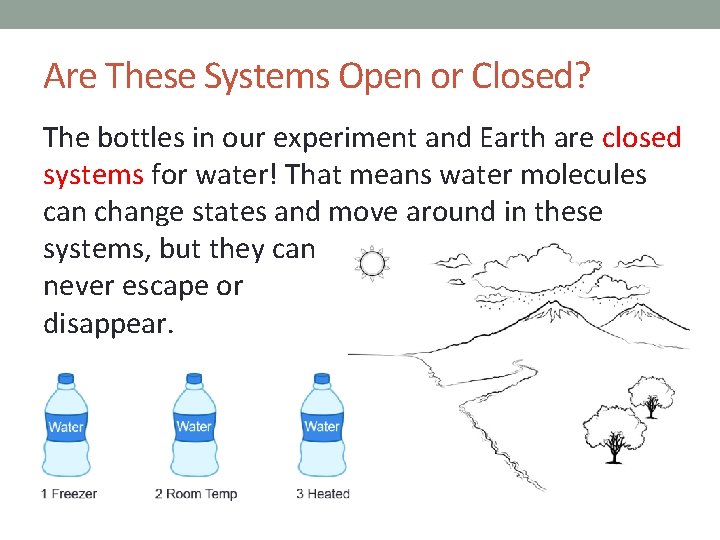
Are These Systems Open or Closed? The bottles in our experiment and Earth are closed systems for water! That means water molecules can change states and move around in these systems, but they can never escape or disappear.
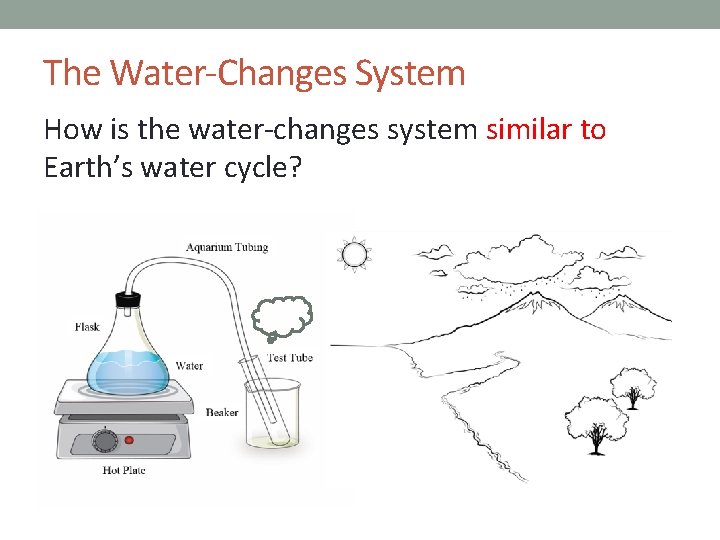
The Water-Changes System How is the water-changes system similar to Earth’s water cycle?
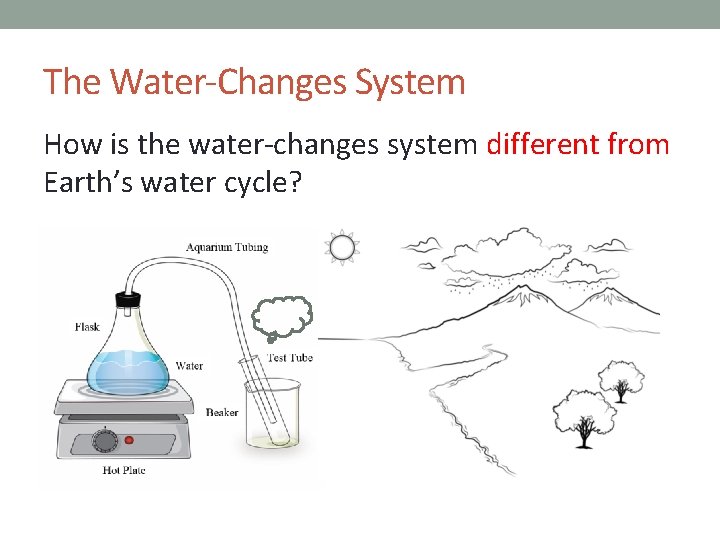
The Water-Changes System How is the water-changes system different from Earth’s water cycle?
Our Unit Central Questions Today you’ll put together all you’ve learned about the water cycle to answer our unit central questions: • How does water change in the world around us? • Does Earth ever run out of water?
Today’s Focus Question Could you be drinking the same water that George Washington used to wash his boots? Explain your thinking.
A Story about George Washington’s Boots To help us answer today’s focus question, we’re going to read a story about some water molecules from George Washington’s boots. • As you read the story, mark each time the water molecules change state. • At the end of the story, you’ll count up how many times the water molecules changed state.
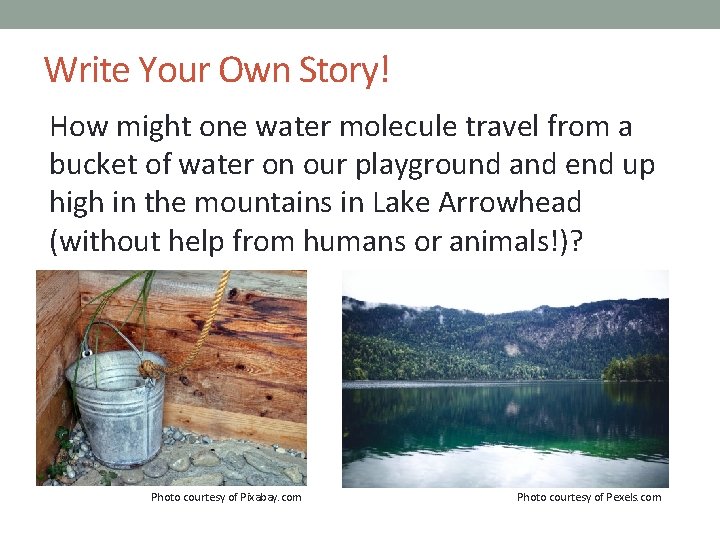
Write Your Own Story! How might one water molecule travel from a bucket of water on our playground and end up high in the mountains in Lake Arrowhead (without help from humans or animals!)? Photo courtesy of Pixabay. com Photo courtesy of Pexels. com
Summary: Did Your Story Include These Ideas? 1. A water molecule in the bucket gains enough energy from 2. 3. 4. 5. 6. the Sun to evaporate and rise into the air. The evaporated water molecule is now water vapor (a gas) moving throughout the air. The water-vapor molecule rises high up in the sky, where it loses heat energy because it’s cooler up there. The water-vapor molecule slows down and joins with other water molecules to condense and form a tiny water droplet that is part of a cloud. The wind blows the cloud over Lake Arrowhead. The water molecule joins up with more and more water molecules until it forms a big, heavy water drop that falls from the sky as rain and lands in Lake Arrowhead.
Our Focus Question Think about everything you’ve learned about the water cycle in this unit. How would you answer this question now? Could you be drinking the same water that George Washington used to wash his boots? Explain your thinking.
The Big Idea! Our unit central questions: How does water change in the world around us? Does Earth ever run out of water? The big idea: Energy from the Sun drives the water cycle. This cycle includes the processes of evaporation, condensation, and precipitation. These processes allow water molecules to change states and move around the Earth and its atmosphere without ever disappearing, losing mass, being destroyed, or being used up. Earth can never run out of water because it’s a closed system for water.
Check Your Understanding How would you explain to someone what happens to water molecules in the water cycle during evaporation, condensation, and precipitation?
- Slides: 14