
Water Cost of Service Rate Study Preliminary Analysis













- Slides: 61
Water Cost of Service & Rate Study Preliminary Analysis Summary May 2, 2017
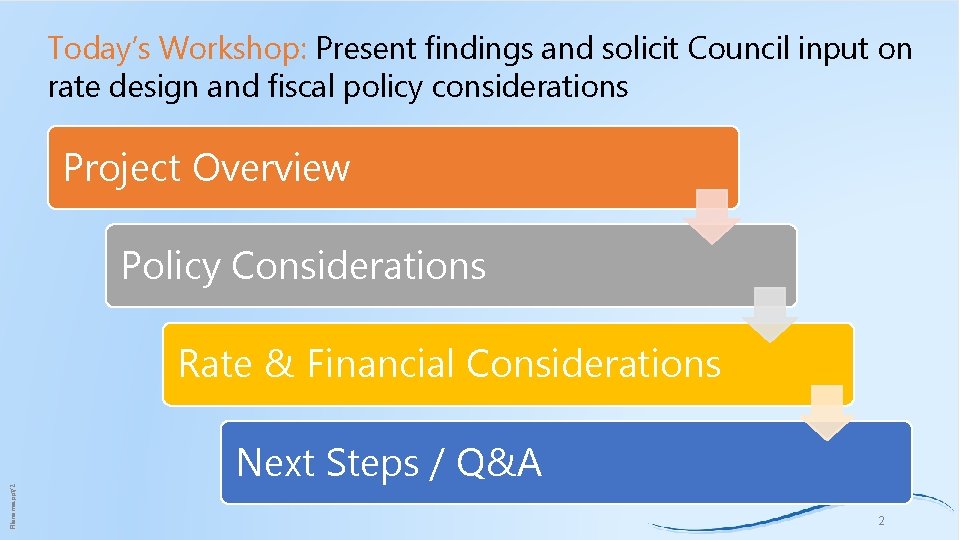
Today’s Workshop: Present findings and solicit Council input on rate design and fiscal policy considerations Project Overview Policy Considerations Filename. ppt/2 Rate & Financial Considerations Next Steps / Q&A 2
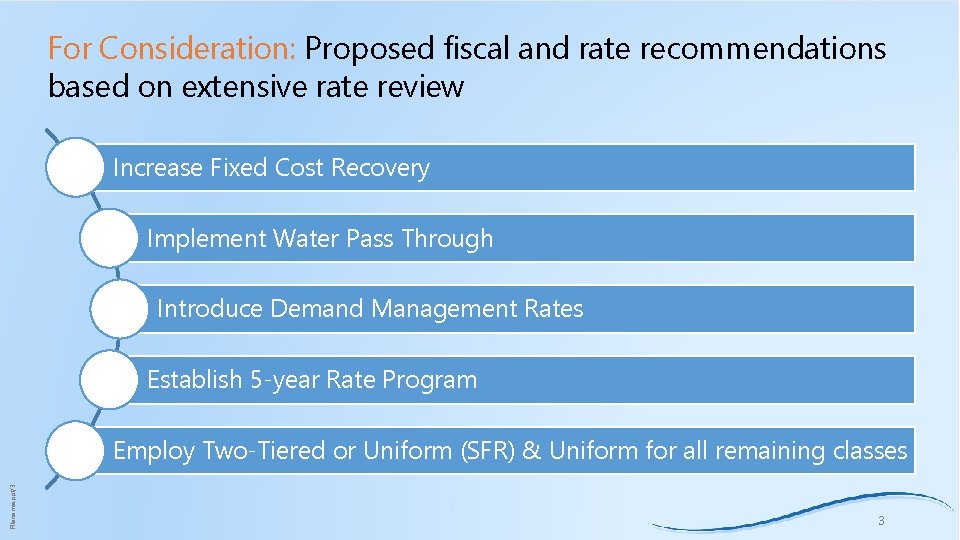
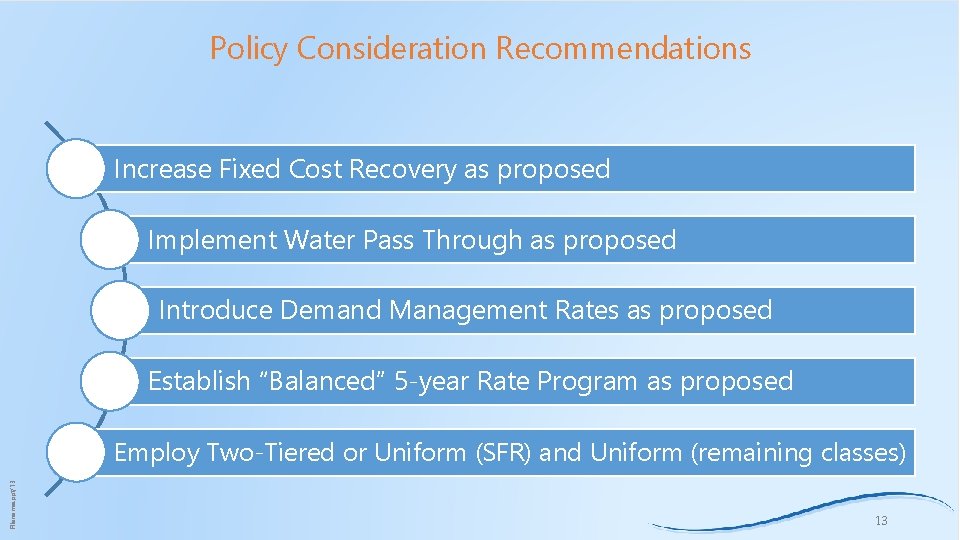
For Consideration: Proposed fiscal and rate recommendations based on extensive rate review Increase Fixed Cost Recovery Implement Water Pass Through Introduce Demand Management Rates Establish 5 -year Rate Program Filename. ppt/3 Employ Two-Tiered or Uniform (SFR) & Uniform for all remaining classes 3
Draft Rates calculated given “Balanced” revenue forecast
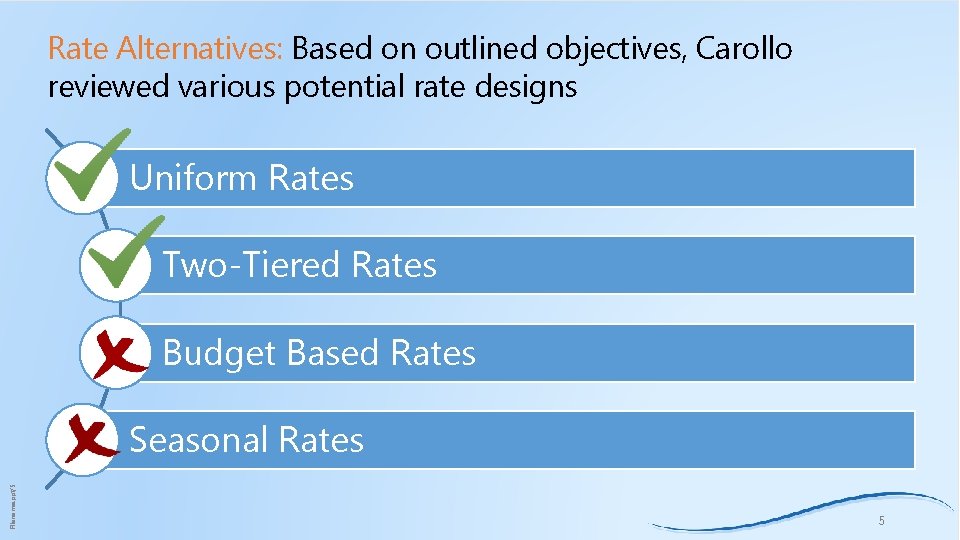
Rate Alternatives: Based on outlined objectives, Carollo reviewed various potential rate designs Uniform Rates Two-Tiered Rates Budget Based Rates Filename. ppt/5 Seasonal Rates 5
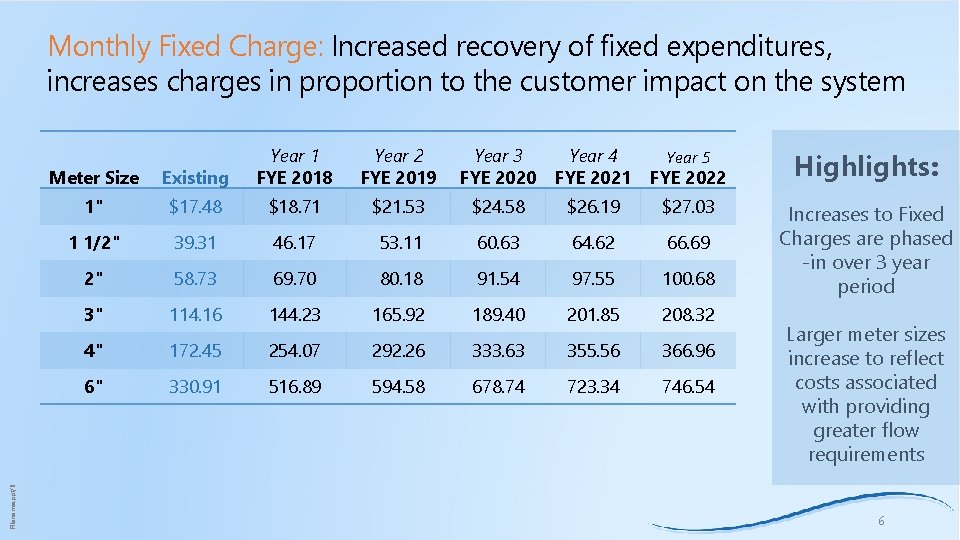
Filename. ppt/6 Monthly Fixed Charge: Increased recovery of fixed expenditures, increases charges in proportion to the customer impact on the system Meter Size Existing Year 1 FYE 2018 Year 2 FYE 2019 Year 3 FYE 2020 Year 4 FYE 2021 Year 5 FYE 2022 Highlights: 1" $17. 48 $18. 71 $21. 53 $24. 58 $26. 19 $27. 03 Increases to Fixed Charges are phased -in over 3 year period 1 1/2" 39. 31 46. 17 53. 11 60. 63 64. 62 66. 69 2" 58. 73 69. 70 80. 18 91. 54 97. 55 100. 68 3" 114. 16 144. 23 165. 92 189. 40 201. 85 208. 32 4" 172. 45 254. 07 292. 26 333. 63 355. 56 366. 96 6" 330. 91 516. 89 594. 58 678. 74 723. 34 746. 54 Larger meter sizes increase to reflect costs associated with providing greater flow requirements 6
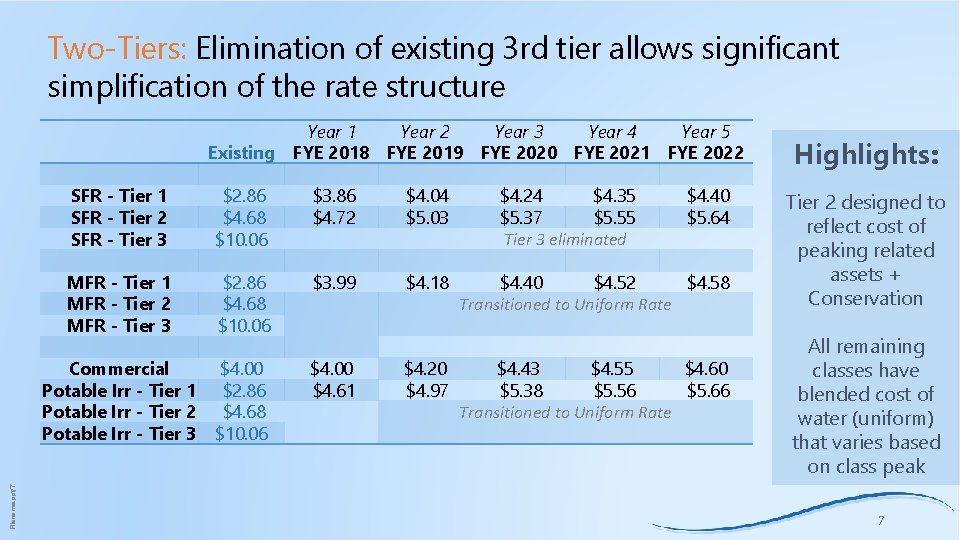
Two-Tiers: Elimination of existing 3 rd tier allows significant simplification of the rate structure Filename. ppt/7 Existing Year 1 Year 2 Year 3 Year 4 Year 5 FYE 2018 FYE 2019 FYE 2020 FYE 2021 FYE 2022 SFR - Tier 1 SFR - Tier 2 SFR - Tier 3 $2. 86 $4. 68 $10. 06 $3. 86 $4. 72 $4. 04 $5. 03 MFR - Tier 1 MFR - Tier 2 MFR - Tier 3 $2. 86 $4. 68 $10. 06 $3. 99 $4. 18 Commercial Potable Irr - Tier 1 Potable Irr - Tier 2 Potable Irr - Tier 3 $4. 00 $2. 86 $4. 68 $10. 06 $4. 00 $4. 61 $4. 20 $4. 97 $4. 24 $4. 35 $5. 37 $5. 55 Tier 3 eliminated $4. 40 $5. 64 $4. 40 $4. 52 $4. 58 Transitioned to Uniform Rate $4. 43 $4. 55 $4. 60 $5. 38 $5. 56 $5. 66 Transitioned to Uniform Rate Highlights: Tier 2 designed to reflect cost of peaking related assets + Conservation All remaining classes have blended cost of water (uniform) that varies based on class peak 7
Uniform Rates: Further simplifies the rate structure by allocating peaking and conservation costs to all users, rather than higher users Filename. ppt/8 Existing Year 1 Year 2 Year 3 Year 4 Year 5 FYE 2018 FYE 2019 FYE 2020 FYE 2021 FYE 2022 SFR - Tier 1 SFR - Tier 2 SFR - Tier 3 $2. 86 $4. 68 $10. 06 $4. 12 MFR - Tier 1 MFR - Tier 2 MFR - Tier 3 $2. 86 $4. 68 $10. 06 $3. 99 Commercial Potable Irr - Tier 1 Potable Irr - Tier 2 Potable Irr - Tier 3 $4. 00 $2. 86 $4. 68 $10. 06 $4. 00 $4. 61 $4. 34 $4. 58 $4. 71 $4. 77 Transitioned to Uniform Rate $4. 18 $4. 40 $4. 52 Highlights: $4. 58 Transitioned to Uniform Rate $4. 20 $4. 97 $4. 43 $5. 38 $4. 55 $5. 56 $4. 60 $5. 66 All classes have blended cost of water (uniform) that varies based on class peak Transitioned to Uniform Rate 8
evenue Requiremen Revenue Adjustments necessary to cover forecasted operating and capital needs
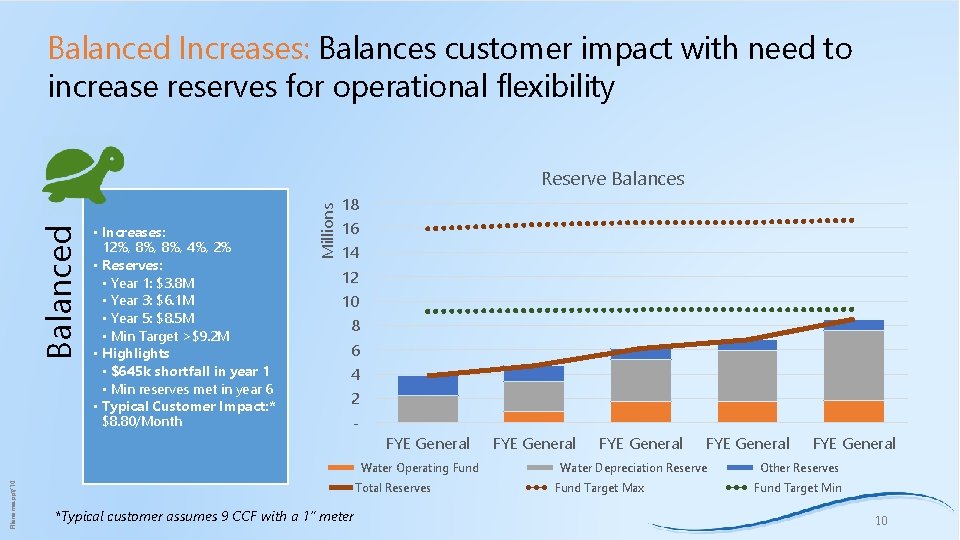
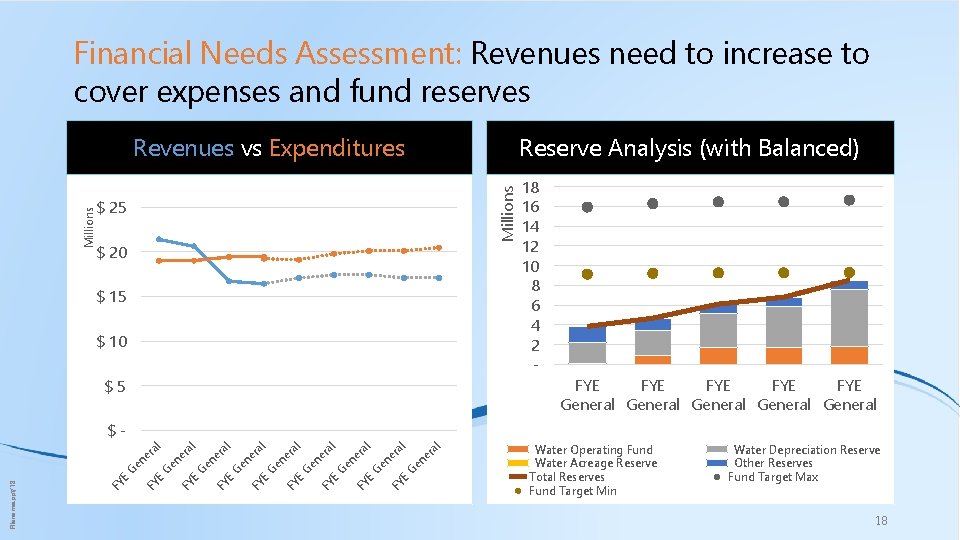
Balanced Increases: Balances customer impact with need to increase reserves for operational flexibility • Increases: 12%, 8%, 4%, 2% • Reserves: • Year 1: $3. 8 M • Year 3: $6. 1 M • Year 5: $8. 5 M • Min Target >$9. 2 M • Highlights • $645 k shortfall in year 1 • Min reserves met in year 6 • Typical Customer Impact: * $8. 80/Month Millions Balanced Reserve Balances 18 16 14 12 10 8 6 4 2 - FYE General Filename. ppt/10 Water Operating Fund Total Reserves *Typical customer assumes 9 CCF with a 1” meter FYE General Water Depreciation Reserve Fund Target Max FYE General Other Reserves Fund Target Min 10
Discussion & Next Steps
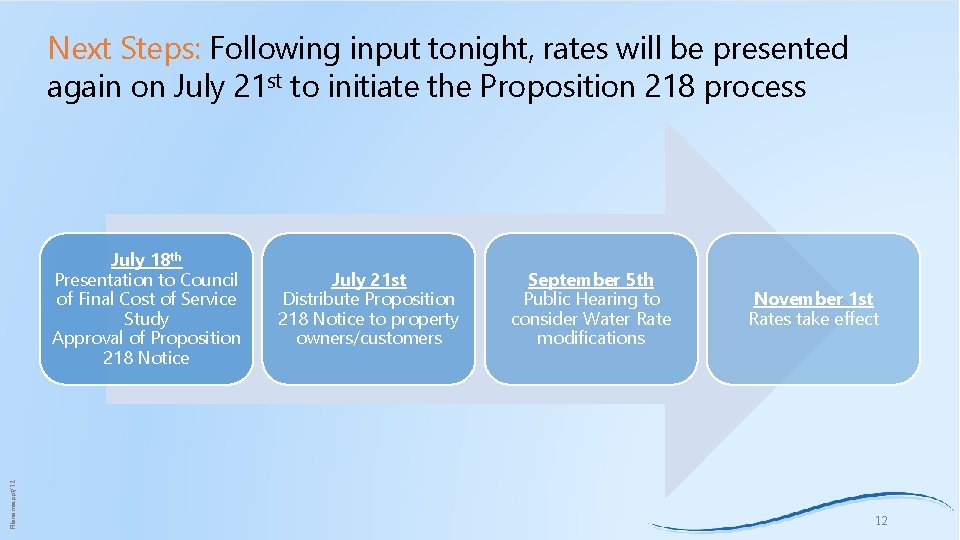
Next Steps: Following input tonight, rates will be presented again on July 21 st to initiate the Proposition 218 process Filename. ppt/12 July 18 th Presentation to Council of Final Cost of Service Study Approval of Proposition 218 Notice July 21 st Distribute Proposition 218 Notice to property owners/customers September 5 th Public Hearing to consider Water Rate modifications November 1 st Rates take effect 12
Policy Consideration Recommendations Increase Fixed Cost Recovery as proposed Implement Water Pass Through as proposed Introduce Demand Management Rates as proposed Establish “Balanced” 5 -year Rate Program as proposed Filename. ppt/13 Employ Two-Tiered or Uniform (SFR) and Uniform (remaining classes) 13
Questions
Extra Slides
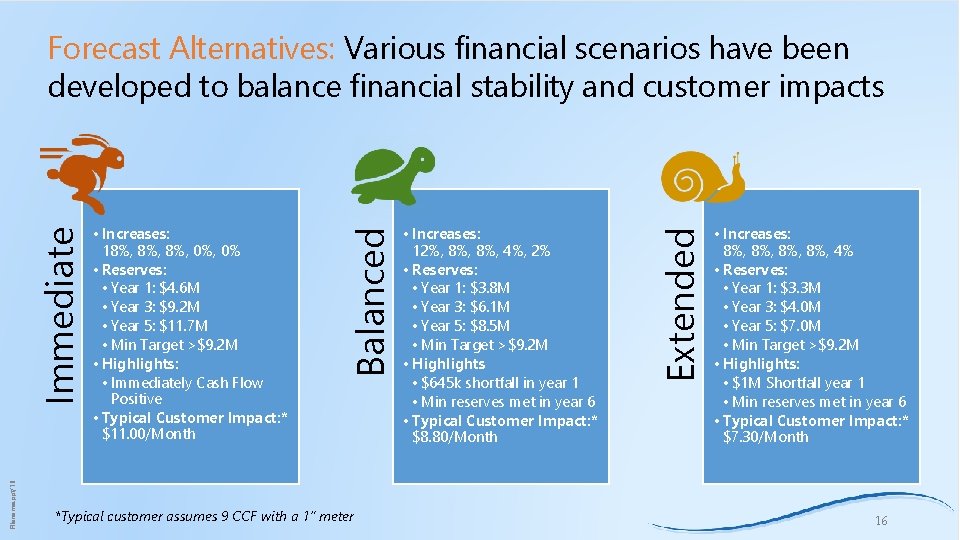
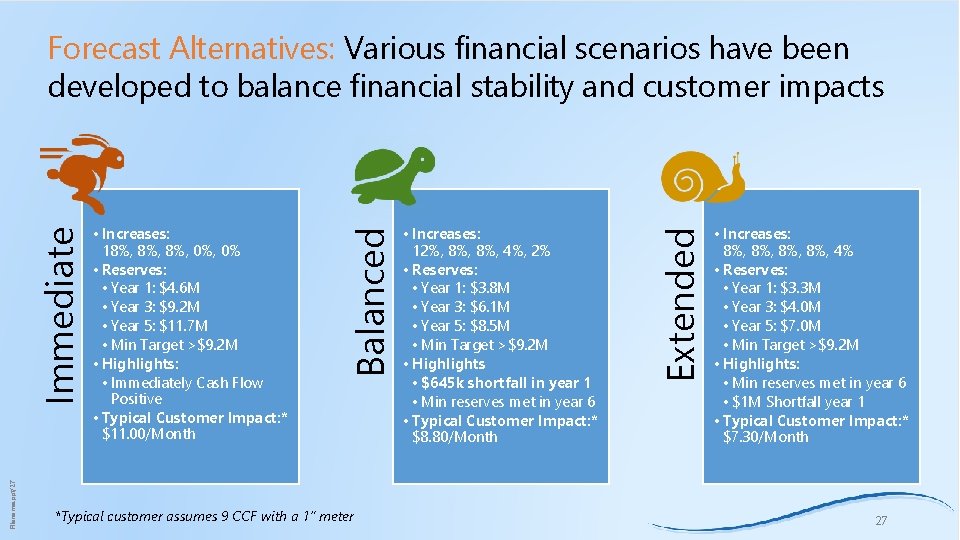
Filename. ppt/16 *Typical customer assumes 9 CCF with a 1” meter • Increases: 12%, 8%, 4%, 2% • Reserves: • Year 1: $3. 8 M • Year 3: $6. 1 M • Year 5: $8. 5 M • Min Target >$9. 2 M • Highlights • $645 k shortfall in year 1 • Min reserves met in year 6 • Typical Customer Impact: * $8. 80/Month Extended • Increases: 18%, 8%, 0% • Reserves: • Year 1: $4. 6 M • Year 3: $9. 2 M • Year 5: $11. 7 M • Min Target >$9. 2 M • Highlights: • Immediately Cash Flow Positive • Typical Customer Impact: * $11. 00/Month Balanced Immediate Forecast Alternatives: Various financial scenarios have been developed to balance financial stability and customer impacts • Increases: 8%, 8%, 4% • Reserves: • Year 1: $3. 3 M • Year 3: $4. 0 M • Year 5: $7. 0 M • Min Target >$9. 2 M • Highlights: • $1 M Shortfall year 1 • Min reserves met in year 6 • Typical Customer Impact: * $7. 30/Month 16
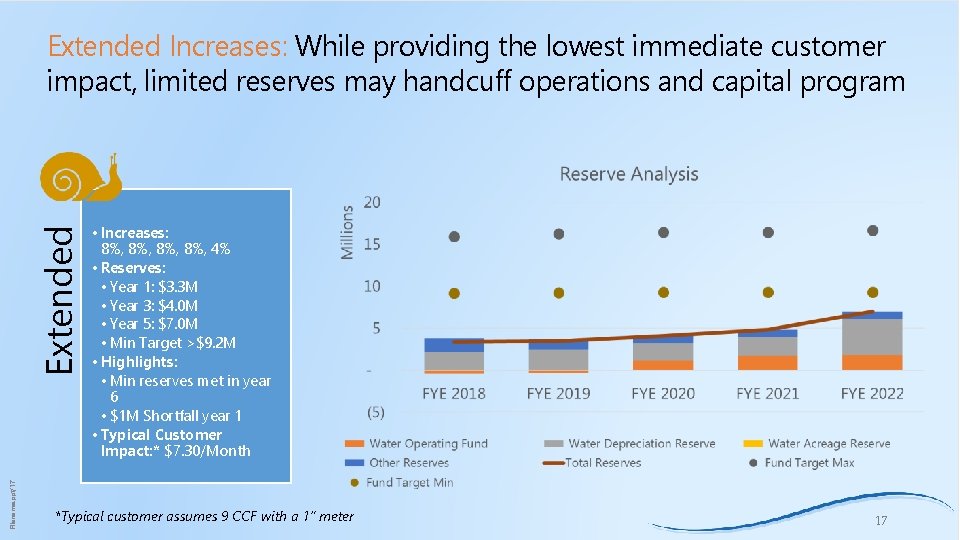
Filename. ppt/17 Extended Increases: While providing the lowest immediate customer impact, limited reserves may handcuff operations and capital program • Increases: 8%, 8%, 4% • Reserves: • Year 1: $3. 3 M • Year 3: $4. 0 M • Year 5: $7. 0 M • Min Target >$9. 2 M • Highlights: • Min reserves met in year 6 • $1 M Shortfall year 1 • Typical Customer Impact: * $7. 30/Month *Typical customer assumes 9 CCF with a 1” meter 17
Financial Needs Assessment: Revenues need to increase to cover expenses and fund reserves Reserve Analysis (with Balanced) Millions Revenues vs Expenditures $ 25 $ 20 $ 15 $ 10 $5 18 16 14 12 10 8 6 4 2 - FYE FYE FYE General General ra l Ge ne ra l ne FY E Ge ne ra l ne FY E Ge ra l ne FY E Ge FY E Filename. ppt/18 Ge ne ra l $Water Operating Fund Water Acreage Reserve Total Reserves Fund Target Min Water Depreciation Reserve Other Reserves Fund Target Max 18
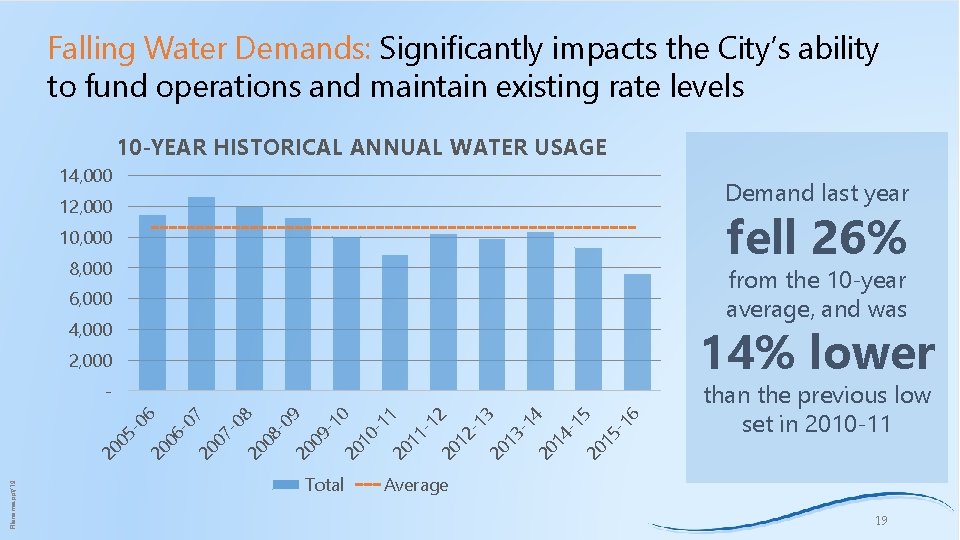
Falling Water Demands: Significantly impacts the City’s ability to fund operations and maintain existing rate levels 10 -YEAR HISTORICAL ANNUAL WATER USAGE 14, 000 Demand last year 12, 000 fell 26% 10, 000 8, 000 from the 10 -year average, and was 6, 000 4, 000 14% lower 2, 000 Filename. ppt/19 Total than the previous low set in 2010 -11 20 15 -1 6 5 -1 14 4 20 -1 13 20 20 12 -1 3 2 -1 11 20 20 10 -1 1 0 -1 09 20 20 08 -0 9 8 -0 07 7 20 -0 06 20 20 05 -0 6 - Average 19
Consideration #1: Increase Fixed Cost recovery • Objective: Improve financial resiliency by aligning revenues and costs • Challenges: − Allocation of fixed costs to variable rates leaves City vulnerable to changes in demand − Alignment of fixed costs with fixed charge has a greater impact on low volume customers • Recommendation: Filename. ppt/20 − Phase-in changes to fixed cost recovery over time to 31% 20
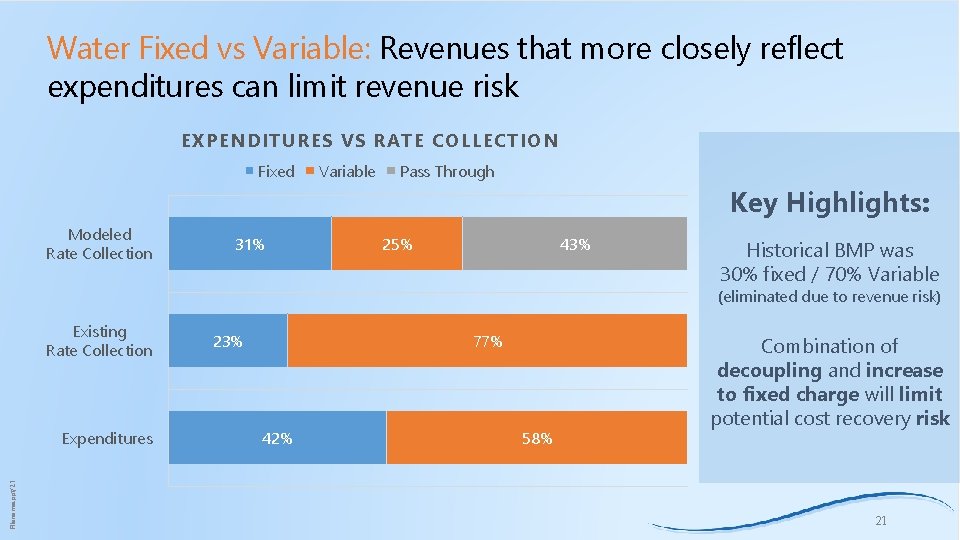
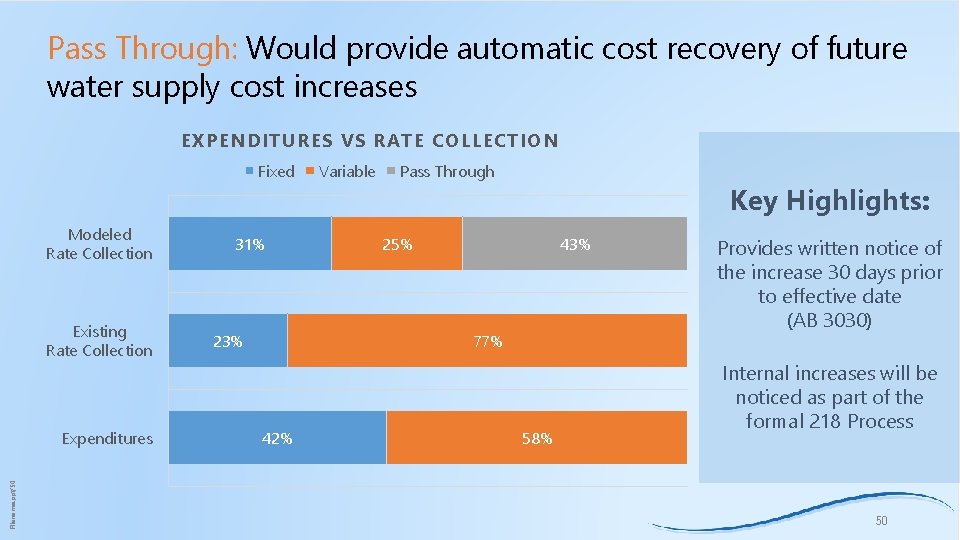
Water Fixed vs Variable: Revenues that more closely reflect expenditures can limit revenue risk EXPENDITURES VS RATE COLLECTION Fixed Variable Pass Through Key Highlights: Modeled Rate Collection 31% 25% 43% Historical BMP was 30% fixed / 70% Variable (eliminated due to revenue risk) Existing Rate Collection Filename. ppt/21 Expenditures 23% 77% 42% 58% Combination of decoupling and increase to fixed charge will limit potential cost recovery risk 21
Consideration #2: Implement a purchased water pass-through • Objective: Decouple and separately account for the cost of purchased water. Any water cost increases, outside the control of the City, will be automatically passed on to ratepayers • Challenges: − Existing method (coupled) leaves City vulnerable to MWDOC rate increases − Remaining costs and increases may be further scrutinized • Recommendation: Filename. ppt/22 − Decouple rates and implement a pass-through provision in accordance with AB 3030 22
Consideration #3: Adoption of Demand Management Rates • Objective: Increase financial resilience by providing cost recovery under various demand reduction or drought conditions • Challenges: − Customer understanding and communication • Recommendation: − Create 3 stages of Demand Reduction Rates to maintain cost recovery Filename. ppt/23 − Require Council approval to implement rates 23
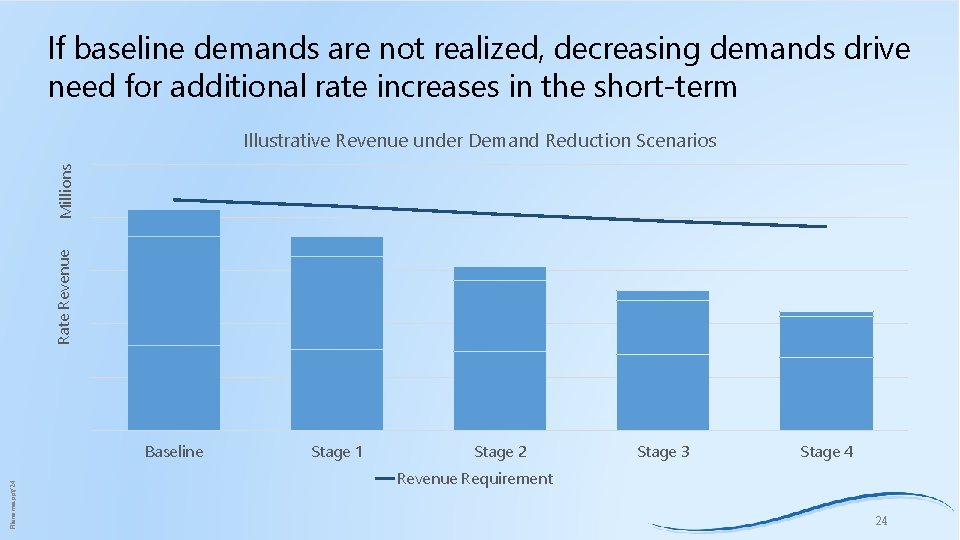
If baseline demands are not realized, decreasing demands drive need for additional rate increases in the short-term Rate Revenue Millions Illustrative Revenue under Demand Reduction Scenarios Filename. ppt/24 Baseline Stage 1 Stage 2 Stage 3 Stage 4 Revenue Requirement 24
evenue Requiremen Revenue How do we fund water operations?
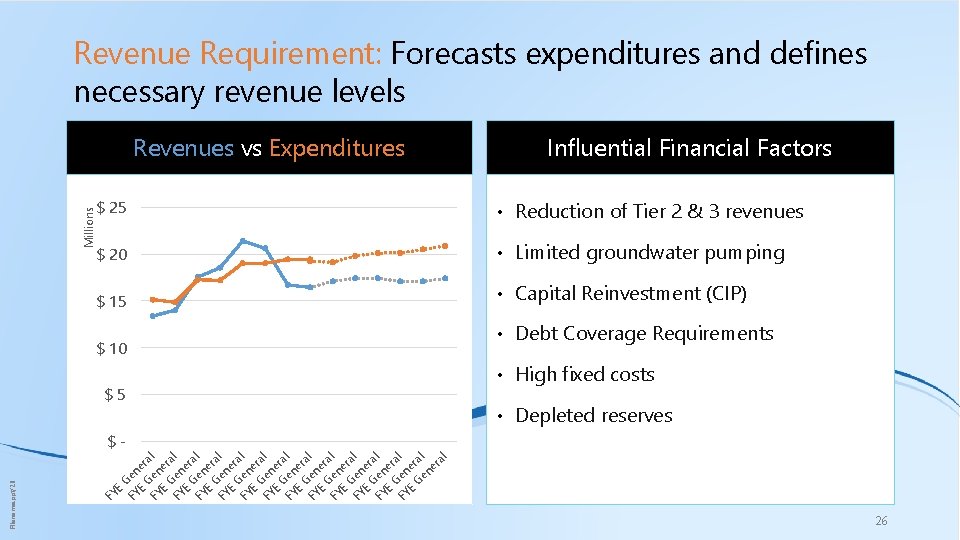
Revenue Requirement: Forecasts expenditures and defines necessary revenue levels Millions Revenues vs Expenditures Influential Financial Factors $ 25 • Reduction of Tier 2 & 3 revenues $ 20 • Limited groundwater pumping $ 15 • Capital Reinvestment (CIP) $ 10 $5 • Debt Coverage Requirements • High fixed costs • Depleted reserves FY E G FY en E er G a FY en l E er G a FY en l E er G a FY en l E er Ge al ne ra l Filename. ppt/26 $- 26
Filename. ppt/27 *Typical customer assumes 9 CCF with a 1” meter • Increases: 12%, 8%, 4%, 2% • Reserves: • Year 1: $3. 8 M • Year 3: $6. 1 M • Year 5: $8. 5 M • Min Target >$9. 2 M • Highlights • $645 k shortfall in year 1 • Min reserves met in year 6 • Typical Customer Impact: * $8. 80/Month Extended • Increases: 18%, 8%, 0% • Reserves: • Year 1: $4. 6 M • Year 3: $9. 2 M • Year 5: $11. 7 M • Min Target >$9. 2 M • Highlights: • Immediately Cash Flow Positive • Typical Customer Impact: * $11. 00/Month Balanced Immediate Forecast Alternatives: Various financial scenarios have been developed to balance financial stability and customer impacts • Increases: 8%, 8%, 4% • Reserves: • Year 1: $3. 3 M • Year 3: $4. 0 M • Year 5: $7. 0 M • Min Target >$9. 2 M • Highlights: • Min reserves met in year 6 • $1 M Shortfall year 1 • Typical Customer Impact: * $7. 30/Month 27
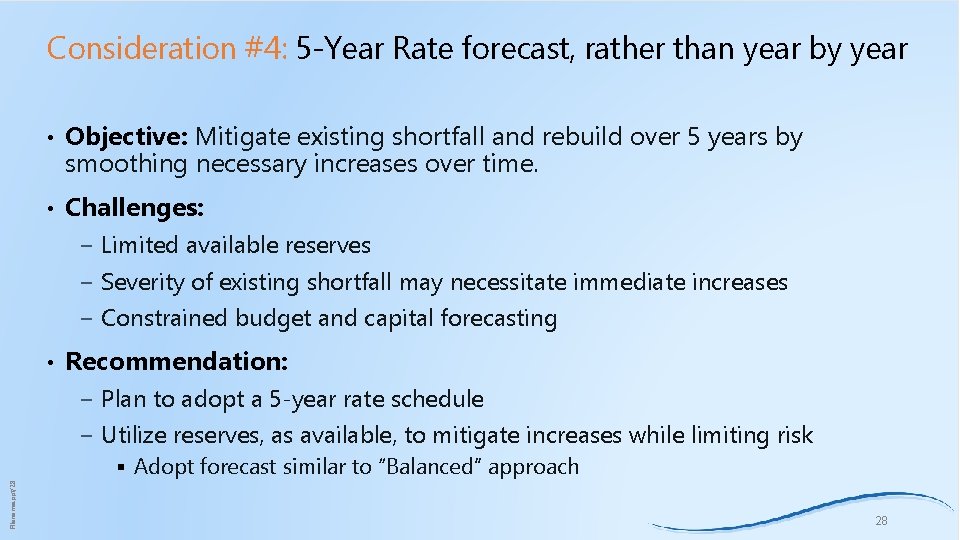
Consideration #4: 5 -Year Rate forecast, rather than year by year • Objective: Mitigate existing shortfall and rebuild over 5 years by smoothing necessary increases over time. • Challenges: − Limited available reserves − Severity of existing shortfall may necessitate immediate increases − Constrained budget and capital forecasting • Recommendation: − Plan to adopt a 5 -year rate schedule − Utilize reserves, as available, to mitigate increases while limiting risk Filename. ppt/28 § Adopt forecast similar to “Balanced” approach 28
Rate Design Tiered Rates or Uniform Rates
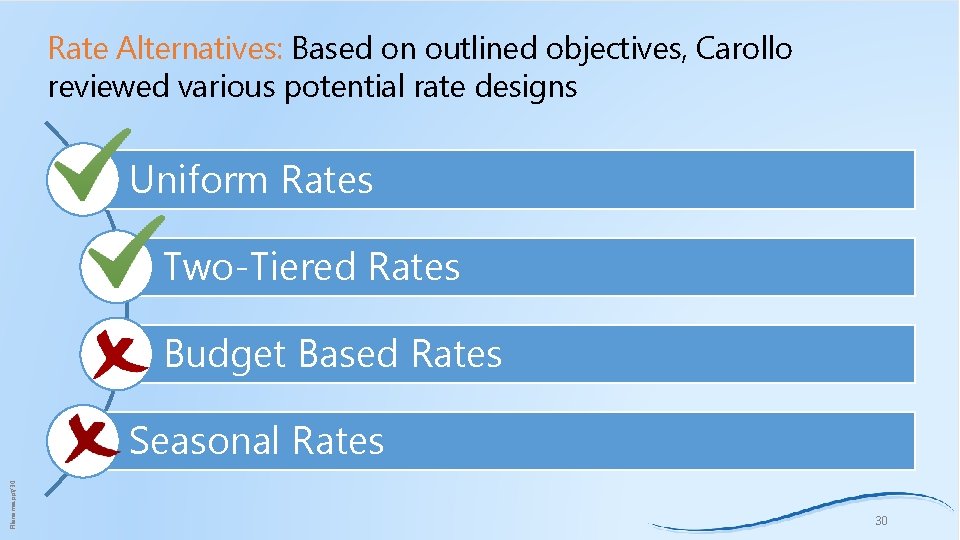
Rate Alternatives: Based on outlined objectives, Carollo reviewed various potential rate designs Uniform Rates Two-Tiered Rates Budget Based Rates Filename. ppt/30 Seasonal Rates 30
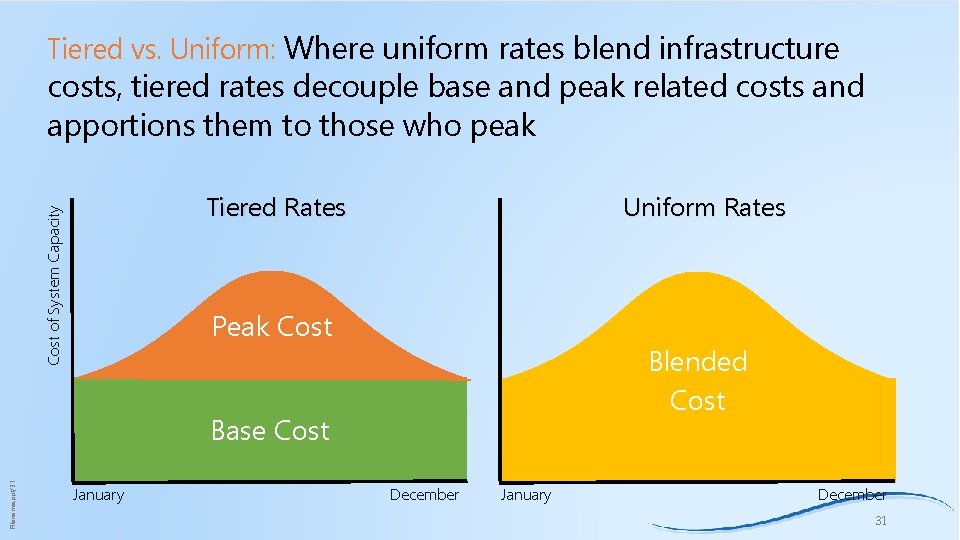
Tiered vs. Uniform: Where uniform rates blend infrastructure costs, tiered rates decouple base and peak related costs and apportions them to those who peak Uniform Rates Cost of System Capacity Tiered Rates Peak Cost Blended Cost Filename. ppt/31 Base Cost January December 31
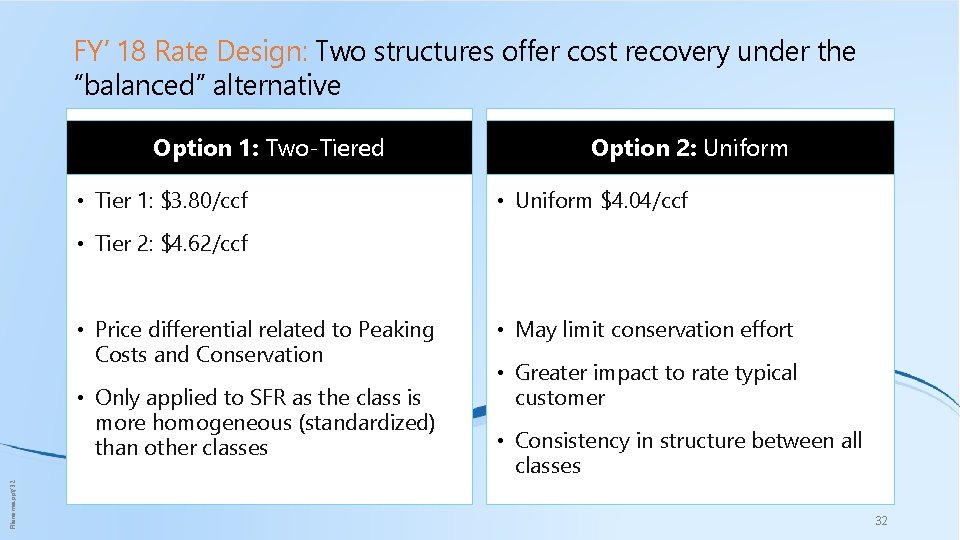
FY’ 18 Rate Design: Two structures offer cost recovery under the “balanced” alternative Option 1: Two-Tiered • Tier 1: $3. 80/ccf Option 2: Uniform • Uniform $4. 04/ccf • Tier 2: $4. 62/ccf • Price differential related to Peaking Costs and Conservation • Only applied to SFR as the class is Filename. ppt/32 more homogeneous (standardized) than other classes • May limit conservation effort • Greater impact to rate typical customer • Consistency in structure between all classes 32
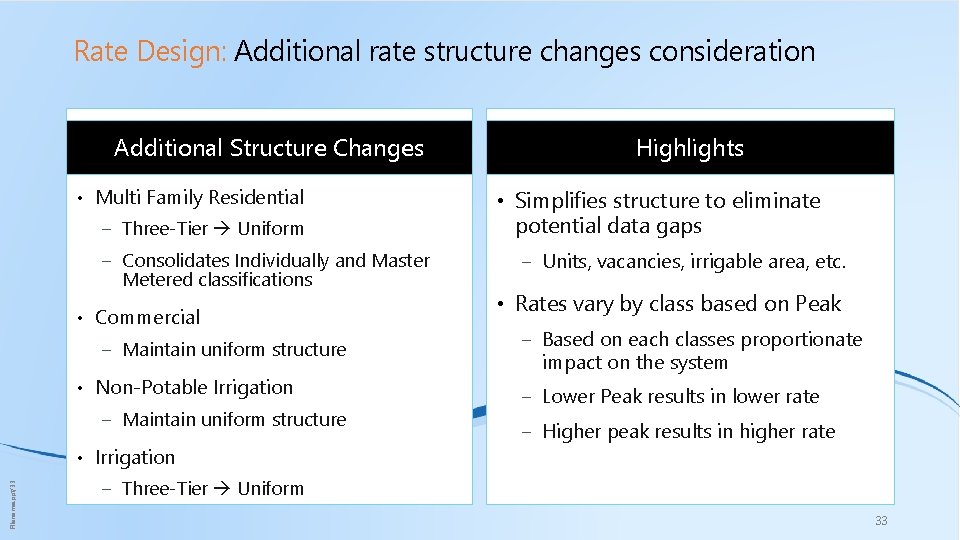
Rate Design: Additional rate structure changes consideration Additional Structure Changes • Multi Family Residential • Simplifies structure to eliminate − Three-Tier Uniform potential data gaps − Consolidates Individually and Master Metered classifications − Units, vacancies, irrigable area, etc. • Commercial − Maintain uniform structure • Non-Potable Irrigation − Maintain uniform structure • Irrigation Filename. ppt/33 Highlights • Rates vary by class based on Peak − Based on each classes proportionate impact on the system − Lower Peak results in lower rate − Higher peak results in higher rate − Three-Tier Uniform 33
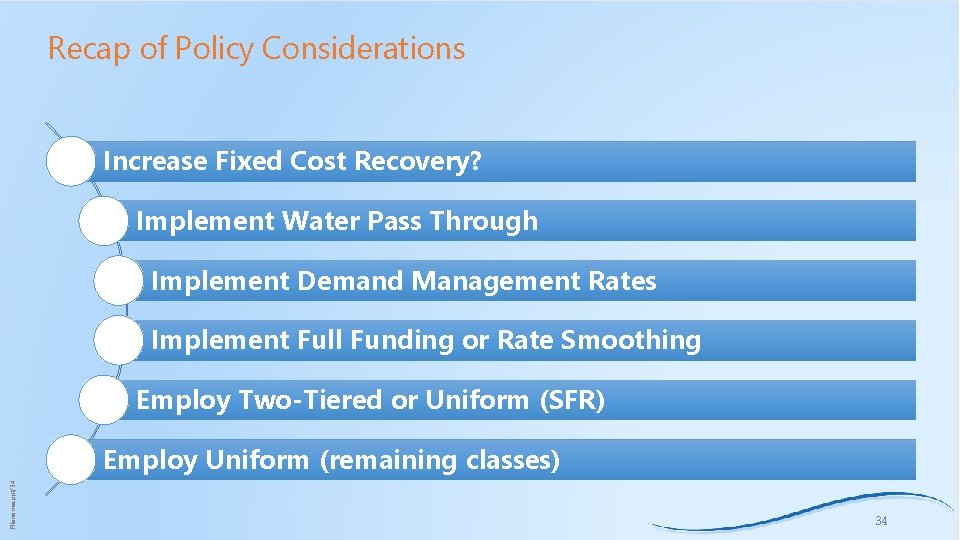
Recap of Policy Considerations Increase Fixed Cost Recovery? Implement Water Pass Through Implement Demand Management Rates Implement Full Funding or Rate Smoothing Employ Two-Tiered or Uniform (SFR) Filename. ppt/34 Employ Uniform (remaining classes) 34
Bill Impacts For Discussion Purposes - Preliminary
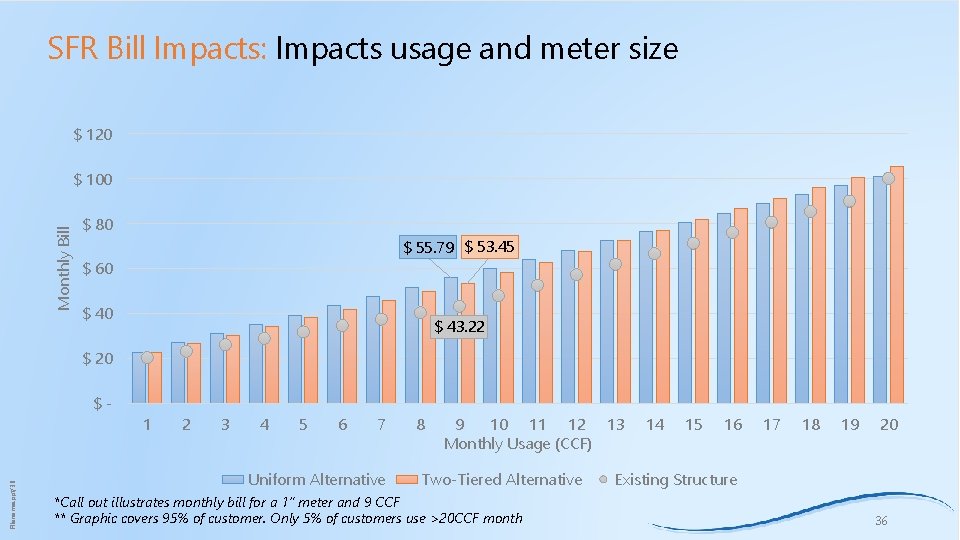
SFR Bill Impacts: Impacts usage and meter size $ 120 Monthly Bill $ 100 $ 80 $ 55. 79 $ 53. 45 $ 60 $ 43. 22 $ 20 Filename. ppt/36 $- 1 2 3 4 5 6 7 Uniform Alternative 8 9 10 11 12 13 Monthly Usage (CCF) Two-Tiered Alternative *Call out illustrates monthly bill for a 1” meter and 9 CCF ** Graphic covers 95% of customer. Only 5% of customers use >20 CCF month 14 15 16 17 18 19 20 Existing Structure 36
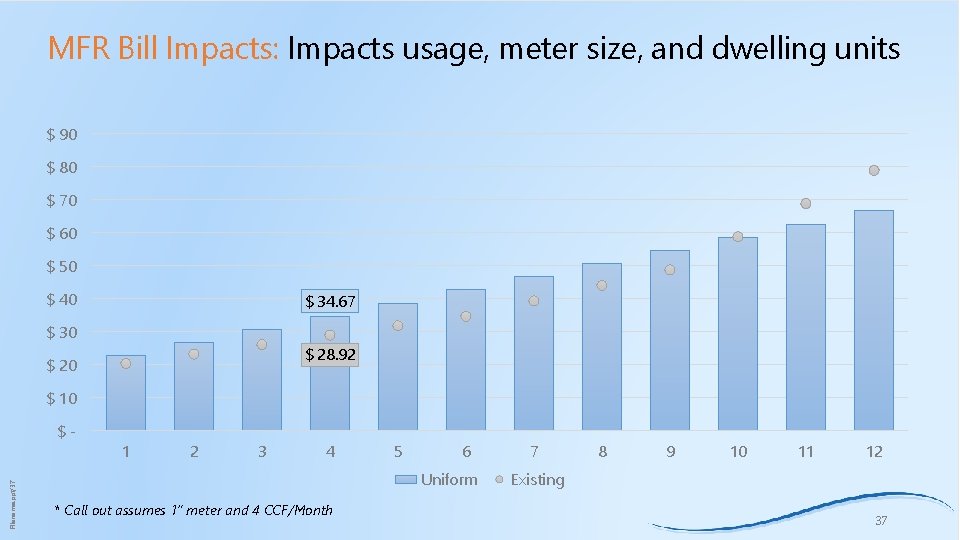
MFR Bill Impacts: Impacts usage, meter size, and dwelling units $ 90 $ 80 $ 70 $ 60 $ 50 $ 40 $ 34. 67 $ 30 $ 28. 92 $ 20 $ 10 Filename. ppt/37 $- 1 2 3 4 5 6 Uniform * Call out assumes 1” meter and 4 CCF/Month 7 8 9 10 11 12 Existing 37
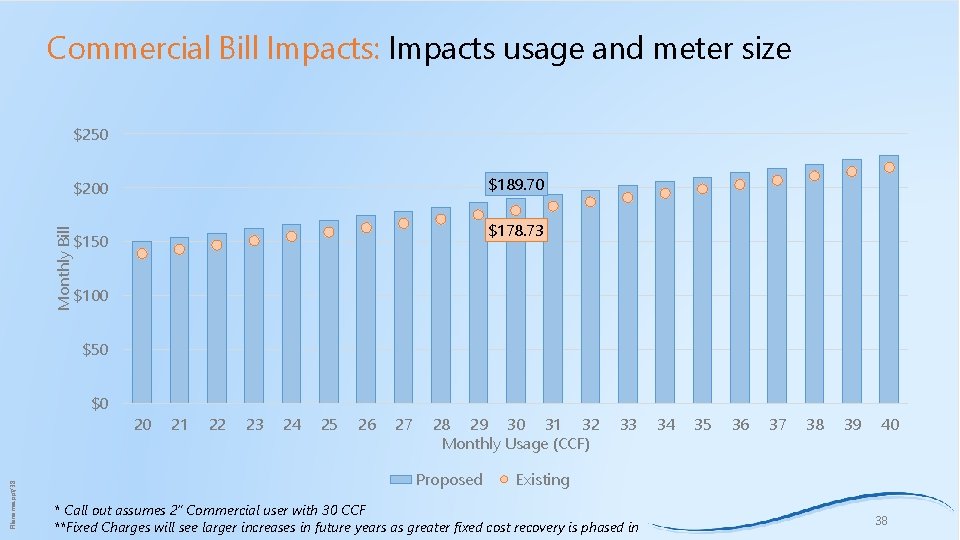
Commercial Bill Impacts: Impacts usage and meter size $250 $189. 70 Monthly Bill $200 $178. 73 $150 $100 $50 Filename. ppt/38 $0 20 21 22 23 24 25 26 27 28 29 30 31 32 Monthly Usage (CCF) Proposed 33 34 35 36 37 38 39 40 Existing * Call out assumes 2” Commercial user with 30 CCF **Fixed Charges will see larger increases in future years as greater fixed cost recovery is phased in 38
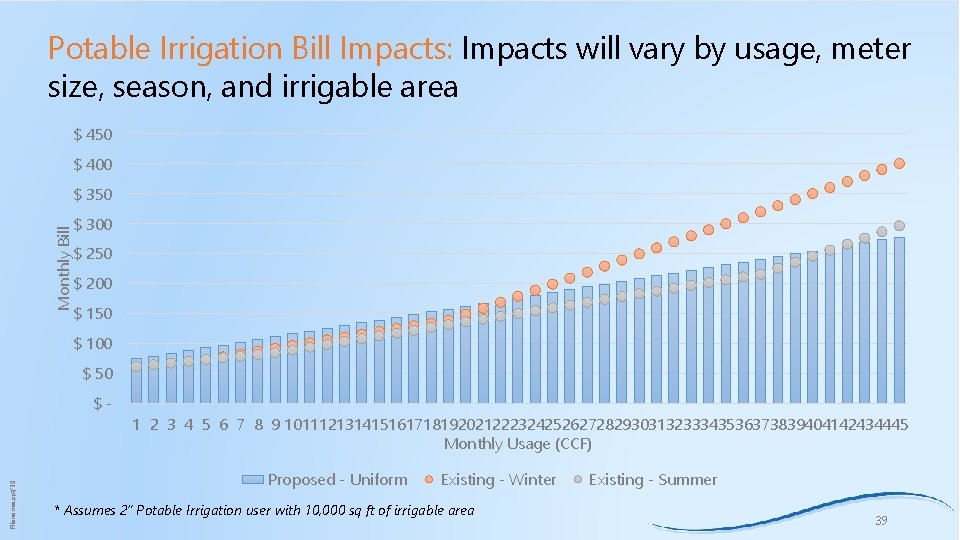
Potable Irrigation Bill Impacts: Impacts will vary by usage, meter size, season, and irrigable area $ 450 $ 400 Monthly Bill $ 350 $ 300 $ 250 $ 200 $ 150 $ 100 $ 50 Filename. ppt/39 $- 1 2 3 4 5 6 7 8 9 101112131415161718192021222324252627282930313233343536373839404142434445 Monthly Usage (CCF) Proposed - Uniform Existing - Winter * Assumes 2” Potable Irrigation user with 10, 000 sq ft of irrigable area Existing - Summer 39
Q&A
Assumptions: As multiple considerations were presented, the following preliminary bill impacts assume the following… • “Balanced” approach to increase (Slide 24) • Increase and phasing of Fixed Cost Recovery (Slide 12) • Reflects current cost of purchased water Filename. ppt/41 • Forecasted demands of ~17, 500 AF (comparable to FY 2016) 41
Filename. ppt/42 Project Overview 42
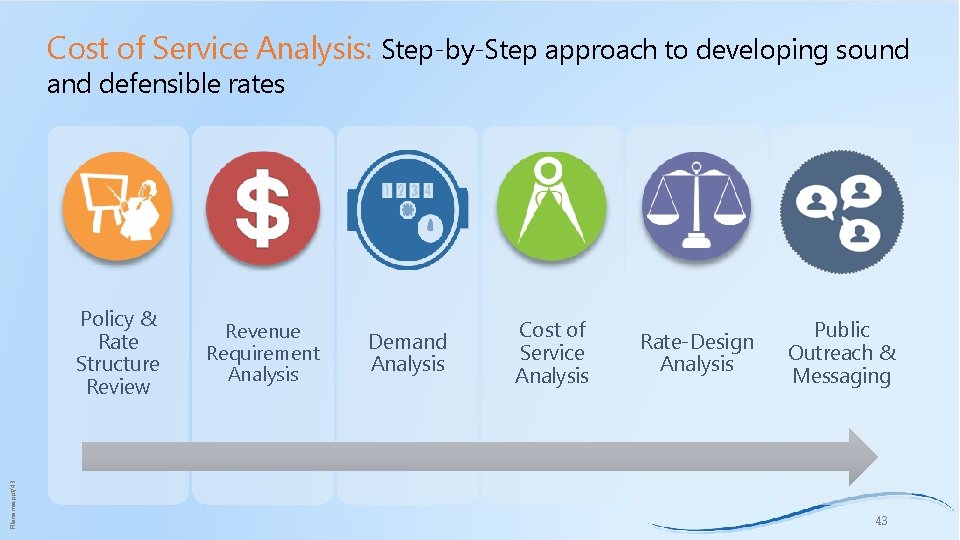
Cost of Service Analysis: Step-by-Step approach to developing sound and defensible rates Filename. ppt/43 Policy & Rate Structure Review Revenue Requirement Analysis Demand Analysis Cost of Service Analysis Rate-Design Analysis Public Outreach & Messaging 43
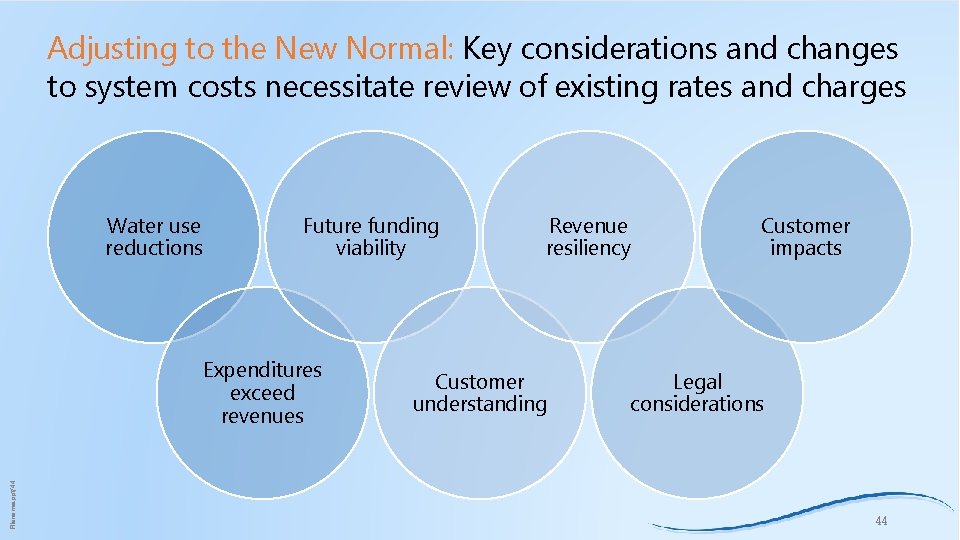
Adjusting to the New Normal: Key considerations and changes to system costs necessitate review of existing rates and charges Water use reductions Future funding viability Filename. ppt/44 Expenditures exceed revenues Revenue resiliency Customer understanding Customer impacts Legal considerations 44
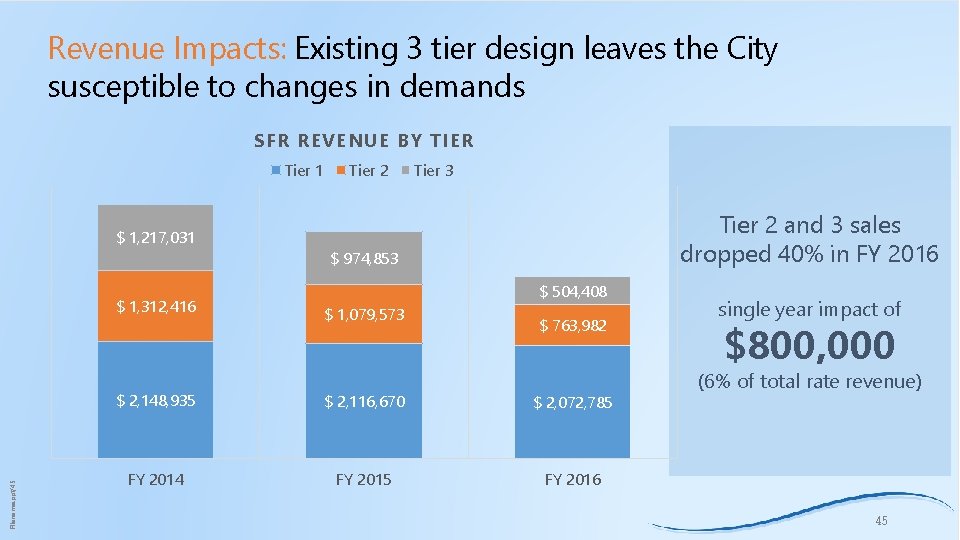
Revenue Impacts: Existing 3 tier design leaves the City susceptible to changes in demands SFR REVENUE BY TIER Tier 1 $ 1, 217, 031 Filename. ppt/45 $ 1, 312, 416 Tier 2 Tier 3 Tier 2 and 3 sales dropped 40% in FY 2016 $ 974, 853 $ 504, 408 $ 1, 079, 573 $ 763, 982 $ 2, 148, 935 $ 2, 116, 670 $ 2, 072, 785 FY 2014 FY 2015 FY 2016 single year impact of $800, 000 (6% of total rate revenue) 45
Policy Consideration
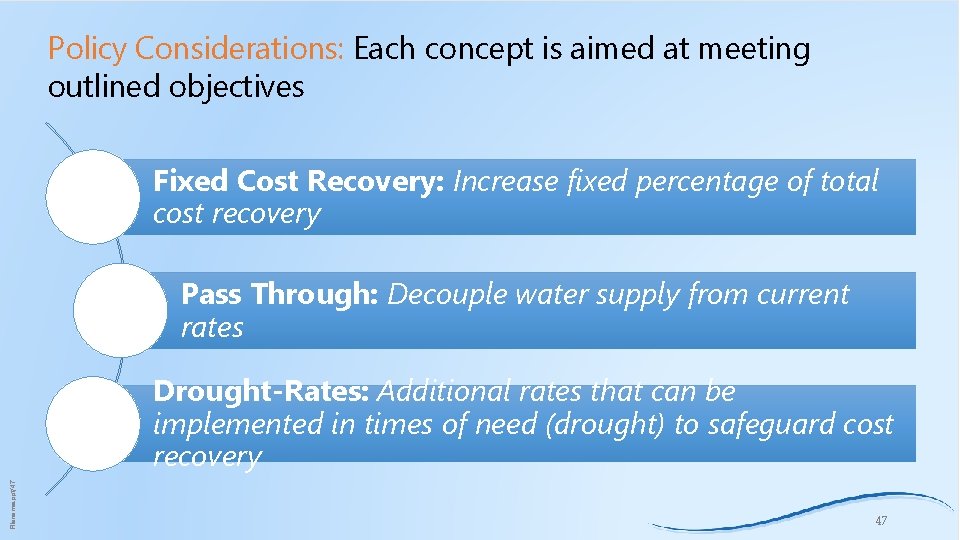
Policy Considerations: Each concept is aimed at meeting outlined objectives Fixed Cost Recovery: Increase fixed percentage of total cost recovery Pass Through: Decouple water supply from current rates Filename. ppt/47 Drought-Rates: Additional rates that can be implemented in times of need (drought) to safeguard cost recovery 47
Fixed Cost Recovery Filename. ppt/48 crease to the Fixed Charg Char 48
Pass Through Filename. ppt/49 ouple Purchased Water C 49
Pass Through: Would provide automatic cost recovery of future water supply cost increases EXPENDITURES VS RATE COLLECTION Fixed Modeled Rate Collection Existing Rate Collection Filename. ppt/50 Expenditures 31% 23% Variable Pass Through Key Highlights: 25% 43% 77% 42% 58% Provides written notice of the increase 30 days prior to effective date (AB 3030) Internal increases will be noticed as part of the formal 218 Process 50
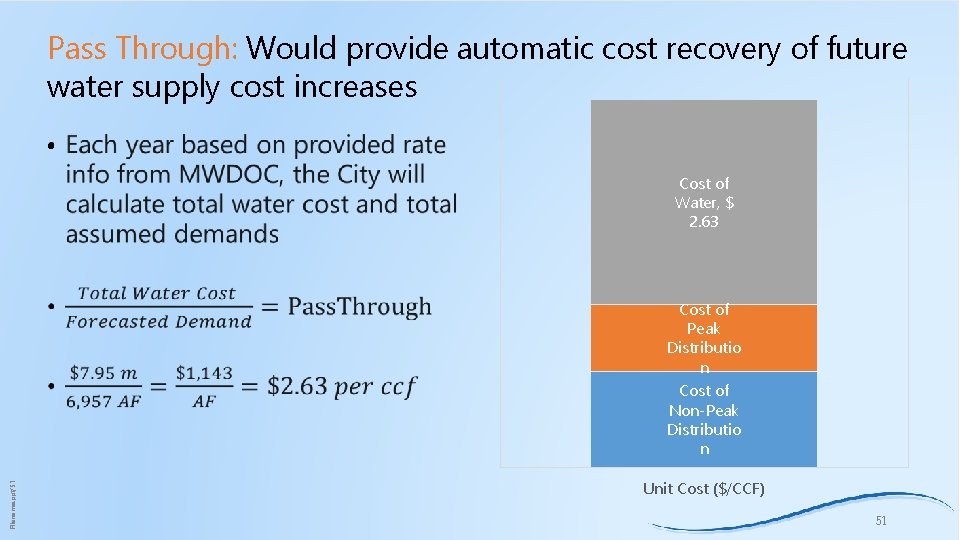
Pass Through: Would provide automatic cost recovery of future water supply cost increases • Cost of Water, $ 2. 63 Filename. ppt/51 Cost of Peak Distributio n Cost of Non-Peak Distributio n Unit Cost ($/CCF) 51
Filename. ppt/52 mand Management R 52
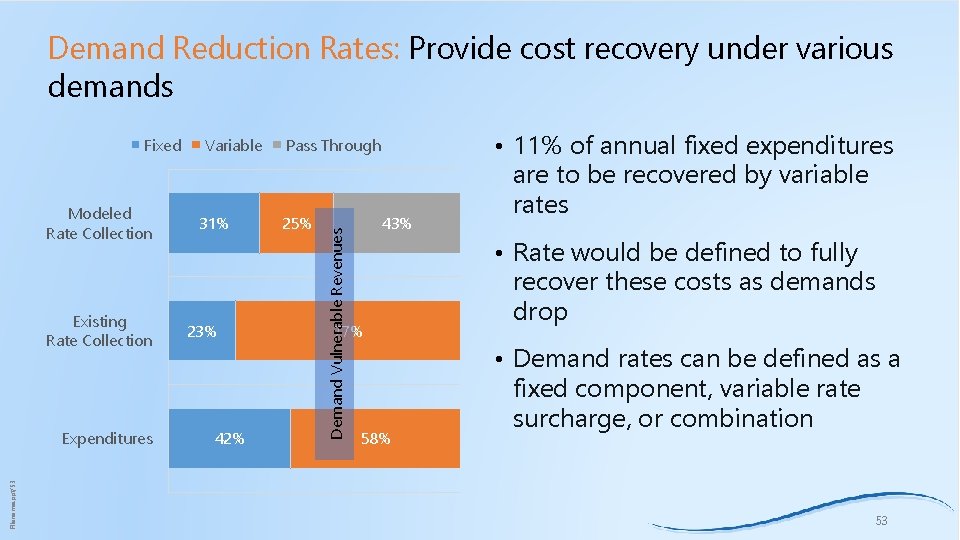
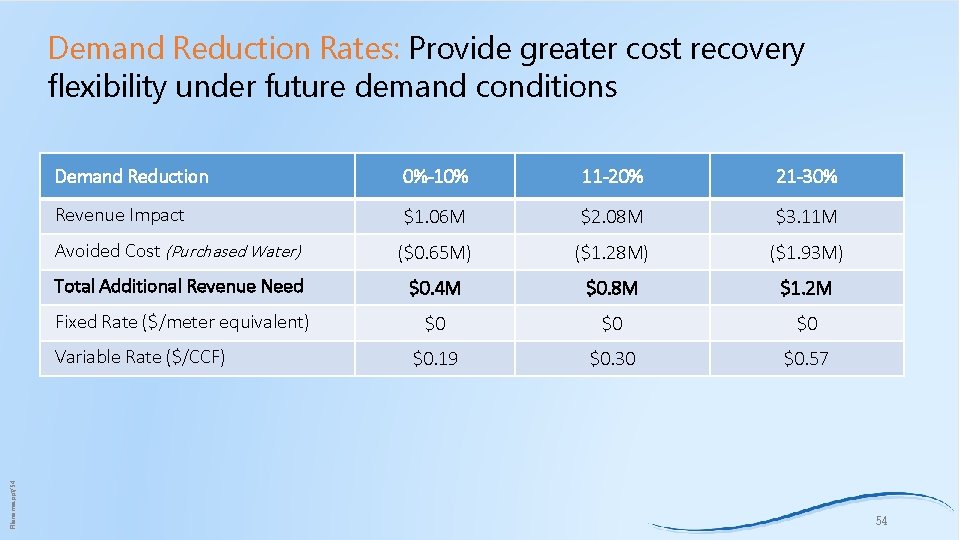
Demand Reduction Rates: Provide cost recovery under various demands Modeled Rate Collection Existing Rate Collection Filename. ppt/53 Expenditures Variable 31% 23% 42% • 11% of annual fixed expenditures Pass Through 25% Demand Vulnerable Revenues Fixed 43% 77% 58% are to be recovered by variable rates • Rate would be defined to fully recover these costs as demands drop • Demand rates can be defined as a fixed component, variable rate surcharge, or combination 53
Demand Reduction Rates: Provide greater cost recovery flexibility under future demand conditions Demand Reduction 0%-10% 11 -20% 21 -30% Revenue Impact $1. 06 M $2. 08 M $3. 11 M Avoided Cost (Purchased Water) ($0. 65 M) ($1. 28 M) ($1. 93 M) Total Additional Revenue Need $0. 4 M $0. 8 M $1. 2 M Fixed Rate ($/meter equivalent) $0 $0. 19 $0. 30 $0. 57 Filename. ppt/54 Variable Rate ($/CCF) 54
onsumption Analysi Consumption Analys & Cost of Service Implications
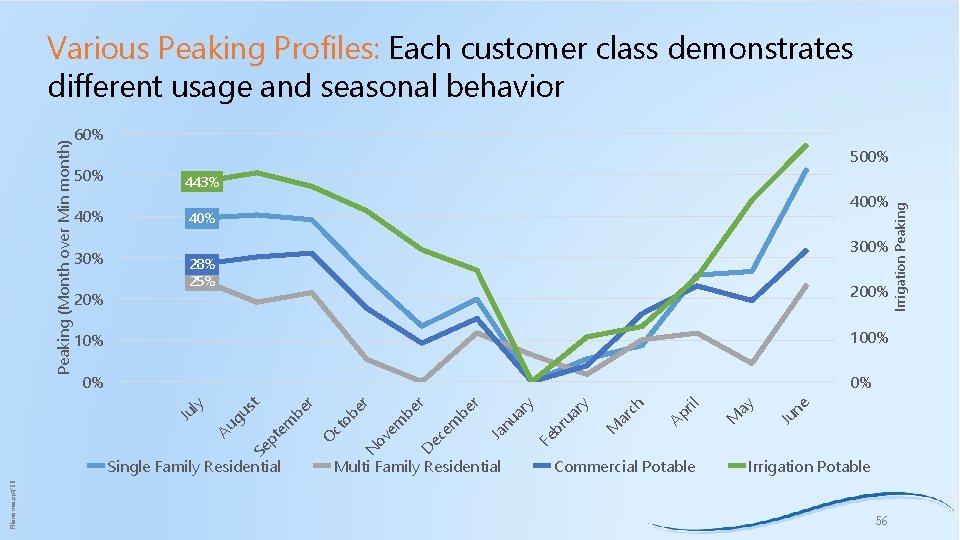
60% 40% 30% 20% 443% 400% 40% 300% 28% 25% 200% 10% Multi Family Residential ne Ju ay M il Ap r ch ar M ry ua Fe br ar nu Ja be m ce De y r r be em N ov O ct ob r be em Se pt gu s Au Ju Single Family Residential Filename. ppt/56 er 0% t 0% Commercial Potable Irrigation Potable 56 Irrigation Peaking 50% 500% ly Peaking (Month over Min month) Various Peaking Profiles: Each customer class demonstrates different usage and seasonal behavior
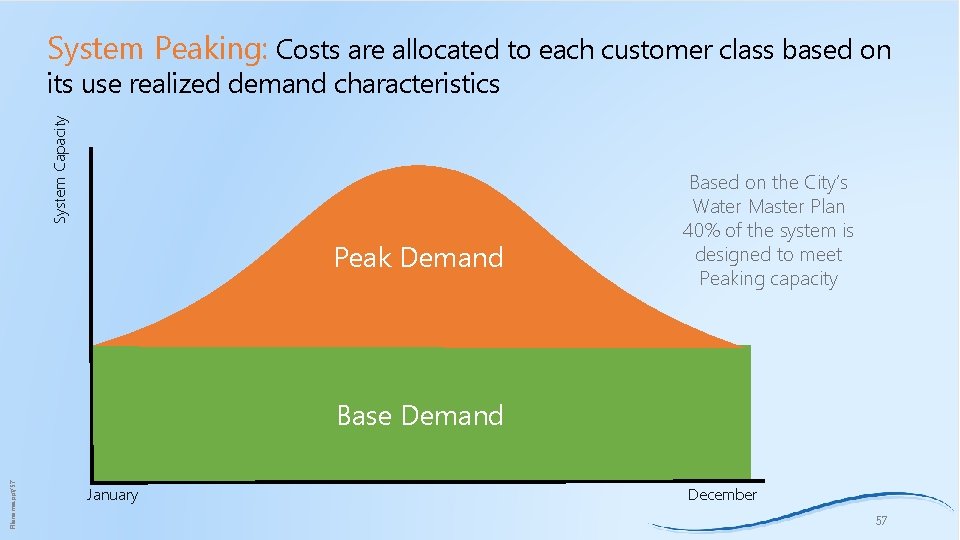
System Peaking: Costs are allocated to each customer class based on System Capacity its use realized demand characteristics Peak Demand Based on the City’s Water Master Plan 40% of the system is designed to meet Peaking capacity Filename. ppt/57 Base Demand January December 57
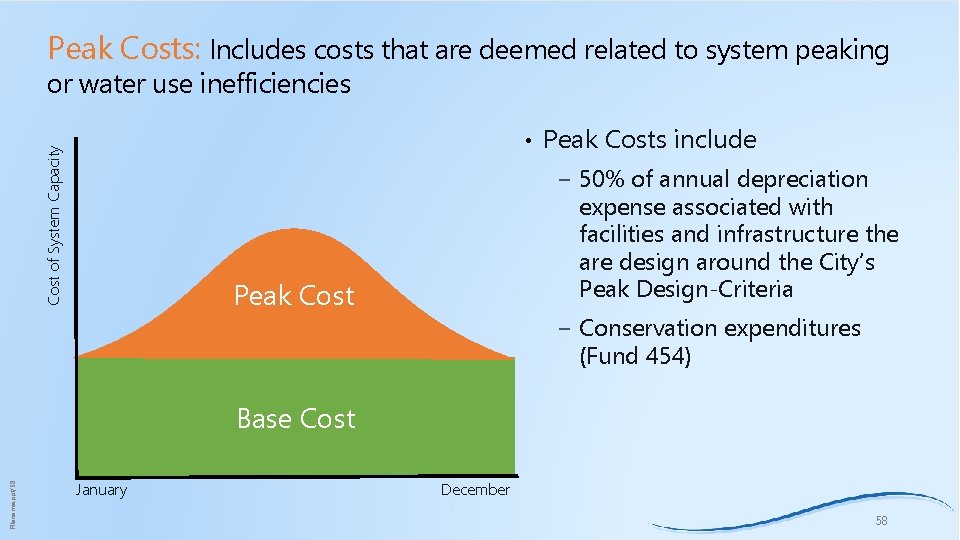
Peak Costs: Includes costs that are deemed related to system peaking or water use inefficiencies Cost of System Capacity • Peak Costs include − 50% of annual depreciation expense associated with facilities and infrastructure the are design around the City’s Peak Design-Criteria Peak Cost − Conservation expenditures (Fund 454) Filename. ppt/58 Base Cost January December 58
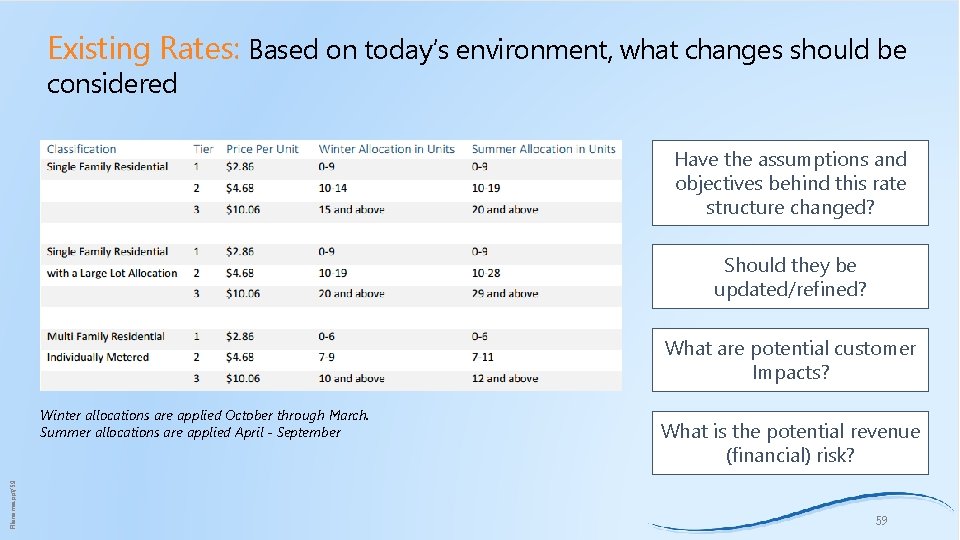
Existing Rates: Based on today’s environment, what changes should be considered Have the assumptions and objectives behind this rate structure changed? Should they be updated/refined? What are potential customer Impacts? Filename. ppt/59 Winter allocations are applied October through March. Summer allocations are applied April - September What is the potential revenue (financial) risk? 59
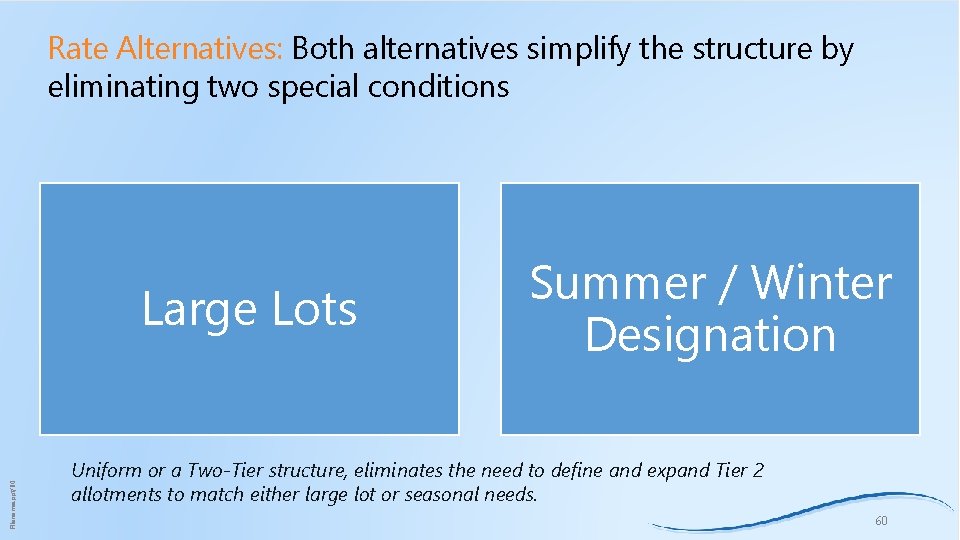
Rate Alternatives: Both alternatives simplify the structure by eliminating two special conditions Filename. ppt/60 Large Lots Summer / Winter Designation Uniform or a Two-Tier structure, eliminates the need to define and expand Tier 2 allotments to match either large lot or seasonal needs. 60
Rate Considerations: Various alternatives were developed to meet key objectives • Objective: Simplify the rate structure to improve customer understanding. Have rates reflect current demand conditions and cost of service requirements • Challenges: − Water usage patterns have changed since previous study − Elimination of tiers has a greater impact on low volume customers − Compression of tier pricing has greater impact of low volume customers • Recommendation: Filename. ppt/61 − Reduce from three to two tiers (For Single-Family) − Implement uniform rates (varied by customer class) for remaining classes 61