
Water Chapter 12 lecture 6 http classroom jcschools

- Slides: 8
Water – Chapter 12 lecture 6 http: //classroom. jc-schools. net/sci-units/2007/Properties%20 of%20 Water. ppt
Properties of Water • Polar molecule – Cohesion and adhesion • High specific heat • Density – greatest at 4 o. C • Universal solvent
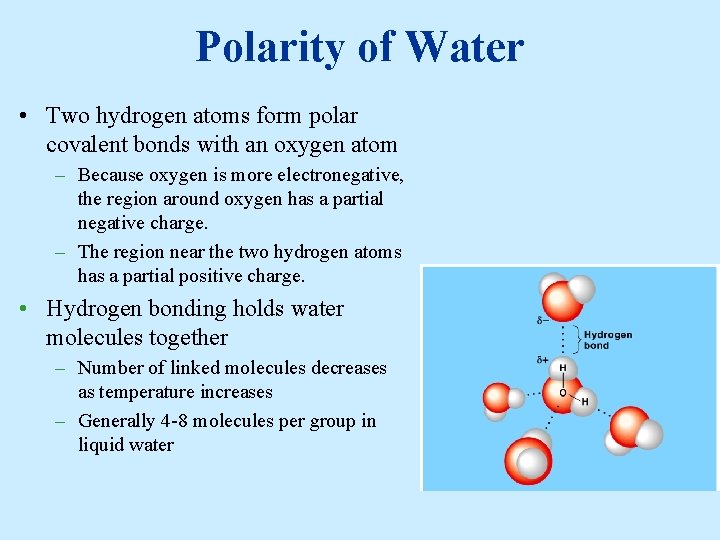
Polarity of Water • Two hydrogen atoms form polar covalent bonds with an oxygen atom – Because oxygen is more electronegative, the region around oxygen has a partial negative charge. – The region near the two hydrogen atoms has a partial positive charge. • Hydrogen bonding holds water molecules together – Number of linked molecules decreases as temperature increases – Generally 4 -8 molecules per group in liquid water
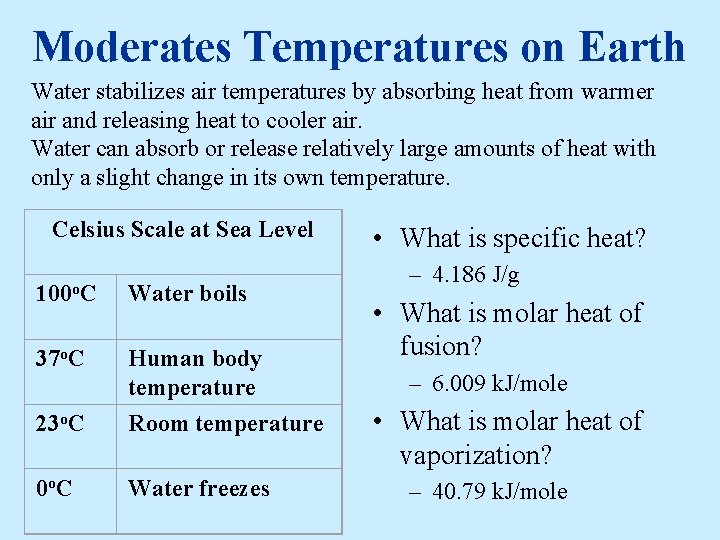
Moderates Temperatures on Earth Water stabilizes air temperatures by absorbing heat from warmer air and releasing heat to cooler air. Water can absorb or release relatively large amounts of heat with only a slight change in its own temperature. Celsius Scale at Sea Level 100 o. C Water boils 37 o. C 23 o. C Human body temperature Room temperature 0 o. C Water freezes • What is specific heat? – 4. 186 J/g • What is molar heat of fusion? – 6. 009 k. J/mole • What is molar heat of vaporization? – 40. 79 k. J/mole
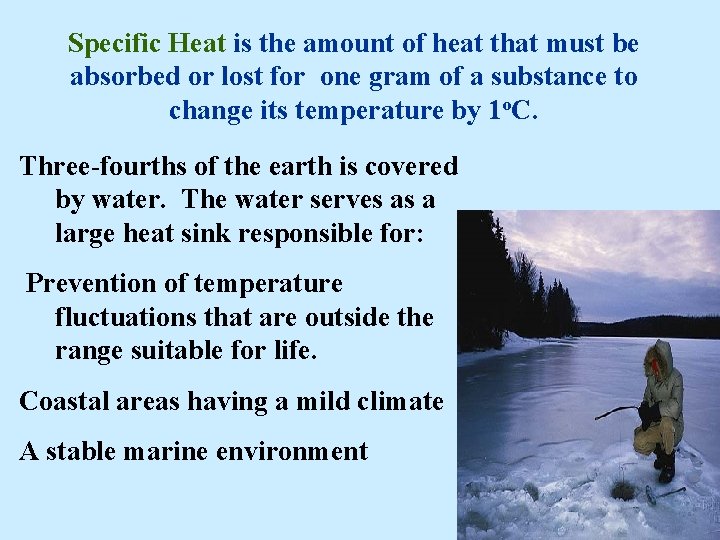
Specific Heat is the amount of heat that must be absorbed or lost for one gram of a substance to change its temperature by 1 o. C. Three-fourths of the earth is covered by water. The water serves as a large heat sink responsible for: Prevention of temperature fluctuations that are outside the range suitable for life. Coastal areas having a mild climate A stable marine environment
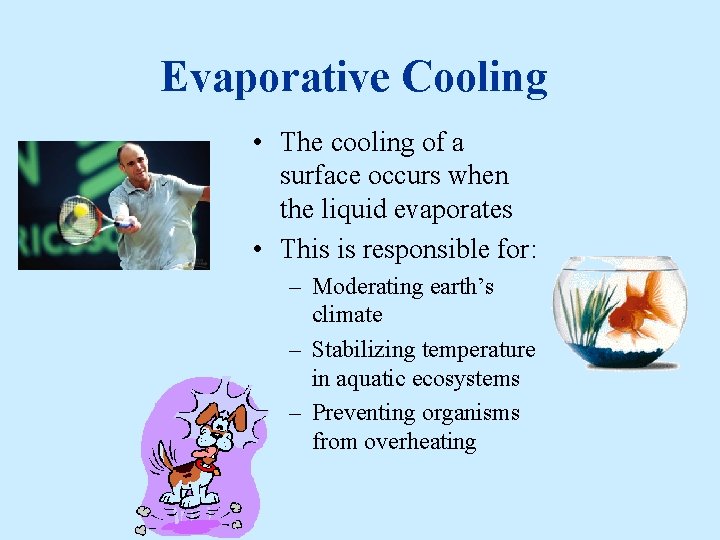
Evaporative Cooling • The cooling of a surface occurs when the liquid evaporates • This is responsible for: – Moderating earth’s climate – Stabilizing temperature in aquatic ecosystems – Preventing organisms from overheating
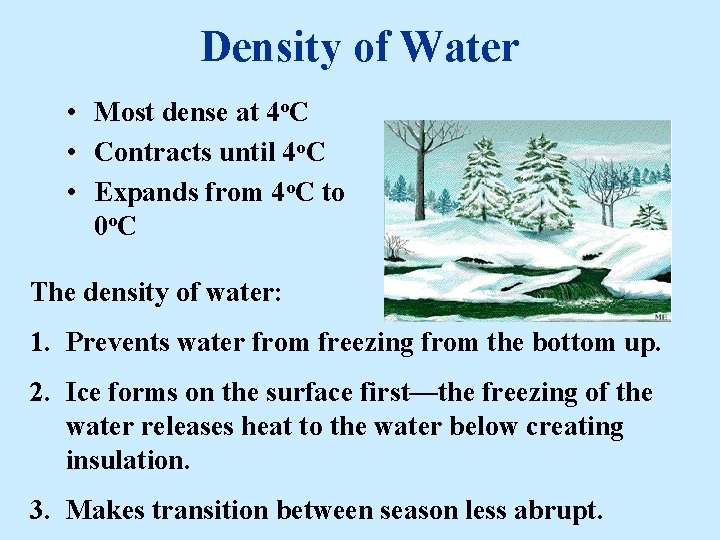
Density of Water • Most dense at 4 o. C • Contracts until 4 o. C • Expands from 4 o. C to 0 o. C The density of water: 1. Prevents water from freezing from the bottom up. 2. Ice forms on the surface first—the freezing of the water releases heat to the water below creating insulation. 3. Makes transition between season less abrupt.
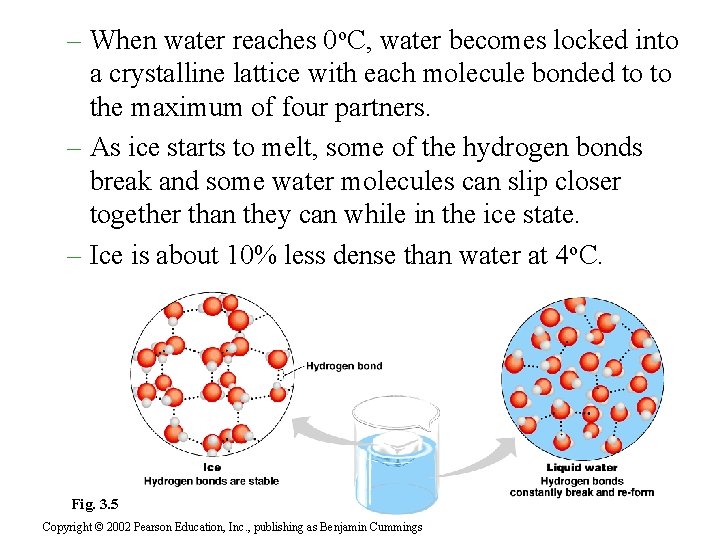
– When water reaches 0 o. C, water becomes locked into a crystalline lattice with each molecule bonded to to the maximum of four partners. – As ice starts to melt, some of the hydrogen bonds break and some water molecules can slip closer together than they can while in the ice state. – Ice is about 10% less dense than water at 4 o. C. Fig. 3. 5 Copyright © 2002 Pearson Education, Inc. , publishing as Benjamin Cummings