
Water Bath Canning Presented by Michael Lucero MPH
Water Bath Canning Presented by Michael Lucero, MPH Colorado State University El Paso County Extension
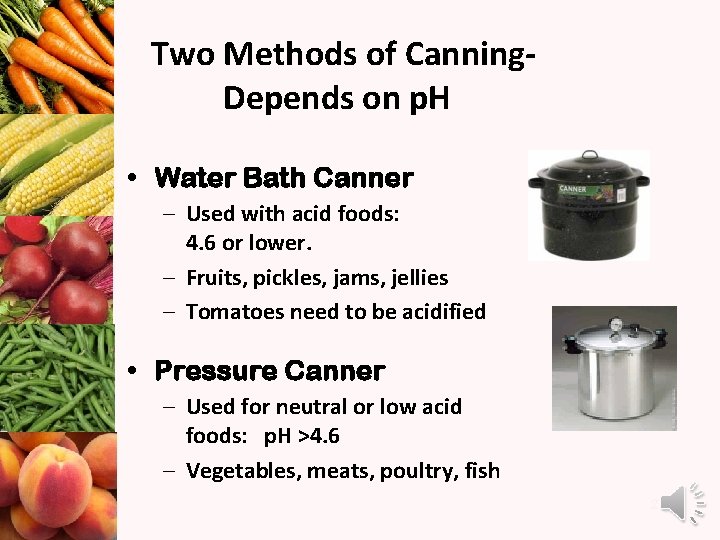
Two Methods of Canning. Depends on p. H • Water Bath Canner – Used with acid foods: 4. 6 or lower. – Fruits, pickles, jams, jellies – Tomatoes need to be acidified p. H of • Pressure Canner – Used for neutral or low acid foods: p. H >4. 6 – Vegetables, meats, poultry, fish 2
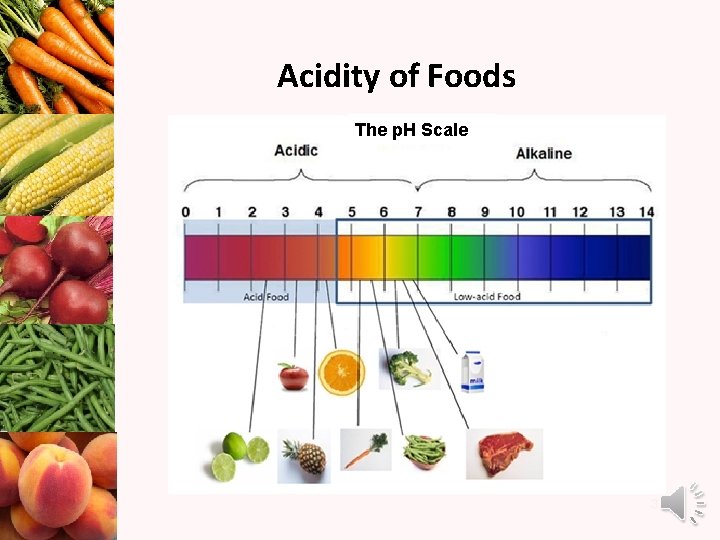
Acidity of Foods The p. H Scale 3
Very High Acid Foods p. H 3. 0 • PRODUCTS • Jams, jellies • Conserves • Apple & grape juice • Some pickled products Type of PROCESSING • Boiling water canner. • Short processing time (5 min. at sea level). Processing time needs to be adjusted for altitude. 4
High Acid Foods p. H 3. 4 to 4. 0 • • • PROCESSING PRODUCTS Most berry fruits • Boiling water canner. Apples • Time varies 10 - 35 Apricots minutes at sea level. Grapes Processing time needs to be adjusted Nectarines for altitude. Peaches Pears Rhubarb Some pickled foods 5
High Acid Foods p. H 4. 0 to 4. 6 • PRODUCTS • Tomatoes with added lemon juice, vinegar or citric acid • Figs with added lemon juice PROCESSING • Boiling water canner. • 45 to 85 minute process at sea level. Adjust for Altitude. • Must reach minimum internal temperature of 200°F to destroy mildly heat resistant spore forming bacteria. 6
Low Acid Foods p. H >4. 6 • PRODUCTS PROCESSING • Vegetables and vegetable products • Meats • Seafood • Poultry • Pressure canner. • Must reach internal temperature of 240°F to destroy very heat resistant bacteria. 7
Preventing Botulism in Home Canned Foods • Yeasts, molds and most bacteria are destroyed at boiling temperatures. • C. botulinum forms heat resistant spores. • Spores do not germinate in acidic foods (p. H ≤ 4. 6). • Spores require high temperatures for destruction: 240°F or above. • Pressure canner must be used for low acid foods. • Pressure increases temperature: 10 psi = 240°F at sea level. 8
Water Bath Canning Basics To make sure your home canned foods are safe and good quality - carefully follow safe food handling recommendations and proper canning methods. 9
1. Review Tested Recipes and Instructions • Select only up-to-date recipes. • Get instructions from reliable source. • Follow research tested recipes exactly for processing methods and processing times. Make appropriate altitude adjustments. 10
Canning Resources • CSU Extension Office • So Easy to Preserve • USDA Complete Guide to Home Canning National Center for Home Food Preservation: www. uga. edu/nchfp • Ball Blue Book (1994 or newer) • Preserve Smart – https: //apps. chhs. colostate. edu/preserves mart 11
2. Plan Time for Canning • Estimate time required for your canning project: Uninterrupted time required for preparation, waiting for water to boil, processing and cool down can be several hours. • Canning takes more time and energy than other preservation methods. • Time spent planning and preparing will make canning day go more smoothly and 12 more enjoyable.
3. Select Fresh Ingredients • Can fruits and vegetables at peak of quality – soon after harvest. • Rinse fruits and vegetables – don’t soak. Peel if appropriate. • Fresh meat and poultry from healthy animals should be chilled and canned immediately. 13
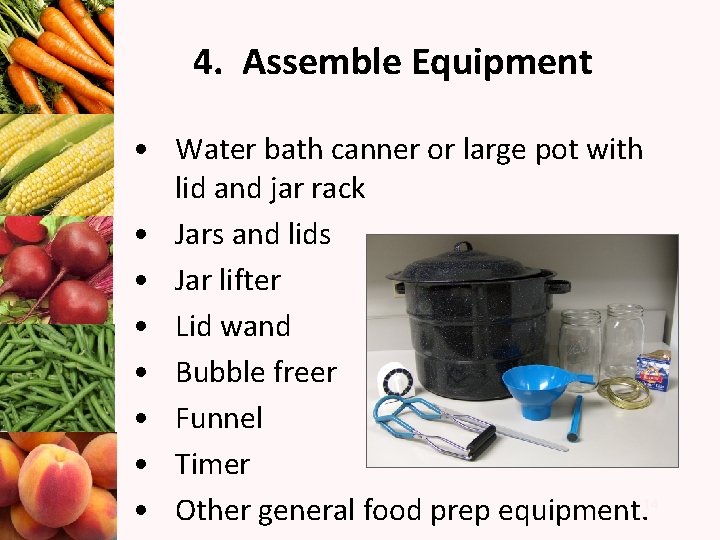
4. Assemble Equipment • Water bath canner or large pot with lid and jar rack • Jars and lids • Jar lifter • Lid wand • Bubble freer • Funnel • Timer • Other general food prep equipment. 14
Water Bath Canner • Aluminum or porcelain-covered steel. • Removable perforated jar rack. • Fitted lid. • Must be deep enough so that at least one inch of boiling water covers jar tops. 15
Water Bath Canner • Flat bottom canner must be used on electric coil range and smooth top electric ranges. • Canner bottom must be in good contact with cooktop in order for efficient heat transfer. • Canner should be no more than 4 inches wider in diameter than the element on which it is heated. 16
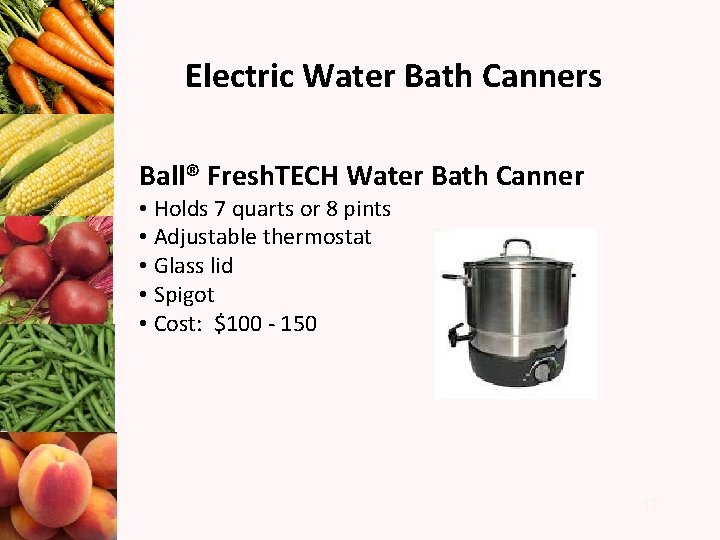
Electric Water Bath Canners Ball® Fresh. TECH Water Bath Canner • Holds 7 quarts or 8 pints • Adjustable thermostat • Glass lid • Spigot • Cost: $100 - 150 17
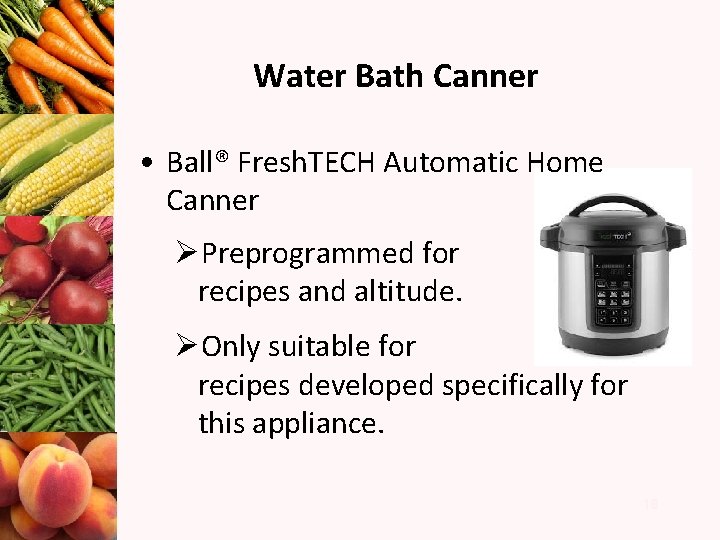
Water Bath Canner • Ball® Fresh. TECH Automatic Home Canner ØPreprogrammed for recipes and altitude. ØOnly suitable for recipes developed specifically for this appliance. 18
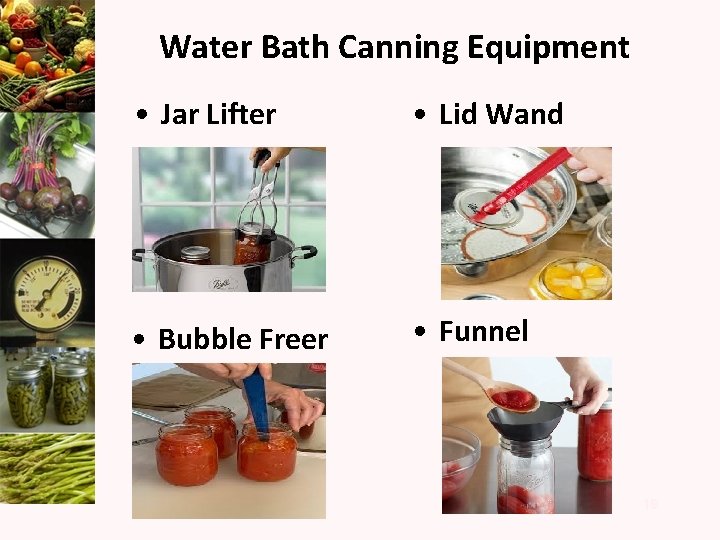
Water Bath Canning Equipment • Jar Lifter • Lid Wand • Bubble Freer • Funnel 19
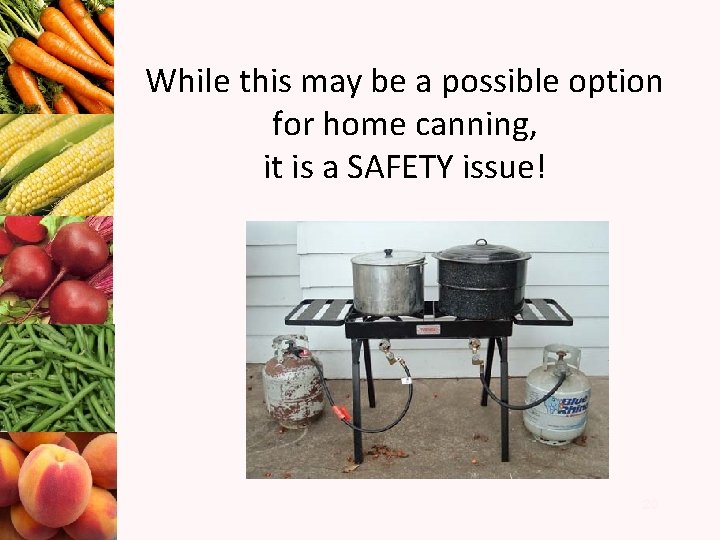
While this may be a possible option for home canning, it is a SAFETY issue! 20
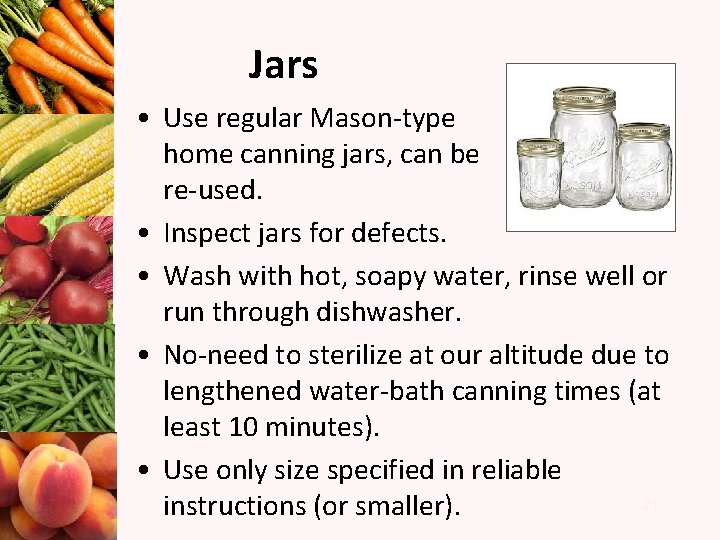
Jars • Use regular Mason-type home canning jars, can be re-used. • Inspect jars for defects. • Wash with hot, soapy water, rinse well or run through dishwasher. • No-need to sterilize at our altitude due to lengthened water-bath canning times (at least 10 minutes). • Use only size specified in reliable 21 instructions (or smaller).
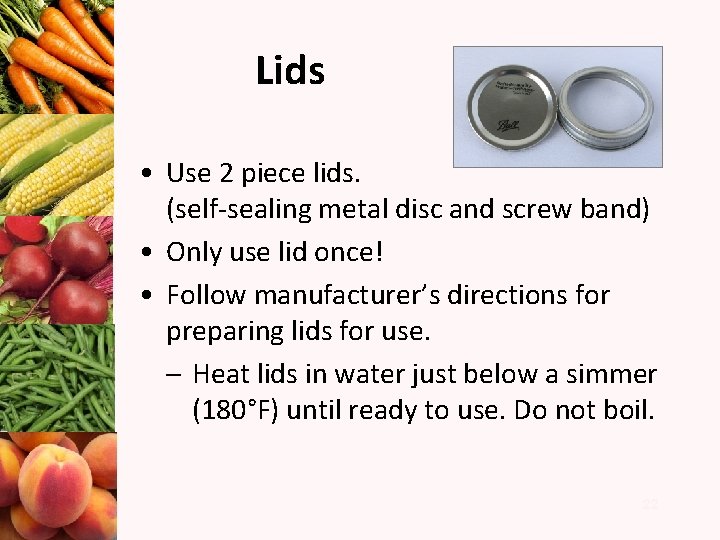
Lids • Use 2 piece lids. (self-sealing metal disc and screw band) • Only use lid once! • Follow manufacturer’s directions for preparing lids for use. – Heat lids in water just below a simmer (180°F) until ready to use. Do not boil. 22
Steps to Water Bath Canning 23
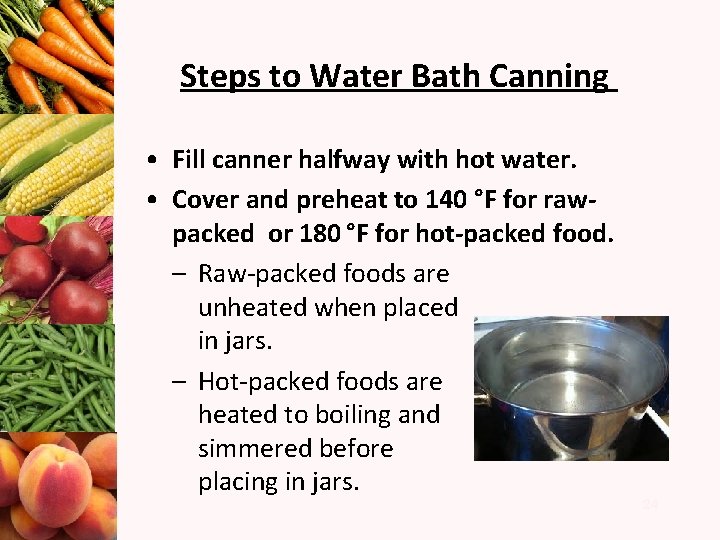
Steps to Water Bath Canning • Fill canner halfway with hot water. • Cover and preheat to 140 °F for rawpacked or 180 °F for hot-packed food. – Raw-packed foods are unheated when placed in jars. – Hot-packed foods are heated to boiling and simmered before placing in jars. 24
Hot Pack vs. Raw Pack HOT PACK Food brought to boil, then simmered 3 -5 minutes, packed hot. RESULT Ø More food in jar. Less oxygen results in better color and nutrient retention. Less likely to float. Ø Preferred pack style for foods processed in boiling water. 25
Hot Pack vs. Raw Pack RAW PACK Jars filled tightly with freshly prepared, unheated food. RESULT Ø Less food in jar. Fruit may float. Trapped air may cause discoloration during storage. Ø Foods that loose shape in cooking are easier to handle in raw pack. 26
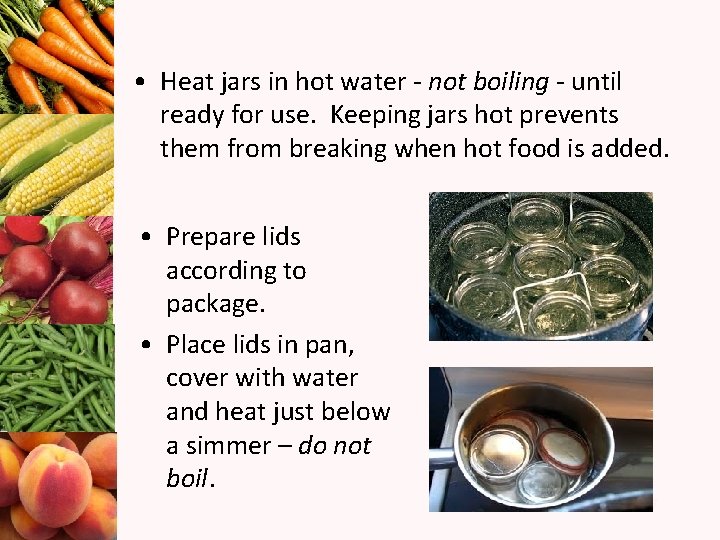
• Heat jars in hot water - not boiling - until ready for use. Keeping jars hot prevents them from breaking when hot food is added. • Prepare lids according to package. • Place lids in pan, cover with water and heat just below a simmer – do not boil. 27
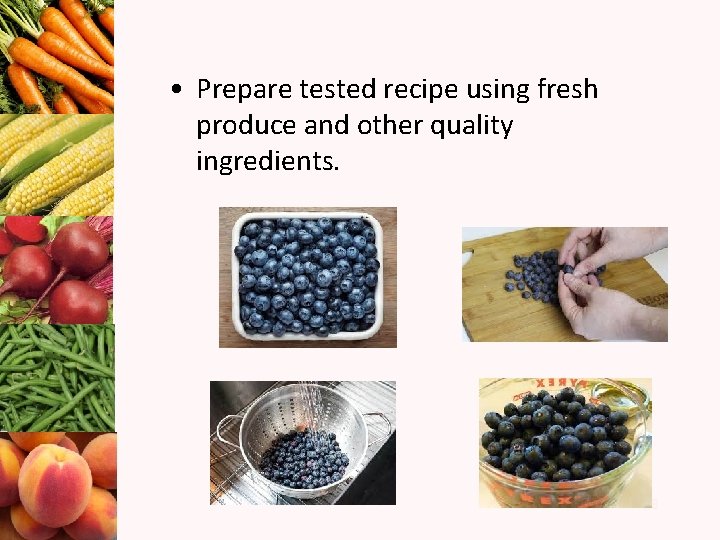
• Prepare tested recipe using fresh produce and other quality ingredients. 28
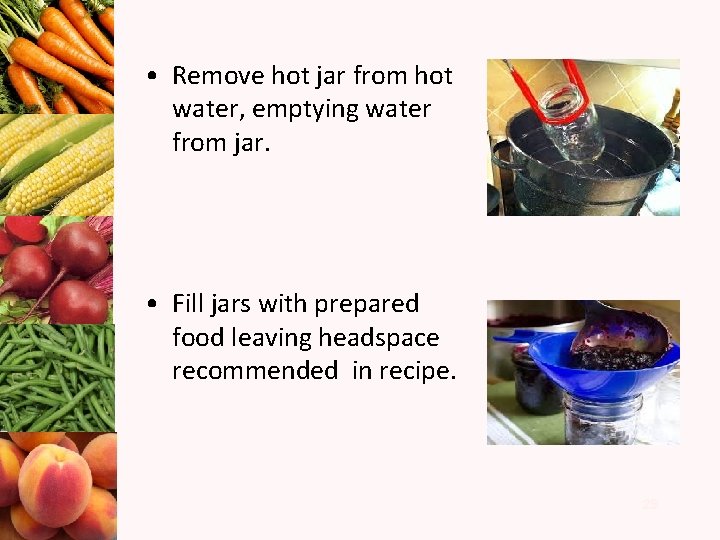
• Remove hot jar from hot water, emptying water from jar. • Fill jars with prepared food leaving headspace recommended in recipe. 29
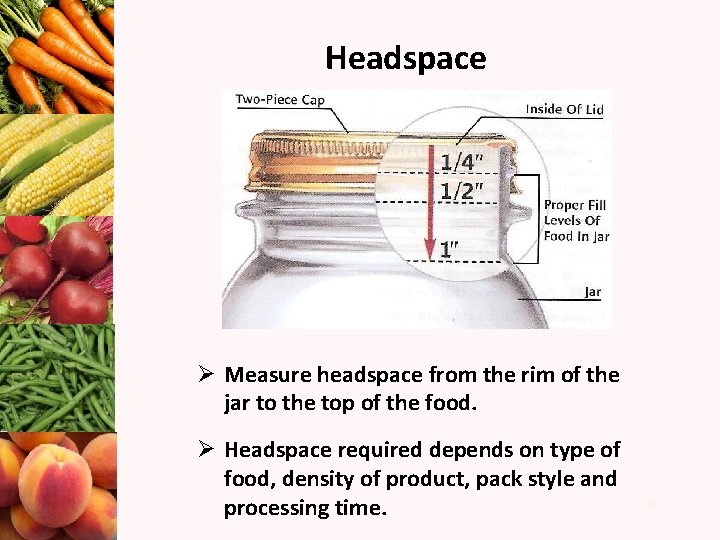
Headspace Ø Measure headspace from the rim of the jar to the top of the food. Ø Headspace required depends on type of food, density of product, pack style and processing time. 30
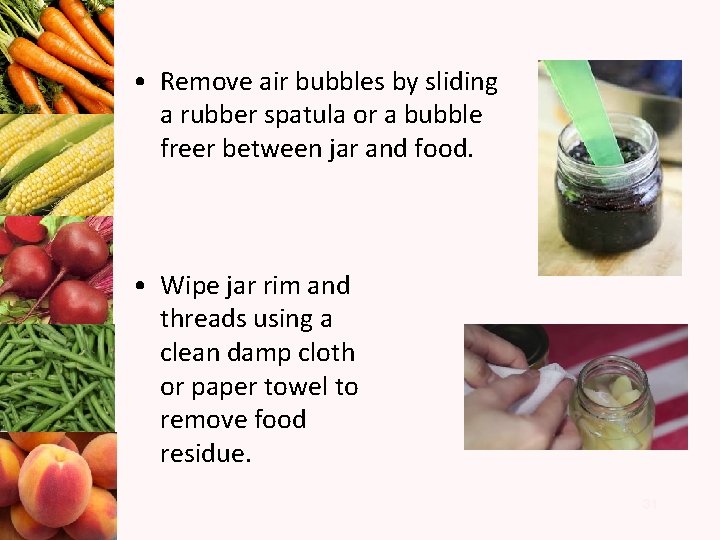
• Remove air bubbles by sliding a rubber spatula or a bubble freer between jar and food. • Wipe jar rim and threads using a clean damp cloth or paper towel to remove food residue. 31
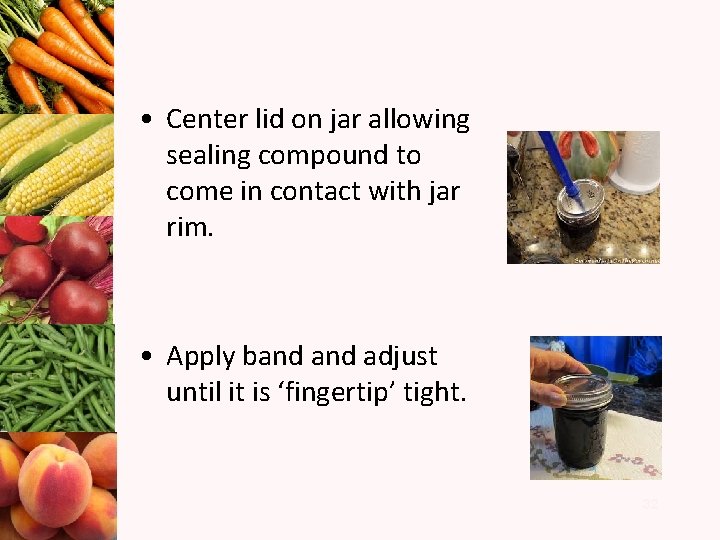
• Center lid on jar allowing sealing compound to come in contact with jar rim. • Apply band adjust until it is ‘fingertip’ tight. 32
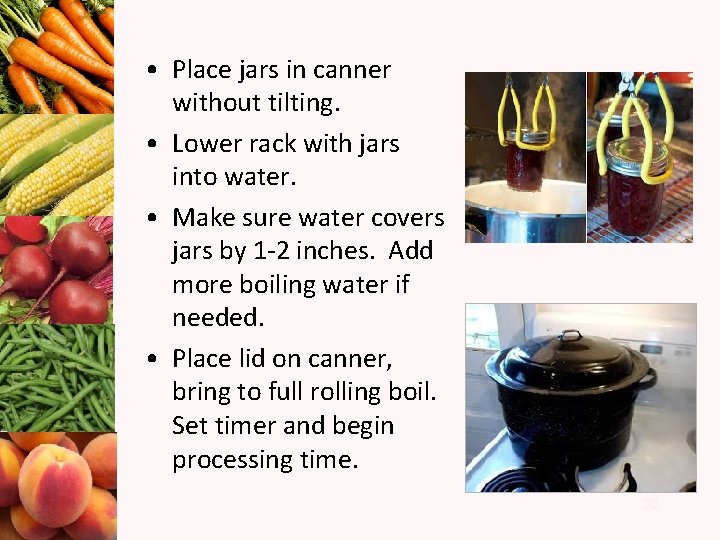
• Place jars in canner without tilting. • Lower rack with jars into water. • Make sure water covers jars by 1 -2 inches. Add more boiling water if needed. • Place lid on canner, bring to full rolling boil. Set timer and begin processing time. 33
Altitude Adjustment for Water Bath Canning Increase the processing time: • Processing time at sea level 20 minutes or less: – Increase the processing time 1 minute for each 1, 000 feet above sea level • Processing time at sea level more than 20 minutes: – Increase by 2 minutes per 1, 000 feet • OR, refer to altitude adjustment chart accompanying credible canning recipe. 34
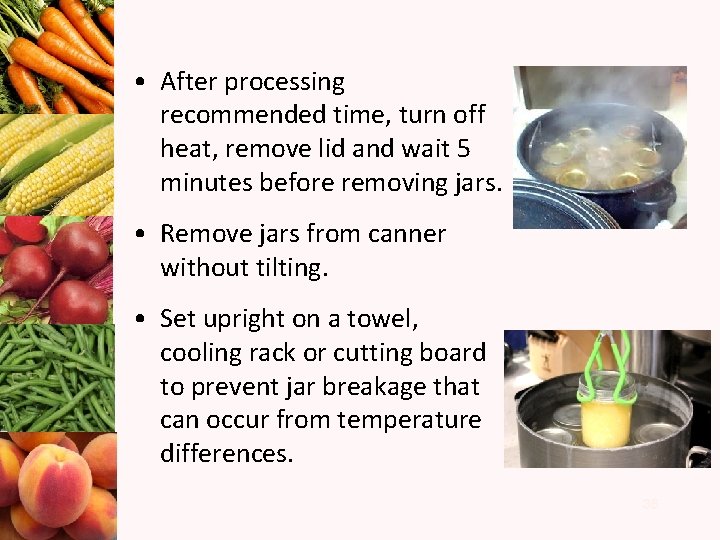
• After processing recommended time, turn off heat, remove lid and wait 5 minutes before removing jars. • Remove jars from canner without tilting. • Set upright on a towel, cooling rack or cutting board to prevent jar breakage that can occur from temperature differences. 35
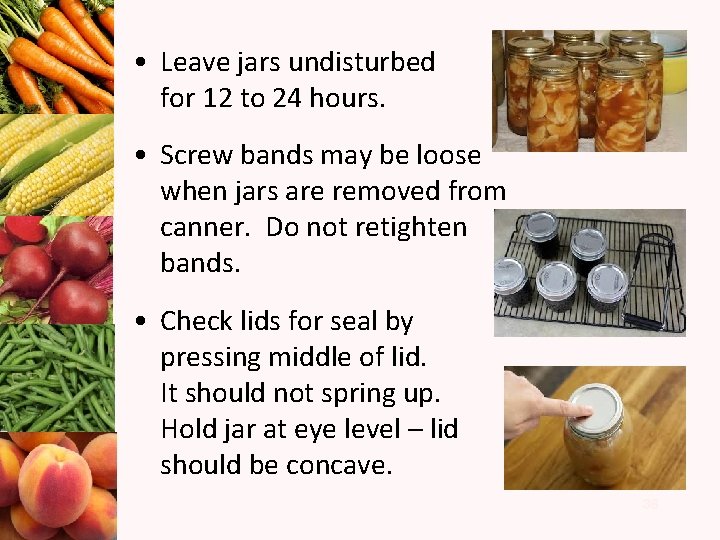
• Leave jars undisturbed for 12 to 24 hours. • Screw bands may be loose when jars are removed from canner. Do not retighten bands. • Check lids for seal by pressing middle of lid. It should not spring up. Hold jar at eye level – lid should be concave. 36
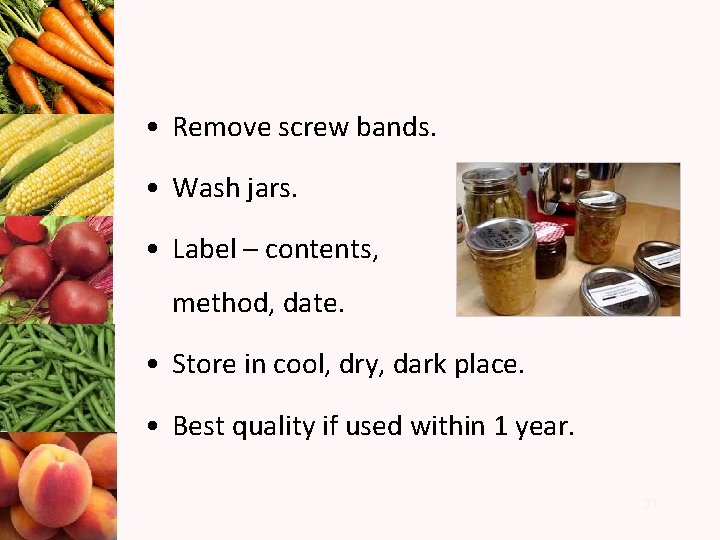
• Remove screw bands. • Wash jars. • Label – contents, method, date. • Store in cool, dry, dark place. • Best quality if used within 1 year. 37
Reprocessing Unsealed Jars • If less than 24 hours, may reprocess. – Use new lid. – Use full processing time. – May wish to refrigerate or freeze instead of reprocessing for better quality. • If more than 24 hours, discard! 38
Processes NOT Recommended • Open kettle canning – temperatures obtained are not high enough to destroy all microorganisms that cause spoilage and foodborne illness. • Oven, microwave, dishwasher processing – do not prevent risks of spoilage organisms. 39
Processes NOT Recommended • Paraffin or wax seals – allows mold to contaminate and grow into product; mycotoxins produced have been shown to cause cancer in lab animals. • Glass and zinc caps used with rubber rings – often fail to seal properly. • Tattler lids – reusable plastic; BPA free; NCHFP research ongoing to determine safe use. 40
Signs of Spoilage • Incorrectly processed low acid food, even if it appears normal. • Cloudy canning liquid (may also be caused by salt additives or minerals in water). • Strange odor. • Mold growth. • Jar not sealed. 41
Is the food safe to eat? • Was it canned by up-to-date tested recipe? • Instructions followed explicitly? • Processing time adjusted for altitude? • Is jar sealed? • Are there no obvious signs of spoilage? 42
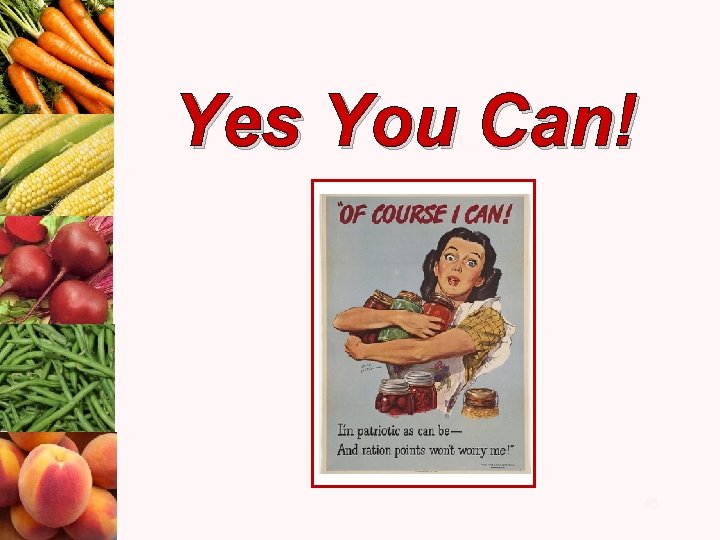
Yes You Can! 43
For more information contact: Food. Safety@elpasoco. com 719 -520 -7690 Michael Lucero, MPH Colorado State University Extension Agent Nutrition, Food Safety and Health Programs Revised April 2020 44
- Slides: 44